

ASTM D8092-22
(Test Method)Standard Test Method for Field Determination of Kinematic Viscosity Using a Microchannel Viscometer
General Information
- Abstract
SIGNIFICANCE AND USE
5.1 The significance of this test method is that it provides a means for a reliable field determination of kinematic viscosity at 40 °C without requiring solvents or chemicals for cleaning. Field use implies that the fluid may be very opaque, such as an in-service engine oil. The device may be cleaned with a disposable lint-free oil-absorbent material such as a clean cotton shop rag, and requires only 60 µL of sample for operation. As such the device provides a unique service to a range of industries where it is difficult or undesirable to obtain chemicals of any sort in order to determine the kinematic viscosity of their fluid of interest. Examples of such industries include many marine-based systems where a laboratory does not exist on-board, mines where equipment is needed for on-the-spot determination of asset viscosity, and large industrial plants where a walk-around inspection of oil sumps greatly increases efficiency. By using this test method, one can serve these crucial use-cases where a direct, immediate measure of kinematic viscosity at 40 °C may otherwise be difficult to obtain.
SCOPE
1.1 This test method describes a means for measuring the kinematic viscosity of transparent and opaque liquids such as new and in-service lubricating oils using a miniature microchannel viscometer at 40 °C in the range of 12.9 mm2/s to 174 mm2/s
1.2 The precision has only been determined for those materials and viscosity ranges, as indicated in Section 17 on Precision and Bias.
1.3 This test method is specifically tailored to obtaining a rapid, direct, temperature- stabilized measure of the kinematic viscosity of new and in-service lubricants in the field in real- time without the use of solvents or chemical cleaning agents. The measurement takes place at 40 °C and kinematic viscosity is directly obtained. No temperature extrapolations or density corrections are necessary.
1.4 The values stated in SI units are to be regarded as standard. No other units of measurement are included in this standard.
1.5 This standard does not purport to address all of the safety concerns, if any, associated with its use. It is the responsibility of the user of this standard to establish appropriate safety, health, and environmental practices and determine the applicability of regulatory limitations prior to use. Some specific hazards statements are given in Section 9 on Hazards.
1.6 This international standard was developed in accordance with internationally recognized principles on standardization established in the Decision on Principles for the Development of International Standards, Guides and Recommendations issued by the World Trade Organization Technical Barriers to Trade (TBT) Committee.
- Status
- Published
- Publication Date
- 30-Nov-2022
- Technical Committee
- D02 - Petroleum Products, Liquid Fuels, and Lubricants
- Drafting Committee
- D02.07 - Flow Properties
Buy Documents
ASTM D8092-22 - Standard Test Method for Field Determination of Kinematic Viscosity Using a Microchannel Viscometer
REDLINE ASTM D8092-22 - Standard Test Method for Field Determination of Kinematic Viscosity Using a Microchannel Viscometer
Overview
ASTM D8092-22: Standard Test Method for Field Determination of Kinematic Viscosity Using a Microchannel Viscometer establishes a procedure for measuring the kinematic viscosity of liquids-such as new and in-service lubricating oils-using a miniature microchannel viscometer at 40 °C. Designed specifically for field applications, this method allows for rapid, direct, and temperature-controlled measurement without the need for solvents or hazardous cleaning chemicals. The standard ensures a practical, portable solution for obtaining real-time viscosity data, especially where traditional laboratory equipment is impractical.
Key Topics
- Field-Based Kinematic Viscosity Measurement: Enables accurate determination of the kinematic viscosity of both transparent and opaque liquids at 40 °C, which is critical for assessing lubricant condition in real-time.
- Portable Microchannel Viscometer: Utilizes a miniature capillary device that requires only 60 μL of sample and can be easily cleaned with lint-free absorbent wipes, increasing efficiency and reducing environmental impact.
- Direct Measurement: Provides immediate results without the need for density corrections, temperature extrapolations, or use of chemicals.
- Sample Types: Suitable for a wide range of lubricating and hydraulic oils, including those in highly opaque or contaminated states.
- Calibration & Precision: Relies on certified viscosity reference standards to validate measurement accuracy, with guidance on repeatability, reproducibility, and calibration intervals.
- User Safety: Designed with operational safeguards, such as temperature controls, to ensure safe handling even in challenging environments.
Applications
ASTM D8092-22 is ideal for industries and environments where onsite fluid diagnostics are essential:
- Maritime Operations: Ships and offshore platforms without permanent laboratories benefit from on-the-spot engine oil analysis.
- Mining: Mines require immediate equipment condition monitoring to minimize downtime and optimize maintenance schedules.
- Industrial Plants: Facilitates walk-around inspections and rapid assessment of oil sumps and lubricants without halting operations.
- Mobile Equipment Servicing: Enables technicians to quickly evaluate lubricant health in field conditions for vehicles and machinery.
- Asset Management: Supports predictive maintenance programs by providing accurate viscosity data for trending and decision-making.
- Environmental Health and Safety: Reduces chemical usage and potential hazards associated with traditional viscometer cleaning procedures.
Related Standards
Several standards complement and reference ASTM D8092-22, ensuring consistency and interoperability across viscosity testing and lubricant analysis practices:
- ASTM D445: Test Method for Kinematic Viscosity of Transparent and Opaque Liquids (and Calculation of Dynamic Viscosity)
- ASTM D2162: Practice for Basic Calibration of Master Viscometers and Viscosity Oil Standards
- ASTM D4057: Practice for Manual Sampling of Petroleum and Petroleum Products
- ASTM D4175: Terminology Relating to Petroleum Products, Liquid Fuels, and Lubricants
- ASTM D5854: Practice for Mixing and Handling of Liquid Samples of Petroleum and Petroleum Products
- ASTM D6708: Practice for Statistical Assessment and Improvement of Expected Agreement Between Two Test Methods that Purport to Measure the Same Property of a Material
- ISO/IEC 17025: General Requirements for the Competence of Testing and Calibration Laboratories
ASTM D8092-22 brings substantial practical value by ensuring field personnel have a reliable, robust test method for rapid kinematic viscosity measurements-improving maintenance efficiency, safety, and overall asset management in diverse operational settings.
Relations
- Effective Date
- 01-Apr-2024
- Effective Date
- 01-Mar-2024
- Refers
ASTM D4175-23a - Standard Terminology Relating to Petroleum Products, Liquid Fuels, and Lubricants - Effective Date
- 15-Dec-2023
- Effective Date
- 01-Nov-2023
- Refers
ASTM D4175-23e1 - Standard Terminology Relating to Petroleum Products, Liquid Fuels, and Lubricants - Effective Date
- 01-Jul-2023
- Effective Date
- 01-May-2019
- Effective Date
- 01-Apr-2018
- Effective Date
- 15-Dec-2016
- Effective Date
- 01-Apr-2016
- Effective Date
- 01-Jan-2016
- Effective Date
- 01-Jul-2015
- Effective Date
- 01-Jul-2014
- Effective Date
- 01-Jul-2014
- Effective Date
- 01-Jun-2014
- Effective Date
- 01-May-2013
Buy Documents
ASTM D8092-22 - Standard Test Method for Field Determination of Kinematic Viscosity Using a Microchannel Viscometer
REDLINE ASTM D8092-22 - Standard Test Method for Field Determination of Kinematic Viscosity Using a Microchannel Viscometer
Get Certified
Connect with accredited certification bodies for this standard

Element Materials Technology
Materials testing and product certification.

ABS Group Brazil
ABS Group certification services in Brazil.

ABS Quality Evaluations Inc.
American Bureau of Shipping quality certification.
Sponsored listings
Frequently Asked Questions
ASTM D8092-22 is a standard published by ASTM International. Its full title is "Standard Test Method for Field Determination of Kinematic Viscosity Using a Microchannel Viscometer". This standard covers: SIGNIFICANCE AND USE 5.1 The significance of this test method is that it provides a means for a reliable field determination of kinematic viscosity at 40 °C without requiring solvents or chemicals for cleaning. Field use implies that the fluid may be very opaque, such as an in-service engine oil. The device may be cleaned with a disposable lint-free oil-absorbent material such as a clean cotton shop rag, and requires only 60 µL of sample for operation. As such the device provides a unique service to a range of industries where it is difficult or undesirable to obtain chemicals of any sort in order to determine the kinematic viscosity of their fluid of interest. Examples of such industries include many marine-based systems where a laboratory does not exist on-board, mines where equipment is needed for on-the-spot determination of asset viscosity, and large industrial plants where a walk-around inspection of oil sumps greatly increases efficiency. By using this test method, one can serve these crucial use-cases where a direct, immediate measure of kinematic viscosity at 40 °C may otherwise be difficult to obtain. SCOPE 1.1 This test method describes a means for measuring the kinematic viscosity of transparent and opaque liquids such as new and in-service lubricating oils using a miniature microchannel viscometer at 40 °C in the range of 12.9 mm2/s to 174 mm2/s 1.2 The precision has only been determined for those materials and viscosity ranges, as indicated in Section 17 on Precision and Bias. 1.3 This test method is specifically tailored to obtaining a rapid, direct, temperature- stabilized measure of the kinematic viscosity of new and in-service lubricants in the field in real- time without the use of solvents or chemical cleaning agents. The measurement takes place at 40 °C and kinematic viscosity is directly obtained. No temperature extrapolations or density corrections are necessary. 1.4 The values stated in SI units are to be regarded as standard. No other units of measurement are included in this standard. 1.5 This standard does not purport to address all of the safety concerns, if any, associated with its use. It is the responsibility of the user of this standard to establish appropriate safety, health, and environmental practices and determine the applicability of regulatory limitations prior to use. Some specific hazards statements are given in Section 9 on Hazards. 1.6 This international standard was developed in accordance with internationally recognized principles on standardization established in the Decision on Principles for the Development of International Standards, Guides and Recommendations issued by the World Trade Organization Technical Barriers to Trade (TBT) Committee.
SIGNIFICANCE AND USE 5.1 The significance of this test method is that it provides a means for a reliable field determination of kinematic viscosity at 40 °C without requiring solvents or chemicals for cleaning. Field use implies that the fluid may be very opaque, such as an in-service engine oil. The device may be cleaned with a disposable lint-free oil-absorbent material such as a clean cotton shop rag, and requires only 60 µL of sample for operation. As such the device provides a unique service to a range of industries where it is difficult or undesirable to obtain chemicals of any sort in order to determine the kinematic viscosity of their fluid of interest. Examples of such industries include many marine-based systems where a laboratory does not exist on-board, mines where equipment is needed for on-the-spot determination of asset viscosity, and large industrial plants where a walk-around inspection of oil sumps greatly increases efficiency. By using this test method, one can serve these crucial use-cases where a direct, immediate measure of kinematic viscosity at 40 °C may otherwise be difficult to obtain. SCOPE 1.1 This test method describes a means for measuring the kinematic viscosity of transparent and opaque liquids such as new and in-service lubricating oils using a miniature microchannel viscometer at 40 °C in the range of 12.9 mm2/s to 174 mm2/s 1.2 The precision has only been determined for those materials and viscosity ranges, as indicated in Section 17 on Precision and Bias. 1.3 This test method is specifically tailored to obtaining a rapid, direct, temperature- stabilized measure of the kinematic viscosity of new and in-service lubricants in the field in real- time without the use of solvents or chemical cleaning agents. The measurement takes place at 40 °C and kinematic viscosity is directly obtained. No temperature extrapolations or density corrections are necessary. 1.4 The values stated in SI units are to be regarded as standard. No other units of measurement are included in this standard. 1.5 This standard does not purport to address all of the safety concerns, if any, associated with its use. It is the responsibility of the user of this standard to establish appropriate safety, health, and environmental practices and determine the applicability of regulatory limitations prior to use. Some specific hazards statements are given in Section 9 on Hazards. 1.6 This international standard was developed in accordance with internationally recognized principles on standardization established in the Decision on Principles for the Development of International Standards, Guides and Recommendations issued by the World Trade Organization Technical Barriers to Trade (TBT) Committee.
ASTM D8092-22 is classified under the following ICS (International Classification for Standards) categories: 17.060 - Measurement of volume, mass, density, viscosity; 75.080 - Petroleum products in general. The ICS classification helps identify the subject area and facilitates finding related standards.
ASTM D8092-22 has the following relationships with other standards: It is inter standard links to ASTM D445-24, ASTM D6708-24, ASTM D4175-23a, ASTM D445-23, ASTM D4175-23e1, ASTM D6708-19, ASTM D6708-18, ASTM D445-16, ASTM D6708-16a, ASTM D6708-16, ASTM D6708-15, ASTM D445-14e1, ASTM D445-14, ASTM D2162-14, ASTM D6708-13e1. Understanding these relationships helps ensure you are using the most current and applicable version of the standard.
ASTM D8092-22 is available in PDF format for immediate download after purchase. The document can be added to your cart and obtained through the secure checkout process. Digital delivery ensures instant access to the complete standard document.
Standards Content (Sample)
This international standard was developed in accordance with internationally recognized principles on standardization established in the Decision on Principles for the
Development of International Standards, Guides and Recommendations issued by the World Trade Organization Technical Barriers to Trade (TBT) Committee.
Designation: D8092 − 22
Standard Test Method for
Field Determination of Kinematic Viscosity Using a
Microchannel Viscometer
This standard is issued under the fixed designation D8092; the number immediately following the designation indicates the year of
original adoption or, in the case of revision, the year of last revision. A number in parentheses indicates the year of last reapproval. A
superscript epsilon (´) indicates an editorial change since the last revision or reapproval.
1. Scope* 2. Referenced Documents
2.1 ASTM Standards:
1.1 This test method describes a means for measuring the
D445 Test Method for Kinematic Viscosity of Transparent
kinematic viscosity of transparent and opaque liquids such as
and Opaque Liquids (and Calculation of Dynamic Viscos-
new and in-service lubricating oils using a miniature micro-
ity)
channel viscometer at 40 °C in the range of 12.9 mm /s to
2 D2162 Practice for Basic Calibration of Master Viscometers
174 mm /s
and Viscosity Oil Standards
1.2 The precision has only been determined for those
D4057 Practice for Manual Sampling of Petroleum and
materials and viscosity ranges, as indicated in Section 17 on
Petroleum Products
Precision and Bias. D4175 Terminology Relating to Petroleum Products, Liquid
Fuels, and Lubricants
1.3 This test method is specifically tailored to obtaining a
D5854 Practice for Mixing and Handling of Liquid Samples
rapid, direct, temperature- stabilized measure of the kinematic
of Petroleum and Petroleum Products
viscosity of new and in-service lubricants in the field in real-
D6708 Practice for StatisticalAssessment and Improvement
time without the use of solvents or chemical cleaning agents.
of Expected Agreement Between Two Test Methods that
The measurement takes place at 40 °C and kinematic viscosity
Purport to Measure the Same Property of a Material
is directly obtained. No temperature extrapolations or density
2.2 ISO Standard:
corrections are necessary.
ISO/IEC 17025 General Requirements for the Competence
1.4 The values stated in SI units are to be regarded as
of Testing and Calibration Laboratories
standard. No other units of measurement are included in this
standard.
3. Terminology
3.1 Definitions:
1.5 This standard does not purport to address all of the
3.1.1 For definitions of terms used in this test method, refer
safety concerns, if any, associated with its use. It is the
to Terminology D4175.
responsibility of the user of this standard to establish appro-
3.2 Definitions of Terms Specific to This Standard:
priate safety, health, and environmental practices and deter-
3.2.1 Hele-Shaw cell, n—a liquid cell wherein Stokes flow
mine the applicability of regulatory limitations prior to use.
is present between two parallel plates.
Some specific hazards statements are given in Section 9 on
Hazards.
3.2.1.1 Discussion—The unbounded microchannel capillary
1.6 This international standard was developed in accor-
acts as a Hele-Shaw cell in this test method, which enables a
dance with internationally recognized principles on standard-
simple relationship between kinematic viscosity and fluid
ization established in the Decision on Principles for the
velocity to be established.
Development of International Standards, Guides and Recom- 3.2.2 loading funnel, n—the cavity in Fig. 1 that the liquid
mendations issued by the World Trade Organization Technical is placed into upon sample introduction; the sample then
Barriers to Trade (TBT) Committee. travels out of this funnel and enters the capillary.
1 2
This test method is under the jurisdiction of ASTM Committee D02 on For referenced ASTM standards, visit the ASTM website, www.astm.org, or
Petroleum Products, Liquid Fuels, and Lubricants and is the direct responsibility of contact ASTM Customer Service at service@astm.org. For Annual Book of ASTM
Subcommittee D02.07 on Flow Properties. Standards volume information, refer to the standard’s Document Summary page on
Current edition approved Dec. 1, 2022. Published December 2022. Originally the ASTM website.
approved in 2017. Last previous edition approved in 2017 as D8092 – 17. DOI: Available fromAmerican National Standards Institute (ANSI), 25 W. 43rd St.,
10.1520/D8092-22. 4th Floor, New York, NY 10036, http://www.ansi.org.
*A Summary of Changes section appears at the end of this standard
Copyright © ASTM International, 100 Barr Harbor Drive, PO Box C700, West Conshohocken, PA 19428-2959. United States
D8092 − 22
FIG. 1 Miniature Capillary Viscometer Schematic
3.2.3 miniature capillary viscometer, n—a viscometer, as 4. Summary of Test Method
shown in Fig. 1, which utilizes an unbounded microchannel
4.1 A liquid sample is placed into the loading funnel (see
capillary in order to enable the direct measurement of kine-
Fig. 1) of the miniature capillary viscometer and kinematic
matic viscosity.
viscosity at 40 °C is determined by measuring the time in
3.2.4 unbounded microchannel capillary, n—a rectangular
seconds (∆t) it takes this liquid to travel between the beam
channel, approximately 100 µm by 2 mm, which comprises the
produced by LED (light-emitting diode) #1 and LED #3.
capillary for this test method.
4.2 These times associated with the liquid passing each
3.2.4.1 Discussion—The channel, whose top view can be
LED are determined by monitoring the voltage of the corre-
seen in Fig. 1, is unbounded because it is open to air on two
sponding photodiodes: The starting time (t=0) is defined as
sides. The sample stays in the capillary and does not leak
when the operator initiates by means of button push the test
through the unbounded portion due to the inherent surface
sequence; a built-in clock then tracks the travel time.When the
tension at the boundary between the capillary and air. The
liquid enters the vicinity of the LED beam, the time, from the
capillary is repeatedly assembled for the purpose of the
test starting time, at which the liquid is determined to have
viscosity measurement and then disassembled immediately
passedthisbeamisdefinedasthephotodiodevoltagefallingby
after the viscosity measurement to allow for cleaning. This is
a factor of 0.5.
accomplished by having two mirror sides, which comprise the
4.3 The liquid sample thermalizes rapidly to 40 °C as the
capillary, coupled by means of a clamshell arrangement. The
integrity of the capillary is ensured by spacers which guarantee entire unbounded microchannel capillary is constructed of
aluminum which is stabilized at 40 °C. Thus when the 60 µL
the distance between the two mirror sides when closing the
clamshell. liquid is placed into the microchannel capillary it immediately
D8092 − 22
comes into contact with the aluminum and the liquid flowing 7.1.1 Temperature-controlled aluminum plates coupled to-
out of the loading funnel thermalizes to 40 °C within tenths of gether in a clamshell arrangement. These plates serve as a heat
seconds. sink for bringing the liquid to a fixed temperature rapidly upon
the sample being loaded into the device.
4.4 The kinematic viscosity ν in square millimetres per
2 7.1.2 Temperature control of the aluminum plates is accom-
second(mm /s)isdeterminedalinearrelationshipwith∆t,that
2 2
plished using a built-in PID controller with insulated strip
is, ν5n ·∆t1n . The slope (n)inmm /s and offset (n)in
1 2 1 2
2 heaters placed on the back side of each plate. Two PID
mm /s of this linear relationship are determined by calibration
(proportional integral derivative) loops control each plate
at the factory or at the point of use using certified viscosity
separately. The thermistor is also placed into each plate, on the
reference standards.
back side but as near as possible to the center of the liquid flow
through the capillary. Such an arrangement controls tempera-
5. Significance and Use
ture of the liquid to within 0.1 °C.
5.1 The significance of this test method is that it provides a
7.1.3 An unbounded microchannel capillary is machined
means for a reliable field determination of kinematic viscosity
into the temperature-controlled aluminum plates in the center
at 40 °C without requiring solvents or chemicals for cleaning.
of the two plates.
Field use implies that the fluid may be very opaque, such as an
7.1.4 Miniature emitters operating at a center wavelength of
in-service engine oil. The device may be cleaned with a
880 nm are used for the LEDs. Center wavelength 850 nm
disposable lint-free oil-absorbent material such as a clean
silicon photodiodes are used for detecting the LED illumina-
cotton shop rag, and requires only 60 µL of sample for
tion. Using a real-time operating system, the voltage on these
operation. As such the device provides a unique service to a
photodiodes is monitored at millisecond resolution and is used
range of industries where it is difficult or undesirable to obtain
determine the time, relative to when the test is initiated, when
chemicals of any sort in order to determine the kinematic
the liquid has passed the threshold of each LED beam. This
viscosity of their fluid of interest. Examples of such industries
time detection system is mounted in a measurement chamber
include many marine-based systems where a laboratory does
which receives the aluminum plates. This measurement cham-
not exist on-board, mines where equipment is needed for
ber uses a permanent-magnet holder to ensure the alignment
on-the-spot determination of asset viscosity, and large indus-
between the aluminum plates (which contain the capillary) and
trial plants where a walk-around inspection of oil sumps
the time detection system.
greatly increases efficiency. By using this test method, one can
7.1.5 The viscometer control system comprises embedded
serve these crucial use-cases where a direct, immediate mea-
electronics which allow the user to control the system and
sure of kinematic viscosity at 40 °C may otherwise be difficult
perform the viscosity measurement.
to obtain.
7.1.6 A micropastuerette, or micropipette with disposable
tip, is used to dispense 60 µL of fluid into the loading funnel.
6. Interferences
6.1 Possible interferences for this test method include the
8. Reagents and Materials
presenceoflargeparticlesintheliquidwhichwouldtendtoget
8.1 Reagent grade chemicals shall be used in all tests.
stuck in the capillary and impede the liquid flow. Since the
Unless otherwise indicated, it is intended that all reagents shall
capillary is only approximately 100 µm in its smallest dimen-
conform to the specifications of the committee on Analytical
sion this must be carefully considered. To address this in the
Reagents of the American Chemical Society, where such
field, a middle LED/photodiode arrangement (#2, see Fig. 1)
specifications are available. Other grades may be used, pro-
validates the linearity of the flow. If the flow is found to be
vided it is pure enough to be used without lessening the
non-linear, the operator is instructed that a probable invalid
accuracy of the determination.
measurement has occurred and a re-test is indicated. This
re-test involves cleaning the capillary and thereby removing
8.2 Certified Viscosity Reference Standards—These are for
any trapped particulate. If the liquid being analyzed commonly
use as confirmatory checks on the procedure in the laboratory.
has a large population of particulate expected in the 60 µL of
Certified viscosity reference standards shall be certified by a
drawn sample, letting the sample settle and sampling towards
laboratory, which has shown to meet the requirements of
the top of a bottle as described in Practice D4057 may be
ISO/IEC 17025 or a corresponding national standard by
followed in order to significantly reduce the probability that
independent assessment. Viscosity standards shall be traceable
this occurs.
to master viscometer procedures described in Test Method
D2162. The accepted reference value for the Certified Refer-
7. Apparatus
ence Material must be known with a relative error no greater
7.1 The miniature capillary viscometer (see Fig. 1) consists
than 0.25 % with a 95 % confidence.
of the following components:
4 5
The sole source of supply of the apparatus known to the committee at this time ACS Reagent Chemicals, Specifications and Procedures for Reagents and
is Spectro Scientific, Inc., Chelmsford, MA, USA. These viscometers are covered Standard-Grade Reference Materials, American Chemical Society, Washington,
underUSParents8,661,878,9,234,829,andrelatedinternationalpatentsandfilings. DC. For suggestions on the testing of reagents not listed by theAmerican Chemical
If you are aware of alternative suppliers, please p
...
This document is not an ASTM standard and is intended only to provide the user of an ASTM standard an indication of what changes have been made to the previous version. Because
it may not be technically possible to adequately depict all changes accurately, ASTM recommends that users consult prior editions as appropriate. In all cases only the current version
of the standard as published by ASTM is to be considered the official document.
Designation: D8092 − 17 D8092 − 22
Standard Test Method for
Field Determination of Kinematic Viscosity Using a
Microchannel Viscometer
This standard is issued under the fixed designation D8092; the number immediately following the designation indicates the year of
original adoption or, in the case of revision, the year of last revision. A number in parentheses indicates the year of last reapproval. A
superscript epsilon (´) indicates an editorial change since the last revision or reapproval.
1. Scope Scope*
1.1 This test method describes a means for measuring the kinematic viscosity of transparent and opaque liquids such as new and
2 2
in-service lubricating oils using a miniature microchannel viscometer at 40 °C in the range of 12.9 mm /s to 174 mm /s
1.2 The precision has only been determined for those materials and viscosity ranges, as indicated in Section 17 on Precision and
Bias.
1.3 This test method is specifically tailored to obtaining a rapid, direct, temperature- stabilized measure of the kinematic viscosity
of new and in-service lubricants in the field in real- time without the use of solvents or chemical cleaning agents. The measurement
takes place at 40 °C and kinematic viscosity is directly obtained. No temperature extrapolations or density corrections are
necessary.
1.4 The values stated in SI units are to be regarded as standard. No other units of measurement are included in this standard.
1.5 This standard does not purport to address all of the safety concerns, if any, associated with its use. It is the responsibility
of the user of this standard to establish appropriate safety safety, health, and healthenvironmental practices and determine the
applicability of regulatory limitations prior to use. Some specific hazards statements are given in Section 9 on Hazards.
1.6 This international standard was developed in accordance with internationally recognized principles on standardization
established in the Decision on Principles for the Development of International Standards, Guides and Recommendations issued
by the World Trade Organization Technical Barriers to Trade (TBT) Committee.
2. Referenced Documents
2.1 ASTM Standards:
D445 Test Method for Kinematic Viscosity of Transparent and Opaque Liquids (and Calculation of Dynamic Viscosity)
D2162 Practice for Basic Calibration of Master Viscometers and Viscosity Oil Standards
D4057 Practice for Manual Sampling of Petroleum and Petroleum Products
D4175 Terminology Relating to Petroleum Products, Liquid Fuels, and Lubricants
D5854 Practice for Mixing and Handling of Liquid Samples of Petroleum and Petroleum Products
D6708 Practice for Statistical Assessment and Improvement of Expected Agreement Between Two Test Methods that Purport
to Measure the Same Property of a Material
This test method is under the jurisdiction of ASTM Committee D02 on Petroleum Products, Liquid Fuels, and Lubricants and is the direct responsibility of Subcommittee
D02.07.0A on Newtonian Viscosity.
Current edition approved May 1, 2017Dec. 1, 2022. Published May 2017December 2022. Originally approved in 2017. Last previous edition approved in 2017 as
D8092 – 17. DOI: 10.1520/D8092-17.10.1520/D8092-22.
For referenced ASTM standards, visit the ASTM website, www.astm.org, or contact ASTM Customer Service at service@astm.org. For Annual Book of ASTM Standards
volume information, refer to the standard’s Document Summary page on the ASTM website.
*A Summary of Changes section appears at the end of this standard
Copyright © ASTM International, 100 Barr Harbor Drive, PO Box C700, West Conshohocken, PA 19428-2959. United States
D8092 − 22
2.2 ISO Standard:
ISO/IEC 17025 General Requirements for the Competence of Testing and Calibration Laboratories
3. Terminology
3.1 Definitions:
3.1.1 For definitions of terms used in this test method, refer to Terminology D4175.
3.2 Definitions of Terms Specific to This Standard:
3.2.1 Hele-Shaw cell, n—a liquid cell wherein Stokes flow is present between two parallel plates.
3.2.1.1 Discussion—
The unbounded microchannel capillary acts as a Hele-Shaw cell in this test method, which enables a simple relationship between
kinematic viscosity and fluid velocity to be established.
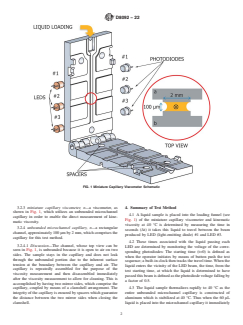
3.2.2 loading funnel, n—the cavity in Fig. 1 that the liquid is placed into upon sample introduction; the sample then travels out
of this funnel and enters the capillary.
3.2.3 miniature capillary viscometer, n—a viscometer, as shown in Fig. 1, which utilizes an unbounded microchannel capillary in
order to enable the direct measurement of kinematic viscosity.
FIG. 1 Miniature Capillary Viscometer Schematic
Available from American National Standards Institute (ANSI), 25 W. 43rd St., 4th Floor, New York, NY 10036, http://www.ansi.org.
D8092 − 22
3.2.4 unbounded microchannel capillary, n—a rectangular channel, approximately 100 μm by 2 mm, which comprises the
capillary for this test method.
3.2.4.1 Discussion—
The channel, whose top view can be seen in Fig. 1, is unbounded because it is open to air on two sides. The sample stays in the
capillary and does not leak through the unbounded portion due to the inherent surface tension at the boundary between the capillary
and air. The capillary is repeatedly assembled for the purpose of the viscosity measurement and then disassembled immediately
after the viscosity measurement to allow for cleaning. This is accomplished by having two mirror sides, which comprise the
capillary, coupled by means of a clamshell arrangement. The integrity of the capillary is ensured by spacers which guarantee the
distance between the two mirror sides when closing the clamshell.
4. Summary of Test Method
4.1 A liquid sample is placed into the loading funnel (see Fig. 1) of the miniature capillary viscometer and kinematic viscosity
at 40 °C is determined by measuring the time in seconds (Δt) it takes this liquid to travel between the beam produced by LED
(light-emitting diode) #1 and LED #3.
4.2 These times associated with the liquid passing each LED are determined by monitoring the voltage of the corresponding
photodiodes: The starting time (t=0) is defined as when the operator initiates by means of button push the test sequence; a built-in
clock then tracks the travel time. When the liquid enters the vicinity of the LED beam, the time, from the test starting time, at which
the liquid is determined to have passed this beam is defined as the photodiode voltage falling by a factor of 0.5.
4.3 The liquid sample thermalizes rapidly to 40 °C as the entire unbounded microchannel capillary is constructed of aluminum
which is stabilized at 40 °C. Thus when the 60 μL liquid is placed into the microchannel capillary it immediately comes into contact
with the aluminum and the liquid flowing out of the loading funnel thermalizes to 40 °C within tenths of seconds.
4.4 The kinematic viscosity ν in square millimetres per second (mm /s) is determined a linear relationship with Δt, that is, ν
2 2 2
5n ·Δt1n . The slope (n ) in mm /s and offset (n ) in mm /s of this linear relationship are determined by calibration at the factory
1 2 1 2
or at the point of use using certified viscosity reference standards.
5. Significance and Use
5.1 The significance of this test method is that it provides a means for a reliable field determination of kinematic viscosity at 40
°C without requiring solvents or chemicals for cleaning. Field use implies that the fluid may be very opaque, such as an in-service
engine oil. The device may be cleaned with a disposable lint-free oil-absorbent material such as a clean cotton shop rag, and
requires only 60 μL of sample for operation. As such the device provides a unique service to a range of industries where it is
difficult or undesirable to obtain chemicals of any sort in order to determine the kinematic viscosity of their fluid of interest.
Examples of such industries include many marine-based systems where a laboratory does not exist on-board, mines where
equipment is needed for on-the-spot determination of asset viscosity, and large industrial plants where a walk-around inspection
of oil sumps greatly increases efficiency. By using this test method, one can serve these crucial use-cases where a direct, immediate
measure of kinematic viscosity at 40 °C may otherwise be difficult to obtain.
6. Interferences
6.1 Possible interferences for this test method include the presence of large particles in the liquid which would tend to get stuck
in the capillary and impede the liquid flow. Since the capillary is only approximately 100 μm in its smallest dimension this must
be carefully considered. To address this in the field, a middle LED/photodiode arrangement (#2, see Fig. 1) validates the linearity
of the flow. If the flow is found to be non-linear, the operator is instructed that a probable invalid measurement has occurred and
a re-test is indicated. This re-test involves cleaning the capillary and thereby removing any trapped particulate. If the liquid being
analyzed commonly has a large population of particulate expected in the 60 μL of drawn sample, letting the sample settle and
sampling towards the top of a bottle as described in Practice D4057 may be followed in order to significantly reduce the probability
that this occurs.
D8092 − 22
7. Apparatus
7.1 The miniature capillary viscometer (see Fig. 1) consists of the following components:
7.1.1 Temperature-controlled aluminum plates coupled together in a clamshell arrangement. These plates serve as a heat sink for
bringing the liquid to a fixed temperature rapidly upon the sample being loaded into the device.
7.1.2 Temperature control of the aluminum plates is accomplished using a built-in PID controller with insulated strip heaters
placed on the back side of each plate. Two PID (proportional integral derivative) loops control each plate separately. The thermistor
is also placed into each plate, on the back side but as near as possible to the center of the liquid flow through the capillary. Such
an arrangement controls temperature of the liquid to within 0.1 °C.
7.1.3 An unbounded microchannel capillary is machined into the temperature-controlled aluminum plates in the center of the two
plates.
7.1.4 Miniature emitters operating at a center wavelength of 880 nm are used for the LEDs. Center wavelength 850 nm silicon
photodiodes are used for detecting the LED illumination. Using a real-time operating system, the voltage on these photodiodes is
monitored at millisecond resolution and is used determine the time, relative to when the test is initiated, when the liquid has passed
the threshold of each LED beam. This time detection system is mounted in a measurement chamber which receives the aluminum
plates. This measurement chamber uses a permanent-magnet holder to ensure the alignment between the aluminum plates (which
contain the capillary) and the time detection system.
7.1.5 The viscometer control system comprises embedded electronics which allow the user to control the system and perform the
viscosity measurement.
7.1.6 A micropastuerette, or micropipette with disposable tip, is used to dispense 60 μL of fluid into the loading funnel.
8. Reagents and Materials
8.1 Reagent grade chemicals shall be used in all tests. Unless otherwise indicated, it is intended that all reagents shall conform
to the specifications of the committee on Analytical Reagents of the American Chemical Society, where such specifications are
available. Other grades may be used, provided it is pure enough to be used without lessening the accuracy of the determination.
8.2 Certified Viscosity Reference Standards—These are for use as confirmatory checks on the procedure in the laboratory. Certified
viscosity reference standards shall be certified by a laboratory, which has shown to meet the requirements of ISO/IEC 17025 or
a corresponding national standard by independent assessment. Viscosity standards shall be traceable to master viscometer
procedures described in Test Method D2162. The accepted reference value for the Certified Reference Material must be known
with a relative error no greater than 0.25 % with a 95 % confidence.
8.3 A microdispenser (such as a pastuerette) which can accurately (within 610 μL) dispense 60 μL of sample liquid is required.
8.4 A lint free, oil-absorbent material should be used to clean the viscometer. Some suitable examples would be polypropylene
industrial wipes or a clean cotton shop rag.
9. Hazards
9.1 The device may utilize a certified Li-Ion battery.
9.2 Since the viscometer employs metal plates heated to 40 °C which come into contact with the operator when wiping
...