

ASTM D7454-19
(Test Method)Standard Test Method for Determination of Vibrated Bulk Density of Calcined Petroleum Coke using a Semi-Automated Apparatus
General Information
- Abstract
SIGNIFICANCE AND USE
5.1 Vibrated bulk density (VBD) is an indicator of calcined petroleum coke porosity, which affects its suitability for use in pitch-bonded carbon applications. (Warning—Vibrated bulk density for a sample of calcined petroleum coke is strongly dependent upon average particle size and particle size range. Bulk density tends to increase with decreasing coke size. A narrow particle size range for this test minimizes the possibility for variation due to skewing of the test sample toward either screen defining the sample.)
SCOPE
1.1 This test method covers the determination of bulk density of a representative 2 kg sample of calcined petroleum coke, after vibration to increase compaction, using a semi-automatic apparatus.
1.2 The procedure is applied, but not limited, to particles passing through a 4.75 mm opening sieve and retained on a 1.18 mm opening sieve. Further, the procedure is applied, but not limited, to a specific test sample having particles passing through a 0.85 mm opening sieve and retained on a 0.425 mm opening sieve. This procedure could also be applied to other sieve fractions being agreed on in the aluminum industry as specified in Annex A1.
1.3 The values stated in SI units are to be regarded as standard. No other units of measurement are included in this standard.
1.4 This standard does not purport to address all of the safety concerns, if any, associated with its use. It is the responsibility of the user of this standard to establish appropriate safety, health, and environmental practices and determine the applicability of regulatory limitations prior to use.
1.5 This international standard was developed in accordance with internationally recognized principles on standardization established in the Decision on Principles for the Development of International Standards, Guides and Recommendations issued by the World Trade Organization Technical Barriers to Trade (TBT) Committee.
- Status
- Published
- Publication Date
- 30-Nov-2019
- Technical Committee
- D02 - Petroleum Products, Liquid Fuels, and Lubricants
- Drafting Committee
- D02.05 - Properties of Fuels, Petroleum Coke and Carbon Material
Buy Documents
ASTM D7454-19 - Standard Test Method for Determination of Vibrated Bulk Density of Calcined Petroleum Coke using a Semi-Automated Apparatus
REDLINE ASTM D7454-19 - Standard Test Method for Determination of Vibrated Bulk Density of Calcined Petroleum Coke using a Semi-Automated Apparatus
Overview
ASTM D7454-19, Standard Test Method for Determination of Vibrated Bulk Density of Calcined Petroleum Coke using a Semi-Automated Apparatus, outlines a procedure for accurately measuring the vibrated bulk density (VBD) of calcined petroleum coke. The test method applies to representative 2 kg samples, especially those used in the production of pitch-bonded carbon products such as electrodes for the aluminum industry. Vibrated bulk density is a critical quality parameter, reflecting the porosity of petroleum coke and thereby influencing its performance in industrial applications. This standard relies on precise sample handling and semi-automated equipment to ensure test repeatability and reproduce reliable data across laboratories.
Key Topics
- Vibrated Bulk Density (VBD): An empirical measure of the porosity and compaction behavior of calcined petroleum coke following vibration. The VBD is calculated as the mass of the test sample divided by the volume it occupies after vibration.
- Sample Preparation: Detailed, multi-stage procedures are defined for screening, grinding, and sieving petroleum coke to achieve a narrow particle size range-typically passing through a 0.85 mm sieve and retained on a 0.425 mm sieve-to minimize variation in results.
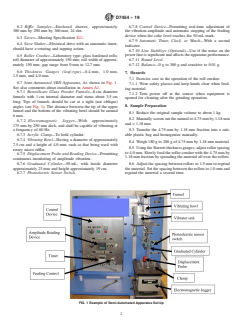
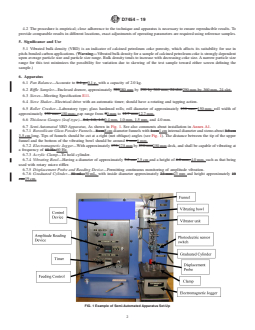
- Semi-Automated Apparatus: Describes the required setup, including a vibrating table, photoelectric sensor, graduated cylinder, electromagnetic jogger, roller crusher, sieves, and control devices to ensure consistent compaction and accurate measurement.
- Calibration and Standardization: Each new setup or apparatus move requires calibration of the graduated cylinder and sensor to maintain measurement consistency.
- Repeatability and Reproducibility: Test precision is determined by strict adherence to the method, referencing interlaboratory studies for measurement reliability and confidence.
- Health and Safety: Safety measures such as appropriate personal protective equipment and safe handling of machinery (e.g., roll crushers) are emphasized.
Applications
- Pitch-Bonded Carbon Applications: Accurate VBD measurement is essential for assessing the suitability of calcined petroleum coke in producing high-quality electrodes, which are key components in aluminum smelting and other metallurgical processes.
- Quality Control in Manufacturing: Producers and users of petroleum coke employ ASTM D7454-19 to ensure raw material consistency and optimize blending strategies. Maintaining the correct bulk density affects product strength, conductivity, and durability.
- Interlaboratory Comparison: The standardized method supports procurement, supply chain, and regulatory requirements by providing a uniform basis for reporting and evaluating petroleum coke properties across different facilities.
- Research and Development: Laboratories use this standard during product development and material characterization, as vibrated bulk density is directly linked to other structural and performance qualities.
Related Standards
- ASTM E11 - Specification for Woven Wire Test Sieve Cloth and Test Sieves: Governs the sieving tools used for sample preparation.
- ASTM E691 - Practice for Conducting an Interlaboratory Study: Sets out the procedures for determining the precision and bias of test methods, relevant for validating results obtained via ASTM D7454-19.
- Other Sieve Fraction Methods: Annex guidance in D7454 refers to additional sieve ranges as commonly used in the aluminum sector, supporting broader material evaluation.
Keywords: calcined petroleum coke, vibrated bulk density, ASTM D7454-19, semi-automated apparatus, pitch-bonded carbon, aluminum industry, sample preparation, petroleum coke quality, porosity testing, laboratory methods, bulk density test, ASTM standards.
Following ASTM D7454-19 ensures consistent, accurate determination of vibrated bulk density, fostering material quality and reliability in critical industrial applications.
Relations
- Effective Date
- 01-Dec-2019
- Effective Date
- 01-Oct-2013
- Effective Date
- 01-May-2013
- Effective Date
- 01-Nov-2011
- Effective Date
- 01-May-2009
- Effective Date
- 01-Oct-2008
- Effective Date
- 01-Nov-2005
- Effective Date
- 01-May-2004
- Effective Date
- 10-May-2001
- Effective Date
- 10-May-2001
- Effective Date
- 10-May-1999
- Effective Date
- 01-Dec-2019
- Referred By
ASTM D6969-23 - Standard Practice for Preparation of Calcined Petroleum Coke Samples for Analysis - Effective Date
- 01-Dec-2019
Buy Documents
ASTM D7454-19 - Standard Test Method for Determination of Vibrated Bulk Density of Calcined Petroleum Coke using a Semi-Automated Apparatus
REDLINE ASTM D7454-19 - Standard Test Method for Determination of Vibrated Bulk Density of Calcined Petroleum Coke using a Semi-Automated Apparatus
Get Certified
Connect with accredited certification bodies for this standard

Element Materials Technology
Materials testing and product certification.

ABS Group Brazil
ABS Group certification services in Brazil.

ABS Quality Evaluations Inc.
American Bureau of Shipping quality certification.
Sponsored listings
Frequently Asked Questions
ASTM D7454-19 is a standard published by ASTM International. Its full title is "Standard Test Method for Determination of Vibrated Bulk Density of Calcined Petroleum Coke using a Semi-Automated Apparatus". This standard covers: SIGNIFICANCE AND USE 5.1 Vibrated bulk density (VBD) is an indicator of calcined petroleum coke porosity, which affects its suitability for use in pitch-bonded carbon applications. (Warning—Vibrated bulk density for a sample of calcined petroleum coke is strongly dependent upon average particle size and particle size range. Bulk density tends to increase with decreasing coke size. A narrow particle size range for this test minimizes the possibility for variation due to skewing of the test sample toward either screen defining the sample.) SCOPE 1.1 This test method covers the determination of bulk density of a representative 2 kg sample of calcined petroleum coke, after vibration to increase compaction, using a semi-automatic apparatus. 1.2 The procedure is applied, but not limited, to particles passing through a 4.75 mm opening sieve and retained on a 1.18 mm opening sieve. Further, the procedure is applied, but not limited, to a specific test sample having particles passing through a 0.85 mm opening sieve and retained on a 0.425 mm opening sieve. This procedure could also be applied to other sieve fractions being agreed on in the aluminum industry as specified in Annex A1. 1.3 The values stated in SI units are to be regarded as standard. No other units of measurement are included in this standard. 1.4 This standard does not purport to address all of the safety concerns, if any, associated with its use. It is the responsibility of the user of this standard to establish appropriate safety, health, and environmental practices and determine the applicability of regulatory limitations prior to use. 1.5 This international standard was developed in accordance with internationally recognized principles on standardization established in the Decision on Principles for the Development of International Standards, Guides and Recommendations issued by the World Trade Organization Technical Barriers to Trade (TBT) Committee.
SIGNIFICANCE AND USE 5.1 Vibrated bulk density (VBD) is an indicator of calcined petroleum coke porosity, which affects its suitability for use in pitch-bonded carbon applications. (Warning—Vibrated bulk density for a sample of calcined petroleum coke is strongly dependent upon average particle size and particle size range. Bulk density tends to increase with decreasing coke size. A narrow particle size range for this test minimizes the possibility for variation due to skewing of the test sample toward either screen defining the sample.) SCOPE 1.1 This test method covers the determination of bulk density of a representative 2 kg sample of calcined petroleum coke, after vibration to increase compaction, using a semi-automatic apparatus. 1.2 The procedure is applied, but not limited, to particles passing through a 4.75 mm opening sieve and retained on a 1.18 mm opening sieve. Further, the procedure is applied, but not limited, to a specific test sample having particles passing through a 0.85 mm opening sieve and retained on a 0.425 mm opening sieve. This procedure could also be applied to other sieve fractions being agreed on in the aluminum industry as specified in Annex A1. 1.3 The values stated in SI units are to be regarded as standard. No other units of measurement are included in this standard. 1.4 This standard does not purport to address all of the safety concerns, if any, associated with its use. It is the responsibility of the user of this standard to establish appropriate safety, health, and environmental practices and determine the applicability of regulatory limitations prior to use. 1.5 This international standard was developed in accordance with internationally recognized principles on standardization established in the Decision on Principles for the Development of International Standards, Guides and Recommendations issued by the World Trade Organization Technical Barriers to Trade (TBT) Committee.
ASTM D7454-19 is classified under the following ICS (International Classification for Standards) categories: 75.160.10 - Solid fuels. The ICS classification helps identify the subject area and facilitates finding related standards.
ASTM D7454-19 has the following relationships with other standards: It is inter standard links to ASTM D7454-14e1, ASTM E11-13, ASTM E691-13, ASTM E691-11, ASTM E11-09e1, ASTM E691-08, ASTM E691-05, ASTM E11-04, ASTM E11-95, ASTM E11-01, ASTM E691-99, ASTM D5004-11(2017), ASTM D6969-23. Understanding these relationships helps ensure you are using the most current and applicable version of the standard.
ASTM D7454-19 is available in PDF format for immediate download after purchase. The document can be added to your cart and obtained through the secure checkout process. Digital delivery ensures instant access to the complete standard document.
Standards Content (Sample)
This international standard was developed in accordance with internationally recognized principles on standardization established in the Decision on Principles for the
Development of International Standards, Guides and Recommendations issued by the World Trade Organization Technical Barriers to Trade (TBT) Committee.
Designation: D7454 − 19
Standard Test Method for
Determination of Vibrated Bulk Density of Calcined
Petroleum Coke using a Semi-Automated Apparatus
This standard is issued under the fixed designation D7454; the number immediately following the designation indicates the year of
original adoption or, in the case of revision, the year of last revision. A number in parentheses indicates the year of last reapproval. A
superscript epsilon (´) indicates an editorial change since the last revision or reapproval.
1. Scope* E691 Practice for Conducting an Interlaboratory Study to
Determine the Precision of a Test Method
1.1 This test method covers the determination of bulk
density of a representative 2 kg sample of calcined petroleum
3. Terminology
coke, after vibration to increase compaction, using a semi-
3.1 Definitions:
automatic apparatus.
3.1.1 as-calcined particles, n—of coke, those particles that
1.2 The procedure is applied, but not limited, to particles
have not been subject to laboratory crushing.
passing through a 4.75 mm opening sieve and retained on a
3.1.2 bulk density, n—of coke, the ratio of the mass of a
1.18 mm opening sieve. Further, the procedure is applied, but
collection of particles of a specified particle size range to the
not limited, to a specific test sample having particles passing
volume occupied.
through a 0.85 mm opening sieve and retained on a 0.425 mm
opening sieve. This procedure could also be applied to other
3.1.3 laboratory crushed particles, n— of coke, those par-
sieve fractions being agreed on in the aluminum industry as
ticles of petroleum coke that have been crushed in the
specified in Annex A1.
laboratory.
1.3 The values stated in SI units are to be regarded as
4. Summary of Test Method
standard. No other units of measurement are included in this
standard. 4.1 Thenatural4.75 mmby1.18 mmfractionoftheoriginal
cokeisseparatedfromthesamplebymanualscreening,ground
1.4 This standard does not purport to address all of the
to 0.85 mm by 0.425 mm, and fed at a controlled rate into a
safety concerns, if any, associated with its use. It is the
graduated cylinder on a vibrating table until the coke reaches
responsibility of the user of this standard to establish appro-
the 50 mL mark. The collected coke is weighed and the bulk
priate safety, health, and environmental practices and deter-
density is calculated and reported in g/mL.
mine the applicability of regulatory limitations prior to use.
1.5 This international standard was developed in accor-
4.2 The procedure is empirical; close adherence to the
dance with internationally recognized principles on standard-
technique and apparatus is necessary to ensure reproducible
ization established in the Decision on Principles for the
results. To provide comparable results in different locations,
Development of International Standards, Guides and Recom-
exact adjustments of operating parameters are required using
mendations issued by the World Trade Organization Technical
reference samples.
Barriers to Trade (TBT) Committee.
5. Significance and Use
2. Referenced Documents
5.1 Vibrated bulk density (VBD) is an indicator of calcined
2.1 ASTM Standards:
petroleum coke porosity, which affects its suitability for use in
E11 Specification for Woven Wire Test Sieve Cloth and Test
pitch-bonded carbon applications. (Warning—Vibrated bulk
Sieves
density for a sample of calcined petroleum coke is strongly
dependent upon average particle size and particle size range.
1 Bulk density tends to increase with decreasing coke size. A
This test method is under the jurisdiction of ASTM Committee D02 on
Petroleum Products, Liquid Fuels, and Lubricants and is the direct responsibility of narrowparticlesizerangeforthistestminimizesthepossibility
SubcommitteeD02.05onPropertiesofFuels,PetroleumCokeandCarbonMaterial.
for variation due to skewing of the test sample toward either
Current edition approved Dec. 1, 2019. Published January 2020. Originally
screen defining the sample.)
ɛ1
approved in 2008. Last previous edition approved in 2014 as D7454 – 14 . DOI:
10.1520/D7454-19.
For referenced ASTM standards, visit the ASTM website, www.astm.org, or 6. Apparatus
contact ASTM Customer Service at service@astm.org. For Annual Book of ASTM
6.1 Pan Balance—Accurate to 0.1 g, with a capacity of
Standards volume information, refer to the standard’s Document Summary page on
the ASTM website. 2.0 kg.
*A Summary of Changes section appears at the end of this standard
Copyright © ASTM International, 100 Barr Harbor Drive, PO Box C700, West Conshohocken, PA 19428-2959. United States
D7454 − 19
6.2 Riffle Sampler—Enclosed drawer, approximately 6.7.8 Control Device—Permitting real-time adjustment of
380 mm by 290 mm by 360 mm, 24 slot. the vibration amplitude and automatic stopping of the feeding
device when the coke level reaches the 50 mL mark.
6.3 Sieves—Meeting Specification E11.
6.7.9 Automatic Timer, Clock, or Watch—With a second
6.4 Sieve Shaker—Electrical drive with an automatic timer;
indicator.
should have a rotating and tapping action.
6.7.10 Line Stabilizer (Optional)—Use if the noise on the
power line is significant and affects the apparatus performance.
6.5 Roller Crusher—Laboratory type; glass hardened rolls;
roll diameter of approximately 150 mm; roll width of approxi- 6.7.11 Round Level.
6.7.12 Balance—0 g to 300 g and sensitive to 0.01 g.
mately 150 mm; gap range from 0 mm to 12.7 mm.
6.6 Thickness Gauges (leaf-type)—0.4 mm, 1.0 mm,
7. Hazards
1.5 mm, and 4.0 mm.
7.1 Exercise care in the operation of the roll crusher.
6.7 Semi-Automated VBD Apparatus, As shown in Fig. 1.
7.1.1 Wear safety glasses and keep hands clear when feed-
See also comments about installation in Annex A1.
ing material.
6.7.1 Borosilicate Glass Powder Funnels—8 cm diameter
7.1.2 Turn power off at the source when equipment is
funnels with 1 cm internal diameter and stems about 3.5 cm
opened for cleaning after the grinding operation.
long. Tips of funnels should be cut at a right (not oblique)
angles (see Fig. 1). The distance between the tip of the upper 8. Sample Preparation
funnel and the bottom of the vibrating bowl should be around
8.1 Reduce the original sample volume to about 1 kg.
6 mm.
8.2 Manually screen out the natural to 4.75 mm by 1.18 mm
6.7.2 Electromagnetic Jogger—With approximately
and < 1.18 mm.
175 mm by 250 mm deck, and shall be capable of vibrating at
8.3 Transfer the 4.75 mm by 1.18 mm fraction into a suit-
a frequency of 60 Hz.
6.7.3 Acrylic Clamp—To hold cylinder. able plastic bag and homogenize manually.
6.7.4 Vibrating Bowl—Having a diameter of approximately
8.4 Weigh 180 g to 200 g of 4.75 mm by 1.18 mm material.
7.5 cm and a height of 4.0 mm, such as that being used with
8.5 UsingtheStarrettthicknessgauges,adjustrollerspacing
rotary micro riffler.
to 4.0 mm. Slowly feed the roller crusher with the 4.75 mm by
6.7.5 Displacement Probe and Reading Device—Permitting
1.18 mm fraction by spreading the material all over the rollers.
continuous monitoring of amplitude vibration.
6.7.6 Graduated Cylinder—50 mL, with inside diameter 8.6 Adjust the spacing between rollers to 1.5 mm to regrind
approximately 23 mm and height approximately 19 cm. the material. Set the spacing between the rollers to 1.0 mm and
6.7.7 Photoelectric Sensor Switch. regrind the material a second time.
FIG. 1 Example of Semi-Automated Apparatus Set-Up
D7454 − 19
8.7 Manually screen out the 0.85 mm by 0.425 mm fraction feeding, empty the cylinder in the upper funnel, and reinsert it
and transfer it into a plastic bag. Discard the < 0.425 mm in the clamping device.
fraction and keep the > 0.85 mm fraction.
11.6 Using the automatic mode, reset the chronometer,
8.8 Adjust the roller spacing to 0.5 mm and grind the initiate the feeding and adjust if necessary, the bowl vibration
> 0.85 mm fraction. Manually screen out the 0.85 mm by intensity to obtain the feeding time of 30 s 6 3 s⁄10 mL. The
0.425 mm fraction and add this fraction into the same plastic feeding will automatically stop when the 50 mL mark is
bag referred to in 8.7. Discard the < 0.425 mm material and reached.Ifnofeedingtimeadjustmentwasnecessaryandifthe
recuperate the > 0.85 mm fraction, if present. discharge time falls within 135 s and 165 s, proceed to 11.7.
Otherwise, repeat 11.6 until the time target is met.
8.9 Repeat,ifnecessary,thegrindingprocedurein8.8ofthe
> 0.85 mm fraction, until all particles pass through the 11.7 Empty the cylinder in the upper funnel, reinsert it into
0.85 mm sieve. It is possible that at this step, about 1 g to 3 g the clamping device, and let the table vibration stabilize to the
of particles larger than 0.85 mm cannot be ground to finer set points (it takes few seconds). Then, using the automatic
particles. Do not attempt to grind them using roller spacing mode, reset the chronometer and initiate feeding. The feeding
smaller than 0.5 mm. Simply discard them (these particles are will stop automatically.
in general, plate-like shape particles and should not be used for
11.8 Check that the discharge time falls within 135 s and
bulk density measurement).
165 s (150 s 6 15 s). If not, return the coke to the upper funnel
8.10 Manually mix the contents of the plastic bag. and repeat from 11.6 to readjust the feeding time.
8.11 Divide the 0.85 mm by 0.425 mm material between 11.9 Remove the cylinder containing the coke and weigh to
twosetsofsieveswithopeningsof0.85 mmand0.425 mmand the nearest 0.01 g. Take two additional readings according to
their pan. Using a sieving shaker screen out the 0.85 mm by 11.7, readjusting, if necessary, the feeding time to meet the
0.425 mmfractionfor7 min.Discardthe< 0.425 mmmaterial. target (between 135 s and 165 s).
8.12 Transfer the 0.85 mm by 0.425 mm material into an 11.10 If the difference between the lowest and highest
appropriate plastic container and manually mix the contents weight readings exceeds 0.40 g, check if the apparatus is
(about 100 mL of material is needed for analysis). properly functioning, and repeat the test until two consecutive
runs agree within the specified 0.40 g. Discard readings only if
9. Preparation of Apparatus
a malfunction was identified (for example, the apparatus was
9.1 Install the apparatus as shown Fig. 1. not on speed displacement target, or the time target was not
met).
10. Calibration and Standardization
10.1 Calibration of Graduated Cylinder—Adjust the height 12. Calculation or Interpretation o
...
This document is not an ASTM standard and is intended only to provide the user of an ASTM standard an indication of what changes have been made to the previous version. Because
it may not be technically possible to adequately depict all changes accurately, ASTM recommends that users consult prior editions as appropriate. In all cases only the current version
of the standard as published by ASTM is to be considered the official document.
´1
Designation: D7454 − 14 D7454 − 19
Standard Test Method for
Determination of Vibrated Bulk Density of Calcined
Petroleum Coke using a Semi-Automated Apparatus
This standard is issued under the fixed designation D7454; the number immediately following the designation indicates the year of
original adoption or, in the case of revision, the year of last revision. A number in parentheses indicates the year of last reapproval. A
superscript epsilon (´) indicates an editorial change since the last revision or reapproval.
ε NOTE—Research Report information was added editorially to the Precision and Bias section in September 2014.
1. Scope*
1.1 This test method covers the determination of bulk density of a representative 2-kg2 kg sample of calcined petroleum coke,
after vibration to increase compaction, using a semi-automatic apparatus.
1.2 The procedure is applied, but not limited, to particles passing through a 4.75-mm4.75 mm opening sieve and retained on
a 1.18-mm1.18 mm opening sieve. Further, the procedure is applied, but not limited, to a specific test sample having particles
passing through a 0.85-mm0.85 mm opening sieve and retained on a 0.425-mm0.425 mm opening sieve. This procedure could also
be applied to other sieve fractions being agreed on in the aluminum industry as specified in Annex A1.
1.3 The values stated in SI units are to be regarded as standard. No other units of measurement are included in this standard.
1.4 This standard does not purport to address all of the safety concerns, if any, associated with its use. It is the responsibility
of the user of this standard to establish appropriate safety safety, health, and healthenvironmental practices and determine the
applicability of regulatory limitations prior to use.
1.5 This international standard was developed in accordance with internationally recognized principles on standardization
established in the Decision on Principles for the Development of International Standards, Guides and Recommendations issued
by the World Trade Organization Technical Barriers to Trade (TBT) Committee.
2. Referenced Documents
2.1 ASTM Standards:
E11 Specification for Woven Wire Test Sieve Cloth and Test Sieves
E691 Practice for Conducting an Interlaboratory Study to Determine the Precision of a Test Method
3. Terminology
3.1 Definitions:
3.1.1 as-calcined particles, n—of coke, those particles that have not been subject to laboratory crushing.
3.1.2 bulk density, n—of coke, the ratio of the mass of a collection of particles of a specified particle size range to the volume
occupied.
3.1.3 laboratory crushed particles, n— of coke, those particles of petroleum coke that have been crushed in the laboratory.
4. Summary of Test Method
4.1 The natural 4.754.75 mm by 1.18-mm1.18 mm fraction of the original coke is separated from the sample by manual
screening, ground to 0.850.85 mm by 0.425 mm, 0.425 mm, and fed at a controlled rate into a graduated cylinder on a vibrating
table until the coke reaches the 50-mL50 mL mark. The collected coke is weighed and the bulk density is calculated and reported
in g/mL.
This test method is under the jurisdiction of ASTM Committee D02 on Petroleum Products, Liquid Fuels, and Lubricants and is the direct responsibility of Subcommittee
D02.05 on Properties of Fuels, Petroleum Coke and Carbon Material.
Current edition approved May 1, 2014Dec. 1, 2019. Published May 2014January 2020. Originally approved in 2008. Last previous edition approved in 20082014 as
ɛ1
D7454 – 08.D7454 – 14 . DOI: 10.1520/D7454-14E01.10.1520/D7454-19.
For referenced ASTM standards, visit the ASTM website, www.astm.org, or contact ASTM Customer Service at service@astm.org. For Annual Book of ASTM Standards
volume information, refer to the standard’s Document Summary page on the ASTM website.
*A Summary of Changes section appears at the end of this standard
Copyright © ASTM International, 100 Barr Harbor Drive, PO Box C700, West Conshohocken, PA 19428-2959. United States
D7454 − 19
4.2 The procedure is empirical; close adherence to the technique and apparatus is necessary to ensure reproducible results. To
provide comparable results in different locations, exact adjustments of operating parameters are required using reference samples.
5. Significance and Use
5.1 Vibrated bulk density (VBD) is an indicator of calcined petroleum coke porosity, which affects its suitability for use in
pitch-bonded carbon applications. (Warning—Vibrated bulk density for a sample of calcined petroleum coke is strongly dependent
upon average particle size and particle size range. Bulk density tends to increase with decreasing coke size. A narrow particle size
range for this test minimizes the possibility for variation due to skewing of the test sample toward either screen defining the
sample.)
6. Apparatus
6.1 Pan Balance—Accurate to 0.1 g, 0.1 g, with a capacity of 2.0 kg.
6.2 Riffle Sampler—Enclosed drawer, approximately 380380 mm by 290 by 360 mm, 24-slot.290 mm by 360 mm, 24 slot.
6.3 Sieves—Meeting Specification E11.
6.4 Sieve Shaker—Electrical drive with an automatic timer; should have a rotating and tapping action.
6.5 Roller Crusher—Laboratory type; glass hardened rolls; roll diameter of approximately 150 mm; 150 mm; roll width of
approximately 150 mm; 150 mm; gap range from 00 mm to 12.7 mm.12.7 mm.
6.6 Thickness Gauges (leaf-type)—0.4, 1.0, 1.5,0.4 mm, 1.0 mm, 1.5 mm, and 4.0 mm.
6.7 Semi-Automated VBD Apparatus, As shown in Fig. 1. See also comments about installation in Annex A1.
6.7.1 Borosilicate Glass Powder Funnels—8-cm8 cm diameter funnels with 1-cm1 cm internal diameter and stems about 3.5 cm
3.5 cm long. Tips of funnels should be cut at a right (not oblique) angles (see Fig. 1). The distance between the tip of the upper
funnel and the bottom of the vibrating bowl should be around 6 mm.6 mm.
6.7.2 Electromagnetic Jogger—With approximately 175-175 mm by 250-mm250 mm deck, and shall be capable of vibrating at
a frequency of 60 Hz.60 Hz.
6.7.3 Acrylic Clamp—To hold cylinder.
6.7.4 Vibrating Bowl—Having a diameter of approximately 7.5 cm 7.5 cm and a height of 4.0 mm, 4.0 mm, such as that being
used with rotary micro riffler.
6.7.5 Displacement Probe and Reading Device—Permitting continuous monitoring of amplitude vibration.
6.7.6 Graduated Cylinder—50 mL, 50 mL, with inside diameter approximately 23 mm 23 mm and height approximately 19
cm.19 cm.
FIG. 1 Example of Semi-Automated Apparatus Set-Up
D7454 − 19
6.7.7 Photoelectric Sensor Switch.
6.7.8 Control Device—Permitting real-time adjustment of the vibration amplitude and automatic stopping of the feeding device
when the coke level reaches the 50-mL50 mL mark.
6.7.9 Automatic Timer, Clock, or Watch—With a second indicator.
6.7.10 Line Stabilizer (Optional)—Use if the noise on the power line is significant and affects the apparatus performance.
6.7.11 Round Level.
6.7.12 Balance—00 g to 300 g 300 g and sensitive to 0.01 g.0.01 g.
7. Hazards
7.1 Exercise care in the operation of the roll crusher.
7.1.1 Wear safety glasses and keep hands clear when feeding material.
7.1.2 Turn power off at the source when equipment is opened for cleaning after the grinding operation.
8. Sample Preparation
8.1 Reduce the original sample volume to about 1 kg. 1 kg.
8.2 Manually screen out the natural to 4.754.75 mm by 1.18 mm and < 1.18 mm.1.18 mm and < 1.18 mm.
8.3 Transfer the 4.754.75 mm by 1.18-mm1.18 mm fraction into a suitable plastic bag and homogenize manually.
8.4 Weigh 180180 g to 200 g 200 g of 4.754.75 mm by 1.18 mm 1.18 mm material.
8.5 Using the Starrett thickness gauges, adjust roller spacing to 4.0 mm. 4.0 mm. Slowly feed the roller crusher with the
4.754.75 mm by 1.18-mm1.18 mm fraction by spreading the material all over the rollers.
8.6 Adjust the spacing between rollers to 1.5 mm 1.5 mm to regrind the material. Set the spacing between the rollers to 1.0 mm
1.0 mm and regrind the material a second time.
8.7 Manually screen out the 0.850.85 mm by 0.425-mm0.425 mm fraction and transfer it into a plastic bag. Discard the
< 0.425-mm< 0.425 mm fraction and keep the > 0.85-mm> 0.85 mm fraction.
8.8 Adjust the roller spacing to 0.5 mm 0.5 mm and grind the > 0.85-mm> 0.85 mm fraction. Manually screen out the
0.850.85 mm by 0.425-mm0.425 mm fraction and add this fraction into the same plastic bag referred to in 8.7. Discard the < 0.425
mm < 0.425 mm material and recuperate the > 0.85-mm> 0.85 mm fraction, if present.
8.9 Repeat, if necessary, the grinding procedure in 8.8 of the > 0.85-mm> 0.85 mm fraction, until all particles pass through the
0.85-mm0.85 mm sieve. It is possible that at this step, about 11 g to 3 g 3 g of particles larger than 0.85 mm 0.85 mm cannot be
ground to finer particles. Do not attempt to grind them using roller spacing smaller than 0.5 mm. 0.5 mm. Simply discard them
(these particles are in general, plate-like shape particles and should not be used for bulk density measurement).
8.10 Manually mix the contents of the plastic bag.
8.11 Divide the 0.850.85 mm by 0.425-mm0.425 mm material between two sets of sieves with openings of 0.85 mm and 0.425
mm 0.85 mm and 0.425 mm and their pan. Using a sieving shaker screen out the 0.850.85 mm by 0.425-mm0.425 mm fraction
for 7 min. 7 min. Discard the < 0.425 mm < 0.425 mm material.
8.12 Transfer the 0.850.85 mm by 0.425-mm0.425 mm material into an appropriate plastic container and manually mix the
contents (about 100 mL 100 mL of material is needed for analysis).
9. Preparation of Apparatus
9.1 Install the apparatus as shown Fig. 1.
10. Calibration and Standardization
10.1 Calibration of Graduated Cylinder—Adjust the height of the photodetector, and determine the true volume at the
50-mL50 mL mark of the graduated cylinder, following the detailed procedure given in Annex A2. Calibration shall be made each
time a new cylinder is used or when the apparatus is moved.
10.2 Determination of the Displacement Speed Target of the Jogger—Determine the displacement target, in accordance with
Annex A3, using standard reference materials. Once established, this target shall be kept indefinitely unless the probe, the controller
or the jogger have to be changed.
10.3 Feeding Rate—Check/adjust the feeding rate for each sample.
11. Procedure
11.1 Make sure that the vibrating table is levelled.
11.2 Turn on the apparatus at least 10 min 10 min before initiating measurements. The power should not be turned off between
readings.
D7454 − 19
11.3 Weigh the graduated cylinder to the nearest 0.01 g, 0.01 g, insert it into the clamping device on the vibrating table while
ensuring it does not touch the photoelectric sensor, and let the table vibration stabilize to the set points (it takes a few seconds).
11.4 Fill the upper funnel with the coke sample.
11.5 Fill the cylinder to about half, using maximum feeding rate, to make a constant bed in the vibrator bowl. Stop the feeding,
empty the cylinder in the upper funnel, and reinsert it in the
...