


ASTM D1478-20
(Test Method)Standard Test Method for Low-Temperature Torque of Ball Bearing Grease
Standard Test Method for Low-Temperature Torque of Ball Bearing Grease
SIGNIFICANCE AND USE
5.1 This test method was developed using greases having very low torque characteristics at −54 °C (−65 °F). Specifications for greases of this type commonly require testing at this temperature. Specifications for greases of other types can require testing at temperatures from −73 °C to −18 °C (−100 °F to 0 °F).
5.2 This test method has proved helpful in the selection of greases for low-powered mechanisms, such as instrument bearings used in aerospace applications. The suitability of this test method for other applications requiring different greases, speeds, and temperatures should be determined on an individual basis.
5.3 Test Method D4693 may be better suited for applications using larger bearings or greater loads. However, greases having such characteristics that permit torque evaluations by either this test method or Test Method D4693 will not give the same values in the two test methods (even when converted to the same torque units) because the apparatus and test bearings are different.
SCOPE
1.1 This test method covers the determination of the extent to which a grease retards the rotation of a slow-speed ball bearing by measuring starting and running torques at low temperatures (below −18 °C (0 °F)).
1.1.1 Torque measurements are limited by the capacity of the torque-measuring equipment.
1.1.2 This test method is not suitable for greases exhibiting torque values greater than 50 000 g·cm at the selected test temperature.
Note 1: When initially developed, the original dynamometer scale limited the torque capacity to approximately 30 000 g·cm; the original dynamometer scale is obsolete, however. The suggested replacement scale has not been evaluated; it could extend the limit to approximately 50 000 g·cm.
1.2 The values stated in SI units are to be regarded as standard.
1.2.1 Exceptions—The values given in parentheses are for information only. The exception is torque values that are given in cgs-metric units, which are widely used in grease specifications.
1.3 This standard does not purport to address all of the safety concerns, if any, associated with its use. It is the responsibility of the user of this standard to establish appropriate safety, health, and environmental practices and determine the applicability of regulatory limitations prior to use. For specific hazard and warning statements, see 6.1.1, 7.2, 7.4, 8.7, and 8.11.
1.4 This international standard was developed in accordance with internationally recognized principles on standardization established in the Decision on Principles for the Development of International Standards, Guides and Recommendations issued by the World Trade Organization Technical Barriers to Trade (TBT) Committee.
General Information
- Status
- Published
- Publication Date
- 30-Apr-2020
- Technical Committee
- D02 - Petroleum Products, Liquid Fuels, and Lubricants
- Drafting Committee
- D02.G0.05 - Functional Tests - Temperature
Relations
- Refers
ASTM D4693-07 - Standard Test Method for Low-Temperature Torque of Grease-Lubricated Wheel Bearings - Effective Date
- 01-Nov-2007
- Refers
ASTM D4693-03 - Standard Test Method for Low-Temperature Torque of Grease-Lubricated Wheel Bearings - Effective Date
- 01-Dec-2003
- Effective Date
- 10-Jun-1997
Overview
ASTM D1478-20: Standard Test Method for Low-Temperature Torque of Ball Bearing Grease is a widely referenced method for evaluating the performance of lubricating greases in ball bearings under low-temperature conditions. Developed by ASTM International, this standard defines a consistent procedure for determining how greases impact the starting and running torques of slow-speed ball bearings at temperatures below −18 °C (0 °F). The test is critical for identifying lubricants suitable for mechanisms operating in extreme cold, such as aerospace instrumentation.
Key Topics
Purpose and Scope
- Measures the torque required to start and keep a ball bearing rotating at low temperatures, specifically for bearings lubricated with test grease.
- Applicable for greases intended for use in environments as cold as −73 °C (−100 °F) and as warm as −18 °C (0 °F).
- Ensures comparable, repeatable results when evaluating different lubricants’ suitability for critical low-temperature applications.
Test Limits
- Not suitable for greases with torque values exceeding 50,000 g·cm at the chosen test temperature, due to equipment limitations.
- Uses a No. 6204 open ball bearing as the test specimen.
Procedure Highlights
- Grease is worked fully into a cleaned and prepared ball bearing.
- The bearing is equilibrated at the test temperature for a fixed duration.
- Starting torque (maximum needed to initiate rotation) and running torque (average needed to maintain rotation over 60 minutes) are both measured.
Precision and Repeatability
- Results can show statistical scatter and may require replicate testing.
- Traditional and currently available apparatus might yield different values due to design differences.
Applications
Aerospace Industry
- Critical for selecting ball bearing greases for low-powered and sensitive mechanisms, such as those found in aerospace instruments, where reliable function in extreme cold is essential.
Automotive and Industrial Equipment
- Beneficial for qualifying lubricating greases used in machinery or vehicles expected to operate in sub-zero conditions.
Quality Control and Specification Compliance
- Enables manufacturers and suppliers to verify product compliance with performance standards for low-temperature torque.
- Supports comparative testing between various grease formulas.
Product Development and R&D
- Used in research and development for improving grease formulations suited for harsh or variable temperature environments.
Related Standards
ASTM D4693
- Test Method for Low-Temperature Torque of Grease-Lubricated Wheel Bearings. This standard may be preferred for larger bearings or higher load scenarios.
ANSI/ABMA 20:2011
- Covers the design and specification of radial ball bearings applicable to this test.
International Standardization
- Developed in adherence with principles set by the World Trade Organization Technical Barriers to Trade (TBT) Committee, ensuring global applicability.
Value in Practice
By following ASTM D1478-20, laboratories and quality control teams can confidently compare the low-temperature performance of ball bearing greases, helping to ensure:
- Enhanced reliability of equipment in cold climates
- Reduction of maintenance-related downtime
- Optimization of lubricant selection for specific low-power, precision applications
Keywords: low-temperature torque, ball bearing grease, lubricating grease, starting torque, running torque, ASTM D1478, torque testing, cold temperature lubrication, bearing performance standard.
Buy Documents
ASTM D1478-20 - Standard Test Method for Low-Temperature Torque of Ball Bearing Grease
REDLINE ASTM D1478-20 - Standard Test Method for Low-Temperature Torque of Ball Bearing Grease
Get Certified
Connect with accredited certification bodies for this standard

ABS Quality Evaluations Inc.
American Bureau of Shipping quality certification.

Element Materials Technology
Materials testing and product certification.

ABS Group Brazil
ABS Group certification services in Brazil.
Sponsored listings
Frequently Asked Questions
ASTM D1478-20 is a standard published by ASTM International. Its full title is "Standard Test Method for Low-Temperature Torque of Ball Bearing Grease". This standard covers: SIGNIFICANCE AND USE 5.1 This test method was developed using greases having very low torque characteristics at −54 °C (−65 °F). Specifications for greases of this type commonly require testing at this temperature. Specifications for greases of other types can require testing at temperatures from −73 °C to −18 °C (−100 °F to 0 °F). 5.2 This test method has proved helpful in the selection of greases for low-powered mechanisms, such as instrument bearings used in aerospace applications. The suitability of this test method for other applications requiring different greases, speeds, and temperatures should be determined on an individual basis. 5.3 Test Method D4693 may be better suited for applications using larger bearings or greater loads. However, greases having such characteristics that permit torque evaluations by either this test method or Test Method D4693 will not give the same values in the two test methods (even when converted to the same torque units) because the apparatus and test bearings are different. SCOPE 1.1 This test method covers the determination of the extent to which a grease retards the rotation of a slow-speed ball bearing by measuring starting and running torques at low temperatures (below −18 °C (0 °F)). 1.1.1 Torque measurements are limited by the capacity of the torque-measuring equipment. 1.1.2 This test method is not suitable for greases exhibiting torque values greater than 50 000 g·cm at the selected test temperature. Note 1: When initially developed, the original dynamometer scale limited the torque capacity to approximately 30 000 g·cm; the original dynamometer scale is obsolete, however. The suggested replacement scale has not been evaluated; it could extend the limit to approximately 50 000 g·cm. 1.2 The values stated in SI units are to be regarded as standard. 1.2.1 Exceptions—The values given in parentheses are for information only. The exception is torque values that are given in cgs-metric units, which are widely used in grease specifications. 1.3 This standard does not purport to address all of the safety concerns, if any, associated with its use. It is the responsibility of the user of this standard to establish appropriate safety, health, and environmental practices and determine the applicability of regulatory limitations prior to use. For specific hazard and warning statements, see 6.1.1, 7.2, 7.4, 8.7, and 8.11. 1.4 This international standard was developed in accordance with internationally recognized principles on standardization established in the Decision on Principles for the Development of International Standards, Guides and Recommendations issued by the World Trade Organization Technical Barriers to Trade (TBT) Committee.
SIGNIFICANCE AND USE 5.1 This test method was developed using greases having very low torque characteristics at −54 °C (−65 °F). Specifications for greases of this type commonly require testing at this temperature. Specifications for greases of other types can require testing at temperatures from −73 °C to −18 °C (−100 °F to 0 °F). 5.2 This test method has proved helpful in the selection of greases for low-powered mechanisms, such as instrument bearings used in aerospace applications. The suitability of this test method for other applications requiring different greases, speeds, and temperatures should be determined on an individual basis. 5.3 Test Method D4693 may be better suited for applications using larger bearings or greater loads. However, greases having such characteristics that permit torque evaluations by either this test method or Test Method D4693 will not give the same values in the two test methods (even when converted to the same torque units) because the apparatus and test bearings are different. SCOPE 1.1 This test method covers the determination of the extent to which a grease retards the rotation of a slow-speed ball bearing by measuring starting and running torques at low temperatures (below −18 °C (0 °F)). 1.1.1 Torque measurements are limited by the capacity of the torque-measuring equipment. 1.1.2 This test method is not suitable for greases exhibiting torque values greater than 50 000 g·cm at the selected test temperature. Note 1: When initially developed, the original dynamometer scale limited the torque capacity to approximately 30 000 g·cm; the original dynamometer scale is obsolete, however. The suggested replacement scale has not been evaluated; it could extend the limit to approximately 50 000 g·cm. 1.2 The values stated in SI units are to be regarded as standard. 1.2.1 Exceptions—The values given in parentheses are for information only. The exception is torque values that are given in cgs-metric units, which are widely used in grease specifications. 1.3 This standard does not purport to address all of the safety concerns, if any, associated with its use. It is the responsibility of the user of this standard to establish appropriate safety, health, and environmental practices and determine the applicability of regulatory limitations prior to use. For specific hazard and warning statements, see 6.1.1, 7.2, 7.4, 8.7, and 8.11. 1.4 This international standard was developed in accordance with internationally recognized principles on standardization established in the Decision on Principles for the Development of International Standards, Guides and Recommendations issued by the World Trade Organization Technical Barriers to Trade (TBT) Committee.
ASTM D1478-20 is classified under the following ICS (International Classification for Standards) categories: 75.100 - Lubricants, industrial oils and related products. The ICS classification helps identify the subject area and facilitates finding related standards.
ASTM D1478-20 has the following relationships with other standards: It is inter standard links to ASTM D4693-07, ASTM D4693-03, ASTM D4693-97(2002)e1. Understanding these relationships helps ensure you are using the most current and applicable version of the standard.
ASTM D1478-20 is available in PDF format for immediate download after purchase. The document can be added to your cart and obtained through the secure checkout process. Digital delivery ensures instant access to the complete standard document.
Standards Content (Sample)
This international standard was developed in accordance with internationally recognized principles on standardization established in the Decision on Principles for the
Development of International Standards, Guides and Recommendations issued by the World Trade Organization Technical Barriers to Trade (TBT) Committee.
Designation: D1478 − 20
Standard Test Method for
Low-Temperature Torque of Ball Bearing Grease
This standard is issued under the fixed designation D1478; the number immediately following the designation indicates the year of
original adoption or, in the case of revision, the year of last revision.Anumber in parentheses indicates the year of last reapproval.A
superscript epsilon (´) indicates an editorial change since the last revision or reapproval.
This standard has been approved for use by agencies of the U.S. Department of Defense.
1. Scope* 2. Referenced Documents
1.1 This test method covers the determination of the extent
2.1 ASTM Standards:
to which a grease retards the rotation of a slow-speed ball D4693TestMethodforLow-TemperatureTorqueofGrease-
bearing by measuring starting and running torques at low
Lubricated Wheel Bearings
temperatures (below−18°C (0°F)).
2.2 ANSI/ABMA Standard:
1.1.1 Torque measurements are limited by the capacity of
ABMA20:2011RadialBearingsofBall,Cylindrical,Roller,
the torque-measuring equipment.
andSphericalRollerType—MetricDesigns(ABMACode
1.1.2 This test method is not suitable for greases exhibiting
20BCO2JO)
torque values greater than 50000g·cm at the selected test
temperature.
3. Terminology
NOTE 1—When initially developed, the original dynamometer scale
3.1 Definitions of Terms Specific to This Standard:
limited the torque capacity to approximately 30000g·cm; the original
3.1.1 low-temperature torque, n—the torque in g·cm re-
dynamometerscaleisobsolete,however.Thesuggestedreplacementscale
quired to restrain the outer ring of a No. 6204 size open ball
has not been evaluated; it could extend the limit to approximately
50000g·cm. bearing lubricated with the test grease while the inner ring is
rotated at 1r⁄min 6 0.05r⁄min at the test temperature.
1.2 The values stated in SI units are to be regarded as
standard. 3.1.2 running torque, n—the 15s average value of the
torque after rotation for a specified period of time (60min).
1.2.1 Exceptions—The values given in parentheses are for
information only.The exception is torque values that are given
3.1.3 starting torque, n—the maximum torque measured at
in cgs-metric units, which are widely used in grease specifica-
the start of rotation.
tions.
1.3 This standard does not purport to address all of the 4. Summary of Test Method
safety concerns, if any, associated with its use. It is the
4.1 ANo. 6204 open ball bearing is packed completely full
responsibility of the user of this standard to establish appro-
of the test grease and cleaned off flush with the sides. The
priate safety, health, and environmental practices and deter-
bearing remains stationary while ambient temperature is low-
mine the applicability of regulatory limitations prior to use.
ered to the test temperature and held there for 2h. At the end
For specific hazard and warning statements, see 6.1.1, 7.2, 7.4,
of this time, the inner ring of the ball bearing is rotated at
8.7, and 8.11.
1r⁄min 6 0.05r⁄min while the restraining force on the outer
1.4 This international standard was developed in accor-
ring is measured.
dance with internationally recognized principles on standard-
ization established in the Decision on Principles for the 4.2 Torque is determined by multiplying the restraining
Development of International Standards, Guides and Recom- forcebytheradiusofthebearinghousing.Bothstartingtorque
mendations issued by the World Trade Organization Technical and torque after 60min of rotation (running torque) are
Barriers to Trade (TBT) Committee. determined.
1 2
This test method is under the jurisdiction of ASTM Committee D02 on For referenced ASTM standards, visit the ASTM website, www.astm.org, or
Petroleum Products, Liquid Fuels, and Lubricants and is the direct responsibility of contact ASTM Customer Service at service@astm.org. For Annual Book of ASTM
Subcommittee D02.G0.05 on Functional Tests - Temperature. Standards volume information, refer to the standard’s Document Summary page on
Current edition approved May 1, 2020. Published June 2020. Originally the ASTM website.
approved in 1957. Last previous edition approved in 2018 as D1478–18. DOI: Available fromABMA(American Bearing ManufacturersAssociation), 330 N.
10.1520/D1478-20. Wabash Ave., Ste. 2000, Chicago, IL 60611.
*A Summary of Changes section appears at the end of this standard
Copyright © ASTM International, 100 Barr Harbor Drive, PO Box C700, West Conshohocken, PA 19428-2959. United States
D1478 − 20
5. Significance and Use than the inner race shoulder of the bearing. Use a spacer
washerofthesamediameterandatleast1.6mm( ⁄16in.)thick,
5.1 This test method was developed using greases having
alongwithatestbearinglocknut,toclamptheinnerringofthe
very low torque characteristics at−54°C (−65°F). Specifica-
test bearing to the 1r⁄min shaft.
tions for greases of this type commonly require testing at this
6.1.3 Housing (Cage)—Bearing housing, load disk, load
temperature. Specifications for greases of other types can
ring, clamp rod, and associated parts made in accordance with
require testing at temperatures from −73 °C to −18 °C
Fig.3.AdjustthemassofPart2A(loaddisk)tobe454g 63g
(−100°F to 0°F).
(1lb). Alternatively, if Part 2B (load ring) is used, adjust the
5.2 This test method has proved helpful in the selection of
mass of Part 2B to be 454g 6 3g (1lb).
greases for low-powered mechanisms, such as instrument
6.1.4 Torque-Measuring Equipment—A calibrated dyna-
bearings used in aerospace applications. The suitability of this
mometerscale havingarangeofapproximately0kgto10kg,
test method for other applications requiring different greases,
0N to 100N, or 0lb to 25lb, with a large face diameter
speeds, and temperatures should be determined on an indi-
(approximately 200mm (8in.), or larger) and a suitable
vidual basis.
connecting cord of sufficient length (for example, a braided
5.3 Test Method D4693 may be better suited for applica- metalliccablefittedwitharingorlooponeachend,ora15kg
(35lb) nylon fishing line, or test string saturated with silicone
tions using larger bearings or greater loads. However, greases
having such characteristics that permit torque evaluations by oil).
either this test method orTest Method D4693 will not give the
NOTE 2—Substitution of other suitable torque-measuring equipment,
same values in the two test methods (even when converted to
such as a strain-gage load cell, is permitted.
the same torque units) because the apparatus and test bearings
6.1.5 Spindle and Grease Cup, as shown in Fig. 4 and Fig.
are different.
5, respectively.
6. Apparatus
7. Materials
6.1 Fig. 1 shows a suitable torque test apparatus assembly.
7.1 Test Bearing—No. 6204 size open ball bearing
It consists of the components described in 6.1.1 – 6.1.5.
(ABMA20:2011, ABMA Code 20BCO2JO) containing eight
6.1.1 Low-Temperature Box—Any well-insulated box of at
7.9mm ( ⁄16in.) balls, separated by a two-piece, pressed steel
3 3
least 0.03m (1ft ) interior volume, in which the air tempera-
cage, and manufactured to ABEC-3 (Annular Bearing Engi-
ture can be controlled and maintained within 0.5°C (1°F) of
neering Committee) tolerances with the standard radial clear-
the test temperature. (Warning—Direct impact on the test
ance of 0.021mm to 0.028mm (0.0008in. to 0.0011 in.).
bearing by an air stream colder than the test temperature must
7.2 Mineral Spirits, Reagent Grade. (Warning—
be avoided to preclude erroneous results. Baffles should be
Combustible. Health Hazard.)
used where necessary to prevent such direct impact. The drive
mechanism can be mounted externally as shown in Fig. 2,or
7.3 Purity of Reagents—Reagent grade chemicals shall be
the entire drive mechanism can be inserted directly into the
used in all tests. Unless otherwise indicated, it is intended that
box. When the drive is mounted externally, the temperature
all reagents shall conform to the specifications of the commit-
measuredatapointonthesurfaceofthetestshaftbetweenthe
tee onAnalytical Reagents of theAmerican Chemical Society,
test bearing and wall of the box shall be not more than 0.5°C
where such specifications are available.
(1°F) above the test temperature.)
7.4 n-Heptane,reagentgrademinimumpurity.(Warning—
6.1.2 Drive Assembly, as shown in Fig. 2, including drive
Flammable. Health Hazard.)
motor, gear reductor, and test shaft.The test shaft shall receive
the test bearing against a shoulder having a diameter smaller
8. Procedure
8.1 Wash the selected test bearing thoroughly in mineral
spiritsandrinseitinabeakerof n-heptane.Drythebearingfor
The sole source of supply of the Dynamometer Scale, QDS-25 previously
known to the committee was R. Chatillon & Sons Inc., 83-28 Kew Gardens Rd.,
Kew Gardens, NY11415. However, it is understood that over time, this Dynamom-
eter Scale became obsolete, and it is no longer commercially available. If you are
aware of potential alternative suppliers, please provide this information to ASTM
International Headquarters. Your comments will receive careful consideration at a
meeting of the responsible technical committee, which you may attend.
Supportingdata(copiesofcorrespondenceandtestdataregardingtheselection
ofthetestbearing)havebeenfiledatASTMInternationalHeadquartersandmaybe
obtained by requesting Research Report RR:D02-1272. Contact ASTM Customer
Service at service@astm.org.
ACS Reagent Chemicals, Specifications and Procedures for Reagents and
Standard-Grade Reference Materials, American Chemical Society, Washington,
DC. For suggestions on the testing of reagents not listed by theAmerican Chemical
Society, see Analar Standards for Laboratory Chemicals, BDH Ltd., Poole, Dorset,
U.K., and the United States Pharmacopeia and National Formulary, U.S. Pharma-
FIG. 1 Torque Test Apparatus Assembly copeial Convention, Inc. (USPC), Rockville, MD.
D1478 − 20
FIG. 2 Drive (Top View)
FIG. 3 Cage Parts
approximately 20min in a warm oven (not over 100°C maximum running torque peaks. The average shall not exceed
(212°F)). Permit the bearing to cool to room temperature 20g·cm (2.0mN·m), and no peak shall exceed 25g·cm
before proceeding. (2.5mN·m). If torque value
...
This document is not an ASTM standard and is intended only to provide the user of an ASTM standard an indication of what changes have been made to the previous version. Because
it may not be technically possible to adequately depict all changes accurately, ASTM recommends that users consult prior editions as appropriate. In all cases only the current version
of the standard as published by ASTM is to be considered the official document.
Designation: D1478 − 18 D1478 − 20
Standard Test Method for
Low-Temperature Torque of Ball Bearing Grease
This standard is issued under the fixed designation D1478; the number immediately following the designation indicates the year of
original adoption or, in the case of revision, the year of last revision. A number in parentheses indicates the year of last reapproval. A
superscript epsilon (´) indicates an editorial change since the last revision or reapproval.
This standard has been approved for use by agencies of the U.S. Department of Defense.
1. Scope*
1.1 This test method covers the determination of the extent to which a grease retards the rotation of a slow-speed ball bearing
by measuring starting and running torques at low temperatures (below −18 °C (0 °F)).
1.1.1 Torque measurements are limited by the capacity of the torque-measuring equipment.
1.1.2 This test method is not suitable for greases exhibiting torque values greater than 50 000 g·cm at the selected test
temperature.
NOTE 1—When initially developed, the original dynamometer scale limited the torque capacity to approximately 30 000 g·cm; the original
dynamometer scale is obsolete, however. The suggested replacement scale has not been evaluated; it could extend the limit to approximately 50 000 g·cm.
1.2 The values stated in SI units are to be regarded as standard.
1.2.1 Exceptions—The values given in parentheses are for information only. The exception is torque values that are given in
cgs-metric units, which are widely used in grease specifications.
1.3 This standard does not purport to address all of the safety concerns, if any, associated with its use. It is the responsibility
of the user of this standard to establish appropriate safety, health, and environmental practices and determine the applicability of
regulatory limitations prior to use. For specific hazard and warning statements, see 6.1.1, 7.2, 7.4, 8.7, and 8.11.
1.4 This international standard was developed in accordance with internationally recognized principles on standardization
established in the Decision on Principles for the Development of International Standards, Guides and Recommendations issued
by the World Trade Organization Technical Barriers to Trade (TBT) Committee.
2. Referenced Documents
2.1 ASTM Standards:
D4693 Test Method for Low-Temperature Torque of Grease-Lubricated Wheel Bearings
2.2 ANSI/ABMA Standard:
ABMA 20:2011 Radial Bearings of Ball, Cylindrical, Roller, and Spherical Roller Type—Metric Designs (ABMA Code
20BCO2JO)
3. Terminology
3.1 Definitions of Terms Specific to This Standard:
3.1.1 low-temperature torque, n—the torque in g·cm required to restrain the outer ring of a No. 6204 size open ball bearing
lubricated with the test grease while the inner ring is rotated at 1 r ⁄min 6 0.05 r ⁄min at the test temperature.
3.1.2 running torque, n—the 15 s average value of the torque after rotation for a specified period of time (60 min).
3.1.3 starting torque, n—the maximum torque measured at the start of rotation.
4. Summary of Test Method
4.1 A No. 6204 open ball bearing is packed completely full of the test grease and cleaned off flush with the sides. The bearing
remains stationary while ambient temperature is lowered to the test temperature and held there for 2 h. At the end of this time, the
inner ring of the ball bearing is rotated at 1 r ⁄min 6 0.05 r ⁄min while the restraining force on the outer ring is measured.
This test method is under the jurisdiction of ASTM Committee D02 on Petroleum Products, Liquid Fuels, and Lubricants and is the direct responsibility of Subcommittee
D02.G0.05 on Functional Tests - Temperature.
Current edition approved June 1, 2018May 1, 2020. Published July 2018June 2020. Originally approved in 1957. Last previous edition approved in 20172018 as
ɛ1
D1478 – 11 (2017)D1478 – 18. . DOI: 10.1520/D1478-18.10.1520/D1478-20.
For referenced ASTM standards, visit the ASTM website, www.astm.org, or contact ASTM Customer Service at service@astm.org. For Annual Book of ASTM Standards
volume information, refer to the standard’s Document Summary page on the ASTM website.
Available from ABMA (American Bearing Manufacturers Association), 330 N. Wabash Ave., Ste. 2000, Chicago, IL 60611.
*A Summary of Changes section appears at the end of this standard
Copyright © ASTM International, 100 Barr Harbor Drive, PO Box C700, West Conshohocken, PA 19428-2959. United States
D1478 − 20
4.2 Torque is determined by multiplying the restraining force by the radius of the bearing housing. Both starting torque and
torque after 60 min of rotation (running torque) are determined.
5. Significance and Use
5.1 This test method was developed using greases having very low torque characteristics at −54 °C (−65 °F). Specifications for
greases of this type commonly require testing at this temperature. Specifications for greases of other types can require testing at
temperatures from −73 °C to −18 °C (−100 °F to 0 °F).
5.2 This test method has proved helpful in the selection of greases for low-powered mechanisms, such as instrument bearings
used in aerospace applications. The suitability of this test method for other applications requiring different greases, speeds, and
temperatures should be determined on an individual basis.
5.3 Test Method D4693 may be better suited for applications using larger bearings or greater loads. However, greases having
such characteristics that permit torque evaluations by either this test method or Test Method D4693 will not give the same values
in the two test methods (even when converted to the same torque units) because the apparatus and test bearings are different.
6. Apparatus
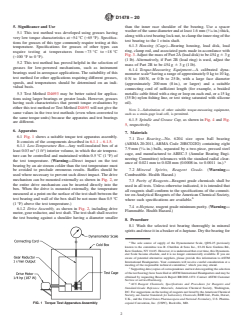
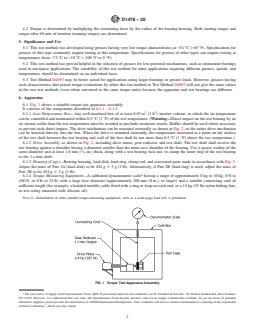
6.1 Fig. 1 shows a suitable torque test apparatus assembly.
It consists of the components described in 6.1.1 – 6.1.5.
3 3
6.1.1 Low-Temperature Box—Any well-insulated box of at least 0.03 m (1 ft ) interior volume, in which the air temperature
can be controlled and maintained within 0.5 °C (1 °F) of the test temperature. (Warning—Direct impact on the test bearing by an
air stream colder than the test temperature must be avoided to preclude erroneous results. Baffles should be used where necessary
to prevent such direct impact. The drive mechanism can be mounted externally as shown in Fig. 2, or the entire drive mechanism
can be inserted directly into the box. When the drive is mounted externally, the temperature measured at a point on the surface
of the test shaft between the test bearing and wall of the box shall be not more than 0.5 °C (1 °F) above the test temperature.)
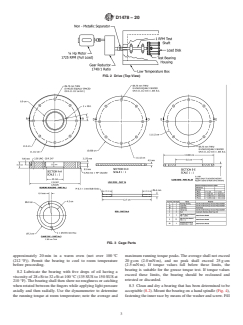
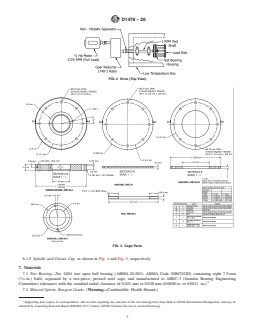
6.1.2 Drive Assembly, as shown in Fig. 2, including drive motor, gear reductor, and test shaft. The test shaft shall receive the
test bearing against a shoulder having a diameter smaller than the inner race shoulder of the bearing. Use a spacer washer of the
same diameter and at least 1.6 mm ( ⁄16 in.) thick, along with a test bearing lock nut, to clamp the inner ring of the test bearing
to the 1 r ⁄min shaft.
6.1.3 Housing (Cage)—Bearing housing, load disk, load ring, clamp rod, and associated parts made in accordance with Fig. 3.
Adjust the mass of Part 2A (load disk) to be 454 g 6 3 g (1 lb). Alternatively, if Part 2B (load ring) is used, adjust the mass of
Part 2B to be 454 g 6 3 g (1 lb).
6.1.4 Torque-Measuring Equipment—A calibrated dynamometer scale having a range of approximately 0 kg to 10 kg, 0 N to
100 N, or 0 lb to 25 lb, with a large face diameter (approximately 200 mm (8 in.), or larger) and a suitable connecting cord of
sufficient length (for example, a braided metallic cable fitted with a ring or loop on each end, or a 15 kg (35 lb) nylon fishing line,
or test string saturated with silicone oil).
NOTE 2—Substitution of other suitable torque-measuring equipment, such as a strain-gage load cell, is permitted.
FIG. 1 Torque Test Apparatus Assembly
The sole source of supply of the Dynamometer Scale, QDS-25 previously known to the committee was R. Chatillon & Sons Inc., 83-28 Kew Gardens Rd., Kew Gardens,
NY 11415. However, it is understood that over time, this Dynamometer Scale became obsolete, and it is no longer commercially available. If you are aware of potential
alternative suppliers, please provide this information to ASTM International Headquarters. Your comments will receive careful consideration at a meeting of the responsible
technical committee, which you may attend.
D1478 − 20
FIG. 2 Drive (Top View)
FIG. 3 Cage Parts
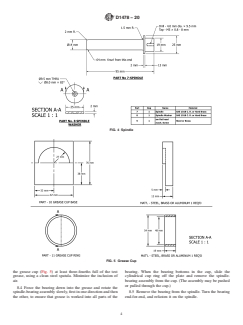
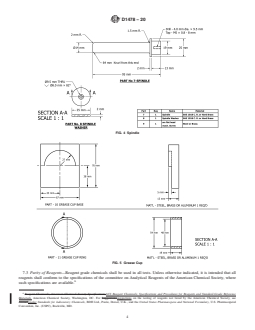
6.1.5 Spindle and Grease Cup, as shown in Fig. 4 and Fig. 5, respectively.
7. Materials
7.1 Test Bearing—No. 6204 size open ball bearing (ABMA 20:2011, ABMA Code 20BCO2JO) containing eight 7.9 mm
( ⁄16 in.) balls, separated by a two-piece, pressed steel cage, and manufactured to ABEC-3 (Annular Bearing Engineering
Committee) tolerances with the standard radial clearance of 0.021 mm to 0.028 mm (0.0008 in. to 0.0011 in.).
7.2 Mineral Spirits, Reagent Grade. (Warning—Combustible. Health Hazard.)
Supporting data (copies of correspondence and test data regarding the selection of the test bearing) have been filed at ASTM International Headquarters and may be
obtained by requesting Research Report RR:D02-1272. Contact ASTM Customer Service at service@astm.org.
D1478 − 20
FIG. 4 Spindle
FIG. 5 Grease Cup
7.3 Purity of Reagents—Reagent grade chemicals shall be used in all tests. Unless otherwise indicated, it is intended that all
reagents shall conform to the specifications of the committee on Analytical Reagents of the American Chemical Society, where
such specifications are available.
Reagent Chemicals, American Chemical Society Specifications,ACS Reagent Chemicals, Specifications and Procedures for Reagents and Standard-Grade Reference
Materials, American Chemical Society, Washington, DC. For Suggestionssuggestions on the testing of reagents not listed by the American Chemical Society, see
AnnualAnalar Standards for Laboratory Chemicals, BDH Ltd., Poole, Dorset, U.K., and the United States Pharmacopeia and National Formulary, U.S. Pharmacopeial
Convention, Inc. (USPC), Rockville, MD.
D1478 − 20
7.4 n-Heptane, reagent grade minimum purity. (Warning—Flammable. Health Hazard.)
8. Procedure
8.1 Wash the selected test bearing thoroughly in mineral spirits and rinse it in a beaker of n-heptane. Dry the bearing for
approximately 20 min in a warm oven (not over 100
...
Questions, Comments and Discussion
Ask us and Technical Secretary will try to provide an answer. You can facilitate discussion about the standard in here.
Loading comments...