

ASTM D6100-17
(Specification)Standard Specification for Extruded, Compression Molded and Injection Molded Polyoxymethylene Shapes (POM)
General Information
- Abstract
ABSTRACT
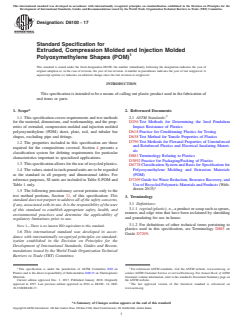
This specification covers the requirements and test methods for the material, dimensions, workmanship, and properties of extruded, compression molded, and injection molded acetal shapes such as sheet, plate, rod, and tubular bar. The specimens shall be a pure polyoxymethylene or may filled, lubricated, or reinforced with carbon and graphite fiber, glass, PTFE, graphite, silicone, molybdenum disulfide, mineral, combinations of reinforcements or fillers, or both. The products shall conform to the physical property requirements which include tensile strength, elongation at break, tensile modulus, dimensional stability, flexural modulus, Izod impact, and porosity level. Thickness tolerance, length camber, and width bow properties shall also comply with the dimensional requirements of the different acetal shapes.
SCOPE
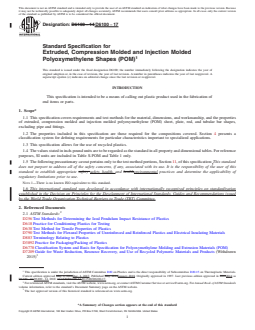
1.1 This specification covers requirements and test methods for the material, dimensions, and workmanship, and the properties of extruded, compression molded and injection molded polyoxymethylene (POM) sheet, plate, rod, and tubular bar shapes, excluding pipe and fittings.
1.2 The properties included in this specification are those required for the compositions covered. Section 4 presents a classification system for defining requirements for particular characteristics important to specialized applications.
1.3 This specification allows for the use of recycled plastics.
1.4 The values stated in inch-pound units are to be regarded as the standard in all property and dimensional tables. For reference purposes, SI units are included in Table S-POM and Table 1 only.
1.5 The following precautionary caveat pertains only to the test method portions, Section 11, of this specification: This standard does not purport to address all of the safety concerns, if any, associated with its use. It is the responsibility of the user of this standard to establish appropriate safety, health, and environmental practices and determine the applicability of regulatory limitations prior to use.
Note 1: There is no known ISO equivalent to this standard.
1.6 This international standard was developed in accordance with internationally recognized principles on standardization established in the Decision on Principles for the Development of International Standards, Guides and Recommendations issued by the World Trade Organization Technical Barriers to Trade (TBT) Committee.
- Status
- Published
- Publication Date
- 30-Nov-2017
- Technical Committee
- D20 - Plastics
- Drafting Committee
- D20.15 - Thermoplastic Materials
Buy Documents
ASTM D6100-17 - Standard Specification for Extruded, Compression Molded and Injection Molded Polyoxymethylene Shapes (POM)
REDLINE ASTM D6100-17 - Standard Specification for Extruded, Compression Molded and Injection Molded Polyoxymethylene Shapes (POM)
Overview
ASTM D6100-17: Standard Specification for Extruded, Compression Molded and Injection Molded Polyoxymethylene (POM) Shapes provides comprehensive requirements and test methods for POM plastic shapes including sheet, plate, rod, and tubular bar. Developed by ASTM International, this specification defines quality parameters for both virgin and recycled polyoxymethylene materials formed by extrusion, compression molding, or injection molding (excluding pipe and fittings). The document outlines standards for material composition, workmanship, dimensional accuracy, and key physical properties to ensure consistency and reliability in manufacturing and end-use applications.
Key Topics
- Material Scope: Covers extruded, compression molded, and injection molded POM shapes, which can be unfilled, filled, lubricated, or reinforced with additives such as glass fiber, PTFE, graphite, or mineral fillers.
- Physical Property Requirements: Ensures compliance with minimum values for critical properties, such as:
- Tensile strength and modulus
- Elongation at break
- Flexural modulus
- Dimensional stability
- Izod impact resistance
- Porosity level
- Dimensional Tolerances: Specifies requirements for thickness tolerance, camber, width bow, roundness, and squareness for various POM shapes.
- Classification System: Utilizes a cell callout designation to detail POM resin type, grade, and additives, providing a standardized way to specify products for procurement.
- Workmanship and Appearance: Mandates defect-free surfaces, uniform color, and limits on embedded foreign material or porosity.
- Recycled Content: Permits the use of recycled POM plastics up to 100%, with a clear distinction between general purpose and recycled grades.
- Testing Procedures: References recognized ASTM methods for evaluating product properties, including D638 (tensile), D790 (flexural), D256 (impact), and others, and provides specific conditioning and test conditions.
Applications
ASTM D6100-17 is widely used by manufacturers and purchasers across industries requiring high-performance engineering plastics. Typical application areas include:
- Automotive and Transportation: Bushings, gears, and structural components that demand durability, dimensional stability, and resistance to wear and chemicals.
- Industrial Machinery: Precision parts such as rollers, bearings, and guides fabricated from POM rod, plate, or tubular bars.
- Consumer Products: Components for electronics, appliances, and sporting goods, where dimensional stability, strength, and clean appearance are critical.
- Medical Device Housings: Non-implantable parts benefiting from POM’s low friction, machinability, and chemical resistance.
- Custom Engineering Solutions: When tight tolerances, specific mechanical properties, and tailored material compositions are necessary.
The standard is essential for specifying material during procurement, establishing quality control benchmarks, and ensuring interoperability within global supply chains.
Related Standards
ASTM D6100-17 references several related ASTM and industry standards, including:
- ASTM D6778: Classification and specification system for POM molding and extrusion materials
- ASTM D638: Test method for tensile properties of plastics
- ASTM D790: Test methods for flexural properties of reinforced and unreinforced plastics
- ASTM D256: Test methods for determining the Izod pendulum impact resistance of plastics
- ASTM D618: Practice for conditioning plastics for testing
- ASTM D3892: Practice for packaging and packing of plastics
- ASTM D883: Terminology relating to plastics
This specification is developed in alignment with internationally recognized standardization principles and is widely recognized for defining state-of-the-art requirements for polyoxymethylene shapes for use in demanding environments.
Keywords: ASTM D6100, POM standard, polyoxymethylene specification, extruded POM, injection molded POM, compression molded POM, POM rod, POM sheet, POM plate, POM bar, engineering plastics standard.
Relations
- Effective Date
- 01-Dec-2017
- Effective Date
- 01-Feb-2024
- Effective Date
- 01-Nov-2023
- Effective Date
- 01-Jan-2020
- Effective Date
- 01-Aug-2019
- Effective Date
- 15-Apr-2019
- Effective Date
- 01-Feb-2019
- Effective Date
- 01-Dec-2018
- Effective Date
- 01-Nov-2018
- Effective Date
- 15-Aug-2017
- Effective Date
- 01-Jul-2017
- Effective Date
- 01-Dec-2015
- Effective Date
- 01-Dec-2015
- Effective Date
- 01-Sep-2015
- Effective Date
- 01-Aug-2014
Buy Documents
ASTM D6100-17 - Standard Specification for Extruded, Compression Molded and Injection Molded Polyoxymethylene Shapes (POM)
REDLINE ASTM D6100-17 - Standard Specification for Extruded, Compression Molded and Injection Molded Polyoxymethylene Shapes (POM)
Get Certified
Connect with accredited certification bodies for this standard

ECOCERT
Organic and sustainability certification.

Eurofins Food Testing Global
Global leader in food, environment, and pharmaceutical product testing.

Intertek Bangladesh
Intertek certification and testing services in Bangladesh.
Sponsored listings
Frequently Asked Questions
ASTM D6100-17 is a technical specification published by ASTM International. Its full title is "Standard Specification for Extruded, Compression Molded and Injection Molded Polyoxymethylene Shapes (POM)". This standard covers: ABSTRACT This specification covers the requirements and test methods for the material, dimensions, workmanship, and properties of extruded, compression molded, and injection molded acetal shapes such as sheet, plate, rod, and tubular bar. The specimens shall be a pure polyoxymethylene or may filled, lubricated, or reinforced with carbon and graphite fiber, glass, PTFE, graphite, silicone, molybdenum disulfide, mineral, combinations of reinforcements or fillers, or both. The products shall conform to the physical property requirements which include tensile strength, elongation at break, tensile modulus, dimensional stability, flexural modulus, Izod impact, and porosity level. Thickness tolerance, length camber, and width bow properties shall also comply with the dimensional requirements of the different acetal shapes. SCOPE 1.1 This specification covers requirements and test methods for the material, dimensions, and workmanship, and the properties of extruded, compression molded and injection molded polyoxymethylene (POM) sheet, plate, rod, and tubular bar shapes, excluding pipe and fittings. 1.2 The properties included in this specification are those required for the compositions covered. Section 4 presents a classification system for defining requirements for particular characteristics important to specialized applications. 1.3 This specification allows for the use of recycled plastics. 1.4 The values stated in inch-pound units are to be regarded as the standard in all property and dimensional tables. For reference purposes, SI units are included in Table S-POM and Table 1 only. 1.5 The following precautionary caveat pertains only to the test method portions, Section 11, of this specification: This standard does not purport to address all of the safety concerns, if any, associated with its use. It is the responsibility of the user of this standard to establish appropriate safety, health, and environmental practices and determine the applicability of regulatory limitations prior to use. Note 1: There is no known ISO equivalent to this standard. 1.6 This international standard was developed in accordance with internationally recognized principles on standardization established in the Decision on Principles for the Development of International Standards, Guides and Recommendations issued by the World Trade Organization Technical Barriers to Trade (TBT) Committee.
ABSTRACT This specification covers the requirements and test methods for the material, dimensions, workmanship, and properties of extruded, compression molded, and injection molded acetal shapes such as sheet, plate, rod, and tubular bar. The specimens shall be a pure polyoxymethylene or may filled, lubricated, or reinforced with carbon and graphite fiber, glass, PTFE, graphite, silicone, molybdenum disulfide, mineral, combinations of reinforcements or fillers, or both. The products shall conform to the physical property requirements which include tensile strength, elongation at break, tensile modulus, dimensional stability, flexural modulus, Izod impact, and porosity level. Thickness tolerance, length camber, and width bow properties shall also comply with the dimensional requirements of the different acetal shapes. SCOPE 1.1 This specification covers requirements and test methods for the material, dimensions, and workmanship, and the properties of extruded, compression molded and injection molded polyoxymethylene (POM) sheet, plate, rod, and tubular bar shapes, excluding pipe and fittings. 1.2 The properties included in this specification are those required for the compositions covered. Section 4 presents a classification system for defining requirements for particular characteristics important to specialized applications. 1.3 This specification allows for the use of recycled plastics. 1.4 The values stated in inch-pound units are to be regarded as the standard in all property and dimensional tables. For reference purposes, SI units are included in Table S-POM and Table 1 only. 1.5 The following precautionary caveat pertains only to the test method portions, Section 11, of this specification: This standard does not purport to address all of the safety concerns, if any, associated with its use. It is the responsibility of the user of this standard to establish appropriate safety, health, and environmental practices and determine the applicability of regulatory limitations prior to use. Note 1: There is no known ISO equivalent to this standard. 1.6 This international standard was developed in accordance with internationally recognized principles on standardization established in the Decision on Principles for the Development of International Standards, Guides and Recommendations issued by the World Trade Organization Technical Barriers to Trade (TBT) Committee.
ASTM D6100-17 is classified under the following ICS (International Classification for Standards) categories: 71.080.10 - Aliphatic hydrocarbons. The ICS classification helps identify the subject area and facilitates finding related standards.
ASTM D6100-17 has the following relationships with other standards: It is inter standard links to ASTM D6100-14, ASTM D883-24, ASTM D883-23, ASTM D883-20, ASTM D883-19c, ASTM D883-19a, ASTM D883-19, ASTM D883-18a, ASTM D883-18, ASTM D883-17, ASTM D790-17, ASTM D790-15e1, ASTM D790-15, ASTM D3892-15, ASTM D6778-14. Understanding these relationships helps ensure you are using the most current and applicable version of the standard.
ASTM D6100-17 is available in PDF format for immediate download after purchase. The document can be added to your cart and obtained through the secure checkout process. Digital delivery ensures instant access to the complete standard document.
Standards Content (Sample)
This international standard was developed in accordance with internationally recognized principles on standardization established in the Decision on Principles for the
Development of International Standards, Guides and Recommendations issued by the World Trade Organization Technical Barriers to Trade (TBT) Committee.
Designation: D6100 −17
Standard Specification for
Extruded, Compression Molded and Injection Molded
Polyoxymethylene Shapes (POM)
This standard is issued under the fixed designation D6100; the number immediately following the designation indicates the year of
original adoption or, in the case of revision, the year of last revision. A number in parentheses indicates the year of last reapproval. A
superscript epsilon (´) indicates an editorial change since the last revision or reapproval.
INTRODUCTION
This specification is intended to be a means of calling out plastic product used in the fabrication of
end items or parts.
1. Scope* 2. Referenced Documents
1.1 This specification covers requirements and test methods 2.1 ASTM Standards:
for the material, dimensions, and workmanship, and the prop- D256 Test Methods for Determining the Izod Pendulum
erties of extruded, compression molded and injection molded Impact Resistance of Plastics
polyoxymethylene (POM) sheet, plate, rod, and tubular bar D618 Practice for Conditioning Plastics for Testing
shapes, excluding pipe and fittings. D638 Test Method for Tensile Properties of Plastics
D790 Test Methods for Flexural Properties of Unreinforced
1.2 The properties included in this specification are those
and Reinforced Plastics and Electrical Insulating Materi-
required for the compositions covered. Section 4 presents a
als
classification system for defining requirements for particular
D883 Terminology Relating to Plastics
characteristics important to specialized applications.
D3892 Practice for Packaging/Packing of Plastics
1.3 Thisspecificationallowsfortheuseofrecycledplastics.
D6778 Classification System and Basis for Specification for
Polyoxymethylene Molding and Extrusion Materials
1.4 The values stated in inch-pound units are to be regarded
as the standard in all property and dimensional tables. For (POM)
D7209 Guide for Waste Reduction, Resource Recovery, and
reference purposes, SI units are included in Table S-POM and
Table 1 only. Use of Recycled Polymeric Materials and Products (With-
drawn 2015)
1.5 The following precautionary caveat pertains only to the
test method portions, Section 11, of this specification: This
3. Terminology
standard does not purport to address all of the safety concerns,
3.1 Definitions:
if any, associated with its use. It is the responsibility of the user
3.1.1 regrind (plastic), n—a product or scrap such as sprues,
of this standard to establish appropriate safety, health, and
runners and edge trim that have been reclaimed by shredding
environmental practices and determine the applicability of
and granulating for use in-house.
regulatory limitations prior to use.
3.1.2 For definitions of other technical terms pertaining to
NOTE 1—There is no known ISO equivalent to this standard.
plastics used in this specification, see Terminology D883 or
1.6 This international standard was developed in accor-
Guide D7209.
dance with internationally recognized principles on standard-
ization established in the Decision on Principles for the
Development of International Standards, Guides and Recom-
mendations issued by the World Trade Organization Technical
Barriers to Trade (TBT) Committee.
1 2
This specification is under the jurisdiction of ASTM Committee D20 on For referenced ASTM standards, visit the ASTM website, www.astm.org, or
Plastics and is the direct responsibility of Subcommittee D20.15 on Thermoplastic contact ASTM Customer Service at service@astm.org. For Annual Book of ASTM
Materials. Standards volume information, refer to the standard’s Document Summary page on
Current edition approved Dec. 1, 2017. Published January 2018. Originally the ASTM website.
approved in 1997. Last previous edition approved in 2014 as D6100 - 14. DOI: The last approved version of this historical standard is referenced on
10.1520/D6100-17. www.astm.org.
*A Summary of Changes section appears at the end of this standard
Copyright © ASTM International, 100 Barr Harbor Drive, PO Box C700, West Conshohocken, PA 19428-2959. United States
D6100 − 17
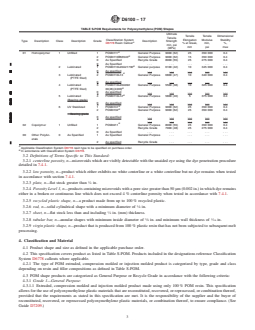
TABLE S-POM Requirements for Polyoxymethylene (POM) Shapes
Ultimate
Tensile Tensile Dimensional
Tensile
Classification System Elongation Modulus Stability
Type Description Class Description Grade Description Strength
A
D6778 Resin Callout % at break, min, %,
min, psi
mm psi max
(MPa)
B
01 Homopolymer 1 Unfilled 1 POM0111 General Purpose 9000 (62) 25 350 000 0.4
B
2 POM0110B56540 General Purpose 9000 (62) 15 350 000 0.4
0 As Specified Recycle Grade 8000 (55) 25 275 000 0.4
9 As Specified . . . . . . . . . . . . . . .
B
2 Lubricated 1 POM0110L20A21730 General purpose 6100 (42) 10 345 000 0.4
0 As specified . . . . . . . . . . . . . . .
B
3 Lubricated 2 POM0110L13 General Purpose 6800 (47) 10 340 000 0.4
(PTFE filled)
0 As specified . . . . . . . . . . . . . . .
4 Lubricated 3 POM0110L20A992 General Purpose 5500 (38) 10 325 000 0.4
B
(PTFE filled) 30(46)(2400)
0 As specified . . . . . . . . . . . . . . .
B
5 Lubricated 4 POM0110L12 General Purpose 5800 (40) 5 375 000 0.4
(Bearing grade)
0 As specified . . . . . . . . . . . . . . .
B
6 UV Stabilized 1 POM0131 General Purpose 9000 (62) 25 350 000 0.4
B
2 POM0132 General Purpose 9000 (62) 25 350 000 0.4
0 As specified . . . . . . . . . . . . . . .
... ... ... ... ...
B
02 Copolymer 1 Unfilled 1 POM0211 General Purpose 8000 (55) 25 350 000 0.4
2 Recycle Grade 7000 (48) 25 275 000 0.4
0 As Specified . . . . . . . . . . . . . . .
00 Other PolyAc- 0 As Specified 1 As Specified General Purpose . . . . . . . . . . . .
etals
2 As specified Recycle Grade . . . . . . . . . . . .
A
Applicable Classification System D6778 resin type to be specified on purchase order.
B
In accordance with Classification System D6778.
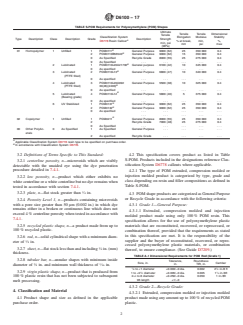
3.2 Definitions of Terms Specific to This Standard: 4.2 This specification covers product as listed in Table
S-POM. Products included in the designations reference Clas-
3.2.1 centerline porosity, n—microvoids which are visibly
detectable with the unaided eye using the dye penetration sification System D6778 callouts where applicable.
procedure detailed in 7.4.1.
4.2.1 The type of POM extruded, compression molded or
injection molded product is categorized by type, grade and
3.2.2 low porosity, n—product which either exhibits no
class depending on resin and filler compositions as defined in
white centerline or a white centerline but no dye remains when
Table S-POM.
tested in accordance with section 7.4.1.
3.2.3 plate, n—flat stock greater than ⁄4 in.
4.3 POMshapeproductsarecategorizedasGeneralPurpose
or Recycle Grade in accordance with the following criteria:
3.2.4 Porosity Level 1, n—products containing microvoids
with a pore size greater than 50 µm (0.002 in.) in which dye 4.3.1 Grade 1—General Purpose:
remains either in a broken or continuous line which does not
4.3.1.1 Extruded, compression molded and injection
exceed 4 % centerline porosity when tested in accordance with
molded product made using only 100 % POM resin. This
7.4.1.
specification allows for the use of polyoxymethylene plastic
materials that are reconstituted, recovered, or reprocessed, or
3.2.5 recycled plastic shape, n—a product made from up to
100 % recycled plastic. combination thereof, provided that the requirements as stated
in this specification are met. It is the responsibility of the
3.2.6 rod, n—solid cylindrical shape with a minimum diam-
supplier and the buyer of reconstituted, recovered, or repro-
eter of ⁄8 in.
cessed polyoxymethylene plastic materials, or combination
3.2.7 sheet, n—flatstocklessthanandincluding ⁄4in.(mm)
thereof, to ensure compliance. (See Guide D7209.)
thickness.
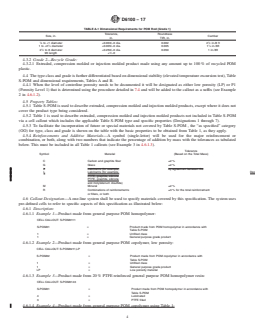
TABLE A-1 Dimensional Requirements for POM Rod (Grade 1)
3.2.8 tubular bar, n—annular shapes with minimum inside
Tolerance, Roundness
Size, in. Camber
3 1
in. TIR, in.
diameter of ⁄8 in. and minimum wall thickness of ⁄16 in.
1 1
⁄8 to <1 diameter +0.003/–0 dia. 0.002 2 ⁄2 in./8 ft
3.2.9 virgin plastic shape, n—product that is produced from
1 1
1to<2 ⁄2 diameter +0.005/–0 dia. 0.005 1 ⁄4 in./8ft
2 ⁄2 to 8 diameter +0.250/–0 dia. 0.050 1 in./8ft
100 % plastic resin that has not been subjected to subsequent
96 length +1/–0
melt processing.
4.3.2 Grade 2—Recycle Grade:
4. Classification and Material
4.3.2.1 Extruded, compression molded or injection molded
product made using any amount up to 100 % of recycled POM
4.1 Product shape and size as defined in the applicable
purchase order. plastic.
D6100 − 17
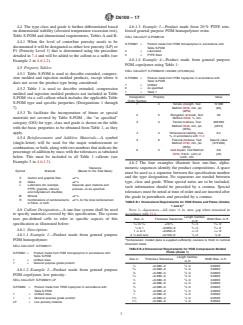
4.4 The type class and grade is further differentiated based 4.6.1.3 Example 3—Product made from 20 % PTFE rein-
on dimensional stability (elevated temperature excursion test), forced general purpose POM homopolymer resin:
Table S-POM and dimensional requirements, Tables A and B.
CELL CALLOUT: S-POM0143
4.4.1 When the level of centerline porosity needs to be
S-POM01 = Product made from POM homopolymer in accordance with
documented it will be designated as either low porosity (LP) or
Table S-POM
P1 (Porosity Level 1) that is determined using the procedure 4 = Lubricated
3 = PTFE filled
detailed in 7.4 and will be added to the callout as a suffix (see
4.6.1.4 Example 4—Product made from general purpose
Example 2 in 4.6.1.2).
POM copolymer using Table 1:
4.5 Property Tables:
CELL CALLOUT: S-POM0210 1453493 (475,000 psi)
4.5.1 Table S-POM is used to describe extruded, compres-
S-POM02 = Product made from POM copolymer in accordance with
sion molded and injection molded products, except where it
Table S-POM
does not cover the product type being considered.
1 = Unfilled
0 = As specified
4.5.2 Table 1 is used to describe extruded, compression
1 = Table 1
molded and injection molded products not included in Table
Designation Property Value
S-POM via a cell callout which includes the applicable Table
Order Number
S-POM type and specific properties (Designations 1 through
1 4 Tensile strength, Test 12 000
7). Method D638,min,psi (83)
(MPa)
4.5.3 To facilitate the incorporation of future or special
2 5 Elongation at break, Test 20
materials not covered by Table S-POM , the “as specified”
Method D638,%,min
3 3 Tensile modulus, Test 300 000
category (OO) for type, class and grade is shown on the table
Method D638,min,psi (2073)
with the basic properties to be obtained from Table 1, as they
(MPa)
apply. 4 4 Dimensional stability, max, 0.4
%, in accordance with 11.2
4.5.4 Reinforcements and Additive Materials—A symbol
5 9 Flexural modulus, Test Specify value
(single-letter) will be used for the major reinforcement or Method D790,min,psi (475 000)
(MPa)
combination, or both, along with two numbers that indicate the
6 3 Izod impact, Test Method 0.8
percentage of addition by mass with the tolerances as tabulated
D256, ft·lb/in. (J/m) of (43)
below. This must be included in all Table 1 callouts (see
notch, min
Example 3 in 4.6.1.3).
4.6.2 The four examples illustrate how one-line, alpha-
Tolerance
numeric sequences identify the product compositions. A space
Symbol Material (Based on the Total Mass)
must be used as a separator between the specification number
and the type designation. No separators are needed between
C Carbon and graphite fiber ±2 %
G Glass ±2 %
type, class and grade. When special notes are to be included,
L Lubricants (for example, Depends upon material and
such information should be preceded by a comma. Special
PTFE, graphite, silicone process—to be specified.
tolerances must be noted at time of order and are inserted after
and molybdenum disulfide)
M Mineral ±2 %
the grade in parenthesis and preceded by a comma.
R Combinations of reinforcements ±3 % for the total reinforcement
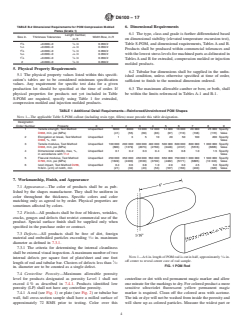
TABLE B-1 Dimensional Requirements for POM Sheets and Plates (Grades
or fillers, or both
A
1 and 2)
4.6 Callout Designation—A one-line system shall be used NOTE 1—Squareness—All sizes ⁄8 in. max, gap when measured in
accordance with 11.4.
to specify materials covered by this specification. The system
Length Camber,
Size, in. Thickness Tolerances Width Bow, in./ft
uses pre-defined cells to refer to specific aspects of this
in./ft
1 3 3 3
specification as illustrated below: ⁄16 to ⁄16 ±10 % ⁄4 /4 ⁄16 /2
1 3 3
⁄4 to 1 +0.025/–0 ⁄4 /4 ⁄16 /2
4.6.1 Description:
1 1 1
1 ⁄8 to 3 +0.050/–0 ⁄4 /4 ⁄16 /2
1 1 1
4.6.1.1 Example 1—Product made from general purpose 3 ⁄8 and over +0.125/–0 ⁄4 /4 ⁄8 /2
A
POM homopolymer:
Compression molded plate is supplied sufficiently oversize to finish to nominal
dimension listed.
CELL CALLOUT: S-POM0111
TABLE B-2 Dimensional Requirements for POM Compression Molded
S-POM01 = Product made from POM homopolymer in accordance with Plates (Grade 1)
Table S-POM
Length Camber,
Size in. Thickness Tolerances Width Bow, in./ft
1 = Unfilled class
in./ft
1 = General purpose grade product
1 3
⁄4 +0.090/–0 ⁄8 /4 0.090/2
5 3
⁄16 +0.090/–0 ⁄8 /4 0.090/2
4.6.1.2 Example 2—Product made from general purpose
3 3
⁄8 +0.090/–0 ⁄8 /4 0.090/2
POM copolymer, low porosity:
7 3
⁄16 +0.090/–0 ⁄8 /4 0.090/2
1 3
⁄2 +0.090/–0 ⁄8 /4 0.090/2
CELL CALLOUT: S-POM0211,LP
5 3
⁄8 +0.090/–0 ⁄8 /4 0.090/2
3 3
⁄4 +0.090/–0 ⁄8 /4 0.090/2
S-POM02 = Product made from POM copolymer in accordance with
7 3
⁄8 +0.090/–0 ⁄8 /4 0.090/2
Table S-POM
1 +0.090/–0 ⁄8 /4 0.050/2
1 = Unfilled class
1 1
1 ⁄8 +0.090/–0 ⁄8 /4 0.050/2
1 = General purpose grade product
...
This document is not an ASTM standard and is intended only to provide the user of an ASTM standard an indication of what changes have been made to the previous version. Because
it may not be technically possible to adequately depict all changes accurately, ASTM recommends that users consult prior editions as appropriate. In all cases only the current version
of the standard as published by ASTM is to be considered the official document.
Designation: D6100 − 14 D6100 − 17
Standard Specification for
Extruded, Compression Molded and Injection Molded
Polyoxymethylene Shapes (POM)
This standard is issued under the fixed designation D6100; the number immediately following the designation indicates the year of
original adoption or, in the case of revision, the year of last revision. A number in parentheses indicates the year of last reapproval. A
superscript epsilon (´) indicates an editorial change since the last revision or reapproval.
INTRODUCTION
This specification is intended to be a means of calling out plastic product used in the fabrication of
end items or parts.
1. Scope*
1.1 This specification covers requirements and test methods for the material, dimensions, and workmanship, and the properties
of extruded, compression molded and injection molded polyoxymethylene (POM) sheet, plate, rod, and tubular bar shapes,
excluding pipe and fittings.
1.2 The properties included in this specification are those required for the compositions covered. Section 4 presents a
classification system for defining requirements for particular characteristics important to specialized applications.
1.3 This specification allows for the use of recycled plastics.
1.4 The values stated in inch-pound units are to be regarded as the standard in all property and dimensional tables. For reference
purposes, SI units are included in Table S-POM and Table 1 only.
1.5 The following precautionary caveat pertains only to the test method portions, Section 11, of this specification: This standard
does not purport to address all of the safety concerns, if any, associated with its use. It is the responsibility of the user of this
standard to establish appropriate safety safety, health, and healthenvironmental practices and determine the applicability of
regulatory limitations prior to use.
NOTE 1—There is no known ISO equivalent to this standard.
1.6 This international standard was developed in accordance with internationally recognized principles on standardization
established in the Decision on Principles for the Development of International Standards, Guides and Recommendations issued
by the World Trade Organization Technical Barriers to Trade (TBT) Committee.
2. Referenced Documents
2.1 ASTM Standards:
D256 Test Methods for Determining the Izod Pendulum Impact Resistance of Plastics
D618 Practice for Conditioning Plastics for Testing
D638 Test Method for Tensile Properties of Plastics
D790 Test Methods for Flexural Properties of Unreinforced and Reinforced Plastics and Electrical Insulating Materials
D883 Terminology Relating to Plastics
D3892 Practice for Packaging/Packing of Plastics
D6778 Classification System and Basis for Specification for Polyoxymethylene Molding and Extrusion Materials (POM)
D7209 Guide for Waste Reduction, Resource Recovery, and Use of Recycled Polymeric Materials and Products (Withdrawn
2015)
This specification is under the jurisdiction of ASTM Committee D20 on Plastics and is the direct responsibility of Subcommittee D20.15 on Thermoplastic Materials.
Current edition approved May 1, 2014Dec. 1, 2017. Published May 2014January 2018. Originally approved in 1997. Last previous edition approved in 20112014 as
D6100 - 11.D6100 - 14. DOI: 10.1520/D6100-14.10.1520/D6100-17.
For referenced ASTM standards, visit the ASTM website, www.astm.org, or contact ASTM Customer Service at service@astm.org. For Annual Book of ASTM Standards
volume information, refer to the standard’s Document Summary page on the ASTM website.
The last approved version of this historical standard is referenced on www.astm.org.
*A Summary of Changes section appears at the end of this standard
Copyright © ASTM International, 100 Barr Harbor Drive, PO Box C700, West Conshohocken, PA 19428-2959. United States
D6100 − 17
3. Terminology
3.1 Definitions:
3.1.1 regrind (plastic), n—a product or scrap such as sprues, runners and edge trim that have been reclaimed by shredding and
granulating for use in-house.
3.1.2 For definitions of other technical terms pertaining to plastics used in this specification, see Terminology D883 or Guide
D7209.
D6100 − 17
TABLE S-POM Requirements for Polyoxymethylene (POM) Shapes
Ultimate
Tensile Tensile Dimensional
Tensile
Classification System Elongation Modulus Stability
Type Description Class Description Grade Description Strength
A
D6778 Resin Callout % at break, min, %,
min, psi
mm psi max
(MPa)
B
01 Homopolymer 1 Unfilled 1 POM0111 General Purpose 9000 (62) 25 350 000 0.4
B
2 POM0110B56540 General Purpose 9000 (62) 15 350 000 0.4
0 As Specified Recycle Grade 8000 (55) 25 275 000 0.4
9 As Specified . . . . . . . . . . . . . . .
B
2 Lubricated 1 POM0110L20A21730 General purpose 6100 (42) 10 345 000 0.4
0 As specified . . . . . . . . . . . . . . .
B
3 Lubricated 2 POM0110L13 General Purpose 6800 (47) 10 340 000 0.4
(PTFE filled)
0 As specified . . . . . . . . . . . . . . .
4 Lubricated 3 POM0110L20A992 General Purpose 5500 (38) 10 325 000 0.4
B
(PTFE filled) 30(46)(2400)
0 As specified . . . . . . . . . . . . . . .
B
5 Lubricated 4 POM0110L12 General Purpose 5800 (40) 5 375 000 0.4
(Bearing grade)
0 As specified . . . . . . . . . . . . . . .
B
6 UV Stabilized 1 POM0131 General Purpose 9000 (62) 25 350 000 0.4
B
2 POM0132 General Purpose 9000 (62) 25 350 000 0.4
Bearing grade
0 As specified . . . . . . . . . . . . . . .
. . . . . . . . . . . . . . .
B
02 Copolymer 1 Unfilled 1 POM0211 General Purpose 8000 (55) 25 350 000 0.4
2 Recycle Grade 7000 (48) 25 275 000 0.4
0 As Specified . . . . . . . . . . . . . . .
00 Other PolyAc- 0 As Specified 1 As Specified General Purpose . . . . . . . . . . . .
etals
2 As specified Recycle Grade . . . . . . . . . . . .
A
Applicable Classification System D6778 resin type to be specified on purchase order.
B
In accordance with Classification System D6778.
3.2 Definitions of Terms Specific to This Standard:
3.2.1 centerline porosity, n—microvoids which are visibly detectable with the unaided eye using the dye penetration procedure
detailed in 7.4.1.
3.2.2 low porosity, n—product which either exhibits no white centerline or a white centerline but no dye remains when tested
in accordance with section 7.4.1.
3.2.3 plate, n—flat stock greater than ⁄4 in.
3.2.4 Porosity Level 1, n—products containing microvoids with a pore size greater than 50 μm (0.002 in.) in which dye remains
either in a broken or continuous line which does not exceed 4 % centerline porosity when tested in accordance with 7.4.1.
3.2.5 recycled plastic shape, n—a product made from up to 100 % recycled plastic.
3.2.6 rod, n—solid cylindrical shape with a minimum diameter of ⁄8 in.
3.2.7 sheet, n—flat stock less than and including ⁄4 in. (mm) thickness.
3 1
3.2.8 tubular bar, n—annular shapes with minimum inside diameter of ⁄8 in. and minimum wall thickness of ⁄16 in.
3.2.9 virgin plastic shape, n—product that is produced from 100 % plastic resin that has not been subjected to subsequent melt
processing.
4. Classification and Material
4.1 Product shape and size as defined in the applicable purchase order.
4.2 This specification covers product as listed in Table S-POM. Products included in the designations reference Classification
System D6778 callouts where applicable.
4.2.1 The type of POM extruded, compression molded or injection molded product is categorized by type, grade and class
depending on resin and filler compositions as defined in Table S-POM.
4.3 POM shape products are categorized as General Purpose or Recycle Grade in accordance with the following criteria:
4.3.1 Grade 1—General Purpose:
4.3.1.1 Extruded, compression molded and injection molded product made using only 100 % POM resin. This specification
allows for the use of polyoxymethylene plastic materials that are reconstituted, recovered, or reprocessed, or combination thereof,
provided that the requirements as stated in this specification are met. It is the responsibility of the supplier and the buyer of
reconstituted, recovered, or reprocessed polyoxymethylene plastic materials, or combination thereof, to ensure compliance. (See
Guide D7209.)
D6100 − 17
TABLE A-1 Dimensional Requirements for POM Rod (Grade 1)
Tolerance, Roundness
Size, in. Camber
in. TIR, in.
1 1
⁄8 to <1 diameter +0.003/–0 dia. 0.002 2 ⁄2 in./8 ft
1 1
1 to <2 ⁄2 diameter +0.005/–0 dia. 0.005 1 ⁄4 in./8ft
2 ⁄2 to 8 diameter +0.250/–0 dia. 0.050 1 in./8ft
96 length +1/–0
4.3.2 Grade 2—Recycle Grade:
4.3.2.1 Extruded, compression molded or injection molded product made using any amount up to 100 % of recycled POM
plastic.
4.4 The type class and grade is further differentiated based on dimensional stability (elevated temperature excursion test), Table
S-POM and dimensional requirements, Tables A and B.
4.4.1 When the level of centerline porosity needs to be documented it will be designated as either low porosity (LP) or P1
(Porosity Level 1) that is determined using the procedure detailed in 7.4 and will be added to the callout as a suffix (see Example
2 in 4.6.1.2).
4.5 Property Tables:
4.5.1 Table S-POM is used to describe extruded, compression molded and injection molded products, except where it does not
cover the product type being considered.
4.5.2 Table 1 is used to describe extruded, compression molded and injection molded products not included in Table S-POM
via a cell callout which includes the applicable Table S-POM type and specific properties (Designations 1 through 7).
4.5.3 To facilitate the incorporation of future or special materials not covered by Table S-POM , the “as specified” category
(OO) for type, class and grade is shown on the table with the basic properties to be obtained from Table 1, as they apply.
4.5.4 Reinforcements and Additive Materials—A symbol (single-letter) will be used for the major reinforcement or
combination, or both, along with two numbers that indicate the percentage of addition by mass with the tolerances as tabulated
below. This must be included in all Table 1 callouts (see Example 3 in 4.6.1.3).
Tolerance
Symbol Material (Based on the Total Mass)
C Carbon and graphite fiber ±2 %
G Glass ±2 %
L Lubricants (for example, by agreement between the
L Lubricants (for example, Depends
PTFE, graphite, silicone
PTFE, graphite, silicone
and molybdenum disulfide)
M Mineral ±2 %
R Combinations of reinforcements ±3 % for the total reinforcement
or fillers, or both
4.6 Callout Designation—A one-line system shall be used to specify materials covered by this specification. The system uses
pre-defined cells to refer to specific aspects of this specification as illustrated below:
4.6.1 Description:
4.6.1.1 Example 1—Product made from general purpose POM homopolymer:
CELL CALLOUT: S-POM0111
S-POM01 = Product made from POM homopolymer in accordance with
Table S-POM
1 = Unfilled class
1 = General purpose grade product
4.6.1.2 Example 2—Product made from general purpose POM copolymer, low porosity:
CELL CALLOUT: S-POM0211,LP
S-POM02 = Product made from POM copolymer in accordance with
Table S-POM
1 = Unfilled class
1 = General purpose grade product
LP = Low porosity material
4.6.1.3 Example 3—Product made from 20 % PTFE reinforced general purpose POM homopolymer resin:
CELL CALLOUT: S-POM0143
S-POM01 = Product made from POM homopolymer in accordance with
Table S-POM
4 = Lubricated
3 = PTFE filled
4.6.1.4 Example 4—Product made from general purpose POM copolymer using Table 1:
D6100 − 17
CELL CALLOUT: S-POM0210 1453493 (475,000 psi)
S-POM02 = Product made from POM copolymer in accordance with
Table S-POM
1 = Unfilled
0 = As specified
1 = Table 1
Designation Property Value
Order Number
1 4 Tensile strength, Test Method D638, min, psi (MPa) 12 000
(83)
2 5 Elongation at break, Test Method D638, %, min 20
3 3 Tensile modulus, Test Method D638, min, psi (MPa) 300 000
(2073)
4 4 Dimensional stability, max, %, in accordance with 11.2 0.4
5 9 Flexural modulus, Test Method D790, min, psi (MPa) Specify value
(475 000)
6 3 Izod impact, Test Method D256, ft·lb/in. (J/m) of notch, min 0.8
(43)
4.6.2 The threefour examples illustrate how a one-line, alpha-numeric sequence can sequences identify the product composition,
commercial parameters and physical characteristics of extruded, compression molded and injection molded product. compositions.
A space must be used as a separator between the specification number and the type designation. No separators are needed between
type, class and grade. When special notes are to be included, such information should be preceded by a comma. Special tolerances
must be noted at time of order and are inserted after the grade in parenthesis and preceded by a comma.
A
TABLE B-1 Dimensional Requirements for POM Sheets and Plates (Grades 1 and 2)
NOTE 1—Squareness—All sizes ⁄8 in. max, gap when measured in accordance with 11.4.
Length Camber,
Size, in. Thickness Tolerances Width Bow, in./ft
in./ft
1 3 3 3
⁄16 to ⁄16 ±10 % ⁄4 /4 ⁄16 /2
1 3 3
⁄4 to 1 +0.025/–0 ⁄4 /4 ⁄16 /2
1 1 1
1 ⁄8 to 3 +0.050/–0 ⁄4 /4 ⁄16 /2
1 1 1
3 ⁄8 and over +0.125/–0 ⁄4 /4 ⁄8 /2
A
Compression molded plate is supplied sufficiently oversize to finish to nominal dimension listed.
TABLE B-2 Dimensional Requirements for POM Compression Molded Plates (Grade 1)
Length Camber,
Size in. Thickness Tolerances Width Bow, in./ft
in./ft
1 3
⁄4 +0.090/–0 ⁄8 /4 0.090/2
5 3
⁄16 +0.090/–0 ⁄8 /4 0.090/2
3 3
⁄8 +0.090/–0 ⁄8 /4 0.090/2
7 3
⁄16 +0.090/–0
...