

ASTM D3652/D3652M-01(2020)
(Test Method)Standard Test Method for Thickness of Pressure-Sensitive Tapes
General Information
- Abstract
SIGNIFICANCE AND USE
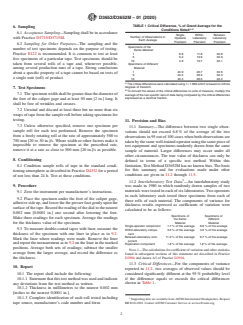
4.1 Thickness is an important property of tapes, and this dimension is important for certain end uses. This test method is useful for quality control and for acceptance testing for conformance to specifications.
SCOPE
1.1 This test method covers the determination of the thickness of pressure-sensitive tapes at standard conditions.
1.2 This test method is intended to replace AFERA 40062 and PSTC 33.2
1.3 The values stated in either SI units or inch-pound units are to be regarded separately as standard. The values stated in each system may not be exact equivalents; therefore, each system shall be used independently of the other. Combining values from the two systems may result in non-conformance with the standard.
1.4 This standard does not purport to address all of the safety concerns, if any, associated with its use. It is the responsibility of the user of this standard to establish appropriate safety, health, and environmental practices and determine the applicability of regulatory limitations prior to use.
1.5 This international standard was developed in accordance with internationally recognized principles on standardization established in the Decision on Principles for the Development of International Standards, Guides and Recommendations issued by the World Trade Organization Technical Barriers to Trade (TBT) Committee.
- Status
- Published
- Publication Date
- 30-Sep-2020
- Technical Committee
- D10 - Packaging
- Drafting Committee
- D10.14 - Tape and Labels

Overview
ASTM D3652/D3652M-01(2020): Standard Test Method for Thickness of Pressure-Sensitive Tapes is an internationally recognized ASTM standard that specifies procedures for accurately determining the thickness (caliper, gauge) of pressure-sensitive tapes. Thickness is a critical physical property of such tapes and influences performance, suitability, and quality for various applications. This standard provides a reliable method for routine quality control, acceptance testing, and specification conformance, applicable across industries where pressure-sensitive tapes are used.
ASTM D3652/D3652M draws on best practices and replaces earlier standards (AFERA 4006 and PSTC 33) to ensure global consistency and compliance with internationally recognized principles, as emphasized by the World Trade Organization’s Technical Barriers to Trade Committee.
Key Topics
Purpose and Scope
- Describes test methods for determining the thickness of pressure-sensitive tapes under standard laboratory conditions.
- Separate provisions for SI and inch-pound units - both systems are standard, but must not be mixed.
- Applies to a wide range of pressure-sensitive tapes, including single-coated and double-coated variants.
Significance of Tape Thickness
- Thickness affects tape performance in application, such as bonding strength, flexibility, and compatibility with substrates.
- Critical for end-use requirements, product development, and procurement processes.
- Supports effective quality control programs and product acceptance procedures.
Test Apparatus and Procedure
- Specifies the use of a caliper gauge with highly parallel measuring faces and controlled pressure for consistency.
- Details specimen preparation to avoid surface defects and ensure representative results.
- Specifies conditioning protocols to standardize environmental effects.
- Stipulates test reporting requirements for traceability and completeness.
Precision, Bias, and Statistical Considerations
- Includes guidelines on sampling, precision, and interlaboratory comparisons.
- Advises on critical differences and confidence limits for comparing test results.
- No absolute bias as the true value of thickness is defined only in terms of the method used.
Applications
The ASTM D3652/D3652M standard is highly relevant for:
Quality Control in Manufacturing
- Ensures consistent tape thickness, reducing risk of performance variability in end products.
- Used by tape manufacturers to certify products before shipment.
Product Development and R&D
- Facilitates material selection and design modifications by providing reliable thickness measurements.
- Used in benchmarking and comparative analyses of new tape formulations.
Supply Chain and Procurement
- Used by purchasers and inspectors for incoming product acceptance and verification of supplier conformance to specifications.
- Provides confidence that delivered tapes meet application-specific requirements.
Regulatory and Compliance Settings
- Accepted by agencies such as the U.S. Department of Defense, ensuring suitability for critical applications.
- Meets international trade expectations related to harmonized testing methods.
Related Standards
For broader context and integrated quality systems, the following related standards may be relevant:
- ASTM D3715/D3715M – Quality Assurance of Pressure-Sensitive Tapes
- ASTM D4332 – Conditioning of Containers, Packages, or Packaging Components for Testing
- ASTM E122 – Calculating Sample Size to Estimate the Average for a Characteristic
- ASTM D996 – Terminology of Packaging and Distribution Environments
By adhering to ASTM D3652/D3652M, organizations ensure reliable, repeatable, and accurate measurement of pressure-sensitive tape thickness, supporting product excellence and regulatory compliance on a global scale.
Keywords: pressure-sensitive tape, tape thickness measurement, ASTM D3652, caliper gauge, tape quality control, packaging standards, tape testing, specification conformance
Relations
- Refers
ASTM D3715/D3715M-98(2019) - Standard Practice for Quality Assurance of Pressure-Sensitive Tapes - Effective Date
- 01-Aug-2019
- Effective Date
- 15-Mar-2013
- Effective Date
- 01-Aug-2011
- Refers
ASTM D3715/D3715M-98(2011) - Standard Practice for Quality Assurance of Pressure-Sensitive Tapes - Effective Date
- 01-Apr-2011
- Effective Date
- 01-Dec-2010
- Effective Date
- 01-Aug-2009
- Effective Date
- 01-Oct-2007
- Effective Date
- 01-Nov-2006
- Effective Date
- 01-Apr-2004
- Effective Date
- 10-Apr-2002
- Effective Date
- 10-Apr-2002
- Effective Date
- 10-Apr-2001
- Effective Date
- 10-Apr-2001
- Effective Date
- 10-Apr-2001
- Effective Date
- 10-Apr-2001
Get Certified
Connect with accredited certification bodies for this standard

DIN CERTCO
DIN Group product certification.

Smithers Quality Assessments
US management systems and product certification.
Sponsored listings
Frequently Asked Questions
ASTM D3652/D3652M-01(2020) is a standard published by ASTM International. Its full title is "Standard Test Method for Thickness of Pressure-Sensitive Tapes". This standard covers: SIGNIFICANCE AND USE 4.1 Thickness is an important property of tapes, and this dimension is important for certain end uses. This test method is useful for quality control and for acceptance testing for conformance to specifications. SCOPE 1.1 This test method covers the determination of the thickness of pressure-sensitive tapes at standard conditions. 1.2 This test method is intended to replace AFERA 40062 and PSTC 33.2 1.3 The values stated in either SI units or inch-pound units are to be regarded separately as standard. The values stated in each system may not be exact equivalents; therefore, each system shall be used independently of the other. Combining values from the two systems may result in non-conformance with the standard. 1.4 This standard does not purport to address all of the safety concerns, if any, associated with its use. It is the responsibility of the user of this standard to establish appropriate safety, health, and environmental practices and determine the applicability of regulatory limitations prior to use. 1.5 This international standard was developed in accordance with internationally recognized principles on standardization established in the Decision on Principles for the Development of International Standards, Guides and Recommendations issued by the World Trade Organization Technical Barriers to Trade (TBT) Committee.
SIGNIFICANCE AND USE 4.1 Thickness is an important property of tapes, and this dimension is important for certain end uses. This test method is useful for quality control and for acceptance testing for conformance to specifications. SCOPE 1.1 This test method covers the determination of the thickness of pressure-sensitive tapes at standard conditions. 1.2 This test method is intended to replace AFERA 40062 and PSTC 33.2 1.3 The values stated in either SI units or inch-pound units are to be regarded separately as standard. The values stated in each system may not be exact equivalents; therefore, each system shall be used independently of the other. Combining values from the two systems may result in non-conformance with the standard. 1.4 This standard does not purport to address all of the safety concerns, if any, associated with its use. It is the responsibility of the user of this standard to establish appropriate safety, health, and environmental practices and determine the applicability of regulatory limitations prior to use. 1.5 This international standard was developed in accordance with internationally recognized principles on standardization established in the Decision on Principles for the Development of International Standards, Guides and Recommendations issued by the World Trade Organization Technical Barriers to Trade (TBT) Committee.
ASTM D3652/D3652M-01(2020) is classified under the following ICS (International Classification for Standards) categories: 83.180 - Adhesives. The ICS classification helps identify the subject area and facilitates finding related standards.
ASTM D3652/D3652M-01(2020) has the following relationships with other standards: It is inter standard links to ASTM D3715/D3715M-98(2019), ASTM D4332-13, ASTM E122-09e1, ASTM D3715/D3715M-98(2011), ASTM D996-10a, ASTM E122-09, ASTM E122-07, ASTM D4332-01(2006), ASTM D996-04, ASTM D996-02, ASTM D996-99, ASTM D4332-00, ASTM D4332-99, ASTM D4332-01e2, ASTM D4332-01e1. Understanding these relationships helps ensure you are using the most current and applicable version of the standard.
ASTM D3652/D3652M-01(2020) is available in PDF format for immediate download after purchase. The document can be added to your cart and obtained through the secure checkout process. Digital delivery ensures instant access to the complete standard document.
Standards Content (Sample)
This international standard was developed in accordance with internationally recognized principles on standardization established in the Decision on Principles for the
Development of International Standards, Guides and Recommendations issued by the World Trade Organization Technical Barriers to Trade (TBT) Committee.
Designation: D3652/D3652M − 01 (Reapproved 2020)
Standard Test Method for
Thickness of Pressure-Sensitive Tapes
This standard is issued under the fixed designation D3652/D3652M; the number immediately following the designation indicates the
year of original adoption or, in the case of revision, the year of last revision. A number in parentheses indicates the year of last
reapproval. A superscript epsilon (´) indicates an editorial change since the last revision or reapproval.
This standard has been approved for use by agencies of the U.S. Department of Defense.
1. Scope D2904 Practice for Interlaboratory Testing of a Textile Test
Method that Produces Normally Distributed Data (With-
1.1 This test method covers the determination of the thick-
drawn 2008)
ness of pressure-sensitive tapes at standard conditions.
D2906 Practice for Statements on Precision and Bias for
Textiles (Withdrawn 2008)
1.2 This test method is intended to replace AFERA 4006
D3715/D3715M Practice for QualityAssurance of Pressure-
and PSTC 33.
Sensitive Tapes
1.3 The values stated in either SI units or inch-pound units
D4332 Practice for Conditioning Containers, Packages, or
are to be regarded separately as standard. The values stated in
Packaging Components for Testing
each system may not be exact equivalents; therefore, each
E122 Practice for Calculating Sample Size to Estimate,With
system shall be used independently of the other. Combining Specified Precision, the Average for a Characteristic of a
Lot or Process
values from the two systems may result in non-conformance
with the standard.
3. Terminology
1.4 This standard does not purport to address all of the
3.1 Definitions—Terms found in Terminology D996 shall
safety concerns, if any, associated with its use. It is the
apply.
responsibility of the user of this standard to establish appro-
3.2 Definitions of Terms Specific to This Standard:
priate safety, health, and environmental practices and deter-
3.2.1 thickness (caliper, gage)—the perpendicular distance
mine the applicability of regulatory limitations prior to use.
between opposite surfaces of a tape expressed in mils [1/1000
1.5 This international standard was developed in accor-
in.]; usually measured under slight pressure with a special
dance with internationally recognized principles on standard-
gage.
ization established in the Decision on Principles for the
4. Significance and Use
Development of International Standards, Guides and Recom-
mendations issued by the World Trade Organization Technical 4.1 Thickness is an important property of tapes, and this
Barriers to Trade (TBT) Committee. dimension is important for certain end uses.This test method is
useful for quality control and for acceptance testing for
conformance to specifications.
2. Referenced Documents
5. Apparatus
2.1 ASTM Standards:
D996 Terminology of Packaging and Distribution Environ-
5.1 Cailper Gage, with the following requirements:
ments
5.1.1 Two plain faces, the smaller of which is circular and 8
to 16 mm [0.32 to 0.64 in.] in diameter. The faces shall be
parallel to within 0.005 mm [0.0002 in.] and constrained to
move apart along an axis perpendicular to them.
This test method is under the jurisdiction of ASTM Committee D10 on
Packaging and is the direct responsibility of Subcommittee D10.14 on Tape and 5.1.2 When the specimen is placed between the faces, the
Labels.
force should be such that the specimen shall be under a 50 to
Current edition approved Oct. 1, 2020. Published October 2020. Originally
60 kPa [7.3 to 8.7 psi].
approved in 1978. Last previous edition approved in 2012 as D3652/
5.1.3 The distance between the graduations on the dial shall
D3652M – 01 (2012). DOI: 10.1520/D3652_D3652M-01R20.
AFERA:Association des Fabricants de RubansAuto-Adhesif; PSTC: Pressure
be such as to permit estimating the thickness to at least 0.002
Sensitive Tape Council (U.S.A.).
mm [0.0001 in.].
For referenced ASTM standards, visit the ASTM website, www.astm.org, or
contact ASTM Customer Service at service@astm.org. For Annual Book of ASTM
Standards volume information, refer to the standard’s Document Summary page on The last approved version of this historical standard is referenced on
the ASTM website. www.astm.org.
Copyright © ASTM International, 100 Barr Harbor Drive, PO Box C700, West Conshohocken, PA 19428-2959. United States
D3652/D3652M − 01 (2020)
TABLE 1 Critical Difference, % of Grand Average for the
6. Sampling
A,B
Conditions Noted
6.1 Acceptance Sampling—Sampling shall be in accordance
Single- Within- Between-
Number of Observations in
with Practice D3715/D3715M.
Operator Laboratory Laboratory
Each Average
Precision Precision Precision
6.2 Sampling for Other Purposes—The sampling and the
Specimens of the
number of test specimens depends on the purpose of testing.
Same Material:
1 6.8 11.8 35.8
Practice E122 is recommended. It is common to test at least
5 5.2 10.9 32.9
five specimens of a particular tape. Test specimens should be
10 4.9 10.7 32.1
taken from several rolls of a tape and, whenever possible,
Specimens of Different
among several production runs of a tape. Strong conclusions Material:
1 24.9 26.7 32.6
about a specific property of a tape cannot be based on tests of
5 24.5 26.3 32.3
a single unit (roll) of product.
10 24.4 26.3 32.2
A
The critical differences were calculated using t = 1.960 which is based on infinite
degrees of freedom.
7. Test Specimens
B
To convert the values of the critical differences to units of measure, multiply the
7.1 Thespecimenwidthshallbegreaterthanthediameterof
average of the two specific sets of data being compared by the critical differences
expressed as a decimal fraction.
the foot of the caliper gage and at least 50 mm [2 in.] long. It
shall be free of wrinkles and creases.
7.2 Unwind and discard at least three but no more than six
wraps of tape from the sample roll before taking specimens for
testing.
11. Precision and Bias
7.3 Unless otherwise specified, remove one specimen per
11.1 Summary—The difference between two single obser-
sample roll for each test performed. Remove the specimen
vations should not exceed 6.8 % of the average of the two
from a freely rotating roll at the rate of approximately 500 to
...