


ASTM F1014-20
(Specification)Standard Specification for Flashlights on Vessels
Standard Specification for Flashlights on Vessels
ABSTRACT
This specification covers three types of flashlights. The three types of flashlights are classified as follows: Type I; Type II; and Type III. All materials used in the construction of these flashlights shall be of a quality suitable for the purpose intended and shall conform to the requirements of this specification. Each flashlight must be furnished with two lamps. All metal parts of each flashlight shall be made of corrosion-resistant material. Switches, watertightness, and impact tests shall be performed to conform with the specified requirements.
SCOPE
1.1 This specification covers three types of flashlights (see Section 4).
1.2 The values stated in inch-pound units are to be regarded as standard. The values given in parentheses are mathematical conversions to SI units that are provided for information only and are not considered standard.
1.3 The following precautionary caveat pertains only to the test method portion, Section 9, of this specification: This standard does not purport to address all of the safety concerns, if any, associated with its use. It is the responsibility of the user of this standard to establish appropriate safety, health, and environmental practices and determine the applicability of regulatory limitations prior to use.
1.4 This international standard was developed in accordance with internationally recognized principles on standardization established in the Decision on Principles for the Development of International Standards, Guides and Recommendations issued by the World Trade Organization Technical Barriers to Trade (TBT) Committee.
General Information
- Status
- Published
- Publication Date
- 31-May-2020
- Technical Committee
- F25 - Ships and Marine Technology
- Drafting Committee
- F25.10 - Electrical
Relations
- Effective Date
- 01-Jun-2020
Overview
ASTM F1014-20: Standard Specification for Flashlights on Vessels is an internationally recognized standard that defines the requirements for flashlights used on marine vessels. Developed by ASTM International, this specification covers the construction, performance, and testing of three types of flashlights designated for lifeboats, liferafts, and hazardous locations aboard vessels. The primary aim is to ensure reliability, durability, and safety for critical illumination needs in marine environments.
ASTM F1014-20 applies to flashlights intended for emergency and operational use on vessels, focusing on materials, protection against environmental conditions, and operational integrity. The specification emphasizes the importance of quality in materials and construction to withstand challenging maritime conditions, including exposure to water, corrosion, and physical impact.
Key Topics
- Classification of Flashlights
- Type I: For use in lifeboats and liferafts.
- Type II: For use in hazardous locations with fire or explosion risks.
- Type III: Suitable for both lifeboats/liferafts and hazardous locations.
- Material and Construction Requirements
- Use of corrosion-resistant metals and durable plastics.
- All finished flashlights must be of sturdy construction and free from significant defects.
- Inclusion of two lamps per unit, with a spare contained within the flashlight body.
- Operational Features
- Designed to prevent accidental activation and rolling.
- Secure, durable switches with defined ON, OFF, and signaling positions.
- Reliable lamp focus and secure suspension ring or clip.
- Performance Testing
- Watertightness under saltwater immersion for 24 hours.
- Impact, vibration, and drop tests to verify durability.
- Corrosion resistance via extended salt spray exposure.
- Marking and Quality Assurance
- Each flashlight must be marked with manufacturer details and type designation.
- Prescribed quality assurance processes including sampling inspection and adherence to relevant standards (e.g., ANSI/ASQ Z1.4).
Applications
The ASTM F1014-20 standard is critical in ensuring that flashlights on vessels are safe, reliable, and effective for marine environments. Practical applications include:
- Emergency and Safety Equipment: Ensuring that flashlights on lifeboats and liferafts function properly during abandonment or rescue operations.
- Hazardous Locations: Providing safety-rated flashlights in areas with flammable gases, vapors, or liquids on vessels, complying with industry and regulatory requirements.
- Marine Operations: Assisting crew visibility during nighttime operations, power outages, or adverse conditions at sea.
- Regulatory Compliance: Meeting the requirements for safety equipment as mandated by flag state authorities or classification societies.
Vessel owners, operators, safety officers, and marine equipment suppliers rely on the ASTM F1014-20 standard to specify, test, and procure compliant portable lighting devices for comprehensive vessel safety management.
Related Standards
For comprehensive compliance and best practices in marine equipment, the following standards are relevant:
- ANSI/ASQ Z1.4: Sampling Procedures and Tables for Inspection by Attributes
- UL 783: Standard for Safety Electric Flashlights and Lanterns for Use in Hazardous (Classified) Locations
- SOLAS (Safety of Life at Sea) Regulations: International requirements for lifeboats, liferafts, and associated emergency equipment
- Relevant IMO Guidelines: Guidance on the provision and inspection of life-saving appliances and arrangements on ships
By adhering to ASTM F1014-20, stakeholders in the maritime industry ensure that flashlights used on vessels are robust, reliable, and appropriately certified for marine and hazardous environments. This contributes to vessel safety, emergency preparedness, and conformity with international marine standards.
Buy Documents
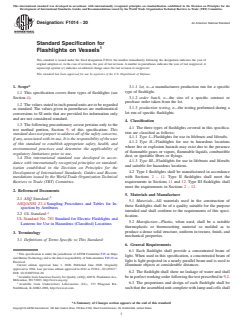

ASTM F1014-20 - Standard Specification for Flashlights on Vessels
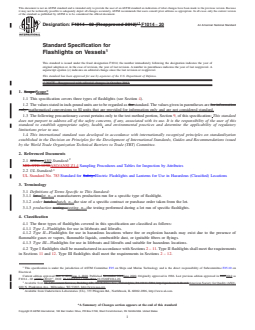
REDLINE ASTM F1014-20 - Standard Specification for Flashlights on Vessels
Get Certified
Connect with accredited certification bodies for this standard

DNV
DNV is an independent assurance and risk management provider.

Lloyd's Register
Lloyd's Register is a global professional services organisation specialising in engineering and technology.

ABS Quality Evaluations Inc.
American Bureau of Shipping quality certification.
Sponsored listings
Frequently Asked Questions
ASTM F1014-20 is a technical specification published by ASTM International. Its full title is "Standard Specification for Flashlights on Vessels". This standard covers: ABSTRACT This specification covers three types of flashlights. The three types of flashlights are classified as follows: Type I; Type II; and Type III. All materials used in the construction of these flashlights shall be of a quality suitable for the purpose intended and shall conform to the requirements of this specification. Each flashlight must be furnished with two lamps. All metal parts of each flashlight shall be made of corrosion-resistant material. Switches, watertightness, and impact tests shall be performed to conform with the specified requirements. SCOPE 1.1 This specification covers three types of flashlights (see Section 4). 1.2 The values stated in inch-pound units are to be regarded as standard. The values given in parentheses are mathematical conversions to SI units that are provided for information only and are not considered standard. 1.3 The following precautionary caveat pertains only to the test method portion, Section 9, of this specification: This standard does not purport to address all of the safety concerns, if any, associated with its use. It is the responsibility of the user of this standard to establish appropriate safety, health, and environmental practices and determine the applicability of regulatory limitations prior to use. 1.4 This international standard was developed in accordance with internationally recognized principles on standardization established in the Decision on Principles for the Development of International Standards, Guides and Recommendations issued by the World Trade Organization Technical Barriers to Trade (TBT) Committee.
ABSTRACT This specification covers three types of flashlights. The three types of flashlights are classified as follows: Type I; Type II; and Type III. All materials used in the construction of these flashlights shall be of a quality suitable for the purpose intended and shall conform to the requirements of this specification. Each flashlight must be furnished with two lamps. All metal parts of each flashlight shall be made of corrosion-resistant material. Switches, watertightness, and impact tests shall be performed to conform with the specified requirements. SCOPE 1.1 This specification covers three types of flashlights (see Section 4). 1.2 The values stated in inch-pound units are to be regarded as standard. The values given in parentheses are mathematical conversions to SI units that are provided for information only and are not considered standard. 1.3 The following precautionary caveat pertains only to the test method portion, Section 9, of this specification: This standard does not purport to address all of the safety concerns, if any, associated with its use. It is the responsibility of the user of this standard to establish appropriate safety, health, and environmental practices and determine the applicability of regulatory limitations prior to use. 1.4 This international standard was developed in accordance with internationally recognized principles on standardization established in the Decision on Principles for the Development of International Standards, Guides and Recommendations issued by the World Trade Organization Technical Barriers to Trade (TBT) Committee.
ASTM F1014-20 is classified under the following ICS (International Classification for Standards) categories: 47.020.70 - Navigation and control equipment. The ICS classification helps identify the subject area and facilitates finding related standards.
ASTM F1014-20 has the following relationships with other standards: It is inter standard links to ASTM F1014-02(2012)e1. Understanding these relationships helps ensure you are using the most current and applicable version of the standard.
ASTM F1014-20 is available in PDF format for immediate download after purchase. The document can be added to your cart and obtained through the secure checkout process. Digital delivery ensures instant access to the complete standard document.
Standards Content (Sample)
This international standard was developed in accordance with internationally recognized principles on standardization established in the Decision on Principles for the
Development of International Standards, Guides and Recommendations issued by the World Trade Organization Technical Barriers to Trade (TBT) Committee.
Designation:F1014 −20 An American National Standard
Standard Specification for
Flashlights on Vessels
This standard is issued under the fixed designation F1014; the number immediately following the designation indicates the year of
original adoption or, in the case of revision, the year of last revision. A number in parentheses indicates the year of last reapproval. A
superscript epsilon (´) indicates an editorial change since the last revision or reapproval.
This standard has been approved for use by agencies of the U.S. Department of Defense.
1. Scope* 3.1.1 lot, n—a manufacturers production run for a specific
type of flashlight.
1.1 This specification covers three types of flashlights (see
3.1.2 order batch, n—the size of a specific contract or
Section 4).
purchase order taken from the lot.
1.2 The values stated in inch-pound units are to be regarded
3.1.3 production testing, n—the testing performed during a
as standard. The values given in parentheses are mathematical
lot run of specific flashlights.
conversions to SI units that are provided for information only
and are not considered standard.
4. Classification
1.3 The following precautionary caveat pertains only to the
4.1 The three types of flashlights covered in this specifica-
test method portion, Section 9, of this specification: This
tion are classified as follows:
standard does not purport to address all of the safety concerns,
4.1.1 Type I—Flashlights for use in lifeboats and liferafts.
if any, associated with its use. It is the responsibility of the user
4.1.2 Type II—Flashlights for use in hazardous locations
of this standard to establish appropriate safety, health, and
where fire or explosion hazards may exist due to the presence
environmental practices and determine the applicability of
of flammable gases or vapors, flammable liquids, combustible
regulatory limitations prior to use.
dust, or ignitable fibers or flyings.
1.4 This international standard was developed in accor-
4.1.3 Type III—Flashlights for use in lifeboats and liferafts
dance with internationally recognized principles on standard-
and suitable for hazardous locations.
ization established in the Decision on Principles for the
Development of International Standards, Guides and Recom- 4.2 Type I flashlights shall be manufactured in accordance
with Sections 2–11. Type II flashlights shall meet the
mendations issued by the World Trade Organization Technical
Barriers to Trade (TBT) Committee. requirements in Sections 11 and 12. Type III flashlights shall
meet the requirements in Sections2–12.
2. Referenced Documents
5. Materials and Manufacture
2.1 ASQ Standard:
5.1 Materials—All materials used in the construction of
ASQ/ANSI Z1.4Sampling Procedures and Tables for In-
these flashlights shall be of a quality suitable for the purpose
spection by Attributes
intended and shall conform to the requirements of this speci-
2.2 UL Standard:
fication.
UL Standard No. 783Standard for Electric Flashlights and
5.2 Manufacture—Plastic, when used, shall be a suitable
Lanterns for Use in Hazardous (Classified) Locations
thermoplastic or thermosetting material so molded as to
produce a dense solid structure, uniform in texture, finish, and
3. Terminology
mechanical properties.
3.1 Definitions of Terms Specific to This Standard:
6. General Requirements
6.1 Each flashlight shall provide a concentrated beam of
This specification is under the jurisdiction of ASTM Committee F25 on Ships
light. When used in this specification, a concentrated beam of
and Marine Technology and is the direct responsibility of Subcommittee F25.10 on
light is light projected in a nearly parallel beam and is used to
Electrical.
Current edition approved June 1, 2020. Published June 2020. Originally illuminate objects at considerable distances.
ɛ1
approved in 1986. Last previous edition approved in 2012 as F1014–02 (2012) .
6.2 The flashlight shall show no leakage of water and shall
DOI: 10.1520/F1014-20.
Available from American Society for Quality (ASQ), 600 N. Plankinton Ave., beinperfectworkingorderfollowingthetestprescribedin9.2.
Milwaukee, WI 53203, http://www.asq.org.
6.3 The proportions and design of each flashlight shall be
Available from Underwriters Laboratories (UL), 333 Pfingsten Rd.,
Northbrook, IL 60062-2096, http://www.ul.com. suchthattheassembledunitcompletewithlampandcellsshall
*A Summary of Changes section appears at the end of this standard
Copyright © ASTM International, 100 Barr Harbor Drive, PO Box C700, West Conshohocken, PA 19428-2959. United States
F1014−20
be capable of withstanding, without breakage or material sufficient rigidity so as not to become distorted when the
distortion of any part and without upsetting the lamp focus, the flashlight is completely assembled with cells and lamp. Means
test specified in 9.6. Damage of lamp filament or shifting of shall be provided to protect the lamp from damage by battery
filament within the lamp as a result of this test shall not be impact and for conveniently removing and replacing the lamp.
cause for rejection of the flashlight if the flashlight operates The mounting adjustment shall have sufficient stability to
when the spare lamp is used. retain the focal adjustment of the lamp under a condition of
vibration, and when the flashlight is tested in accordance with
6.4 Each flashlight must be furnished with two lamps. One
9.1.2.
oftheselampsisaspareandmustbecontainedwithinthebody
of the flashlight, either in the end cap or reflector head area. 7.7 Switch—The switch shall be conveniently located and
securely attached to the flashlight. It shall be provided with a
6.5 All metal parts of each flashlight shall be made of
permanent “ON” position, a manually operable signaling or
corrosion-resistant material. All copper or copper-alloy parts
“FLASHING” position, and a locked “OFF” position. It shall
coming in contact with rubber shall not corrode or disintegrate
be provided with means to prevent accidental closing of the
the rubber.
lamp circuit. The switch parts and switch contact strip shall be
6.6 The construction of each flashlight shall be such that a
adequatelyinsulatedsothatitwillbeimpossibleformetal-clad
metalliccontactoutsidethecasecannotclosethebatterycircuit
cells to close a circuit when the switch is on the “OFF”
and cause the light to come on.
position. The flashlight shall be designed with a switch guard.
Contact springs shall be of phosphor bronze, spring brass, or
6.7 Each flashlight shall be provided with means to prevent
other corrosion-resistant equivalent material.
it from rolling.
7.8 Suspension Member—Each flashlight shall be equipped
7. Physical Requirements
withasuitablesuspensionringorclip.Theringorclipshallbe
1 tested as specified in 9.8.
7.1 Dimensions—Each flashlight shall not exceed 11 ⁄2 in.
(292 mm) in length and shall have a lens ring diameter of no
8. Workmanship
more than 2 ⁄2 in. (63.5 mm).
8.1 Flashlights shall be of sturdy construction and free of
7.2 Case, Lens Head Ring, and End Cap:
mechanical, electrical, or other imperfections or defects that
7.2.1 The exterior of the flashlight shall have molded flutes
materially affect appearance or that may affect quality,
or ribs to provide a satisfactory gripping surface when wet.
reliability, or serviceability. The finished flashlight shall not
Cells must be held in the case under sufficient pressure to
contain rough edges, burrs, blemishes, or other disfigurements
ensuregoodcontactandtopreventbreakingofthecircuitwhen
and shall be clean, free from rust, toolmarks, pits, and other
the flashlight is tested in accordance with 9.1.2. The flashlight
injurious defects.
must be constructed so that the cells are readily replaceable.
8.1.1 Threaded parts shall be smooth and close fitting and
7.2.2 The case, ring, and cap, need not be made of the same
shallbecapableofbeingeasilymovedbyhandrelativetoeach
material but cooperating threaded surfaces should be of the
other. Threaded parts shall not jump or change adjustment
same type material.
when being put together or when subjected to the tests in
7.3 Lens—The lens shall be of good quality, laminated,
Section 9.
shatter-proof glass or clear plastic, free from bubbles, striae,
9. Test Methods
wrinkles, or other defects and blemishes that would affect the
light distribution. The lens shall be secured to the lens head
9.1 Switches:
ringbyasuitableretainingringorotherdevicesoastoprevent
9.1.1 Switch Leakage—With the lamp and reflector
it from being dropped when the lens head ring is unscrewed.
removed, insert fresh batteries into the flashlight. Connect a
voltmeter across the switch and battery or the switch and
7.4 Reflector—The reflector may be of metal or plastic and
battery contacts, as appropriate, in such a way as to read the
musthavesufficientrigiditysoasnottobecomedistortedwhen
batteryvoltageacrosstheswitch.Withtheswitchinthe“OFF”
the flashlight is completely assembled with cells and lamp. It
position,readthevoltage.Anydistinguishabledeflectionofthe
must have an essentially parabolic reflecting surface, highly
meter hand when the meter is set in the voltage range, nearest
polished and resistant to corrosion and discoloration. The
3 1 the battery voltage, shall constitute failure of this test.
reflector shall be 1 ⁄4 6 ⁄4 in. (44 66 mm) in diameter if the
9.1.2 Operation—Insert batteries into the flashlight and
flashlight utilizes D-cells. If other battery cells are used, the
operate the switch five times in each of the three switch
reflector should be sized proportionally.
positions. Shake the flashlight vigorously in each “ON” and
7.5 Lamps—The lamps shall be appropriate for use with the
“FLASHING” switch p
...
This document is not an ASTM standard and is intended only to provide the user of an ASTM standard an indication of what changes have been made to the previous version. Because
it may not be technically possible to adequately depict all changes accurately, ASTM recommends that users consult prior editions as appropriate. In all cases only the current version
of the standard as published by ASTM is to be considered the official document.
´1
Designation: F1014 − 02 (Reapproved 2012) F1014 − 20 An American National Standard
Standard Specification for
Flashlights on Vessels
This standard is issued under the fixed designation F1014; the number immediately following the designation indicates the year of
original adoption or, in the case of revision, the year of last revision. A number in parentheses indicates the year of last reapproval. A
superscript epsilon (´) indicates an editorial change since the last revision or reapproval.
This standard has been approved for use by agencies of the U.S. Department of Defense.
ε NOTE—Reapproved with editorial changes in October 2012.
1. Scope Scope*
1.1 This specification covers three types of flashlights (see Section 4).
1.2 The values stated in inch-pound units are to be regarded as the standard. The values given in parentheses are for information
only. mathematical conversions to SI units that are provided for information only and are not considered standard.
1.3 The following precautionary caveat pertains only to the test method portion, Section 9, of this specification: This standard
does not purport to address all of the safety concerns, if any, associated with its use. It is the responsibility of the user of this
standard to establish appropriate safety, health, and environmental practices and determine the applicability of regulatory
limitations prior to use.
1.4 This international standard was developed in accordance with internationally recognized principles on standardization
established in the Decision on Principles for the Development of International Standards, Guides and Recommendations issued
by the World Trade Organization Technical Barriers to Trade (TBT) Committee.
2. Referenced Documents
2.1 MilitaryASQ Standard:
MIL-STD-105DASQ/ANSI Z1.4 Sampling Procedures and Tables for Inspection by Attributes
2.2 UL Standard:
UL Standard No. 783 Standard for Safety Electric Flashlights and Lanterns for Use in Hazardous (Classified) Locations
3. Terminology
3.1 Definitions of Terms Specific to This Standard:
3.1.1 lot—lot, n—a manufacturers production run for a specific type of flashlight.
3.1.2 order batch—batch, n—the size of a specific contract or purchase order taken from the lot.
3.1.3 production testing—testing, n—the testing performed during a lot run of specific flashlights.
4. Classification
4.1 The three types of flashlights covered in this specification are classified as follows:
4.1.1 Type I—Flashlights for use in lifeboats and liferafts.
4.1.2 Type II—Flashlights for use in hazardous locations where fire or explosion hazards may exist due to the presence of
flammable gases or vapors, flammable liquids, combustible dust, or ignitable fibers or flyings.
4.1.3 Type III—Flashlights for use in lifeboats and liferafts and suitable for hazardous locations.
4.2 Type I flashlights shall be manufactured in accordance with Sections 2 – 11. Type II flashlights shall meet the requirements
in Sections 11 and 12. Type III flashlights shall meet the requirements in Sections 2 – 12.
This specification is under the jurisdiction of ASTM Committee F25 on Ships and Marine Technology and is the direct responsibility of Subcommittee F25.10 on
Electrical.
Current edition approved Oct. 1, 2012June 1, 2020. Published November 2012June 2020. Originally approved in 1986. Last previous edition approved in 20072012 as
ɛ1
F1014 – 02 (2007).(2012) . DOI: 10.1520/F1014-02R12E01.10.1520/F1014-20.
Available from DLA Document Services, Building 4/D, 700 Robbins Ave., Philadelphia, PA 19111-5094, http://quicksearch.dla.mil.American Society for Quality (ASQ),
600 N. Plankinton Ave., Milwaukee, WI 53203, http://www.asq.org.
Available from Underwriters Laboratories (UL), 333 Pfingsten Rd., Northbrook, IL 60062-2096, http://www.ul.com.
*A Summary of Changes section appears at the end of this standard
Copyright © ASTM International, 100 Barr Harbor Drive, PO Box C700, West Conshohocken, PA 19428-2959. United States
F1014 − 20
5. Materials and Manufacture
5.1 Materials—All materials used in the construction of these flashlights shall be of a quality suitable for the purpose intended
and shall conform to the requirements of this specification.
5.2 Manufacture—Plastic, when used, shall be a suitable thermoplastic or thermosetting material so molded as to produce a
dense solid structure, uniform in texture, finish, and mechanical properties.
6. General Requirements
6.1 Each flashlight shall be a three-cell light.
6.1 Each flashlight shall provide a concentrated beam of light. When used in this specification, a concentrated beam of light is
light projected in a nearly parallel beam and is used to illuminate objects at considerable distances.
6.2 The flashlight shall show no leakage of water and shall be in perfect working order following the test prescribed in 9.2.
6.3 The proportions and design of each flashlight shall be such that the assembled unit complete with lamp and cells shall be
capable of withstanding, without breakage or material distortion of any part and without upsetting the lamp focus, the test specified
in 9.6. Damage of lamp filament or shifting of filament within the lamp as a result of this test shall not be cause for rejection of
the flashlight if the flashlight operates when the spare lamp is used.
6.4 Each flashlight must be furnished with two lamps. One of these lamps is a spare and must be contained within the body of
the flashlight, either in the end cap or reflector head area.
6.5 All metal parts of each flashlight shall be made of corrosion-resistant material. All copper or copper-alloy parts coming in
contact with rubber shall not corrode or disintegrate the rubber.
6.6 The construction of each flashlight shall be such that a metallic contact outside the case cannot close the battery circuit and
cause the light to come on.
6.7 Each flashlight shall be provided with means to prevent it from rolling.
7. Physical Requirements
7.1 Dimensions—Each flashlight shall not exceed 11 ⁄2 in. (292 mm) in length and shall have a lens ring diameter of no more
than 2 ⁄2 in. (63.5 mm).
7.2 Case, Lens Head Ring, and End Cap:
7.2.1 The flashlight case must be suitable to receive three commercial D-size dry cells. The exterior of the flashlight shall have
molded flutes or ribs to provide a satisfactory gripping surface when wet. Cells must be held in the case under sufficient pressure
to ensure good contact and to prevent breaking of the circuit when the flashlight is tested in accordance with 9.1.2. The flashlight
must be constructed so that the cells are readily replaceable.
7.2.2 The case, ring, and cap, need not be made of the same material but cooperating threaded surfaces should be of the same
type material.
7.3 Lens—The lens shall be of good quality, laminated, shatter-proof glass or clear plastic, free from bubbles, striae, wrinkles,
or other defects and blemishes that would affect the light distribution. The lens shall be secured to the lens head ring by a suitable
retaining ring or other device so as to prevent it from being dropped when the lens head ring is unscrewed.
7.4 Reflector—The reflector may be of metal or plastic and must have sufficient rigidity so as not to become distorted when the
flashlight is completely assembled with cells and lamp. It must have an essentially parabolic reflecting surface, highly polished and
3 1
resistant to corrosion and discoloration. The reflector shall be 1 ⁄4 6 ⁄4 in. (44 6 6 mm) in diameter. diameter if the flashlight
utilizes D-cells. If other battery cells are used, the reflector should be sized proportionally.
7.5 Lamps—The lamps shall be appropriate for use with alkaline or carbon-zinc batteries.the type battery utilized. Each lamp
must have a lamp life of at least 15 h at the rated battery voltage.
7.6 Lamp Holder—The lamp shall be firmly positioned in the reflector. It shall be so positioned that the lamp, when assembled
in the holder, shall have its filament located at the focus of the reflector, with the accuracy necessary to produce a concentrated
beam of light as specified in 9.7. It shall have sufficient rigidity so as not to become distorted when the flashlight is completely
assembled with cells and lamp. Means shall be provided to protect the lamp from damage by battery impact and for conveniently
removing and replacing the lamp. The mounting adjustment shall have sufficient stability to retain the focal adjustment of the lamp
under a condition of vibration, and when the flashlight is tested in accordance with 9.1.2.
7.7 Switch—The switch shall be conveniently located and securely attached to the flashlight. It shall be provided with a
permanent “ON” position, a manually operable signaling or “FLASHING” position, and a locked “OFF” position. It shall be
provided with means to prevent accidental closing of the lamp circuit. The switch parts and switch contact strip shall be adequately
F1014 − 20
insulated so that it will be impossible for metal-clad cells to close a circuit when the switch is on the “OFF” position. The flashlight
shall be designed with a switch guard. Contact springs shall be of phosphor bronze, spring brass, or other corrosion-resistant
equivalent material.
7.8 Suspension Member—Each flashlight shall be equipped with a suitable suspension ring or clip. The ring or clip shall be
tested as specified in 9.8.
8. Workmanship
8.1 Flashlights shall be of sturdy construction and free of mechanical, electrical, or other imperfections or defects that materially
affect appearance or that may affect quality, reliability, or serviceability. The finished flashlight shall not contain rough edges, burrs,
blemishes, or other disfigurements and shall be clean, free from rust, toolmarks, pits, and other injurious defects.
8.1.1 Threaded parts shall be smooth and close fitting and shall be capable of being easily moved by hand relative to each other.
Threaded parts shall not jump or change adjustment when being put togethe
...
Questions, Comments and Discussion
Ask us and Technical Secretary will try to provide an answer. You can facilitate discussion about the standard in here.
Loading comments...