

ASTM F1359/F1359M-22
(Test Method)Standard Test Method for Liquid Penetration Resistance of Protective Clothing or Protective Ensembles Under a Shower Spray While on a Manikin
General Information
- Abstract
SIGNIFICANCE AND USE
5.1 This test method evaluates the ability of the construction and configuration of protective clothing or protective ensembles to resist liquid penetration. In most cases, the conditions used in this test method will not represent actual end-use conditions.
5.2 Two different spray configurations are used for exposing the protective clothing or protective ensemble on a manikin.
5.2.1 Procedure A involves five shower nozzles, with one nozzle directly above the clothed manikin and two nozzles each to upper and lower sides of the manikin that are all positioned in the same vertical plane. This spray configuration is intended to provide a full exposure of the entire protective clothing or protective ensemble system.
5.2.2 Procedure B involves three shower nozzles that are positioned at different heights on a vertical line that is parallel to the manikin with the locations and direction of each nozzle set with respect to targets on the manikin. This spray configuration is intended to provide a direct assessment of garment features such as the front closure.
5.3 The selected duration of the test is not intended to simulate user exposure to splashes of liquid substances but rather to provide sufficient time for enough liquid to penetrate to make visual detection easier. The default liquid exposure time for Procedure A is 20 min. The default liquid exposure time for Procedure B is 10 min.
5.3.1 It is permissible to specify shorter test durations. It is recommended that the duration of exposure be the same in each manikin orientation.
5.3.2 The choice of different test duration is partly based on the number of layers in the specimen being tested, some of which serve to absorb the surfactant-treated test liquid and result in attenuating the severity of the liquid challenge to the specimen.
5.4 A nontoxic, non-foaming surfactant is added to water for this test method to simulate liquids of lower surface tensions. Liquids of specific interest can be simulat...
SCOPE
1.1 This test method measures the ability of protective clothing or protective ensembles to resist liquid penetration in the form of a shower spray with surfactant-treated water.
1.2 This test method measures the liquid penetration resistance of the construction and configuration of the overall protective clothing or protective ensemble, but especially of seams, closures, and interfaces with other components such as gloves, boots, hoods, and respiratory protective equipment. It is intended that this test method be used to assess the liquid penetration resistance of protective clothing and protective ensembles as received from the manufacturer and worn in accordance with their instructions.
1.3 Resistance of materials used in protective clothing to permeation or penetration can be determined in accordance with Test Method F739 (or Test Method F1383 or F1407) and Test Method F903, respectively. Alternatively, resistance of materials used in protective clothing to penetration by synthetic blood or liquids containing virus can be determined in accordance with Test Methods F1670/F1670M and F1671/F1671M.
1.4 The integrity of vapor protective ensembles is measured by its ability to maintain positive internal pressure with Test Method F1052.
1.5 The values in SI units or in other units shall be regarded separately as standard. The values stated in each system must be used independently of the other, without combining values in any way.
1.6 This standard does not purport to address all of the safety concerns, if any, associated with its use. It is the responsibility of the user of this standard to establish appropriate safety, health, and environmental practices and determine the applicability of regulatory limitations prior to use.
1.7 This international standard was developed in accordance with internationally recognized principles on standardization established in the Decision on Principles for the Developmen...
- Status
- Published
- Publication Date
- 31-Dec-2021
- Technical Committee
- F23 - Personal Protective Clothing and Equipment
- Drafting Committee
- F23.30 - Chemicals
Buy Documents
ASTM F1359/F1359M-22 - Standard Test Method for Liquid Penetration Resistance of Protective Clothing or Protective Ensembles Under a Shower Spray While on a Manikin
REDLINE ASTM F1359/F1359M-22 - Standard Test Method for Liquid Penetration Resistance of Protective Clothing or Protective Ensembles Under a Shower Spray While on a Manikin
Overview
ASTM F1359/F1359M-22, titled Standard Test Method for Liquid Penetration Resistance of Protective Clothing or Protective Ensembles Under a Shower Spray While on a Manikin, provides a standardized approach to evaluating the resistance of protective clothing and ensembles against liquid penetration. Developed by ASTM International, this standard is critical for manufacturers and users seeking to ensure that protective garments provide reliable barriers against liquid hazards.
This test method is designed to assess the construction and configuration of protective clothing, with a particular focus on seams, closures, and interfaces with gloves, boots, hoods, and respiratory equipment. The standard involves the exposure of clothing fitted on a manikin to a controlled shower spray of surfactant-treated water, simulating liquids of lower surface tension that are more challenging to repel.
Key Topics
Test Method Scope
- Measures the overall penetration resistance of protective clothing and ensembles.
- Evaluates critical features such as seams, closures, and component interfaces.
Test Procedures
- Procedure A: Utilizes five nozzles in a fixed configuration to provide full exposure of the garment system.
- Procedure B: Uses three vertically aligned nozzles for direct assessment of specific garment features, such as front closures.
Test Parameters
- Duration of spray exposure is typically 20 minutes for Procedure A and 10 minutes for Procedure B, but these can be modified as needed.
- Water is combined with a nontoxic, non-foaming surfactant to simulate challenging liquid conditions.
Evaluation Criteria
- A garment passes the test if no observable wetting occurs on the inner, liquid-absorptive garment or inside of the specimen.
- The method includes guidance for documenting, reporting, and interpreting test results.
Significance
- Does not simulate exact end-use conditions but provides a reliable means for comparative assessment and quality assurance.
Applications
The ASTM F1359/F1359M-22 standard is widely applicable in the safety and personal protective equipment (PPE) industry:
Quality Control for Manufacturers
- Manufacturers utilize this test to evaluate product design and production consistency in liquid barrier performance.
Selection and Validation for End Users
- Organizations, especially in emergency response, healthcare, and chemical industries, use this standard to assess and select appropriate protective clothing.
Performance Assessment
- Assists in identifying weaknesses in garment configurations, particularly at interfaces and closures.
- Useful for certifying ensembles intended for splash protection and comparing different brands or types of garments.
Regulatory Compliance and Procurement
- Test results can support compliance with regulatory requirements or internal procurement standards for protective clothing.
Related Standards
ASTM F1359/F1359M-22 references and complements several other standards for evaluating protective clothing:
- ASTM F903: Test Method for Resistance of Materials Used in Protective Clothing to Penetration by Liquids.
- ASTM F739: Test Method for Permeation of Liquids and Gases Through Protective Clothing Materials Under Conditions of Continuous Contact.
- ASTM F1383: Test Method for Permeation of Liquids and Gases Through Protective Clothing Materials Under Conditions of Intermittent Contact.
- ASTM F1407: Permeation Cup Method for Chemical Protective Materials.
- ASTM F1670/F1670M: Resistance of Materials Used in Protective Clothing to Penetration by Synthetic Blood.
- ASTM F1671/F1671M: Resistance to Blood-Borne Pathogens Using Viral Challenge.
- ASTM F1052: Pressure Testing Vapor Protective Suits.
By adhering to ASTM F1359/F1359M-22, manufacturers, laboratories, and end users ensure a consistent, internationally recognized method for evaluating the liquid penetration resistance of protective clothing, leading to improved safety and product performance.
Relations
- Effective Date
- 01-Feb-2024
- Effective Date
- 01-Jul-2018
- Effective Date
- 25-Oct-2017
- Effective Date
- 01-Jul-2017
- Effective Date
- 01-Jun-2017
- Effective Date
- 01-Feb-2017
- Effective Date
- 15-Jun-2014
- Effective Date
- 01-Sep-2012
- Effective Date
- 01-Sep-2012
- Effective Date
- 01-Jun-2012
- Effective Date
- 01-Jul-2011
- Effective Date
- 01-Jul-2011
- Effective Date
- 01-Jan-2010
- Effective Date
- 01-Feb-2009
- Effective Date
- 01-Jul-2007
Buy Documents
ASTM F1359/F1359M-22 - Standard Test Method for Liquid Penetration Resistance of Protective Clothing or Protective Ensembles Under a Shower Spray While on a Manikin
REDLINE ASTM F1359/F1359M-22 - Standard Test Method for Liquid Penetration Resistance of Protective Clothing or Protective Ensembles Under a Shower Spray While on a Manikin
Get Certified
Connect with accredited certification bodies for this standard

CIS Institut d.o.o.
Personal Protective Equipment (PPE) certification body. Notified Body NB-2890 for EU Regulation 2016/425 PPE.

Kiwa BDA Testing
Building and construction product certification.
Kmetijski inštitut Slovenije
Agricultural Institute of Slovenia. Soil testing, plant health, agricultural product analysis.
Sponsored listings
Frequently Asked Questions
ASTM F1359/F1359M-22 is a standard published by ASTM International. Its full title is "Standard Test Method for Liquid Penetration Resistance of Protective Clothing or Protective Ensembles Under a Shower Spray While on a Manikin". This standard covers: SIGNIFICANCE AND USE 5.1 This test method evaluates the ability of the construction and configuration of protective clothing or protective ensembles to resist liquid penetration. In most cases, the conditions used in this test method will not represent actual end-use conditions. 5.2 Two different spray configurations are used for exposing the protective clothing or protective ensemble on a manikin. 5.2.1 Procedure A involves five shower nozzles, with one nozzle directly above the clothed manikin and two nozzles each to upper and lower sides of the manikin that are all positioned in the same vertical plane. This spray configuration is intended to provide a full exposure of the entire protective clothing or protective ensemble system. 5.2.2 Procedure B involves three shower nozzles that are positioned at different heights on a vertical line that is parallel to the manikin with the locations and direction of each nozzle set with respect to targets on the manikin. This spray configuration is intended to provide a direct assessment of garment features such as the front closure. 5.3 The selected duration of the test is not intended to simulate user exposure to splashes of liquid substances but rather to provide sufficient time for enough liquid to penetrate to make visual detection easier. The default liquid exposure time for Procedure A is 20 min. The default liquid exposure time for Procedure B is 10 min. 5.3.1 It is permissible to specify shorter test durations. It is recommended that the duration of exposure be the same in each manikin orientation. 5.3.2 The choice of different test duration is partly based on the number of layers in the specimen being tested, some of which serve to absorb the surfactant-treated test liquid and result in attenuating the severity of the liquid challenge to the specimen. 5.4 A nontoxic, non-foaming surfactant is added to water for this test method to simulate liquids of lower surface tensions. Liquids of specific interest can be simulat... SCOPE 1.1 This test method measures the ability of protective clothing or protective ensembles to resist liquid penetration in the form of a shower spray with surfactant-treated water. 1.2 This test method measures the liquid penetration resistance of the construction and configuration of the overall protective clothing or protective ensemble, but especially of seams, closures, and interfaces with other components such as gloves, boots, hoods, and respiratory protective equipment. It is intended that this test method be used to assess the liquid penetration resistance of protective clothing and protective ensembles as received from the manufacturer and worn in accordance with their instructions. 1.3 Resistance of materials used in protective clothing to permeation or penetration can be determined in accordance with Test Method F739 (or Test Method F1383 or F1407) and Test Method F903, respectively. Alternatively, resistance of materials used in protective clothing to penetration by synthetic blood or liquids containing virus can be determined in accordance with Test Methods F1670/F1670M and F1671/F1671M. 1.4 The integrity of vapor protective ensembles is measured by its ability to maintain positive internal pressure with Test Method F1052. 1.5 The values in SI units or in other units shall be regarded separately as standard. The values stated in each system must be used independently of the other, without combining values in any way. 1.6 This standard does not purport to address all of the safety concerns, if any, associated with its use. It is the responsibility of the user of this standard to establish appropriate safety, health, and environmental practices and determine the applicability of regulatory limitations prior to use. 1.7 This international standard was developed in accordance with internationally recognized principles on standardization established in the Decision on Principles for the Developmen...
SIGNIFICANCE AND USE 5.1 This test method evaluates the ability of the construction and configuration of protective clothing or protective ensembles to resist liquid penetration. In most cases, the conditions used in this test method will not represent actual end-use conditions. 5.2 Two different spray configurations are used for exposing the protective clothing or protective ensemble on a manikin. 5.2.1 Procedure A involves five shower nozzles, with one nozzle directly above the clothed manikin and two nozzles each to upper and lower sides of the manikin that are all positioned in the same vertical plane. This spray configuration is intended to provide a full exposure of the entire protective clothing or protective ensemble system. 5.2.2 Procedure B involves three shower nozzles that are positioned at different heights on a vertical line that is parallel to the manikin with the locations and direction of each nozzle set with respect to targets on the manikin. This spray configuration is intended to provide a direct assessment of garment features such as the front closure. 5.3 The selected duration of the test is not intended to simulate user exposure to splashes of liquid substances but rather to provide sufficient time for enough liquid to penetrate to make visual detection easier. The default liquid exposure time for Procedure A is 20 min. The default liquid exposure time for Procedure B is 10 min. 5.3.1 It is permissible to specify shorter test durations. It is recommended that the duration of exposure be the same in each manikin orientation. 5.3.2 The choice of different test duration is partly based on the number of layers in the specimen being tested, some of which serve to absorb the surfactant-treated test liquid and result in attenuating the severity of the liquid challenge to the specimen. 5.4 A nontoxic, non-foaming surfactant is added to water for this test method to simulate liquids of lower surface tensions. Liquids of specific interest can be simulat... SCOPE 1.1 This test method measures the ability of protective clothing or protective ensembles to resist liquid penetration in the form of a shower spray with surfactant-treated water. 1.2 This test method measures the liquid penetration resistance of the construction and configuration of the overall protective clothing or protective ensemble, but especially of seams, closures, and interfaces with other components such as gloves, boots, hoods, and respiratory protective equipment. It is intended that this test method be used to assess the liquid penetration resistance of protective clothing and protective ensembles as received from the manufacturer and worn in accordance with their instructions. 1.3 Resistance of materials used in protective clothing to permeation or penetration can be determined in accordance with Test Method F739 (or Test Method F1383 or F1407) and Test Method F903, respectively. Alternatively, resistance of materials used in protective clothing to penetration by synthetic blood or liquids containing virus can be determined in accordance with Test Methods F1670/F1670M and F1671/F1671M. 1.4 The integrity of vapor protective ensembles is measured by its ability to maintain positive internal pressure with Test Method F1052. 1.5 The values in SI units or in other units shall be regarded separately as standard. The values stated in each system must be used independently of the other, without combining values in any way. 1.6 This standard does not purport to address all of the safety concerns, if any, associated with its use. It is the responsibility of the user of this standard to establish appropriate safety, health, and environmental practices and determine the applicability of regulatory limitations prior to use. 1.7 This international standard was developed in accordance with internationally recognized principles on standardization established in the Decision on Principles for the Developmen...
ASTM F1359/F1359M-22 is classified under the following ICS (International Classification for Standards) categories: 13.340.10 - Protective clothing. The ICS classification helps identify the subject area and facilitates finding related standards.
ASTM F1359/F1359M-22 has the following relationships with other standards: It is inter standard links to ASTM F1670/F1670M-24, ASTM F903-18, ASTM F1670/F1670M-17a, ASTM F1670/F1670M-17, ASTM F1407-12(2017), ASTM F903-17, ASTM F1670/F1670M-08(2014)e1, ASTM F739-12, ASTM F1383-12, ASTM F1407-12, ASTM F1383-11, ASTM F1407-11, ASTM F903-10, ASTM F1052-09, ASTM F1383-07. Understanding these relationships helps ensure you are using the most current and applicable version of the standard.
ASTM F1359/F1359M-22 is available in PDF format for immediate download after purchase. The document can be added to your cart and obtained through the secure checkout process. Digital delivery ensures instant access to the complete standard document.
Standards Content (Sample)
This international standard was developed in accordance with internationally recognized principles on standardization established in the Decision on Principles for the
Development of International Standards, Guides and Recommendations issued by the World Trade Organization Technical Barriers to Trade (TBT) Committee.
Designation: F1359/F1359M − 22
Standard Test Method for
Liquid Penetration Resistance of Protective Clothing or
Protective Ensembles Under a Shower Spray While on a
Manikin
ThisstandardisissuedunderthefixeddesignationF1359/F1359M;thenumberimmediatelyfollowingthedesignationindicatestheyear
of original adoption or, in the case of revision, the year of last revision. A number in parentheses indicates the year of last reapproval.
A superscript epsilon (´) indicates an editorial change since the last revision or reapproval.
INTRODUCTION
Personnel in industry and emergency response can be exposed to numerous liquids capable of
causing harm upon contact with the human body. These liquids may include chemicals, contaminated
blood or body fluids, and other hazardous liquids. The deleterious effects of different chemicals can
range from acute trauma such as skin irritation and burn, to chronic degenerative disease such as
cancer. Biological-based hazard liquids may include various liquid-borne pathogens capable of
causing infection directly or with non-intact skin. Since engineering controls cannot eliminate all
possible exposures, attention is often placed on reducing the potential for direct skin contact through
the use of protective clothing.
Protective clothing is available in a variety of constructions, configurations, and materials, and is
designed to provide various levels of protection against many hazards. Protective clothing offering the
highest level of chemical protection is constructed to prevent any contact of solid, liquid, or gaseous
chemicals with the wearer. Test Method F1052 evaluates the integrity and construction of the vapor
protective ensembles by way of an internal pressure test. In some applications, protective clothing
need only isolate the wearer from splashes of liquids. This test method evaluates the integrity of the
construction and configuration of liquid-penetration-resistant protective clothing or protective
ensembles with a shower spray test.
Resistance of materials used in protective clothing to chemical permeation should be evaluated by
Test Method F739 for continuous contact and Test Method F1383 for intermittent contact (that is,
splash), or by Test Method F1407 using the permeation cup method. Resistance of protective clothing
materials to liquid penetration should be determined by Test Method F903. Resistance of protective
clothingmaterialsspecificallytobloodandotherpotentiallyinfectiousmaterialsshouldbedetermined
by Test Methods F1670/F1670M and F1671/F1671M.
1. Scope seams, closures, and interfaces with other components such as
gloves,boots,hoods,andrespiratoryprotectiveequipment.Itis
1.1 This test method measures the ability of protective
intended that this test method be used to assess the liquid
clothing or protective ensembles to resist liquid penetration in
penetration resistance of protective clothing and protective
the form of a shower spray with surfactant-treated water.
ensembles as received from the manufacturer and worn in
1.2 This test method measures the liquid penetration resis-
accordance with their instructions.
tance of the construction and configuration of the overall
protective clothing or protective ensemble, but especially of 1.3 Resistance of materials used in protective clothing to
permeation or penetration can be determined in accordance
1 with Test Method F739 (or Test Method F1383 or F1407) and
ThistestmethodisunderthejurisdictionofASTMCommitteeF23onPersonal
Protective Clothing and Equipment and is the direct responsibility of Subcommittee Test Method F903, respectively. Alternatively, resistance of
F23.30 on Chemicals.
materialsusedinprotectiveclothingtopenetrationbysynthetic
Current edition approved Jan. 1, 2022. Published January 2022. Originally
blood or liquids containing virus can be determined in accor-
approved in 1991. Last previous edition approved in 2016 as F1359/F1359M – 16a.
DOI: 10.1520/F1359_F1359M-22. dance with Test Methods F1670/F1670M and F1671/F1671M.
Copyright © ASTM International, 100 Barr Harbor Drive, PO Box C700, West Conshohocken, PA 19428-2959. United States
F1359/F1359M − 22
1.4 The integrity of vapor protective ensembles is measured 3.1.1 liquid splash protective clothing, n—protective cloth-
by its ability to maintain positive internal pressure with Test ing used to protect the wearer from liquid splashes and other
Method F1052. forms of incidental liquid contact.
3.1.2 liquid splash protective ensemble, n—protective en-
1.5 The values in SI units or in other units shall be regarded
semble used to protect the wearer from liquid splashes and
separately as standard. The values stated in each system must
other forms of incidental liquid contact.
be used independently of the other, without combining values
in any way.
3.1.3 penetration, n—for chemical protective clothing, the
movement of substances through voids in protective clothing
1.6 This standard does not purport to address all of the
materials or items on a nonmolecular level.
safety concerns, if any, associated with its use. It is the
3.1.3.1 Discussion—Voids include gaps, pores, holes, and
responsibility of the user of this standard to establish appro-
imperfections in closures, seams, interfaces, and protective
priate safety, health, and environmental practices and deter-
clothing materials. Penetration does not require a change of
mine the applicability of regulatory limitations prior to use.
state; solid chemicals move through voids in materials as
1.7 This international standard was developed in accor-
solids, liquids as liquids, and gases as gases. Penetration is a
dance with internationally recognized principles on standard-
distinctly different mechanism from permeation.
ization established in the Decision on Principles for the
Development of International Standards, Guides and Recom-
3.1.4 permeation, n—for chemical protective clothing, the
mendations issued by the World Trade Organization Technical
movements of chemicals as molecules through protective
Barriers to Trade (TBT) Committee.
clothing materials by the processes of (1) absorption of the
chemical into the contact surface of the materials, (2) diffusion
2. Referenced Documents
of the absorbed molecules throughout the material, and (3)
2.1 ASTM Standards: desorption of the chemical from the opposite surface of the
material.
D1331 Test Methods for Surface and Interfacial Tension of
Solutions of Paints, Solvents, Solutions of Surface-Active 3.1.4.1 Discussion—Permeation is a distinctly different
mechanism from penetration.
Agents, and Related Materials
F739 Test Method for Permeation of Liquids and Gases
3.1.5 protective clothing, n—an item of clothing that is
Through Protective Clothing Materials Under Conditions
specifically designed and constructed for the intended purpose
of Continuous Contact
of isolating all or part of the body from a potential hazard; or,
F903 Test Method for Resistance of Materials Used in
isolating the external environment from contamination by the
Protective Clothing to Penetration by Liquids
wearer of the clothing.
F1052 Test Method for Pressure Testing Vapor Protective
3.1.6 protective ensemble, n—the combination of protective
Suits
clothingwithrespiratoryprotectiveequipment,hoods,helmets,
F1383 Test Method for Permeation of Liquids and Gases
gloves, boots, communication systems, cooling devices, and
Through Protective Clothing Materials Under Conditions
other accessories intended to protect the wearer from a
of Intermittent Contact
potential hazard when worn together.
F1407 Test Method for Resistance of Chemical Protective
3.1.6.1 Discussion—For evaluating liquid penetration
Clothing Materials to Liquid Permeation—Permeation
resistance, the protective ensemble includes only those cloth-
Cup Method
ingitemsoraccessoriesthatarenecessarytoprovideresistance
F1670/F1670M Test Method for Resistance of Materials
to liquid penetration.
Used in Protective Clothing to Penetration by Synthetic
Blood
4. Summary of Test Method
F1671/F1671M Test Method for Resistance of Materials
4.1 A properly fitting test specimen (protective clothing or
Used in Protective Clothing to Penetration by Blood-
protective ensemble) is placed on a standardized manikin that
Borne Pathogens Using Phi-X174 Bacteriophage Penetra-
is already dressed in a specified liquid-absorptive garment
tion as a Test System
covering portions of the manikin form that are of interest.
2.2 AATCC Standard:
4.2 Water, treated to achieve a surface tension of
AATCC Test Method 135 Dimensional Changes in Auto-
0.032 6 0.002 N/m [32 6 2 dynes⁄cm], is sprayed at the test
matic Home Laundering of Woven and Knitted Fabrics
specimen from nozzles positioned in a specific configuration
3. Terminology with respect to the specimen. The specimen is exposed to the
liquid spray for a specified period in each of four specimen
3.1 Definitions:
orientations.
4.2.1 InProcedureA,fivenozzlesarepositionedinthesame
2 plane and directed towards the center of the manikin from
For referenced ASTM standards, visit the ASTM website, www.astm.org, or
specified locations above and to the sides of the manikin. The
contact ASTM Customer Service at service@astm.org. For Annual Book of ASTM
Standards volume information, refer to the standard’s Document Summary page on
manikin is rotated 45° through each of four different orienta-
the ASTM website.
tions.
Available from American Association of Textile Chemists and Colorists
4.2.2 In Procedure B, three nozzles are positioned in a
(AATCC), P.O. Box 12215, Research Triangle Park, NC 27709-2215, http://
www.aatcc.org. verticallineparalleltotheverticalplaneofthemanikinandare
F1359/F1359M − 22
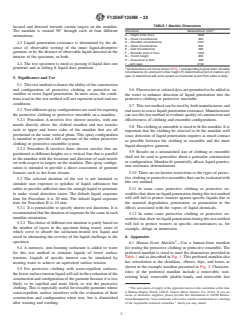
TABLE 1 Manikin Dimensions
located and directed towards certain targets on the manikin.
A
The manikin is rotated 90° through each of four different Dimension Measurement (mm)
A – Height (from floor) 1828
orientations.
B – Chest circumference 965
C – Shoulder circumference 1357
4.3 Liquid penetration resistance is determined by the ab-
D – Waist circumference 800
sence of observable wetting of the inner liquid-absorptive
E – Calf circumference 385
garment, or by the absence of observable liquid detected on the
F – Shoulder pivot to floor 1420
G – Crotch height 865
interior of the specimen, or both.
H – Knee pivot to floor 480
4.4 The test specimen is rated as passing if liquid does not I – Arm span 2194
A
penetrate and as failing if liquid does penetrate.
All dimensions ±12 mm as shown in Fig. 1 corresponding to given letter; shoulder
circumference (C) and pivot to floor height (F) determined at joint of manikin; arm
span (I) determined with arms spread out horizontal at joint from sides of body.
5. Significance and Use
5.1 Thistestmethodevaluatestheabilityoftheconstruction
and configuration of protective clothing or protective en-
5.6 Fluorescent or colored dyes are permitted to be added to
sembles to resist liquid penetration. In most cases, the condi- the water to enhance detection of liquid penetration into the
tions used in this test method will not represent actual end-use
protective clothing or protective ensemble.
conditions.
5.7 This test method can be used by both manufacturers and
5.2 Twodifferentsprayconfigurationsareusedforexposing enduserstoassessliquidpenetrationresistance.Manufacturers
the protective clothing or protective ensemble on a manikin. can use this test method to evaluate quality of construction and
5.2.1 Procedure A involves five shower nozzles, with one effectiveness of clothing and ensemble configurations.
nozzle directly above the clothed manikin and two nozzles
5.8 The clothing or ensemble is sized to fit the manikin. It is
each to upper and lower sides of the manikin that are all
important that the clothing be selected to fit the manikin well
positioned in the same vertical plane. This spray configuration
since detection of liquid penetration requires as much contact
is intended to provide a full exposure of the entire protective
as possible between the clothing or ensemble and the inner
clothing or protective ensemble system.
liquid-absorptive garment.
5.2.2 Procedure B involves three shower nozzles that are
5.9 Results on a mismatched size of clothing or ensemble
positioned at different heights on a vertical line that is parallel
shall not be used to generalize about a particular construction
to the manikin with the locations and direction of each nozzle
or configuration. Manikin fit potentially affects liquid penetra-
set with respect to targets on the manikin. This spray configu-
tion resistance determinations.
ration is intended to provide a direct assessment of garment
features such as the front closure. 5.10 There are no known restrictions to the types of protec-
tiveclothingorprotectiveensemblesthatcanbeevaluatedwith
5.3 The selected duration of the test is not intended to
this test method.
simulate user exposure to splashes of liquid substances but
5.11 In some cases protective clothing or protective en-
rather to provide sufficient time for enough liquid to penetrate
semblesthatshownoliquidpenetrationduringthistestmethod
to make visual detection easier. The default liquid exposure
time for Procedure A is 20 min. The default liquid exposure will still fail to protect wearers against specific liquids due to
the material degradation, penetration, or permeation or the
time for Procedure B is 10 min.
effects associated with the vapors of liquid chemicals.
5.3.1 It is permissible to specify shorter test durations. It is
recommendedthatthedurationofexposurebethesameineach
5.12 In some cases protective clothing or protective en-
manikin orientation.
semblesthatshownoliquidpenetrationduringthistestmethod
5.3.2 The choice of different test duration is partly based on
will fail to protect wearers in specific circumstances as, for
the number of layers in the specimen being tested, some of
example, deluge or immersion.
which serve to absorb the surfactant-treated test liquid and
6. Apparatus
result in attenuating the severity of the liquid challenge to the
specimen.
6.1 Human-Form Manikin —Use a human-form manikin
for testing the protective clothing or protective ensemble. The
5.4 A nontoxic, non-foaming surfactant is added to water
preferred manikin is sized to meet the dimensions provided in
for this test method to simulate liquids of lower surface
Table 1 and as described in Fig. 1. This preferred manikin also
tensions. Liquids of specific interest can be simulated by
has articulation at the shoulders, elbows, hips, and knees as
treating water to achieve an equivalent surface tension.
shown in the example manikin presented in Fig. 2. Character-
5.5 For protective clothing with water-repellent surfaces,
istics of the preferred manikin include a removable, non-
thelowersurfacetensionliquidwillaidintheevaluationofthe
rotating head, removable pliable hands, and removable feet
construction and configuration of the garment because it is less
likely to be repelled and more likely to wet the protective
The sole source of supply of the apparatus known to the committee at this time
clothing. This is especially useful for reusable garments whose
is Rubens Display World, 1482 E. Francis Street, Ontario, CA, 91761. If you are
water-repellent surface interferes with the evaluation of their
aware of alternative suppliers, please provide this information to ASTM Interna-
construction and configuration when new, but is diminished
tional Headquarters.Your comments will receive careful consideration at a meeting
after wearing and washing. of the responsible technical committee, which you may attend.
F1359/F1359M − 22
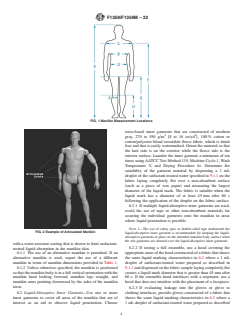
FIG. 1 Manikin Measurement Locations
torso-based inner garments that are constructed of medium
2 2
gray, 270 to 550 g/m [8 to 16 oz/yd ], 100 % cotton or
cotton/polyester blend sweatshirt fleece fabric, which is finish
free and that is easily watermarked. Orient the material so that
the knit side is on the exterior while the fleece side is the
interior surface. Launder the inner garment a minimum of ten
times usingAATCC Test Method 135, Machine Cycle 1, Wash
Temperature V, and Drying Procedure Ai. Determine the
suitability of the garment material by dispensinga1mL
droplet of the surfactant-treated water specified in 9.1.1 on the
fabric laying completely flat over a non-absorbent surface
(such as a piece of wax paper) and measuring the largest
diameter of the liquid mark. The fabric is suitable when the
liquid mark has a diameter of at least 45 mm after 60 s
following the application of the droplet on the fabric surface.
6.2.1 If multiple liquid-absorptive inner garments are used,
avoid the use of tape or other non-absorbent materials for
securing the individual garments onto the manikin in areas
where liquid penetration is possible.
NOTE 1—The use of safety pins or double-sided tape underneath the
FIG. 2 Example of Articulated Manikin
liquid-absorptive inner garment is recommended for keeping the liquid-
absorptive garments in place on the intended manikin body surface when
the test garments are donned over the liquid-absorptive inner garments.
with a water-resistant coating that is shown to limit surfactant-
6.2.2 If testing a full ensemble, use a hood covering the
treated liquid absorption in the manikin skin.
appropriate areas of the head constructed of a fabric that shows
6.1.1 The use of an alternative manikin is permitted. If an
the same liquid marking characteristics in 6.2 wherea1mL
alternative manikin is used, report the use of a different
manikin in terms of manikin dimensions provided in Table 1. droplet of surfactant-treated water prepared as described in
6.1.2 Unless otherwise specified, the manikin is positioned 9.1.1 and dispensed on the fabric sample laying completely flat
sothatthemanikinbodyisinafullverticalorientationwiththe creates a liquid mark diameter that is greater than 45 mm after
manikin head looking forward, manikin legs straight, and 60 s. If the ensemble hood interfaces with a respirator, use a
manikin arms pointing downward by the sides of the manikin
hood that does not interfere with the placement of a facepiece.
torso.
6.2.3 If evaluating leakage into the gloves or glove to
6.2 Liquid-Absorptive Inner Garment—Use one or more clothing interfaces, provide gloves constructed of a fabric that
shows the same liquid marking characteristics in 6.2 where a
inner garments to cover all areas of the manikin that are of
interest as an aid to observe liquid penetration. Choose 1 mL droplet of surfactant-treated water prepared as described
F1359/F1359M − 22
FIG. 3 Positions of Shower Nozzles with Respect to Manikin for Procedure A
in 9.1.1 and dispensed on the fabric sample laying completely
flat creates a liquid mark diameter that is greater than 45 mm
after 60 s.
6.2.4 If evaluating leakage into the footwear or footwear to
clothing interfaces, provide socks constructed of a fabric that
shows the same liquid marking characteristics in 6.2 where a
1 mL droplet of s
...
This document is not an ASTM standard and is intended only to provide the user of an ASTM standard an indication of what changes have been made to the previous version. Because
it may not be technically possible to adequately depict all changes accurately, ASTM recommends that users consult prior editions as appropriate. In all cases only the current version
of the standard as published by ASTM is to be considered the official document.
Designation: F1359/F1359M − 16a F1359/F1359M − 22
Standard Test Method for
Liquid Penetration Resistance of Protective Clothing or
Protective Ensembles Under a Shower Spray While on a
Manikin
This standard is issued under the fixed designation F1359/F1359M; the number immediately following the designation indicates the year
of original adoption or, in the case of revision, the year of last revision. A number in parentheses indicates the year of last reapproval.
A superscript epsilon (´) indicates an editorial change since the last revision or reapproval.
INTRODUCTION
Personnel in industry and emergency response can be exposed to numerous liquids capable of
causing harm upon contact with the human body. These liquids may include chemicals, contaminated
blood or body fluids, and other hazardous liquids. The deleterious effects of different chemicals can
range from acute trauma such as skin irritation and burn, to chronic degenerative disease such as
cancer. Biological-based hazard liquids may include various liquidborneliquid-borne pathogens
capable of causing infection directly or with non-intact skin. Since engineering controls cannot
eliminate all possible exposures, attention is often placed on reducing the potential for direct skin
contact through the use of protective clothing.
Protective clothing is available in a variety of constructions, configurations, and materials, and is
designed to provide various levels of protection against many hazards. Protective clothing offering the
highest level of chemical protection is constructed to prevent any contact of solid, liquid, or gaseous
chemicals with the wearer. Test Method F1052 evaluates the integrity and construction of the vapor
protective ensembles by way of an internal pressure test. In some applications, protective clothing
need only isolate the wearer from splashes of liquids. This test method evaluates the integrity of the
construction and configuration of liquid-penetration-resistant protective clothing or protective
ensembles with a shower spray test.
Resistance of materials used in protective clothing to chemical permeation should be evaluated by
Test Method F739 for continuous contact and Test Method F1383 for intermittent contact (that is,
splash), or by Test Method F1407 using the permeation cup method. Resistance of protective clothing
materials to liquid penetration should be determined by Test Method F903. Resistance of protective
clothing materials specifically to blood and other potentially infectious materials should be determined
by Test MethodMethods F1670F1670/F1670M and Test Method F1671F1671/F1671M.
1. Scope
1.1 This test method measures the ability of protective clothing or protective ensembles to resist liquid penetration in the form of
a shower spray with surfactant-treated water.
1.2 This test method measures the liquid penetration resistance of the construction and configuration of the overall protective
clothing or protective ensemble, but especially of seams, closures, and interfaces with other components such as gloves, boots,
This test method is under the jurisdiction of ASTM Committee F23 on Personal Protective Clothing and Equipment and is the direct responsibility of Subcommittee
F23.30 on Chemicals.
Current edition approved July 1, 2016Jan. 1, 2022. Published October 2016January 2022. Originally approved in 1991. Last previous edition approved in 2016 as
F1359/F1359M - 16.F1359/F1359M – 16a. DOI: 10.1520/F1359_F1359M-16A.10.1520/F1359_F1359M-22.
Copyright © ASTM International, 100 Barr Harbor Drive, PO Box C700, West Conshohocken, PA 19428-2959. United States
F1359/F1359M − 22
hoods, and respiratory protective equipment. It is intended that this test method be used to assess the liquid penetration resistance
of protective clothing and protective ensembles as received from the manufacturer and worn in accordance with their instructions.
1.3 Resistance of materials used in protective clothing to permeation or penetration can be determined in accordance with Test
Method F739 (or Test Method F1383 or Test Method F1407) and Test Method F903, respectively. Alternatively, resistance of
materials used in protective clothing to penetration by synthetic blood or liquids containing virus can be determined in accordance
with Test MethodMethods F1670F1670/F1670M and Test Method F1671F1671/F1671M.
1.4 The integrity of vapor protective ensembles is measured by its ability to maintain positive internal pressure with Test Method
F1052.
1.5 The values in SI units or in other units shall be regarded separately as standard. The values stated in each system must be used
independently of the other, without combining values in any way.
1.6 This standard does not purport to address all of the safety concerns, if any, associated with its use. It is the responsibility
of the user of this standard to establish appropriate safety safety, health, and healthenvironmental practices and determine the
applicability of regulatory limitations prior to use.
1.7 This international standard was developed in accordance with internationally recognized principles on standardization
established in the Decision on Principles for the Development of International Standards, Guides and Recommendations issued
by the World Trade Organization Technical Barriers to Trade (TBT) Committee.
2. Referenced Documents
2.1 ASTM Standards:
D1331 Test Methods for Surface and Interfacial Tension of Solutions of Paints, Solvents, Solutions of Surface-Active Agents,
and Related Materials
F739 Test Method for Permeation of Liquids and Gases Through Protective Clothing Materials Under Conditions of Continuous
Contact
F903 Test Method for Resistance of Materials Used in Protective Clothing to Penetration by Liquids
F1052 Test Method for Pressure Testing Vapor Protective Suits
F1383 Test Method for Permeation of Liquids and Gases Through Protective Clothing Materials Under Conditions of
Intermittent Contact
F1407 Test Method for Resistance of Chemical Protective Clothing Materials to Liquid Permeation—Permeation Cup Method
F1670F1670/F1670M Test Method for Resistance of Materials Used in Protective Clothing to Penetration by Synthetic Blood
F1671F1671/F1671M Test Method for Resistance of Materials Used in Protective Clothing to Penetration by Blood-Borne
Pathogens Using Phi-X174 Bacteriophage Penetration as a Test System
2.2 AATCC Standards:Standard:
AATCC Test Method 135 Dimensional Changes in Automatic Home Laundering of Woven and Knitted Fabrics
3. Terminology
3.1 Definitions:
3.1.1 liquid splash protective clothing, n—protective clothing used to protect the wearer from liquid splashes and other forms of
incidental liquid contact.
3.1.2 liquid splash protective ensemble, n—protective ensemble used to protect the wearer from liquid splashes and other forms
of incidental liquid contact.
3.1.3 penetration, n—for chemical protective clothing, the movement of substances through voids in protective clothing materials
or items on a nonmolecular level.
3.1.3.1 Discussion—
Voids include gaps, pores, holes, and imperfections in closures, seams, interfaces, and protective clothing materials. Penetration
does not require a change of state; solid chemicals move through voids in materials as solids, liquids as liquids, and gases as gases.
Penetration is a distinctly different mechanism from permeation.
For referenced ASTM standards, visit the ASTM website, www.astm.org, or contact ASTM Customer Service at service@astm.org. For Annual Book of ASTM Standards
volume information, refer to the standard’s Document Summary page on the ASTM website.
Available from American Association of Textile Chemists and Colorists (AATCC), P.O. Box 12215, Research Triangle Park, NC 27709-2215, http://www.aatcc.org.
F1359/F1359M − 22
3.1.4 permeation, n—for chemical protective clothing, the movements of chemicals as molecules through protective clothing
materials by the processes of (1) absorption of the chemical into the contact surface of the materials, (2) diffusion of the absorbed
molecules throughout the material, and (3) desorption of the chemical from the opposite surface of the material.
3.1.4.1 Discussion—
Permeation is a distinctly different mechanism from penetration.
3.1.5 protective clothing, n—an item of clothing that is specifically designed and constructed for the intended purpose of isolating
all or part of the body from a potential hazard; or, isolating the external environment from contamination by the wearer of the
clothing.
3.1.6 protective ensemble, n—the combination of protective clothing with respiratory protective equipment, hoods, helmets,
gloves, boots, communication systems, cooling devices, and other accessories intended to protect the wearer from a potential
hazard when worn together.
3.1.6.1 Discussion—
For evaluating liquid penetration resistance, the protective ensemble includes only those clothing items or accessories that are
necessary to provide resistance to liquid penetration.
4. Summary of Test Method
4.1 A properly fitting test specimen (protective clothing or protective ensemble) is placed on a standardized manikin that is already
dressed in a specified liquid-absorptive garment covering portions of the manikin form that are of interest.
4.2 Water, treated to achieve a surface tension of 0.032 6 0.002 N/m [32 6 2 dynes ⁄cm]⁄cm], is sprayed at the test specimen from
nozzles positioned in a specific configuration with respect to the specimen. The specimen is exposed to the liquid spray for a
specified period in each of four specimen orientations.
4.2.1 In Procedure A, five nozzles are positioned in the same plane and directed towards the center of the manikin from specified
locations above and to the sides of the manikin. The manikin is rotated 45° through each of four different orientations.
4.2.2 In Procedure B, three nozzles are positioned in a vertical line parallel to the vertical plane of the manikin and are located
and directed towards certain targets on the manikin. The manikin is rotated 90° through each of four different orientations.
4.3 Liquid penetration resistance is determined by the absence of observable wetting of the inner liquid-absorptive garment, or
by the absence of observable liquid detected on the interior of the specimen, or both.
4.4 The test specimen is rated as passing if liquid does not penetrate and as failing if liquid does penetrate.
5. Significance and Use
5.1 This test method evaluates the ability of the construction and configuration of protective clothing or protective ensembles to
resist liquid penetration. In most cases, the conditions used in this test method will not represent actual end-use conditions.
5.2 Two different spray configurations are used for exposing the protective clothing or protective ensemble on a manikin.
5.2.1 Procedure A involves five shower nozzles, with one nozzle directly above the clothed manikin and two nozzles each to upper
and lower sides of the manikin that are all positioned in the same vertical plane. This spray configuration is intended to provide
a full exposure of the entire protective clothing or protective ensemble system.
5.2.2 Procedure B involves three shower nozzles that are positioned at different heights on a vertical line that is parallel to the
manikin with the locations and direction of each nozzle set with respect to targets on the manikin. This spray configuration is
intended to provide a direct assessment of garment features such as the front closure.
5.3 The selected duration of the test is not intended to simulate user exposure to splashes of liquid substances but rather to provide
sufficient time for enough liquid to penetrate to make visual detection easier. The default liquid exposure time for Procedure A is
20 min. The default liquid exposure time for Procedure B is 10 min.
F1359/F1359M − 22
5.3.1 It is permissible to specify shorter test durations. It is recommended that the duration of exposure be the same in each
manikin orientation.
5.3.2 The choice of different test duration is partly based on the number of layers in the specimen being tested, some of which
serve to absorb the surfactant-treated test liquid and result in attenuating the severity of the liquid challenge to the specimen.
5.4 A nontoxic, non-foaming surfactant is added to water for this test method to simulate liquids of lower surface tensions. Liquids
of specific interest can be simulated by treating water to achieve an equivalent surface tension.
5.5 For protective clothing with water-repellent surfaces, the lower surface tension liquid will aid in the evaluation of the
construction and configuration of the garment because it is less likely to be repelled and more likely to wet the protective clothing.
This is especially useful for reusable garments whose water-repellent surface interferes with the evaluation of their construction
and configuration when new, but is diminished after wearing and washing.
5.6 Fluorescent or colored dyes are permitted to be added to the water to enhance detection of liquid penetration into the protective
clothing or protective ensemble.
5.7 This test method can be used by both manufacturers and end users to assess liquid penetration resistance. Manufacturers can
use this test method to evaluate quality of construction and effectiveness of clothing and ensemble configurations.
5.8 The clothing or ensemble is sized to fit the manikin. It is important that the clothing be selected to fit the manikin well since
detection of liquid penetration requires as much contact as possible between the clothing or ensemble and the inner
liquid-absorptive garment.
5.9 Results on a mismatched size of clothing or ensemble shall not be used to generalize about a particular construction or
configuration. Manikin fit potentially affects liquid penetration resistance determinations.
5.10 There are no known restrictions to the types of protective clothing or protective ensembles that can be evaluated with this
test method.
5.11 In some cases protective clothing or protective ensembles that show no liquid penetration during this test method will still
fail to protect wearers against specific liquids due to the material degradation, penetration, or permeation or the effects associated
with the vapors of liquid chemicals.
5.12 In some cases protective clothing or protective ensembles that show no liquid penetration during this test method will fail
to protect wearers in specific circumstances as, for example, deluge or immersion.
6. Apparatus
6.1 Human-Form Manikin,Manikin —Use a human-form manikin for testing the protective clothing or protective ensemble. The
preferred manikin is sized to meet the dimensions provided in Table 1 and as described in Fig. 1. This preferred manikin also has
articulation at the shoulders, elbows, hips, and knees as shown in the example manikin presented in Fig. 2. Characteristics of the
preferred manikin include a removable, non-rotating head, removable pliable hands, and removable feet with a water-resistant
coating that is shown to limit surfactant treated surfactant-treated liquid absorption in the manikin skin.
6.1.1 The use of an alternative manikin is permitted. If an alternative manikin is used, report the use of a different manikin in terms
of manikin dimensions provided in Table 1.
6.1.2 Unless otherwise specified, the manikin is positioned so that the manikin body is in a full vertical orientation with the
manikin head looking forward, manikin legs straight, and manikin arms pointing downward by the sides of the manikin torso.
The sole source of supply of the apparatus known to the committee at this time is Rubens Display World, 1482 E. Francis Street, Ontario, CA, 91761. If you are aware
of alternative suppliers, please provide this information to ASTM International Headquarters. Your comments will receive careful consideration at a meeting of the responsible
technical committee, which you may attend.
F1359/F1359M − 22
TABLE 1 Manikin Dimensions
A
Dimension Measurement (mm)
A – Height (from floor) 1828
B – Chest circumference 965
C – Shoulder circumference 1357
D – Waist circumference 800
E – Calf circumference 385
F – Shoulder pivot to floor 1420
G – Crotch height 865
H – Knee pivot to floor 480
I – Arm span 2194
A
All dimensions ±12 mm as shown in Fig. 1 corresponding to given letter; shoulder
circumference (C) and pivot to floor height (F) determined at joint of manikin; arm
span (I) determined with arms spread out horizontal at joint from sides of body.
6.2 Liquid-Absorptive Inner Garment, Garment—Use one or more inner garments to cover all areas of the manikin that are of
interest as an aid to observe liquid penetration. Choose torso-based inner garments that are constructed of medium gray, 270 to
2 2
550 g/m [8 to 16 oz/yd ], 100 % cotton, 95 % cotton/5 % polyester, or 90 % cotton/10 % polyester cotton or cotton/polyester
blend sweatshirt fleece fabric, which is finish free and that is easily watermarked. Orient the material so that the knit side is on
the exterior while the fleece side is the interior surface. Launder the inner garment a minimum of ten times using AATCC Test
Method 135, Machine Cycle 1, Wash Temperature V, and Drying Procedure Ai. Determine the suitability of the garment material
by dispensing a 1 mL droplet of the surfactant-treated water specified in 9.1.1 on the fabric laying completely flat over a
non-absorbent surface (such as a piece of wax paper) and measuring the largest diameter of the liquid mark. The fabric is suitable
when the liquid mark has a diameter of at least 45 mm after 60 s following the application of the droplet on the fabric surface.
6.2.1 If multiple liquid-absorptive inner garments are used, avoid the use of tape or other non-absorbent materials for securing the
individual garments onto the manikin in areas where liquid penetration is possible.
NOTE 1—The use of safety pins or double-sided tape underneath the liquid-absorptive inner garment is recommended for keeping the liquid-absorptive
garments in place on the intended manikin body surface when the test garments are donned over the liquid-absorptive inner garments.
6.2.2 If testing a full ensemble, use a hood covering the appropriate areas of the head constructed of a fabric that shows the same
liquid marking characteristics in 6.2 where a 1 mL droplet of surfactant-treated water prepared as described in 9.1.1 and dispensed
on the fabric sample laying completely flat creates a liquid mark diameter that is greater than 45 mm after 60 s. If the ensemble
hood interfaces with a respirator, use a hood that does not interfere with the placement of a facepiece.
6.2.3 If evaluating leakage into the gloves or glove to clothing interfaces, provide gloves constructed of a fabric that shows the
same liquid marking characteristics in 6.2 where a 1 mL droplet of surfactant-treated water prepared as described in 9.1.1 and
dispensed on the fabric sample laying completely flat creates a liquid mark diameter that is greater than 45 mm after 60 s.
6.2.4 If evaluating leakage into the footwear or footwear to clothing interfaces, provide socks constructed of a fabric that shows
the same liquid marking characteristics in 6.2 where a 1 mL droplet of surfactant-treated water prepared as described in 9.1.1 and
dispensed on the fabric sample laying completely flat creates a liquid mark
...