

ASTM F1113-87(2017)
(Test Method)Standard Test Method for Electrochemical Measurement of Diffusible Hydrogen in Steels (Barnacle Electrode)
General Information
- Abstract
SIGNIFICANCE AND USE
4.1 The critical level of hydrogen in steels is that hydrogen which can build up to high concentrations at points of high triaxial stress causing embrittlement of the steel which can lead to catastrophic damage. This hydrogen can enter by various means, such as during pickling and electroplating. Means of reducing this hydrogen during processing are given in Specification B766 and Practices B183 and B242. It is still necessary, however, to know how effective these methods are. Though the ultimate reason for measuring this hydrogen is to relate it to embrittlement, this is not within the scope of this test method. As susceptibility to hydrogen embrittlement is a function of alloy type, heat treatment, intended use,and so forth, the tolerance for hydrogen must be determined by the user according to Method F519.
4.2 Though the actual hydrogen concentration is not determined in this test method, the current densities have been shown to be useful as an indication of relative hydrogen concentrations (1-3),3 and therefore the degree of hydrogen embrittlement (1,2). Thus, measurements can be compared to one another (see 4.1 and 7.1).
4.3 This test method is applicable as a quality control tool for processing (such as to monitor plating and baking) or to measure hydrogen uptake caused by corrosion.
4.4 This test method is nondestructive; however, if there is a coating, it must be removed by a method which has been demonstrated to neither damage the steel nor introduce hydrogen to make the measurement.
4.5 This test method is also applicable to situations producing continuous hydrogen permeation, such as high pressure hydrogen cylinders or corrosion processes. The results, however, would require a different treatment and interpretation (4).
4.6 This test method is also applicable to small parts, such as fasteners. The technique, procedure, and interpretation would, however, have to be altered.
4.7 Use of this test method on austenitic stainless steels and o...
SCOPE
1.1 This test method covers the procedure for measuring diffusible hydrogen in steels by an electrochemical method.
1.2 This test method is limited to carbon or alloy steels, excluding austenitic stainless steels.
1.3 This test method is limited to flat specimens to which the cell can be attached (see 4.6 and 4.8).
1.4 This test method describes testing on bare or plated steel after the plate has been removed (see 4.4).
1.5 This test method is limited to measurements at room temperature, 20 to 25°C (68 to 77°F).
1.6 This standard does not purport to address all of the safety concerns, if any, associated with its use. It is the responsibility of the user of this standard to establish appropriate safety and health practices and determine the applicability of regulatory limitations prior to use.
1.7 This international standard was developed in accordance with internationally recognized principles on standardization established in the Decision on Principles for the Development of International Standards, Guides and Recommendations issued by the World Trade Organization Technical Barriers to Trade (TBT) Committee.
- Status
- Published
- Publication Date
- 31-May-2017
- Technical Committee
- F07 - Aerospace and Aircraft
- Drafting Committee
- F07.04 - Hydrogen Embrittlement
Overview
ASTM F1113-87(2017): Standard Test Method for Electrochemical Measurement of Diffusible Hydrogen in Steels (Barnacle Electrode) provides a standardized procedure to measure diffusible hydrogen in carbon and alloy steels using an electrochemical method known as the barnacle electrode. Excessive hydrogen in steels can lead to hydrogen embrittlement, potentially resulting in catastrophic material failure. This standard helps monitor and control hydrogen levels, supporting the integrity of critical steel components used in various industries.
This test method is applicable to flat steel specimens, either bare or after plating/coating has been removed, and is conducted at room temperature (20-25°C). It serves as a nondestructive quality control tool for detecting hydrogen uptake during processes like pickling, electroplating, or exposure to corrosive environments.
Key Topics
- Measurement Principle: The steel specimen is immersed in an electrochemical cell where dissolved hydrogen migrates to the metal-electrolyte interface and is oxidized. The resulting oxidation current, measured at a fixed time interval (typically 30 minutes), provides an indication of the relative hydrogen concentration in the steel.
- Applicability: The test method is specifically designed for carbon and alloy steels. It excludes austenitic stainless steels due to their different hydrogen diffusion characteristics.
- Specimen Requirements:
- Only flat specimens to ensure proper sealing and measurement accuracy.
- Applicable to both finished parts and prepared test coupons of the same alloy and condition as the items of interest.
- Coatings must be removed by non-damaging, non-hydrogen-introducing methods.
- Nondestructive Assessment: The procedure is minimally invasive to the steel sample, allowing for further use if required.
- Comparison and Quality Control: The test does not yield absolute hydrogen concentration but enables comparison between specimens or treatments, supporting process optimization and validation.
Applications
The ASTM F1113-87(2017) standard is widely used as a quality control and diagnostic tool in industries where steel component reliability is mission-critical. Key application areas include:
- Monitoring Plating and Baking Processes: Ensures that electroplating and subsequent baking treatments effectively minimize hydrogen uptake in high-strength steels.
- Corrosion Assessment: Evaluates hydrogen absorption due to environmental exposure, particularly in corrosive or high-pressure hydrogen service environments.
- Small Parts Testing: Adaptable for small steel components like fasteners, though techniques may require modification for such use cases.
- Process Efficacy Validation: Assesses the effectiveness of hydrogen removal methods outlined in related ASTM specifications and practices, ensuring risk of embrittlement is mitigated.
- Continuous Hydrogen Permeation: Suitable for ongoing monitoring in situations where continuous hydrogen ingress occurs, such as in pressure vessels or pipelines.
Related Standards
When implementing or referencing ASTM F1113-87(2017), consider the following related ASTM standards and specifications:
- ASTM B183: Practice for Preparation of Low-Carbon Steel for Electroplating
- ASTM B242: Guide for Preparation of High-Carbon Steel for Electroplating
- ASTM B766: Specification for Electrodeposited Coatings of Cadmium
- ASTM D1193: Specification for Reagent Water
- ASTM F519: Test Method for Mechanical Hydrogen Embrittlement Evaluation of Plating/Coating Processes and Service Environments
- ASTM G3: Practice for Conventions Applicable to Electrochemical Measurements in Corrosion Testing
By applying ASTM F1113-87(2017), organizations can improve steel quality assurance, support compliance with international materials standards, and proactively manage the risks associated with hydrogen embrittlement in steel products. This not only extends component lifespan but also contributes to the safety and reliability of engineering systems in sectors ranging from aerospace and automotive to construction and energy.
Relations
- Effective Date
- 01-Jun-2017
- Effective Date
- 01-Dec-2023
- Effective Date
- 01-May-2019
- Effective Date
- 01-Nov-2018
- Effective Date
- 01-Dec-2017
- Effective Date
- 01-Mar-2017
- Effective Date
- 15-Dec-2014
- Effective Date
- 01-Nov-2014
- Effective Date
- 01-Nov-2014
- Effective Date
- 01-Dec-2013
- Effective Date
- 01-Dec-2013
- Effective Date
- 15-Nov-2012
- Effective Date
- 01-Jun-2012
- Effective Date
- 01-Dec-2010
- Effective Date
- 01-May-2010
Get Certified
Connect with accredited certification bodies for this standard

DVS-ZERT GmbH
German welding certification society.
CARES (UK Certification Authority for Reinforcing Steels)
UK certification for reinforcing steels and construction.
EWF/IIW (European/International Welding Federation)
International welding personnel certification.
Sponsored listings
Frequently Asked Questions
ASTM F1113-87(2017) is a standard published by ASTM International. Its full title is "Standard Test Method for Electrochemical Measurement of Diffusible Hydrogen in Steels (Barnacle Electrode)". This standard covers: SIGNIFICANCE AND USE 4.1 The critical level of hydrogen in steels is that hydrogen which can build up to high concentrations at points of high triaxial stress causing embrittlement of the steel which can lead to catastrophic damage. This hydrogen can enter by various means, such as during pickling and electroplating. Means of reducing this hydrogen during processing are given in Specification B766 and Practices B183 and B242. It is still necessary, however, to know how effective these methods are. Though the ultimate reason for measuring this hydrogen is to relate it to embrittlement, this is not within the scope of this test method. As susceptibility to hydrogen embrittlement is a function of alloy type, heat treatment, intended use,and so forth, the tolerance for hydrogen must be determined by the user according to Method F519. 4.2 Though the actual hydrogen concentration is not determined in this test method, the current densities have been shown to be useful as an indication of relative hydrogen concentrations (1-3),3 and therefore the degree of hydrogen embrittlement (1,2). Thus, measurements can be compared to one another (see 4.1 and 7.1). 4.3 This test method is applicable as a quality control tool for processing (such as to monitor plating and baking) or to measure hydrogen uptake caused by corrosion. 4.4 This test method is nondestructive; however, if there is a coating, it must be removed by a method which has been demonstrated to neither damage the steel nor introduce hydrogen to make the measurement. 4.5 This test method is also applicable to situations producing continuous hydrogen permeation, such as high pressure hydrogen cylinders or corrosion processes. The results, however, would require a different treatment and interpretation (4). 4.6 This test method is also applicable to small parts, such as fasteners. The technique, procedure, and interpretation would, however, have to be altered. 4.7 Use of this test method on austenitic stainless steels and o... SCOPE 1.1 This test method covers the procedure for measuring diffusible hydrogen in steels by an electrochemical method. 1.2 This test method is limited to carbon or alloy steels, excluding austenitic stainless steels. 1.3 This test method is limited to flat specimens to which the cell can be attached (see 4.6 and 4.8). 1.4 This test method describes testing on bare or plated steel after the plate has been removed (see 4.4). 1.5 This test method is limited to measurements at room temperature, 20 to 25°C (68 to 77°F). 1.6 This standard does not purport to address all of the safety concerns, if any, associated with its use. It is the responsibility of the user of this standard to establish appropriate safety and health practices and determine the applicability of regulatory limitations prior to use. 1.7 This international standard was developed in accordance with internationally recognized principles on standardization established in the Decision on Principles for the Development of International Standards, Guides and Recommendations issued by the World Trade Organization Technical Barriers to Trade (TBT) Committee.
SIGNIFICANCE AND USE 4.1 The critical level of hydrogen in steels is that hydrogen which can build up to high concentrations at points of high triaxial stress causing embrittlement of the steel which can lead to catastrophic damage. This hydrogen can enter by various means, such as during pickling and electroplating. Means of reducing this hydrogen during processing are given in Specification B766 and Practices B183 and B242. It is still necessary, however, to know how effective these methods are. Though the ultimate reason for measuring this hydrogen is to relate it to embrittlement, this is not within the scope of this test method. As susceptibility to hydrogen embrittlement is a function of alloy type, heat treatment, intended use,and so forth, the tolerance for hydrogen must be determined by the user according to Method F519. 4.2 Though the actual hydrogen concentration is not determined in this test method, the current densities have been shown to be useful as an indication of relative hydrogen concentrations (1-3),3 and therefore the degree of hydrogen embrittlement (1,2). Thus, measurements can be compared to one another (see 4.1 and 7.1). 4.3 This test method is applicable as a quality control tool for processing (such as to monitor plating and baking) or to measure hydrogen uptake caused by corrosion. 4.4 This test method is nondestructive; however, if there is a coating, it must be removed by a method which has been demonstrated to neither damage the steel nor introduce hydrogen to make the measurement. 4.5 This test method is also applicable to situations producing continuous hydrogen permeation, such as high pressure hydrogen cylinders or corrosion processes. The results, however, would require a different treatment and interpretation (4). 4.6 This test method is also applicable to small parts, such as fasteners. The technique, procedure, and interpretation would, however, have to be altered. 4.7 Use of this test method on austenitic stainless steels and o... SCOPE 1.1 This test method covers the procedure for measuring diffusible hydrogen in steels by an electrochemical method. 1.2 This test method is limited to carbon or alloy steels, excluding austenitic stainless steels. 1.3 This test method is limited to flat specimens to which the cell can be attached (see 4.6 and 4.8). 1.4 This test method describes testing on bare or plated steel after the plate has been removed (see 4.4). 1.5 This test method is limited to measurements at room temperature, 20 to 25°C (68 to 77°F). 1.6 This standard does not purport to address all of the safety concerns, if any, associated with its use. It is the responsibility of the user of this standard to establish appropriate safety and health practices and determine the applicability of regulatory limitations prior to use. 1.7 This international standard was developed in accordance with internationally recognized principles on standardization established in the Decision on Principles for the Development of International Standards, Guides and Recommendations issued by the World Trade Organization Technical Barriers to Trade (TBT) Committee.
ASTM F1113-87(2017) is classified under the following ICS (International Classification for Standards) categories: 25.220.20 - Surface treatment. The ICS classification helps identify the subject area and facilitates finding related standards.
ASTM F1113-87(2017) has the following relationships with other standards: It is inter standard links to ASTM F1113-87(2011), ASTM F519-23, ASTM G3-14(2019), ASTM F519-18, ASTM F519-17a, ASTM F519-17, ASTM G3-14, ASTM B242-99(2014), ASTM B183-79(2014), ASTM G3-13, ASTM F519-13, ASTM F519-12a, ASTM F519-12, ASTM F519-10, ASTM G3-89(2010). Understanding these relationships helps ensure you are using the most current and applicable version of the standard.
ASTM F1113-87(2017) is available in PDF format for immediate download after purchase. The document can be added to your cart and obtained through the secure checkout process. Digital delivery ensures instant access to the complete standard document.
Standards Content (Sample)
This international standard was developed in accordance with internationally recognized principles on standardization established in the Decision on Principles for the
Development of International Standards, Guides and Recommendations issued by the World Trade Organization Technical Barriers to Trade (TBT) Committee.
Designation: F1113 − 87 (Reapproved 2017)
Standard Test Method for
Electrochemical Measurement of Diffusible Hydrogen in
Steels (Barnacle Electrode)
This standard is issued under the fixed designation F1113; the number immediately following the designation indicates the year of
original adoption or, in the case of revision, the year of last revision.Anumber in parentheses indicates the year of last reapproval.A
superscript epsilon (´) indicates an editorial change since the last revision or reapproval.
1. Scope D1193Specification for Reagent Water
F519Test Method for Mechanical Hydrogen Embrittlement
1.1 This test method covers the procedure for measuring
Evaluation of Plating/Coating Processes and Service En-
diffusible hydrogen in steels by an electrochemical method.
vironments
1.2 This test method is limited to carbon or alloy steels,
G3Practice for Conventions Applicable to Electrochemical
excluding austenitic stainless steels.
Measurements in Corrosion Testing
1.3 This test method is limited to flat specimens to which
3. Summary of Test Method
the cell can be attached (see 4.6 and 4.8).
3.1 A hydrogen-containing part is made the anode in an
1.4 Thistestmethoddescribestestingonbareorplatedsteel
electrochemical cell. The diffusible (atomic) hydrogen, which
after the plate has been removed (see 4.4).
comes to the metal-electrolyte interface, is oxidized to protons
+ + −
1.5 This test method is limited to measurements at room
(H );H combineswithhydroxylions(OH )intheelectrolyte
temperature, 20 to 25°C (68 to 77°F).
toformwater.Theoxidationcurrentismeasuredandrelatedto
1.6 This standard does not purport to address all of the
the hydrogen concentration.
safety concerns, if any, associated with its use. It is the
4. Significance and Use
responsibility of the user of this standard to establish appro-
priate safety and health practices and determine the applica-
4.1 The critical level of hydrogen in steels is that hydrogen
bility of regulatory limitations prior to use.
which can build up to high concentrations at points of high
1.7 This international standard was developed in accor-
triaxialstresscausingembrittlementofthesteelwhichcanlead
dance with internationally recognized principles on standard-
to catastrophic damage. This hydrogen can enter by various
ization established in the Decision on Principles for the
means, such as during pickling and electroplating. Means of
Development of International Standards, Guides and Recom-
reducing this hydrogen during processing are given in Speci-
mendations issued by the World Trade Organization Technical
fication B766 and Practices B183 and B242. It is still
Barriers to Trade (TBT) Committee.
necessary, however, to know how effective these methods are.
Though the ultimate reason for measuring this hydrogen is to
2. Referenced Documents
relateittoembrittlement,thisisnotwithinthescopeofthistest
method. As susceptibility to hydrogen embrittlement is a
2.1 ASTM Standards:
function of alloy type, heat treatment, intended use,and so
B183Practice for Preparation of Low-Carbon Steel for
forth, the tolerance for hydrogen must be determined by the
Electroplating
user according to Method F519.
B242Guide for Preparation of High-Carbon Steel for Elec-
troplating
4.2 Though the actual hydrogen concentration is not deter-
B766Specification for Electrodeposited Coatings of Cad-
mined in this test method, the current densities have been
mium
shown to be useful as an indication of relative hydrogen
concentrations (1-3), and therefore the degree of hydrogen
embrittlement (1,2). Thus, measurements can be compared to
This test method is under the jurisdiction of ASTM Committee F07 on
one another (see 4.1 and 7.1).
Aerospace andAircraft and is the direct responsibility of Subcommittee F07.04 on
Hydrogen Embrittlement.
4.3 This test method is applicable as a quality control tool
CurrenteditionapprovedJune1,2017.PublishedJuly2017.Originallyapproved
for processing (such as to monitor plating and baking) or to
in 1987. Last previous edition approved in 2011 as F1113 – 87 (2011). DOI:
10.1520/F1113-87R17. measure hydrogen uptake caused by corrosion.
For referenced ASTM standards, visit the ASTM website, www.astm.org, or
contact ASTM Customer Service at service@astm.org. For Annual Book of ASTM
Standards volume information, refer to the standard’s Document Summary page on Boldfacenumbersinparenthesesrefertothelistofreferencesattheendofthis
the ASTM website. standard.
Copyright © ASTM International, 100 Barr Harbor Drive, PO Box C700, West Conshohocken, PA 19428-2959. United States
F1113 − 87 (2017)
4.4 This test method is nondestructive; however, if there is
a coating, it must be removed by a method which has been
demonstrated to neither damage the steel nor introduce hydro-
gen to make the measurement.
4.5 This test method is also applicable to situations produc-
ing continuous hydrogen permeation, such as high pressure
hydrogen cylinders or corrosion processes. The results,
however,wouldrequireadifferenttreatmentandinterpretation
(4).
4.6 This test method is also applicable to small parts, such
as fasteners. The technique, procedure, and interpretation
would, however, have to be altered.
4.7 Use of this test method on austenitic stainless steels and
other face centered cubic (FCC) alloys would require different
measurement times and interpretation of results because of
differing kinetics.
4.8 Thistestmethodcanbeusedonslightlycurvedsurfaces
as long as the gasket defines a reproducible area. The area
calculation must, however, be changed.
5. Apparatus
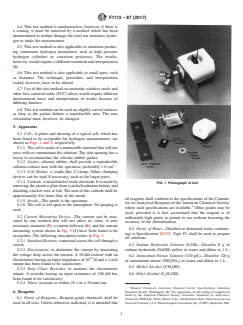
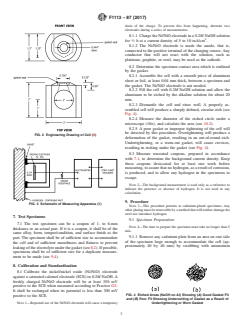
5.1 Cell—A photo and drawing of a typical cell, which has
been found to be acceptable for hydrogen measurements, are
shown in Figs. 1 and 2, respectively.
5.1.1 Thecellismadeofanonmetallicmaterialthatwillnot
react with or contaminate the solution. The side opening has a
recess to accommodate the silicone rubber gasket.
5.1.2 Gasket, silicone rubber, shall provide a reproducible
solution-contact area with the specimen, preferably 1.0 cm .
5.1.3 Cell Holder, a cradle-like C-clamp. Other clamping
devices can be used if necessary, such as for larger parts.
5.1.4 Cathode,anickel/nickeloxideelectrode.Itismadeby
FIG. 1 Photograph of Cell
removingthepositiveplatefromanickel/cadmiumbatteryand
attachinganickelwireorfoil.Theareaofthiscathodeshallbe
approximately five times that of the anode.
all reagents shall conform to the specifications of the Commit-
5.1.5 Anode—The anode is the specimen.
tee onAnalytical Reagents of theAmerican Chemical Society,
5.1.6 The cell is left open to the atmosphere. No purging is
where such specifications are available. Other grades may be
used.
used, provided it is first ascertained that the reagent is of
5.2 Current Measuring Device—The current can be mea-
sufficiently high purity to permit its use without lessening the
sured by any method that will not affect its value. A zero
accuracy of the determination.
resistance ammeter (5), a current follower (6), and the current
6.2 Purity of Water—Distilled or deionized water conform-
measuring system shown in Fig. 3 (1) have been found to be
ing to Specification D1193, Type IV, shall be used to prepare
acceptable. The following description refers to Fig. 3.
all solutions.
5.2.1 Standard Resistor, connected across the cell through a
6.3 Sodium Hydroxide Solution (0.2M)—Dissolve8gof
switch.
sodium hydroxide (NaOH) pellets in water and dilute to 1 L.
5.2.2 Electrometer, to determine the current by measuring
the voltage drop across the resistor. A 10-kΩ resistor with an
6.4 Ammonium Nitrate Solution (120 g/L)—Dissolve 120 g
electrometer having an input impedance of 10 Ω and a 1-mA
of ammonium nitrate (NH NO ) in water and dilute to 1 L.
4 3
output has been found to be satisfactory.
6.5 Methyl Alcohol (CH OH).
5.2.3 Strip Chart Recorder, to monitor the electrometer
6.6 Ethyl Alcohol (C H OH).
output. A recorder having an input resistance of 100 kΩ has
2 5
been found to be satisfactory.
5.2.4 Timer, accurate to within 10 s in a 30-min run.
Reagent Chemicals, American Chemical Society Specifications, American
6. Reagents Chemical Society, Washington, DC. For suggestions on the testing of reagents not
listed by the American Chemical Society, seeAnalar Standards for Laboratory
6.1 Purity of Reagents—Reagent grade chemicals shall be
Chemicals,BDHLtd.,Poole,Dorset,U.K.,andtheUnited States Pharmacopeia and
used in all tests. Unless otherwise indicated, it is intended that National Formulary,U.S.PharmacopeialConvention,Inc.(USPC),Rockville,MD.
F1113 − 87 (2017)
drain of the charge. To prevent this from happening, alternate two
electrodes during a series of measurements.
8.1.1 ChargetheNi/NiOelectrodeina0.2MNaOHsolution
for ⁄2 h at a current density of 5 to 10 mA/cm .
8.1.2 The Ni/NiO electrode is made the anode, that is,
connected to the positive terminal of the charging source.Any
conductor that will not react with the solution, such as
platinum, graphite, or steel, may be used as the cathode.
8.2 Determine the specimen contact area which is outlined
by the gasket.
8.2.1 Assemble the cell with a smooth piece of aluminum
sheet or foil, at least 0.04 mm thick, between a specimen and
the gasket. The Ni/NiO electrode is not needed.
8.2.2 Fill the cell with 0.2M NaOH solution and allow the
aluminum to be etched by the alkaline solution for about 20
min.
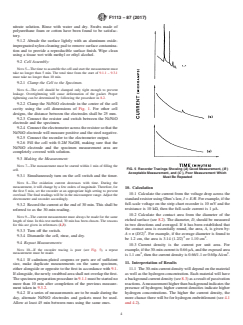
8.2.3 Dismantle the cell and rinse well. A properly as-
sembled cell will produce a sharply defined, circular etch (see
Fig. 4).
8.2.4 Measure the diameter of the etched circle under a
microscope (10×), and calculate the area (see 10.2).
8.2.5 A poor gasket or improper tightening of the cell will
be detected by this procedure. Overtightening will produce a
FIG. 2 Engineering Drawing of Cell (3)
deformation of the gasket, resulting in an out-of-round etch.
Undertightening, or a worn-out gasket, will cause crevices,
resulting in etching under the gasket (see Fig. 4).
8.3 Measure uncoated coupons, prepared in accordance
with 7.1, to determine the background current density. Keep
these coupons desiccated for at least one week before
measuring, to assure that no hydrogen, as a result of corrosion,
is produced, and to allow any hydrogen in the specimens to
escape.
NOTE 2—The background measurement is used only as a reference to
indicate the presence or absence of hydrogen. It is not used in any
calculation.
9. Procedure
FIG. 3 Schematic of Measuring Apparatus (1)
NOTE 3—This procedure pertains to cadmium-plated specimens. Any
other plating must be removable by a method that will neither damage the
steel nor introduce hydrogen.
7. Test Specimens
9.1 Specimen Preparation:
7.1 The test specimen can be a coupon of 1- to 6-mm
NOTE 4—The time to prepare the specimen must take no longer than 5
thickness or an actual part. If it is a coupon, it shall be of the
min.
same alloy, form, temper/condition, and surface finish as the
9.1.1 Remove any cadmium plate from an area on one side
part. The specimen shall be of sufficient size to accommodate
of the specimen large enough to accommodate the cell (ap-
the cell and of sufficient smoothness and flatness to prevent
proximately 40 by 40 mm) by swabbing wit
...