

ASTM D8185-23
(Guide)Standard Guide for In-Service Lubricant Viscosity Measurement
General Information
- Abstract
SCOPE
1.1 Significance and Determination of Viscosity—The purpose of this guide is to provide sufficient knowledge for a person with some technical background in lubrication or condition monitoring from which they can determine the best choice for measuring viscosity of an in-service oil. Such information from this guide should enable the user to engage in productive discussions with colleagues, service providers, managers, and service personnel about obtaining and using information on and from viscosity. There are a number of different approaches to viscometric measurement, and this guide is intended to be a helpful resource in selecting the most appropriate viscometric approach to gain information for the in-service fluid.
1.2 The values stated in either SI units or inch-pound units are to be regarded separately as standard. The values stated in each system are not necessarily exact equivalents; therefore, to ensure conformance with the standard, each system shall be used independently of the other, and values from the two systems shall not be combined.
1.3 This standard does not purport to address all of the safety concerns, if any, associated with its use. It is the responsibility of the user of this standard to establish appropriate safety, health, and environmental practices and determine the applicability of regulatory limitations prior to use.
1.4 This international standard was developed in accordance with internationally recognized principles on standardization established in the Decision on Principles for the Development of International Standards, Guides and Recommendations issued by the World Trade Organization Technical Barriers to Trade (TBT) Committee.
- Status
- Published
- Publication Date
- 30-Nov-2023
- Technical Committee
- D02 - Petroleum Products, Liquid Fuels, and Lubricants
Overview
ASTM D8185-23: Standard Guide for In-Service Lubricant Viscosity Measurement provides comprehensive guidance for evaluating the viscosity of in-service lubricants. Developed by ASTM International, this standard supports individuals with a technical background in lubrication or condition monitoring in selecting effective viscometric measurement approaches. Accurate in-service lubricant viscosity measurement is crucial for assessing oil performance, detecting equipment wear, and ensuring component reliability across a variety of industries.
The guide helps users engage in meaningful discussions about lubricant condition, outlines common viscosity measurement methods, and emphasizes the importance of consistent units and practices. It accommodates both SI and inch-pound units and stresses the need for appropriate safety and quality control procedures.
Key Topics
- Significance of Viscosity Measurement: Viscosity is central to lubricant performance and system reliability. Changes in an oil’s viscosity can signal contamination, degradation, or the need for maintenance. The guide discusses how to interpret viscosity data and its impact on machinery.
- Measurement Approaches: Multiple viscometric methods are available, including capillary, rotational, and field-based instruments. Each method requires careful selection based on oil type, application, and desired accuracy. The guide highlights the importance of distinguishing between dynamic and kinematic viscosity, as well as understanding Newtonian and non-Newtonian fluid behaviors.
- Sampling and Testing Procedures: Proper sampling is essential for reliable results. The standard details best practices for representative sampling, temperature control, turnaround time, and consistent analysis techniques. Emphasis is placed on using standardized procedures such as those found in referenced ASTM practices (e.g., D4057 for sampling).
- Quality Assurance: ASTM D8185-23 underscores using certified reference fluids and adhering to calibration protocols. Regular method verification and participation in proficiency testing programs support measurement reliability and ensure actionable data for maintenance decisions.
Applications
- Routine Oil Analysis: Monitoring the viscosity of in-service lubricants enables proactive maintenance for engines, turbines, hydraulic systems, and industrial machinery. Early detection of viscosity changes can prevent costly failures.
- Condition Monitoring Programs: The standard informs the design of oil analysis programs by defining sampling frequencies, alarm limits, and interpretation guidelines. This supports optimized equipment uptime, safety, and compliance with warranties.
- Troubleshooting and Root Cause Analysis: By interpreting viscosity changes, maintenance teams can troubleshoot issues related to contamination, additive depletion, or mechanical stress, supporting informed decision-making.
- Compliance and Documentation: The standard aids organizations in meeting industry best practices, provides defensible data for regulatory compliance, and supports warranty claims via clear documentation of lubricant condition.
Related Standards
For users implementing ASTM D8185-23, familiarity with related standards enhances the effectiveness and reliability of viscosity measurement programs. Frequently referenced ASTM standards include:
- ASTM D445: Kinematic Viscosity of Transparent and Opaque Liquids
- ASTM D446: Glass Capillary Kinematic Viscometers
- ASTM D4057: Manual Sampling of Petroleum and Petroleum Products
- ASTM D4378 & D6224: In-Service Monitoring of Turbine Oils and Auxiliary Equipment Lubricants
- ASTM D4683, D5133, D5293, D6616, D7042, D7279, D7483, D8092: Various test methods for dynamic/kinematic viscosity, low-temperature viscosity, and field measurements
Implementing ASTM D8185-23 along with these standards supports robust in-service lubricant viscosity measurement, contributing to enhanced operational reliability, reduced downtime, and optimal lubricant use across industries such as manufacturing, power generation, transportation, and more.
Relations
- Effective Date
- 01-Dec-2023
- Effective Date
- 01-Apr-2024
- Effective Date
- 01-Mar-2024
- Effective Date
- 01-Nov-2023
- Effective Date
- 01-Jul-2022
- Effective Date
- 01-Jun-2020
Get Certified
Connect with accredited certification bodies for this standard

Element Materials Technology
Materials testing and product certification.

ABS Group Brazil
ABS Group certification services in Brazil.

ABS Quality Evaluations Inc.
American Bureau of Shipping quality certification.
Sponsored listings
Frequently Asked Questions
ASTM D8185-23 is a guide published by ASTM International. Its full title is "Standard Guide for In-Service Lubricant Viscosity Measurement". This standard covers: SCOPE 1.1 Significance and Determination of Viscosity—The purpose of this guide is to provide sufficient knowledge for a person with some technical background in lubrication or condition monitoring from which they can determine the best choice for measuring viscosity of an in-service oil. Such information from this guide should enable the user to engage in productive discussions with colleagues, service providers, managers, and service personnel about obtaining and using information on and from viscosity. There are a number of different approaches to viscometric measurement, and this guide is intended to be a helpful resource in selecting the most appropriate viscometric approach to gain information for the in-service fluid. 1.2 The values stated in either SI units or inch-pound units are to be regarded separately as standard. The values stated in each system are not necessarily exact equivalents; therefore, to ensure conformance with the standard, each system shall be used independently of the other, and values from the two systems shall not be combined. 1.3 This standard does not purport to address all of the safety concerns, if any, associated with its use. It is the responsibility of the user of this standard to establish appropriate safety, health, and environmental practices and determine the applicability of regulatory limitations prior to use. 1.4 This international standard was developed in accordance with internationally recognized principles on standardization established in the Decision on Principles for the Development of International Standards, Guides and Recommendations issued by the World Trade Organization Technical Barriers to Trade (TBT) Committee.
SCOPE 1.1 Significance and Determination of Viscosity—The purpose of this guide is to provide sufficient knowledge for a person with some technical background in lubrication or condition monitoring from which they can determine the best choice for measuring viscosity of an in-service oil. Such information from this guide should enable the user to engage in productive discussions with colleagues, service providers, managers, and service personnel about obtaining and using information on and from viscosity. There are a number of different approaches to viscometric measurement, and this guide is intended to be a helpful resource in selecting the most appropriate viscometric approach to gain information for the in-service fluid. 1.2 The values stated in either SI units or inch-pound units are to be regarded separately as standard. The values stated in each system are not necessarily exact equivalents; therefore, to ensure conformance with the standard, each system shall be used independently of the other, and values from the two systems shall not be combined. 1.3 This standard does not purport to address all of the safety concerns, if any, associated with its use. It is the responsibility of the user of this standard to establish appropriate safety, health, and environmental practices and determine the applicability of regulatory limitations prior to use. 1.4 This international standard was developed in accordance with internationally recognized principles on standardization established in the Decision on Principles for the Development of International Standards, Guides and Recommendations issued by the World Trade Organization Technical Barriers to Trade (TBT) Committee.
ASTM D8185-23 is classified under the following ICS (International Classification for Standards) categories: 75.100 - Lubricants, industrial oils and related products. The ICS classification helps identify the subject area and facilitates finding related standards.
ASTM D8185-23 has the following relationships with other standards: It is inter standard links to ASTM D8185-18, ASTM D445-24, ASTM D4378-24, ASTM D445-23, ASTM D4378-22, ASTM D4683-20. Understanding these relationships helps ensure you are using the most current and applicable version of the standard.
ASTM D8185-23 is available in PDF format for immediate download after purchase. The document can be added to your cart and obtained through the secure checkout process. Digital delivery ensures instant access to the complete standard document.
Standards Content (Sample)
This international standard was developed in accordance with internationally recognized principles on standardization established in the Decision on Principles for the
Development of International Standards, Guides and Recommendations issued by the World Trade Organization Technical Barriers to Trade (TBT) Committee.
Designation: D8185 − 23
Standard Guide for
In-Service Lubricant Viscosity Measurement
This standard is issued under the fixed designation D8185; the number immediately following the designation indicates the year of
original adoption or, in the case of revision, the year of last revision. A number in parentheses indicates the year of last reapproval. A
superscript epsilon (´) indicates an editorial change since the last revision or reapproval.
1. Scope* 2. Referenced Documents
1.1 Significance and Determination of Viscosity—The pur- 2.1 ASTM Standards:
pose of this guide is to provide sufficient knowledge for a D445 Test Method for Kinematic Viscosity of Transparent
person with some technical background in lubrication or and Opaque Liquids (and Calculation of Dynamic Viscos-
condition monitoring from which they can determine the best ity)
choice for measuring viscosity of an in-service oil. Such D446 Specifications and Operating Instructions for Glass
information from this guide should enable the user to engage in Capillary Kinematic Viscometers
productive discussions with colleagues, service providers, D2983 Test Method for Low-Temperature Viscosity of Au-
managers, and service personnel about obtaining and using tomatic Transmission Fluids, Hydraulic Fluids, and Lubri-
information on and from viscosity. There are a number of cants using a Rotational Viscometer
different approaches to viscometric measurement, and this D4057 Practice for Manual Sampling of Petroleum and
guide is intended to be a helpful resource in selecting the most Petroleum Products
appropriate viscometric approach to gain information for the D4175 Terminology Relating to Petroleum Products, Liquid
in-service fluid. Fuels, and Lubricants
D4378 Practice for In-Service Monitoring of Mineral Tur-
1.2 The values stated in either SI units or inch-pound units
bine Oils for Steam, Gas, and Combined Cycle Turbines
are to be regarded separately as standard. The values stated in
D4683 Test Method for Measuring Viscosity of New and
each system are not necessarily exact equivalents; therefore, to
Used Engine Oils at High Shear Rate and High Tempera-
ensure conformance with the standard, each system shall be
ture by Tapered Bearing Simulator Viscometer at 150 °C
used independently of the other, and values from the two
D5133 Test Method for Low Temperature, Low Shear Rate,
systems shall not be combined.
Viscosity/Temperature Dependence of Lubricating Oils
1.3 This standard does not purport to address all of the
Using a Temperature-Scanning Technique
safety concerns, if any, associated with its use. It is the
D5293 Test Method for Apparent Viscosity of Engine Oils
responsibility of the user of this standard to establish appro-
and Base Stocks Between –10 °C and –35 °C Using
priate safety, health, and environmental practices and deter-
Cold-Cranking Simulator
mine the applicability of regulatory limitations prior to use.
D5478 Test Methods for Viscosity of Materials by a Falling
1.4 This international standard was developed in accor-
Needle Viscometer
dance with internationally recognized principles on standard-
D6224 Practice for In-Service Monitoring of Lubricating Oil
ization established in the Decision on Principles for the
for Auxiliary Power Plant Equipment
Development of International Standards, Guides and Recom-
D6299 Practice for Applying Statistical Quality Assurance
mendations issued by the World Trade Organization Technical
and Control Charting Techniques to Evaluate Analytical
Barriers to Trade (TBT) Committee.
Measurement System Performance
D6304 Test Method for Determination of Water in Petro-
leum Products, Lubricating Oils, and Additives by Cou-
This guide is under the jurisdiction of ASTM Committee D02 on Petroleum lometric Karl Fischer Titration
Products, Liquid Fuels, and Lubricants and is the direct responsibility of Subcom-
mittee D02.96.01 on In-Service Lubricant Viscosity Testing Practices and Tech-
niques. For referenced ASTM standards, visit the ASTM website, www.astm.org, or
Current edition approved Dec. 1, 2023. Published January 2024. Originally contact ASTM Customer Service at service@astm.org. For Annual Book of ASTM
approved in 2018. Last previous edition approved in 2018 as D8185 – 18. DOI: Standards volume information, refer to the standard’s Document Summary page on
10.1520/D8185-23. the ASTM website.
*A Summary of Changes section appears at the end of this standard
Copyright © ASTM International, 100 Barr Harbor Drive, PO Box C700, West Conshohocken, PA 19428-2959. United States
D8185 − 23
D6616 Test Method for Measuring Viscosity at High Shear
Rate by Tapered Bearing Simulator Viscometer at 100 °C
D6896 Test Method for Determination of Yield Stress and
Apparent Viscosity of Used Engine Oils at Low Tempera-
ture
D7042 Test Method for Dynamic Viscosity and Density of
Liquids by Stabinger Viscometer (and the Calculation of
Kinematic Viscosity)
FIG. 1 Depiction of Velocity Gradient in a Flowing Fluid
D7110 Test Method for Determining the Viscosity-
Temperature Relationship of Used and Soot-Containing
Engine Oils at Low Temperatures
η 5 τ⁄δu/δy (1)
D7279 Test Method for Kinematic Viscosity of Transparent
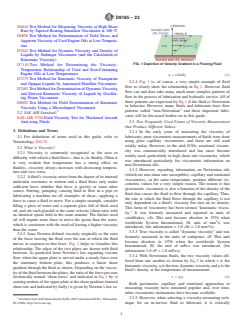
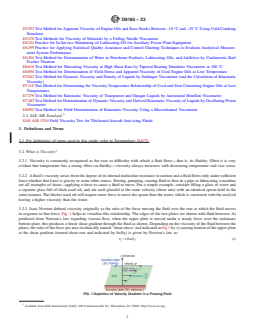
3.2.4 Fig. 1 is, of course, a very simple example of fluid
and Opaque Liquids by Automated Houillon Viscometer
flow to clearly show the relationship in Eq 1. However, fluid
D7483 Test Method for Determination of Dynamic Viscosity
flow can and does take many much more complex patterns of
and Derived Kinematic Viscosity of Liquids by Oscillat-
flow in the process of lubrication and hydraulic service. All of
ing Piston Viscometer
these patterns are expressed by Eq 1 if the fluid is Newtonian
D8092 Test Method for Field Determination of Kinematic
in behavior. However, many fluids and lubricants have flow
Viscosity Using a Microchannel Viscometer
3 patterns called “non-Newtonian” and these important lubri-
2.2 SAE AIR Standard:
cants will be discussed further on in this guide.
SAE AIR 5704 Field Viscosity Test for Thickened Aircraft
3.3 Two Frequently Used Forms of Viscosity Measurement
Anti-icing Fluids
that Produce Different Values:
3. Definitions and Terms
3.3.1 In the early years of measuring the viscosity of
lubricants, most viscometric measurements of fluids were done
3.1 For definitions of terms used in this guide, refer to
using glass capillary viscometers, and these are still used
Terminology D4175.
widely today. However, in the mid-1930s, rotational viscom-
3.2 What is Viscosity?
etry was commercially introduced and has since become
3.2.1 Viscosity is commonly recognized as the ease or
widely used, particularly in high shear rate viscometry, which
difficulty with which a fluid flows—that is, its fluidity. Often it
was introduced particularly for viscometric information on
is very evident that temperature has a strong effect on
non-Newtonian oils.
fluidity—viscosity always increases with decreasing tempera-
3.3.2 However, regarding information on Newtonian oils
ture and vice versa.
(which are non-shear rate susceptible), capillary and rotational
3.2.2 A fluid’s viscosity arises from the degree of its internal
viscometers—at the same temperature, produce different vis-
molecular resistance to motion and a fluid flows only under
cometric values for a very simple reason. The reason is that
sufficient force whether that force is gravity or some other
gravimetric viscometry is also a function of the density of the
source. Stirring, pumping, causing fluid to flow in a pipe or
fluid that causes the fluid to flow through the capillary. Thus,
lubricating a machine are all examples of shear—applying a
the rate at which the fluid flows through the capillary is not
force to cause a fluid to move. For a simple example, consider
only dependent on a fluid’s viscosity but also on its density.
filling a glass of water and a separate glass full of thick used
This form of viscometry has been termed “kinematic viscos-
oil, and stir each glassful at the same velocity (shear rate) with
ity.” It was formerly measured and reported in units of
an identical spoon held in the same manner. The thicker used
centiStokes, cSt. This unit became obsolete in 1976 when
oil will require more force to move the spoon than the water,
worldwide System International, SI, unit of mm /s was
which is consistent with the used oil having a higher viscosity
introduced, (for information = 1.0 cSt = 1.0 mm /s).
than the water.
3.3.3 True viscosity is called “dynamic viscosity” and was
3.2.3 Isaac Newton defined viscosity originally as the ratio
formerly measured in the units of centipoise, cP. This unit
of the force moving the fluid over the rate at which the fluid
became obsolete in 1976 when the worldwide System
moves in response to that force. Fig. 1 helps to visualize this
International, SI, the unit of mPa·s was introduced, (for
relationship. The edges of the two plates are shown with fluid
information 1.0 cP = 1.0 mPa·s).
between. As predicted from Newton’s law regarding viscous
3.3.4 With Newtonian fluids, the two viscosity values dif-
flow, when the upper plate is moved under a steady force over
fered from one another as shown by Eq 2 in which ν is the
the stationary bottom plate, this produces a linear shear
kinematic viscosity, η is the true, dynamic viscosity and ρ is the
gradient through the fluid as shown. Depending on the viscos-
fluid’s density at the temperature of measurement.
ity of the fluid between the plates, the ratio of the force per area
ν 5 η⁄ρ (2)
(technically named ‘shear-stress’ and indicated in Eq 1 by τ)
causing motion of the upper plate at the shear gradient (termed
Both gravimetric capillary and rotational approaches to
shear rate and indicated by δu/δy) is given by Newton’s law as:
measuring viscosity have remained popular and, over time,
other viscometric instruments have become available.
3.3.5 However, when selecting a viscosity-measuring tech-
Available from SAE International (SAE), 400 Commonwealth Dr., Warrendale,
PA 15096, http://www.sae.org. nique for an in-service fluid or lubricant, it is critically
D8185 − 23
important to clearly understand which unit of measurement has posed of polymeric molecules which are dissolved in relatively
previously been used to characterize its viscosity—that is, small amounts in the mineral oil base stock to impart desirable
whether it is dynamic or kinematic viscosity. Conversion by viscometric properties at both low and operating temperatures
density according to Eq 2 above may be required to achieve the at low shear rates.
desired unit of measurement. To repeat, viscosity data must be 3.4.4 Conventional wisdom has held that on dissolution, the
in identical units before comparison, otherwise incorrect con- volume of these VI modifiers increases greatly and thus impart
clusions and false expectations of responses to conditions may an accompanying large viscosity increase to the base oil. The
result in poor choice of lubricants with a waste of time, effort, polymer volume increases when it is dissolved and is at higher
and resources or may even result in choices harmful to the temperature, thus giving a greater increase in viscosity than at
device using the fluid or those depending on it. lower temperature, but more recent investigations suggest that
3.3.6 However, there is another very important factor in the this phenomenon may occur only with certain polymeric
measurement of viscosity, and that is whether the fluid is structures, and that for different structures, there is a different
Newtonian or non-Newtonian and that subject is opened in the mechanism. Using much lower viscosity base oils, this results
following section. in formulations that at low shear rates have viscosities similar
to those of non-polymer containing lubricants at operating
3.4 Newtonian and Non-Newtonian Viscosity and Its Mea-
temperatures. However, as noted above, much of this viscosity
surement:
increase is subject to TVL.
3.4.1 As noted earlier, Newton’s definition of viscosity was
3.4.5 Unfortunately, there is another factor to be considered.
given in Eq 1, in which the ratio of shear stress to shear rate is
At the shear rates and other, non-viscous forces applied in
constant for a fluid. Many simple fluids such as mineral oils are
lubrication, the larger of these polymeric additives are vulner-
Newtonian. However, with some more complex fluids or when
able to mechanical rupture. This causes a significant and
certain additives are dissolved in some Newtonian fluids, the
unrecoverable loss of lubricant viscosity, a so-called “perma-
ratio of shear stress to shear rate is not constant and these fluids
nent viscosity loss” or PVL, depending on how vulnerable the
are called non-Newtonian. Today, many lubricating oils are
dissolved macromolecules are to the forces and conditions to
non-Newtonian in behavior, and this fact also can affect their
which they are exposed during use. PVL may reach 20 % or
ability to lubricate or the energy required to overcome viscous
more during use of the lubricant.
resistance to flow.
3.4.2 Non-Newtonian flow may take many forms in com-
4. Measuring Viscosity
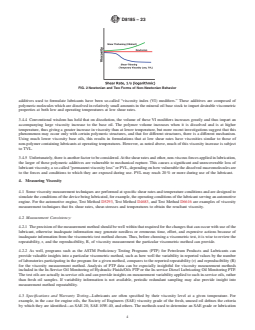
parison to Newtonian flow, two of which are shown in Fig. 2
compared to Newtonian flow. Shear-thickening by lubricants is
4.1 Some viscosity measurement techniques are performed
rarely shown, however, shear-thinning is very commonly
at specific shear rates and temperature conditions and are
encountered especially in lubricants. This shear-thinning is
designed to simulate the conditions of the device being
often called “temporary viscosity loss” or TVL, since on
lubricated, for example, the operating conditions of the lubri-
lowering shear rate, the viscosity “lost” returns. The shear rates
cant serving an automotive engine. For the automotive engine,
producing TVL are in the millions of units (called “reciprocal
Test Method D5293, Test Method D4683, and Test Method
–1
seconds,” denoted frequently by 1/s or s ). Such high values
D6616 are examples of viscosity measurement techniques that
of shear rate are the normal operating level for most lubrication
fix shear rates, shear-stresses and temperatures to obtain the
of automotive engines and other machinery. Temporary viscos-
resultant viscosity.
ity loss may reach levels of 30 % or more depending on the
4.2 Measurement Consistency:
lubricant formulation.
4.2.1 The precision of the measurement method should be
3.4.3 The base mineral oils used to manufacture lubricants
well within that required for the changes that can occur with
are essentially Newtonian. For many years, one of the impor-
use of the lubricant, otherwise inadequate information may
tant additives used to formulate lubricants have been so-called
generate needless or erroneous time, effort, and expensive
“viscosity index (VI) modifiers.” These additives are com-
actions because of inadequate information from the viscomet-
ric test method chosen. Thus, before choosing a viscometric
test, it is wise to review the repeatability, r, and the
reproducibility, R, of viscosity measurement the particular
viscometric method can provide.
4.2.2 As well, programs such as the ASTM Proficiency
Testing Programs (PTP) for Petroleum Products and Lubricants
can provide valuable insights into a particular viscometric
method, such as how well the variability in reported values by
the number of laboratories participating in the program for a
given method, compares to the reported repeatability (r) and
reproducibility (R) for the viscosity measurement method.
Analysis of PTP data can be especially insightful for viscosity
measurement methods included in the In-Service Oil Monitor-
ing of Hydraulic Fluids/Oils PTP or the In-service Diesel
FIG. 2 Newtonian and Two Forms of Non-Newtonian Behavior Lubricating Oil Monitoring PTP. The test oils are actually
D8185 − 23
in-service oils and can provide insights on measurement time. In some cases, it is helpful to have the identification of
variability applied to such in-service oils, rather than fresh oil the person collecting the sample as well.
samples. If variability information is not available, periodic 4.4.6 For samples likely to contain volatile components/
redundant sampling may also provide insight into measurement contaminants, sample-containing vessels should be chosen
method repeatability. which are readily and completely closable and thus suitable to
consistently preserve the sample from changes that may occur
4.3 Specifications and Warranty Testing—Lubricants are
between the time the sample is taken and the measurement
often specified by their viscosity level at a given temperature.
performed. They should also be sized to hold adequate sample
For example, in the case for engine oils, the Society of
for the measurement method or methods being applied. The
Engineers (SAE) viscosity grade of the fresh, unused oil
measurement plan should define the range of time allowed
defines the criteria by which they are identified—as SAE 20,
between sampling and the time a measurement should be made
SAE 10W-40, and others. The methods used to determine an
to minimize sample degradation and to provide actionable data
SAE grade or lubrication specification can be applied to a used
as quickly as possible. Ideally this time should be as short as
oil to determine if the oil is still within reasonable proximity to
possible.
the recommended viscosity specification specified by the
4.4.7 The level of analysis at which action should be taken
manufacturer of the equipment. Warranties may require the
should also be clearly identified as part of the measurement
lubricant meet the requirements of a given specification or the
plan, along with what actions should be taken, who should
warranty is subject to voiding.
perform them, and the timeliness expected in completing them.
4.4 Establishing a Monitoring Plan for Viscosity Measure-
In some cases, actions may require additional measurements of
ment:
other properties. This should be taken into consideration when
4.4.1 Often, a series of in-service viscosity measurements
sizing the sample vessels. The most subjective factor of the
are helpful and informative when taken in a systematic way.
sampling plan is the frequency of sampling. This will depend
Such data can be of interest, for example in comparison to the
highly on the application, the particular oil type, and take into
initial fresh oil value. Or, depending on the equipment, if there
account the following:
is a minimum value below which the viscosity of the fluid
4.4.7.1 Cost of analyses,
should not fall or a maximum above which viscosity should not
4.4.7.2 Expected sample degradation rate under normal
rise. Documenting a plan for an in-service series of viscosity
conditions,
measurements will likely also improve one’s skill in good
4.4.7.3 The likelihood of equipment failure, and
decision making regarding the information generated by the
4.4.7.4 Potential cost of a failure if serious degradation is
series.
not detected fast enough.
4.4.2 Information on specific measurement plans advice can
4.5 Obtaining a Representative Sample:
also be found in the following ASTM methods:
4.5.1 There are inherent limitations when performing any
4.4.2.1 Practice D6224 for monitoring of turbine oils,
type of sampling, any one of which may affect the information
4.4.2.2 Practice D4378 for mineral turbine oils, and
obtained on the sample. For example, a small sample for
4.4.2.3 Guide to ASTM Test Methods for the Analysis of
determining the viscosity of the oil in a pipeline provides a
Petroleum Products and Lubricants.
sample from only one particular location. Therefore, when a
4.4.3 Measurement plans should be designed to ensure
representative sample cannot be obtained from a single port, a
reasonably trouble-free operation of machines and equipment.
better approach is to collect samples from multiple locations.
An effective plan will often include several different pieces of
4.5.2 It is important to clearly understand that the objectives
information, starting with the technique to ensure a represen-
of sampling an oil or lubricant are to:
tative sample. The amount of sample should be sufficient for
4.5.2.1 Maintain data integrity,
the planned slate of tests. If the fluid to be analyzed is well
4.5.2.2 Maintain proper frequency of sampling,
circulated in the mechanism, the sample can be taken at any
site containing the circulating fluid—for example, the sump of 4.5.2.3 Set proper targets and alarms for each type of
equipment, and
an engine.
4.4.4 In some cases, lubricant viscosity may be best ana- 4.5.2.4 Minimize data obstructions.
lyzed under temperatures and shear rates similar to in-service 4.5.3 Moreover, another area of planning involves strategic
conditions. Frequently, measurements are also made under sampling conditions that include such matters as:
conditions specified for new oils (for example, 40 °C or 100 °C 4.5.3.1 Safety considerations,
at atmospheric pressure).
4.5.3.2 Sampling location, and
4.4.5 Regardless of where the samples are obtained and 4.5.3.3 Sampling tools.
under what conditions they are analyzed, consistent sampling
(1) Hardware.
location(s) are important for meaningful interpretation of the (2) Bottles.
results. If multiple sample ports are desired, the location at
(3) Sampling and procedure practices (Practice D4057).
which the sample is taken should be recorded with analysis
4.5.4 Under all circumstances, it is necessary to follow safe
values, together with any machine identification, and date and
and well-planned sampling procedures for each type of equip-
ment whether they be:
4 4.5.4.1 From pressurized or non-pressurized systems.
Nadkarni, K., Guide to ASTM Test Methods for the Analysis of Petroleum
Products and Lubricants, 2007. 4.5.4.2 From small reservoirs (such as bearing housings).
D8185 − 23
4.5.4.3 From a drum or reservoir without a test port. required by the ASTM method or provide a traceable certificate
to the organization which provides the calibration services.
4.5.4.4 From otherwise difficult or dangerous environments.
4.5.5 All sophisticated oil analysis tools, techniques, and
4.7 Turnaround Time Requirements for Results:
diagnostic processes are meaningless if the oil sample fails to
4.7.1 Different viscosity measurement techniques can re-
effectively represent the actual condition of the oil in service in
quire different amounts of time to produce the data. Table 1
the machine. Proper sampling procedures build the foundation
provides insights on the elements that affect turnaround time
of an effective oil analysis program. Without good sampling
for each of the viscosity measurement methods. Included in
procedures that obtain a representative quantity of the fluid or
Table 1 is a brief description of the viscometric measurement
lubricant in service, both time and money are wasted, and
technique and the ASTM method number. The information in
incorrect conclusions are likely if the data are faulty.
the Typical Location column indicates where the viscosity
4.5.6 Another caution with sampling is the importance of
measurement is most likely to be executed if the nature of
consistency of the method and the analytical technique. It is not
measurement is crucial enough to support investment in
a good idea to trend sample results taken using different
equipment and facilities to execute the method and personnel
sampling methods or different test methods.
are trained to run the test method.
4.7.2 Elements That Affect Turnaround column summaries
4.6 Temperature of the Viscometric Test and Measurement:
assume that the instrument is properly set-up, calibrated, and
4.6.1 Viscosity of an in-service oil will change significantly
ready for sample testing. Such time to execute the test may be
with temperature. Proper viscosity measurement requires the
extended if calibration and reference procedures are not
instrument or technique to control the temperature of the
included unless required by the method to be completed for
sample appropriately during measurement. Some ASTM meth-
each test. Time estimates obviously do not include time to ship
ods are written for elevated temperature measurement, and
the samples to a laboratory nor do they include response time
others have been specifically developed to evaluate viscosity of
of the chosen laboratory if the measurement technique is not
the oil at low temperatures. ASTM methods typically indicate
immediately available at or associated with the location at
the required temperature control limits during the measure-
which the sample is obtained.
ment. For some time, 40 °C, 100 °C, and 150 °C have been the
4.7.3 The rate at which data is collected must be balanced
three most common above-ambient temperatures at which
with the information that is required for the information
viscosity data are collected and compared.
desired. An in-service oil analysis plan that utilizes the most
4.6.2 When performing different test methodologies, it is
appropriate measurement technique and allows for the results
important to have an understanding that time to reach the
to be turned around in the appropriate time will achieve the
temperature equilibrium at which measurements will be made
best results with the minimum delay in appropriate response to
differs with instrument and technique. For example, the kine-
the data’s information. Make sure that the laboratory you
matic capillary viscosity test, Test Method D445 requires the
choose is qualified, ISO 9001 or 17025 certified, and experi-
use of clear liquid baths which may need 30 min or more to
enced in running the test method.
become constant depending on the temperature of measure-
ment prior to performing a test run. As another example, with
4.8 Availability of Certified Reference Fluids—Reference
the low-temperature dynamic viscosity Test Method D5133,
fluids are an important tool that a laboratory must use to ensure
the test requires cooling at a rate of 1 °C per hour after
that the viscosity measurement equipment and procedures of
stabilizing either the liquid bath or the refrigerated metal
the technicians are both correct and consistent. When devel-
dry-bath at –5 °C. Not waiting sufficient time for equilibrium to
oping an in-service viscosity measurement program, it may be
take place will produce test results outside the expected
advantageous to understand the reference fluids available and
repeatability/reproducibility stated in the respective test
how they can be used by a laboratory to ensure consistent
method and operators need to be aware that such poor practice
results. Either the viscometer manufacturer or the ASTM
will produce erroneous test results. Obviously, poor tempera-
committee responsible for viscosity reference material pro-
ture control while taking a viscosity measurement will very
ducer can give assistance with selection of appropriate refer-
likely lead to:
ence materials for a particular application. Reference materials
4.6.2.1 Inaccurate results, are generally classified as certified and non-certified. Here we
will describe these and how they can be used.
4.6.2.2 Wrong conclusions, and
4.8.1 Standard Viscosity Reference Fluids:
4.6.2.3 Poor reproducibility and poor consistency,
4.8.1.1 Special standardized fluids are necessary for:
4.6.3 Checking the temperature measurements devices, such
(1) Viscometer calibration.
as the thermometer or PT-100, against a reference on a
(2) Verification of a viscometer’s calibration or perfor-
semi-annual basis (as a minimum) will help to ensure that the
mance.
viscosity measurements being taken are accurate. Each instru-
(3) Or in the case of non-Newtonian behavior, to appraise
ment is likely to have specific procedures for calibrating the
an instrument’s response to certain test conditions.
temperature measurement and temperature control devices.
ASTM methods often detail the procedures for calibrating a 4.8.1.2 Certified standard viscosity reference materials
device. A laboratory practicing a given form or forms of should be sourced from the instrument manufacturer, the
viscosity measurement should be able to demonstrate profi- ASTM or other group responsible for the viscometric test
ciency in the performance of the calibrations to the frequency method, or an ISO 17025 or Guide 34 accredited laboratory
D8185 − 23
TABLE 1 Elements Affecting Turnaround for Each Viscosity Measurement Method
Description ASTM Method Temperature Typical Location Elements that Affect Turnaround
Capillary D445 Typical 40 °C and 100 °C, Oil Analysis • If the measurement is made by an automatic unit or
Viscosity Kinematic Viscosity wide range possible; –40 °C to Laboratory manual procedure.
150 °C • Temperature of measurement as a sample must equili-
brate at the test temperature. Standard temperatures such
as 40 °C and 100 °C are more likely to be ready on an au-
tomated unit or have a bath ready at temperature for a
manual measurement.
Low Temperature D2983 –55 °C to 20 °C Oil Analysis • This method requires the sample to equilibrate to tem-
Viscosity Dynamic Viscosity Laboratory perature for 16 h before measurement.
TBS HTHS Viscosity D4683 40 °C to 200 °C Oil Analysis • Non-standard temperatures will require a calibration pro-
150 °C Dynamic Viscosity Laboratory cedure
Scanning Brookfield D5133 –5 °C to –40 °C is typical, Oil Analysis • Test method requires cooling at 1 °C per hour from –5 °C
Technique Dynamic Viscosity can be run to –70 °C Laboratory to –40 °C. Test will take at least 48 h to complete.
Cold Cranking D5293 –5 °C to –30 °C, Oil Analysis • Test takes 1 h to 2 h to complete.
Simulator Dynamic Viscosity depending on viscosity grade Laboratory
Falling Needle D5478 –40 °C to 350 °C Field, • Field measurements take 2 min to 3 min.
Viscometer Dynamic Viscosity Oil Analysis • Tests completed in the lab take 2 min to 3 min after tem-
Laboratory perature equilibration of approximately 5 min to 10 min.
TBS HTHS Viscosity D6616 100 °C, see D4683 Oil Analysis • Method takes 5 min for results when unit is calibrated and
100 °C Dynamic Viscosity Laboratory ready to test.
Yield Stress and D6896 –15 °C to –40 °C, depending Oil Analysis • Depends on W grade, and the temperature of the test.
Apparent Viscosity Dynamic Viscosity on viscosity grade Laboratory Lower temperatures can require 48 h to 72 h to complete
the test.
Dynamic Viscosity D7042 –60 °C to 135 °C Oil Analysis • Test results take 1 min to 3 min, depending on precision
Stabinger Dynamic Viscosity Laboratory mode selected.
• For samples containing ferrous materials, a magnetic par-
ticle trap can be used with to improve performance by re-
moving larger fragments.
Houillon Kinematic D7279 20 °C to 120 °C Oil Analysis • A typical test takes 2 min to 3 min to complete. Sample
Viscosity Kinematic Viscosity Laboratory must equilibrate to test temperature.
Oscillating Piston D7483 –40 °C to 190 °C Oil Analysis • A typical test takes 3 min to 25 min, depending on sample
Dynamic Viscosity Dynamic Viscosity Laboratory viscosity and temperature differential at the time the new
sample is introduced to the viscometer.
Microchannel D8092 40 °C Field • Test takes approximately 1 s per centistoke.
Viscometer Kinematic Viscosity
capable of manufacturing the certified standard viscosity ref- 4.8.2.1 Suitable reference fluids can be chosen and used in
erence material. Some methods specify qualifications of the a laboratory for a daily or periodic verification of an instrument
source for these reference materials. Calibration of various and these measurements can become part of a statistical quality
viscometers are defined in their ASTM test methods. Calibra- control (SQC) system for a laboratory. This system would track
tion of automated viscometers may be defined in the corre- changes or drifts in the measurement system. If the measured
sponding ASTM method or the manufacturer’s operating result for a SQC sample does not fall within a defined
manual. A calibration interval for the viscometer may be tolerance, then the viscometer can be calibrated again or the
suggested in its ASTM test method and should be further cause of the error found and repaired. The tolerance should be
determined by each laboratory. A calibration verification inter- based on the ASTM test method’s precision. Non-certified
val should also be determined to ensure accuracy of the viscosity reference fluids are also available from accredited
measurement results. laboratories. However, many companies use their own base
4.8.1.3 Calibration verification of a viscometer by use of a stock or formulated engine oils as the non-certified reference
standard is measured by the instrument and the resultant value material. When choosing a fluid to use, some important
compared to the certified value of the standard. If the two characteristics are:
values agree within an acceptable tolerance as specified by the (1) The material must be homogeneous,
ASTM Test Method, then the viscometer can be put into use. If (2) Stable over time,
the two values do not agree within the acceptable tolerance, (3) Free of contaminants, and
then the viscometer or its manual should be checked for help or (4) Of sufficient volume such that the material will be
the manufacturer contacted as needed. (For manual glass available for an extended time.
capillary viscometers, see Test Method D445, subsection 9.2 4.8.2.2 The viscometer manufacturer should be able to
(Certified Viscosity Reference Standards) and Annex A4 (Cal- assist with selection of an appropriate material for the desired
culation of Acceptable Tolerance Zone (Band) to Determine application. Some viscometers are made to measure shear
Conformance with a Certified Reference Material).) The cer- sensitive fluids or low-temperature sensitivity to gelation, and
tified reference materials are typically manufactured for an therefore a fluid with similar non-Newtonian characteristics is
intended use and the data corresponds to the appropriate preferred. For example, some reference materials are fully
temperature and viscosity range. formulated motor oils and can be used to verify that the applied
4.8.2 Non-certified Reference Fluids: shear rate corresponds to the method. Practice D6299 is an
D8185 − 23
available resource for this further information on this topic. fresh Newtonian engine oil measured at three temperatures as
Both certified and non-certified viscosity reference materials an example. Of further interest in Fig. 3 is the evident effect of
should be considered to ensure the accuracy and consistency of temperature on viscosity. Not only does the viscosity of a fluid
the viscosity measurements of the in-service fluids. increase with decreasing temperature but, as suggested by the
slopes of the engine oil at the three temperatures, the effect of
5. Fluid Rheology; the Flow Behavior of Fluids
the temperature is exponential.
5.2.3 That the principles of Newton’s equation remain
5.1 Previous sections of this guide have presented a some-
what simple view of flow behavior of fluids. Understanding of constant to the physical limits of high shear rate viscometry has
been shown by studies made, for example, over a very large
the property of viscosity of a fresh lubricant is not simple, and
this property becomes more complex with use of the lubricant. shear rate range by the tapered bearing simulator (TBS)
viscometer. A plot of the shear rate versus the shear-stress on
Moreover, the conditions under which the lubricant is used can
add further complexity to its viscous behavior. This section several Newtonian mineral oils in the TBS viscometer over a
wide range of shear rates is shown in Fig. 4. The plot again
extends the degree of understanding of how lubricant viscosity
affects and is affected by its hours of use in an effort to remove emphasizes the linearity and zero intercept associated with
Newton’s concept of viscosity shown in Eq 3 when analyzing
some of the complexity.
the viscosity of Newtonian fluids.
5.2 Newtonian Fluid Behavior:
5.3 Non-Newtonian Fluids and Their Complex Behavior:
5.2.1 As previously noted, the viscosity of a simple fluid
5.3.1 Many simple fluids, such as basic mineral oils, are
was defined initially by Newton as the ratio of the force
moving the fluid to the rate at which the fluid moves. This ratio Newtonian. However, with some more complex fluids or when
certain additives are dissolved in some Newtonian fluids the
is apparent in a restatement of Eq 1 where Newton’s Equation
is stated as: ratio of shear stress to shear rate is not constant, and these
fluids are called non-Newtonian. Today, many lubricating oils
˙
η 5 τ⁄G (3)
are non-Newtonian in behavior, and this fact also can affect
their ability to lubricate and the energy required to overcome
where:
their viscous resistance to flow.
η = is the viscosity (most often expressed in milliPascal
5.3.2 Non-Newtonian flow may take many forms in com-
seconds, mPa·s, or centipoise, cP),
parison to Newtonian flow. An important expression of such
τ = is the force moving the fluid (called shearstress, ex-
non-Newtonian flow in lubricants is shown in Fig. 5 compared
pressed experimentally in whatever units of force are
to Newtonian flow and is termed “Temporary Viscosity Loss”
applied) and
˙ (TVL). Its history is interesting.
= is the rate at which the fluid moves in response to the
G
5.3.3 Since the 1940s, some of the important additives used
force (called shear rate and expressed in terms of
–1
to formulate lubricants have been so-called “Viscosity Index
reciprocal seconds, 1/s or s ).
(VI) Modifiers.” These additives are composed of very large
5.2.2 As stated earlier, an important point is that a fluid
polymeric macromolecules which, in relatively small
having Newtonian properties will, at constant temperature,
concentrations, are dissolved in the mineral oil base stock.
have the same viscosity no matter what the shear-stress or
These macromolecules impart desirable viscometric properties
resultant shear rate is. That is, since Eq 3 is a linear equation,
at both low and operating temperatures at low shear rates.
a plot of Eq 3 should be a straight line with the slope equal to
5.3.4 On dissolution, the molecular size of these VI modi-
viscosity and a zero intercept. This is shown in Fig. 3 for a
fiers increases greatly, and by doing this impart a resistance to
flow that results in an accompanying large viscosity increase to
the base oil in which they are dissolved as shown in Fig. 6.
FIG. 3 Viscometric Response of a Newtonian Lubricant FIG. 4 Higher Shear Rate Newtonian Response
D8185 − 23
applied in lubrication, the larger of these polymeric additives
are vulnerable to mechanical rupture. This causes a significant
and unrecoverable loss of lubricant viscosity—a so-called
“Permanent Viscosity Loss” or PVL. The amount of loss is
dependent on how vulnerable the dissolved macromolecules
are to the forces and conditions to which they are exposed
during use. It has been found that PVL may reach 20 % or
more during use of the lubricant.
5.3.7 Another factor that can influence the viscosity/shear
rate response is the increase of viscosity due to oxidation of the
lubricant. Usually, the effect of lubricant oxidation is shown by
viscosity increase which may or may not be affected by shear
rate.
5.3.8 Specific to the Falling Needle Viscometer—For shear
thinning fluids, drop a needle with hemispherical ends and
FIG. 5 Example of a Non-Newtonian Oil Showing Classic Tempo-
extension bar plus external weights (different densities with the
rary Viscosity Loss
same geometry) and measure their terminal velocities by the
amount of time taken to travel between two of the measure-
ment lines by using a stopwatch or an automatic sensing
device. The viscosities and shear rates can be determined based
on the needle velocities, the fluid and needle densities, the
needle and system geometries, and gravitational acceleration.
6. Care to Avoid Adverse Effects of Contaminants
6.1 Sampling Procedures—Sampling procedures must be
developed and applied with care particularly when sampling
from large containers or sumps of machines. This is especially
FIG. 6 Distention of the Polymeric Macromolecule in Mineral Oil
true when sampling from the bottom of a tank, container, or
Solution
sump, where heavier particulates and water—both heavier than
the oil—will accumulate. Viscosity of the oil sample will
Using much lower viscosity base oils results in formulations
obviously be influenced by the water content and particulate
that at low shear rates have viscosities similar to those of
content and perhaps even prevent a viscosity measurement
non-polymer-containing lubricants at operating temperatures.
from being made depending on the instrument. It is certainly
This enables the formulator to use lower viscosity base oils and
important to choose a viscometric instrument and method to
still achieve the same viscosity that higher viscosity oils show
avoid significant error in the effort to obtain meaningful
at operating temperatures. However, as noted above, much of
information.
this viscosity increase is subject to TVL. This approach has
6.2 Effect of Solids or Semi-solid Particles in the Sample:
since become a well-known practice in lubricant formulations
6.2.1 Some viscosity measurement techniques, such as cap-
and is very common, for example, in blending so-called
illary viscometry, can be sensitive to the presence of particu-
“multi-grade engine oils” to meet the Society of Automotive
lates in a sample and may require the sample to be filtered prior
Engineers (SAE) classifications of engine oils such as SAE
to analysis. Depending on the purpose of the analysis, filtration
10W-30, SAE 0W-20, and so on. Such non-Newtonian behav-
prior to measurement may be an acceptable practice.
ior and its variation with usage of the lubricant has been the
Alternatively, obtaining the viscosity of both the unfiltered and
subject of much dialogue and technical publications over the
filtered oil sample may provide desirable information. On the
last several decades.
other hand, it may be of primary interest to analyze the
5.3.5 Shear-thinning is very commonly encountered espe-
unfiltered sample to learn about the cause or character of the
cially in lubricants in which VI improvers are used. The fact
particles.
that this shear-thinning is often called Temporary Viscosity
6.2.2 Once more, it is informative to consider why moni-
Loss (TVL) is because on lowering shear rate any viscosity
toring oil viscosity is very important. Most lubricated, load
“lost” returns. Shear rates producing TVL are in the millions of
bearing moving surfaces are separated by a lubrication film
reciprocal seconds. Such high values of shear rate are the
thickness of 10 μm or less. Many of these loaded surfaces in
normal operating level for most lubrication of automotive
near-contact are prevented from contacting only by the viscos-
engines and other machinery. Temporary viscosity loss may
ity of the lubricant at that temperature. This viscosity-imposed
reach levels of 30 % or more depending on the lubricant
separation is dependent on the viscosity of the continuously
formulation.
supplied lubricating oil forced into that zone of separation. If
5.3.6 Another important reason for high technical interest in
the contribution of viscosity to mineral oils by the addition of
VI improvers is particularly in regard to engine oils.
Additional resources available from Trico Corporation, 1235 Hickory St.,
Unfortunately, at the shear rates and other, non-viscous forces Pewaukee WI 53072, http://www.tricocorp.com.
D8185 − 23
the lubricant cannot escape the compressive pressure fast
Reduction in Viscosity:
Thermal cracking of oil molecules.
enough, the surfaces cannot come into contact because the
Shear thinning of VI improvers (for multigrade engine oil).
lubricant cannot be compressed beyond a certain thickness,
Fuel dilution.
again dependent upon the lubricant. Especially for systems
Cross mixing with lower viscosity oil.
Increase in Viscosity:
such as engines or high speed turbochargers, maintaining the
Oxidation.
correct oil viscosity is quite critical. Any significant decrease of
Water (emulsion).
oil viscosity may permit contact of the two surfaces in relative
Formation of carbon and oxides that create insoluble soot.
Antifreeze (Glycol).
moti
...
This document is not an ASTM standard and is intended only to provide the user of an ASTM standard an indication of what changes have been made to the previous version. Because
it may not be technically possible to adequately depict all changes accurately, ASTM recommends that users consult prior editions as appropriate. In all cases only the current version
of the standard as published by ASTM is to be considered the official document.
Designation: D8185 − 18 D8185 − 23
Standard Guide for
In-Service Lubricant Viscosity Measurement
This standard is issued under the fixed designation D8185; the number immediately following the designation indicates the year of
original adoption or, in the case of revision, the year of last revision. A number in parentheses indicates the year of last reapproval. A
superscript epsilon (´) indicates an editorial change since the last revision or reapproval.
1. Scope Scope*
1.1 Significance and Determination of Viscosity—The purpose of this guide is to provide sufficient knowledge for a person with
some technical background in lubrication or condition monitoring from which they can determine the best choice for measuring
viscosity of an in-service oil. Such information from this guide should enable the user to engage in productive discussions with
colleagues, service providers, managers, and service personnel about obtaining and using information on and from viscosity. There
are a number of different approaches to viscometric measurement, and this guide is intended to be a helpful resource in selecting
the most appropriate viscometric approach to gain information for the in-service fluid.
1.2 The values stated in either SI units or inch-pound units are to be regarded separately as standard. The values stated in each
system are not necessarily exact equivalents; therefore, to ensure conformance with the standard, each system shall be used
independently of the other, and values from the two systems shall not be combined.
1.3 This standard does not purport to address all of the safety concerns, if any, associated with its use. It is the responsibility
of the user of this standard to establish appropriate safety, health, and environmental practices and determine the applicability of
regulatory limitations prior to use.
1.4 This international standard was developed in accordance with internationally recognized principles on standardization
established in the Decision on Principles for the Development of International Standards, Guides and Recommendations issued
by the World Trade Organization Technical Barriers to Trade (TBT) Committee.
2. Referenced Documents
2.1 ASTM Standards:
D445 Test Method for Kinematic Viscosity of Transparent and Opaque Liquids (and Calculation of Dynamic Viscosity)
D446 Specifications and Operating Instructions for Glass Capillary Kinematic Viscometers
D2983 Test Method for Low-Temperature Viscosity of Automatic Transmission Fluids, Hydraulic Fluids, and Lubricants using
a Rotational Viscometer
D4057 Practice for Manual Sampling of Petroleum and Petroleum Products
D4175 Terminology Relating to Petroleum Products, Liquid Fuels, and Lubricants
D4378 Practice for In-Service Monitoring of Mineral Turbine Oils for Steam, Gas, and Combined Cycle Turbines
D4683 Test Method for Measuring Viscosity of New and Used Engine Oils at High Shear Rate and High Temperature by Tapered
Bearing Simulator Viscometer at 150 °C
D5133 Test Method for Low Temperature, Low Shear Rate, Viscosity/Temperature Dependence of Lubricating Oils Using a
Temperature-Scanning Technique
This guide is under the jurisdiction of ASTM Committee D02 on Petroleum Products, Liquid Fuels, and Lubricants and is the direct responsibility of Subcommittee
D02.96.01 on In-Service Lubricant Viscosity Testing Practices and Techniques.
Current edition approved April 1, 2018Dec. 1, 2023. Published June 2018January 2024. Originally approved in 2018. Last previous edition approved in 2018 as
D8185 – 18. DOI: 10.1520/D8185-18.10.1520/D8185-23.
For referenced ASTM standards, visit the ASTM website, www.astm.org, or contact ASTM Customer Service at service@astm.org. For Annual Book of ASTM Standards
volume information, refer to the standard’s Document Summary page on the ASTM website.
*A Summary of Changes section appears at the end of this standard
Copyright © ASTM International, 100 Barr Harbor Drive, PO Box C700, West Conshohocken, PA 19428-2959. United States
D8185 − 23
D5293 Test Method for Apparent Viscosity of Engine Oils and Base Stocks Between –10 °C and –35 °C Using Cold-Cranking
Simulator
D5478 Test Methods for Viscosity of Materials by a Falling Needle Viscometer
D6224 Practice for In-Service Monitoring of Lubricating Oil for Auxiliary Power Plant Equipment
D6299 Practice for Applying Statistical Quality Assurance and Control Charting Techniques to Evaluate Analytical Measure-
ment System Performance
D6304 Test Method for Determination of Water in Petroleum Products, Lubricating Oils, and Additives by Coulometric Karl
Fischer Titration
D6616 Test Method for Measuring Viscosity at High Shear Rate by Tapered Bearing Simulator Viscometer at 100 °C
D6896 Test Method for Determination of Yield Stress and Apparent Viscosity of Used Engine Oils at Low Temperature
D7042 Test Method for Dynamic Viscosity and Density of Liquids by Stabinger Viscometer (and the Calculation of Kinematic
Viscosity)
D7110 Test Method for Determining the Viscosity-Temperature Relationship of Used and Soot-Containing Engine Oils at Low
Temperatures
D7279 Test Method for Kinematic Viscosity of Transparent and Opaque Liquids by Automated Houillon Viscometer
D7483 Test Method for Determination of Dynamic Viscosity and Derived Kinematic Viscosity of Liquids by Oscillating Piston
Viscometer
D8092 Test Method for Field Determination of Kinematic Viscosity Using a Microchannel Viscometer
2.2 SAE AIR Standard:
SAE AIR 5704 Field Viscosity Test for Thickened Aircraft Anti-icing Fluids
3. Definitions and Terms
3.1 For definitions of terms used in this guide, refer to Terminology D4175.
3.2 What is Viscosity?
3.2.1 Viscosity is commonly recognized as the ease or difficulty with which a fluid flows—that is, its fluidity. Often it is very
evident that temperature has a strong effect on fluidity—viscosity always increases with decreasing temperature and vice versa.
3.2.2 A fluid’s viscosity arises from the degree of its internal molecular resistance to motion and a fluid flows only under sufficient
force whether that force is gravity or some other source. Stirring, pumping, causing fluid to flow in a pipe or lubricating a machine
are all examples of shear—applying a force to cause a fluid to move. For a simple example, consider filling a glass of water and
a separate glass full of thick used oil, and stir each glassful at the same velocity (shear rate) with an identical spoon held in the
same manner. The thicker used oil will require more force to move the spoon than the water, which is consistent with the used oil
having a higher viscosity than the water.
3.2.3 Isaac Newton defined viscosity originally as the ratio of the force moving the fluid over the rate at which the fluid moves
in response to that force. Fig. 1 helps to visualize this relationship. The edges of the two plates are shown with fluid between. As
predicted from Newton’s law regarding viscous flow, when the upper plate is moved under a steady force over the stationary
bottom plate, this produces a linear shear gradient through the fluid as shown. Depending on the viscosity of the fluid between the
plates, the ratio of the force per area (technically named ‘shear-stress’ and indicated in Eq 1 by τ) causing motion of the upper plate
at the shear gradient (termed shear rate and indicated by δu/δy) is given by Newton’s law as:
η 5 τ⁄δu/δy (1)
FIG. 1 Depiction of Velocity Gradient in a Flowing Fluid
Available from SAE International (SAE), 400 Commonwealth Dr., Warrendale, PA 15096, http://www.sae.org.
D8185 − 23
3.2.4 Fig. 1 is, of course, a very simple example of fluid flow to clearly show the relationship in Eq 1. However, fluid flow can
and does take many much more complex patterns of flow in the process of lubrication and hydraulic service. All of these patterns
are expressed by Eq 1 if the fluid is Newtonian in behavior. However, many fluids and lubricants have flow patterns called
“non-Newtonian” and these important lubricants will be discussed further on in this guide.
3.3 Two Frequently Used Forms of Viscosity Measurement that Produce Different Values:
3.3.1 In the early years of measuring the viscosity of lubricants, most viscometric measurements of fluids were done using glass
capillary viscometers, and these are still used widely today. However, in the mid-1930s, rotational viscometry was commercially
introduced and has since become widely used, particularly in high shear rate viscometry, which was introduced particularly for
viscometric information on non-Newtonian oils.
3.3.2 However, regarding information on Newtonian oils (which are non-shear rate susceptible), capillary and rotational
viscometers—at the same temperature, produce different viscometric values for a very simple reason. The reason is that gravimetric
viscometry is also a function of the density of the fluid that causes the fluid to flow through the capillary. Thus, the rate at which
the fluid flows through the capillary is not only dependent on a fluid’s viscosity but also on its density. This form of viscometry
has been termed “kinematic viscosity.” It was formerly measured and reported in units of centiStokes, cSt. This unit became
2 2
obsolete in 1976 when worldwide System International, SI, unit of mm /s was introduced, (for information = 1.0 cSt = 1.0 mm /s).
3.3.3 True viscosity is called “dynamic viscosity” and was formerly measured in the units of centipoise, cP. This unit became
obsolete in 1976 when the worldwide System International, SI, the unit of mPa·s was introduced, (for information 1.0 cP = 1.0
mPa·s).
3.3.4 With Newtonian fluids, the two viscosity values differed from one another as shown by Eq 2 in which ν is the kinematic
viscosity, η is the true, dynamic viscosity and ρ is the fluid’s density at the temperature of measurement.
ν 5η⁄ρ (2)
Both gravimetric capillary and rotational approaches to measuring viscosity have remained popular and, over time, other
viscometric instruments have become available.
3.3.5 However, when selecting a viscosity-measuring technique for an in-service fluid or lubricant, it is critically important to
clearly understand which unit of measurement has previously been used to characterize its viscosity—that is, whether it is dynamic
or kinematic viscosity. Conversion by density according to Eq 2 above may be required to achieve the desired unit of measurement.
To repeat, viscosity data must be in identical units before comparison, otherwise incorrect conclusions and false expectations of
responses to conditions may result in poor choice of lubricants with a waste of time, effort, and resources or may even result in
choices harmful to the device using the fluid or those depending on it.
3.3.6 However, there is another very important factor in the measurement of viscosity, and that is whether the fluid is Newtonian
or non-Newtonian and that subject is opened in the following section.
3.4 Newtonian and Non-Newtonian Viscosity and Its Measurement:
3.4.1 As noted earlier, Newton’s definition of viscosity was given in Eq 1, in which the ratio of shear stress to shear rate is constant
for a fluid. Many simple fluids such as mineral oils are Newtonian. However, with some more complex fluids or when certain
additives are dissolved in some Newtonian fluids, the ratio of shear stress to shear rate is not constant and these fluids are called
non-Newtonian. Today, many lubricating oils are non-Newtonian in behavior, and this fact also can affect their ability to lubricate
or the energy required to overcome viscous resistance to flow.
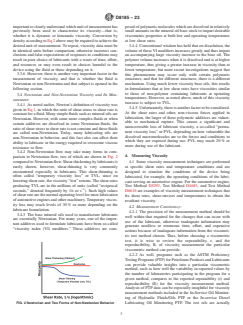
3.4.2 Non-Newtonian flow may take many forms in comparison to Newtonian flow, two of which are shown in Fig. 2 compared
to Newtonian flow. Shear-thickening by lubricants is rarely shown, however, shear-thinning is very commonly encountered
especially in lubricants. This shear-thinning is often called “temporary viscosity loss” or TVL, since on lowering shear rate, the
viscosity “lost” returns. The shear rates producing TVL are in the millions of units (called “reciprocal seconds,” denoted frequently
–1
by 1/s or s ). Such high values of shear rate are the normal operating level for most lubrication of automotive engines and other
machinery. Temporary viscosity loss may reach levels of 30 % or more depending on the lubricant formulation.
3.4.3 The base mineral oils used to manufacture lubricants are essentially Newtonian. For many years, one of the important
D8185 − 23
FIG. 2 Newtonian and Two Forms of Non-Newtonian Behavior
additives used to formulate lubricants have been so-called “viscosity index (VI) modifiers.” These additives are composed of
polymeric molecules which are dissolved in relatively small amounts in the mineral oil base stock to impart desirable viscometric
properties at both low and operating temperatures at low shear rates.
3.4.4 Conventional wisdom has held that on dissolution, the volume of these VI modifiers increases greatly and thus impart an
accompanying large viscosity increase to the base oil. The polymer volume increases when it is dissolved and is at higher
temperature, thus giving a greater increase in viscosity than at lower temperature, but more recent investigations suggest that this
phenomenon may occur only with certain polymeric structures, and that for different structures, there is a different mechanism.
Using much lower viscosity base oils, this results in formulations that at low shear rates have viscosities similar to those of
non-polymer containing lubricants at operating temperatures. However, as noted above, much of this viscosity increase is subject
to TVL.
3.4.5 Unfortunately, there is another factor to be considered. At the shear rates and other, non-viscous forces applied in lubrication,
the larger of these polymeric additives are vulnerable to mechanical rupture. This causes a significant and unrecoverable loss of
lubricant viscosity, a so-called “permanent viscosity loss” or PVL, depending on how vulnerable the dissolved macromolecules are
to the forces and conditions to which they are exposed during use. PVL may reach 20 % or more during use of the lubricant.
4. Measuring Viscosity
4.1 Some viscosity measurement techniques are performed at specific shear rates and temperature conditions and are designed to
simulate the conditions of the device being lubricated, for example, the operating conditions of the lubricant serving an automotive
engine. For the automotive engine, Test Method D5293, Test Method D4683, and Test Method D6616 are examples of viscosity
measurement techniques that fix shear rates, shear-stresses and temperatures to obtain the resultant viscosity.
4.2 Measurement Consistency:
4.2.1 The precision of the measurement method should be well within that required for the changes that can occur with use of the
lubricant, otherwise inadequate information may generate needless or erroneous time, effort, and expensive actions because of
inadequate information from the viscometric test method chosen. Thus, before choosing a viscometric test, it is wise to review the
repeatability, r, and the reproducibility, R, of viscosity measurement the particular viscometric method can provide.
4.2.2 As well, programs such as the ASTM Proficiency Testing Programs (PTP) for Petroleum Products and Lubricants can
provide valuable insights into a particular viscometric method, such as how well the variability in reported values by the number
of laboratories participating in the program for a given method, compares to the reported repeatability (r) and reproducibility (R)
for the viscosity measurement method. Analysis of PTP data can be especially insightful for viscosity measurement methods
included in the In-Service Oil Monitoring of Hydraulic Fluids/Oils PTP or the In-service Diesel Lubricating Oil Monitoring PTP.
The test oils are actually in-service oils and can provide insights on measurement variability applied to such in-service oils, rather
than fresh oil samples. If variability information is not available, periodic redundant sampling may also provide insight into
measurement method repeatability.
4.3 Specifications and Warranty Testing—Lubricants are often specified by their viscosity level at a given temperature. For
example, in the case for engine oils, the Society of Engineers (SAE) viscosity grade of the fresh, unused oil defines the criteria
by which they are identified—as SAE 20, SAE 10W-40, and others. The methods used to determine an SAE grade or lubrication
D8185 − 23
specification can be applied to a used oil to determine if the oil is still within reasonable proximity to the recommended viscosity
specification specified by the manufacturer of the equipment. Warranties may require the lubricant meet the requirements of a given
specification or the warranty is subject to voiding.
4.4 Establishing a Monitoring Plan for Viscosity Measurement:
4.4.1 Often, a series of in-service viscosity measurements are helpful and informative when taken in a systematic way. Such data
can be of interest, for example in comparison to the initial fresh oil value. Or, depending on the equipment, if there is a minimum
value below which the viscosity of the fluid should not fall or a maximum above which viscosity should not rise. Documenting
a plan for an in-service series of viscosity measurements will likely also improve one’s skill in good decision making regarding
the information generated by the series.
4.4.2 Information on specific measurement plans advice can also be found in the following ASTM methods:
4.4.2.1 Practice D6224 for monitoring of turbine oils,
4.4.2.2 Practice D4378 for mineral turbine oils, and
4.4.2.3 Guide to ASTM Test Methods for the Analysis of Petroleum Products and Lubricants.
4.4.3 Measurement plans should be designed to ensure reasonably trouble-free operation of machines and equipment. An effective
plan will often include several different pieces of information, starting with the technique to ensure a representative sample. The
amount of sample should be sufficient for the planned slate of tests. If the fluid to be analyzed is well circulated in the mechanism,
the sample can be taken at any site containing the circulating fluid—for example, the sump of an engine.
4.4.4 In some cases, lubricant viscosity may be best analyzed under temperatures and shear rates similar to in-service conditions.
Frequently, measurements are also made under conditions specified for new oils (for example, 40 °C or 100 °C at atmospheric
pressure).
4.4.5 Regardless of where the samples are obtained and under what conditions they are analyzed, consistent sampling location(s)
are important for meaningful interpretation of the results. If multiple sample ports are desired, the location at which the sample
is taken should be recorded with analysis values, together with any machine identification, and date and time. In some cases, it
is helpful to have the identification of the person collecting the sample as well.
4.4.6 For samples likely to contain volatile components/contaminants, sample-containing vessels should be chosen which are
readily and completely closable and thus suitable to consistently preserve the sample from changes that may occur between the
time the sample is taken and the measurement performed. They should also be sized to hold adequate sample for the measurement
method or methods being applied. The measurement plan should define the range of time allowed between sampling and the time
a measurement should be made to minimize sample degradation and to provide actionable data as quickly as possible. Ideally this
time should be as short as possible.
4.4.7 The level of analysis at which action should be taken should also be clearly identified as part of the measurement plan, along
with what actions should be taken, who should perform them, and the timeliness expected in completing them. In some cases,
actions may require additional measurements of other properties. This should be taken into consideration when sizing the sample
vessels. The most subjective factor of the sampling plan is the frequency of sampling. This will depend highly on the application,
the particular oil type, and take into account the following:
4.4.7.1 Cost of analyses,
4.4.7.2 Expected sample degradation rate under normal conditions,
4.4.7.3 The likelihood of equipment failure, and
4.4.7.4 Potential cost of a failure if serious degradation is not detected fast enough.
4.5 Obtaining a Representative Sample:
Nadkarni, K., Guide to ASTM Test Methods for the Analysis of Petroleum Products and Lubricants, 2007.
D8185 − 23
4.5.1 There are inherent limitations when performing any type of sampling, any one of which may affect the information obtained
on the sample. For example, a small sample for determining the viscosity of the oil in a pipeline provides a sample from only one
particular location. Therefore, when a representative sample cannot be obtained from a single port, a better approach is to collect
samples from multiple locations.
4.5.2 It is important to clearly understand that the objectives of sampling an oil or lubricant are to:
4.5.2.1 Maintain data integrity,
4.5.2.2 Maintain proper frequency of sampling,
4.5.2.3 Set proper targets and alarms for each type of equipment, and
4.5.2.4 Minimize data obstructions.
4.5.3 Moreover, another area of planning involves strategic sampling conditions that include such matters as:
4.5.3.1 Safety considerations,
4.5.3.2 Sampling location, and
4.5.3.3 Sampling tools.
(1) Hardware.
(2) Bottles.
(3) Sampling and procedure practices (Practice D4057).
4.5.4 Under all circumstances, it is necessary to follow safe and well-planned sampling procedures for each type of equipment
whether they be:
4.5.4.1 From pressurized or non-pressurized systems.
4.5.4.2 From small reservoirs (such as bearing housings).
4.5.4.3 From a drum or reservoir without a test port.
4.5.4.4 From otherwise difficult or dangerous environments.
4.5.5 All sophisticated oil analysis tools, techniques, and diagnostic processes are meaningless if the oil sample fails to effectively
represent the actual condition of the oil in service in the machine. Proper sampling procedures build the foundation of an effective
oil analysis program. Without good sampling procedures that obtain a representative quantity of the fluid or lubricant in service,
both time and money are wasted, and incorrect conclusions are likely if the data are faulty.
4.5.6 Another caution with sampling is the importance of consistency of the method and the analytical technique. It is not a good
idea to trend sample results taken using different sampling methods or different test methods.
4.6 Temperature of the Viscometric Test and Measurement:
4.6.1 Viscosity of an in-service oil will change significantly with temperature. Proper viscosity measurement requires the
instrument or technique to control the temperature of the sample appropriately during measurement. Some ASTM methods are
written for elevated temperature measurement, and others have been specifically developed to evaluate viscosity of the oil at low
temperatures. ASTM methods typically indicate the required temperature control limits during the measurement. For some time,
40 °C, 100 °C, and 150 °C have been the three most common above-ambient temperatures at which viscosity data are collected
and compared.
4.6.2 When performing different test methodologies, it is important to have an understanding that time to reach the temperature
equilibrium at which measurements will be made differs with instrument and technique. For example, the kinematic capillary
viscosity test, Test Method D445 requires the use of clear liquid baths which may need 30 min or more to become constant
D8185 − 23
depending on the temperature of measurement prior to performing a test run. As another example, with the low-temperature
dynamic viscosity Test Method D5133, the test requires cooling at a rate of 1 °C per hour after stabilizing either the liquid bath
or the refrigerated metal dry-bath at –5 °C. Not waiting sufficient time for equilibrium to take place will produce test results outside
the expected repeatability/reproducibility stated in the respective test method and operators need to be aware that such poor
practice will produce erroneous test results. Obviously, poor temperature control while taking a viscosity measurement will very
likely lead to:
4.6.2.1 Inaccurate results,
4.6.2.2 Wrong conclusions, and
4.6.2.3 Poor reproducibility and poor consistency,
4.6.3 Checking the temperature measurements devices, such as the thermometer or PT-100, against a reference on a semi-annual
basis (as a minimum) will help to ensure that the viscosity measurements being taken are accurate. Each instrument is likely to
have specific procedures for calibrating the temperature measurement and temperature control devices. ASTM methods often detail
the procedures for calibrating a device. A laboratory practicing a given form or forms of viscosity measurement should be able to
demonstrate proficiency in the performance of the calibrations to the frequency required by the ASTM method or provide a
traceable certificate to the organization which provides the calibration services.
4.7 Turnaround Time Requirements for Results:
4.7.1 Different viscosity measurement techniques can require different amounts of time to produce the data. Table 1 provides
insights on the elements that affect turnaround time for each of the viscosity measurement methods. Included in Table 1 is a brief
description of the viscometric measurement technique and the ASTM method number. The information in the Typical Location
column indicates where the viscosity measurement is most likely to be executed if the nature of measurement is crucial enough
to support investment in equipment and facilities to execute the method and personnel are trained to run the test method.
TABLE 1 Elements Affecting Turnaround for Each Viscosity Measurement Method
Description ASTM Method Temperature Typical Location Elements that Affect Turnaround
Capillary D445 Typical 40 °C and 100 °C, Oil Analysis • If the measurement is made by an automatic unit or
Viscosity Kinematic Viscosity wide range possible; –40 °C to Laboratory manual procedure.
150 °C • Temperature of measurement as a sample must equili-
brate at the test temperature. Standard temperatures such
as 40 °C and 100 °C are more likely to be ready on an au-
tomated unit or have a bath ready at temperature for a
manual measurement.
Low Temperature D2983 –55 °C to 20 °C Oil Analysis • This method requires the sample to equilibrate to tem-
Viscosity Dynamic Viscosity Laboratory perature for 16 h before measurement.
TBS HTHS Viscosity D4683 40 °C to 200 °C Oil Analysis • Non-standard temperatures will require a calibration pro-
150 °C Dynamic Viscosity Laboratory cedure
Scanning Brookfield D5133 –5 °C to –40 °C is typical, Oil Analysis • Test method requires cooling at 1 °C per hour from –5 °C
Technique Dynamic Viscosity can be run to –70 °C Laboratory to –40 °C. Test will take at least 48 h to complete.
Cold Cranking D5293 –5 °C to –30 °C, Oil Analysis • Test takes 1 h to 2 h to complete.
Simulator Dynamic Viscosity depending on viscosity grade Laboratory
Falling Needle D5478 –40 °C to 350 °C Field, • Field measurements take 2 min to 3 min.
Viscometer Dynamic Viscosity Oil Analysis • Tests completed in the lab take 2 min to 3 min after tem-
Laboratory perature equilibration of approximately 5 min to 10 min.
TBS HTHS Viscosity D6616 100 °C, see D4683 Oil Analysis • Method takes 5 min for results when unit is calibrated and
100 °C Dynamic Viscosity Laboratory ready to test.
Yield Stress and D6896 –15 °C to –40 °C, depending Oil Analysis • Depends on W grade, and the temperature of the test.
Apparent Viscosity Dynamic Viscosity on viscosity grade Laboratory Lower temperatures can require 48 h to 72 h to complete
the test.
Dynamic Viscosity D7042 –60 °C to 135 °C Oil Analysis • Test results take 1 min to 3 min, depending on precision
Stabinger Dynamic Viscosity Laboratory mode selected.
• For samples containing ferrous materials, a magnetic par-
ticle trap can be used with to improve performance by re-
moving larger fragments.
Houillon Kinematic D7279 20 °C to 120 °C Oil Analysis • A typical test takes 2 min to 3 min to complete. Sample
Viscosity Kinematic Viscosity Laboratory must equilibrate to test temperature.
Oscillating Piston D7483 –40 °C to 190 °C Oil Analysis • A typical test takes 3 min to 25 min, depending on sample
Dynamic Viscosity Dynamic Viscosity Laboratory viscosity and temperature differential at the time the new
sample is introduced to the viscometer.
Microchannel D8092 40 °C Field • Test takes approximately 1 s per centistoke.
Viscometer Kinematic Viscosity
D8185 − 23
4.7.2 Elements That Affect Turnaround column summaries assume that the instrument is properly set-up, calibrated, and ready for
sample testing. Such time to execute the test may be extended if calibration and reference procedures are not included unless
required by the method to be completed for each test. Time estimates obviously do not include time to ship the samples to a
laboratory nor do they include response time of the chosen laboratory if the measurement technique is not immediately available
at or associated with the location at which the sample is obtained.
4.7.3 The rate at which data is collected must be balanced with the information that is required for the information desired. An
in-service oil analysis plan that utilizes the most appropriate measurement technique and allows for the results to be turned around
in the appropriate time will achieve the best results with the minimum delay in appropriate response to the data’s information.
Make sure that the laboratory you choose is qualified, ISO 9001 or 17025 certified, and experienced in running the test method.
4.8 Availability of Certified Reference Fluids—Reference fluids are an important tool that a laboratory must use to ensure that the
viscosity measurement equipment and procedures of the technicians are both correct and consistent. When developing an in-service
viscosity measurement program, it may be advantageous to understand the reference fluids available and how they can be used by
a laboratory to ensure consistent results. Either the viscometer manufacturer or the ASTM committee responsible for viscosity
reference material producer can give assistance with selection of appropriate reference materials for a particular application.
Reference materials are generally classified as certified and non-certified. Here we will describe these and how they can be used.
4.8.1 Standard Viscosity Reference Fluids:
4.8.1.1 Special standardized fluids are necessary for:
(1) Viscometer calibration.
(2) Verification of a viscometer’s calibration or performance.
(3) Or in the case of non-Newtonian behavior, to appraise an instrument’s response to certain test conditions.
4.8.1.2 Certified standard viscosity reference materials should be sourced from the instrument manufacturer, the ASTM or other
group responsible for the viscometric test method, or an ISO 17025 or Guide 34 accredited laboratory capable of manufacturing
the certified standard viscosity reference material. Some methods specify qualifications of the source for these reference materials.
Calibration of various viscometers are defined in their ASTM test methods. Calibration of automated viscometers may be defined
in the corresponding ASTM method or the manufacturer’s operating manual. A calibration interval for the viscometer may be
suggested in its ASTM test method and should be further determined by each laboratory. A calibration verification interval should
also be determined to ensure accuracy of the measurement results.
4.8.1.3 Calibration verification of a viscometer by use of a standard is measured by the instrument and the resultant value
compared to the certified value of the standard. If the two values agree within an acceptable tolerance as specified by the ASTM
Test Method, then the viscometer can be put into use. If the two values do not agree within the acceptable tolerance, then the
viscometer or its manual should be checked for help or the manufacturer contacted as needed. (For manual glass capillary
viscometers, see Test Method D445, subsection 9.2 (Certified Viscosity Reference Standards) and Annex A4 (Calculation of
Acceptable Tolerance Zone (Band) to Determine Conformance with a Certified Reference Material).) The certified reference
materials are typically manufactured for an intended use and the data corresponds to the appropriate temperature and viscosity
range.
4.8.2 Non-certified Reference Fluids:
4.8.2.1 Suitable reference fluids can be chosen and used in a laboratory for a daily or periodic verification of an instrument and
these measurements can become part of a statistical quality control (SQC) system for a laboratory. This system would track
changes or drifts in the measurement system. If the measured result for a SQC sample does not fall within a defined tolerance, then
the viscometer can be calibrated again or the cause of the error found and repaired. The tolerance should be based on the ASTM
test method’s precision. Non-certified viscosity reference fluids are also available from accredited laboratories. However, many
companies use their own base stock or formulated engine oils as the non-certified reference material. When choosing a fluid to use,
some important characteristics are:
(1) The material must be homogeneous,
(2) Stable over time,
(3) Free of contaminants, and
(4) Of sufficient volume such that the material will be available for an extended time.
4.8.2.2 The viscometer manufacturer should be able to assist with selection of an appropriate material for the desired application.
D8185 − 23
Some viscometers are made to measure shear sensitive fluids or low-temperature sensitivity to gelation, and therefore a fluid with
similar non-Newtonian characteristics is preferred. For example, some reference materials are fully formulated motor oils and can
be used to verify that the applied shear rate corresponds to the method. Practice D6299 is an available resource for this further
information on this topic. Both certified and non-certified viscosity reference materials should be considered to ensure the accuracy
and consistency of the viscosity measurements of the in-service fluids.
5. Fluid Rheology; the Flow Behavior of Fluids
5.1 Previous sections of this guide have presented a somewhat simple view of flow behavior of fluids. Understanding of the
property of viscosity of a fresh lubricant is not simple, and this property becomes more complex with use of the lubricant.
Moreover, the conditions under which the lubricant is used can add further complexity to its viscous behavior. This section extends
the degree of understanding of how lubricant viscosity affects and is affected by its hours of use in an effort to remove some of
the complexity.
5.2 Newtonian Fluid Behavior:
5.2.1 As previously noted, the viscosity of a simple fluid was defined initially by Newton as the ratio of the force moving the fluid
to the rate at which the fluid moves. This ratio is apparent in a restatement of Eq 1 where Newton’s Equation is stated as:
˙
η 5 τ⁄G (3)
where:
η = is the viscosity (most often expressed in milliPascal seconds, mPa·s, or centipoise, cP),
τ = is the force moving the fluid (called shearstress, expressed experimentally in whatever units of force are applied) and
˙
= is the rate at which the fluid moves in response to the force (called shear rate and expressed in terms of reciprocal seconds,
G
–1
1/s or s ).
5.2.2 As stated earlier, an important point is that a fluid having Newtonian properties will, at constant temperature, have the same
viscosity no matter what the shear-stress or resultant shear rate is. That is, since Eq 3 is a linear equation, a plot of Eq 3 should
be a straight line with the slope equal to viscosity and a zero intercept. This is shown in Fig. 3 for a fresh Newtonian engine oil
measured at three temperatures as an example. Of further interest in Fig. 3 is the evident effect of temperature on viscosity. Not
only does the viscosity of a fluid increase with decreasing temperature but, as suggested by the slopes of the engine oil at the three
temperatures, the effect of the temperature is exponential.
5.2.3 That the principles of Newton’s equation remain constant to the physical limits of high shear rate viscometry has been shown
by studies made, for example, over a very large shear rate range by the tapered bearing simulator (TBS) viscometer. A plot of the
shear rate versus the shear-stress on several Newtonian mineral oils in the TBS viscometer over a wide range of shear rates is
FIG. 3 Viscometric Response of a Newtonian Lubricant
D8185 − 23
shown in Fig. 4. The plot again emphasizes the linearity and zero intercept associated with Newton’s concept of viscosity shown
in Eq 3 when analyzing the viscosity of Newtonian fluids.
5.3 Non-Newtonian Fluids and Their Complex Behavior:
5.3.1 Many simple fluids, such as basic mineral oils, are Newtonian. However, with some more complex fluids or when certain
additives are dissolved in some Newtonian fluids the ratio of shear stress to shear rate is not constant, and these fluids are called
non-Newtonian. Today, many lubricating oils are non-Newtonian in behavior, and this fact also can affect their ability to lubricate
and the energy required to overcome their viscous resistance to flow.
5.3.2 Non-Newtonian flow may take many forms in comparison to Newtonian flow. An important expression of such
non-Newtonian flow in lubricants is shown in Fig. 5 compared to Newtonian flow and is termed “Temporary Viscosity Loss”
(TVL). Its history is interesting.
5.3.3 Since the 1940s, some of the important additives used to formulate lubricants have been so-called “Viscosity Index (VI)
Modifiers.” These additives are composed of very large polymeric macromolecules which, in relatively small concentrations, are
dissolved in the mineral oil base stock. These macromolecules impart desirable viscometric properties at both low and operating
temperatures at low shear rates.
5.3.4 On dissolution, the molecular size of these VI modifiers increases greatly, and by doing this impart a resistance to flow that
results in an accompanying large viscosity increase to the base oil in which they are dissolved as shown in Fig. 6. Using much
lower viscosity base oils results in formulations that at low shear rates have viscosities similar to those of non-polymer-containing
lubricants at operating temperatures. This enables the formulator to use lower viscosity base oils and still achieve the same
viscosity that higher viscosity oils show at operating temperatures. However, as noted above, much of this viscosity increase is
subject to TVL. This approach has since become a well-known practice in lubricant formulations and is very common, for example,
in blending so-called “multi-grade engine oils” to meet the Society of Automotive Engineers (SAE) classifications of engine oils
such as SAE 10W-30, SAE 0W-20, and so on. Such non-Newtonian behavior and its variation with usage of the lubricant has been
the subject of much dialogue and technical publications over the last several decades.
5.3.5 Shear-thinning is very commonly encountered especially in lubricants in which VI improvers are used. The fact that this
shear-thinning is often called Temporary Viscosity Loss (TVL) is because on lowering shear rate any viscosity “lost” returns. Shear
rates producing TVL are in the millions of reciprocal seconds. Such high values of shear rate are the normal operating level for
most lubrication of automotive engines and other machinery. Temporary viscosity loss may reach levels of 30 % or more depending
on the lubricant formulation.
5.3.6 Another important reason for high technical interest in the contribution of viscosity to mineral oils by the addition of VI
improvers is particularly in regard to engine oils. Unfortunately, at the shear rates and other, non-viscous forces applied in
lubrication, the larger of these polymeric additives are vulnerable to mechanical rupture. This causes a significant and
unrecoverable loss of lubricant viscosity—a so-called “Permanent Viscosity Loss” or PVL. The amount of loss is dependent on
how vulnerable the dissolved macromolecules are to the forces and conditions to which they are exposed during use. It has been
found that PVL may reach 20 % or more during use of the lubricant.
FIG. 4 Higher Shear Rate Newtonian Response
D8185 − 23
FIG. 5 Example of a Non-Newtonian Oil Showing Classic Temporary Viscosity Loss
FIG. 6 Distention of the Polymeric Macromolecule in Mineral Oil Solution
5.3.7 Another factor that can influence the viscosity/shear rate response is the increase of viscosity due to oxidation of the
lubricant. Usually, the effect of lubricant oxidation is shown by viscosity increase which may or may not be affected by shear rate.
5.3.8 Specific to the Falling Needle Viscometer—For shear thinning fluids, drop a needle with hemispherical ends and extension
bar plus external weights (different densities with the same geometry) and measure their terminal velocities by the amount of time
taken to travel between two of the measurement lines by using a stopwatch or an automatic sensing device. The viscosities and
shear rates can be determined based on the needle velocities, the fluid and needle densities, the needle and system geometries, and
gravitational acceleration.
6. Care to Avoid Adverse Effects of Contaminants
6.1 Sampling Procedures—Sampling procedures must be developed and applied with care particularly when sampling from large
containers or sumps of machines. This is especially true when sampling from the bottom of a tank, container, or sump, where
heavier particulates and water—both heavier than the oil—will accumulate. Viscosity of the oil sample will obviously be
influenced by the water content and particulate content and perhaps even prevent a viscosity measurement from being made
depending on the instrument. It is certainly important to choose a viscometric instrument and method to avoid significant error in
the effort to obtain meaningful information.
6.2 Effect of Solids or Semi-solid Particles in the Sample:
6.2.1 Some viscosity measurement techniques, such as capillary viscometry, can be sensitive to the presence of particulates in a
sample and may require the sample to be filtered prior to analysis. Depending on the purpose of the analysis, filtration prior to
measurement may be an acceptable practice. Alternatively, obtaining the viscosity of both the unfiltered and filtered oil sample may
provide desirable information. On the other hand, it may be of primary interest to analyze the unfiltered sample to learn about the
cause or character of the particles.
Additional resources available from Trico Corporation, 1235 Hickory St., Pewaukee WI 53072, http://www.tricocorp.com.
D8185 − 23
6.2.2 Once more, it is informative to consider why monitoring oil viscosity is very important. Most lubricated, load bearing
moving surfaces are separated by a lubrication film thickness of 10 μm or less. Many of these loaded surfaces in near-contact are
prevented from contacting only by the viscosity of the lubricant at that temperature. This viscosity-imposed separation is dependent
on the viscosity of the continuously supplied lubricating oil forced into that zone of separation. If the lubricant cannot escape the
compressive pressure fast enough, the surfaces cannot come into contact because the lubricant cannot be compressed beyond a
certain thickness, again dependent upon the lubricant. Especially for systems such as engines or high speed turbochargers,
maintaining the correct oil viscosity is quite critical. Any significant decrease of oil viscosity may permit contact of the two
surfaces in relative motion and cause damage. In high-pressure hydraulic syste
...