

ASTM F2918-11(2023)
(Test Method)Standard Test Method for Weighing a Bicycle
General Information
- Abstract
SIGNIFICANCE AND USE
5.1 The minimum and as-sold weight of a bicycle are properties used by consumers to evaluate bicycles. The weight may also be used for specifications, manufacturing standards, and quality control.
SCOPE
1.1 This test method covers requirements for weighing and marketing bicycles, including all adult, and childrens bicycles.
1.2 This standard may contain test methods that do not entirely simulate real life situations. The test methods are designed to give reproducible results in a laboratory and, thereby, a means for product comparison.
1.3 The values stated in SI units are to be regarded as standard. No other units of measurement are included in this standard.
1.4 This standard does not purport to address all of the safety concerns, if any, associated with its use. It is the responsibility of the user of this standard to establish appropriate safety, health, and environmental practices and determine the applicability of regulatory limitations prior to use.
1.5 This international standard was developed in accordance with internationally recognized principles on standardization established in the Decision on Principles for the Development of International Standards, Guides and Recommendations issued by the World Trade Organization Technical Barriers to Trade (TBT) Committee.
- Status
- Published
- Publication Date
- 31-Jul-2023
- Technical Committee
- F08 - Sports Equipment, Playing Surfaces, and Facilities
- Drafting Committee
- F08.10 - Bicycles

Overview
ASTM F2918-11(2023) - Standard Test Method for Weighing a Bicycle provides a reproducible laboratory method for determining and reporting the weight of both adult and children's bicycles. Developed by ASTM International, this standard defines procedures to measure and report two key weights: the minimum bicycle weight, which consists of the bicycle ready to ride (excluding pedals), and the as-sold bicycle weight, which includes all original equipment except packaging and aftermarket components. Using standardized weighing methods allows for accurate product comparisons, facilitates quality control, and meets consumer expectations, especially when the weight is a major consideration in bicycle selection.
Key Topics
- Test Methods: Defines step-by-step procedures for weighing bicycles using calibrated scales, including explicit instructions for minimum and as-sold weight determination.
- Terminology: Clarifies essential terms like minimum bicycle weight, as-sold bicycle weight, bicycle frame, and size to ensure consistency across test reports and marketing materials.
- Sampling Requirements: Requires random selection of new, unused bicycles directly from production lots, ensuring that tested samples are representative of the products sold to consumers.
- Test Apparatus: Specifies the use of calibrated scales compliant with recognized calibration standards (such as ASTM E4).
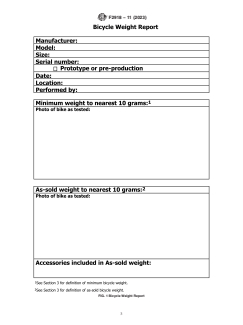
- Reporting Requirements: Outlines detailed information to be documented, including manufacturer details, serial numbers, dates, model/size, digital photos, and comprehensive component listings.
- Reproducibility and Precision: Emphasizes the importance of laboratory reproducibility-tests are designed to yield results within 1% precision, supporting reliable product comparison and regulatory compliance.
Applications
ASTM F2918-11(2023) is essential for:
- Manufacturers: Enabling accurate and consistent reporting of bicycle weights for product specifications, marketing materials, and internal quality control.
- Retailers and Marketers: Providing transparent and comparable weight information to assist consumers in their purchasing decisions.
- Testing Laboratories: Ensuring that product evaluations conform to international standards, particularly relevant for import/export compliance.
- Product Development: Assisting engineering and design teams in evaluating prototypes and production models against stated weight targets.
- Consumer Advocacy and Product Comparison: Supporting consumer organizations and review platforms in providing objective, verifiable data regarding bicycle weights.
- Regulatory Compliance: Satisfying requirements of contracts or government tenders that reference ASTM standards for sports equipment and bicycles.
Related Standards
- ASTM E4: Practices for Force Calibration and Verification of Testing Machines, referenced for ensuring calibrated scales meet required accuracy.
- Other ASTM Bicycle Safety and Performance Standards: Such as ASTM F2043 (performance specifications for bicycles), relevant when integrating weight as a comparative property.
- ISO Bicycle Standards: International standards related to bicycle safety, testing, and labeling, which may intersect with or reference ASTM methods.
Keywords: bicycle weight, ASTM F2918, minimum bicycle weight, as-sold bicycle weight, bicycle testing standard, bicycle quality control, weighing methods, sports equipment standards
Adopting ASTM F2918-11(2023) helps ensure precise, consistent, and internationally recognized methods for bicycle weight determination-enhancing the reliability of product information and supporting both manufacturers and consumers across the cycling industry.
Relations
- Effective Date
- 01-Jun-2014
- Effective Date
- 01-Jun-2010
- Effective Date
- 01-Nov-2009
- Effective Date
- 01-Apr-2009
- Effective Date
- 01-Dec-2008
- Effective Date
- 01-Jan-2007
- Effective Date
- 10-Aug-2003
- Effective Date
- 10-Nov-2002
- Effective Date
- 10-Apr-2001
- Effective Date
- 10-Apr-2001
Get Certified
Connect with accredited certification bodies for this standard

TÜV Rheinland
TÜV Rheinland is a leading international provider of technical services.

TÜV SÜD
TÜV SÜD is a trusted partner of choice for safety, security and sustainability solutions.

DEKRA Certification Inc.
DEKRA US certification services.
Sponsored listings
Frequently Asked Questions
ASTM F2918-11(2023) is a standard published by ASTM International. Its full title is "Standard Test Method for Weighing a Bicycle". This standard covers: SIGNIFICANCE AND USE 5.1 The minimum and as-sold weight of a bicycle are properties used by consumers to evaluate bicycles. The weight may also be used for specifications, manufacturing standards, and quality control. SCOPE 1.1 This test method covers requirements for weighing and marketing bicycles, including all adult, and childrens bicycles. 1.2 This standard may contain test methods that do not entirely simulate real life situations. The test methods are designed to give reproducible results in a laboratory and, thereby, a means for product comparison. 1.3 The values stated in SI units are to be regarded as standard. No other units of measurement are included in this standard. 1.4 This standard does not purport to address all of the safety concerns, if any, associated with its use. It is the responsibility of the user of this standard to establish appropriate safety, health, and environmental practices and determine the applicability of regulatory limitations prior to use. 1.5 This international standard was developed in accordance with internationally recognized principles on standardization established in the Decision on Principles for the Development of International Standards, Guides and Recommendations issued by the World Trade Organization Technical Barriers to Trade (TBT) Committee.
SIGNIFICANCE AND USE 5.1 The minimum and as-sold weight of a bicycle are properties used by consumers to evaluate bicycles. The weight may also be used for specifications, manufacturing standards, and quality control. SCOPE 1.1 This test method covers requirements for weighing and marketing bicycles, including all adult, and childrens bicycles. 1.2 This standard may contain test methods that do not entirely simulate real life situations. The test methods are designed to give reproducible results in a laboratory and, thereby, a means for product comparison. 1.3 The values stated in SI units are to be regarded as standard. No other units of measurement are included in this standard. 1.4 This standard does not purport to address all of the safety concerns, if any, associated with its use. It is the responsibility of the user of this standard to establish appropriate safety, health, and environmental practices and determine the applicability of regulatory limitations prior to use. 1.5 This international standard was developed in accordance with internationally recognized principles on standardization established in the Decision on Principles for the Development of International Standards, Guides and Recommendations issued by the World Trade Organization Technical Barriers to Trade (TBT) Committee.
ASTM F2918-11(2023) is classified under the following ICS (International Classification for Standards) categories: 43.150 - Cycles. The ICS classification helps identify the subject area and facilitates finding related standards.
ASTM F2918-11(2023) has the following relationships with other standards: It is inter standard links to ASTM E4-14, ASTM E4-10, ASTM E4-09a, ASTM E4-09, ASTM E4-08, ASTM E4-07, ASTM E4-03, ASTM E4-02, ASTM E4-01, ASTM E4-99. Understanding these relationships helps ensure you are using the most current and applicable version of the standard.
ASTM F2918-11(2023) is available in PDF format for immediate download after purchase. The document can be added to your cart and obtained through the secure checkout process. Digital delivery ensures instant access to the complete standard document.
Standards Content (Sample)
This international standard was developed in accordance with internationally recognized principles on standardization established in the Decision on Principles for the
Development of International Standards, Guides and Recommendations issued by the World Trade Organization Technical Barriers to Trade (TBT) Committee.
Designation: F2918 − 11 (Reapproved 2023) An American National Standard
Standard Test Method for
Weighing a Bicycle
This standard is issued under the fixed designation F2918; the number immediately following the designation indicates the year of
original adoption or, in the case of revision, the year of last revision. A number in parentheses indicates the year of last reapproval. A
superscript epsilon (´) indicates an editorial change since the last revision or reapproval.
1. Scope minus any packaging materials and aftermarket accessories.
Examples of potential original equipment includes: kickstand,
1.1 This test method covers requirements for weighing and
reflectors, chain guards, racks, fenders, pedals, water bottles
marketing bicycles, including all adult, and childrens bicycles.
and cages, etc.
1.2 This standard may contain test methods that do not
3.1.3 bicycle, n—two-wheeled, single-track, articulated ve-
entirely simulate real life situations. The test methods are
hicle that is solely human powered.
designed to give reproducible results in a laboratory and,
thereby, a means for product comparison. 3.1.4 bicycle frame, n—the structural member that supports
the seat with rear connection for the rear wheel, front connec-
1.3 The values stated in SI units are to be regarded as
tion via the head tube for the fork and lower connection for the
standard. No other units of measurement are included in this
crank/pedal assembly.
standard.
3.1.5 minimum bicycle weight, n—the combined weight of
1.4 This standard does not purport to address all of the
the frame and components necessary to ride the bicycle, and
safety concerns, if any, associated with its use. It is the
change gears (if bicycle is multi-speed), minus the pedals.
responsibility of the user of this standard to establish appro-
Handlebars, stem, brakes, seat, seatpost, and any handlebar
priate safety, health, and environmental practices and deter-
coverings are to be included.
mine the applicability of regulatory limitations prior to use.
1.5 This international standard was developed in accor-
3.1.6 size, n—the marketed representation of the bicycle
dance with internationally recognized principles on standard-
frame dimensions that may or may not be determinable from
ization established in the Decision on Principles for the
measurement. Examples of sizes are: small, medium, large, 19
Development of International Standards, Guides and Recom-
inch, 21 inch, 56 cm, 58 cm.
mendations issued by the World Trade Organization Technical
Barriers to Trade (TBT) Committee.
4. Summary of Test Method
4.1 Representative samples of bicycles are weighed on a
2. Referenced Documents
calibrated scale, using two methods.
2.1 ASTM Standards:
E4 Practices for Force Calibration and Verification of Test-
5. Significance and Use
ing Machines
5.1 The minimum and as-sold weight of a bicycle are
3. Terminology
properties used by consumers to evaluate bicycles. The weight
may also be used for specifications, manufacturing standards,
3.1 Definitions of Terms Specific to This Standard:
and quality control.
3.1.1 aftermarket, n—components intended to be fitted to a
bicycle but not included as original equipment with the bicycle.
6. Apparatus
3.1.2 as-sold bicycle weight, n—the weight of the complete
bicycle with all original equipment as sold to the customer
6.1 Calibrated Scale, within the weight range of the bicycle.
7. Sampling, Test Specimens, and Test Units
This test method is under the jurisdiction of ASTM Committee F08 on Sports
Equipment, Playing Surfaces, and Facilities and is the direct responsibility of
7.1 Test specimens shall be new and in unused condition,
Subcommittee F08.10 on Bicycles.
selected randomly from a production lot of a given model of
Current edition approved Aug. 1, 2023. Published August 2023. Originally
bicycle. The bicycle shall conform in all respects to the
approved in 2011. Last previous edition approved in 2015 as F2918 – 11 (2015).
DOI: 10.1520/F2918-11R23.
manufacturer’s specifications for the model to be tested with all
For referenced ASTM standards, visit the ASTM website, www.a
...