

ASTM C403/C403M-23
(Test Method)Standard Test Method for Time of Setting of Concrete Mixtures by Penetration Resistance
General Information
- Abstract
SIGNIFICANCE AND USE
5.1 Since the setting of concrete is a gradual process, any definition of time of setting must necessarily be arbitrary. In this test method, the times required for the mortar to reach specified values of resistance to penetration are used to define times of setting.
5.2 This test method can be used to determine the effects of variables, such as water content; brand, type and amount of cementitious material; or admixtures, upon the time of setting of concrete. This test method may also be used to determine compliance with specified time-of-setting requirements.
5.3 This test method may also be applied to prepared mortars and grouts. However, when the setting time of concrete is desired, the test shall be performed on mortar sieved from the concrete mixture and not on a prepared mortar intended to simulate the mortar fraction of the concrete; it has been shown that the initial and final setting times may be increased when using the prepared mortar.
SCOPE
1.1 This test method covers the determination of the time of setting of concrete, with slump greater than zero, by means of penetration resistance measurements on mortar sieved from the concrete mixture.
1.2 This test method is suitable for use only when tests of the mortar fraction will provide the information required.
1.3 This test method may also be applied to prepared mortars and grouts.
1.4 This test method is applicable under controlled laboratory conditions, as well as under field conditions.
1.5 The values stated in either SI units or inch-pound units are to be regarded separately as standard. The values stated in each system may not be exact equivalents; therefore, each system shall be used independently of the other. Combining values from the two systems may result in non-conformance with the standard.
1.6 The text of this standard refers to notes and footnotes that provide explanatory material. These notes and footnotes (excluding those in tables and figures) shall not be considered as requirements of the standard.
1.7 This standard does not purport to address all of the safety concerns, if any, associated with its use. It is the responsibility of the user of this standard to establish appropriate safety, health, and environmental practices and determine the applicability of regulatory limitations prior to use.
1.8 This international standard was developed in accordance with internationally recognized principles on standardization established in the Decision on Principles for the Development of International Standards, Guides and Recommendations issued by the World Trade Organization Technical Barriers to Trade (TBT) Committee.
- Status
- Published
- Publication Date
- 31-May-2023
- Technical Committee
- C09 - Concrete and Concrete Aggregates
- Drafting Committee
- C09.23 - Chemical Admixtures
Buy Documents
ASTM C403/C403M-23 - Standard Test Method for Time of Setting of Concrete Mixtures by Penetration Resistance
REDLINE ASTM C403/C403M-23 - Standard Test Method for Time of Setting of Concrete Mixtures by Penetration Resistance
Overview
ASTM C403/C403M-23 is the Standard Test Method for Time of Setting of Concrete Mixtures by Penetration Resistance, developed by ASTM International. This method measures the time it takes for mortar sieved from a fresh concrete mixture with slump greater than zero to achieve specified penetration resistance values, which correspond to the initial and final setting times. This standard is widely used in both laboratory and field conditions for assessing concrete, mortar, and grout setting behavior, supporting quality control, research, and compliance in construction projects.
Key Topics
- Penetration Resistance Measurement: The test determines the time of setting by plotting mortar’s resistance to penetration by standard needles over time. Initial and final setting times are defined as the points where the mortar reaches pre-established penetration values.
- Sample Preparation: Mortar is obtained by wet-sieving fresh concrete and tested in a rigid, non-absorbent container. Prepared mortars and grouts may also be evaluated, but for concrete, only mortar sieved from the mix should be used.
- Testing Conditions: The method applies to both controlled laboratory environments and field conditions. Ambient temperature and storage conditions are noted, as they influence setting characteristics.
- Influence of Variables: Water content, cement type, cementitious material amount, and chemical admixtures can all affect setting times. This method enables systematic comparison of such variables.
- Data Analysis: Results are charted to establish the time when penetration resistance matches fixed benchmarks, specifically 500 psi (3.5 MPa) for initial set and 4000 psi (27.6 MPa) for final set. Linear or log-log regression analysis may be used for accurate determination.
- Reporting: The standard requires detailed reporting of materials, admixtures, air content, slump, temperature conditions, and clear plots of penetration resistance vs. time.
Applications
- Construction Quality Control: Ensuring concrete meets time-of-setting specifications for placement, finishing, and curing.
- Mixture Optimization: Evaluating how changes in mix design, such as water/cement ratios or use of admixtures, influence setting characteristics.
- Materials Research: Comparing the performance of different cementitious materials or admixtures in concrete, mortar, and grout formulations.
- Specification Compliance: Conformance with contract requirements related to setting times in infrastructure and commercial construction projects.
- Site Assessments: Field testing allows real-time measurement of setting behavior under actual site conditions, supporting decision-making for project timelines.
Related Standards
- ASTM C125 – Terminology Relating to Concrete and Concrete Aggregates
- ASTM C143/C143M – Test Method for Slump of Hydraulic-Cement Concrete
- ASTM C172/C172M – Practice for Sampling Freshly Mixed Concrete
- ASTM C173/C173M – Test Method for Air Content of Freshly Mixed Concrete by the Volumetric Method
- ASTM C231/C231M – Test Method for Air Content of Freshly Mixed Concrete by the Pressure Method
- ASTM C192/C192M – Practice for Making and Curing Concrete Test Specimens in the Laboratory
- ASTM C670 – Practice for Preparing Precision and Bias Statements for Test Methods for Construction Materials
- ASTM E11 – Specification for Woven Wire Test Sieve Cloth and Test Sieves
- ASTM E2251 – Specification for Liquid-in-Glass ASTM Thermometers with Low-Hazard Precision Liquids
Practical Value
ASTM C403/C403M-23 provides a standardized method to reliably measure and report the time of setting for concrete mixtures, critical for ensuring strength development, scheduling, and overall quality on construction sites. This test supports engineers and laboratory technicians in optimizing mixes and verifying compliance with industry and project specifications. Accurate determination of initial and final set times is essential for proper finishing, formwork removal, and subsequent construction activities, making this standard an indispensable tool in concrete technology and construction quality assurance.
Relations
- Effective Date
- 01-Feb-2024
- Effective Date
- 01-Jan-2024
- Effective Date
- 01-Jan-2024
- Effective Date
- 01-Jan-2024
- Effective Date
- 01-Sep-2023
- Effective Date
- 15-Dec-2019
- Effective Date
- 01-Jan-2019
- Effective Date
- 01-Oct-2018
- Effective Date
- 01-Jul-2018
- Effective Date
- 01-Jan-2018
- Effective Date
- 15-Dec-2016
- Effective Date
- 01-Feb-2016
- Effective Date
- 15-Dec-2015
- Effective Date
- 01-Jul-2015
- Effective Date
- 01-Feb-2015
Buy Documents
ASTM C403/C403M-23 - Standard Test Method for Time of Setting of Concrete Mixtures by Penetration Resistance
REDLINE ASTM C403/C403M-23 - Standard Test Method for Time of Setting of Concrete Mixtures by Penetration Resistance
Get Certified
Connect with accredited certification bodies for this standard

DIBt (Deutsches Institut für Bautechnik)
German Institute for Building Technology.
DIN CERTCO
DIN Group product certification.

Aboma Certification B.V.
Specialized in construction, metal, and transport sectors.
Sponsored listings
Frequently Asked Questions
ASTM C403/C403M-23 is a standard published by ASTM International. Its full title is "Standard Test Method for Time of Setting of Concrete Mixtures by Penetration Resistance". This standard covers: SIGNIFICANCE AND USE 5.1 Since the setting of concrete is a gradual process, any definition of time of setting must necessarily be arbitrary. In this test method, the times required for the mortar to reach specified values of resistance to penetration are used to define times of setting. 5.2 This test method can be used to determine the effects of variables, such as water content; brand, type and amount of cementitious material; or admixtures, upon the time of setting of concrete. This test method may also be used to determine compliance with specified time-of-setting requirements. 5.3 This test method may also be applied to prepared mortars and grouts. However, when the setting time of concrete is desired, the test shall be performed on mortar sieved from the concrete mixture and not on a prepared mortar intended to simulate the mortar fraction of the concrete; it has been shown that the initial and final setting times may be increased when using the prepared mortar. SCOPE 1.1 This test method covers the determination of the time of setting of concrete, with slump greater than zero, by means of penetration resistance measurements on mortar sieved from the concrete mixture. 1.2 This test method is suitable for use only when tests of the mortar fraction will provide the information required. 1.3 This test method may also be applied to prepared mortars and grouts. 1.4 This test method is applicable under controlled laboratory conditions, as well as under field conditions. 1.5 The values stated in either SI units or inch-pound units are to be regarded separately as standard. The values stated in each system may not be exact equivalents; therefore, each system shall be used independently of the other. Combining values from the two systems may result in non-conformance with the standard. 1.6 The text of this standard refers to notes and footnotes that provide explanatory material. These notes and footnotes (excluding those in tables and figures) shall not be considered as requirements of the standard. 1.7 This standard does not purport to address all of the safety concerns, if any, associated with its use. It is the responsibility of the user of this standard to establish appropriate safety, health, and environmental practices and determine the applicability of regulatory limitations prior to use. 1.8 This international standard was developed in accordance with internationally recognized principles on standardization established in the Decision on Principles for the Development of International Standards, Guides and Recommendations issued by the World Trade Organization Technical Barriers to Trade (TBT) Committee.
SIGNIFICANCE AND USE 5.1 Since the setting of concrete is a gradual process, any definition of time of setting must necessarily be arbitrary. In this test method, the times required for the mortar to reach specified values of resistance to penetration are used to define times of setting. 5.2 This test method can be used to determine the effects of variables, such as water content; brand, type and amount of cementitious material; or admixtures, upon the time of setting of concrete. This test method may also be used to determine compliance with specified time-of-setting requirements. 5.3 This test method may also be applied to prepared mortars and grouts. However, when the setting time of concrete is desired, the test shall be performed on mortar sieved from the concrete mixture and not on a prepared mortar intended to simulate the mortar fraction of the concrete; it has been shown that the initial and final setting times may be increased when using the prepared mortar. SCOPE 1.1 This test method covers the determination of the time of setting of concrete, with slump greater than zero, by means of penetration resistance measurements on mortar sieved from the concrete mixture. 1.2 This test method is suitable for use only when tests of the mortar fraction will provide the information required. 1.3 This test method may also be applied to prepared mortars and grouts. 1.4 This test method is applicable under controlled laboratory conditions, as well as under field conditions. 1.5 The values stated in either SI units or inch-pound units are to be regarded separately as standard. The values stated in each system may not be exact equivalents; therefore, each system shall be used independently of the other. Combining values from the two systems may result in non-conformance with the standard. 1.6 The text of this standard refers to notes and footnotes that provide explanatory material. These notes and footnotes (excluding those in tables and figures) shall not be considered as requirements of the standard. 1.7 This standard does not purport to address all of the safety concerns, if any, associated with its use. It is the responsibility of the user of this standard to establish appropriate safety, health, and environmental practices and determine the applicability of regulatory limitations prior to use. 1.8 This international standard was developed in accordance with internationally recognized principles on standardization established in the Decision on Principles for the Development of International Standards, Guides and Recommendations issued by the World Trade Organization Technical Barriers to Trade (TBT) Committee.
ASTM C403/C403M-23 is classified under the following ICS (International Classification for Standards) categories: 91.100.30 - Concrete and concrete products. The ICS classification helps identify the subject area and facilitates finding related standards.
ASTM C403/C403M-23 has the following relationships with other standards: It is inter standard links to ASTM C670-24a, ASTM C231/C231M-24, ASTM C173/C173M-24, ASTM C670-24, ASTM C173/C173M-23, ASTM C125-19a, ASTM C125-19, ASTM C125-18b, ASTM C125-18a, ASTM C125-18, ASTM C125-16, ASTM C192/C192M-16, ASTM C125-15b, ASTM C125-15a, ASTM C125-15. Understanding these relationships helps ensure you are using the most current and applicable version of the standard.
ASTM C403/C403M-23 is available in PDF format for immediate download after purchase. The document can be added to your cart and obtained through the secure checkout process. Digital delivery ensures instant access to the complete standard document.
Standards Content (Sample)
This international standard was developed in accordance with internationally recognized principles on standardization established in the Decision on Principles for the
Development of International Standards, Guides and Recommendations issued by the World Trade Organization Technical Barriers to Trade (TBT) Committee.
Designation: C403/C403M − 23
Standard Test Method for
Time of Setting of Concrete Mixtures by Penetration
Resistance
This standard is issued under the fixed designation C403/C403M; the number immediately following the designation indicates the year
of original adoption or, in the case of revision, the year of last revision. A number in parentheses indicates the year of last reapproval.
A superscript epsilon (´) indicates an editorial change since the last revision or reapproval.
This standard has been approved for use by agencies of the U.S. Department of Defense.
1. Scope* 2. Referenced Documents
1.1 This test method covers the determination of the time of 2.1 ASTM Standards:
setting of concrete, with slump greater than zero, by means of C125 Terminology Relating to Concrete and Concrete Ag-
penetration resistance measurements on mortar sieved from the gregates
concrete mixture. C143/C143M Test Method for Slump of Hydraulic-Cement
Concrete
1.2 This test method is suitable for use only when tests of
C172/C172M Practice for Sampling Freshly Mixed Con-
the mortar fraction will provide the information required.
crete
1.3 This test method may also be applied to prepared
C173/C173M Test Method for Air Content of Freshly Mixed
mortars and grouts.
Concrete by the Volumetric Method
1.4 This test method is applicable under controlled labora- C192/C192M Practice for Making and Curing Concrete Test
Specimens in the Laboratory
tory conditions, as well as under field conditions.
C231/C231M Test Method for Air Content of Freshly Mixed
1.5 The values stated in either SI units or inch-pound units
Concrete by the Pressure Method
are to be regarded separately as standard. The values stated in
C670 Practice for Preparing Precision and Bias Statements
each system may not be exact equivalents; therefore, each
for Test Methods for Construction Materials
system shall be used independently of the other. Combining
C802 Practice for Conducting an Interlaboratory Test Pro-
values from the two systems may result in non-conformance
gram to Determine the Precision of Test Methods for
with the standard.
Construction Materials
1.6 The text of this standard refers to notes and footnotes
D1558 Test Method for Moisture Content Penetration Resis-
that provide explanatory material. These notes and footnotes
tance Relationships of Fine-Grained Soils (Withdrawn
(excluding those in tables and figures) shall not be considered
2019)
as requirements of the standard.
E11 Specification for Woven Wire Test Sieve Cloth and Test
1.7 This standard does not purport to address all of the Sieves
safety concerns, if any, associated with its use. It is the E2251 Specification for Liquid-in-Glass ASTM Thermom-
responsibility of the user of this standard to establish appro- eters with Low-Hazard Precision Liquids
priate safety, health, and environmental practices and deter-
3. Terminology
mine the applicability of regulatory limitations prior to use.
1.8 This international standard was developed in accor-
3.1 Definitions—Definitions are given in Terminology
dance with internationally recognized principles on standard-
C125.
ization established in the Decision on Principles for the
Development of International Standards, Guides and Recom-
4. Summary of Test Method
mendations issued by the World Trade Organization Technical
4.1 A mortar sample is obtained by sieving a representative
Barriers to Trade (TBT) Committee.
sample of fresh concrete. The mortar is placed in a container
1 2
This test method is under the jurisdiction of ASTM Committee C09 on For referenced ASTM standards, visit the ASTM website, www.astm.org, or
Concrete and Concrete Aggregatesand is the direct responsibility of Subcommittee contact ASTM Customer Service at service@astm.org. For Annual Book of ASTM
C09.23 on Chemical Admixtures. Standards volume information, refer to the standard’s Document Summary page on
Current edition approved June 1, 2023. Published June 2023. Originally the ASTM website.
approved in 1957. Last previous edition approved in 2016 as C403/C403M–16. The last approved version of this historical standard is referenced on
DOI: 10.1520/C0403_C0403M-23. www.astm.org.
*A Summary of Changes section appears at the end of this standard
Copyright © ASTM International, 100 Barr Harbor Drive, PO Box C700, West Conshohocken, PA 19428-2959. United States
C403/C403M − 23
and stored at a specified ambient temperature. At regular time 6.6 Thermometer—The thermometer shall be capable of
intervals, the resistance of the mortar to penetration by stan- measuring the temperature of the fresh mortar to 61 °F [60.5
dard needles is measured. From a plot of penetration resistance °C]. ASTM liquid-in-glass thermometers having a temperature
versus elapsed time, the times of initial and final setting are range from 0 °F to 120 °F [−20 °C to 50 °C], and conforming
determined. to the requirements of Thermometer 97F (or 97C) as prescribed
in Specification E2251 are satisfactory. Other thermometers of
5. Significance and Use
the required accuracy, including the metal immersion type, are
5.1 Since the setting of concrete is a gradual process, any
acceptable.
definition of time of setting must necessarily be arbitrary. In
this test method, the times required for the mortar to reach 7. Sampling, Test Specimens, and Test Units
specified values of resistance to penetration are used to define
7.1 For tests under field conditions, prepare three specimens
times of setting.
from each sample of concrete.
5.2 This test method can be used to determine the effects of
7.2 For tests under laboratory conditions, the requirements
variables, such as water content; brand, type and amount of
depend upon the purpose of the tests.
cementitious material; or admixtures, upon the time of setting
7.2.1 For testing to prove compliance of a material with
of concrete. This test method may also be used to determine
performance requirements, make at least three separate con-
compliance with specified time-of-setting requirements.
crete batches for each variable under investigation. Perform
5.3 This test method may also be applied to prepared
one time of setting test on each batch. Make an equal number
mortars and grouts. However, when the setting time of concrete
of batches for each variable on any one day. When it is
is desired, the test shall be performed on mortar sieved from
impossible to perform at least one test for each variable on any
the concrete mixture and not on a prepared mortar intended to
one day, mix the entire series of batches in as few days as
simulate the mortar fraction of the concrete; it has been shown
possible, and repeat one of the mixtures each day as a standard
that the initial and final setting times may be increased when
for comparison.
using the prepared mortar.
7.2.2 For other tests, prepare three test specimens from one
batch of concrete for each test variable.
6. Apparatus
7.3 Record the time at which initial contact was made
6.1 Containers for Mortar Specimens—The containers shall
between cement and mixing water.
be rigid, watertight, nonabsorptive, free of oil or grease, and
either cylindrical or rectangular in cross section. Mortar
7.4 For tests under field conditions, obtain a representative
surface area shall be provided for ten undisturbed readings of
sample of the fresh concrete in accordance with Practice
penetration resistance in accordance with clear distance re-
C172/C172M. For tests under laboratory conditions, make the
quirements specified in Procedure. The lateral dimension shall
concrete in accordance with Practice C192/C192M. Determine
be at least 6 in. [150 mm] and the height at least 6 in. [150
and record the slump (Test Method C143/C143M) and air
mm].
content (Test Method C173/C173M or C231/C231M) of the
fresh concrete.
6.2 Penetration Needles—Needles shall be provided which
can be attached to the loading apparatus and which have the
7.5 From the concrete not used in the slump and air content
1 1 1 1 1
following bearing areas: 1, ⁄2, ⁄4, ⁄10, ⁄20, and ⁄40 in. [645,
tests, select a representative portion of sufficient volume to
323, 161, 65, 32, and 16 mm ]. Each needle shank shall be
provide enough mortar to fill the test container, or containers,
scribed circumferentially at a distance 1 in. [25 mm] from the
to a depth of at least 5 ⁄2 in. [140 mm].
2 2
bearing area. The length of the ⁄40 in. [16-mm ] needle shall
7.6 Using the procedure in Practice C172/C172M, obtain a
be not more than 3 ⁄2 in. [90 mm].
mortar sample by wet-sieving the selected portion of concrete
6.3 Loading Apparatus—A device shall be provided to
through a 4.75-mm sieve and onto a nonabsorptive surface.
measure the force required to cause penetration of the needles.
7.7 Thoroughly remix the mortar by hand methods on the
The device shall be capable of measuring the penetration force
nonabsorptive surface. Measure and record the temperature of
with an accuracy of 62 lbf [10 N] and shall have a capacity of
the mortar. Place the mortar in the container, or containers,
at least 130 lbf [600 N].
using a single layer. Consolidate the mortar to eliminate air
NOTE 1—Suitable loading apparatus can be of the spring-reaction type
pockets in the specimen and level the top surface. This may be
as described in Test Method D1558, or of other types with a calibrated
accomplished by rocking the container back and forth on a
force measuring device, such as an electronic load cell or a hydraulic
solid surface, by tapping the sides of the container with the
pressure gage.
tamping rod, by rodding the mortar, or by placing the container
6.4 Tamping Rod—The tamping rod shall be a round,
on a vibrating table (see Note 2). If rodding is used, rod the
straight, steel rod ⁄8 in. [16 mm] in diameter and approxi-
mortar with the hemispherical end of the tamping rod. Rod the
mately 24 in. [600 mm] in length, having the tamping end or
2 2
mortar once for each 1 in. [645 mm ] of top surface area of
both ends rounded to a hemispherical tip, the diameter of
the specimen and distribute the strokes uniformly over the
which is ⁄8 in. [16 mm].
cross section of the specimen. After completion of the rodding,
6.5 Pipet—A pipet or other suitable instrument shall be used
for drawing off bleed water from the surface of the test
specimen. Detailed requirements for this sieve are given in Specification E11.
C403/C403M − 23
tap the sides of the containers lightly with the tamping rod to
close voids left by the tamping rod and to further level the
surface of the specimen. Upon completion of specimen
preparation, the mortar surface shall be at least ⁄2 in. [10 mm]
below the top edge of the container to provide space for the
collection and removal of bleed water and to avoid contact
between the mortar surface and the protective covering speci-
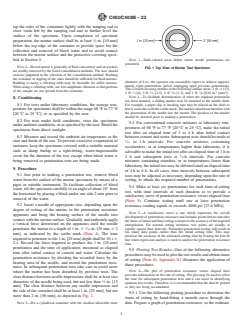
NOTE 1—Dark-colored areas define where needle penetrations are
fied in Section 8.
permitted.
NOTE 2—Sieved mortar is generally of fluid consistency and air pockets
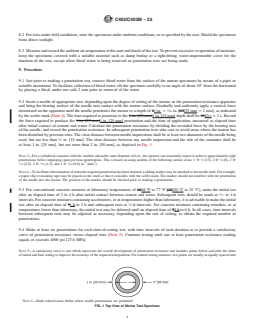
FIG. 1 Top View of Mortar Test Specimen
are readily removed by the listed consolidation methods. The user should
exercise judgment in the selection of the consolidation method. Rocking
the container or tapping of the sides should be sufficient for fluid mortars.
diameter of 6 in., the operator can reasonably expect to achieve approxi-
Rodding or using a vibrating table may be desirable for stiffer mortars.
mately eight penetrations before impinging upon previous penetrations.
When using a vibrating table, use low-amplitude vibration so that portions
This is based on using needles of the following surface areas: 1 @ ⁄2 [13],
of the sample are not ejected from the container.
2 2
1 1 1 1
2 @ ⁄4 [6], 2 @ ⁄10 [2.5], 2 @ ⁄20 [1.3], and 1 @ ⁄40 [0.6] in. [mm ].
NOTE 4—To facilitate determination of when the required penetration
8. Conditioning
has been attained, a sliding marker may be attached to the needle shaft.
8.1 For tests under laboratory conditions, the storage tem-
For example, a paper clip or masking tape may be placed on the shaft so
perature for specimens shall be within the range 68 °F to 77 °F that it coincides with the scribe mark. The marker should not interfere with
the penetration of the needle into the mortar. The position of the marker
[20 °C to 25 °C], or as specified by the user.
should be checked prior to making a penetration.
8.2 For tests under field conditions, store the specimens
9.3 For conventional concrete mixtures at laboratory tem-
under ambient conditions, or as specified by the user. Shield the
peratures of 68 °F to 77 °F [20 °C to 25 °C], make the initial
specimens from direct sunlight.
test after an elapsed time of 3 to 4 h after initial contact
8.3 Measure and record the ambient air temperature at the
between cement and water. Subsequent tests should be made at
start and finish of the test. To prevent excessive evaporation of
⁄2- to 1-h intervals. For concrete mixtures containing
moisture, keep the specimens covered with a suitable material
accelerators, or at temperatures higher than laboratory, it is
such as damp burlap or a tight-fitting, water-impermeable
advisable to make the initial test after an elapsed time of 1 h to
cover for the duration of the test, except when bleed water is
2 h and subsequent tests at ⁄2-h intervals. For concrete
being removed or penetration tests are being made.
mixtures containing retarders, or at temperatures lower than
laboratory, the initial test may be deferred until an elapsed time
9. Procedure
of 4 h to 6 h. In all cases, time intervals between subsequent
9.1 Just prior to making a penetration test, remove bleed
tests may be adjusted as necessary, depending upon the rate of
water from the surface of the mortar specimens by means of a
setting, to obtain the required number of penetrations.
pipet or suitable instrument. To facilitate collection of bleed
9.4 Make at least six penetrations for each time-of-setting
water, tilt the specimen carefully to an angle of about 10° from
test, with time intervals of such duration as to provide a
the horizontal by placing a block under one side 2 min prior to
satisfactory curve of penetration resistance versus elapsed time
removal of the water.
(Note 5). Continue testing until one at least penetration
9.2 Insert a needle of appropriate size, depending upon the
resistance reading equals or exceeds 4000 psi [27.6 MPa].
degree of setting of the mortar, in the penetration resistance
NOTE 5—A satisfactory curve is one which
...
This document is not an ASTM standard and is intended only to provide the user of an ASTM standard an indication of what changes have been made to the previous version. Because
it may not be technically possible to adequately depict all changes accurately, ASTM recommends that users consult prior editions as appropriate. In all cases only the current version
of the standard as published by ASTM is to be considered the official document.
Designation: C403/C403M − 16 C403/C403M − 23
Standard Test Method for
Time of Setting of Concrete Mixtures by Penetration
Resistance
This standard is issued under the fixed designation C403/C403M; the number immediately following the designation indicates the year
of original adoption or, in the case of revision, the year of last revision. A number in parentheses indicates the year of last reapproval.
A superscript epsilon (´) indicates an editorial change since the last revision or reapproval.
This standard has been approved for use by agencies of the U.S. Department of Defense.
1. Scope*
1.1 This test method covers the determination of the time of setting of concrete, with slump greater than zero, by means of
penetration resistance measurements on mortar sieved from the concrete mixture.
1.2 This test method is suitable for use only when tests of the mortar fraction will provide the information required.
1.3 This test method may also be applied to prepared mortars and grouts.
1.4 This test method is applicable under controlled laboratory conditions, as well as under field conditions.
1.5 The values stated in either SI units or inch-pound units are to be regarded separately as standard. The values stated in each
system may not be exact equivalents; therefore, each system shall be used independently of the other. Combining values from the
two systems may result in non-conformance with the standard.
1.6 The text of this standard refers to notes and footnotes that provide explanatory material. These notes and footnotes (excluding
those in tables and figures) shall not be considered as requirements of the standard.
1.7 This standard does not purport to address all of the safety concerns, if any, associated with its use. It is the responsibility
of the user of this standard to establish appropriate safety and healthsafety, health, and environmental practices and determine
the applicability of regulatory limitations prior to use.
1.8 This international standard was developed in accordance with internationally recognized principles on standardization
established in the Decision on Principles for the Development of International Standards, Guides and Recommendations issued
by the World Trade Organization Technical Barriers to Trade (TBT) Committee.
2. Referenced Documents
2.1 ASTM Standards:
C125 Terminology Relating to Concrete and Concrete Aggregates
C143/C143M Test Method for Slump of Hydraulic-Cement Concrete
This test method is under the jurisdiction of ASTM Committee C09 on Concrete and Concrete Aggregatesand is the direct responsibility of Subcommittee C09.23 on
Chemical Admixtures.
Current edition approved Oct. 1, 2016June 1, 2023. Published January 2017June 2023. Originally approved in 1957. Last previous edition approved in 20082016 as
C403/C403M–08. DOI: 10.1520/C0403_C0403M-16.–16. DOI: 10.1520/C0403_C0403M-23.
For referenced ASTM standards, visit the ASTM website, www.astm.org, or contact ASTM Customer Service at service@astm.org. For Annual Book of ASTM Standards
volume information, refer to the standard’s Document Summary page on the ASTM website.
*A Summary of Changes section appears at the end of this standard
Copyright © ASTM International, 100 Barr Harbor Drive, PO Box C700, West Conshohocken, PA 19428-2959. United States
C403/C403M − 23
C172C172/C172M Practice for Sampling Freshly Mixed Concrete
C173/C173M Test Method for Air Content of Freshly Mixed Concrete by the Volumetric Method
C192/C192M Practice for Making and Curing Concrete Test Specimens in the Laboratory
C231C231/C231M Test Method for Air Content of Freshly Mixed Concrete by the Pressure Method
C670 Practice for Preparing Precision and Bias Statements for Test Methods for Construction Materials
C802 Practice for Conducting an Interlaboratory Test Program to Determine the Precision of Test Methods for Construction
Materials
D1558 Test Method for Moisture Content Penetration Resistance Relationships of Fine-Grained Soils (Withdrawn 2019)
E11 Specification for Woven Wire Test Sieve Cloth and Test Sieves
E2251 Specification for Liquid-in-Glass ASTM Thermometers with Low-Hazard Precision Liquids
3. Terminology
3.1 Definitions—Definitions are given in Terminology C125.
4. Summary of Test Method
4.1 A mortar sample is obtained by sieving a representative sample of fresh concrete. The mortar is placed in a container and stored
at a specified ambient temperature. At regular time intervals, the resistance of the mortar to penetration by standard needles is
measured. From a plot of penetration resistance versus elapsed time, the times of initial and final setting are determined.
5. Significance and Use
5.1 Since the setting of concrete is a gradual process, any definition of time of setting must necessarily be arbitrary. In this test
method, the times required for the mortar to reach specified values of resistance to penetration are used to define times of setting.
5.2 This test method can be used to determine the effects of variables, such as water content; brand, type and amount of
cementitious material; or admixtures, upon the time of setting of concrete. This test method may also be used to determine
compliance with specified time-of-setting requirements.
5.3 This test method may also be applied to prepared mortars and grouts. However, when the setting time of concrete is desired,
the test shall be performed on mortar sieved from the concrete mixture and not on a prepared mortar intended to simulate the mortar
fraction of the concrete; it has been shown that the initial and final setting times may be increased when using the prepared mortar.
6. Apparatus
6.1 Containers for Mortar Specimens—The containers shall be rigid, watertight, nonabsorptive, free of oil or grease, and either
cylindrical or rectangular in cross section. Mortar surface area shall be provided for ten undisturbed readings of penetration
resistance in accordance with clear distance requirements specified in Procedure. The lateral dimension shall be at least 6 in. [150
mm] and the height at least 6 in. [150 mm].
6.2 Penetration Needles—Needles shall be provided which can be attached to the loading apparatus and which have the following
2 2
1 1 1 1 1
bearing areas: 1, ⁄2, ⁄4, ⁄10, ⁄20, and ⁄40 in. [645, 323, 161, 65, 32, and 16 mm ]. Each needle shank shall be scribed
2 2
circumferentially at a distance 1 in. [25 mm] from the bearing area. The length of the ⁄40 in. [16-mm ] needle shall be not more
than 3 ⁄2 in. [90 mm].
6.3 Loading Apparatus—A device shall be provided to measure the force required to cause penetration of the needles. The device
shall be capable of measuring the penetration force with an accuracy of 62 lbf [10 N] and shall have a capacity of at least 130
lbf [600 N].
NOTE 1—Suitable loading apparatus can be of the spring-reaction type as described in Test Method D1558, or of other types with a calibrated force
measuring device, such as an electronic load cell or a hydraulic pressure gage.
6.4 Tamping Rod—The tamping rod shall be a round, straight, steel rod ⁄8 in. [16 mm] in diameter and approximately 24 in. [600
mm] in length, having the tamping end or both ends rounded to a hemispherical tip, the diameter of which is ⁄8 in. [16 mm].
The last approved version of this historical standard is referenced on www.astm.org.
C403/C403M − 23
6.5 Pipet—A pipet or other suitable instrument shall be used for drawing off bleed water from the surface of the test specimen.
6.6 Thermometer—The thermometer shall be capable of measuring the temperature of the fresh mortar to 61 °F [60.5 °C]. ASTM
liquid-in-glass thermometers having a temperature range from 00 °F to 120 °F [−20[−20 °C to 50 °C], and conforming to the
requirements of Thermometer 97F (or 97C) as prescribed in Specification E2251 are satisfactory. Other thermometers of the
required accuracy, including the metal immersion type, are acceptable.
7. Sampling, Test Specimens, and Test Units
7.1 For tests under field conditions, prepare three specimens from each sample of concrete.
7.2 For tests under laboratory conditions, the requirements depend upon the purpose of the tests.
7.2.1 For testing to prove compliance of a material with performance requirements, make at least three separate concrete batches
for each variable under investigation. Perform one time of setting test on each batch. Make an equal number of batches for each
variable on any one day. When it is impossible to perform at least one test for each variable on any one day, mix the entire series
of batches in as few days as possible, and repeat one of the mixtures each day as a standard for comparison.
7.2.2 For other tests, prepare three test specimens from one batch of concrete for each test variable.
7.3 Record the time at which initial contact was made between cement and mixing water.
7.4 For tests under field conditions, obtain a representative sample of the fresh concrete in accordance with Practice
C172C172/C172M. For tests under laboratory conditions, make the concrete in accordance with Practice C192/C192M. Determine
and record the slump (Test Method C143/C143M) and air content (Test Method C173/C173M or C231C231/C231M) of the fresh
concrete.
7.5 From the concrete not used in the slump and air content tests, select a representative portion of sufficient volume to provide
enough mortar to fill the test container, or containers, to a depth of at least 5 ⁄2 in. [140 mm].
7.6 Using the procedure in Practice C172C172/C172M, obtain a mortar sample by wet-sieving the selected portion of concrete
through a 4.75-mm sieve and onto a nonabsorptive surface.
7.7 Thoroughly remix the mortar by hand methods on the nonabsorptive surface. Measure and record the temperature of the
mortar. Place the mortar in the container, or containers, using a single layer. Consolidate the mortar to eliminate air pockets in the
specimen and level the top surface. This may be accomplished by rocking the container back and forth on a solid surface, by
tapping the sides of the container with the tamping rod, by rodding the mortar, or by placing the container on a vibrating table (see
Note 2). If rodding is used, rod the mortar with the hemispherical end of the tamping rod. Rod the mortar once for each 1 in. [645
mm ] of top surface area of the specimen and distribute the strokes uniformly over the cross section of the specimen. After
completion of the rodding, tap the sides of the containers lightly with the tamping rod to close voids left by the tamping rod and
to further level the surface of the specimen. Upon completion of specimen preparation, the mortar surface shall be at least ⁄2 in.
[10 mm] below the top edge of the container to provide space for the collection and removal of bleed water and to avoid contact
between the mortar surface and the protective covering specified in Section 8.
NOTE 2—Sieved mortar is generally of fluid consistency and air pockets are readily removed by the listed consolidation methods. The user should exercise
judgment in the selection of the consolidation method. Rocking the container or tapping of the sides should be sufficient for fluid mortars. Rodding or
using a vibrating table may be desirable for stiffer mortars. When using a vibrating table, use low-amplitude vibration so that portions of the sample are
not ejected from the container.
8. Conditioning
8.1 For tests under laboratory conditions, the storage temperature for specimens shall be within the range 68 to 77 °F [20 68 °F
to 77 °F [20 °C to 25 °C], or as specified by the user.
Detailed requirements for this sieve are given in Specification E11.
C403/C403M − 23
8.2 For tests under field conditions, store the specimens under ambient conditions, or as specified by the user. Shield the specimens
from direct sunlight.
8.3 Measure and record the ambient air temperature at the start and finish of the test. To prevent excessive evaporation of moisture,
keep the specimens covered with a suitable material such as damp burlap or a tight-fitting, water-impermeable cover for the
duration of the test, except when bleed water is being removed or penetration tests are being made.
9. Procedure
9.1 Just prior to making a penetration test, remove bleed water from the surface of the mortar specimens by means of a pipet or
suitable instrument. To facilitate collection of bleed water, tilt the specimen carefully to an angle of about 10° from the horizontal
by placing a block under one side 2 min prior to removal of the water.
9.2 Insert a needle of appropriate size, depending upon the degree of setting of the mortar, in the penetration resistance apparatus
and bring the bearing surface of the needle into contact with the mortar surface. Gradually and uniformly apply a vertical force
downward on the apparatus until the needle penetrates the mortar to a depth of 11 in. 6 ⁄16 in. [25[25 mm 6 2 mm], as indicated
by the scribe mark (Note 4). The time required to penetrate to the 1-in. [25-mm]1 in. [25 mm] depth shall be 1010 s 6 2 s. Record
the force required to produce the 1-in. [25-mm]1 in. [25 mm] penetration and the time of application, measured as elapsed time
after initial contact of cement and water. Calculate the penetration resistance by dividing the recorded force by the bearing area
of the needle, and record the penetration resistance. In subsequent penetration tests take care to avoid areas where the mortar has
been disturbed by previous tests. The clear distance between needle impressions shall be at least two diameters of the needle being
used, but not less than ⁄2 in. [15 mm]. The clear distance between any needle impression and the side of the container shall be
at least 1 in. [25 mm], but not more than 2 in. [50 mm], as depicted in Fig. 1.
NOTE 3—For a cylindrical container with the smallest allowable outer diameter of 6 in., the operator can reasonably expect to achieve approximately eight
1 1
penetrations before impinging upon previous penetrations. This is based on using needles of the following surface areas: 1 @ ⁄2 [13], 2 @ ⁄4 [6], 2 @
2 2
1 1 1
⁄10 [2.5], 2 @ ⁄20 [1.3], and 1 @ ⁄40 [0.6] in. [mm ].
NOTE 4—To facilitate determination of when the required penetration has been attained, a sliding marker may be attached to the needle shaft. For example,
a paper clip or masking tape may be placed on the shaft so that it coincides with the scribe mark. The marker should not interfere with the penetration
of the needle into the mortar. The position of the marker should be checked prior to making a penetration.
9.3 For conventional concrete mixtures at laboratory temperatures of 6868 °F to
...