

ASTM D6668-21
(Test Method)Standard Test Method for Discrimination Between Flammability Ratings of F = 0 and F = 1
General Information
- Abstract
SIGNIFICANCE AND USE
5.1 A material which does not exhibit any evidence of burning as defined herein under the conditions of the test procedure may be classified as Flammability Degree of Hazard Zero material (F=0) provided other properties of the material are not such as to require a higher degree of classification.
SCOPE
1.1 This test method covers a means for the discrimination between solid and liquid materials which will not burn in air when exposed to a temperature of 1500 °F (815.5 °C) for a period of 5 min and those which will ignite and burn under the same conditions.
1.2 This test method may be applied to any substance which is a solid or liquid at ambient temperature and pressure.
1.3 The purpose of this test method is to provide a means for the classification of the flammability hazard of materials of hazard degrees (F=0) and (F=1) or both, in accordance with the definitions of degrees of flammability hazard as defined by NFPA 704 (par. 3.2.1).
1.4 This test method should be used subject to the limitations that no single fire hazard property such as flash point, ignition temperature, or the performance under the conditions of the present method shall be used to describe or appraise the fire hazard or fire risk of a material, product, assembly or system under actual fire conditions. Fire hazard properties measured under controlled laboratory conditions may, nevertheless, be employed to describe properly the response of materials, products, assemblies or systems under said controlled conditions. Properties measured under controlled laboratory conditions may be used as elements of hazard or risk assessment only when such assessment takes into account all of the factors that are pertinent to the evolution of the fire hazard of a given situation.
1.5 The values stated in inch-pound units are to be regarded as standard. The values given in parentheses are mathematical conversions to SI units that are provided for information only and are not considered standard.
1.6 This standard is used to predict or provide a quantitative measure of the fire hazard from a specified set of fire conditions involving specific materials, products, or assemblies. This assessment does not necessarily predict the hazard of actual fires which involve conditions other than those assumed in the analysis.
1.7 This standard does not purport to address all of the safety concerns, if any, associated with its use. It is the responsibility of the user of this standard to establish appropriate safety, health, and environmental practices and determine the applicability of regulatory limitations prior to use.
1.8 This international standard was developed in accordance with internationally recognized principles on standardization established in the Decision on Principles for the Development of International Standards, Guides and Recommendations issued by the World Trade Organization Technical Barriers to Trade (TBT) Committee.
- Status
- Published
- Publication Date
- 30-Nov-2021
- Technical Committee
- D02 - Petroleum Products, Liquid Fuels, and Lubricants
Buy Documents


ASTM D6668-21 - Standard Test Method for Discrimination Between Flammability Ratings of F = 0 <brk />and F = 1
REDLINE ASTM D6668-21 - Standard Test Method for Discrimination Between Flammability Ratings of F = 0 <brk />and F = 1
Overview
ASTM D6668-21: Standard Test Method for Discrimination Between Flammability Ratings of F = 0 and F = 1 provides a reliable laboratory procedure for determining the relative flammability hazard classification of materials. Specifically, it distinguishes between solids and liquids that will not burn in air at high temperatures (Flammability Hazard Degree Zero, F=0) and those that will ignite and burn (Flammability Hazard Degree One, F=1). This flammability test method supports fire safety assessments, regulatory compliance, and hazard communication as outlined in standards such as NFPA 704.
Key Topics
- Flammability Hazard Classification: The method classifies materials as F=0 (will not burn) or F=1 (will burn) under specific test conditions. This provides vital data for hazard labeling and emergency response planning.
- Controlled Laboratory Conditions: Materials are exposed to 1500 °F (815.5 °C) for 5 minutes. The test observes visible signs of burning, including flames, sparks, or glowing embers.
- Applicability: The test applies to any solid or liquid material at ambient temperature and pressure. Both small liquid and solid samples are tested incrementally to confirm response under test conditions.
- Limitations: Results are specific to the controlled test method and should not be used in isolation to predict fire behavior in real-world scenarios. They are most valuable as part of comprehensive fire hazard or risk assessments.
- Reporting: Findings must clearly state if burning occurred and indicate the flammability rating assigned (F=0 or F=1) unless overriding properties require a higher hazard classification.
Applications
ASTM D6668-21 is widely used for:
- Material Safety Data Sheets (MSDS): Supporting accurate flammability hazard ratings for inclusion in safety documentation.
- Regulatory Compliance: Assisting manufacturers and suppliers in meeting fire safety regulations by providing reliable flammability ratings.
- Hazard Communication: Guiding hazard identification labeling according to NFPA 704 and similar systems.
- Product Development: Assisting research and development teams in evaluating and improving material safety profiles, especially for products intended for environments with strict flammability controls.
- Emergency Response Planning: Informing fire prevention and emergency response strategies by providing clear, standardized classification of potential material hazards.
- Quality Control: Enabling manufacturers to test and verify the flammability characteristics of materials prior to market introduction.
Related Standards
- NFPA 704: Standard System for the Identification of the Hazards of Materials for Emergency Response
- Provides the hazard rating definitions used in this test method.
- ASTM D235: Specification for Mineral Spirits (Petroleum Spirits)
- Referenced in the test method for specific material usage.
- ASTM D4175: Terminology Relating to Petroleum Products, Liquid Fuels, and Lubricants
- Provides standard terminology relevant to this method.
Other flammability-related standards or methods that complement ASTM D6668-21 include procedures for determining flash point, ignition temperature, or sustained combustibility under various conditions.
Implementing ASTM D6668-21 delivers consistent, standardized results for flammability hazard discrimination, supporting safe handling, storage, and regulatory adherence across industries handling solid and liquid materials. For anyone responsible for fire hazard assessment, risk management, or product safety compliance, this test method offers essential guidance for categorizing material flammability in alignment with international best practices.
Relations
- Refers
ASTM D4175-23a - Standard Terminology Relating to Petroleum Products, Liquid Fuels, and Lubricants - Effective Date
- 15-Dec-2023
- Refers
ASTM D4175-23e1 - Standard Terminology Relating to Petroleum Products, Liquid Fuels, and Lubricants - Effective Date
- 01-Jul-2023
- Effective Date
- 01-Jun-2007
- Effective Date
- 10-Dec-2002
- Effective Date
- 10-Dec-1999
Buy Documents
ASTM D6668-21 - Standard Test Method for Discrimination Between Flammability Ratings of F = 0 <brk />and F = 1
REDLINE ASTM D6668-21 - Standard Test Method for Discrimination Between Flammability Ratings of F = 0 <brk />and F = 1
Get Certified
Connect with accredited certification bodies for this standard

CIS Institut d.o.o.
Personal Protective Equipment (PPE) certification body. Notified Body NB-2890 for EU Regulation 2016/425 PPE.

Kiwa BDA Testing
Building and construction product certification.
Kmetijski inštitut Slovenije
Agricultural Institute of Slovenia. Soil testing, plant health, agricultural product analysis.
Sponsored listings
Frequently Asked Questions
ASTM D6668-21 is a standard published by ASTM International. Its full title is "Standard Test Method for Discrimination Between Flammability Ratings of F = 0 <brk />and F = 1". This standard covers: SIGNIFICANCE AND USE 5.1 A material which does not exhibit any evidence of burning as defined herein under the conditions of the test procedure may be classified as Flammability Degree of Hazard Zero material (F=0) provided other properties of the material are not such as to require a higher degree of classification. SCOPE 1.1 This test method covers a means for the discrimination between solid and liquid materials which will not burn in air when exposed to a temperature of 1500 °F (815.5 °C) for a period of 5 min and those which will ignite and burn under the same conditions. 1.2 This test method may be applied to any substance which is a solid or liquid at ambient temperature and pressure. 1.3 The purpose of this test method is to provide a means for the classification of the flammability hazard of materials of hazard degrees (F=0) and (F=1) or both, in accordance with the definitions of degrees of flammability hazard as defined by NFPA 704 (par. 3.2.1). 1.4 This test method should be used subject to the limitations that no single fire hazard property such as flash point, ignition temperature, or the performance under the conditions of the present method shall be used to describe or appraise the fire hazard or fire risk of a material, product, assembly or system under actual fire conditions. Fire hazard properties measured under controlled laboratory conditions may, nevertheless, be employed to describe properly the response of materials, products, assemblies or systems under said controlled conditions. Properties measured under controlled laboratory conditions may be used as elements of hazard or risk assessment only when such assessment takes into account all of the factors that are pertinent to the evolution of the fire hazard of a given situation. 1.5 The values stated in inch-pound units are to be regarded as standard. The values given in parentheses are mathematical conversions to SI units that are provided for information only and are not considered standard. 1.6 This standard is used to predict or provide a quantitative measure of the fire hazard from a specified set of fire conditions involving specific materials, products, or assemblies. This assessment does not necessarily predict the hazard of actual fires which involve conditions other than those assumed in the analysis. 1.7 This standard does not purport to address all of the safety concerns, if any, associated with its use. It is the responsibility of the user of this standard to establish appropriate safety, health, and environmental practices and determine the applicability of regulatory limitations prior to use. 1.8 This international standard was developed in accordance with internationally recognized principles on standardization established in the Decision on Principles for the Development of International Standards, Guides and Recommendations issued by the World Trade Organization Technical Barriers to Trade (TBT) Committee.
SIGNIFICANCE AND USE 5.1 A material which does not exhibit any evidence of burning as defined herein under the conditions of the test procedure may be classified as Flammability Degree of Hazard Zero material (F=0) provided other properties of the material are not such as to require a higher degree of classification. SCOPE 1.1 This test method covers a means for the discrimination between solid and liquid materials which will not burn in air when exposed to a temperature of 1500 °F (815.5 °C) for a period of 5 min and those which will ignite and burn under the same conditions. 1.2 This test method may be applied to any substance which is a solid or liquid at ambient temperature and pressure. 1.3 The purpose of this test method is to provide a means for the classification of the flammability hazard of materials of hazard degrees (F=0) and (F=1) or both, in accordance with the definitions of degrees of flammability hazard as defined by NFPA 704 (par. 3.2.1). 1.4 This test method should be used subject to the limitations that no single fire hazard property such as flash point, ignition temperature, or the performance under the conditions of the present method shall be used to describe or appraise the fire hazard or fire risk of a material, product, assembly or system under actual fire conditions. Fire hazard properties measured under controlled laboratory conditions may, nevertheless, be employed to describe properly the response of materials, products, assemblies or systems under said controlled conditions. Properties measured under controlled laboratory conditions may be used as elements of hazard or risk assessment only when such assessment takes into account all of the factors that are pertinent to the evolution of the fire hazard of a given situation. 1.5 The values stated in inch-pound units are to be regarded as standard. The values given in parentheses are mathematical conversions to SI units that are provided for information only and are not considered standard. 1.6 This standard is used to predict or provide a quantitative measure of the fire hazard from a specified set of fire conditions involving specific materials, products, or assemblies. This assessment does not necessarily predict the hazard of actual fires which involve conditions other than those assumed in the analysis. 1.7 This standard does not purport to address all of the safety concerns, if any, associated with its use. It is the responsibility of the user of this standard to establish appropriate safety, health, and environmental practices and determine the applicability of regulatory limitations prior to use. 1.8 This international standard was developed in accordance with internationally recognized principles on standardization established in the Decision on Principles for the Development of International Standards, Guides and Recommendations issued by the World Trade Organization Technical Barriers to Trade (TBT) Committee.
ASTM D6668-21 is classified under the following ICS (International Classification for Standards) categories: 13.220.50 - Fire-resistance of building materials and elements. The ICS classification helps identify the subject area and facilitates finding related standards.
ASTM D6668-21 has the following relationships with other standards: It is inter standard links to ASTM D4175-23a, ASTM D4175-23e1, ASTM D235-02(2007), ASTM D235-02, ASTM D235-99. Understanding these relationships helps ensure you are using the most current and applicable version of the standard.
ASTM D6668-21 is available in PDF format for immediate download after purchase. The document can be added to your cart and obtained through the secure checkout process. Digital delivery ensures instant access to the complete standard document.
Standards Content (Sample)
This international standard was developed in accordance with internationally recognized principles on standardization established in the Decision on Principles for the
Development of International Standards, Guides and Recommendations issued by the World Trade Organization Technical Barriers to Trade (TBT) Committee.
Designation: D6668 − 21
Standard Test Method for
Discrimination Between Flammability Ratings of F = 0
and F = 1
This standard is issued under the fixed designation D6668; the number immediately following the designation indicates the year of
original adoption or, in the case of revision, the year of last revision. A number in parentheses indicates the year of last reapproval. A
superscript epsilon (´) indicates an editorial change since the last revision or reapproval.
1. Scope* involving specific materials, products, or assemblies. This
assessment does not necessarily predict the hazard of actual
1.1 This test method covers a means for the discrimination
fires which involve conditions other than those assumed in the
between solid and liquid materials which will not burn in air
analysis.
when exposed to a temperature of 1500 °F (815.5 °C) for a
1.7 This standard does not purport to address all of the
period of 5 min and those which will ignite and burn under the
safety concerns, if any, associated with its use. It is the
same conditions.
responsibility of the user of this standard to establish appro-
1.2 This test method may be applied to any substance which
priate safety, health, and environmental practices and deter-
is a solid or liquid at ambient temperature and pressure.
mine the applicability of regulatory limitations prior to use.
1.3 Thepurposeofthistestmethodistoprovideameansfor
1.8 This international standard was developed in accor-
the classification of the flammability hazard of materials of
dance with internationally recognized principles on standard-
hazarddegrees(F=0)and(F=1)orboth,inaccordancewiththe
ization established in the Decision on Principles for the
definitions of degrees of flammability hazard as defined by
Development of International Standards, Guides and Recom-
NFPA 704 (par. 3.2.1).
mendations issued by the World Trade Organization Technical
Barriers to Trade (TBT) Committee.
1.4 This test method should be used subject to the limita-
tions that no single fire hazard property such as flash point,
2. Referenced Documents
ignition temperature, or the performance under the conditions
2.1 ASTM Standards:
of the present method shall be used to describe or appraise the
fire hazard or fire risk of a material, product, assembly or D235 Specification for Mineral Spirits (Petroleum Spirits)
(Hydrocarbon Dry Cleaning Solvent)
system under actual fire conditions. Fire hazard properties
measured under controlled laboratory conditions may, D4175 Terminology Relating to Petroleum Products, Liquid
nevertheless, be employed to describe properly the response of Fuels, and Lubricants
materials, products, assemblies or systems under said con- 2.2 NFPA Standards:
trolled conditions. Properties measured under controlled labo-
NFPA 704 Identification of the Hazards of Materials for
ratory conditions may be used as elements of hazard or risk Emergency Response
assessmentonlywhensuchassessmenttakesintoaccountallof
3. Terminology
the factors that are pertinent to the evolution of the fire hazard
of a given situation.
3.1 Definitions of Terms Specific to This Standard:
3.1.1 For definitions of terms used in this test method, refer
1.5 The values stated in inch-pound units are to be regarded
to Terminology D4175.
as standard. The values given in parentheses are mathematical
3.1.2 burning, n—for the purposes of this test method,
conversions to SI units that are provided for information only
burning shall be defined to include the presence of any visible
and are not considered standard.
flame,sparksorglowingemberswhenthesampleisexposedto
1.6 Thisstandardisusedtopredictorprovideaquantitative
1500 °F (815.5 °C) for 5 min under the conditions of the test
measure of the fire hazard from a specified set of fire conditions
method. Charring withouit visible evidence of flame, sparks, or
glowing embers shall not be considered to constitute burning.
This test method is under the jurisdiction of ASTM Committee D02 on
Petroleum Products, Liquid Fuels, and Lubricants and is the direct responsibility of For referenced ASTM standards, visit the ASTM website, www.astm.org, or
Subcommittee D02.L0.07 on Engineering Sciences of High Performance Fluids and contact ASTM Customer Service at service@astm.org. For Annual Book of ASTM
Solids (Formally D02.1100). Standards volume information, refer to the standard’s Document Summary page on
Current edition approved Dec. 1, 2021. Published January 2022. Originally the ASTM website.
approved in 2001. Last previous edition approved in 2016 as D6668 – 01 (2016). Available from National Fire Protection Association (NFPA), 1 Batterymarch
DOI: 10.1520/D6668-21. Park, Quincy, MA 02169-7471, http://www.nfpa.org.
*A Summary of Changes section appears at the end of this standard
Copyright © ASTM International, 100 Barr Harbor Drive, PO Box C700, West Conshohocken, PA 19428-2959. United States
D6668 − 21
3.1.3 flammability hazard degree one (F=1), n—materials 6.2 Solid Specimens—30 g are sufficient for the perfor-
that will burn in air when exposed to a temperature of 1500 °F mance of this test method.
(815.5 °C)for5 minundertheconditionsofthistestmethodor
7. Apparatus
which, by reason of their flash point, fire point, autoignition
temperature, or sustained combustibility, would be rated as
7.1 Flask Heater, 750 W with transformer control heater,
Hazard Degree One regardless of their performance in this test
stepless, repeatable 60.6 W.
method.
7.2 Temperature Readout Device, any potentiometric or
3.1.4 flammability hazard degree zero (F=0), n—materials
electronic device capable of reading the temperature of a
that will not burn in air when exposed to a temperature of
chromel alumel thermocouple within 61 °F (0.6 °C).
1500 °F (815.5 °C) for 5 min under the conditions of this test
7.3 Chromel-Alumel Thermocoupl
...
This document is not an ASTM standard and is intended only to provide the user of an ASTM standard an indication of what changes have been made to the previous version. Because
it may not be technically possible to adequately depict all changes accurately, ASTM recommends that users consult prior editions as appropriate. In all cases only the current version
of the standard as published by ASTM is to be considered the official document.
Designation: D6668 − 01 (Reapproved 2016) D6668 − 21
Standard Test Method for
Discrimination Between Flammability Ratings of F = 0
and F = 1
This standard is issued under the fixed designation D6668; the number immediately following the designation indicates the year of
original adoption or, in the case of revision, the year of last revision. A number in parentheses indicates the year of last reapproval. A
superscript epsilon (´) indicates an editorial change since the last revision or reapproval.
1. Scope Scope*
1.1 This test method covers a means for the discrimination between solid and liquid materials which will not burn in air when
exposed to a temperature of 1500 °F (815.5 °C) for a period of 5 min and those which will ignite and burn under the same
conditions.
1.2 This test method may be applied to any substance which is a solid or liquid at ambient temperature and pressure.
1.3 The purpose of this test method is to provide a means for the classification of the flammability hazard of materials of hazard
degrees (F=0) and (F=1) or both, in accordance with the definitions of degrees of flammability hazard as defined by NFPA 704
(par. 3.2.1).
1.4 This test method should be used subject to the limitations that no single fire hazard property such as flash point, ignition
temperature, or the performance under the conditions of the present method shall be used to describe or appraise the fire hazard
or fire risk of a material, product, assembly or system under actual fire conditions. Fire hazard properties measured under controlled
laboratory conditions may, nevertheless, be employed to describe properly the response of materials, products, assemblies or
systems under said controlled conditions. Properties measured under controlled laboratory conditions may be used as elements of
hazard or risk assessment only when such assessment takes into account all of the factors that are pertinent to the evolution of the
fire hazard of a given situation.
1.5 The values stated in inch-pound units are to be regarded as standard. The values given in parentheses are mathematical
conversions to SI units that are provided for information only and are not considered standard.
1.6 This standard is used to predict or provide a quantitative measure of the fire hazard from a specified set of fire conditions
involving specific materials, products, or assemblies. This assessment does not necessarily predict the hazard of actual fires which
involve conditions other than those assumed in the analysis.
1.7 This standard does not purport to address all of the safety concerns, if any, associated with its use. It is the responsibility
of the user of this standard to establish appropriate safety safety, health, and healthenvironmental practices and determine the
applicability of regulatory limitations prior to use.
1.8 This international standard was developed in accordance with internationally recognized principles on standardization
established in the Decision on Principles for the Development of International Standards, Guides and Recommendations issued
by the World Trade Organization Technical Barriers to Trade (TBT) Committee.
This test method is under the jurisdiction of ASTM Committee D02 on Petroleum Products, Liquid Fuels, and Lubricants and is the direct responsibility of Subcommittee
D02.L0.07 on Engineering Sciences of High Performance Fluids and Solids (Formally D02.1100).
Current edition approved Jan. 1, 2016Dec. 1, 2021. Published February 2016January 2022. Originally approved in 2001. Last previous edition approved in 20102016 as
D6668 – 01 (2010).(2016). DOI: 10.1520/D6668-01R16.10.1520/D6668-21.
*A Summary of Changes section appears at the end of this standard
Copyright © ASTM International, 100 Barr Harbor Drive, PO Box C700, West Conshohocken, PA 19428-2959. United States
D6668 − 21
2. Referenced Documents
2.1 ASTM Standards:
D235 Specification for Mineral Spirits (Petroleum Spirits) (Hydrocarbon Dry Cleaning Solvent)
D4175 Terminology Relating to Petroleum Products, Liquid Fuels, and Lubricants
2.2 NFPA Standards:
NFPA 704 Identification of the Hazards of Materials for Emergency Response
3. Terminology
3.1 Definitions of Terms Specific to This Standard:
3.1.1 For definitions of terms used in this test method, refer to Terminology D4175.
3.1.2 burning, n—for the purposes of this test method, burning shall be defined to include the presence of any visible flame, sparks
or glowing embers when the sample is exposed to 1500 °F (815.5 °C) for 5 min under the conditions of the test method. Charring
withouit visible evidence of flame, sparks, or glowing embers shall not be considered to constitute burning.
3.1.3 flammability hazard degree one (F=1) , =1), n—materials that will burn in air when exposed to a temperature of 1500 °F
(815.5 °C) for 5 min under the conditions of this test method or which, by reason of their flash point, fire point, autoignition
temperature, or sustained combustibility, would be rated as Hazard Degree One regardless of their performance in this test method.
3.1.4 flammability hazard degree zero (F=0) , =0), n—materials that will not burn in air when exposed to a temperature of 1500 °F
(815.5 °C) for 5 min under the conditions of this test method provided that they do not exhibit properties including flash point, fire
point, autoignition, or sustained combustibility which might cause them to be rated or classified as a more hazardous material (that
is, F=1 or higher).
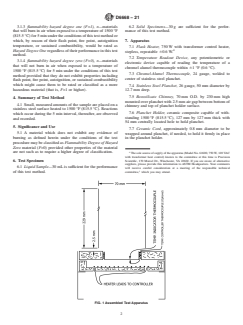
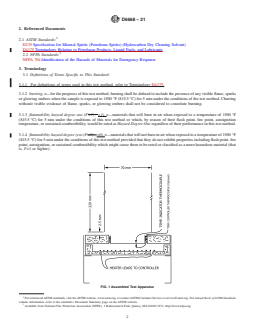
FIG. 1 Assembled Test Apparatus
For referenced ASTM standards, visit the ASTM website, www.astm.org, or contact ASTM Customer Service at service@astm.org. For Annual Book of ASTM Standards
volume information, refer to the standard’s Document Summary page on the ASTM website.
Available from National Fire Protection Association (NFPA), 1 Batterymarch Park, Quincy, MA 02169-7471, http://www.nfpa.org.
D6668 − 21
4. Su
...