

ASTM D8447-22e1
(Test Method)Standard Test Method for Determination of Turbo Charger Deposits by Thermo-Oxidation Engine Oil Simulation Test
General Information
- Abstract
SIGNIFICANCE AND USE
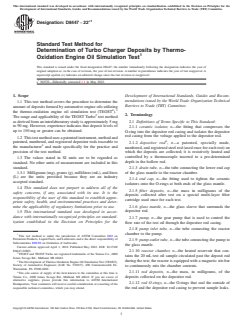
4.1 The test method is designed to predict the elevated temperature deposit forming tendencies of an engine oil subject to the added oxidizing stress of a turbocharger. This test method can be used to screen oil samples or as a quality assurance tool.
SCOPE
1.1 This test method covers the procedure to determine the amount of deposits formed by automotive engine oils utilizing the thermo-oxidation engine oil simulation test (TEOST2).3 The range and applicability of the TEOST Turbo2 test method as derived from an interlaboratory study is approximately 5 mg to 90 mg. However, experience indicates that deposit levels of up to 150 mg or greater can be obtained.
1.2 This test method uses a patented instrument, method and patented, numbered, and registered depositor rods traceable to the manufacturer4 and made specifically for the practice and precision of the test method.
1.3 The values stated in SI units are to be regarded as standard. No other units of measurement are included in this standard.
1.3.1 Milligrams (mg), grams (g), milliliters (mL), and liters (L) are the units provided because they are an industry accepted standard.
1.4 This standard does not purport to address all of the safety concerns, if any, associated with its use. It is the responsibility of the user of this standard to establish appropriate safety, health, and environmental practices and determine the applicability of regulatory limitations prior to use.
1.5 This international standard was developed in accordance with internationally recognized principles on standardization established in the Decision on Principles for the Development of International Standards, Guides and Recommendations issued by the World Trade Organization Technical Barriers to Trade (TBT) Committee.
- Status
- Published
- Publication Date
- 31-Mar-2022
- Technical Committee
- D02 - Petroleum Products, Liquid Fuels, and Lubricants
- Drafting Committee
- D02.09 - Oxidation of Lubricants
Overview
ASTM D8447-22e1 - Standard Test Method for Determination of Turbo Charger Deposits by Thermo-Oxidation Engine Oil Simulation Test provides a reliable laboratory procedure to evaluate the deposit-forming tendencies of automotive engine oils under the high-temperature, oxidizing conditions typical of turbochargers. This test method uses the Thermo-Oxidation Engine Oil Simulation Test (TEOST) Turbo2 instrument to replicate the conditions inside a turbocharged engine, allowing for precise screening and quality assurance of engine oil formulations. The standard is widely applied for both routine oil sample screening and as a critical quality assurance tool in the lubricant manufacturing industry.
Key Topics
- Purpose: Predicts the elevated temperature deposit-forming tendencies of engine oils subjected to turbocharger-specific thermal and oxidative stress.
- Applicability: Measures deposits in a range from approximately 5 mg to 90 mg, with possible levels up to 150 mg or higher under some conditions.
- Test Apparatus: Employs a patented TEOST Turbo2 instrument and specially designed, registered depositor rods to ensure method consistency and precision.
- Process Overview:
- Combines engine oil with a catalyst and circulates it within a heated environment simulating a turbocharger.
- Deposits are formed on a heated depositor rod and captured by a multi-layer filter after the test.
- Masses of deposits are measured and reported in SI units (milligrams), providing a quantifiable assessment of oil performance.
Applications
- Engine Oil Development: Used by lubricant formulators to develop and optimize engine oils that resist deposit formation in turbocharged engines.
- Quality Assurance: Serves as a routine screening and batch quality check for manufacturers, ensuring product consistency and meeting industry requirements.
- Research & Development: Enables comparative analysis of oil samples in laboratory settings, speeding up innovation and verification of new oil additives or base stocks.
- Regulatory Compliance: Supports compliance with OEM and industry standards regarding oil cleanliness, oxidation stability, and deposit control.
- Predictive Maintenance: Helps fleet operators and engine manufacturers predict in-service oil performance, minimizing the risk of turbocharger deposit-related failures.
Related Standards
- ASTM D3241: Standard Test Method for Thermal Oxidation Stability of Aviation Turbine Fuels.
- ASTM D6335: Standard Test Method for Determination of High Temperature Deposits by Thermo-Oxidation of Gasoline Engine Oils.
- ASTM D7097: Standard Test Method for Determinability of High Temperature Deposits using TEOST for Gasoline Direct-Injection Engines.
- SAE Papers: Research publications from the Society of Automotive Engineers on TEOST and engine oil thermal stability.
- ISO 9001: Quality management systems relevant for quality assurance applications.
Keywords: ASTM D8447, turbocharger deposits, thermo-oxidation, engine oil simulation, TEOST Turbo, engine oil testing, lubricant quality assurance, automotive standards, deposit measurement, oxidation stability, high temperature oil testing, turbocharged engine performance.
By adhering to ASTM D8447-22e1, manufacturers and laboratories gain a standardized, repeatable method to evaluate and control engine oil deposit formation under turbocharger-representative conditions, supporting higher engine reliability, optimum oil performance, and compliance with modern automotive requirements.
Get Certified
Connect with accredited certification bodies for this standard

TÜV Rheinland
TÜV Rheinland is a leading international provider of technical services.

TÜV SÜD
TÜV SÜD is a trusted partner of choice for safety, security and sustainability solutions.

DEKRA Certification Inc.
DEKRA US certification services.
Sponsored listings
Frequently Asked Questions
ASTM D8447-22e1 is a standard published by ASTM International. Its full title is "Standard Test Method for Determination of Turbo Charger Deposits by Thermo-Oxidation Engine Oil Simulation Test". This standard covers: SIGNIFICANCE AND USE 4.1 The test method is designed to predict the elevated temperature deposit forming tendencies of an engine oil subject to the added oxidizing stress of a turbocharger. This test method can be used to screen oil samples or as a quality assurance tool. SCOPE 1.1 This test method covers the procedure to determine the amount of deposits formed by automotive engine oils utilizing the thermo-oxidation engine oil simulation test (TEOST2).3 The range and applicability of the TEOST Turbo2 test method as derived from an interlaboratory study is approximately 5 mg to 90 mg. However, experience indicates that deposit levels of up to 150 mg or greater can be obtained. 1.2 This test method uses a patented instrument, method and patented, numbered, and registered depositor rods traceable to the manufacturer4 and made specifically for the practice and precision of the test method. 1.3 The values stated in SI units are to be regarded as standard. No other units of measurement are included in this standard. 1.3.1 Milligrams (mg), grams (g), milliliters (mL), and liters (L) are the units provided because they are an industry accepted standard. 1.4 This standard does not purport to address all of the safety concerns, if any, associated with its use. It is the responsibility of the user of this standard to establish appropriate safety, health, and environmental practices and determine the applicability of regulatory limitations prior to use. 1.5 This international standard was developed in accordance with internationally recognized principles on standardization established in the Decision on Principles for the Development of International Standards, Guides and Recommendations issued by the World Trade Organization Technical Barriers to Trade (TBT) Committee.
SIGNIFICANCE AND USE 4.1 The test method is designed to predict the elevated temperature deposit forming tendencies of an engine oil subject to the added oxidizing stress of a turbocharger. This test method can be used to screen oil samples or as a quality assurance tool. SCOPE 1.1 This test method covers the procedure to determine the amount of deposits formed by automotive engine oils utilizing the thermo-oxidation engine oil simulation test (TEOST2).3 The range and applicability of the TEOST Turbo2 test method as derived from an interlaboratory study is approximately 5 mg to 90 mg. However, experience indicates that deposit levels of up to 150 mg or greater can be obtained. 1.2 This test method uses a patented instrument, method and patented, numbered, and registered depositor rods traceable to the manufacturer4 and made specifically for the practice and precision of the test method. 1.3 The values stated in SI units are to be regarded as standard. No other units of measurement are included in this standard. 1.3.1 Milligrams (mg), grams (g), milliliters (mL), and liters (L) are the units provided because they are an industry accepted standard. 1.4 This standard does not purport to address all of the safety concerns, if any, associated with its use. It is the responsibility of the user of this standard to establish appropriate safety, health, and environmental practices and determine the applicability of regulatory limitations prior to use. 1.5 This international standard was developed in accordance with internationally recognized principles on standardization established in the Decision on Principles for the Development of International Standards, Guides and Recommendations issued by the World Trade Organization Technical Barriers to Trade (TBT) Committee.
ASTM D8447-22e1 is classified under the following ICS (International Classification for Standards) categories: 43.060.01 - Internal combustion engines for road vehicles in general. The ICS classification helps identify the subject area and facilitates finding related standards.
ASTM D8447-22e1 is available in PDF format for immediate download after purchase. The document can be added to your cart and obtained through the secure checkout process. Digital delivery ensures instant access to the complete standard document.
Standards Content (Sample)
This international standard was developed in accordance with internationally recognized principles on standardization established in the Decision on Principles for the
Development of International Standards, Guides and Recommendations issued by the World Trade Organization Technical Barriers to Trade (TBT) Committee.
´1
Designation: D8447 − 22
Standard Test Method for
Determination of Turbo Charger Deposits by Thermo-
Oxidation Engine Oil Simulation Test
This standard is issued under the fixed designation D8447; the number immediately following the designation indicates the year of
original adoption or, in the case of revision, the year of last revision.Anumber in parentheses indicates the year of last reapproval.A
superscript epsilon (´) indicates an editorial change since the last revision or reapproval.
ε NOTE—Editorially corrected 1.1 in May 2022.
1. Scope Development of International Standards, Guides and Recom-
mendations issued by the World Trade Organization Technical
1.1 This test method covers the procedure to determine the
Barriers to Trade (TBT) Committee.
amount of deposits formed by automotive engine oils utilizing
2 3
the thermo-oxidation engine oil simulation test (TEOST ).
2 2. Terminology
The range and applicability of the TEOST Turbo test method
asderivedfromaninterlaboratorystudyisapproximately5mg
2.1 Definitions of Terms Specific to This Standard:
to 90mg. However, experience indicates that deposit levels of
2.1.1 ceramic isolator, n—the fitting that compresses the
up to 150mg or greater can be obtained.
O-ring into the depositor rod casing and isolates the depositor
rod casing from the voltage applied to the depositor rod.
1.2 Thistestmethodusesapatentedinstrument,methodand
patented, numbered, and registered depositor rods traceable to
2.1.2 depositor rod , n—a patented, specially made,
the manufacturer and made specifically for the practice and
numbered, and registered steel rod (used once for each test) on
precision of the test method.
which the deposits are collected; it is resistively heated and
controlled by a thermocouple inserted to a pre-determined
1.3 The values stated in SI units are to be regarded as
depth in the hollow rod.
standard. No other units of measurement are included in this
standard.
2.1.3 drain tube, n—the tube connecting the lower end cap
1.3.1 Milligrams(mg),grams(g),milliliters(mL),andliters
of the glass mantle to the reactor chamber.
(L) are the units provided because they are an industry
2.1.4 end cap, n—the fitting used to tighten the ceramic
accepted standard.
isolators onto the O-rings at both ends of the glass mantle.
1.4 This standard does not purport to address all of the
2.1.5 filter deposits, n—the mass in milligrams of the
safety concerns, if any, associated with its use. It is the
deposits collected after test on a special multi-layer filter
responsibility of the user of this standard to establish appro-
cartridge used once for each test.
priate safety, health, and environmental practices and deter-
2.1.6 glass mantle, n—the glass sleeve that surrounds the
mine the applicability of regulatory limitations prior to use.
depositor rod.
1.5 This international standard was developed in accor-
dance with internationally recognized principles on standard-
2.1.7 pump, n—the gear pump that is used to control the
ization established in the Decision on Principles for the
flow rate of the test oil through the depositor rod casing.
2.1.8 pump inlet tube, n—the tube connecting the reactor
chamber to the pump.
This test method is under the jurisdiction of ASTM Committee D02 on
Petroleum Products, Liquid Fuels, and Lubricants and is the direct responsibility of
2.1.9 pump outlet tube, n—the tube connecting the pump to
Subcommittee D02.09 on Oxidation of Lubricants.
the glass mantle.
Current edition approved April 1, 2022. Published May 2022. DOI: 10.1520/
D8447-22E01.
2.1.10 reactor chamber, n—the heated reservoir that con-
TEOST and TEOST Turbo are registered trademarks of the Tannas Co., 4800
tains the 20mL test oil sample circulated past the deposit rod
James Savage Rd., Midland, MI 48642.
3 during the test; the reactor is equipped with a magnetic stir-bar
The Development of Thermo-Oxidation Engine Oil Simulation Test (TEOST),
Society of Automotive Engineers (SAE No. 932837), 400 Commonwealth Dr., to continuously mix the chamber contents.
Warrendale, PA 15096-0001.
4 2.1.11 rod deposits, n—the mass, in milligrams, of the
The sole source of supply of the item known to the committee at this time is
Tannas Co., 4800 James Savage Rd., Midland, MI 48642. If you are aware of deposits collected on the depositor rod.
alternative suppliers, please provide this information to ASTM International
2.1.12 rod O-rings, n—the O-rings that seal the outside of
Headquarters.Your comments will receive careful consideration at a meeting of the
responsible technical committee, which you may attend. the rod and the depositor rod casing to prevent sample leaks.
Copyright © ASTM International, 100 Barr Harbor Drive, PO Box C700, West Conshohocken, PA 19428-2959. United States
´1
D8447 − 22
2.1.13 thermocouple lock collar, n—afittingthattightenson 5. Apparatus
the thermocouple to ensure the thermocouple is at the correct
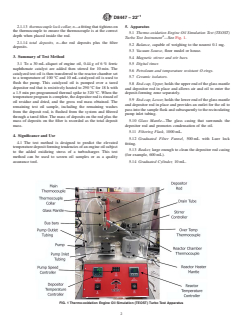
5.1 Thermo-oxidation Engine Oil Simulation Test (TEOST)
depth when placed inside the rod. 4
Turbo Test Instrument —See Fig. 1.
2.1.14 total deposits, n—the rod deposits plus the filter
5.2 Balance, capable of weighing to the nearest 0.1mg.
deposits.
5.3 Vacuum Source, floor model or house.
3. Summary of Test Method
5.4 Magnetic stirrer and stir bars.
3.1 To a 30mL aliquot of engine oil, 0.44g of 6% ferric
5.5 Digital timer.
naphthenate catalyst are added then stirred for 10min. The
5.6 Petroleum and temperature resistant O-rings.
catalyzed test oil is then transferred to the reactor chamber set
5.7 Ceramic isolators.
to a temperature of 100°C and 10mL catalyzed oil is used to
flush the pump. This catalyzed oil is pumped over a tared
5.8 End-cap, Upper,holdstheupperendoftheglassmantle
depositor rod that is resistively heated to 290°C for 18h with
and depositor rod in place and allows air and oil to enter the
a 1.5min pre-programmed thermal spike to 320°C. When the
deposit-forming zone separately.
temperatureprogramiscomplete,thedepositorrodisrinsedof
5.9 End-cap, Lower,holdsthelowerendoftheglassmantle
oil residue and dried, and the gross rod mass obtained. The
and depositor rod in place and provides an outlet for the oil to
remaining test oil sample, including the remaining washes
passintothesampleflaskandsubsequentlytotherecirculating
from the deposit rod, is flushed from the system and filtered
pump inlet tubing.
through a tared filter. The mass of deposits on the rod plus the
5.10 Glass Mantle—The glass casing that surrounds the
mass of deposits on the filter is recorded as the total deposit
depositor rod and promotes condensation of the oil.
mass.
5.11 Filtering Flask, 1000mL.
4. Significance and Use
5.12 Graduated Filter Funnel, 500mL with Luer lock
4.1 The test method is designed to predict the elevated
fitting.
temperaturedepositformingtendenciesofanengineoilsubject
5.13 Beaker, large enough to clean the depositor rod casing
to the added oxidizing stress of a turbocharger. This test
(for example, 600mL).
method can be used to screen oil samples or as a quality
assurance tool. 5.14 Graduated Cylinder, 10mL.
FIG. 1 Thermo-oxidation Engine Oil Simulation (TEOST) Turbo Test Apparatus
´1
D8447 − 22
5.15 Adjustable hex wrench. after test. Other glass cleaners with varnish removing capabili-
ties also may be used.
5.16 Pipe cleaners, 3mm × 304.8mm.
6.6 Combination Pump Calibration and Temperature Con-
5.17 Steel Wool, 4/0 (ultra-fine).
trol Thermocouple Depth Setting Oil, TPC-1 —A highly
5.18 Glass Syringe, 100µL.
deposit-resistant oil used in setting pump calibration and
5.19 One-piece disposable multi-layer cartridge filters . temperature control calibration without forming significant
deposits on the depositor rod during these calibrations.
5.20 Flow Meters, capable of measuring 0mL⁄min to
10mL⁄min of gas.
7. Preparation of Apparatus
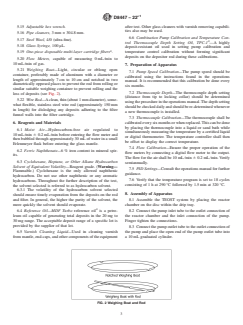
5.21 Weighing Boat—Light, circular or oblong open
7.1 Pump Speed Calibration—The pump speed should be
container, preferably made of aluminum with a diameter or
calibrated using the instructions found in the operations
length of approximately 7cm to 10cm and notched in two
manual. It is recommended that this calibration be done every
diametricallyopposedplacestopreventtherodfromrollingor
six months.
similar suitable weighing container to prevent rolling and the
7.2 Thermocouple Depth—The thermocouple depth setting
loss of deposits (see Fig. 2).
(distance from tip to locking collar) should be determined
5.22 Wire Rod—Aclean,thin(about1mmdiameter),some-
usingtheprocedureintheoperationsmanual.Thedepthsetting
what flexible, stainless steel wire rod (approximately 150mm
shouldbecheckeddailyandshouldbere-determinedwhenever
in length) for dislodging any deposits adhering to the filter
a new thermocouple is installed.
funnel walls into the filter cartridge.
7.3 Thermocouple Calibration—The thermocouple shall be
calibratedeverysixmonthsorwhenreplaced.Thiscanbedone
6. Reagents and Materials
by placing the thermocouple into a liquid or sand bath while
6.1 Moist Air—Hydrocarbon-free air regulated to
simultaneously measuring the temperature by a certified liquid
10mL⁄min 6 0.2mL⁄min before entering the flow meter and
or digital thermometer. The temperature controller shall then
then bubbled through approximately 30mLof water in a small
be offset to display the correct temperature.
Erlenmeyer flask before entering the glass mantle.
7.4 Flow Calibration—Ensure the proper operation of the
6.2 Ferric Naphthenate—6% iron content in mineral spir-
flow meters by connecting a digital flow meter to the output.
its.
The flow for the air shall be 10mL⁄min 6 0.2mL⁄min.Verify
6.3 Cyclohexane, Heptane, or Other Alkane Hydrocarbon
semiannually.
Solvent of Equivalent Volatility—Reagent grade. (Warning—
7.5 PID Settings—Consulttheoperationsmanualforfurther
Flammable.) Cyclohexane is the only allowed naphthenic
guidance.
hydrocarbon. Do not use other naphthenic or any aromatic
7.6 Verify that the temperature program is set to 18 cycles
hydrocarbons. Throughout the further description of the test,
consisting of 1h at 290°C followed by 1.5min at 320°C.
the solvent selected is referred to as hydrocarbon solvent.
6.3.1 The volatility of the hydrocarbon solvent selected
8. Assembly of Apparatus
should ensure timely evaporation from the deposits on the rod
and filter. In general, the higher the purity of the solvent, the 8.1 Assemble the TEOST system by placing the reactor
more quickly the solvent should evaporate. chamber on the disc within the drip tray.
6.4 Reference Oil—MDF Turbo reference oil is a petro- 8.2 Connect the pump inlet tube to the outlet connection of
leum oil capable of generating total deposits in the 20mg to the reactor chamber and the inlet connection of the pump.
30mg range. The acceptable deposit range of a specific lot is Finger tighten the connections.
provided by the supplier of that lot.
8.3 Connectthepumpoutlettubetotheoutletconnectionof
6.5 Varnish Cleaning Liquid—Used in cleaning varnish the pump and place the open end of the pump outlet tube into
frommantle,end-caps,andothercomponentsoftheequipment a 10mL graduated cylinder.
FIG. 2 Weighing Boat and Rod
´1
D8447 − 22
8.4 On the main panel of the instrument, connect the 11.5 Inspectthebusbarstomakesuretheyareclean.Ifnot,
thermocouplestothelabeledconnections,andpluginandtwist clean the bus bars according to the operations manual. Secure
the heater cable clockwise for proper connection. Use the the upper end cap and the lower end cap onto the clean glass
reactor temperature controller to set the temperature of the mantle. Slide the pre-weighed depositor rod into the glass
reactor chamber to 100°C. mantle assembly.
11.6 PlacetwoVitonO-ringsovereachendofthedepositor
9. Calibration and Standardization
rod to the glass mantle, followed by the ceramic isolators.
9.1 The TEOST instrument is calibrated by performing the TheseO-ringsneedtobecheckedandreplacedwhenwornout.
procedure described in Section 7.At that point, a reference oil
11.7 Start securing the end nuts, but do not tighten.
shall be run.The results shall be within the repeatability limits
11.8 Align the rod in the glass mantle to ensure proper
established by the supplier of the reference oils.
alignment with the bus bars. When this is achieved, the end
9.2 The calibration should be performed a minimum of
nuts are finger-tightened. Connect the top end by placing the
every six months, as recommended by the instrument manu-
depositor rod into the indentation of the bus bar and swinging
facturer.
the cap over the depositor rod.
9.3 If the repeatability is not within the established limits,
11.9 Place the glass mantle assembly vertically in the bus
the instrument setup steps in Section 7 should be performed.
bars protruding from the instrument. Slip one end of the
Then the reference oil should be rerun.
depositor rod into the bottom bus bar over the over-temp
thermocouple.
10. Sample Preparation
11.10 Insert the hex screw to begin the securing process.
10.1 After thoroughly mixing the test sample, use a gradu-
11.11 Tighten all four hex screws with a ⁄3
...