

ASTM A871/A871M-20
(Specification)Standard Specification for High-Strength Low-Alloy Structural Steel Plate With Atmospheric Corrosion Resistance
General Information
- Abstract
ABSTRACT
This specification covers high-strength low-alloy structural steel plate used for tubular structures and poles. This steel has atmospheric corrosion resistance so it can be used bare or unpainted for many applications. The materials shall be made by fine grain practice, normal furnishing in the as-rolled condition, and normalizing heat treatment. Chemical requirements shall be obtained by heat analysis. Mechanical requirements shall be done by tension test and Charpy V-notch impact test.
SCOPE
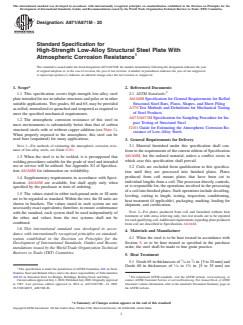
1.1 This specification covers high-strength low-alloy steel plate intended for use in tubular structures and poles or in other suitable applications. Two grades, 60 and 65, may be provided as-rolled, normalized or quenched and tempered as required to meet the specified mechanical requirements.
1.2 The atmospheric corrosion resistance of this steel in most environments is substantially better than that of carbon structural steels with or without copper addition (see Note 1). When properly exposed to the atmosphere, this steel can be used bare (unpainted) for many applications.
Note 1: For methods of estimating the atmospheric corrosion resistance of low-alloy steels, see Guide G101.
1.3 When the steel is to be welded, it is presupposed that welding procedures suitable for the grade of steel and intended use or service will be utilized. See Appendix X3 of Specification A6/A6M for information on weldability.
1.4 Supplementary requirements in accordance with Specification A6/A6M are available, but shall apply only when specified by the purchaser at time of ordering.
1.5 The values stated in either inch-pound units or SI units are to be regarded as standard. Within the text, the SI units are shown in brackets. The values stated in each system are not necessarily exact equivalents; therefore, to ensure conformance with the standard, each system shall be used independently of the other, and values from the two systems shall not be combined.
1.6 This international standard was developed in accordance with internationally recognized principles on standardization established in the Decision on Principles for the Development of International Standards, Guides and Recommendations issued by the World Trade Organization Technical Barriers to Trade (TBT) Committee.
- Status
- Published
- Publication Date
- 30-Jun-2020
- Technical Committee
- A01 - Steel, Stainless Steel and Related Alloys
Buy Documents


ASTM A871/A871M-20 - Standard Specification for High-Strength Low-Alloy Structural Steel Plate With Atmospheric Corrosion Resistance

REDLINE ASTM A871/A871M-20 - Standard Specification for High-Strength Low-Alloy Structural Steel Plate With Atmospheric Corrosion Resistance
Overview
ASTM A871/A871M-20 is the internationally recognized standard specification from ASTM International for high-strength low-alloy structural steel plate with enhanced atmospheric corrosion resistance. The specification primarily addresses steel plates intended for use in tubular structures and poles, or other suitable applications where durability and corrosion resistance are critically important. This standard enables engineers and specifiers to select steel plates that can be used bare or unpainted, thanks to their improved resistance to atmospheric conditions. ASTM A871/A871M covers two steel grades (60 and 65), delivered in as-rolled, normalized, or quenched and tempered conditions to meet specific mechanical and chemical requirements.
Key Topics
- Material Types and Grades: Defines requirements for Grades 60 and 65, allowing for flexibility in mechanical properties and finishing processes.
- Atmospheric Corrosion Resistance: Specifies steel compositions that provide superior resistance to atmospheric corrosion compared to standard carbon structural steels, with or without copper addition.
- Applications in Tubular Structures and Poles: Focuses on the use of these steel plates in structures exposed to outdoor environments, such as utility poles, light standards, and similar structures.
- Manufacturing Practices: Steel must be produced by fine grain practice and may be furnished in the as-rolled condition or after normalizing heat treatment. Special requirements are specified for heat treatment, chemical composition, and mechanical properties.
- Testing and Quality Assurance: Chemical composition is verified by heat analysis, while mechanical properties are demonstrated through tension and Charpy V-notch impact tests. Additional requirements may be applied if specified by the purchaser.
- Weldability: Advises that the material’s weldability depends on the selected grade and application, referencing ASTM A6/A6M for detailed guidance.
Applications
ASTM A871/A871M-20 high-strength low-alloy steel plates are widely used in a range of construction and industrial applications where exposure to outdoor elements and the need for long-term durability are key factors. Typical applications include:
- Tubular Structures and Poles: Supports the manufacture of utility poles, transmission and lighting standards, and telecommunications towers that require both strength and weathering resistance.
- Bridge Components: Suitable for application in bridge superstructures and railings, where reduced need for painting can lower long-term maintenance costs.
- Building Exteriors: Utilized in building facades, industrial platforms, and architectural features where enhanced corrosion resistance is beneficial.
- Transportation Infrastructure: Applied in the assembly of highway sign structures, sound barriers, and safety barriers that are exposed to varying weather conditions.
Using ASTM A871/A871M steel helps extend service life and reduce maintenance costs in areas where repainting or protection is difficult or costly. Its performance in atmospheric conditions makes it particularly valuable for structures in rural, industrial, and urban environments.
Related Standards
For comprehensive fabrication and quality assurance, it is important to consult related ASTM standards, including:
- ASTM A6/A6M: General requirements for rolled structural steel bars, plates, shapes, and sheet piling; includes guidance on weldability and supplementary requirements.
- ASTM A370: Test methods and definitions for mechanical testing of steel products.
- ASTM A673/A673M: Sampling procedure for impact testing of structural steel.
- ASTM G101: Guide for estimating the atmospheric corrosion resistance of low-alloy steels.
These related standards provide additional requirements and methodologies necessary for the reliable specification, manufacturing, and testing of high-strength low-alloy structural steel plates intended for demanding applications.
Keywords: ASTM A871, A871/A871M-20, high-strength low-alloy steel, structural steel plate, atmospheric corrosion resistance, tubular structures, utility poles, steel standards, weathering steel, corrosion-resistant steel, ASTM steel specifications.
Relations
- Effective Date
- 01-Mar-2024
- Effective Date
- 01-Mar-2024
- Effective Date
- 01-Nov-2023
- Effective Date
- 01-Jul-2019
- Refers
ASTM A370-17a - Standard Test Methods and Definitions for Mechanical Testing of Steel Products - Effective Date
- 15-Nov-2017
- Effective Date
- 15-Nov-2017
- Effective Date
- 01-Nov-2017
- Effective Date
- 01-Jan-2017
- Effective Date
- 15-Nov-2016
- Effective Date
- 01-May-2016
- Effective Date
- 01-Nov-2015
- Effective Date
- 15-May-2014
- Effective Date
- 01-May-2014
- Effective Date
- 15-Nov-2013
- Effective Date
- 01-Oct-2013
Buy Documents
ASTM A871/A871M-20 - Standard Specification for High-Strength Low-Alloy Structural Steel Plate With Atmospheric Corrosion Resistance
REDLINE ASTM A871/A871M-20 - Standard Specification for High-Strength Low-Alloy Structural Steel Plate With Atmospheric Corrosion Resistance
Get Certified
Connect with accredited certification bodies for this standard

Element Materials Technology
Materials testing and product certification.

Inštitut za kovinske materiale in tehnologije
Institute of Metals and Technology. Materials testing, metallurgical analysis, NDT.
Sponsored listings
Frequently Asked Questions
ASTM A871/A871M-20 is a technical specification published by ASTM International. Its full title is "Standard Specification for High-Strength Low-Alloy Structural Steel Plate With Atmospheric Corrosion Resistance". This standard covers: ABSTRACT This specification covers high-strength low-alloy structural steel plate used for tubular structures and poles. This steel has atmospheric corrosion resistance so it can be used bare or unpainted for many applications. The materials shall be made by fine grain practice, normal furnishing in the as-rolled condition, and normalizing heat treatment. Chemical requirements shall be obtained by heat analysis. Mechanical requirements shall be done by tension test and Charpy V-notch impact test. SCOPE 1.1 This specification covers high-strength low-alloy steel plate intended for use in tubular structures and poles or in other suitable applications. Two grades, 60 and 65, may be provided as-rolled, normalized or quenched and tempered as required to meet the specified mechanical requirements. 1.2 The atmospheric corrosion resistance of this steel in most environments is substantially better than that of carbon structural steels with or without copper addition (see Note 1). When properly exposed to the atmosphere, this steel can be used bare (unpainted) for many applications. Note 1: For methods of estimating the atmospheric corrosion resistance of low-alloy steels, see Guide G101. 1.3 When the steel is to be welded, it is presupposed that welding procedures suitable for the grade of steel and intended use or service will be utilized. See Appendix X3 of Specification A6/A6M for information on weldability. 1.4 Supplementary requirements in accordance with Specification A6/A6M are available, but shall apply only when specified by the purchaser at time of ordering. 1.5 The values stated in either inch-pound units or SI units are to be regarded as standard. Within the text, the SI units are shown in brackets. The values stated in each system are not necessarily exact equivalents; therefore, to ensure conformance with the standard, each system shall be used independently of the other, and values from the two systems shall not be combined. 1.6 This international standard was developed in accordance with internationally recognized principles on standardization established in the Decision on Principles for the Development of International Standards, Guides and Recommendations issued by the World Trade Organization Technical Barriers to Trade (TBT) Committee.
ABSTRACT This specification covers high-strength low-alloy structural steel plate used for tubular structures and poles. This steel has atmospheric corrosion resistance so it can be used bare or unpainted for many applications. The materials shall be made by fine grain practice, normal furnishing in the as-rolled condition, and normalizing heat treatment. Chemical requirements shall be obtained by heat analysis. Mechanical requirements shall be done by tension test and Charpy V-notch impact test. SCOPE 1.1 This specification covers high-strength low-alloy steel plate intended for use in tubular structures and poles or in other suitable applications. Two grades, 60 and 65, may be provided as-rolled, normalized or quenched and tempered as required to meet the specified mechanical requirements. 1.2 The atmospheric corrosion resistance of this steel in most environments is substantially better than that of carbon structural steels with or without copper addition (see Note 1). When properly exposed to the atmosphere, this steel can be used bare (unpainted) for many applications. Note 1: For methods of estimating the atmospheric corrosion resistance of low-alloy steels, see Guide G101. 1.3 When the steel is to be welded, it is presupposed that welding procedures suitable for the grade of steel and intended use or service will be utilized. See Appendix X3 of Specification A6/A6M for information on weldability. 1.4 Supplementary requirements in accordance with Specification A6/A6M are available, but shall apply only when specified by the purchaser at time of ordering. 1.5 The values stated in either inch-pound units or SI units are to be regarded as standard. Within the text, the SI units are shown in brackets. The values stated in each system are not necessarily exact equivalents; therefore, to ensure conformance with the standard, each system shall be used independently of the other, and values from the two systems shall not be combined. 1.6 This international standard was developed in accordance with internationally recognized principles on standardization established in the Decision on Principles for the Development of International Standards, Guides and Recommendations issued by the World Trade Organization Technical Barriers to Trade (TBT) Committee.
ASTM A871/A871M-20 is classified under the following ICS (International Classification for Standards) categories: 77.140.50 - Flat steel products and semi-products. The ICS classification helps identify the subject area and facilitates finding related standards.
ASTM A871/A871M-20 has the following relationships with other standards: It is inter standard links to ASTM A6/A6M-24, ASTM A370-24, ASTM A6/A6M-23, ASTM A370-19, ASTM A370-17a, ASTM A673/A673M-17, ASTM A6/A6M-17a, ASTM A370-17, ASTM A6/A6M-16a, ASTM A6/A6M-16, ASTM A370-15, ASTM A370-14, ASTM A6/A6M-14, ASTM A370-13, ASTM A6/A6M-13a. Understanding these relationships helps ensure you are using the most current and applicable version of the standard.
ASTM A871/A871M-20 is available in PDF format for immediate download after purchase. The document can be added to your cart and obtained through the secure checkout process. Digital delivery ensures instant access to the complete standard document.
Standards Content (Sample)
This international standard was developed in accordance with internationally recognized principles on standardization established in the Decision on Principles for the
Development of International Standards, Guides and Recommendations issued by the World Trade Organization Technical Barriers to Trade (TBT) Committee.
Designation:A871/A871M −20
Standard Specification for
High-Strength Low-Alloy Structural Steel Plate With
Atmospheric Corrosion Resistance
This standard is issued under the fixed designationA871/A871M; the number immediately following the designation indicates the year
of original adoption or, in the case of revision, the year of last revision. A number in parentheses indicates the year of last reapproval.
A superscript epsilon (´) indicates an editorial change since the last revision or reapproval.
1. Scope* 2. Referenced Documents
2.1 ASTM Standards:
1.1 This specification covers high-strength low-alloy steel
A6/A6M Specification for General Requirements for Rolled
plate intended for use in tubular structures and poles or in other
Structural Steel Bars, Plates, Shapes, and Sheet Piling
suitable applications. Two grades, 60 and 65, may be provided
A370 Test Methods and Definitions for Mechanical Testing
as-rolled, normalized or quenched and tempered as required to
of Steel Products
meet the specified mechanical requirements.
A673/A673M Specification for Sampling Procedure for Im-
1.2 The atmospheric corrosion resistance of this steel in
pact Testing of Structural Steel
most environments is substantially better than that of carbon
G101 Guide for Estimating the Atmospheric Corrosion Re-
structural steels with or without copper addition (see Note 1).
sistance of Low-Alloy Steels
When properly exposed to the atmosphere, this steel can be
used bare (unpainted) for many applications.
3. General Requirements for Delivery
NOTE 1—For methods of estimating the atmospheric corrosion resis- 3.1 Material furnished under this specification shall con-
tance of low-alloy steels, see Guide G101.
form to the requirements of the current edition of Specification
A6/A6M, for the ordered material, unless a conflict exists in
1.3 When the steel is to be welded, it is presupposed that
which case this specification shall prevail.
welding procedures suitable for the grade of steel and intended
use or service will be utilized. See Appendix X3 of Specifica-
3.2 Coils are excluded from qualification to this specifica-
tion A6/A6M for information on weldability.
tion until they are processed into finished plates. Plates
produced from coil means plates that have been cut to
1.4 Supplementary requirements in accordance with Speci-
individual lengths from a coil. The processor directly controls,
fication A6/A6M are available, but shall apply only when
or is responsible for, the operations involved in the processing
specified by the purchaser at time of ordering.
ofacoilintofinishedplates.Suchoperationsincludedecoiling,
1.5 The values stated in either inch-pound units or SI units
leveling, cutting to length, testing, inspection, conditioning,
are to be regarded as standard. Within the text, the SI units are
heat treatment (if applicable), packaging, marking, loading for
shown in brackets. The values stated in each system are not
shipment, and certification.
necessarilyexactequivalents;therefore,toensureconformance
NOTE 2—For plates produced from coil and furnished without heat
with the standard, each system shall be used independently of
treatment or with stress relieving only, two test results are to be reported
the other, and values from the two systems shall not be
foreachqualifyingcoil.Additionalrequirementsregardingplateproduced
combined.
from coil are described in Specification A6/A6M.
1.6 This international standard was developed in accor-
4. Materials and Manufacture
dance with internationally recognized principles on standard-
4.1 When the steel is to be heat treated in accordance with
ization established in the Decision on Principles for the
Section 5, or to be heat treated as specified in the purchase
Development of International Standards, Guides and Recom-
order, the steel shall be made to fine grain practice.
mendations issued by the World Trade Organization Technical
Barriers to Trade (TBT) Committee.
5. Heat Treatment
3 3
5.1 Grade 65 in thicknesses of ⁄16 to ⁄4 in. [5 to 20 mm] and
3 3
Grade 60 in thicknesses of ⁄16 to 1 ⁄8 in. [5 to 35 mm] are
This specification is under the jurisdiction of ASTM Committee A01 on Steel,
Stainless Steel and Related Alloys and is the direct responsibility of Subcommittee
A01.02 on Structural Steel for Bridges, Buildings, Rolling Stock and Ships. For referenced ASTM standards, visit the ASTM website, www.astm.org, or
Current edition approved July 1, 2020. Published July 2020. Originally approved contact ASTM Customer Service at service@astm.org. For Annual Book of ASTM
in 1987. Last previous edition approved in 2014 as A871/A871M – 14. DOI: Standards volume information, refer to the standard’s Document Summary page on
10.1520/A0871_A0871M-20. the ASTM website.
*A Summary of Changes section appears at the end of this standard
Copyright © ASTM International, 100 Barr Harbor Drive, PO Box C700, West Conshohocken, PA 19428-2959. United States
A871/A871M−20
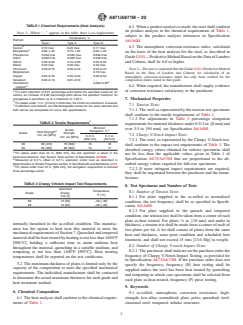
TABLE 1 Chemical Requirements (Heat Analysis)
6.2 Whenaproductanalysisismade,thesteelshallconform
on product analysis to the chemical requirements of Table 1,
NOTE 1—Where “…” appears in this table, there is no requirement.
subject to the product analysis tolerances in Specification
Composition, %
Element
A6/A6M.
Type I Type II Type IV
A
Carbon 0.19 max 0.20 max 0.17 max 6.3 The atmospheric corrosion-resistance index, calculated
A
Manganese 0.80–1.35 0.75–1.35 0.50–1.20
on the basis of the heat analysis for the steel, as described in
Phosphorus 0.030 max 0.030 max 0.030 max
GuideG101—PredictiveMethodBasedontheDataofLarabee
Sulfur 0.030 max 0.030 max 0.030 max
Silicon 0.30–0.65 0.15–0.50 0.25–0.50 and Coburn, shall be 6.0 or higher.
Nickel 0.40 max 0.50 max 0.40 max
NOTE 3—The user is cautioned that the Guide G101 (Predictive Method
Chromium 0.40–0.70 0.40–0.70 0.40–0.70
Molybdenum . . . . . . 0.10 max
Based on the Data of Larabee and Coburn) for calculation of an
Copper 0.25–0.40 0.20–0.40 0.30–0.50
atmospheric corrosion-resistance index has only been verified for the
Vanadium 0.02–0.10 0.01–0.10 . . .
composition limits stated in
...
This document is not an ASTM standard and is intended only to provide the user of an ASTM standard an indication of what changes have been made to the previous version. Because
it may not be technically possible to adequately depict all changes accurately, ASTM recommends that users consult prior editions as appropriate. In all cases only the current version
of the standard as published by ASTM is to be considered the official document.
Designation: A871/A871M − 14 A871/A871M − 20
Standard Specification for
High-Strength Low-Alloy Structural Steel Plate With
Atmospheric Corrosion Resistance
This standard is issued under the fixed designation A871/A871M; the number immediately following the designation indicates the year
of original adoption or, in the case of revision, the year of last revision. A number in parentheses indicates the year of last reapproval.
A superscript epsilon (´) indicates an editorial change since the last revision or reapproval.
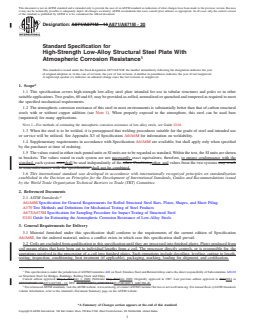
1. Scope*
1.1 This specification covers high-strength low-alloy steel plate intended for use in tubular structures and poles or in other
suitable applications. Two grades, 60 and 65, may be provided as-rolled, normalized or quenched and tempered as required to meet
the specified mechanical requirements.
1.2 The atmospheric corrosion resistance of this steel in most environments is substantially better than that of carbon structural
steels with or without copper addition (see Note 1). When properly exposed to the atmosphere, this steel can be used bare
(unpainted) for many applications.
NOTE 1—For methods of estimating the atmospheric corrosion resistance of low-alloy steels, see Guide G101.
1.3 When the steel is to be welded, it is presupposed that welding procedures suitable for the grade of steel and intended use
or service will be utilized. See Appendix X3 of Specification A6/A6M for information on weldability.
1.4 Supplementary requirements in accordance with Specification A6/A6M are available, but shall apply only when specified
by the purchaser at time of ordering.
1.5 The values stated in either inch-pound units or SI units are to be regarded as standard. Within the text, the SI units are shown
in brackets. The values stated in each system are not necessarily exact equivalents; therefore, to ensure conformance with the
standard, each system mustshall be used independently of the other. Combiningother, and values from the two systems may result
in nonconformance with the specification. shall not be combined.
1.6 This international standard was developed in accordance with internationally recognized principles on standardization
established in the Decision on Principles for the Development of International Standards, Guides and Recommendations issued
by the World Trade Organization Technical Barriers to Trade (TBT) Committee.
2. Referenced Documents
2.1 ASTM Standards:
A6/A6M Specification for General Requirements for Rolled Structural Steel Bars, Plates, Shapes, and Sheet Piling
A370 Test Methods and Definitions for Mechanical Testing of Steel Products
A673/A673M Specification for Sampling Procedure for Impact Testing of Structural Steel
G101 Guide for Estimating the Atmospheric Corrosion Resistance of Low-Alloy Steels
3. General Requirements for Delivery
3.1 Material furnished under this specification shall conform to the requirements of the current edition of Specification
A6/A6M, for the ordered material, unless a conflict exists in which case this specification shall prevail.
3.2 Coils are excluded from qualification to this specification until they are processed into finished plates. Plates produced from
coil means plates that have been cut to individual lengths from a coil. The processor directly controls, or is responsible for, the
operations involved in the processing of a coil into finished plates. Such operations include decoiling, leveling, cutting to length,
testing, inspection, conditioning, heat treatment (if applicable), packaging, marking, loading for shipment, and certification.
This specification is under the jurisdiction of ASTM Committee A01 on Steel, Stainless Steel and Related Alloys and is the direct responsibility of Subcommittee A01.02
on Structural Steel for Bridges, Buildings, Rolling Stock and Ships.
Current edition approved May 1, 2014July 1, 2020. Published May 2014July 2020. Originally approved in 1987. Last previous edition approved in 20122014 as
A871/A871M – 12.A871/A871M – 14. DOI: 10.1520/A0871_A0871M-14.10.1520/A0871_A0871M-20.
For referenced ASTM standards, visit the ASTM website, www.astm.org, or contact ASTM Customer Service at service@astm.org. For Annual Book of ASTM Standards
volume information, refer to the standard’s Document Summary page on the ASTM website.
*A Summary of Changes section appears at the end of this standard
Copyright © ASTM International, 100 Barr Harbor Drive, PO Box C700, West Conshohocken, PA 19428-2959. United States
A871/A871M − 20
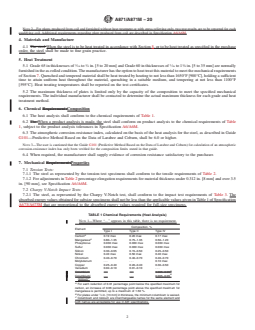
NOTE 2—For plates produced from coil and furnished without heat treatment or with stress relieving only, two test results are to be reported for each
qualifying coil. Additional requirements regarding plate produced from coil are described in Specification A6/A6M.
4. Materials and Manufacture
4.1 The steel When the steel is to be heat treated in accordance with Section 5, or to be heat treated as specified in the purchase
order, the steel shall be made to fine grain practice.
5. Heat Treatment
3 3 3 3
5.1 Grade 65 in thicknesses of ⁄16 to ⁄4 in. [5 to 20 mm] and Grade 60 in thicknesses of ⁄16 to 1 ⁄8 in. [5 to 35 mm] are normally
furnished in the as-rolled condition. The manufacturer has the option to heat treat this material to meet the mechanical requirements
of Section 7. Quenched and tempered material shall be heat treated by heating to not less than 1650°F [900°C], holding a sufficient
time to attain uniform heat throughout the material, quenching in a suitable medium, and tempering at not less than 1100°F
[595°C]. Heat treating temperatures shall be reported on the test certificates.
5.2 The maximum thickness of plates is limited only by the capacity of the composition to meet the specified mechanical
requirements. The individual manufacturer shall be contacted to determine the actual maximum thickness for each grade and heat
treatment method.
6. Chemical RequirementsComposition
6.1 The heat analysis shall conform to the chemical requirements of Table 1.
6.2 The When a product analysis is made, the steel shall conform on product analysis to the chemical requirements of Table
1, subject to the product analysis tolerances in Specification A6/A6M.
6.3 The atmospheric corrosion-resistance index, calculated on the basis of the heat analysis for the steel, as described in Guide
G101—Predictive Method Based on the Data of Larabee and Coburn, shall be 6.0 or higher.
NOTE 3—The user is cautioned that the Guide G101 (Predictive Method Based on the Dat
...