


ASTM D4680-98(2017)
(Test Method)Standard Test Method for Creep and Time to Failure of Adhesives in Static Shear by Compression Loading (Wood-to-Wood)
Standard Test Method for Creep and Time to Failure of Adhesives in Static Shear by Compression Loading (Wood-to-Wood)
SIGNIFICANCE AND USE
4.1 Creep data that are obtained over a relatively short period of time in this test method can provide a measure of an adhesive bond's ability to withstand static loading in shear over a relatively long period of time. Creep measurements are made over a range of expected service conditions, including level of stress, temperature, relative humidity, and duration of load. Creep rate, creep strain, and creep modulus are calculated at the various service conditions.
4.2 Creep data can be used to (1) predict performance of an adhesive under long-term loading, (2) characterize an adhesive, (3) compare adhesives with each other and against specifications, and (4) design structural members fabricated with an adhesive.
4.3 Time-to-failure data provide a measure of the ultimate load-carrying ability of an adhesive bond as a function of time at various levels of stress, temperature, and relative humidity.
4.4 With proper caution, time-to-failure data derived from relatively short loading periods can be extrapolated to estimate the useful service life of an adhesive at working levels of static stress. This property may also be used with creep data to accomplish purposes listed in 4.2.
4.5 This test method is a research tool intended for development or evaluation of new adhesives and new product designs. The researcher may select from suggested tests those that are appropriate. However, creep and time-to-failure tests are nonroutine and can be time-consuming and expensive, so tests must be selected with care.
4.6 The apparatus and procedures may be suitable for measuring creep properties of adhesives on substrates other than wood, such as metal, plastic, and glass, but such considerations are not within the scope of this test method.
SCOPE
1.1 This test method covers the determination of time-dependent properties of structural adhesives in wood-to-wood bonds when specimens are subjected to shearing stresses at various levels of static load, constant temperature, and relative humidity. Apparatus and procedures are provided for direct measurement of time-dependent shear deformation (creep) and time to failure of adhesive bonds under static load. Guidelines for selecting test conditions, methods for calculating creep rate, creep strain, creep modulus, and extrapolation of time to failure, are given along with methods of presenting these data.
1.2 The values stated in inch-pound units are to be regarded as standard. The values given in parentheses are mathematical conversions to SI units that are provided for information only and are not considered standard.
1.3 This standard does not purport to address all of the safety concerns, if any, associated with its use. It is the responsibility of the user of this standard to establish appropriate safety and health practices and determine the applicability of regulatory limitations prior to use.
1.4 This international standard was developed in accordance with internationally recognized principles on standardization established in the Decision on Principles for the Development of International Standards, Guides and Recommendations issued by the World Trade Organization Technical Barriers to Trade (TBT) Committee.
General Information
Buy Standard
Standards Content (Sample)
NOTICE: This standard has either been superseded and replaced by a new version or withdrawn.
Contact ASTM International (www.astm.org) for the latest information
Designation: D4680 − 98 (Reapproved 2017)
Standard Test Method for
Creep and Time to Failure of Adhesives in Static Shear by
Compression Loading (Wood-to-Wood)
This standard is issued under the fixed designation D4680; the number immediately following the designation indicates the year of
original adoption or, in the case of revision, the year of last revision. A number in parentheses indicates the year of last reapproval. A
superscript epsilon (´) indicates an editorial change since the last revision or reapproval.
1. Scope D907 Terminology of Adhesives
D2016 Methods of Test for Moisture Content of Wood
1.1 This test method covers the determination of time-
(Withdrawn 1987)
dependent properties of structural adhesives in wood-to-wood
2.2 ASTM Adjuncts:
bonds when specimens are subjected to shearing stresses at
Compression-Shear Creep Test Apparatus
various levels of static load, constant temperature, and relative
humidity. Apparatus and procedures are provided for direct
3. Terminology
measurement of time-dependent shear deformation (creep) and
3.1 Definitions:
time to failure of adhesive bonds under static load. Guidelines
3.1.1 Many terms in these test methods are defined in
for selecting test conditions, methods for calculating creep rate,
Terminology D907.
creep strain, creep modulus, and extrapolation of time to
3.1.2 creep, n—the dimensional change with time of a
failure, are given along with methods of presenting these data.
material under load, following the initial instantaneous elastic
1.2 The values stated in inch-pound units are to be regarded
or rapid deformation. Creep at room temperature is sometimes
as standard. The values given in parentheses are mathematical
called cold flow.
conversions to SI units that are provided for information only
3.1.3 creep modulus, n—the ratio of initial applied stress to
and are not considered standard.
creep strain.
1.3 This standard does not purport to address all of the
3.1.4 creep strain, n—the total strain, at any given time,
safety concerns, if any, associated with its use. It is the
produced by the applied stress during a creep test.
responsibility of the user of this standard to establish appro-
3.1.4.1 Discussion—In this test method, creep strain is
priate safety and health practices and determine the applica-
calculated by dividing displacement at any given time by the
bility of regulatory limitations prior to use.
estimated apparent thickness of the adhesive bondline.
1.4 This international standard was developed in accor-
dance with internationally recognized principles on standard-
3.1.5 rate of creep, n—the slope of the creep-time curve at
ization established in the Decision on Principles for the
a given time.
Development of International Standards, Guides and Recom-
3.1.6 shear stress, n—the stress component tangential to the
mendations issued by the World Trade Organization Technical
plane on which the forces act, that is, in the plane of the bond
Barriers to Trade (TBT) Committee.
line.
3.1.7 strain, n—the unit change, due to stress, in the size or
2. Referenced Documents
shape of a body referred to its original size or shape.
2.1 ASTM Standards:
3.1.8 stress, n—the force exerted per unit area at a point
D143 Test Methods for Small Clear Specimens of Timber
within the plane.
D905 Test Method for Strength Properties of Adhesive
Bonds in Shear by Compression Loading
4. Significance and Use
4.1 Creep data that are obtained over a relatively short
This test method is under the jurisdiction of ASTM Committee D14 on period of time in this test method can provide a measure of an
Adhesives and is the direct responsibility of Subcommittee D14.30 on Wood
adhesive bond’s ability to withstand static loading in shear over
Adhesives.
a relatively long period of time. Creep measurements are made
Current edition approved Aug. 1, 2017. Published August 2017. Originally
approved in 1987. Last previous edition approved in 2011 as D4680 – 98 (2011).
DOI: 10.1520/D4680-98R17.
2 3
For referenced ASTM standards, visit the ASTM website, www.astm.org, or The last approved version of this historical standard is referenced on
contact ASTM Customer Service at service@astm.org. For Annual Book of ASTM www.astm.org.
Standards volume information, refer to the standard’s Document Summary page on Available from ASTM International Headquarters. Order Adjunct No.
the ASTM website. ADJD4680. Original adjunct produced in 1987.
Copyright © ASTM International, 100 Barr Harbor Drive, PO Box C700, West Conshohocken, PA 19428-2959. United States
D4680 − 98 (2017)
over a range of expected service conditions, including level of test temperature before the test load is applied to the spring.
stress, temperature, relative humidity, and duration of load. The preheated apparatus must be wrapped with a piece of
Creep rate, creep strain, and creep modulus are calculated at flexible thermal insulation material while the test load is
the various service conditions. applied to the specimen. After loading and measurements,
return the loaded apparatus to the test environment. Since there
4.2 Creep data can be used to (1) predict performance of an
are no significant changes in temperature before or after
adhesive under long-term loading, (2) characterize an adhesive,
loading, no adjustments are needed in the spring.
(3) compare adhesives with each other and against
5.3.2 The creep-test apparatus is made of corrosion-resistant
specifications, and (4) design structural members fabricated
components so that it can be used in high-temperature and
with an adhesive.
humid environments for prolonged periods without concern for
4.3 Time-to-failure data provide a measure of the ultimate
damaging the apparatus or interfering with the effectiveness of
load-carrying ability of an adhesive bond as a function of time
the test.
at various levels of stress, temperature, and relative humidity.
5.3.3 The creep-test apparatus has been compactly designed
4.4 With proper caution, time-to-failure data derived from
with its load-applying mechanism built-in. Thus, several of the
relatively short loading periods can be extrapolated to estimate
units may be stacked on racks in a small environmental
the useful service life of an adhesive at working levels of static
chamber such as an oven, incubator, or humidity cabinet. The
stress. This property may also be used with creep data to
apparatus may be transferred from one exposure chamber to
accomplish purposes listed in 4.2.
another, or may be removed from an exposure chamber for
measurements without disturbing the specimen under static
4.5 This test method is a research tool intended for devel-
load.
opment or evaluation of new adhesives and new product
5.3.4 The creep-test apparatus shown in Fig. 1 has a
designs. The researcher may select from suggested tests those
microswitch mounted at its base which is activated when the
that are appropriate. However, creep and time-to-failure tests
creep specimen fails. A small pin is located in the lower
are nonroutine and can be time-consuming and expensive, so
specimen seat which is driven against the microswitch when
tests must be selected with care.
the failed specimen strikes it. The microswitch must be
4.6 The apparatus and procedures may be suitable for
connected to an automatic timer-recorder.
measuring creep properties of adhesives on substrates other
5.4 Automatic Timer-Recorder—If creep or time-to-failure
than wood, such as metal, plastic, and glass, but such consid-
measurements are to be made, an automatic and multi-channel
erations are not within the scope of this test method.
timer-recorder is connected to the microswitch on each creep-
5. Apparatus
test apparatus. The timer-recorder is capable of automatically
scanning the several connected circuits at selected intervals of
5.1 Testing Machine—A testing machine, or other suitable
time. When the creep specimen fails and activates the
loading machine, capable of applying compression loads from
microswitch, the timer-recorder automatically records the time
0 to 5000 lbf (22 kN) and cross-head speeds from 0.01 to 0.40
at which the circuit is broken.
in./min (0.3 to 10.2 mm/min) is sufficient for this test method.
A minimum vertical space of 20 in. (508 mm) is required to
5.5 Microscope—A microscope is required to measure dis-
compress the loading spring in the creep-test apparatus.
placement of scribe marks across the two adherends of a
specimen as creep occurs. Accurate measurements are also
5.2 Compression Shearing Tool—The testing machine is
required for bondline thicknesses. Make measurements to the
equipped with a shearing tool capable of applying a uniformly
nearest 0.001 mm (0.0004 in.). A linear traveling binocular
distributed compression load to the loading ledges of the
microscope is ideally suited to creep measurements; however,
block-shear specimen. A shearing tool equipped with a self-
a microscope fitted with an appropriately graduated scale is
aligning seat in the shearing blade ensures uniform loading.
satisfactory. An objective lens of at least 7× magnification is
5.3 Creep-Test Apparatus—Static loads shall be applied and
required.
maintained on block-shear specimens by means of the
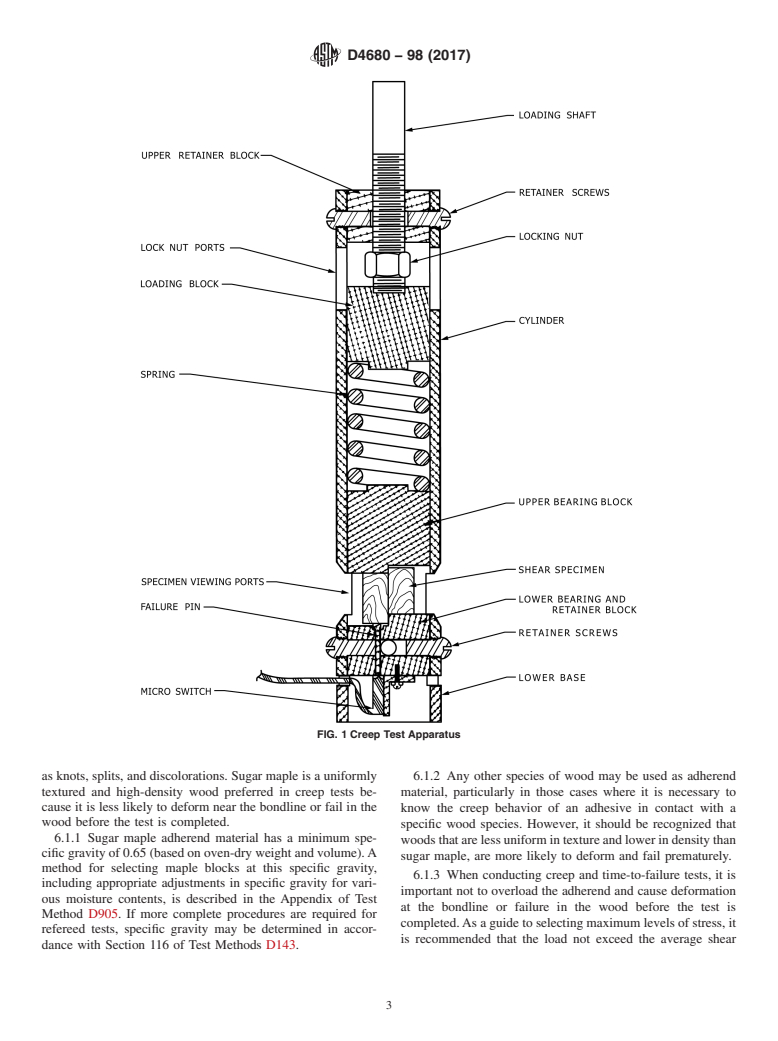
5,4
5.6 Environmental Chambers—Control of temperature and
compression-loaded creep-test cylinder shown in Fig. 1. The
relative humidity is required in creep tests of adhesive bonds
apparatus is spring-loaded and can sustain any load up to the
on wood substrates. Temperature has a profound effect on
design capacity of the spring. This particular spring has a
creep properties of adhesives. Humidity also affects creep of
design load of 2300 lbf (10 kN); however, others of greater or
certain adhesives, but it can also affect dimensional change in
less capacity may be substituted. Varying spring capacities
wood adherends. Conditioning equipment should be capable of
with outside diameters no greater than the cylinder inside
maintaining a constant temperature within 63.0°F (61.7°C) of
diameter are available.
the set-point and constant relative humidity within 65 % of the
5.3.1 For creep tests above room temperature, it is not
set-point at a given temperature.
necessary to adjust the spring or load to compensate for the
effects of changing temperature. It is only necessary that the
6. Materials
apparatus, with included specimen, be preconditioned to the
6.1 Adherends—Select sugar maple (Acer saccharum) as the
5 standard adherend material with the grain of the wood straight
This creep-test apparatus may be purchased from Hull Machine Shop, P.O. 373,
Hull, GA 30646, or other suitable suppliers. and parallel to the direction of shear and free of all defects such
D4680 − 98 (2017)
FIG. 1 Creep Test Apparatus
as knots, splits, and discolorations. Sugar maple is a uniformly 6.1.2 Any other species of wood may be used as adherend
textured and high-density wood preferred in creep tests be-
material, particularly in those cases where it is necessary to
cause it is less likely to deform near the bondline or fail in the
know the creep behavior of an adhesive in contact with a
wood before the test is completed.
specific wood species. However, it should be recognized that
6.1.1 Sugar maple adherend material has a minimum spe-
woods that are less uniform in texture and lower in density than
cific gravity of 0.65 (based on oven-dry weight and volume). A
sugar maple, are more likely to deform and fail prematurely.
method for selecting maple blocks at this specific gravity,
6.1.3 When conducting creep and time-to-failure tests, it is
including appropriate adjustments in specific gravity for vari-
important not to overload the adherend and cause deformation
ous moisture contents, is described in the Appendix of Test
at the bondline or failure in the wood before the test is
Method D905. If more complete procedures are required for
completed. As a guide to selecting maximum levels of stress, it
refereed tests, specific gravity may be determined in accor-
is recommended that the load not exceed the average shear
dance with Section 116 of Test Methods D143.
D4680 − 98 (2017)
FIG. 2 Block-Shear Specimen for Creep and Time To Failure Tests
strength parallel-to-grain for the species of wood when ad- 7. Test Specimens
justed for any change in moisture content from 12 %. Average
7.1 The standard specimen for both creep and time-to-
shear strengths at 12 % moisture content for sugar maple and
failure tests shall be the block-shear specimen illustrated in
other species of wood are presented in Table 4-2 of the Wood
Fig. 2. Use the test adhesive to bond the two hard maple
Handbook. For moisture contents other than 12 %, it will be
adherends together. The shear area is 1.00 by 1.00 in. (2.54 by
necessary to adjust shear strengths by the formula described in 2 2
2.54 cm), equalling 1.00 in. (6.45 cm ).
pp. 4-32 and 4-33 of the Wood Handbook.
7.2 The finished specimen for creep tests has well-defined
6.1.4 Should premature failures occur in the wood after
scribe marks on each side of the specimen for measuring
mean strength values have been adjusted for moisture content,
displacement of the two adherends as creep takes place.
then the 5 % exclusion limit may be used to select the
maximum level of stress for a particular species of wood. The
7.3 Scribe marks are not necessary for specimens intended
maximum level of stress S is determined by the follow-
for the time-to-failure tests.
max0.05
ing equation:
7.4 Number of Specimens:
S 5 S 2 1.645 0.14S (1)
~ !
7.4.1 Test at least ten specimens at each set of test
max0.05 m m
conditions, that is, each combination of stress level,
where S is the mean shear strength parallel-to-grain as
m
6 temperature, and relative humidity, for either creep test or
presented in Table 4-2 of the Wood Handbook.
time-to-failure test. It is suggested that at least one test joint
6.2 Adhesives—Creep properties of any adhesive can be
assembly (contains twelve specimens) be prepared for each
measured on any species of wood as long as the level of shear
combination of test conditions.
stress does not exceed the shear strength of the wood in the
7.4.2 Randomly assign the ten specimens for each set of test
specimen.
conditions to that set from the entire lot of specimens prepared
for testing of a given adhesive.
7.4.3 For many adhesives, measured creep properties will
Wood Handbook: Wood As An Engineering Material, USDA Agriculture
be highly variable, and ten specimens may not be a large
Handbook 72, rev., U.S. Forest Products Lab., 1974, Table 4-2 and p. 4-32 and 4-33.
enough sample to give a high degree of confidence to the mean
Available from U.S. Go
...
This document is not an ASTM standard and is intended only to provide the user of an ASTM standard an indication of what changes have been made to the previous version. Because
it may not be technically possible to adequately depict all changes accurately, ASTM recommends that users consult prior editions as appropriate. In all cases only the current version
of the standard as published by ASTM is to be considered the official document.
Designation: D4680 − 98 (Reapproved 2011) D4680 − 98 (Reapproved 2017)
Standard Test Method for
Creep and Time to Failure of Adhesives in Static Shear by
Compression Loading (Wood-to-Wood)
This standard is issued under the fixed designation D4680; the number immediately following the designation indicates the year of
original adoption or, in the case of revision, the year of last revision. A number in parentheses indicates the year of last reapproval. A
superscript epsilon (´) indicates an editorial change since the last revision or reapproval.
1. Scope
1.1 This test method covers the determination of time-dependent properties of structural adhesives in wood-to-wood bonds
when specimens are subjected to shearing stresses at various levels of static load, constant temperature, and relative humidity.
Apparatus and procedures are provided for direct measurement of time-dependent shear deformation (creep) and time to failure
of adhesive bonds under static load. Guidelines for selecting test conditions, methods for calculating creep rate, creep strain, creep
modulus, and extrapolation of time to failure, are given along with methods of presenting these data.
1.2 The values stated in inch-pound units are to be regarded as standard. The values given in parentheses are mathematical
conversions to SI units that are provided for information only and are not considered standard.
1.3 This standard does not purport to address all of the safety concerns, if any, associated with its use. It is the responsibility
of the user of this standard to establish appropriate safety and health practices and determine the applicability of regulatory
limitations prior to use.
1.4 This international standard was developed in accordance with internationally recognized principles on standardization
established in the Decision on Principles for the Development of International Standards, Guides and Recommendations issued
by the World Trade Organization Technical Barriers to Trade (TBT) Committee.
2. Referenced Documents
2.1 ASTM Standards:
D143 Test Methods for Small Clear Specimens of Timber
D905 Test Method for Strength Properties of Adhesive Bonds in Shear by Compression Loading
D907 Terminology of Adhesives
D2016 Methods of Test for Moisture Content of Wood (Withdrawn 1987)
2.2 ASTM Adjuncts:
Compression-Shear Creep Test Apparatus
3. Terminology
3.1 Definitions:
3.1.1 Many terms in these test methods are defined in Terminology D907.
3.1.2 creep, n—the dimensional change with time of a material under load, following the initial instantaneous elastic or rapid
deformation. Creep at room temperature is sometimes called cold flow.
3.1.3 creep modulus, n—the ratio of initial applied stress to creep strain.
3.1.4 creep strain, n—the total strain, at any given time, produced by the applied stress during a creep test.
This test method is under the jurisdiction of ASTM Committee D14 on Adhesives and is the direct responsibility of Subcommittee D14.30 on Wood Adhesives.
Current edition approved April 1, 2011Aug. 1, 2017. Published April 2011August 2017. Originally approved in 1987. Last previous edition approved in 20042011 as
D4680 – 98 (2004).(2011). DOI: 10.1520/D4680-98R11.10.1520/D4680-98R17.
For referenced ASTM standards, visit the ASTM website, www.astm.org, or contact ASTM Customer Service at service@astm.org. For Annual Book of ASTM Standards
volume information, refer to the standard’s Document Summary page on the ASTM website.
The last approved version of this historical standard is referenced on www.astm.org.
Available from ASTM International Headquarters. Order Adjunct No. ADJD4680. Original adjunct produced in 1987.
3.1.4.1 Discussion—
Copyright © ASTM International, 100 Barr Harbor Drive, PO Box C700, West Conshohocken, PA 19428-2959. United States
D4680 − 98 (2017)
In this test method, creep strain is calculated by dividing displacement at any given time by the estimated apparent thickness of
the adhesive bondline.
3.1.5 rate of creep, n—the slope of the creep-time curve at a given time.
3.1.6 shear stress, n—the stress component tangential to the plane on which the forces act, that is, in the plane of the bond line.
3.1.7 strain, n—the unit change, due to stress, in the size or shape of a body referred to its original size or shape.
3.1.8 stress, n—the force exerted per unit area at a point within the plane.
4. Significance and Use
4.1 Creep data that are obtained over a relatively short period of time in this test method can provide a measure of an adhesive
bond’s ability to withstand static loading in shear over a relatively long period of time. Creep measurements are made over a range
of expected service conditions, including level of stress, temperature, relative humidity, and duration of load. Creep rate, creep
strain, and creep modulus are calculated at the various service conditions.
4.2 Creep data can be used to (1) predict performance of an adhesive under long-term loading, (2) characterize an adhesive, (3)
compare adhesives with each other and against specifications, and (4) design structural members fabricated with an adhesive.
4.3 Time-to-failure data provide a measure of the ultimate load-carrying ability of an adhesive bond as a function of time at
various levels of stress, temperature, and relative humidity.
4.4 With proper caution, time-to-failure data derived from relatively short loading periods can be extrapolated to estimate the
useful service life of an adhesive at working levels of static stress. This property may also be used with creep data to accomplish
purposes listed in 4.2.
4.5 This test method is a research tool intended for development or evaluation of new adhesives and new product designs. The
researcher may select from suggested tests those that are appropriate. However, creep and time-to-failure tests are nonroutine and
can be time-consuming and expensive, so tests must be selected with care.
4.6 The apparatus and procedures may be suitable for measuring creep properties of adhesives on substrates other than wood,
such as metal, plastic, and glass, but such considerations are not within the scope of this test method.
5. Apparatus
5.1 Testing Machine—A testing machine, or other suitable loading machine, capable of applying compression loads from 0 to
5000 lbf (22 kN) and cross-head speeds from 0.01 to 0.40 in./min (0.3 to 10.2 mm/min) is sufficient for this test method. A
minimum vertical space of 20 in. (508 mm) is required to compress the loading spring in the creep-test apparatus.
5.2 Compression Shearing Tool—The testing machine is equipped with a shearing tool capable of applying a uniformly
distributed compression load to the loading ledges of the block-shear specimen. A shearing tool equipped with a self-aligning seat
in the shearing blade ensures uniform loading.
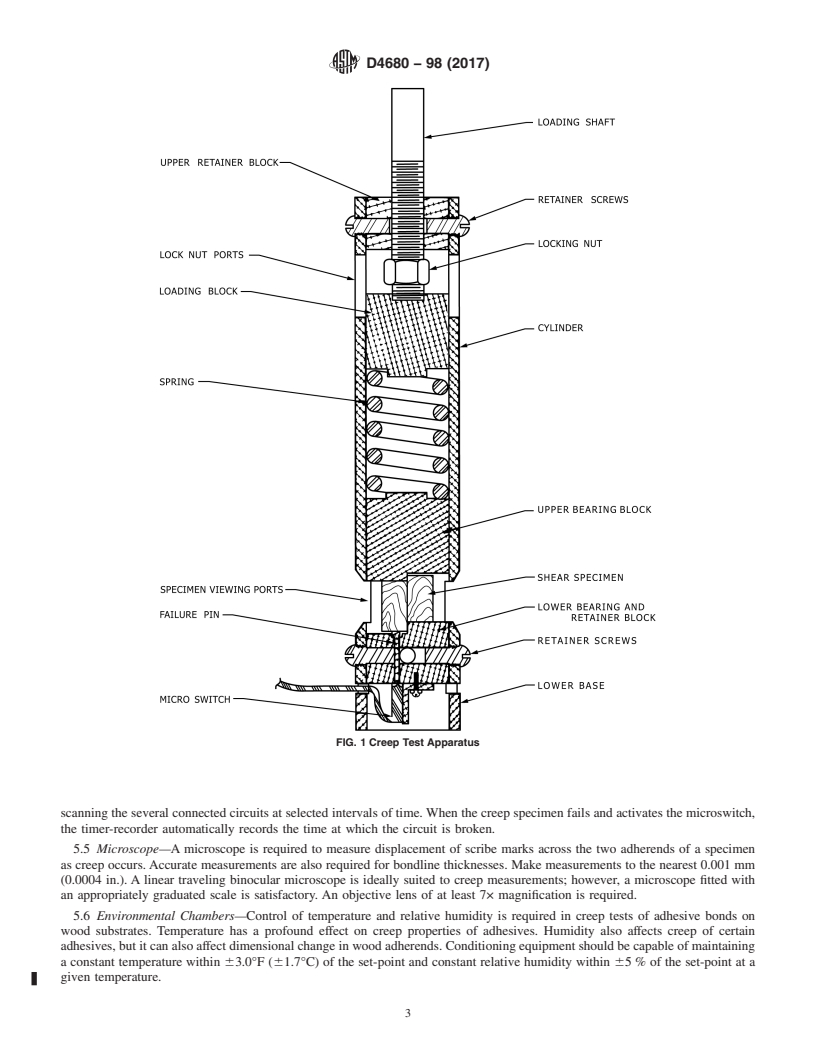
5.3 Creep-Test Apparatus—Static loads shall be applied and maintained on block-shear specimens by means of the
5,4
compression-loaded creep-test cylinder shown in Fig. 1. The apparatus is spring-loaded and can sustain any load up to the design
capacity of the spring. This particular spring has a design load of 2300 lbf (10 kN); however, others of greater or less capacity may
be substituted. Varying spring capacities with outside diameters no greater than the cylinder inside diameter are available.
5.3.1 For creep tests above room temperature, it is not necessary to adjust the spring or load to compensate for the effects of
changing temperature. It is only necessary that the apparatus, with included specimen, be preconditioned to the test temperature
before the test load is applied to the spring. The preheated apparatus must be wrapped with a piece of flexible thermal insulation
material while the test load is applied to the specimen. After loading and measurements, return the loaded apparatus to the test
environment. Since there are no significant changes in temperature before or after loading, no adjustments are needed in the spring.
5.3.2 The creep-test apparatus is made of corrosion-resistant components so that it can be used in high-temperature and humid
environments for prolonged periods without concern for damaging the apparatus or interfering with the effectiveness of the test.
5.3.3 The creep-test apparatus has been compactly designed with its load-applying mechanism built-in. Thus, several of the
units may be stacked on racks in a small environmental chamber such as an oven, incubator, or humidity cabinet. The apparatus
may be transferred from one exposure chamber to another, or may be removed from an exposure chamber for measurements
without disturbing the specimen under static load.
5.3.4 The creep-test apparatus shown in Fig. 1 has a microswitch mounted at its base which is activated when the creep
specimen fails. A small pin is located in the lower specimen seat which is driven against the microswitch when the failed specimen
strikes it. The microswitch must be connected to an automatic timer-recorder.
5.4 Automatic Timer-Recorder—If creep or time-to-failure measurements are to be made, an automatic and multi-channel
timer-recorder is connected to the microswitch on each creep-test apparatus. The timer-recorder is capable of automatically
This creep-test apparatus may be purchased from Hull Machine Shop, P.O. 373, Hull, GA 30646, or other suitable suppliers.
D4680 − 98 (2017)
FIG. 1 Creep Test Apparatus
scanning the several connected circuits at selected intervals of time. When the creep specimen fails and activates the microswitch,
the timer-recorder automatically records the time at which the circuit is broken.
5.5 Microscope—A microscope is required to measure displacement of scribe marks across the two adherends of a specimen
as creep occurs. Accurate measurements are also required for bondline thicknesses. Make measurements to the nearest 0.001 mm
(0.0004 in.). A linear traveling binocular microscope is ideally suited to creep measurements; however, a microscope fitted with
an appropriately graduated scale is satisfactory. An objective lens of at least 7× magnification is required.
5.6 Environmental Chambers—Control of temperature and relative humidity is required in creep tests of adhesive bonds on
wood substrates. Temperature has a profound effect on creep properties of adhesives. Humidity also affects creep of certain
adhesives, but it can also affect dimensional change in wood adherends. Conditioning equipment should be capable of maintaining
a constant temperature within 63.0°F (61.7°C) of the set-point and constant relative humidity within 65 % of the set-point at a
given temperature.
D4680 − 98 (2017)
FIG. 2 Block-Shear Specimen for Creep and Time To Failure Tests
6. Materials
6.1 Adherends—Select sugar maple (Acer saccharum) as the standard adherend material with the grain of the wood straight and
parallel to the direction of shear and free of all defects such as knots, splits, and discolorations. Sugar maple is a uniformly textured
and high-density wood preferred in creep tests because it is less likely to deform near the bondline or fail in the wood before the
test is completed.
6.1.1 Sugar maple adherend material has a minimum specific gravity of 0.65 (based on oven-dry weight and volume). A method
for selecting maple blocks at this specific gravity, including appropriate adjustments in specific gravity for various moisture
contents, is described in the Appendix of Test Method D905. If more complete procedures are required for refereed tests, specific
gravity may be determined in accordance with Section 116 of Test Methods D143.
6.1.2 Any other species of wood may be used as adherend material, particularly in those cases where it is necessary to know
the creep behavior of an adhesive in contact with a specific wood species. However, it should be recognized that woods that are
less uniform in texture and lower in density than sugar maple, are more likely to deform and fail prematurely.
6.1.3 When conducting creep and time-to-failure tests, it is important not to overload the adherend and cause deformation at
the bondline or failure in the wood before the test is completed. As a guide to selecting maximum levels of stress, it is
recommended that the load not exceed the average shear strength parallel-to-grain for the species of wood when adjusted for any
change in moisture content from 12 %. Average shear strengths at 12 % moisture content for sugar maple and other species of wood
are presented in Table 4-2 of the Wood Handbook. For moisture contents other than 12 %, it will be necessary to adjust shear
strengths by the formula described in pp. 4-32 and 4-33 of the Wood Handbook.
6.1.4 Should premature failures occur in the wood after mean strength values have been adjusted for moisture content, then the
5 % exclusion limit may be used to select the maximum level of stress for a particular species of wood. The maximum level of
stress S is determined by the following equation:
max0.05
S 5 S 2 1.645 0.14S (1)
~ !
max0.05 m m
where S is the mean shear strength parallel-to-grain as presented in Table 4-2 of the Wood Handbook.
m
Wood Handbook: Wood As An Engineering Material, USDA Agriculture Handbook 72, rev., U.S. Forest Products Lab., 1974, Table 4-2 and p. 4-32 and 4-33. Available
from U.S. Government Printing Office Superintendent of Documents, 732 N. Capitol St., NW, Mail Stop: SDE, Washington, DC 20401.
D4680 − 98 (2017)
6.2 Adhesives—Creep properties of any adhesive can be measured on any species of wood as long as the level of shear stress
does not exceed the shear strength of the wood in the specimen.
7. Test Specimens
7.1 The standard specimen for both creep and time-to-failure tests shall be the block-shear specimen illustrated in Fig. 2. Use
the test adhesive to bond the two hard maple adherends together. The shear area is 1.00 by 1.00 in. (2.54 by 2.54 cm), equalling
2 2
1.00 in. (6.45 cm ).
7.2 The finished specimen for creep tests has well-defined scribe marks on each side of the specimen for measuring
displacement of the two adherends as creep takes place.
7.3 Scribe marks are not necessary for specimens intended for the time-to-failure tests.
7.4 Number of Specimens:
7.4.1 Test at least ten specimens at each set of test conditions, that is, each combination of stress level, temperature, and relative
humidity, for eithe
...
Questions, Comments and Discussion
Ask us and Technical Secretary will try to provide an answer. You can facilitate discussion about the standard in here.