

ASTM B98/B98M-13(2019)
(Specification)Standard Specification for Copper-Silicon Alloy Rod, Bar and Shapes
General Information
- Abstract
ABSTRACT
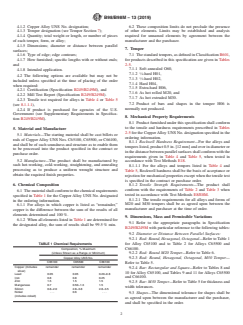
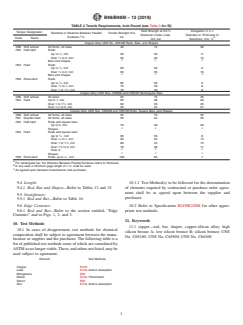
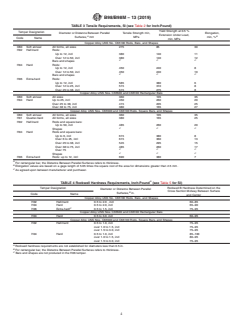
This specification covers rods, bars, and shapes of copper-silicon alloys with UNS Alloy UNS Nos. C65100, C65500, and C66100. The starting materials shall be cast billets or rods of such soundness and structure as to enable them to be processed by hot working, cold working, straightening, and annealing to produce a uniform wrought structure in the finished product. Tempers available under this specification are O60 (soft annealed), H01 (¼-hard), H02 (½-hard), H04 (hard), H06 (extra-hard), M20 (as hot rolled), and M30 (as hot extruded). Products shall be tested and shall adhere to dimensional (mass, diameter, shape, length, straightness, and edge contour), mechanical (tensile and yield strength, elongation, and Rockwell hardness), and chemical composition requirements.
SCOPE
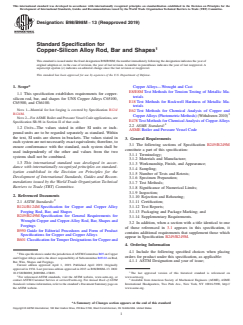
1.1 This specification establishes requirements for copper-silicon rod, bar, and shapes for UNS Copper Alloys C65100, C65500, and C66100.
Note 1: Material for hot forging is covered by Specification B124/B124M.
Note 2: For ASME Boiler and Pressure Vessel Code applications, see Specification SB-98 in Section II of that code.
1.2 Units—The values stated in either SI units or inch-pound units are to be regarded separately as standard. Within the text, SI units are shown in brackets. The values stated in each system are not necessarily exact equivalents; therefore, to ensure conformance with the standard, each system shall be used independently of the other and values from the two systems shall not be combined.
1.3 This international standard was developed in accordance with internationally recognized principles on standardization established in the Decision on Principles for the Development of International Standards, Guides and Recommendations issued by the World Trade Organization Technical Barriers to Trade (TBT) Committee.
- Status
- Published
- Publication Date
- 31-Mar-2019
- Technical Committee
- B05 - Copper and Copper Alloys
- Drafting Committee
- B05.02 - Rod, Bar, Wire, Shapes and Forgings
Overview
ASTM B98/B98M-13(2019), Standard Specification for Copper-Silicon Alloy Rod, Bar and Shapes, establishes the requirements for rods, bars, and shapes made from copper-silicon alloys designated as UNS C65100, C65500, and C66100. The standard is developed under ASTM International, in line with globally recognized standardization principles set by the World Trade Organization.
This specification outlines the chemical, mechanical, and dimensional properties that copper-silicon alloy products must meet, ensuring materials are suitable for further manufacturing and end-use applications. Products covered by this standard are manufactured from high-quality cast billets or rods, worked to achieve the specified shapes and structural integrity.
Key Topics
- Material Scope: Covers copper-silicon alloys C65100, C65500, and C66100, processed for use as rod, bar, and various shapes.
- Tempers Available: Products are available in several tempers, including:
- O60 (soft annealed)
- H01 (¼-hard)
- H02 (½-hard)
- H04 (hard)
- H06 (extra-hard)
- M20 (as hot rolled)
- M30 (as hot extruded)
- Chemical Composition: Specifies precise limits for elements such as copper, silicon, manganese, lead, iron, zinc, and nickel, tailored to each UNS alloy.
- Mechanical Properties: Requirements include minimum tensile and yield strengths, elongation, and Rockwell hardness, with acceptance or rejection often based on specified hardness values or tensile testing.
- Dimensional Requirements: Covers tolerances for mass, diameter, length, straightness, edge contours, and specific shapes, ensuring compatibility with downstream processes and applications.
- Dual Unit System: Allows for specification and testing in both SI and inch-pound units, but prohibits mixing between the two systems within one order.
Applications
Copper-silicon alloy rods, bars, and shapes produced to ASTM B98/B98M are used in a range of industrial and commercial sectors, including:
- Electrical Engineering: Due to good electrical conductivity and corrosion resistance, these alloys are suitable for electrical connectors, relay parts, and switch components.
- Machinery and Equipment: Their mechanical strength and workability make them ideal for valve stems, gears, pump components, and fasteners.
- Automotive and Marine Industries: With enhanced resistance to corrosion and wear, these materials are widely used for bushings, shafts, and marine hardware.
- Construction: Utilized for architectural metalwork, structural support elements, and decorative applications.
- General Fabrication: Rods and bars conforming to this standard support diverse fabrication processes such as machining, forming, and welding.
Adherence to ASTM B98/B98M ensures consistent quality and performance, facilitating supplier selection and regulatory compliance in global markets.
Related Standards
For optimal application and compliance, consider referencing the following standards in conjunction with ASTM B98/B98M:
- ASTM B124/B124M: Specification for Copper and Copper Alloy Forging Rod, Bar, and Shapes (particularly for material used in hot forging applications)
- ASTM B249/B249M: General Requirements for Wrought Copper and Copper-Alloy Rod, Bar, Shapes, and Forgings
- ASTM B601: Classification for Temper Designations for Copper and Copper Alloys
- ASTM E8/E8M: Test Methods for Tension Testing of Metallic Materials
- ASTM E18: Test Methods for Rockwell Hardness of Metallic Materials
- ASTM E478 and E62: Test Methods for Chemical Analysis of Copper Alloys
- ASME Boiler and Pressure Vessel Code, Section II, SB-98: For pressure vessel applications
Conclusion
ASTM B98/B98M-13(2019) provides a comprehensive framework for specifying, manufacturing, and verifying copper-silicon alloy rods, bars, and shapes. By ensuring precise chemical, mechanical, and dimensional characteristics, this standard underpins the reliability and safety of copper-silicon components used across critical industries worldwide.
Relations
- Effective Date
- 01-Apr-2019
- Effective Date
- 01-Jan-2024
- Effective Date
- 01-Oct-2023
- Effective Date
- 01-Oct-2023
- Refers
ASTM B124/B124M-20 - Standard Specification for Copper and Copper Alloy Forging Rod, Bar, and Shapes - Effective Date
- 01-Apr-2020
- Effective Date
- 01-Oct-2019
- Effective Date
- 01-Oct-2019
- Effective Date
- 01-Apr-2019
- Refers
ASTM B124/B124M-19 - Standard Specification for Copper and Copper Alloy Forging Rod, Bar, and Shapes - Effective Date
- 01-Apr-2019
- Effective Date
- 01-Oct-2018
- Effective Date
- 01-Oct-2018
- Effective Date
- 01-Oct-2018
- Effective Date
- 01-Jul-2018
- Refers
ASTM B124/B124M-18 - Standard Specification for Copper and Copper Alloy Forging Rod, Bar, and Shapes - Effective Date
- 15-Mar-2018
- Effective Date
- 01-Mar-2018
Get Certified
Connect with accredited certification bodies for this standard

Element Materials Technology
Materials testing and product certification.

Inštitut za kovinske materiale in tehnologije
Institute of Metals and Technology. Materials testing, metallurgical analysis, NDT.
Sponsored listings
Frequently Asked Questions
ASTM B98/B98M-13(2019) is a technical specification published by ASTM International. Its full title is "Standard Specification for Copper-Silicon Alloy Rod, Bar and Shapes". This standard covers: ABSTRACT This specification covers rods, bars, and shapes of copper-silicon alloys with UNS Alloy UNS Nos. C65100, C65500, and C66100. The starting materials shall be cast billets or rods of such soundness and structure as to enable them to be processed by hot working, cold working, straightening, and annealing to produce a uniform wrought structure in the finished product. Tempers available under this specification are O60 (soft annealed), H01 (¼-hard), H02 (½-hard), H04 (hard), H06 (extra-hard), M20 (as hot rolled), and M30 (as hot extruded). Products shall be tested and shall adhere to dimensional (mass, diameter, shape, length, straightness, and edge contour), mechanical (tensile and yield strength, elongation, and Rockwell hardness), and chemical composition requirements. SCOPE 1.1 This specification establishes requirements for copper-silicon rod, bar, and shapes for UNS Copper Alloys C65100, C65500, and C66100. Note 1: Material for hot forging is covered by Specification B124/B124M. Note 2: For ASME Boiler and Pressure Vessel Code applications, see Specification SB-98 in Section II of that code. 1.2 Units—The values stated in either SI units or inch-pound units are to be regarded separately as standard. Within the text, SI units are shown in brackets. The values stated in each system are not necessarily exact equivalents; therefore, to ensure conformance with the standard, each system shall be used independently of the other and values from the two systems shall not be combined. 1.3 This international standard was developed in accordance with internationally recognized principles on standardization established in the Decision on Principles for the Development of International Standards, Guides and Recommendations issued by the World Trade Organization Technical Barriers to Trade (TBT) Committee.
ABSTRACT This specification covers rods, bars, and shapes of copper-silicon alloys with UNS Alloy UNS Nos. C65100, C65500, and C66100. The starting materials shall be cast billets or rods of such soundness and structure as to enable them to be processed by hot working, cold working, straightening, and annealing to produce a uniform wrought structure in the finished product. Tempers available under this specification are O60 (soft annealed), H01 (¼-hard), H02 (½-hard), H04 (hard), H06 (extra-hard), M20 (as hot rolled), and M30 (as hot extruded). Products shall be tested and shall adhere to dimensional (mass, diameter, shape, length, straightness, and edge contour), mechanical (tensile and yield strength, elongation, and Rockwell hardness), and chemical composition requirements. SCOPE 1.1 This specification establishes requirements for copper-silicon rod, bar, and shapes for UNS Copper Alloys C65100, C65500, and C66100. Note 1: Material for hot forging is covered by Specification B124/B124M. Note 2: For ASME Boiler and Pressure Vessel Code applications, see Specification SB-98 in Section II of that code. 1.2 Units—The values stated in either SI units or inch-pound units are to be regarded separately as standard. Within the text, SI units are shown in brackets. The values stated in each system are not necessarily exact equivalents; therefore, to ensure conformance with the standard, each system shall be used independently of the other and values from the two systems shall not be combined. 1.3 This international standard was developed in accordance with internationally recognized principles on standardization established in the Decision on Principles for the Development of International Standards, Guides and Recommendations issued by the World Trade Organization Technical Barriers to Trade (TBT) Committee.
ASTM B98/B98M-13(2019) is classified under the following ICS (International Classification for Standards) categories: 77.150.30 - Copper products. The ICS classification helps identify the subject area and facilitates finding related standards.
ASTM B98/B98M-13(2019) has the following relationships with other standards: It is inter standard links to ASTM B98/B98M-13, ASTM E8/E8M-24, ASTM B950-23, ASTM B249/B249M-23, ASTM B124/B124M-20, ASTM B124/B124M-19a, ASTM B249/B249M-19a, ASTM B249/B249M-19, ASTM B124/B124M-19, ASTM B124/B124M-18a, ASTM B249/B249M-18a, ASTM B601-18a, ASTM E18-18, ASTM B124/B124M-18, ASTM B601-18. Understanding these relationships helps ensure you are using the most current and applicable version of the standard.
ASTM B98/B98M-13(2019) is available in PDF format for immediate download after purchase. The document can be added to your cart and obtained through the secure checkout process. Digital delivery ensures instant access to the complete standard document.
Standards Content (Sample)
This international standard was developed in accordance with internationally recognized principles on standardization established in the Decision on Principles for the
Development of International Standards, Guides and Recommendations issued by the World Trade Organization Technical Barriers to Trade (TBT) Committee.
Designation: B98/B98M −13 (Reapproved 2019)
Standard Specification for
Copper-Silicon Alloy Rod, Bar and Shapes
This standard is issued under the fixed designation B98/B98M; the number immediately following the designation indicates the year of
original adoption or, in the case of revision, the year of last revision. A number in parentheses indicates the year of last reapproval. A
superscript epsilon (´) indicates an editorial change since the last revision or reapproval.
This standard has been approved for use by agencies of the U.S. Department of Defense.
1. Scope* Copper Alloys—Wrought and Cast
E8/E8M Test Methods for Tension Testing of Metallic Ma-
1.1 This specification establishes requirements for copper-
terials
silicon rod, bar, and shapes for UNS Copper Alloys C65100,
E18 Test Methods for Rockwell Hardness of Metallic Ma-
C65500, and C66100.
terials
NOTE 1—Material for hot forging is covered by Specification B124/
E62 Test Methods for Chemical Analysis of Copper and
B124M.
CopperAlloys (Photometric Methods) (Withdrawn 2010)
NOTE 2—ForASME Boiler and Pressure Vessel Code applications, see
E478 Test Methods for ChemicalAnalysis of CopperAlloys
Specification SB-98 in Section II of that code.
2.2 ASME Standard:
1.2 Units—The values stated in either SI units or inch-
ASME Boiler and Pressure Vessel Code
pound units are to be regarded separately as standard. Within
the text, SI units are shown in brackets. The values stated in
3. General Requirements
each system are not necessarily exact equivalents; therefore, to
3.1 The following sections of Specification B249/B249M
ensure conformance with the standard, each system shall be
constitute a part of this specification:
used independently of the other and values from the two
3.1.1 Terminology;
systems shall not be combined.
3.1.2 Materials and Manufacture;
1.3 This international standard was developed in accor-
3.1.3 Workmanship, Finish, and Appearance;
dance with internationally recognized principles on standard-
3.1.4 Sampling;
ization established in the Decision on Principles for the
3.1.5 Number of Tests and Retests;
Development of International Standards, Guides and Recom-
3.1.6 Specimen Preparation;
mendations issued by the World Trade Organization Technical
3.1.7 Test Methods;
Barriers to Trade (TBT) Committee.
3.1.8 Significance of Numerical Limits;
3.1.9 Inspection;
2. Referenced Documents
3.1.10 Rejection and Rehearing;
2.1 ASTM Standards: 3.1.11 Certification;
B124/B124M Specification for Copper and Copper Alloy
3.1.12 Test Reports;
Forging Rod, Bar, and Shapes 3.1.13 Packaging and Package Marking; and
B249/B249M Specification for General Requirements for
3.1.14 Supplementary Requirements.
Wrought Copper and Copper-Alloy Rod, Bar, Shapes and
3.2 In addition, when a section with a title identical to one
Forgings
of those referenced in 3.1 appears in this specification, it
B950 Guide for Editorial Procedures and Form of Product
contains additional requirements that supplement those which
Specifications for Copper and Copper Alloys
appear in Specification B249/B249M.
B601 Classification forTemper Designations for Copper and
4. Ordering Information
4.1 Include the following specified choices when placing
ThisspecificationisunderthejurisdictionofASTMCommitteeB05onCopper
orders for product under this specification, as applicable:
and CopperAlloys and is the direct responsibility of Subcommittee B05.02 on Rod,
Bar, Wire, Shapes and Forgings. 4.1.1 ASTM Designation and year of issue;
Current edition approved April 1, 2019. Published April 2019. Originally
approved in 1934. Last previous edition approved in 2013 as B98/B98M–13. DOI:
10.1520/B0098_B0098M–13R19. The last approved version of this historical standard is referenced on
For referenced ASTM standards, visit the ASTM website, www.astm.org, or www.astm.org.
contact ASTM Customer Service at service@astm.org. For Annual Book of ASTM Available from American Society of Mechanical Engineers (ASME), ASME
Standards volume information, refer to the standard’s Document Summary page on International Headquarters, Two Park Ave., New York, NY 10016-5990, http://
the ASTM website. www.asme.org.
*A Summary of Changes section appears at the end of this standard
Copyright © ASTM International, 100 Barr Harbor Drive, PO Box C700, West Conshohocken, PA 19428-2959. United States
B98/B98M − 13 (2019)
4.1.2 Copper Alloy UNS No. designation; 6.2 These composition limits do not preclude the presence
4.1.3 Temper designation (see Temper Section 7); of other elements. Limits may be established and analysis
4.1.4 Quantity; total weight or length, or number of pieces required for unnamed elements by agreement between the
of each temper, form, or alloy; manufacturer and the purchaser.
4.1.5 Dimensions; diameter or distance between parallel
7. Temper
surfaces;
7.1 The standard tempers, as defined in Classification B601,
4.1.6 Type of edge; edge contours;
for products described in this specification are given in Tables
4.1.7 How furnished; specific lengths with or without ends;
2-5.
and
7.1.1 Soft annealed O60,
4.1.8 Intended application.
7.1.2 ⁄4-hard H01,
4.2 The following options are available but may not be
7.1.3 ⁄2-hard H02,
included unless specified at the time of placing of the order
7.1.4 Hard H04,
when required:
7.1.5 Extra-hard H06,
4.2.1 Certification (Specification B249/B249M), and
7.1.6 As hot rolled M20, and
4.2.2 Mill Test Report (Specification B249/B249M).
7.1.7 As hot extruded M30.
4.2.3 Tensile test required for alloys in Table 4 or Table 5
7.2 Product of bars and shapes in the temper H06 is
(see 8.1.1.1),
4.2.4 If product is purchased for agencies of the U.S. normally not produced.
Government (see Supplementary Requirements in Specifica-
8. Mechanical Property Requirements
tion B249/B249M).
8.1 Product furnished under this specification shall conform
to the tensile and hardness requirements prescribed in Tables
5. Material and Manufacture
2-5 for the CopperAlloy UNS No. designation specified in the
5.1 Materials—The starting material shall be cast billets or
ordering information.
rods of CopperAlloy UNS Nos. C65100, C65500, or C66100,
8.1.1 Rockwell Hardness Requirement—For the alloys and
and shall be of such soundness and structure as to enable them
tempers listed, product 0.5 in. [12 mm] and over in diameter or
to be processed into the product specified in the contract or
inthedistancebetweenparallelsurfacesshallconformwiththe
purchase order.
requirements given in Table 4 and Table 5, when tested in
5.2 Manufacture—The product shall be manufactured by
accordance with Test Methods E18.
such hot-working, cold-working, straightening, and annealing
8.1.1.1 For the alloys and tempers listed in Table 4 and
processing as to produce a uniform wrought structure and
Table 5, Rockwell hardness shall be the basis of acceptance or
obtain the required finish properties.
rejection for mechanical properties except when the tensile test
is specified in the contract or purchase order.
6. Chemical Composition
8.1.2 Tensile Strength Requirements—The product shall
conform with the requirements of Table 2 and Table 3 when
6.1 Thematerialshallconformtothechemicalrequirements
tested in accordance with Test Methods E8/E8M.
specified in Table 1 for the CopperAlloy UNS No. designated
8.1.2.1 The tensile requirements for all alloys and forms of
in the ordering information.
M20 and M30 tempers shall be as agreed upon between the
6.1.1 For alloys in which copper is listed as “remainder,”
manufacturer and purchaser at the time of order.
copper is the difference between the sum of the results of all
elements determined and 100 %.
9. Dimensions, Mass and Permissible Variations
6.1.2 When all elements listed in Table 1 are determined for
9.1 Refer to the appropriate paragraphs in Specification
the designated alloy, the sum of results shall be 99.5 % min.
B249/B249M with particular reference to the following tables:
9.2 Diameter or Distance Between Parallel Surfaces:
9.2.1 Rod:Round,Hexagonal,Octagonal—Refer toTable 1
TABLE 1 Chemical Requirements
for Alloy C65100 and to Table 2 for Alloys C65500 and
C66100.
Composition, % Maximum
(Unless Shown as a Range or Minimum)
9.2.2 Rod: Round M20 Temper—Refer to Table 6.
Copper Alloy UNS No.
9.2.3 Rod: Round, Hexagonal, Octagonal, M30 Temper—
C65100 C65500 C66100
Re
...