

ASTM F811-02(2016)
(Practice)Standard Practice for Accelerometer Use in Vehicles for Tire Testing
General Information
- Abstract
SIGNIFICANCE AND USE
4.1 The measured accelerometer output can be used to calculate traction properties of combined tire-vehicle systems for passenger cars, light trucks, and heavy trucks through use of applicable methods of testing.
4.2 This practice is intended to achieve uniformity in test vehicle accelerometer use and in accelerometer signal processing. Through such usage, a basis for meaningful comparisons of test results from different sources will be obtained.
4.3 This practice is not applicable to accelerometers used in destructive testing, such as vehicle crash tests or vehicle vibration measurements.
SCOPE
1.1 This practice covers guidelines for using accelerometers in test vehicles to evaluate dynamic accelerations resulting from various maneuvers such as braking, accelerating, or cornering.
1.2 This practice is applicable to accelerometers that are rigidly attached to the body of the test vehicle or stabilized to the earth-fixed axis system by means of a gyroscope.
1.3 The values stated in SI units are to be regarded as the standard. The values given in parentheses are for information only.
1.4 This standard does not purport to address all of the safety concerns, if any, associated with its use. It is the responsibility of the user of this standard to establish appropriate safety and health practices and determine the applicability of regulatory limitations prior to use. Specific precautions are given in Section 6.
- Status
- Published
- Publication Date
- 31-Dec-2015
- Technical Committee
- F09 - Tires
- Drafting Committee
- F09.10 - Equipment, Facilities and Calibration

Overview
ASTM F811-02(2016), titled Standard Practice for Accelerometer Use in Vehicles for Tire Testing, is a widely recognized specification developed by ASTM International. This standard provides comprehensive guidelines for the use of accelerometers in test vehicles to evaluate the dynamic performance of tires during maneuvers such as braking, accelerating, and cornering. Its primary aim is to ensure consistency in test procedures, accelerometer application, and signal processing, thereby enabling meaningful comparison of tire test results across different laboratories and testing facilities.
Key Topics
- Accelerometer Application: The standard specifies that accelerometers must be rigidly attached to the vehicle's body, or stabilized with a gyroscope to align with the earth-fixed axis system, ensuring accurate measurements.
- Measurement Protocols: Outlines protocols for measuring linear and angular accelerations along the primary vehicle axes (x, y, z), providing minimum technical requirements for range, accuracy, bandwidth, temperature tolerance, and cross-axis sensitivity.
- Calibration Requirements: Describes methods for both static and dynamic calibration to maintain measurement accuracy, with periodic verification traceable to national standards.
- Data Processing: Recommends use of low-pass filters to minimize noise from vehicle, tire, and road vibration, specifies sample rates, and addresses recorder accuracy.
- Safety Considerations: Stresses the user's responsibility in implementing safety and regulatory measures, including proper mounting, alignment, and attention to environmental conditions.
- Limitations: Excludes application to destructive tests such as crash testing or vibration measurements not related to tire performance.
Applications
The practical value of ASTM F811-02(2016) lies in its facilitation of reliable and comparable tire performance data, supporting:
- Tire Testing Laboratories: Enhances the consistency and reliability of tire traction, braking, and handling evaluations for cars, light trucks, and heavy trucks.
- Vehicle Manufacturers: Assists in development, safety assessment, and comparison of tires during vehicle design and testing phases.
- Regulatory Compliance: Supports compliance with industry and governmental requirements for vehicle and tire performance characterization.
- Research and Development: Provides a foundation for R&D initiatives focused on advanced tire technology, vehicle dynamics, and performance analysis.
- Performance Benchmarking: Allows organizations to benchmark results, aiding in market comparisons and product improvement.
Related Standards
- ASTM F538 – Terminology Relating to the Characteristics and Performance of Tires: Provides essential definitions used in ASTM F811-02(2016) and other tire-related standards.
- ISO and Other ASTM Standards: May be referenced for metrology, measurement system calibration, and noise filtering techniques in vehicle testing.
- SAE J Standards: Additional industry guidance for instrumented vehicle testing procedures.
Keywords
- Accelerometer use in vehicles
- Tire testing standard
- ASTM F811-02(2016)
- Vehicle dynamics measurement
- Body-mounted accelerometer
- Gyro-stabilized accelerometer
- Tire traction testing
- Automotive test equipment standards
Employing ASTM F811-02(2016) helps organizations maintain high standards in dynamic vehicle testing, ensuring measurement reliability, enhanced safety, and improved product development across the tire and automotive industries.
Relations
- Effective Date
- 01-Jan-2016
- Effective Date
- 15-Jun-2009
- Effective Date
- 01-Dec-2003
- Effective Date
- 10-Apr-1999
- Referred By
ASTM F1572-21 - Standard Test Methods for Tire Performance Testing on Snow and Ice Surfaces - Effective Date
- 01-Jan-2016
Get Certified
Connect with accredited certification bodies for this standard

DIN CERTCO
DIN Group product certification.

Smithers Quality Assessments
US management systems and product certification.
Sponsored listings
Frequently Asked Questions
ASTM F811-02(2016) is a standard published by ASTM International. Its full title is "Standard Practice for Accelerometer Use in Vehicles for Tire Testing". This standard covers: SIGNIFICANCE AND USE 4.1 The measured accelerometer output can be used to calculate traction properties of combined tire-vehicle systems for passenger cars, light trucks, and heavy trucks through use of applicable methods of testing. 4.2 This practice is intended to achieve uniformity in test vehicle accelerometer use and in accelerometer signal processing. Through such usage, a basis for meaningful comparisons of test results from different sources will be obtained. 4.3 This practice is not applicable to accelerometers used in destructive testing, such as vehicle crash tests or vehicle vibration measurements. SCOPE 1.1 This practice covers guidelines for using accelerometers in test vehicles to evaluate dynamic accelerations resulting from various maneuvers such as braking, accelerating, or cornering. 1.2 This practice is applicable to accelerometers that are rigidly attached to the body of the test vehicle or stabilized to the earth-fixed axis system by means of a gyroscope. 1.3 The values stated in SI units are to be regarded as the standard. The values given in parentheses are for information only. 1.4 This standard does not purport to address all of the safety concerns, if any, associated with its use. It is the responsibility of the user of this standard to establish appropriate safety and health practices and determine the applicability of regulatory limitations prior to use. Specific precautions are given in Section 6.
SIGNIFICANCE AND USE 4.1 The measured accelerometer output can be used to calculate traction properties of combined tire-vehicle systems for passenger cars, light trucks, and heavy trucks through use of applicable methods of testing. 4.2 This practice is intended to achieve uniformity in test vehicle accelerometer use and in accelerometer signal processing. Through such usage, a basis for meaningful comparisons of test results from different sources will be obtained. 4.3 This practice is not applicable to accelerometers used in destructive testing, such as vehicle crash tests or vehicle vibration measurements. SCOPE 1.1 This practice covers guidelines for using accelerometers in test vehicles to evaluate dynamic accelerations resulting from various maneuvers such as braking, accelerating, or cornering. 1.2 This practice is applicable to accelerometers that are rigidly attached to the body of the test vehicle or stabilized to the earth-fixed axis system by means of a gyroscope. 1.3 The values stated in SI units are to be regarded as the standard. The values given in parentheses are for information only. 1.4 This standard does not purport to address all of the safety concerns, if any, associated with its use. It is the responsibility of the user of this standard to establish appropriate safety and health practices and determine the applicability of regulatory limitations prior to use. Specific precautions are given in Section 6.
ASTM F811-02(2016) is classified under the following ICS (International Classification for Standards) categories: 83.160.01 - Tyres in general. The ICS classification helps identify the subject area and facilitates finding related standards.
ASTM F811-02(2016) has the following relationships with other standards: It is inter standard links to ASTM F811-02(2010), ASTM F538-09, ASTM F538-03, ASTM F538-99, ASTM F1572-21. Understanding these relationships helps ensure you are using the most current and applicable version of the standard.
ASTM F811-02(2016) is available in PDF format for immediate download after purchase. The document can be added to your cart and obtained through the secure checkout process. Digital delivery ensures instant access to the complete standard document.
Standards Content (Sample)
This international standard was developed in accordance with internationally recognized principles on standardization established in the Decision on Principles for the
Development of International Standards, Guides and Recommendations issued by the World Trade Organization Technical Barriers to Trade (TBT) Committee.
Designation: F811 − 02 (Reapproved 2016)
Standard Practice for
Accelerometer Use in Vehicles for Tire Testing
ThisstandardisissuedunderthefixeddesignationF811;thenumberimmediatelyfollowingthedesignationindicatestheyearoforiginal
adoptionor,inthecaseofrevision,theyearoflastrevision.Anumberinparenthesesindicatestheyearoflastreapproval.Asuperscript
epsilon (´) indicates an editorial change since the last revision or reapproval.
1. Scope 3.1.4 gyro-stabilized accelerometer, n—a precision vertical
gyroscope fitted with one to three accelerometers to provide
1.1 Thispracticecoversguidelinesforusingaccelerometers
orthogonal measurements referenced to the earth-fixed axis
in test vehicles to evaluate dynamic accelerations resulting
system. F538
from various maneuvers such as braking, accelerating, or
3.1.5 servo accelerometer, n—an accelerometer containing
cornering.
servo mechanisms, electronics, and a seismic element to sense
1.2 This practice is applicable to accelerometers that are
inertial reaction. F538
rigidly attached to the body of the test vehicle or stabilized to
3.1.6 strain gage accelerometer, n—an accelerometer using
the earth-fixed axis system by means of a gyroscope.
strain gages to sense the motion of the seismic element. F538
1.3 The values stated in SI units are to be regarded as the
3.2 Definitions of Terms Specific to This Standard:
standard. The values given in parentheses are for information
3.2.1 performance accelerometer, n—a packaged accelera-
only.
tionmeasuringsystemwithintegraldataprocessingcapability.
1.4 This standard does not purport to address all of the
safety concerns, if any, associated with its use. It is the
4. Significance and Use
responsibility of the user of this standard to establish appro-
4.1 The measured accelerometer output can be used to
priate safety and health practices and determine the applica-
calculate traction properties of combined tire-vehicle systems
bility of regulatory limitations prior to use. Specific precau-
for passenger cars, light trucks, and heavy trucks through use
tions are given in Section 6.
of applicable methods of testing.
4.2 This practice is intended to achieve uniformity in test
2. Referenced Documents
vehicle accelerometer use and in accelerometer signal process-
2.1 ASTM Standards:
ing. Through such usage, a basis for meaningful comparisons
F538Terminology Relating to the Characteristics and Per-
of test results from different sources will be obtained.
formance of Tires
4.3 This practice is not applicable to accelerometers used in
3. Terminology destructive testing, such as vehicle crash tests or vehicle
vibration measurements.
3.1 Definitions:
3.1.1 accelerometer, n—an instrument that senses inertial
5. Apparatus
reaction to measure linear or angular acceleration. F538
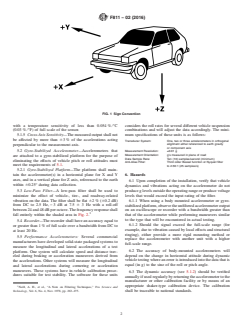
5.1 Body-Mounted Accelerometer—An accelerometer shall
3.1.2 bandwidth, [1/T], n—the range of frequencies within
be used to measure vehicle accelerations in any of the three
whichcertainperformancecharacteristicsoccur;specificlimits
primary vehicle axes (use x, y, z as illustrated in Fig. 1) and
normally apply. F538
shall have the following specifications:
3.1.3 g, n—a unit of acceleration where 1 g is equal to the 5.1.1 Range—The full-scale range of the accelerometer
2 2
acceleration of gravity, 9.8 m/s (32.2 ft/s ). F538
shallbeatleast 61.0gandnotmorethan 65.0gforunitsused
inthexandyaxes,andatleast 62.0gandnotmorethan 65.0
g for units used in the z axis.
This practice is under the jurisdiction ofASTM Committee F09 on Tires and is
5.1.2 Accuracy—Amplitude accuracy shall be equal or bet-
the direct responsibility of Subcommittee F09.10 on Equipment, Facilities and
ter than 61% of full scale including all error sources.
Calibration.
5.1.3 Bandwidth—The frequency response of the complete
Current edition approved Jan. 1, 2016. Published February 2016. Originally
system shall be from DC to a minimum of 20 Hz. The output
approved in 1983. Last previous edition approved in 2010 as F811–02 (2010).
DOI: 10.1520/F0811-02R16.
shall not vary more than 62% of the static output over this
For referenced ASTM standards, visit the ASTM website, www.astm.org, or
frequency range.
contact ASTM Customer Service at service@astm.org. For Annual Book of ASTM
5.1.4 Temperature—The operating temperature range shall
Standards volume information, refer to the standard’s Document Summary page on
the ASTM website. be, as a minimum, between −23 and 66°C (−10 and 150°F)
Copyright © ASTM International, 100 Barr Harbor Drive, PO Box C700, West Conshohocken, PA 19428-2959. United States
F811 − 02 (2016)
FIG. 1 Sign Convention
with a temperature sensitivity of less than 0.054 %⁄°C considers the roll rates for several different vehicle suspension
(0.03%⁄°F) of full scale of the sensor. combinations and will adjust the data accordingly. The mini-
5.1.5 Cross-Axis Sensitivity—The measured output shall not mum specifications of these units is as follows:
be affected by more than 63% of the accelerations acting
Transducer System: One, two or three accelerometers in orthogonal
alignment either referenced to earth gravity
perpendicular to the measurement axis.
or component axis
5.2 Gyro-Stabilized Accelerometer—Accelerometers that
Measurement Resolution: ±0.01 g
Measurement Orientation: g’s measured in plane of road
are attached to a gyro-stabilized platform for the purpose of
Data Sample Rate: Ten (10) samples/second (minimum)
eliminating the effects of vehicle pitch or roll attitudes must
Anti-Alias Filter: Third order Bessel function or Nyquist filter
meet the requirements of 5.1. to 2.56:1 (25 samples/s)
5.2.1 Gyro-Stabilized Platform—The platform shall main-
6. Hazards
tain the accelerometer(s) in a horizontal plane for X and Y
axes, and in a vertical plane for Z axis, referenced to the earth
6.1 Upon completion of the installation, verify that vehicle
within 60.25° during data collection.
dynamics and vibrations acting on the accelerometer do not
5.3 Low-Pass Filter—A low-pass filter shall be used to produceglevelsoutsidetheoperatingrangeorproducevoltage
minimize the effect of vehicle-, tire-, and roadway-related levels that would exceed the input rating of the filter.
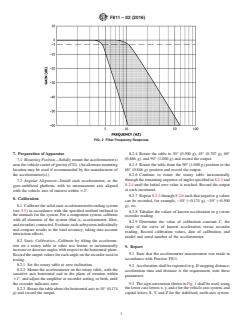
vibration on the data. The filter shall be flat 62%(60.2 dB)
6.1.1 When using a body mounted accelerometer or gyro-
from DC to 2.5 Hz,−3 dB at 7.5 6 3 Hz with a roll-off stabilizedplatform,observetheunfilteredaccelerometeroutput
between24and48dBper
...