


ASTM C1473-19
(Test Method)Standard Test Method for Radiochemical Determination of Uranium Isotopes in Urine by Alpha Spectrometry
Standard Test Method for Radiochemical Determination of Uranium Isotopes in Urine by Alpha Spectrometry
SIGNIFICANCE AND USE
5.1 This test method is used to detect possible exposures to uranium isotopes from occupational operations that may result in elimination via the urinary tract.
SCOPE
1.1 This test method is applicable to the determination of uranium in urine at levels of detection dependent on sample size, count time, detector background, and tracer yield. It is designed as a screening tool for detection of possible exposure of occupational workers.
1.2 This test method is designed for 50 mL of urine. This test method does not address the sampling protocol or sample preservation methods associated with its use.
1.3 Test Method C1844 offers an alternative method for the analysis of uranium in urine using ICP-MS detection.
1.4 The values stated in SI units are to be regarded as standard. No other units of measurement are included in this standard.
1.5 This standard does not purport to address all of the safety concerns, if any, associated with its use. It is the responsibility of the user of this standard to establish appropriate safety, health, and environmental practices and determine the applicability of regulatory limitations prior to use. A specific precautionary statement is given in Section 9.
1.6 This international standard was developed in accordance with internationally recognized principles on standardization established in the Decision on Principles for the Development of International Standards, Guides and Recommendations issued by the World Trade Organization Technical Barriers to Trade (TBT) Committee.
General Information
- Status
- Published
- Publication Date
- 31-Oct-2019
- Technical Committee
- C26 - Nuclear Fuel Cycle
- Drafting Committee
- C26.05 - Methods of Test
Relations
- Effective Date
- 01-Nov-2019
- Effective Date
- 01-Jan-2024
- Effective Date
- 01-Nov-2019
- Refers
ASTM C1284-18 - Standard Practice for Electrodeposition of the Actinides for Alpha Spectrometry - Effective Date
- 01-Jun-2018
- Effective Date
- 15-Dec-2016
- Effective Date
- 01-Jan-2015
- Effective Date
- 15-Jun-2014
- Effective Date
- 15-Jan-2014
- Effective Date
- 01-Jun-2013
- Effective Date
- 01-May-2013
- Effective Date
- 01-Jun-2012
- Effective Date
- 01-Feb-2011
- Effective Date
- 01-Jan-2011
- Effective Date
- 01-Nov-2010
- Effective Date
- 01-Aug-2010
Overview
ASTM C1473-19 establishes a standard test method for the radiochemical determination of uranium isotopes in urine using alpha spectrometry. Developed by ASTM International, this method provides a reliable protocol for detecting and measuring uranium exposure among occupational workers. It is widely used as a screening tool for monitoring internal contamination, particularly in environments where personnel may come into contact with uranium compounds. The standard also references best practices for laboratory safety and emphasizes adherence to international guidelines.
Key Topics
- Radiochemical Testing: The standard outlines detailed procedures for preparing urine samples, separating uranium isotopes, and performing measurement via alpha spectrometry.
- Occupational Uranium Exposure: Designed to detect exposure risks in the workplace, it helps in evaluating whether workers have been exposed to uranium isotopes which are excreted via urine.
- Sample Volume: The method specifically addresses 50 mL urine samples. However, detection sensitivity can be affected by sample volume, count time, detector background, and tracer yield.
- Safety Requirements: Users are responsible for implementing appropriate safety, health, and environmental controls, particularly when handling hazardous reagents such as acids and biological materials.
- Interfering Substances: The standard highlights potential interferences, such as the inability to resolve certain uranium isotope energies and the presence of substances like neptunium.
- Calibration and Standardization: Utilizes uranium-232 as a yield tracer and details the need for proper calibration to achieve reliable results.
Applications
- Health Physics and Occupational Safety: The primary application is in health physics monitoring programs, especially in nuclear, radiological, and heavy industry settings. Facilities processing uranium or employing such materials rely on this method for routine bioassays of workers.
- Medical Surveillance: Medical laboratories and occupational health clinics use this protocol to assess exposure levels in potentially affected individuals.
- Regulatory Compliance: Organizations must often meet regulatory requirements for monitoring internal radiation exposure; this standard helps demonstrate compliance via scientifically validated measurement techniques.
- Environmental and Emergency Response: In the event of accidental releases or suspected contamination incidents, this method supports rapid screening for uranium uptake among exposed workers.
Related Standards
For comprehensive uranium bioassay and alpha spectrometry practices, ASTM C1473-19 references and relates to the following standards:
- ASTM C1844: Test method for determining uranium in urine using inductively coupled plasma mass spectrometry (ICP-MS).
- ASTM C1000: Radiochemical determination of uranium isotopes in soil by alpha spectrometry.
- ASTM C1163 & C1284: Practices for mounting and electrodeposition of actinides for alpha spectrometry.
- ASTM D1193: Specification for reagent water, crucial for laboratory procedures.
- ASTM D3084 & D3972: Methods and practices for alpha-particle spectrometry and isotopic uranium testing in water.
- ASTM D3648: Practices for measuring radioactivity in various matrices.
Practical Value
Implementing ASTM C1473-19 ensures high-confidence results in uranium bioassays, supporting worker safety programs and regulatory obligations in nuclear, defense, mining, and environmental sectors. The use of alpha spectrometry enables sensitive detection of uranium isotopes, helping identify and manage occupational exposures before they become health concerns. The standard is designed for reproducibility, traceability, and compatibility with internationally recognized quality and safety practices aligned with WTO directives.
Keywords: alpha spectrometry, uranium isotopes, urine bioassay, radiochemical method, occupational uranium exposure, ASTM C1473-19, laboratory safety, uranium screening, nuclear worker health monitoring.
Buy Documents

ASTM C1473-19 - Standard Test Method for Radiochemical Determination of Uranium Isotopes in Urine by Alpha Spectrometry
REDLINE ASTM C1473-19 - Standard Test Method for Radiochemical Determination of Uranium Isotopes in Urine by Alpha Spectrometry
Get Certified
Connect with accredited certification bodies for this standard

BSI Group
BSI (British Standards Institution) is the business standards company that helps organizations make excellence a habit.

TÜV Rheinland
TÜV Rheinland is a leading international provider of technical services.

TÜV SÜD
TÜV SÜD is a trusted partner of choice for safety, security and sustainability solutions.
Sponsored listings
Frequently Asked Questions
ASTM C1473-19 is a standard published by ASTM International. Its full title is "Standard Test Method for Radiochemical Determination of Uranium Isotopes in Urine by Alpha Spectrometry". This standard covers: SIGNIFICANCE AND USE 5.1 This test method is used to detect possible exposures to uranium isotopes from occupational operations that may result in elimination via the urinary tract. SCOPE 1.1 This test method is applicable to the determination of uranium in urine at levels of detection dependent on sample size, count time, detector background, and tracer yield. It is designed as a screening tool for detection of possible exposure of occupational workers. 1.2 This test method is designed for 50 mL of urine. This test method does not address the sampling protocol or sample preservation methods associated with its use. 1.3 Test Method C1844 offers an alternative method for the analysis of uranium in urine using ICP-MS detection. 1.4 The values stated in SI units are to be regarded as standard. No other units of measurement are included in this standard. 1.5 This standard does not purport to address all of the safety concerns, if any, associated with its use. It is the responsibility of the user of this standard to establish appropriate safety, health, and environmental practices and determine the applicability of regulatory limitations prior to use. A specific precautionary statement is given in Section 9. 1.6 This international standard was developed in accordance with internationally recognized principles on standardization established in the Decision on Principles for the Development of International Standards, Guides and Recommendations issued by the World Trade Organization Technical Barriers to Trade (TBT) Committee.
SIGNIFICANCE AND USE 5.1 This test method is used to detect possible exposures to uranium isotopes from occupational operations that may result in elimination via the urinary tract. SCOPE 1.1 This test method is applicable to the determination of uranium in urine at levels of detection dependent on sample size, count time, detector background, and tracer yield. It is designed as a screening tool for detection of possible exposure of occupational workers. 1.2 This test method is designed for 50 mL of urine. This test method does not address the sampling protocol or sample preservation methods associated with its use. 1.3 Test Method C1844 offers an alternative method for the analysis of uranium in urine using ICP-MS detection. 1.4 The values stated in SI units are to be regarded as standard. No other units of measurement are included in this standard. 1.5 This standard does not purport to address all of the safety concerns, if any, associated with its use. It is the responsibility of the user of this standard to establish appropriate safety, health, and environmental practices and determine the applicability of regulatory limitations prior to use. A specific precautionary statement is given in Section 9. 1.6 This international standard was developed in accordance with internationally recognized principles on standardization established in the Decision on Principles for the Development of International Standards, Guides and Recommendations issued by the World Trade Organization Technical Barriers to Trade (TBT) Committee.
ASTM C1473-19 is classified under the following ICS (International Classification for Standards) categories: 11.100 - Laboratory medicine. The ICS classification helps identify the subject area and facilitates finding related standards.
ASTM C1473-19 has the following relationships with other standards: It is inter standard links to ASTM C1473-11, ASTM C859-24, ASTM C1000-19, ASTM C1284-18, ASTM C1844-16, ASTM D3972-09(2015), ASTM C859-14a, ASTM C859-14, ASTM C859-13a, ASTM C859-13, ASTM D3084-05(2012), ASTM C1000-11, ASTM D3648-04(2011), ASTM C859-10b, ASTM C859-10a. Understanding these relationships helps ensure you are using the most current and applicable version of the standard.
ASTM C1473-19 is available in PDF format for immediate download after purchase. The document can be added to your cart and obtained through the secure checkout process. Digital delivery ensures instant access to the complete standard document.
Standards Content (Sample)
This international standard was developed in accordance with internationally recognized principles on standardization established in the Decision on Principles for the
Development of International Standards, Guides and Recommendations issued by the World Trade Organization Technical Barriers to Trade (TBT) Committee.
Designation: C1473 − 19
Standard Test Method for
Radiochemical Determination of Uranium Isotopes in Urine
by Alpha Spectrometry
This standard is issued under the fixed designation C1473; the number immediately following the designation indicates the year of
original adoption or, in the case of revision, the year of last revision. A number in parentheses indicates the year of last reapproval. A
superscript epsilon (´) indicates an editorial change since the last revision or reapproval.
1. Scope Uranium Isotopes in Soil by Alpha Spectrometry
C1163 Practice for MountingActinides forAlpha Spectrom-
1.1 This test method is applicable to the determination of
etry Using Neodymium Fluoride
uranium in urine at levels of detection dependent on sample
C1284 Practice for Electrodeposition of the Actinides for
size, count time, detector background, and tracer yield. It is
Alpha Spectrometry
designed as a screening tool for detection of possible exposure
C1844 Test Method for Determination of Uranium in Urine
of occupational workers.
by Inductively Coupled Plasma Mass Spectrometer Fol-
1.2 This test method is designed for 50 mL of urine. This
lowing Nitric Acid Dilution
test method does not address the sampling protocol or sample
D1193 Specification for Reagent Water
preservation methods associated with its use.
D3084 Practice for Alpha-Particle Spectrometry of Water
1.3 Test Method C1844 offers an alternative method for the D3648 Practices for the Measurement of Radioactivity
D3972 Test Method for Isotopic Uranium in Water by
analysis of uranium in urine using ICP-MS detection.
Radiochemistry
1.4 The values stated in SI units are to be regarded as
standard. No other units of measurement are included in this
3. Terminology
standard.
3.1 Except as otherwise defined herein, definition of terms
1.5 This standard does not purport to address all of the
are as given in Terminology C859.
safety concerns, if any, associated with its use. It is the
responsibility of the user of this standard to establish appro-
4. Summary of Test Method
priate safety, health, and environmental practices and deter-
mine the applicability of regulatory limitations prior to use. A
4.1 A urine sample with U tracer solution added is
specific precautionary statement is given in Section 9.
wet-ashed with nitric acid and hydrogen peroxide to destroy
1.6 This international standard was developed in accor-
organic material. The uranium-bearing solution is converted to
dance with internationally recognized principles on standard-
a hydrochloric acid medium. Uranium is absorbed on an anion
ization established in the Decision on Principles for the
exchange column from a 9 M hydrochloric acid solution and
Development of International Standards, Guides and Recom-
eluted with 0.1 M hydrochloric acid solution. The separated
mendations issued by the World Trade Organization Technical
uranium is prepared for alpha spectrometric measurement
Barriers to Trade (TBT) Committee.
either by electrodeposition onto a metal disk or coprecipitation
with neodymium fluoride and filtration onto a membrane filter.
2. Referenced Documents
2.1 ASTM Standards:
5. Significance and Use
C859 Terminology Relating to Nuclear Materials
5.1 This test method is used to detect possible exposures to
C1000 Test Method for Radiochemical Determination of
uranium isotopes from occupational operations that may result
in elimination via the urinary tract.
This test method is under the jurisdiction ofASTM Committee C26 on Nuclear
6. Interferences
Fuel Cycle and is the direct responsibility of Subcommittee C26.05 on Methods of
Test.
6.1 Thepresenceof Uintheurinesamplewillbemasked
Current edition approved Nov. 1, 2019. Published XXX 2019. Originally
233 234
by the tracer addition. The alpha energies of U and U
approved in 2000. Last previous edition approved in 2011 as C1473 – 11. DOI:
10.1520/C1473-19.
cannot be fully resolved by alpha spectrometric measurement.
For referenced ASTM standards, visit the ASTM website, www.astm.org, or
Atable of uranium isotope alpha energies is given in Appendix
contact ASTM Customer Service at service@astm.org. For Annual Book of ASTM
X1. If neptunium is present in the sample in the plus four
Standards volume information, refer to the standard’s Document Summary page on
the ASTM website. oxidation state, it will co–elute with the uranium.
Copyright ©ASTM International, 100 Barr Harbor Drive, PO Box C700, West Conshohocken, PA19428-2959. United States
C1473 − 19
7. Apparatus 8.4 Anion Exchange Resin—Analytical grade, Type 1, 8 %
cross linked, 100-200 mesh, chloride form.
7.1 Alpha Spectrometry System—Refer to Test Method
C1000, and Practices C1163, D3084, and D3648 for guidance. 8.5 Hydrochloric Acid (9 M)—Mix 750 mL of concentrated
HCl with water and dilute to 1 L.
7.2 Electrodeposition Apparatus—Refer to Practice C1284
for guidance. 8.6 Hydrochloric Acid (sp gr 1.19)—Concentrated hydro-
chloric acid (HCl).
7.3 Neodymium Fluoride Precipitation—Refer to Practice
C1163 for guidance. 8.7 Hydrochloric Acid (0.1 M)—Mix 8.3 mL of concen-
trated HCl with water and dilute to 1 L.
7.4 Borosilicate Beakers or Flasks, 250 mL.
8.8 Hydrogen Peroxide (30 %).
7.5 Borosilicate Beakers, 150 and 250 mL.
8.9 Nitric Acid (8 M)—Mix 500 mL of concentrated nitric
7.6 Borosilicate Graduated Glass Cylinders, 5, 25, 100, and
acid with water and dilute to 1 L.
1000 mL.
8.10 Nitric Acid (sp gr 1.4)—Concentrated nitric acid
7.7 Ion Exchange Columns, disposable polypropylene, with
(HNO ).
polyethylene frit, ≥5-mL capacity.
8.11 Uranium-232, standard solution.
7.8 Ion Exchange Column Reservoir,funnel,polypropylene,
100-mL capacity.
9. Precautions
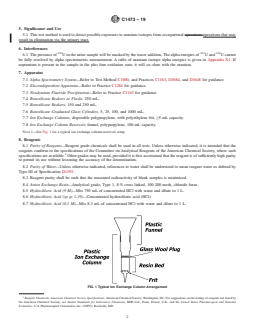
NOTE 1—See Fig. 1 for a typical ion exchange column-reservoir setup.
9.1 Warning—Adequate laboratory facilities, such as fume
hoods and controlled ventilation, along with safe techniques
8. Reagents
must be used in this procedure. Site-specific policies for the
8.1 Purity of Reagents—Reagent grade chemicals shall be
handling of biological materials must be adhered to. Extreme
used in all tests. Unless otherwise indicated, it is intended that
care should be exercised in using hot, concentrated acids. The
the reagents conform to the specifications of the Committee on
use of proper gloves is recommended.
Analytical Reagents of theAmerican Chemical Society, where
such specifications are available. Other grades may be used,
10. Sampling
provided it is first ascertained that the reagent is of sufficiently
10.1 Collect the urine sample in accordance with the site-
high purity to permit its use without lessening the accuracy of
specific protocol.
the determination.
10.2 Preserve the urine sample in accordance with the
8.2 Purity of Water—Unless otherwise indicated, references
site-specificprotocol,typicallybyrefrigerationoracidification.
to water shall be understood to mean reagent water as defined
by Type III of Specification D1193.
11. Calibration and Standardization
8.3 Reagent purity shall be such that the measured radioac-
11.1 A Ustandardisusedtoquantifytheuraniumcontent
tivity of blank samples is minimized.
and may be used to determine the detection efficiency of the
alpha-spectrometry system which, in turn, can be used to
calculate the chemical yield of each sample and the lower limit
Reagent Chemicals, American Chemical Society Specifications, American
of detection (LLD) of this test method.
Chemical Society, Washington, DC. For suggestions on the testing of reagents not
listed by the American Chemical Society, see Analar Standards for Laboratory
Chemicals, BDH Ltd., Poole, Dorset, U.K., and the United States Pharmacopeia 12. Procedure
and National Formulary, U.S. Pharmacopeial Convention, Inc. (USPC), Rockville,
12.1 Sample Preparation:
MD.
12.1.1 Measure 50 mL of urine in a 100-mL graduated
cylinder.
12.1.2 Transfer the urine to a 250-mL beaker or flask.
12.1.3 Rinsethecylindertwicewith5mLof8 MHNO and
add the rinsings to the beaker or flask.
12.1.4 Add an appropriate amount of U tracer solution to
the sample (ca. 0.02 Bq or as prescribed in the site-specific
protocol) and swirl the vessel to mix.
12.1.5 Evaporate the co
...
This document is not an ASTM standard and is intended only to provide the user of an ASTM standard an indication of what changes have been made to the previous version. Because
it may not be technically possible to adequately depict all changes accurately, ASTM recommends that users consult prior editions as appropriate. In all cases only the current version
of the standard as published by ASTM is to be considered the official document.
Designation: C1473 − 11 C1473 − 19
Standard Test Method for
Radiochemical Determination of Uranium Isotopes in Urine
by Alpha Spectrometry
This standard is issued under the fixed designation C1473; the number immediately following the designation indicates the year of
original adoption or, in the case of revision, the year of last revision. A number in parentheses indicates the year of last reapproval. A
superscript epsilon (´) indicates an editorial change since the last revision or reapproval.
1. Scope
1.1 This test method is applicable to the determination of uranium in urine at levels of detection dependent on sample size, count
time, detector background, and tracer yield. It is designed as a screening tool for detection of possible exposure of occupational
workers.
1.2 This test method is designed for 50 mL of urine. This test method does not address the sampling protocol or sample
preservation methods associated with its use.
1.3 Test Method C1844 offers an alternative method for the analysis of uranium in urine using ICP-MS detection.
1.4 The values stated in SI units are to be regarded as standard. No other units of measurement are included in this standard.
1.5 This standard does not purport to address all of the safety concerns, if any, associated with its use. It is the responsibility
of the user of this standard to establish appropriate safety safety, health, and healthenvironmental practices and determine the
applicability of regulatory limitations prior to use. A specific precautionary statement is given in Section 9.
1.6 This international standard was developed in accordance with internationally recognized principles on standardization
established in the Decision on Principles for the Development of International Standards, Guides and Recommendations issued
by the World Trade Organization Technical Barriers to Trade (TBT) Committee.
2. Referenced Documents
2.1 ASTM Standards:
C859 Terminology Relating to Nuclear Materials
C1000 Test Method for Radiochemical Determination of Uranium Isotopes in Soil by Alpha Spectrometry
C1163 Practice for Mounting Actinides for Alpha Spectrometry Using Neodymium Fluoride
C1284 Practice for Electrodeposition of the Actinides for Alpha Spectrometry
C1844 Test Method for Determination of Uranium in Urine by Inductively Coupled Plasma Mass Spectrometer Following Nitric
Acid Dilution
D1193 Specification for Reagent Water
D3084 Practice for Alpha-Particle Spectrometry of Water
D3648 Practices for the Measurement of Radioactivity
D3972 Test Method for Isotopic Uranium in Water by Radiochemistry
3. Terminology
3.1 Except as otherwise defined herein, definition of terms are as given in Terminology C859.
4. Summary of Test Method
4.1 A urine sample with U tracer solution added is wet-ashed with nitric acid and hydrogen peroxide to destroy organic
material. The uranium-bearing solution is converted to a hydrochloric acid medium. Uranium is absorbed on an anion exchange
column from a 9 M hydrochloric acid solution and eluted with 0.1 M hydrochloric acid solution. The separated uranium is prepared
for alpha spectrometric measurement either by electrodeposition onto a metal disk or coprecipitation with neodymium fluoride and
filtration onto a membrane filter.
This test method is under the jurisdiction of ASTM Committee C26 on Nuclear Fuel Cycle and is the direct responsibility of Subcommittee C26.05 on Methods of Test.
Current edition approved Feb. 15, 2011Nov. 1, 2019. Published February 2011XXX 2019. Originally approved in 2000. Last previous edition approved in 20052011 as
C1473 – 05.C1473 – 11. DOI: 10.1520/C1473-11.10.1520/C1473-19.
For referenced ASTM standards, visit the ASTM website, www.astm.org, or contact ASTM Customer Service at service@astm.org. For Annual Book of ASTM Standards
volume information, refer to the standard’s Document Summary page on the ASTM website.
Copyright © ASTM International, 100 Barr Harbor Drive, PO Box C700, West Conshohocken, PA 19428-2959. United States
C1473 − 19
5. Significance and Use
5.1 This test method is used to detect possible exposures to uranium isotopes from occupational operations.operations that may
result in elimination via the urinary tract.
6. Interferences
232 233 234
6.1 The presence of U in the urine sample will be masked by the tracer addition. The alpha energies of U and U cannot
be fully resolved by alpha spectrometric measurement. A table of uranium isotope alpha energies is given in Appendix X1. If
neptunium is present in the sample in the plus four oxidation state, it will co–elute with the uranium.
7. Apparatus
7.1 Alpha Spectrometry System—Refer to Test Method C1000, and Practices C1163, D3084, and D3648 for guidance.
7.2 Electrodeposition Apparatus—Refer to Practice C1284 for guidance.
7.3 Neodymium Fluoride Precipitation—Refer to Practice C1163 for guidance.
7.4 Borosilicate Beakers or Flasks, 250 mL.
7.5 Borosilicate Beakers, 150 and 250 mL.
7.6 Borosilicate Graduated Glass Cylinders, 5, 25, 100, and 1000 mL.
7.7 Ion Exchange Columns, disposable polypropylene, with polyethylene frit, ≥5-mL capacity.
7.8 Ion Exchange Column Reservoir, funnel, polypropylene, 100-mL capacity.
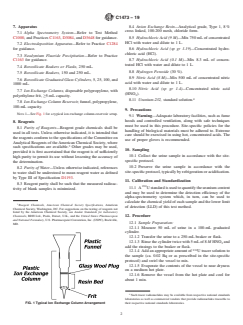
NOTE 1—See Fig. 1 for a typical ion exchange column-reservoir setup.
8. Reagents
8.1 Purity of Reagents—Reagent grade chemicals shall be used in all tests. Unless otherwise indicated, it is intended that the
reagents conform to the specifications of the Committee on Analytical Reagents of the American Chemical Society, where such
specifications are available. Other grades may be used, provided it is first ascertained that the reagent is of sufficiently high purity
to permit its use without lessening the accuracy of the determination.
8.2 Purity of Water—Unless otherwise indicated, references to water shall be understood to mean reagent water as defined by
Type III of Specification D1193.
8.3 Reagent purity shall be such that the measured radioactivity of blank samples is minimized.
8.4 Anion Exchange Resin—Analytical grade, Type 1, 8 % cross linked, 100-200 mesh, chloride form.
8.5 Hydrochloric Acid (9 M)—Mix 750 mL of concentrated HCl with water and dilute to 1 L.
8.6 Hydrochloric Acid (sp gr 1.19)—Concentrated hydrochloric acid (HCl).
8.7 Hydrochloric Acid (0.1 M)—Mix 8.3 mL of concentrated HCl with water and dilute to 1 L.
FIG. 1 Typical Ion Exchange Column Arrangement
Reagent Chemicals, American Chemical Society Specifications, American Chemical Society, Washington, DC. For suggestions on the testing of reagents not listed by
the American Chemical Society, see Analar Standards for Laboratory Chemicals, BDH Ltd., Poole, Dorset, U.K., and the United States Pharmacopeia and National
Formulary, U.S. Pharmacopeial Convention, Inc. (USPC), Rockville, MD.
C1473 − 19
8.8 Hydrogen Peroxide (30 %).
8.9 Nitric Acid (8 M)—Mix 500 mL of concentrated nitric acid with water and dilute to 1 L.
8.10 Nitric Acid (sp gr 1.4)—Concentrated nitric acid (HNO ).
8.11 Uranium-232, standard solution.
9. HazardsPrecautions
9.1 Warning—Adequate laboratory facilities, such as fume hoods and controlled ventilation, along with safe techniques must
be used in this procedure. Site-specific policies for the handling of biological materials must be adhered to. Extreme care should
be exercised in using hydrofluoric and other hot, concentrated acids. The use of proper gloves is recommended.
10. Sampling
10.1 Collect the urine sample in accordance with the site-specific protocol.
10.2 Preserve the urine sample in accordance with the site-specific protocol.protocol, typically by refrigeration or acidification.
11. Calibration and Standardization
11.1 A U standard is used to quantify the uranium content and may be used to determine the detection efficiency of the
alpha-spectrometry system which, in turn, can be used to calculate the chemical yield of each sample and the lower limit of
detection (LLD) of this test method.
12. Procedure
12.1 Sample Preparation:
12.1.1 Measure 50 mL of urine in a 100-mL graduated cylinder.
12.1.2 Transfer the urine to a 250-mL beaker or flask.
12.1.3 Rinse the cylinder twice with 5 mL of 8 M HNO and add the rinsings to the beaker or flask.
12.1.4 Add an appropriate amount of U tracer solution to the sample (ca. 0.02 Bq or as prescribed
...
Questions, Comments and Discussion
Ask us and Technical Secretary will try to provide an answer. You can facilitate discussion about the standard in here.
Loading comments...