

EN 12931:2015
(Main)Chemicals used for treatment of water intended for human consumption - Chemicals for emergency use - Sodium dichloroisocyanurate, anhydrous
- Abstract
This European Standard is applicable to sodium dichloroisocyanurate anhydrous used for emergency treatment of water intended for human consumption. It describes the characteristics of sodium dichloroisocyanurate anhydrous and specifies the requirements and the corresponding test methods for sodium dichloroisocyanurate anhydrous. It gives information on its use in water treatment. It also determines the rules relating to safe handling and use of sodium dichloroisocyanurate anhydrous (see Annex B).
- Status
- Published
- Publication Date
- 24-Mar-2015
- Withdrawal Date
- 29-Sep-2015
- Technical Committee
- CEN/TC 164 - Water supply
- Drafting Committee
- CEN/TC 164/WG 9 - Drinking water treatment
- Current Stage
- 9092 - Decision on results of review/2YR ENQ - revise - Review Enquiry
- Start Date
- 15-Jul-2021
- Completion Date
- 07-Oct-2026

Overview
EN 12931:2015 (CEN) specifies requirements for sodium dichloroisocyanurate, anhydrous (NaDCC) when used for emergency treatment of water intended for human consumption. The standard defines the product identity, physical and chemical characteristics, purity criteria and corresponding test methods, and provides guidance on safe handling, labelling, transportation and storage (notably Annex A - use information, and Annex B - safety rules). EN 12931:2015 supersedes the 2008 edition and is intended for use across CEN member states.
Key topics and technical requirements
- Scope & identification: Chemical name, synonyms (e.g., troclosene sodium), CAS number 2893-78-9, empirical formula C3N3O3Cl2Na and relative molecular mass 219.98.
- Physical properties: white granular solid with chlorinous odour; bulk density ~0.9 g/cm3; solubility ~250 g/L at 25 °C; specific heat ~1.09 ± 0.04 kJ/kg·K.
- Purity and composition: requirements for the composition of the commercial product and limits on impurities and by‑products (detailed testable criteria are given in the standard).
- Test methods: procedures for sampling, determination of available chlorine, analysis of impurities and chemical parameters. Annex C describes atomic absorption hydride techniques for determination of arsenic, antimony and selenium.
- Labelling & regulatory alignment: labelling and safety information updated to current EU chemical regulation; transportation and marking requirements are specified.
- Safety & emergency procedures: Annex B covers safe handling, first aid, spill response and fire measures, plus storage incompatibilities and long‑term stability guidance.
Applications and who uses it
EN 12931:2015 is targeted at organizations involved in emergency water treatment and public health protection:
- Water utilities and emergency responders needing validated products and dosing guidance for emergency disinfection of drinking water.
- Chemical manufacturers and suppliers producing, packing and labelling sodium dichloroisocyanurate (anhydrous) to meet European quality and safety requirements.
- Testing laboratories performing acceptance and compliance testing (available chlorine, impurity analysis, AAS methods).
- Regulators and procurement officers specifying compliant emergency water treatment chemicals and safety documentation.
Practical benefits include consistent product quality, verified test methods for acceptance testing, and clear safety/transport instructions for use in disaster relief and contingency planning.
Related standards
Normative references in EN 12931:2015 include:
- EN 1233 (Cr by AAS), EN ISO 12846 (Hg by AAS), EN ISO 3696 (water for analytical use)
- ISO 3165, ISO 6206, ISO 8213 (sampling standards)
- ISO 8288 (AAS methods for metals)
For compliance or procurement, consult the full EN 12931:2015 document from your national standards body.
Relations
- Effective Date
- 01-Apr-2015
- Effective Date
- 25-Aug-2026
- Effective Date
- 25-Aug-2026
- Effective Date
- 25-Aug-2026
- Effective Date
- 09-Feb-2026
- Effective Date
- 28-Jan-2026
- Effective Date
- 28-Jan-2026
- Effective Date
- 28-Jan-2026
- Effective Date
- 28-Jan-2026
- Effective Date
- 28-Jan-2026
- Refers
EN 1233:1996 - Water quality - Determination of chromium - Atomic absorption spectrometric methods - Effective Date
- 28-Jan-2026
- Effective Date
- 28-Jan-2026
- Effective Date
- 28-Jan-2026
- Effective Date
- 28-Jan-2026
Get Certified
Connect with accredited certification bodies for this standard

ECOCERT
Organic and sustainability certification.

Eurofins Food Testing Global
Global leader in food, environment, and pharmaceutical product testing.

Intertek Bangladesh
Intertek certification and testing services in Bangladesh.
Sponsored listings
Frequently Asked Questions
EN 12931:2015 is a standard published by the European Committee for Standardization (CEN). Its full title is "Chemicals used for treatment of water intended for human consumption - Chemicals for emergency use - Sodium dichloroisocyanurate, anhydrous". This standard covers: This European Standard is applicable to sodium dichloroisocyanurate anhydrous used for emergency treatment of water intended for human consumption. It describes the characteristics of sodium dichloroisocyanurate anhydrous and specifies the requirements and the corresponding test methods for sodium dichloroisocyanurate anhydrous. It gives information on its use in water treatment. It also determines the rules relating to safe handling and use of sodium dichloroisocyanurate anhydrous (see Annex B).
This European Standard is applicable to sodium dichloroisocyanurate anhydrous used for emergency treatment of water intended for human consumption. It describes the characteristics of sodium dichloroisocyanurate anhydrous and specifies the requirements and the corresponding test methods for sodium dichloroisocyanurate anhydrous. It gives information on its use in water treatment. It also determines the rules relating to safe handling and use of sodium dichloroisocyanurate anhydrous (see Annex B).
EN 12931:2015 is classified under the following ICS (International Classification for Standards) categories: 71.100.80 - Chemicals for purification of water. The ICS classification helps identify the subject area and facilitates finding related standards.
EN 12931:2015 has the following relationships with other standards: It is inter standard links to EN 12931:2008, ISO 6206:1979, ISO 8288:1986, ISO 3165:1976, ISO 8213:1986, EN ISO 12846:2012, EN 1998-6:2005, EN 13631-14:2003, EN ISO 8751:1997, EN ISO 3696:1995, EN 1233:1996, EN 15072:2013, CEN ISO/TS 8062-2:2013, EN 15072:2006+A1:2008. Understanding these relationships helps ensure you are using the most current and applicable version of the standard.
EN 12931:2015 is available in PDF format for immediate download after purchase. The document can be added to your cart and obtained through the secure checkout process. Digital delivery ensures instant access to the complete standard document.
Standards Content (Sample)
2003-01.Slovenski inštitut za standardizacijo. Razmnoževanje celote ali delov tega standarda ni dovoljeno.Kemikalije, ki se uporabljajo za pripravo pitne vode - Kemikalije za uporabo v izrednih razmerah - Natrijev dikloroizociaourat, brez vodeProdukte zur Aufbereitung von Wasser für den menschlichen Gebrauch - Produkte für den Notfall - Natriumdichlorisocyanurat, wasserfreiProduits chimiques utilisés pour le traitement de l'eau destinée à la consommation humaine - Produits chimiques utilisés en cas d'urgence - Dichloroisocyanurate de sodium, anhydreChemicals used for treatment of water intended for human consumption - Chemicals for emergency use - Sodium dichloroisocyanurate, anhydrous71.100.80Chemicals for purification of water13.060.20Pitna vodaDrinking waterICS:Ta slovenski standard je istoveten z:EN 12931:2015SIST EN 12931:2015en,fr,de01-junij-2015SIST EN 12931:2015SLOVENSKI
STANDARDSIST EN 12931:20081DGRPHãþD
EUROPEAN STANDARD NORME EUROPÉENNE EUROPÄISCHE NORM
EN 12931
March 2015 ICS 71.100.80 Supersedes EN 12931:2008English Version
Chemicals used for treatment of water intended for human consumption - Chemicals for emergency use - Sodium dichloroisocyanurate, anhydrous
Produits chimiques utilisés pour le traitement de l'eau destinée à la consommation humaine - Produits chimiques utilisés en cas d'urgence - Dichloroisocyanurate de sodium, anhydre
Produkte zur Aufbereitung von Wasser für den menschlichen Gebrauch - Produkte für den Notfall - Natriumdichlorisocyanurat, wasserfrei This European Standard was approved by CEN on 20 December 2014.
CEN members are bound to comply with the CEN/CENELEC Internal Regulations which stipulate the conditions for giving this European Standard the status of a national standard without any alteration. Up-to-date lists and bibliographical references concerning such national standards may be obtained on application to the CEN-CENELEC Management Centre or to any CEN member.
This European Standard exists in three official versions (English, French, German). A version in any other language made by translation under the responsibility of a CEN member into its own language and notified to the CEN-CENELEC Management Centre has the same status as the official versions.
CEN members are the national standards bodies of Austria, Belgium, Bulgaria, Croatia, Cyprus, Czech Republic, Denmark, Estonia, Finland, Former Yugoslav Republic of Macedonia, France, Germany, Greece, Hungary, Iceland, Ireland, Italy, Latvia, Lithuania, Luxembourg, Malta, Netherlands, Norway, Poland, Portugal, Romania, Slovakia, Slovenia, Spain, Sweden, Switzerland, Turkey and United Kingdom.
EUROPEAN COMMITTEE FOR STANDARDIZATION
COMITÉ EUROPÉEN DE NORMALISATION EUROPÄISCHES KOMITEE FÜR NORMUNG
CEN-CENELEC Management Centre:
Avenue Marnix 17,
B-1000 Brussels © 2015 CEN All rights of exploitation in any form and by any means reserved worldwide for CEN national Members. Ref. No. EN 12931:2015 ESIST EN 12931:2015
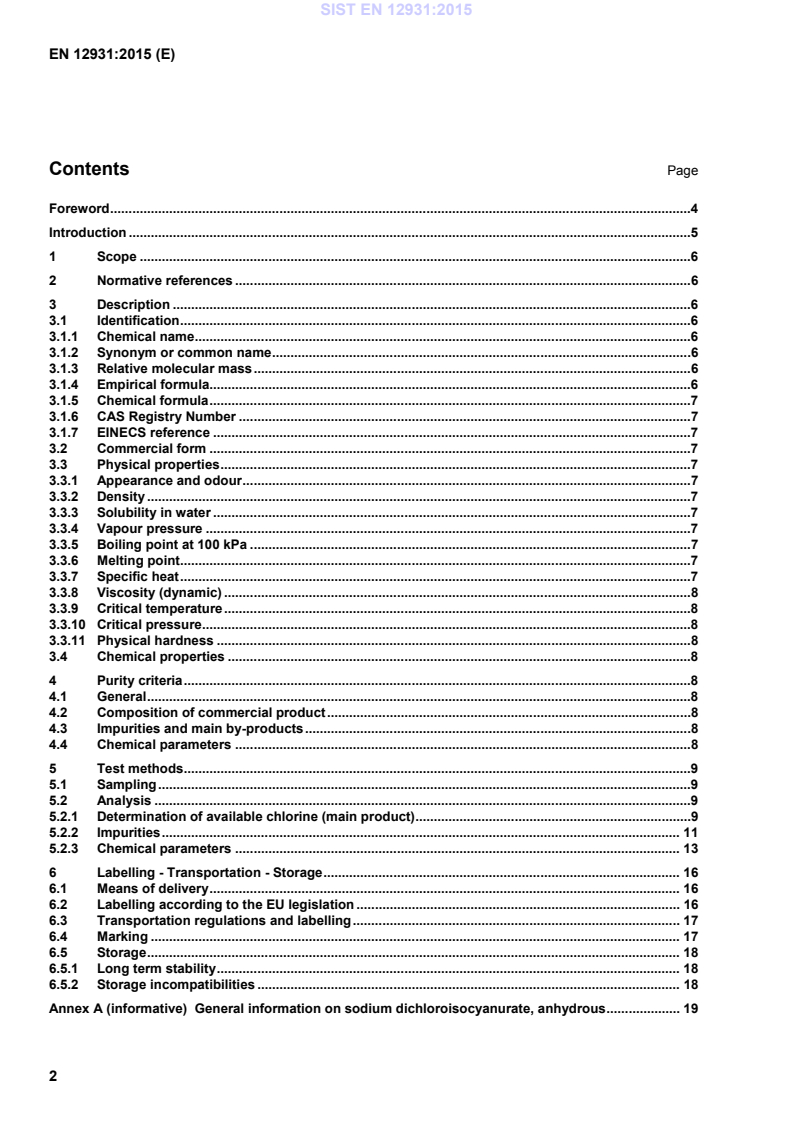
Foreword .4 Introduction .5 1 Scope .6 2 Normative references .6 3 Description .6 3.1 Identification .6 3.1.1 Chemical name .6 3.1.2 Synonym or common name .6 3.1.3 Relative molecular mass .6 3.1.4 Empirical formula.6 3.1.5 Chemical formula .7 3.1.6 CAS Registry Number .7 3.1.7 EINECS reference .7 3.2 Commercial form .7 3.3 Physical properties .7 3.3.1 Appearance and odour .7 3.3.2 Density .7 3.3.3 Solubility in water .7 3.3.4 Vapour pressure .7 3.3.5 Boiling point at 100 kPa .7 3.3.6 Melting point .7 3.3.7 Specific heat .7 3.3.8 Viscosity (dynamic) .8 3.3.9 Critical temperature .8 3.3.10 Critical pressure.8 3.3.11 Physical hardness .8 3.4 Chemical properties .8 4 Purity criteria .8 4.1 General .8 4.2 Composition of commercial product .8 4.3 Impurities and main by-products .8 4.4 Chemical parameters .8 5 Test methods .9 5.1 Sampling .9 5.2 Analysis .9 5.2.1 Determination of available chlorine (main product) .9 5.2.2 Impurities . 11 5.2.3 Chemical parameters . 13 6 Labelling - Transportation - Storage . 16 6.1 Means of delivery . 16 6.2 Labelling according to the EU legislation . 16 6.3 Transportation regulations and labelling . 17 6.4 Marking . 17 6.5 Storage . 18 6.5.1 Long term stability . 18 6.5.2 Storage incompatibilities . 18 Annex A (informative)
General information on sodium dichloroisocyanurate, anhydrous . 19 SIST EN 12931:2015
General rules relating to safety . 21 B.1 Rules for safe handling and use . 21 B.2 Emergency procedures . 21 B.2.1 First aid . 21 B.2.2 Spillage . 21 B.2.3 Fire . 22 Annex C (normative)
Determination of arsenic, antimony and selenium (atomic absorption spectrometry hydride technique) . 23 C.1 General principle . 23 C.2 Interferences . 23 C.3 Reagents. 23 C.4 Apparatus . 25 C.5 Procedure . 26 C.5.1 Preparation of the apparatus . 26 C.5.2 Preparation of calibration solutions . 27 C.5.3 Preparation of test solutions and standard solutions . 27 C.5.4 Determination of arsenic with sodium borohydride . 27 C.5.5 Determination of selenium with sodium borohydride . 27 C.5.6 Determination of antimony with sodium borohydride . 28 C.6 Calculation . 28 Bibliography . 29
3.1.6 CAS Registry Number1) 2893-78-9 3.1.7 EINECS reference2) 220-767-7 3.2 Commercial form The product is available in various granular forms. 3.3 Physical properties 3.3.1 Appearance and odour The product is a white granular solid with chlorinous odour. 3.3.2 Density The bulk density of the product is approximately 0,9 g/cm3. 3.3.3 Solubility in water The solubility of the product in water is 250 g/l at 25 °C. 3.3.4 Vapour pressure Not applicable. 3.3.5 Boiling point at 100 kPa3) Not applicable, the product decomposes before fusion. 3.3.6 Melting point Not applicable. 3.3.7 Specific heat (1,09 ± 0,04) kJ/kg.K at 20 °C.
1) Chemical Abstracts Service Registry Number. 2) European Inventory of Existing Commercial Chemical Substances. 3) 100 kPa = 1 bar. SIST EN 12931:2015
Limit mg/kg of product
Type 1 Type 2 Arsenic (As) max. 10 10 Cadmium (Cd) max. 1 1 Chromium (Cr) max. 6 10 Mercury (Hg) max. 0,02 0,02 Nickel (Ni) max. 3 5 Lead (Pb) max. 4 15 Antimony (Sb) max. 5 5 Selenium (Se) max. 1 1 NOTE Cyanide, which does not exist in a strong oxidizing medium such as sodium dichloroisocyanurate, is not a relevant chemical parameter. Pesticides and polycyclic aromatic hydrocarbons are not by-products of the manufacturing process. For parametric values of sodium dichloroisocyanurate on trace metal content in drinking water, see [1]. 5 Test methods 5.1 Sampling Observe the general recommendations of ISO 3165 and take account of ISO 6206. Prepare the laboratory sample(s) required by the relevant procedure described in ISO 8213. 5.2 Analysis 5.2.1 Determination of available chlorine (main product) 5.2.1.1 Principle The available chlorine is determined by measuring active chlorine in the sample. The oxidizing chlorine reacts with potassium iodide releasing iodine which is then titrated with sodium thiosulfate standard volumetric solution in the presence of starch indicator solution. 5.2.1.2 Reagents All reagents shall be of a recognized analytical grade and the water used shall conform to grade 3 in accordance with EN ISO 3696. 5.2.1.2.1 Potassium iodide crystals (KI). 5.2.1.2.2 Glacial acetic acid. 5.2.1.2.3 Sodium thiosulfate standard volumetric solution, c(Na2S2O3.5H2O) = 0,1 mol/l. Standard volumetric solutions of sodium thiosulfate are commercially available. Alternatively a standard volumetric solution may be prepared by the following procedure: Dissolve 24,8 g Na2S2O3.5 H2O in a 1 000 ml one-mark volumetric flask in about 0,75 l water. After the temperature has equalized, make up to the mark with water and mix thoroughly. SIST EN 12931:2015
(1) where c1 is the concentration, expressed in moles per litre, of the potassium iodate standard reference solution [c(1/6 KIO3) = 0,1 mol/l]; V is the volume, in millilitres, of the sodium thiosulfate standard volumetric solution used for the standardization (V = 10 ml); V1
is the volume, in millilitres, of potassium iodate standard reference solution used in the titration. 5.2.1.2.4 Starch solution, mass fraction 1 %. Make a slurry with (1 ± 0,1) g starch and (5 ± 1) ml water. Add (90 ± 5) ml boiling water to the slurry. Stir to dissolve it and cool the solution. This solution needs refrigeration to avoid the decomposition of the starch which results in a vague end point. Keep the solution cool and use it within one week. Commercial indicators for iodine titration exist and may be used in place of the specified starch solution provided that their efficiency has been previously tested. 5.2.1.3 Apparatus 5.2.1.3.1 Ordinary laboratory apparatus and glassware 5.2.1.4 Procedure 5.2.1.4.1 Test portion Weigh, to the nearest 0,1 mg, 0,25 g of the laboratory sample (m0) into a tared stoppered weighing bottle. 5.2.1.4.2 Determination Transfer the test portion to a 200 ml volumetric flask. Add 10 ml of water and 10 ml of glacial acetic acid (5.2.1.2.2), stir for 5 min and then add 100 ml of water and 2 g of potassium iodide (5.2.1.2.1), and mix to dissolve and wait 10 min. Titrate with the sodium thiosulfate standard volumetric solution (5.2.1.2.3) to a light yellow colour. Add 5 ml of the starch solution (5.2.1.2.4) and continue titration to the disappearance of the blue black colour. Record the volume (V1) of the sodium thiosulfate standard volumetric solution used. SIST EN 12931:2015
(2) where V1 is the volume, in millilitres, of the sodium thiosulfate solution (5.2.1.2.3) used for the titration; m0 is the mass, in grams, of the test portion (5.2.1.4.1); 0,003545 is the mass, in grams, of chlorine (Cl2) corresponding to 1,00 ml of sodium thiosulfate solution, c(Na2S2O3.5H2O) = 0,1 mol/l; c is the actual concentration, expressed in moles per litre of the sodium thiosulfate standard volumetric solution (5.2.1.2.3). 5.2.1.6 Accuracy The result is accurate to within ± 0,1 %. 5.2.2 Impurities 5.2.2.1 Water 5.2.2.1.1 Principle The water content in sodium dichloroisocyanurate is determined by the mass loss after heating in an oven. The temperature is set at a low level because sodium dichloroisocyanurate can lose chlorine on heating. 5.2.2.1.2 Apparatus 5.2.2.1.2.1 Oven made of aluminium, provided with a means of circulating the air inside. 5.2.2.1.3 Procedure Weigh 10 g of the laboratory sample (m1), to the nearest 0,001g, in a glass evaporating dish (diameter 150 mm). Put it in the ventilated oven at 105 °C for 4 h. Allow to cool in a desiccator and weigh again. 5.2.2.1.4 Expression of results The water content (w), expressed as a mass fraction in % is given by the following formula: 121100mmwm−=×
(3) SIST EN 12931:2015
...