

CEN/TS 18345-2:2026
(Main)Paper and board - Laboratory test method for recyclability assessment of paper and board-based materials and products - Part 2: Flotation-deinking recycling process
- Abstract
This document describes a laboratory test method for determining the key parameters for evaluating the level of technical recyclability of a paper-based material and product using a white or off-white substrate, emulating the relevant phases of paper and board mills with alkaline flotation deinking recycling process.
The assessment of the technical recyclability is out of the scope of this document.
- Status
- Published
- Publication Date
- 10-Nov-2026
- Technical Committee
- CEN/TC 172 - Pulp, paper and board
- Drafting Committee
- CEN/TC 172/WG 2 - Paper and board for recycling
- Current Stage
- 6060 - Definitive text made available (DAV) - Publishing
- Start Date
- 11-Nov-2026
- Due Date
- 04-Feb-2027
- Completion Date
- 04-Feb-2027
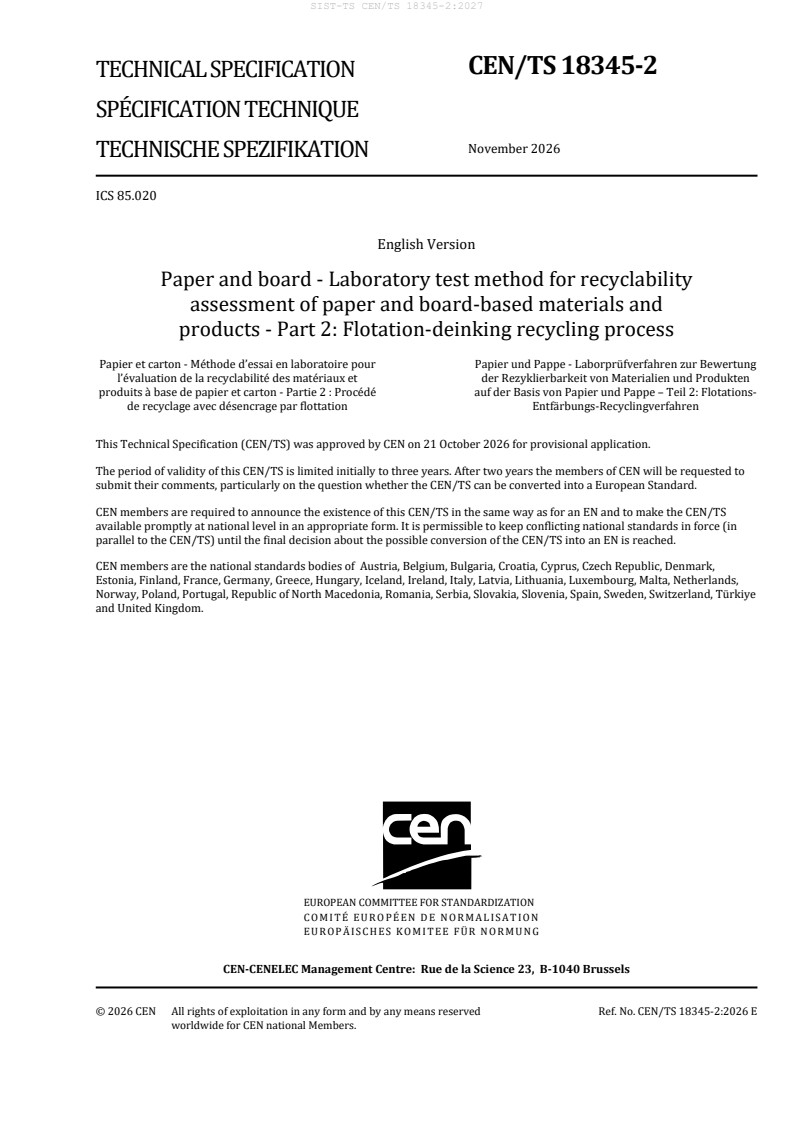

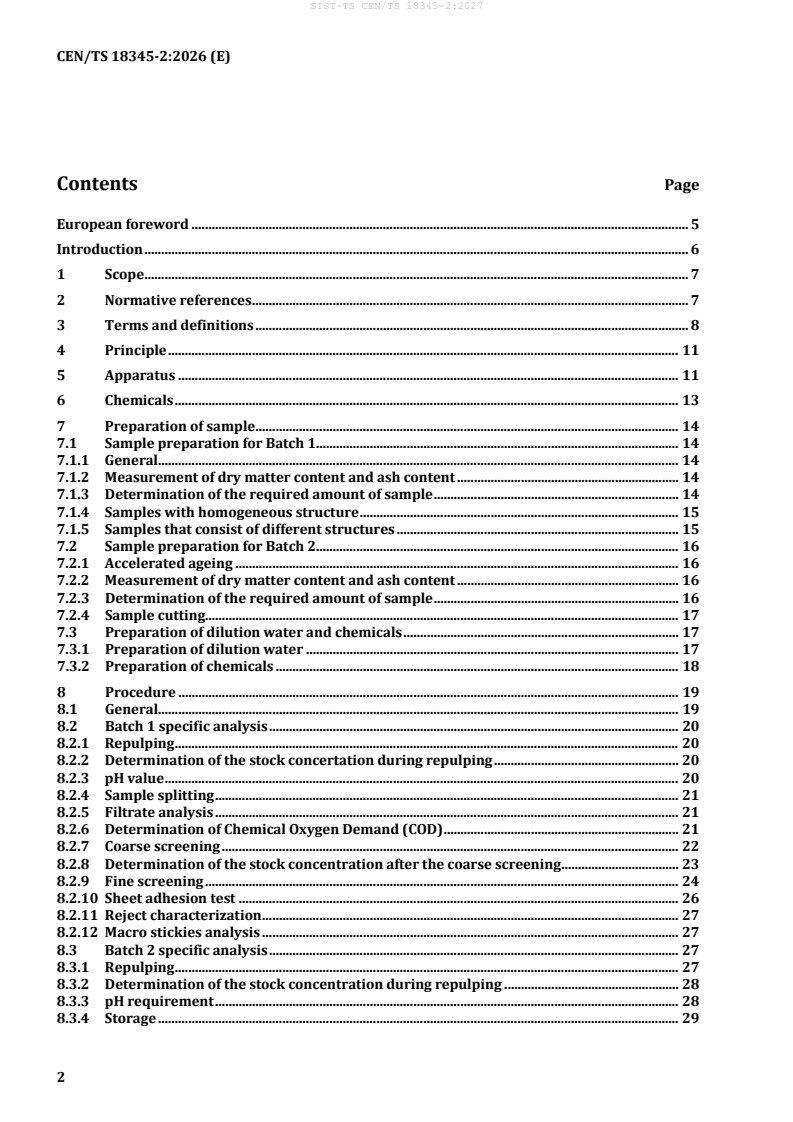
CEN/TS 18345-2:2026 is a CEN technical specification for a laboratory test method that measures the main parameters used to assess the technical recyclability of paper and board-based materials and products with a white or off-white substrate. It emulates the relevant phases of paper and board mills that use an alkaline flotation-deinking recycling process. The document provides test data for recyclability evaluation; the actual assessment of technical recyclability is outside its scope.
What does CEN/TS 18345-2:2026 specify?
CEN/TS 18345-2:2026 specifies how to prepare samples, run the laboratory recycling simulation, and measure the resulting pulp, reject, filtrate and dirt particles. It is aimed at paper and board-based materials and products that are processed through flotation deinking.
The document is organized as a step-by-step test method:
- Clause 4 gives the principle.
- Clause 5 lists apparatus.
- Clause 6 lists chemicals.
- Clause 7 covers sample preparation.
- Clause 8 covers the procedure, split into Batch 1 and Batch 2.
- Clause 9 covers specimen preparation.
- Clause 10 covers analysis.
- Clause 11 defines the test report.
Annexes provide the detailed hardware descriptions, templates, scanner settings, flotation examples and optional methods used by the main clauses.
| Annex | What it covers |
|---|---|
| A | Plate for coarse screening |
| B | Thickener |
| C | Test for flotation time of filter paper |
| D | Repulping device and operating conditions |
| E | Scanner specifications and dirt specks classification |
| F | Flowchart of Batch 1 and Batch 2 |
| G | Reject characterization template |
| H | Macro stickies measurement |
| I | Small-sample pH pre-test |
| J | Example flotation cells |
| K | BOD5 method |
What are the key requirements of CEN/TS 18345-2:2026?
Sampling and sample preparation
CEN/TS 18345-2:2026 requires a representative sample and recommends 1 500 g air-dry mass. Samples are tested at least 15 days after production, and products containing WSA are held for at least 30 days when needed to allow curing before testing. This matters because the ageing state and wet strength chemistry affect disintegration and later flotation behavior.
Clause 7 separates preparation for Batch 1 and Batch 2. Batch 1 is prepared to measure dry matter, ash, coarse-screenable material and reject behavior, while Batch 2 is aged at 60 °C for 72 h and used for the deinking stage. For products with several structures or components, the document requires representative sampling of the different parts, because labels, coatings, seals and other constituents can change the result.
Water, chemistry and repulping
CEN/TS 18345-2:2026 fixes the laboratory water conditions and the deinking chemistry so that results can be compared between laboratories. During treatment it uses deionized water adjusted to a calcium hardness of 128 mg/l Ca2+, and the process temperature is maintained at 45 ± 2 °C. In practice, this controls pulp behavior, because temperature and water hardness influence disintegration, chemistry and flotation.
Clause 7.3 sets a standard deinking recipe with sodium hydroxide, sodium silicate, hydrogen peroxide and oleic acid. The method also requires adjustment of sodium hydroxide and sodium silicate if pH is outside the target range. That means the lab must monitor pH, not only add chemicals by recipe.
Batch 1 - screening test and reject checks
Clause 8.2 uses Batch 1 to characterize the material before flotation. The stock is repulped at 12 % oven-dry fibre concentration, then split for filtrate analysis, coarse screening, fine screening, sheet adhesion testing and reject characterization. This first batch tells the user how much coarse material, fine reject, dissolved and colloidal load, and adhesive interference the material creates.
The coarse screening uses a Somerville fractionator with a 5 mm perforated plate, and the fine screening uses 0.15 mm slots. Rejects are dried and expressed relative to the screening input and to the original test piece, with removed components taken into account when needed. This is important because coarse and fine rejects show whether a product will create losses or mill disturbances.
Batch 1 also includes filtrate analysis for evaporation residue and COD, and optional BOD and macro stickies measurement. The sheet adhesion test classifies tackiness in three levels, from absent to present, by checking whether the handsheet can be separated from the carrier board and cover sheet without damage. In practice, this helps identify adhesive systems that can create sticking, sheet breaks or processing problems.
Batch 2 - flotation deinking and yields
Clause 8.3 uses Batch 2 to run the actual flotation-deinking stage. After repulping, the pulp is stored for 60 min at 45 ± 2 °C, diluted to about 1 %, and floated at 0.8 % stock concentration. The pH must remain in the specified range before flotation, otherwise the test is repeated with adjusted chemical dosage.
The flotation step measures how much material is removed in the froth and how much fibre remains in the pulp. The document requires calculation of overall yield and fibre yield from feed mass, overflow mass, stock concentration and ash content. In practice, these values tell the reader how much usable fibre survives the process and how strongly the product loads the froth.
Specimens, optics and dirt specks
Clause 9 and Clause 10 define how to prepare filter pads, membrane filters and handsheets for optical evaluation. The document measures ISO Brightness, CIELab colour coordinates, luminance Y, filtrate darkening ΔY and dirt particle area A. This matters because recyclability is not only about yield, but also about pulp cleanliness, brightness and filtration quality.
Dirt specks are measured with a calibrated scanner-based image analysis system. The method requires defined scanner performance, calibration and classification of speck sizes. That gives a repeatable way to compare products that leave visible specks in recycled pulp or handsheets.
What terms does CEN/TS 18345-2:2026 define?
| Term | Meaning in the document |
|---|---|
| paper-based product | An article that consists predominantly of paper or board, including moulded products. |
| deinking | The removal of ink from pulp during recycling. |
| flotation | A process step that uses air in diluted pulp to carry ink particles to the surface in froth. |
| deinked pulp | Pulp obtained from printed paper products and deinked according to this document. |
| undeinked pulp | Pulp obtained from printed paper products before flotation, after repulping with deinking chemicals. |
| stock concentration | The oven-dry mass of material that can be filtered from a stock sample relative to the unfiltered sample mass. |
| fibre yield | The oven-dry organic mass after flotation relative to the oven-dry organic mass before flotation. |
| technical recyclability | The ability of a paper and board product to be recycled into new paper and board by an established recycling process. |
Who uses CEN/TS 18345-2:2026?
CEN/TS 18345-2:2026 is used by laboratories that test recyclability, by paper and board mills that receive recycled furnish, and by product developers who need to compare materials under a common method. It is also relevant to quality managers, recyclability assessors, packaging designers and suppliers of inks, coatings, varnishes and adhesives.
In practice, these users apply the method to check whether a product will disintegrate, screen cleanly, float inks and hydrophobic particles, and produce acceptable pulp quality. It also supports eco-design work and recyclability declarations for paper and board-based products.
Which standards are used with CEN/TS 18345-2:2026?
| Normative reference | What it contributes |
|---|---|
| EN ISO 187 | Conditioning atmosphere and sample conditioning procedure |
| EN ISO 638-1:2022 | Dry matter content by oven-drying |
| EN ISO 5269-2 | Rapid-Köthen laboratory sheet preparation |
| ISO 1762 | Ash content on ignition at 525 °C |
| ISO 2469:2024 | Diffuse radiance factor measurement for optical work |
| ISO 2470-1 | ISO Brightness measurement |
| ISO 3310-1 | Technical requirements for test sieves |
| ISO 4119:1995 | Stock concentration determination |
| ISO 5631-1 | Colour by diffuse reflectance |
| ISO 5815-1 | BOD5 determination method |
| ISO 12641-1:2025 | Scanner calibration colour targets |
| ISO 13130 | Desiccators |
| ISO 14487 | Standard water for physical testing |
| ISO 15705 | COD small-scale sealed tube method |
| TAPPI/ANSI T275 | Somerville-type pulp screening |
What does the CEN/TS 18345-2:2026 document contain?
CEN/TS 18345-2:2026 contains the full laboratory procedure, the apparatus list, the chemical recipe, the sample-mass calculations, and the detailed Batch 1 and Batch 2 workflows. It also contains the specimen preparation methods for filter pads, membrane filters and handsheets, plus the reflectance and scanner-based analysis steps used to quantify brightness, colour, filtrate darkening and dirt specks.
The annexes add practical details that users need at the bench: the coarse-screen plate geometry, the thickener design, filter-paper timing, repulping device settings, scanner calibration and dirt-speck classes, reject coding, macro stickies measurement, pH pre-testing, example flotation cells, and BOD5 testing. Clause 11 then brings these results together into the test report, including equipment identification, pH values, chemical dosage, flotation time, yields, optical results and any deviations from the method.
Get Certified
Connect with accredited certification bodies for this standard

Control Union Certifications
Global certification for agriculture and sustainability.

Gozdarski inštitut Slovenije
Slovenian Forestry Institute. Forest management certification support, timber testing.
Sponsored listings
Frequently Asked Questions
CEN/TS 18345-2:2026 is a technical specification published by the European Committee for Standardization (CEN). Its full title is "Paper and board - Laboratory test method for recyclability assessment of paper and board-based materials and products - Part 2: Flotation-deinking recycling process". This standard covers: This document describes a laboratory test method for determining the key parameters for evaluating the level of technical recyclability of a paper-based material and product using a white or off-white substrate, emulating the relevant phases of paper and board mills with alkaline flotation deinking recycling process. The assessment of the technical recyclability is out of the scope of this document.
This document describes a laboratory test method for determining the key parameters for evaluating the level of technical recyclability of a paper-based material and product using a white or off-white substrate, emulating the relevant phases of paper and board mills with alkaline flotation deinking recycling process. The assessment of the technical recyclability is out of the scope of this document.
CEN/TS 18345-2:2026 is classified under the following ICS (International Classification for Standards) categories: 85.020 - Paper production processes. The ICS classification helps identify the subject area and facilitates finding related standards.
CEN/TS 18345-2:2026 is available in PDF format for immediate download after purchase. The document can be added to your cart and obtained through the secure checkout process. Digital delivery ensures instant access to the complete standard document.
Standards Content (Sample)
Contents
- Introduction
- 1 Scope
- 2 Normative references
- 3 Terms and definitions
- 3.1 paper
- 3.2 board
- 3.3 paper-based product
- 3.4 deinking
- 3.5 flotation
- 3.6 recyclability
- 3.7 deinked pulp
- 3.8 undeinked pulp
- 3.9 stock concentration
- 3.10 fibre concentration
- 3.11 fibre yield
- 3.12 non-fibrous coarse-screenable material
- 3.13 constant mass
- 3.14 paper recycling process with flotation deinking
- 3.15 oven-dry mass
- 3.16 constituents
- 3.17 technical recyclability
- 4 Principle
- 5 Apparatus
- 5.1 Forced air oven, able to maintain the required temperatures (60 °C, 105 °C and 130°C) with
- 5.4 Filter paper grade 388, with diameter of 150 mm (basis weight 84 g/m , filtration speed
- 5.11 Filter paper grade 388, with a diameter of 125 mm (basis weight 84 g/m , filtration speed
- 5.40 Photometer measuring device, for Chemical Oxygen Demand (COD) and Biological Oxygen
- 6 Chemicals
- 6.6 Oleic acid (C H O) purified, CAS Registry Number : 112-80-1, with the following
- 6.7 Saturated aluminium sulphate solution Al (SO ) , CAS Registry Number : 10035-04-8; a
- 7 Preparation of sample
- 7.3 Preparation of dilution water and chemicals
- 8 Procedure
- 8.1 General
- 8.2 Batch 1 specific analysis
- 8.3 Batch 2 specific analysis
- 9 Specimen preparation
- 9.1 General
- 9.3 Y, ΔY, R457, L*, a*, b*
- 9.4 Dirt particle area A
- 9.2 Filter pads
- 9.3 Membrane filters
- 9.4 Handsheets for dirt speck measurement
- 10 Analysis
- 10.1 General
- 10.2 Reflectance measurements
- 10.3 Dirt particle measurement
- 11 Test report
- Annex A
- Annex B
- 1 Somerville discharge
- Annex C
- Annex D
- Annex E
- Annex F
- Annex G
- Annex H
- Annex I
- Annex J
- Annex K
- Bibliography
Introduction
The paper and paper board value chain is an example for circularity, displaying very high recycling rates. Moreover, technical innovation is creating new products from paper and board-based materials which are aimed to become papers and boards for recycling after their use. To maintain and further increase the sustainability and circularity of the paper and board value chain
and to help EU Member States and other European countries meet high recycling targets , it is important to ensure that paper and board-based products are recyclable by the paper industry. A laboratory test method is needed for assessing the technical recyclability of these materials and products. The test method in this document emulates the most common phases of the industrial processes to measure the main parameters of recyclability of paper and board-based products based on current knowledge and technology.
This makes it possible to:
- supplement the evaluation of recyclability required by EN 13430 with regard to paper and boardbased products that are sent for recycling in the paper industry;
- guide eco-design, in terms of recyclability, of paper and board-based products currently in use, as well as new materials under development and new additives that can affect the recyclability of the final product;
- support declarations related to the recyclability of materials or products based on grading systems developed by third-party organizations and regulation.
Directives 2018/851/EU, 2018/852/EU set high recycling targets for municipal waste and paper-based packaging (85% by 2025, 90% by 2030).
SIST-TS CEN/TS 18345-2:2027 CEN/TS 18345-2:2026 (E)
1 Scope
This document describes a laboratory test method for determining the key parameters for evaluating the level of technical recyclability of a paper-based material and product using a white or off-white substrate, emulating the relevant phases of paper and board mills with alkaline flotation deinking recycling process. The assessment of the technical recyclability is out of the scope of this document.
2 Normative references
The following documents are referred to in the text in such a way that some or all of their content constitutes requirements of this document. For dated references, only the edition cited applies. For undated references, the latest edition of the referenced document (including any amendments) applies. EN ISO 187, Paper, board and pulps — Standard atmosphere for conditioning and testing and procedure for monitoring the atmosphere and conditioning of samples (ISO 187) EN ISO 638-1:2022, Paper, board, pulps and cellulosic nanomaterials — Determination of dry matter content by oven-drying method — Part 1: Materials in solid form (ISO 638-1:2022) EN ISO 5269-2, Pulps — Preparation of laboratory sheets for physical testing — Part 2: Rapid-Köthen method (ISO 5269-2) ISO 1762, Paper, board, pulps and cellulose nanomaterials — Determination of residue (ash content) on ignition at 525 °C ISO 2469:2024, Paper, board and pulps — Measurement of diffuse radiance factor (diffuse reflectance factor) ISO 2470-1, Paper, board and pulps — Measurement of diffuse blue reflectance factor – Part 1: Indoor daylight conditions (ISO brightness) ISO 3310-1, Test sieves — Technical requirements and testing — Part 1: Test sieves of metal wire cloth ISO 4119:1995, Pulps — Determination of stock concentration ISO 5631-1, Paper and board — Determination of colour by diffuse reflectance — Part 1: Indoor daylight conditions (C/2°) ISO 5815-1, Water quality — Determination of biochemical oxygen demand after n days (BODn) Part 1:
Dilution and seeding method with allylthiourea addition ISO 12641-1:2025, Graphic technology — Prepress digital data exchange —Part 1: Colour targets for input scanner calibration ISO 13130, Laboratory glassware — Desiccators ISO 14487, Pulps — Standard water for physical testing ISO 15705, Water quality — Determination of the chemical oxygen demand index (ST-COD) — Small-scale sealed tube method TAPPI/ANSI T275, Screening of pulp (Somerville-type equipment)
SIST-TS CEN/TS 18345-2:2027 CEN/TS 18345-2:2026 (E)
3 Terms and definitions
For the purposes of this document, the following terms and definitions apply. ISO and IEC maintain terminology databases for use in standardization at the following addresses:
- ISO Online browsing platform: available at https://www.iso.org/obp/
- IEC Electropedia: available at https://www.electropedia.org/
3.1 paper
generic term for a range of materials in the form of a coherent sheet or web, excluding sheets or laps of pulp as commonly understood for paper making or dissolving purposes and non-woven products, made by deposition of vegetable, mineral, animal or synthetic fibres, or their mixtures, from a fluid suspension onto a suitable forming device, with or without the addition of other substances Note 1 to entry: Papers may be coated, impregnated or otherwise converted, during or after their manufacture, without necessarily losing their identity as paper. In conventional papermaking processes, the fluid medium is water; new developments, however, include the use of air and other fluids. Note 2 to entry: In the generic sense, the term “paper” may be used to describe both paper and board as defined in this part of ISO 4046. The primary distinction between paper and board is normally based upon thickness or grammage, though in some instances the distinction will be based on the characteristics and/or end-use. For example, some materials of lower grammage, such as certain grades of folding boxboard and corrugating raw materials, are generally referred to as “board”, while other materials of higher grammage, such as certain grades of blotting paper, felt paper and drawing paper, are generally referred to as “paper”. [SOURCE: ISO 4046-3:2016, 3.95]
3.2 board
cardboard paperboard generic term applied to certain types of paper frequently characterized by their relatively high rigidity Note 1 to entry: In the generic sense, the term “paper” may be used to describe both paper and board as defined in this part of ISO 4046. The primary distinction between paper and board is normally based upon thickness or grammage, though in some instances the distinction will be based on the characteristics and/or end-use. For example, some materials of lower grammage, such as certain grades of folding boxboard and corrugating raw materials, are generally referred to as “board”, while other materials of higher grammage, such as certain grades of blotting paper, felt paper and drawing paper, are generally referred to as “paper”. [SOURCE: ISO 4046-3:2016, 3.16]
3.3 paper-based product
article, predominantly consisting of paper or board Note 1 to entry: Moulded products are included.
3.4 deinking
process of ink removal from pulp during the recycling process [SOURCE: ISO/TS 21331:2020, 3.2.2]
SIST-TS CEN/TS 18345-2:2027 CEN/TS 18345-2:2026 (E)
3.5 flotation
process step intended to selectively remove ink particles from recycled pulp Note 1 to entry: Air is injected into diluted pulp, intended to carry ink particles to the surface of the pulp and to form a froth there.
3.6 recyclability
ability of a paper or board product to be recycled into new paper and board
3.7 deinked pulp
pulp obtained from printed paper products, and deinked according to this document [SOURCE: ISO 21993:2020]
3.8 undeinked pulp
pulp obtained from printed paper products, pulped with added deinking chemicals according to this document, prior to flotation [SOURCE: ISO 21993:2020, 3.2]
3.9 stock concentration
ratio of the oven-dry organic and inorganic mass of material that can be filtered from a stock sample, to the mass of the unfiltered sample Note 1 to entry: the stock concentration is expressed as a percentage by mass [% (m/m)]. [SOURCE: ISO 4119:1995, 3.2]
3.10 fibre concentration
ratio of the oven-dry mass of organic material, that can be filtered from a stock sample, to the mass of the unfiltered sample Note 1 to entry: Organic material is the total material, less its ash. Note 2 to entry: The organic material mainly consists of cellulosic fibres and fines. [SOURCE: ISO 21993:2020, 3.4]
3.11 fibre yield
ratio of the oven-dry mass of organic material after flotation to the oven-dry mass of organic material before flotation Note 1 to entry: Organic material is the total material, less its ash. Note 2 to entry: The organic material mainly consists of cellulosic fibres and fines. [SOURCE: ISO 21993:2020, 3.5]
SIST-TS CEN/TS 18345-2:2027 CEN/TS 18345-2:2026 (E)
3.12 non-fibrous coarse-screenable material
non-fibrous part of the sample which can be removed in the coarse sreening Note to entry: The removal into the coarse reject is determined in batch 1.
3.13 constant mass
mass of the test piece determined at the equilibrium condition after drying until the difference between two successive dryings and weighings, separated in time by at least half the initial drying period, does not exceed 0,1 % mass fraction of the test piece before drying [SOURCE: EN ISO 638-1:2022, 3.2] Note 1 to entry: The removal into the coarse reject is determined in batch 1.
3.14 paper recycling process with flotation deinking
type of process that typically takes in paper for recycling which is based on white or off-white paper and board, and removes ink by flotation deinking
3.15 oven-dry mass
mass obtained on drying pulp at 105 °C ± 2 °C, until constant mass is reached [SOURCE: ISO 801-3:1994, 3.5]
3.16 constituents
part from which a material or its components are made and which cannot be separated by hand or by using simple physical means [SOURCE: ISO 18601:2013, 3.12 - modified by deleting “packaging” from the term and “packaging constituent” and by replacing “packaging” by “material” in the definition]
3.17 technical recyclability
ability of a paper and board product to be recycled into new paper and board by means of an established recycling process Note 1 to entry: The assessment of the technical recyclability is typically done by mimicking the recycling process by a suitable laboratory method and an appropriate assessment scheme. Note 2 to entry: The term recyclability can also mean recyclability at scale.
SIST-TS CEN/TS 18345-2:2027 CEN/TS 18345-2:2026 (E)
4 Principle
The method defined in this document enables analysis of both the process parameters (coarse reject, fine reject, luminance gain within the flotation, filtrate darkening, dissolved, and colloidal substances) and quality parameters of the pulp obtained from the processing of the paper-based product (luminance and a* value of deinked pulp, dirt specks area of deinked pulp, sheet adhesion and interfering materials e.g. stickies). Two subsequent repulping batches are required: the first batch is used to determine dissolved and colloidal substances, Chemical Oxygen Demand (COD), the coarse screening and the fine-screening reject amount as well as an assessment of the adhesives. The second batch is to ascertain the flotationdeinking criteria. For the repulping for the deinking test the amount of non-fibrous coarse-screenable material that can be removed in coarse screening needs to be considered for the second batch calculations (i.e. to adjust chemical dosages and fibre concentration). The recyclability of paper-based products, introduced in the flotation deinking stream, is determined through a laboratory procedure emulating the relevant industrial phases in typical alkaline flotation-deinking mills dedicated to the recycling of paper and board.
5 Apparatus
The usual apparatus and, in particular, the following shall be used:
5.1 Forced air oven, able to maintain the required temperatures (60 °C, 105 °C and 130°C) with
accuracy of ±2 °C.
5.2 pH meter.
5.3 Analytical balance, up to 50 g with an accuracy of at least ±0,001 g.
5.4 Filter paper grade 388, with diameter of 150 mm (basis weight 84 g/m , filtration speed
10 s/10 ml, deposition range 12 µm to 15 μm).
5.5 Büchner funnel, diameter 125 mm and 150 mm equipped with suction flask. 5.6 Aluminium trays, for the determination of the evaporation residue. 5.7 Refrigerator (optional), to store the filtrate.
5.8 Somerville-fractionator, compliant with TAPPI/ANSI T275.
5.9 Perforated screen plate, with 5 mm hole diameter (for details see Annex A). 5.10 Sample containers, beakers, buckets or barrels.
5.11 Filter paper grade 388, with a diameter of 125 mm (basis weight 84 g/m , filtration speed
10 s/10 ml, deposition range 12 µm to 15 μm).
5.12 Stopwatch/timer.
5.13 Thickener, as described in Annex B, with a test sieve compliant to ISO 3310-1. 5.14 Rapid Köthen sheet former, compliant with EN ISO 5269-2.
5.15 Carrier boards and cover sheets, compliant with EN ISO 5269-2.
SIST-TS CEN/TS 18345-2:2027 CEN/TS 18345-2:2026 (E) 5.16 Metal plates (brass or steel), for adhesiveness test, weighing (3,7 ± 0,1) kg and with a diameter of 20 cm (corresponding to a pressure of 1 180 Pa).
5.17 Desiccator, compliant with ISO 13130.
The desiccator should be filled with desiccant to such an extent that there is at least a 10 mm gap between the desiccant and the perforated plate, sieve or grid. The use of a drying cabinet is possible, but ensure that the results are the same.
The temperature and relative humidity in the desiccator shall be measured regularly before and after each test with a suitable measuring device. Each laboratory should maintain a constant value, otherwise the desiccant shall be regenerated.
No specific value is set for the temperature and relative humidity. The values are rather for checking the correct functioning of the desiccator and the desiccant and should be recorded and checked regularly before, during and after each test.
5.18 LED light box, with a recommended LED light source of 5 500 K to 6 500 K (daylight range) and illuminance of at least 5 000 lx.
5.19 Glass bottle (optional), to store the filtrate.
5.20 Cutting mat, for photo documentation.
5.21 Balance, up to 2 kg with an accuracy of at least ±0,1 g.
5.22 Balance, up to 30 kg with an accuracy of ±5 g.
5.23 Digital thermometer, with an accuracy of ±0,1 °C.
5.24 Vacuum device, with a pressure difference ≥ 60 000 Pa.
5.25 Vacuum filtration unit, with 39 mm bottom inner diameter of the funnel. 5.26 Couching roller, compliant with EN ISO 5269-2.
5.27 Slotted screen plate, with 0,15 mm wide slots (for details see TAPPI/ANSI T275).
5.28 Filter paper grade 1289, Grammage of (84 ± 4) g/m , filtration time for deionized water (20 ± 4) s, tested according to Annex C and wet burst strength > 30 kPa according to ISO 3689. The definition of the filter paper is much stricter than in ISO 3688, because the filtrate is used for further analysis (filtrate
darkening). For example, the filter paper Ahlstrom Munktell 12891 meets these requirements. 5.29 Muffle furnance, according to ISO 1762.
5.30 Crucible with lid, for determination of residue (ash content) on ignition at 525 °C. 5.31 Laboratory repulping device, capable of repulping about 200 g to 500 g of paper products under the conditions set in 8.2.1 and 8.3.1. Examples of suitable devices and operating conditions are listed in Annex D.
Ahlstrom Munktell 12891 is a commercially available product. This information is given for the convenience of users of this document and does not constitute an endorsement by CEN of the product named. Equivalent products may be used if they can be shown to lead to the same results.
SIST-TS CEN/TS 18345-2:2027 CEN/TS 18345-2:2026 (E) 5.32 Flatbed scanner or camera, a) Optical scan resolution ≥ 600 dpi, equivalent to a pixel size of ≤ 42 μm; b) Colour depth 24 bit; c) Optical density, DMAX ≥ 4,0; d) with the IT8 calibration (*.ICM-File) according to ISO 12641-1 (see also Annex E IT8 7.2 calibration) and reach a mean grey value of (115 ± 2) for all fields of the IT8 colour calibration sheet according to Annex E. 5.33 Image analysis software, according to Annex E.
5.34 Colour measuring device, according to ISO 2469.
5.35 Flotation cells, according to Annex J.
5.36 COD cuvette tests, (e.g. ranges 15 mg/l to 150 mg/l O and 150 mg/l to 1 000 mg/l O ). 2 2 5.37 Variable pipette, 1 000 μl to 5 000 μl.
5.38 Cuvette rack.
5.39 Cuvette heating block.
5.40 Photometer measuring device, for Chemical Oxygen Demand (COD) and Biological Oxygen
Demand (BOD) measurement.
5.41 BOD5 Bio kit, for preparation of the dilution water.
6 Chemicals
The following reagents shall be used.
6.1 Water, distilled or deionized, according to ISO 14487.
®3 6.2 Calcium chloride dihydrate (CaCl · 2 H O), CAS Registry Number : 10035-04-8. 2 2
6.3 Sodium hydroxide (NaOH), pro analysis, CAS Registry Number : 1310-73-2. 3 3 6.4 Sodium silicate, 1,3 g/cm to 1,4 g/cm (38 °Bé to 40 °Bé).
6.5 Hydrogen peroxide (H O ), e.g. 35 %.
2 2
6.6 Oleic acid (C H O) purified, CAS Registry Number : 112-80-1, with the following
18 34 2 specifications:
a) acid number: 198 to 240; b) iodine number: 92 to 100; c) linoleic acid (C18:2): max. 18 %; d) oleic acid (C18:1): min. 72 %; e) palmitic acid (C16:0): max. 8 %;
CAS Registry Number® (CAS RN®) is a trademark American Chemical Society (ACS). This information is given for the convenience of users of this document and does not constitute an endorsement by CEN of the product named. Equivalent products may be used if they can be shown to lead to the same results.
SIST-TS CEN/TS 18345-2:2027 CEN/TS 18345-2:2026 (E) f) palmitoleic acid (C16:1): max. 1 %; g) stearic acid (C18:0): max. 4 %.
6.7 Saturated aluminium sulphate solution Al (SO ) , CAS Registry Number : 10035-04-8; a
2 4 3 concentration of 330 g/l is considered as a saturated aluminium sulphate solution.
7 Preparation of sample
Take a sample which is representative of the material to be tested. The recommended amount of each sample is 1 500 g air-dry mass.
7.1 Sample preparation for Batch 1
7.1.1 General
The preparation of samples shall differ depending on the type of the sample: if not converted, it can be made of the same structure on its whole surface. (mono-material or paper-based composite material with various constituents, cellulosic or not). In the case of a semi-finished or a finished product, it can also contain integrated or separate components.
NOTE 1 Information on the composition of the product can be found in the technical specification if available. In case of finished products, they shall be emptied from any product and material not being part of this paper-based product before testing. The quantity of tested material or product shall be sufficient to carry out all the measurements indicated by the method.
Samples shall be tested at least 15 days after the production date. If the material or product has been produced less than 15 days before the test or if the production date is unknown, it shall be stored at ambient conditions for the remaining time needed to reach 15 days from the date of production.
If the material or product contains WSA and has been produced less than 30 days before the test or if the production date and exact composition of the sample is unknown, it shall be stored at ambient conditions for the remaining time needed to reach at least 30 days from the date of production. NOTE 2 The curing time for wet strength agents used in papermaking is the time to reach maximum effectiveness. It depends on various factors, including the type of wet strength agent and climate conditions, such as temperature and humidity.
...