

FprEN 13160-3
(Main)Leak detection systems - Part 3: Requirements and test/assessment methods for liquid systems for tanks
- Abstract
This document gives requirements and the corresponding test/assessment methods applicable to leak detectors based on the drop of the liquid level in the leak detection liquid reservoir. Leak detectors are intended to be used with double skin, underground or above ground, non-pressurized tanks designed for water polluting liquids.
The liquid leak detectors are usually composed of:
— sensing device (liquid sensor);
— evaluation device;
— alarm device.
- Status
- Not Published
- Publication Date
- 05-May-2027
- Technical Committee
- CEN/TC 393 - Equipment for storage tanks and for service stations
- Drafting Committee
- CEN/TC 393/WG 2 - Leak detecting devices for tanks and pipes
- Current Stage
- 4599 - Dispatch of FV draft to CMC - Finalization for Vote
- Start Date
- 05-Oct-2026
- Due Date
- 19-Nov-2026
- Completion Date
- 19-Nov-2026
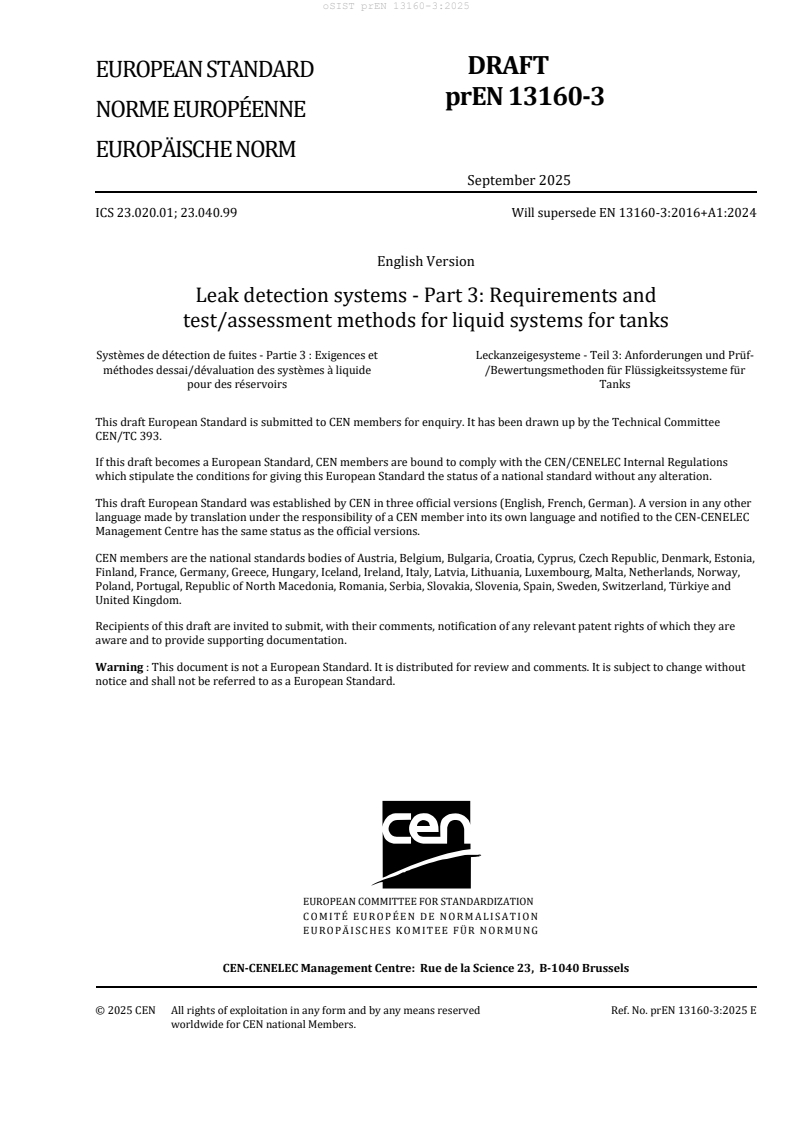

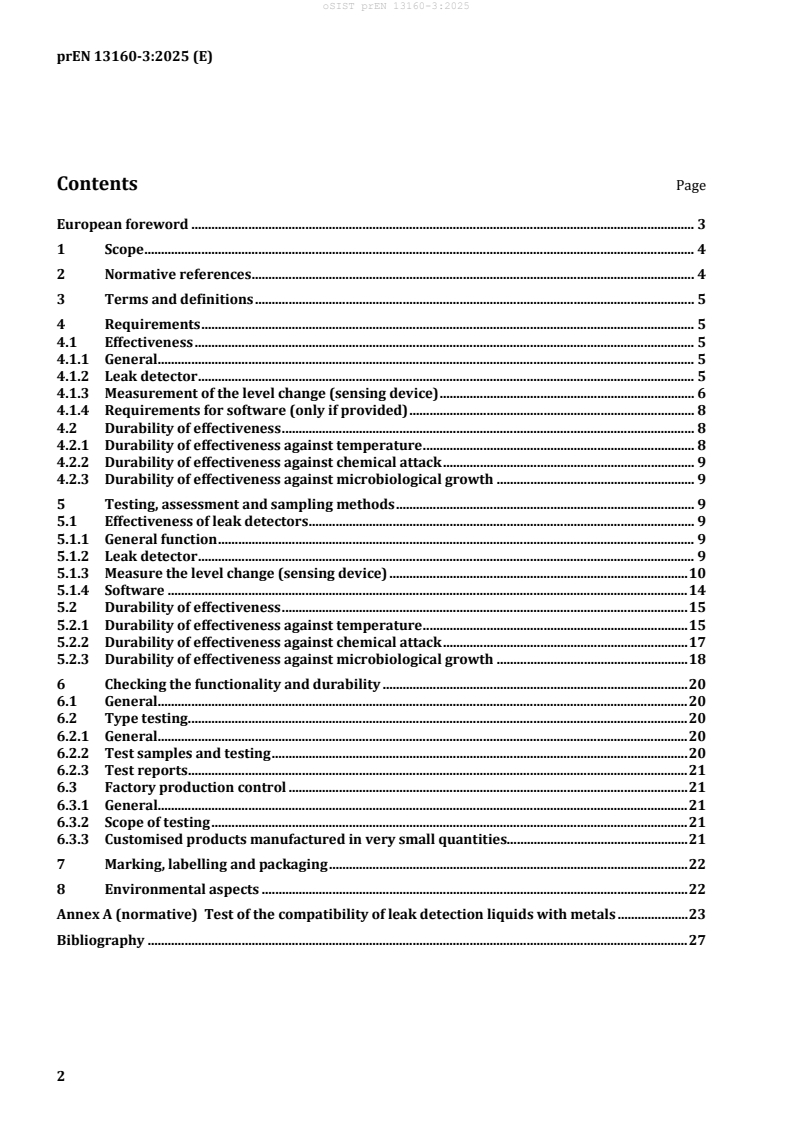
FprEN 13160-3 is a CEN draft European Standard for leak detection systems for tanks. It specifies requirements and test/assessment methods for liquid systems that detect a leak by tracking the drop of liquid level in a leak detection reservoir. The standard is aimed at leak detectors used with double skin, underground or above-ground, non-pressurized tanks for water-polluting liquids.
What does FprEN 13160-3 specify?
FprEN 13160-3 covers liquid leak detectors for tank systems and sets both performance requirements and the methods used to verify them. It is organized into Clauses 1 to 8, plus one normative annex.
The document structure is:
- Clause 1 - Scope
- Clause 2 - Normative references
- Clause 3 - Terms and definitions
- Clause 4 - Requirements
- Clause 5 - Testing, assessment and sampling methods
- Clause 6 - Checking the functionality and durability
- Clause 7 - Marking, labelling and packaging
- Clause 8 - Environmental aspects
- Annex A - normative metal compatibility test for leak detection liquids
| Annex | What it covers |
|---|---|
| A | Compatibility testing of leak detection liquids with metals, including specimen preparation, exposure, corrosion assessment and mass-loss evaluation |
What are the key requirements of FprEN 13160-3?
Classification, application and documentation
FprEN 13160-3 classifies this type of leak detector as class II and requires the general rules of EN 13160-1 to be met. It is intended for use with one tank only, which matters in practice because the reservoir and sensor arrangement must be dedicated to a single installation.
The manufacturer has to provide complete documentation, including the technical values covered by the performance clauses and a statement on how the detector reacts to overvoltage, undervoltage and current conditions. That documentation becomes part of selection, installation and acceptance work.
Reservoir, liquid and connection line
FprEN 13160-3 requires the leak detection liquid reservoir to have enough usable volume for the installation condition, and it requires a vent opening of at least 20 mm. The reservoir also needs a means to check tank level, and if it is used as a visual indicator it must be transparent enough or fitted with a level indicator.
The reservoir position has to keep the hydrostatic pressure of the leak detection liquid above the stored product pressure and groundwater pressure at the lowest point of the tank. This is important because the detector must stay effective under real site pressures.
The leak detection liquid itself must be specified by the manufacturer, including which liquids may be mixed. Its properties are controlled through limits for conductivity, viscosity, freezing point, flash point, thermal expansion, deposits, corrosion behavior and reaction with the stored product. Annex A is used to verify metal compatibility.
The connection line between the reservoir and the interstitial space needs free liquid flow, adequate internal diameter, a minimum bend radius and sufficient hardness. Where explosive atmospheres are involved, the document also controls electrical surface resistance and weather resistance of polymer materials.
Sensor, alarm and software
FprEN 13160-3 requires the liquid sensor to generate an alarm if its power supply is interrupted, if the leak detection liquid no longer touches the sensor, or if the sensor recovers after immersion only within the specified time. The alarm condition must remain active until the sensor has recovered and the alarm has been reset.
The alarm device must give both audible and visible warning. The audible alarm must reach at least 70 dB(A) at 1 m for the specified signal type and remain active for 36 h; the visible alarm must be a clearly indicated red light and must not have a switch-off option. A test facility for the alarm is also required.
If software is provided, it has to self-check at start-up and periodically during use. A failed self-check, or inconsistent input and output data, must lead to an alarm condition. In practice, this means the electronics cannot silently fail.
Durability and environmental aspects
FprEN 13160-3 defines three temperature types for the detector: Type 1, Type 2 and Type 3. It also requires the detector to remain functional after repeated alarm cycling and during temperature-durability testing across the stated temperature profiles.
For chemical durability, polymer parts exposed to the liquid must resist immersion effects, and metal parts must not be corroded by the leak detection liquid. The liquid also has to show fungicidal properties, so the reservoir does not become a growth medium in service.
Clause 8 adds environmental limits for the leak detection liquid. For underground tanks, and for above-ground tanks with larger interstitial spaces, the liquid must not be hazardous to water. For some above-ground installations with smaller interstitial spaces, the allowed GHS status is limited to H302 or to non-classified liquids.
Verification, sampling and production control
FprEN 13160-3 uses both type testing and factory production control to verify conformity. Type testing is required before production of a new or modified detector, when the manufacturing process changes in a way that may affect results, or when the design or supplied components change significantly.
The manufacturer must keep test reports for at least 10 years after the last production of the detector. Factory production control must cover the key product checks, including reservoir inspection, liquid conductivity and freezing point, sensor and evaluation-device function, and alarm-device operation.
What terms does FprEN 13160-3 define?
- Leak detector - The complete system made up of a sensing device, an evaluation device and an alarm device.
- Sensing device (liquid sensor) - The part that detects the presence or loss of contact with the leak detection liquid.
- Evaluation device - The part that interprets the sensor signal and triggers the alarm condition.
- Alarm device - The part that gives the audible and visible warning to the user.
- Interstitial space - The space in the tank system where the leak detection liquid is used to detect leakage.
- Factory production control (FPC) - The manufacturer’s ongoing production checks and records used to keep products conforming.
- Type testing - The qualification testing carried out on representative samples before production or after relevant changes.
Who uses FprEN 13160-3?
FprEN 13160-3 is used by manufacturers of liquid leak detection systems, tank equipment suppliers, and designers of systems for double skin tanks. It is also relevant to testing laboratories, quality managers, and production teams that need to verify design performance, alarm behavior and durability.
Installers and specifiers use FprEN 13160-3 when selecting detectors for underground or above-ground tanks that store water-polluting liquids. Notified bodies and conformity assessment teams may also use it when checking marking, test evidence and factory production control.
What changed in FprEN 13160-3 from the previous edition?
FprEN 13160-3 will supersede EN 13160-3:2016+A1:2024. The foreword states these technical changes:
- the coefficient of thermal expansion in 4.1.3.2.6 has been adapted
- the R phrase in Clause 8 has been replaced by an H phrase
- Clause 6 has been revised and renamed to Checking the functionality and durability
Which standards are used with FprEN 13160-3?
| Reference | What it contributes |
|---|---|
| EN 13160-1:2016 | General principles, class II classification and common terms and definitions |
| EN 13160-2 | Defines p_t2, which is used in the pressure-related reservoir requirement |
| EN 13160-7 | Requirements for interstitial spaces, leak detection linings and leak detection jackets |
| EN 12285-1 | Tank construction context for underground steel tanks |
| EN 12285-2 | Tank construction context for above-ground steel tanks |
| EN 981:1996+A1:2008 | Audible and visual danger signal pattern for the alarm device |
| EN 61672-1 | Sound level meter specification for alarm testing |
| EN 27888 | Electrical conductivity test for the leak detection liquid |
| EN ISO 3104 | Viscosity test for the leak detection liquid |
| ASTM D1177 | Freezing point test for the leak detection liquid |
| EN ISO 2719 | Flash point test for the leak detection liquid |
| EN ISO 12185 | Density-related method used for thermal expansion determination |
| EN ISO 175:2010 | Immersion test method for polymer parts exposed to the liquid |
| ISO 48-4 | Shore hardness test for hoses in the connection line |
| EN IEC 60079-0:2012 | Requirements for explosive atmospheres and surface resistance checks |
| EN 13341:2005+A1:2011 | Weather resistance reference for polymer materials |
| EN 10027-1, EN 1412, EN 1652, ISO 431 | Metal designations and materials used for Annex A compatibility specimens |
What does the FprEN 13160-3 document contain?
FprEN 13160-3 contains the performance requirements for liquid leak detectors, the corresponding test methods, and the verification system for type testing and factory production control. It also includes marking and labelling rules, and environmental conditions for the leak detection liquid.
The body of the document covers reservoir design, liquid properties, sensor response, alarm performance, software self-checks, temperature durability, chemical resistance and microbiological growth resistance. It uses figures for test setups and temperature cycling, plus tables for liquid media, test fungi and related test details.
Annex A gives a full compatibility test for leak detection liquids with metals. It covers specimen preparation, exposure conditions, visual inspection, mass-loss measurement and the criteria used to judge whether corrosion behavior is acceptable.
Relations
- Effective Date
- 05-Feb-2025
Get Certified
Connect with accredited certification bodies for this standard

Institut za varilstvo d.o.o. (Welding Institute)
Slovenia's leading welding institute since 1952. ISO 3834, EN 1090, pressure equipment certification, NDT personnel, welder qualification. Only IIW Au
Sponsored listings
Frequently Asked Questions
FprEN 13160-3 is a draft published by the European Committee for Standardization (CEN). Its full title is "Leak detection systems - Part 3: Requirements and test/assessment methods for liquid systems for tanks". This standard covers: This document gives requirements and the corresponding test/assessment methods applicable to leak detectors based on the drop of the liquid level in the leak detection liquid reservoir. Leak detectors are intended to be used with double skin, underground or above ground, non-pressurized tanks designed for water polluting liquids. The liquid leak detectors are usually composed of: — sensing device (liquid sensor); — evaluation device; — alarm device.
This document gives requirements and the corresponding test/assessment methods applicable to leak detectors based on the drop of the liquid level in the leak detection liquid reservoir. Leak detectors are intended to be used with double skin, underground or above ground, non-pressurized tanks designed for water polluting liquids. The liquid leak detectors are usually composed of: — sensing device (liquid sensor); — evaluation device; — alarm device.
FprEN 13160-3 is classified under the following ICS (International Classification for Standards) categories: 23.020.01 - Fluid storage devices in general; 23.040.99 - Other pipeline components. The ICS classification helps identify the subject area and facilitates finding related standards.
FprEN 13160-3 has the following relationships with other standards: It is inter standard links to EN 13160-3:2016+A1:2024. Understanding these relationships helps ensure you are using the most current and applicable version of the standard.
FprEN 13160-3 is available in PDF format for immediate download after purchase. The document can be added to your cart and obtained through the secure checkout process. Digital delivery ensures instant access to the complete standard document.
Standards Content (Sample)
Contents
- 1 Scope
- 2 Normative references
- 3 Terms and definitions
- 4 Requirements
- 4.1 Effectiveness
- 4.2 Durability of effectiveness
- 5 Testing, assessment and sampling methods
- 5.1 Effectiveness of leak detectors
- 5.2 Durability of effectiveness
- 6 Checking the functionality and durability
- 6.1 General
- 6.2 Type testing
- 6.3 Factory production control
- 7 Marking, labelling and packaging
- 8 Environmental aspects
- Annex A
- Bibliography
- 18 December 2006 concerning the Registration, Evaluation, Authorisation and Restriction of
1 Scope
This document gives requirements and the corresponding test/assessment methods applicable to leak detectors based on the drop of the liquid level in the leak detection liquid reservoir. Leak detectors are intended to be used with double skin, underground or above ground, non-pressurized tanks designed for water polluting liquids.
The liquid leak detectors are usually composed of:
- sensing device (liquid sensor);
- evaluation device;
- alarm device.
2 Normative references
The following documents, in whole or in part, are normatively referenced in this document and are indispensable for its application. For dated references, only the edition cited applies. For undated references, the latest edition of the referenced document (including any amendments) applies. EN 981:1996+A1:2008, Safety of machinery — System of auditory and visual danger and information signals EN 1412, Copper and copper alloys — European numbering system EN 1652, Copper and copper alloys — Plate, sheet, strip and circles for general purposes EN 10027-1, Designation systems for steels — Part 1: Steel names EN 12285-1, Workshop fabricated steel tanks — Part 1: Horizontal cylindrical single skin and double skin tanks for the underground storage of flammable and nonflammable water polluting liquids other than for heating and cooling of buildings EN 12285-2, Workshop fabricated steel tanks — Part 2: Horizontal cylindrical single skin and double skin tanks for the aboveground storage of flammable and non-flammable water polluting liquids EN 13160-1:2016, Leak detection systems — Part 1: General Principles EN 13160-7, Leak detection systems — Part 7: Requirements and test/assessment methods for interstitial spaces, leak detection linings and leak detection jackets EN 13341:2005+A1:2011, Static thermoplastic tanks for above ground storage of domestic heating oils, kerosene and diesel fuels — Blow moulded and rotationally moulded polyethylene tanks and rotationally moulded tanks made of anionically polymerized polyamide 6 — Requirements and test methods EN 27888, Water quality — Determination of electrical conductivity (ISO 7888) EN 61672-1, Electroacoustics — Sound level meters — Part 1: Specifications EN ISO 175:2010, Plastics — Methods of test for the determination of the effects of immersion in liquid chemicals (ISO 175:2010) EN ISO 2719, Determination of flash point — Pensky-Martens closed cup method (ISO 2719)
oSIST prEN 13160-3:2025 prEN 13160-3:2025 (E) EN ISO 3104, Petroleum products — Transparent and opaque liquids — Determination of kinematic viscosity and calculation of dynamic viscosity (ISO 3104) EN ISO 12185, Crude petroleum, petroleum products and related products — Determination of density — Laboratory density meter with an oscillating U-tube sensor (ISO 12185)
EN IEC 60079-0:2012 , Explosive atmospheres — Part 0: Equipment — General requirements (IEC 60079-0:2011, modified + Cor.:2012)
ISO 431 , Copper refinery shapes ISO 48-4, Rubber, vulcanized or thermoplastic — Determination of hardness — Part 4: Indentation hardness by durometer method (Shore hardness) ASTM D 1177, Standard Test Method for Freezing Point of Aqueous Engine Coolants
3 Terms and definitions
For the purposes of this document, the terms and definitions given in EN 13160-1:2016 apply. ISO and IEC maintain terminology databases for use in standardization at the following addresses:
- ISO Online browsing platform: available at https://www.iso.org/obp/
- IEC Electropedia: available at https://www.electropedia.org/
4 Requirements
4.1 Effectiveness
4.1.1 General
This type of leak detector is classified according to EN 13160-1:2016 as class II. The general requirements on leak detection systems according to EN 13160-1:2016 Clause 5 shall be met. The interstitial space shall be in accordance with EN 13160-7, EN 12285-1 or EN 12285-2. NOTE To ensure the effectiveness of the system a liquid leak detector can only serve one tank. A complete documentation shall be provided by the manufacturer. The documentation shall contain the technical values according to 4.1.3 to 4.1.4 and 4.2 as well as a statement about the reaction of the leak detector by over and under power supply voltage and current.
4.1.2 Leak detector
The leak detector shall consist of at least the following:
- sensing device (liquid sensor);
- evaluation device;
- alarm device.
Standard is withdrawn.
Standard is withdrawn.
oSIST prEN 13160-3:2025 prEN 13160-3:2025 (E)
4.1.3 Measurement of the level change (sensing device)
4.1.3.1 Leak detection liquid reservoir
The leak detection liquid reservoir shall have a useable volume of:
- at least 1 l/100 l of leak detection liquid in the interstitial space of tanks with at least 0,3 m earth cover;
- at least 1 l/35 l of leak detection liquid in the interstitial space for all other tanks.
Leak detection liquid reservoir shall have a vent hole of minimum 20 mm open cross-section. The useable volume of the leak detection liquid reservoir is considered to be 50 % of the volume between the liquid level existing just before the visual or audible alarm is issued and the top edge of the leak detection liquid reservoir or the air vent (if the latter is located at a lower level). A facility for checking the tank level (inspection window or level plug) shall be provided. The latter shall divide the volume between the liquid level at alarm indication and the top edge of the leak detection liquid reservoir and/or the vent hole in two.
Leak detection liquid reservoirs that are simultaneously intended as a visual indicator shall be adequately transparent or be equipped with a level indicator.
The leak detection liquid reservoirs shall be positioned so that the hydrostatic pressure of the leak detection liquid at the lowest point of the interstitial space is at least 3 kPa higher than both the maximum pressure of stored product at the lowest point of the tank (including any operating pressure) and the maximum pressure of the groundwater at the lowest point of the tank. The leak detection liquid reservoir shall be positioned so that the pressure in the interstitial space shall not exceed 92 % of p .
t2 NOTE p is defined in EN 13160-2.
t2 For leak detection liquid reservoir installed in a potentially explosive atmosphere the electrical surface
resistance of polymer materials shall be less than 1 GΩ, if the greatest projected surface is > 100 cm . For further information see EN 60079-0:2012 7.4.2.
Polymer materials for leak detection liquid reservoirs shall be weather resistant according to EN 13341:2005+A1:2011 Table 1.
4.1.3.2 Leak detection liquid
4.1.3.2.1 General The manufacturer shall specify which leak detection liquids are suitable for the leak detection system and which leak detection liquids can be mixed.
NOTE 1 When the term “leak detection liquid” is used in this document, the concentrate of leak detection liquid diluted with water according to the ratio specified by the manufacturer is meant. NOTE 2 Leak detection liquid can only be mixed if its compatibility is approved. Leak detection liquids shall have the properties according to 4.1.3.2.2 to 4.1.3.2.9. The compatibility of leak detection liquids with metals shall be tested in accordance with Annex A. 4.1.3.2.2 Electrical conductivity The leak detection liquid shall have an electrical conductivity greater than 10 mS/m, if required.
oSIST prEN 13160-3:2025 prEN 13160-3:2025 (E) 4.1.3.2.3 Viscosity
The leak detection liquid shall have a viscosity not greater than 200 mm /s for the temperature range according to 4.2.1.
4.1.3.2.4 Freezing point The leak detection liquid shall have a freezing point below the minimum temperature of the appropriate temperature range according to 4.2.1.
4.1.3.2.5 Flash point The leak detection liquid shall have a flash point not below +80 °C. 4.1.3.2.6 Thermal expansion −4 The leak detection liquid shall have a coefficient of thermal expansion < 5 × 10 1/K at a temperature of +20 °C.
4.1.3.2.7 Segregation and formation of colloidal or solid deposition
The deposit volume of the leak detection liquid shall not be greater than 0,5 cm /l and the solid materials of the deposit shall have a maximum grain size of 0,125 mm diameter. 4.1.3.2.8 Compatibility with metallic materials The leak detection liquid shall have no deleterious corrosion effects on the materials with which they might be expected to come into contact.
4.1.3.2.9 Reaction with the stored product The leak detection liquid shall have no reaction with the stored product which causes an exothermic reaction, volumetric expansion or the generation of vapour
4.1.3.3 Connection line between leak detection liquid reservoir and interstitial space
If a separate leak detection liquid reservoir is used the free passage of leak detection liquid is given when the connection line has an internal diameter of minimum 13 mm. The connection lines shall ensure the internal diameter over the life time given by the manufacturer. The minimum allowed bend radius of the hose given by the manufacturer shall not be fallen below.
The Shore hardness of hoses tested according to ISO 48-4 shall be minimum 65 Shore A at a temperature of (20 ± 5) °C.
The leak detection liquid reservoir shall have the possibility to be complete emptied in case of a leak in the interstitial space.
The connection line between leak detection liquid reservoir and interstitial space installed in potentially explosive atmosphere of zone 1 shall have an electrical surface resistance less than 1 GΩ. This requirement concerning conductive connection lines of polymer materials becomes no longer necessary if - the outer diameter of the connection lines is ≤ 30 mm for potentially explosive atmospheres of group II A and II B according to EN IEC 60079-0 or - the outer diameter of the connection lines is ≤ 20 mm for potentially explosive atmospheres of group II C according to EN IEC 60079-0
oSIST prEN 13160-3:2025 prEN 13160-3:2025 (E) or - the wall thickness of the connection lines is ≤ 2 mm for potentially explosive atmospheres of group II A and II B according to EN IEC 60079-0 by using conductive leak detection liquid or - the wall thickness of the connection lines is ≤ 0,2 mm for potentially explosive atmospheres of group II C according to EN IEC 60079-0 by using conductive leak detection liquid. For further information see EN IEC 60079-0:2012 7.4.2.
Polymer materials for connection lines shall be weather resistant according to EN 13341:2005+A1:2011 Table 1.
4.1.3.4 Liquid sensor
In the event of a sensor disconnection of the power supply an alarm condition shall result. The sensor shall give a signal within 30 s after the leak detection liquid is no longer in contact with the sensor.
The sensor shall have a measurable recovery time of max 30 s after immersing into the leak detection liquid.
The system shall remain in the alarm condition until the sensor has recovered and the alarm has been reset.
4.1.3.5 Alarm device
The alarm device shall generate an audible and visible alarm. The audible alarm shall have a sound level of ≥ 70 dB (A) in a distance of minimum 1 m with a signal according to EN 981:1996+A1:2008 Table 1 which shall be maintained for a minimum period of 36 h.
The visible alarm shall be clearly indicated i.e. by a “red” light. The visible alarm shall have no switch off option.
A test possibility shall be provided to test the functionality of the audible and visible alarm. The alarm device should be designed for connecting an additional alarm device, e.g. signal horn. The output parameter shall be stated.
4.1.4 Requirements for software (only if provided)
The software, where provided, shall have a facility for self-checking by fulfilling the following requirements:
- a self-diagnostic mode to test the integrity of the system at start up and periodically during use. A negative result of self-diagnostic mode shall result in an alarm condition;
- a facility to check the consistency of the input and output data, malfunction shall result in an alarm condition.
4.2 Durability of effectiveness
4.2.1 Durability of effectiveness against temperature
At a temperature of (20 ± 5) °C the leak detector shall be able to work properly after 1 × 10 alarm cycles.
oSIST prEN 13160-3:2025 prEN 13160-3:2025 (E) The temperature ranges for leak detector shall be as follows:
- Type 1: −20 °C to +60 °C;
- Type 2: 0 °C to +40 °C;
- Type 3: −40 °C to +40 °C.
4.2.2 Durability of effectiveness against chemical attack
4.2.2.1 Polymer materials
Plastic parts of liquid leak detector that can get into contact with the leak detection liquid or its vapour shall be resistant.
4.2.2.2 Metals
The leak detection liquid shall not corrode metal components of the leak detection system.
4.2.3 Durability of effectiveness against microbiological growth
The leak detection liquid shall have fungicidal properties.
5 Testing, assessment and sampling methods
5.1 Effectiveness of leak detectors
5.1.1 General function
For the tests minimum one sample shall be provided by the manufacturer. For the tests the following documentation shall be provided by the manufacturer:
- instruction(s) according to Clause 7;
- datasheet of the parts of the leak detector;
- datasheet for the leak detection liquid;
- electrical diagrams of the parts of the leak detector;
- design and application drawings;
- parts lists of the used components including material data;
- certification for the conductivity and weather resistance of polymer materials. Leak detectors shall be inspected visually to confirm that the sample complies with the documentation.
5.1.2 Leak detector
Visual test shall be carried out that the leak detector consists of sensing device, evaluation device and alarm device.
oSIST prEN 13160-3:2025 prEN 13160-3:2025 (E)
5.1.3 Measure the level change (sensing device)
5.1.3.1 Leak detection liquid reservoir
Leak detection liquid reservoir shall be inspected visually to confirm that the sample complies with the documentation.
5.1.3.2 Leak detection liquid
5.1.3.2.1 General The documentation of the manufacturer shall be inspected.
5.1.3.2.2 Electrical conductivity The electrical conductivity shall be tested according to EN 27888. 5.1.3.2.3 Viscosity The viscosity of the leak detection liquid shall be determined according to EN ISO 3104. 5.1.3.2.4 Freezing point The freezing point of the leak detection liquid shall be determined in accordance with ASTM D 1177. 5.1.3.2.5 Flash point The flash point of the leak detection liquid shall be determined according to EN ISO 2719. 5.1.3.2.6 Thermal expansion The coefficient of thermal expansion of the leak detection liquid shall be determined according to EN ISO 12185.
5.1.3.2.7 Segregation and formation of colloidal or solid deposition 5.1.3.2.7.1 Test equipment Test equipment shall be the following:
- a strainer of 0,2 mm inside mesh width 0,125 mm diameter and 0,325 mm mesh clearance;
- a graduated conical separating funnel according to Squibb with a nominal volume of 1 l;
- 1 l leak detection liquid.
5.1.3.2.7.2 Preparation 1 l of leak detection liquid shall be brought into contact with the materials relevant to testing its tendency to de-mix and precipitate deposits.
5.1.3.2.7.3 Procedure The leak detection liquid shall be stored at ambient temperature (20 ± 5) °C for 56 days in the graduated conical separating funnel with a tap at the bottom.
The leak detection liquid shall be inspected for de-mixing and deposition. The volume of the deposit shall be measured at the graduation at the lowest level of the conical separating funnel, see Figure 1.
oSIST prEN 13160-3:2025 prEN 13160-3:2025 (E) After opening the tap of the separating funnel, the deposit shall be tested whether it will pass completely through the strainer.
Key 1 conical separating funnel, 1 l 2 graduation 3 cock 4 sieve Figure 1 — Conical separating funnel 5.1.3.2.7.4 Evaluation
If the deposit volume is greater than 0,5 cm /l, or if it does not pass completely through the strainer, then the leak detection liquid shall be deemed to have failed the test. 5.1.3.2.8 Compatibility with metallic materials Compatibility with metallic materials shall be according to Annex A. 5.1.3.2.9 Reaction with stored product 5.1.3.2.9.1 Test equipment Test equipment shall be the following:
...