

FprEN 13160-4
(Main)Leak detection systems - Part 4: Requirements and test/assessment methods for sensor-based leak detection systems
- Abstract
This document gives requirements and the corresponding test/assessment methods applicable to sensor-based leak detection systems (leak detectors) for liquids and/or for gases. The leak detectors are intended to be used in interstitial spaces, leakage containments or monitoring wells. The leak detectors are usually composed of:
— sensing device(s);
— evaluation device;
— alarm device.
- Status
- Not Published
- Publication Date
- 05-May-2027
- Technical Committee
- CEN/TC 393 - Equipment for storage tanks and for service stations
- Drafting Committee
- CEN/TC 393/WG 2 - Leak detecting devices for tanks and pipes
- Current Stage
- 4599 - Dispatch of FV draft to CMC - Finalization for Vote
- Start Date
- 05-Oct-2026
- Due Date
- 19-Nov-2026
- Completion Date
- 19-Nov-2026

FprEN 13160-4 is a draft European Standard from the European Committee for Standardization (CEN) for sensor-based leak detection systems used with liquids and/or gases. It specifies the requirements, test methods and assessment methods for leak detectors intended for interstitial spaces, leakage containments and monitoring wells, including the sensing device(s), evaluation device and alarm device.
What does FprEN 13160-4 specify?
FprEN 13160-4 covers sensor-based leak detection systems for liquids and gases and sets out how their performance is to be checked. The standard is aimed at leak detectors used where a release must be detected early, such as around tanks, pipework, containment spaces and monitoring wells.
The document is organized into clauses for scope, normative references, terms and definitions, requirements, testing and assessment, checking functionality and durability, and marking, labelling and packaging. Clause 4 sets the product requirements, Clause 5 gives the corresponding test and assessment methods, Clause 6 covers verification through type testing and factory production control, and Clause 7 covers product information.
What are the key requirements of FprEN 13160-4?
FprEN 13160-4 focuses on whether a sensor-based leak detector reacts correctly, keeps working in its intended environment, and can be verified consistently in production. The most important points are in Clauses 4, 5, 6 and 7.
Effectiveness and alarm behavior
Clause 4.1.1 classifies this type of leak detector as class III under EN 13160-1:2016 and requires the general rules of EN 13160-1:2016, Clause 5, to be met. A leak detector must react within the time stated by the manufacturer, and alarm conditions must also occur if the sensor is disconnected from power or if there is a short circuit between conductors. In practice, the system must fail in a clearly detectable way and not stay silent during a wiring fault.
Liquid detection categories
Clause 4.1.2 distinguishes three liquid-sensor categories. Category 1 is a non-discriminating sensor that detects any liquid, including stored product and water. Category 2A discriminates between product and water, while Category 2B detects a film of product floating on water for liquids with vapour pressure at or above 30 kPa at 20 °C. This matters because the buyer must match the sensor type to the real leak scenario - for example, simple presence detection, product/water separation, or floating product film detection.
Vapour detection
Clause 4.1.3 requires vapour sensors to detect specific vapours of flammable liquids with vapour pressure at or above 30 kPa at 20 °C when the concentration is at or below 1 000 × 10^-6 by volume. In practice, the detector must be selected for the vapours that can actually appear in the monitored space, not just for any gas.
Re-usability and software self-checks
Clause 4.1.4 requires reusable sensors to detect a new leak condition after the liquid or vapour has been removed. The recovery time is limited: vapour sensors must recover quickly after vapour removal, and liquid sensors must recover within the stated period after liquid removal, or after water removal for the vapour sensor case where no manual reset is needed. Clause 4.1.5 adds software checks, if software is provided, including self-diagnostic start-up and periodic checks plus consistency checks on input and output data. For the user, this means reusable sensors and software-controlled units must return to a valid alarm-ready state without hidden faults.
Durability against temperature and chemicals
Clause 4.2.1 requires the components to operate in temperature ranges matched to where they are installed, such as outdoors, inside buildings, in dome or control shafts, or in underground tanks. Clause 4.2.2 requires parts exposed to stored product, water, vapour or air to resist chemical attack. In practice, the installation location and the chemical environment are part of the product selection, not an afterthought.
Verification, production control and marking
Clause 6 requires conformity to be checked by type testing and factory production control. The type test covers the relevant performance, durability and software checks, and test reports must be retained. Clause 7 requires marking with the manufacturer, product type, year of construction, serial number, class III, the standard reference, temperature range, notified body identification if applicable, and the liquid-sensor category, plus instructions for intended use, installation, maintenance and approved liquids. This gives traceability for inspection, commissioning and later maintenance.
What terms does FprEN 13160-4 define?
FprEN 13160-4 uses a small set of terms and classifications that help separate sensor functions and product types.
- re-usability of the sensor - the ability of a sensor to be used again after it has already detected liquid or vapour; this tells the user whether the detector can return to service after a leak event.
- non-discriminating sensor - a liquid sensor that detects any liquid, including water and product; this suits simple presence detection.
- discriminating sensor - a liquid sensor that can tell product and water apart; this is needed where water ingress and product leakage must be distinguished.
- Category 2A - a discriminating liquid sensor that detects product or water and distinguishes between them; this helps reduce false interpretation of the alarm.
- Category 2B - a liquid sensor that detects a film of product floating on water; this is used where a thin product layer must be identified.
- class III - the product class assigned to this leak detector type under EN 13160-1; this identifies the family of leak detection system to which the standard applies.
- evaluation device - the part that interprets the sensor signal and drives the operating condition or alarm; this is the logic between the sensor and the alarm output.
- alarm device - the device that gives the alarm condition; it is the visible or audible result that the operator responds to.
Who uses FprEN 13160-4?
FprEN 13160-4 is used by manufacturers of leak detectors, system integrators, test laboratories, and conformity assessment bodies. It is also relevant to operators, buyers and maintenance teams working with storage tanks, filling stations, leakage containments, monitoring wells and related liquid-handling installations.
In practice, engineers use it to design sensors and alarm logic, quality managers use it to define acceptance and production checks, and buyers use it to compare products by sensor category, temperature range and re-usability. Installers and operators use it to confirm that the detector fits the location and the monitored medium.
What changed in FprEN 13160-4 from the previous edition?
FprEN 13160-4 is intended to supersede EN 13160-4:2016+A1:2024. The foreword lists these significant technical changes:
- Clause 4.1.1 now clarifies that the sensors are either liquid sensors or gas sensors.
- Clause 4.2.1 no longer lists temperatures there and refers to Part 1.
- Clause 5.2.1.3.2 and 5.2.1.3.3 clarify test 2.
- Clause 5.2.2.3 and 5.2.2.4 correct chapter references.
- Clause 6 has been revised and renamed to Checking the functionality and durability.
Which standards are used with FprEN 13160-4?
FprEN 13160-4 cites several standards that support the test liquids, alarm functions and gas-sensor testing.
- EN 13160-1:2016 - gives the general principles for the EN 13160 family and provides the base classification and general requirements used here.
- EN 13160-3:2016+A1:2024 - provides the alarm device reference used in Clause 4.1.1.
- EN 228 - defines unleaded petrol requirements and test methods, used to build reference test liquids for petrol-related sensor tests.
- EN 14879-4:2007 - provides reference liquids for other petroleum products.
- EN 60079-29-1 - provides performance requirements and test approach for gas detectors, used for vapour-sensor testing.
The foreword also names the other parts of the EN 13160 series as related companion standards: Part 2 for pressure and vacuum systems, Part 5 for in-tank gauge systems and pressurized pipework systems, Part 6 for sensors in monitoring wells, and Part 7 for interstitial spaces, leak detection linings and leak detection jackets.
What does the FprEN 13160-4 document contain?
FprEN 13160-4 contains the test equipment, preparation steps, procedures and pass/fail evaluations for liquid detection, vapour detection, re-usability, software checks, temperature durability and chemical resistance. Clause 5 includes detailed set-ups for liquid and vapour tests, and Figure 1 shows the software test arrangement.
Table 1 links each requirement in Clause 4 to the corresponding test or assessment method in Clause 5. Clause 6 sets out how type testing is done on samples, how vapour sensors are tested in sets of three, and how factory production control is to be documented. Clause 7 then turns the technical requirements into traceable product marking and user instructions.
Relations
- Effective Date
- 05-Feb-2025
Get Certified
Connect with accredited certification bodies for this standard

IMQ S.p.A. (Certification)
Italian electrical product certification.

SLG Prüf- und Zertifizierungs GmbH
German testing and certification body.

UL Solutions
Global safety science company with testing, inspection and certification.
Sponsored listings
Frequently Asked Questions
FprEN 13160-4 is a draft published by the European Committee for Standardization (CEN). Its full title is "Leak detection systems - Part 4: Requirements and test/assessment methods for sensor-based leak detection systems". This standard covers: This document gives requirements and the corresponding test/assessment methods applicable to sensor-based leak detection systems (leak detectors) for liquids and/or for gases. The leak detectors are intended to be used in interstitial spaces, leakage containments or monitoring wells. The leak detectors are usually composed of: — sensing device(s); — evaluation device; — alarm device.
This document gives requirements and the corresponding test/assessment methods applicable to sensor-based leak detection systems (leak detectors) for liquids and/or for gases. The leak detectors are intended to be used in interstitial spaces, leakage containments or monitoring wells. The leak detectors are usually composed of: — sensing device(s); — evaluation device; — alarm device.
FprEN 13160-4 is classified under the following ICS (International Classification for Standards) categories: 23.020.01 - Fluid storage devices in general; 23.040.99 - Other pipeline components; 29.260.20 - Electrical apparatus for explosive atmospheres. The ICS classification helps identify the subject area and facilitates finding related standards.
FprEN 13160-4 has the following relationships with other standards: It is inter standard links to EN 13160-4:2016+A1:2024. Understanding these relationships helps ensure you are using the most current and applicable version of the standard.
FprEN 13160-4 is available in PDF format for immediate download after purchase. The document can be added to your cart and obtained through the secure checkout process. Digital delivery ensures instant access to the complete standard document.
Standards Content (Sample)
SLOVENSKI STANDARD
01-november-2025
Sistemi za kontrolo tesnosti - 4. del: Zahteve in metode za preskušanje in
ocenjevanje senzorskih sistemov za zaznavanje netesnosti
Leak detection systems - Part 4: Requirements and test/assessment methods for sensor-
based leak detection systems
Leckanzeigesysteme - Teil 4: Anforderungen und Prüf-/Bewertungsmethoden für
sensorbasierte Leckanzeigesysteme
Systèmes de détection de fuites - Partie 4 : Exigences et méthodes ďessai/ďévaluation
des systèmes de détection de fuites par capteur
Ta slovenski standard je istoveten z: prEN 13160-4
ICS:
23.020.01 Vsebniki za shranjevanje Fluid storage devices in
tekočin na splošno general
23.040.99 Drugi sestavni deli za Other pipeline components
cevovode
2003-01.Slovenski inštitut za standardizacijo. Razmnoževanje celote ali delov tega standarda ni dovoljeno.
DRAFT
EUROPEAN STANDARD
prEN 13160-4
NORME EUROPÉENNE
EUROPÄISCHE NORM
September 2025
ICS 23.020.01; 23.040.99; 29.260.20 Will supersede EN 13160-4:2016+A1:2024
English Version
Leak detection systems - Part 4: Requirements and
test/assessment methods for sensor-based leak detection
systems
Systèmes de détection de fuites - Partie 4 : Exigences et Leckanzeigesysteme - Teil 4: Anforderungen und Prüf-
méthodes dessai/dévaluation des systèmes de /Bewertungsmethoden für sensorbasierte
détection de fuites par capteur Leckanzeigesysteme
This draft European Standard is submitted to CEN members for enquiry. It has been drawn up by the Technical Committee
CEN/TC 393.
If this draft becomes a European Standard, CEN members are bound to comply with the CEN/CENELEC Internal Regulations
which stipulate the conditions for giving this European Standard the status of a national standard without any alteration.
This draft European Standard was established by CEN in three official versions (English, French, German). A version in any other
language made by translation under the responsibility of a CEN member into its own language and notified to the CEN-CENELEC
Management Centre has the same status as the official versions.
CEN members are the national standards bodies of Austria, Belgium, Bulgaria, Croatia, Cyprus, Czech Republic, Denmark, Estonia,
Finland, France, Germany, Greece, Hungary, Iceland, Ireland, Italy, Latvia, Lithuania, Luxembourg, Malta, Netherlands, Norway,
Poland, Portugal, Republic of North Macedonia, Romania, Serbia, Slovakia, Slovenia, Spain, Sweden, Switzerland, Türkiye and
United Kingdom.
Recipients of this draft are invited to submit, with their comments, notification of any relevant patent rights of which they are
aware and to provide supporting documentation.
Warning : This document is not a European Standard. It is distributed for review and comments. It is subject to change without
notice and shall not be referred to as a European Standard.
EUROPEAN COMMITTEE FOR STANDARDIZATION
COMITÉ EUROPÉEN DE NORMALISATION
EUROPÄISCHES KOMITEE FÜR NORMUNG
CEN-CENELEC Management Centre: Rue de la Science 23, B-1040 Brussels
© 2025 CEN All rights of exploitation in any form and by any means reserved Ref. No. prEN 13160-4:2025 E
worldwide for CEN national Members.
prEN 13160-4:2025 (E)
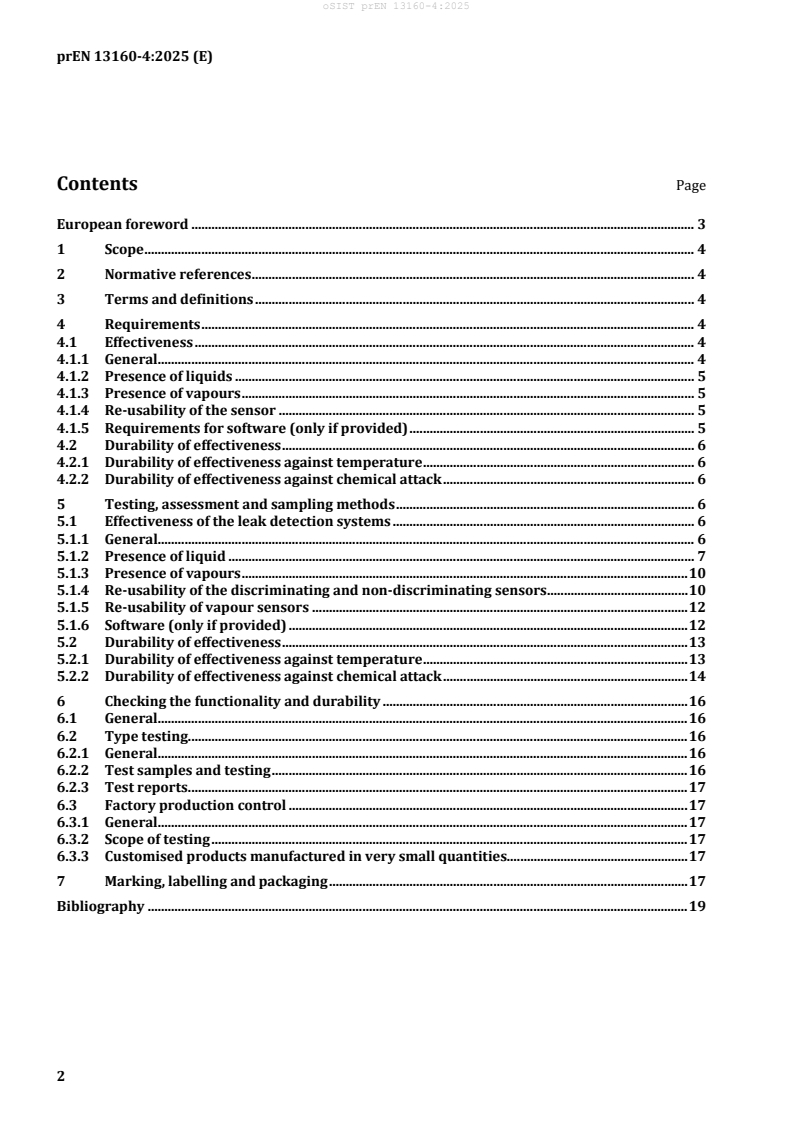
Contents Page
European foreword . 3
1 Scope . 4
2 Normative references . 4
3 Terms and definitions . 4
4 Requirements . 4
4.1 Effectiveness . 4
4.1.1 General. 4
4.1.2 Presence of liquids . 5
4.1.3 Presence of vapours . 5
4.1.4 Re-usability of the sensor . 5
4.1.5 Requirements for software (only if provided) . 5
4.2 Durability of effectiveness . 6
4.2.1 Durability of effectiveness against temperature . 6
4.2.2 Durability of effectiveness against chemical attack . 6
5 Testing, assessment and sampling methods . 6
5.1 Effectiveness of the leak detection systems . 6
5.1.1 General. 6
5.1.2 Presence of liquid . 7
5.1.3 Presence of vapours . 10
5.1.4 Re-usability of the discriminating and non-discriminating sensors . 10
5.1.5 Re-usability of vapour sensors . 12
5.1.6 Software (only if provided) . 12
5.2 Durability of effectiveness . 13
5.2.1 Durability of effectiveness against temperature . 13
5.2.2 Durability of effectiveness against chemical attack . 14
6 Checking the functionality and durability . 16
6.1 General. 16
6.2 Type testing . 16
6.2.1 General. 16
6.2.2 Test samples and testing . 16
6.2.3 Test reports . 17
6.3 Factory production control . 17
6.3.1 General. 17
6.3.2 Scope of testing . 17
6.3.3 Customised products manufactured in very small quantities. 17
7 Marking, labelling and packaging . 17
Bibliography . 19
prEN 13160-4:2025 (E)
European foreword
This document (prEN 13160-4:2025) has been prepared by Technical Committee CEN/TC 393
“Equipment for storage tanks and for filling stations”, the secretariat of which is held by DIN.
This document is currently submitted to the CEN Enquiry.
This document will supersede EN 13160-4:2016+A1:2024.
This document includes the following significant technical changes with respect to
EN 13160-4:2016+A1:2024:
— clarified in 4.1.1 that these are either liquid sensors or gas sensors;
— in 4.2.1 remove the temperatures and refer to Part 1;
— in 5.2.1.3.2 and 5.2.1.3.3 clarification of test 2;
— in 5.2.2.3 and 5.2.2.4 references to chapter numbers corrected;
— Clause 6 has been revised and renamed to Checking the functionality and durability.
The EN 13160 series, under the general title Leak detection systems, is composed of the following parts:
— Part 1: General principles
— Part 2: Requirements and test/assessment methods for pressure and vacuum systems
— Part 3: Requirements and test/assessment methods for liquid systems for tanks
— Part 4: Requirements and test/assessment methods for sensor-based leak detection systems
— Part 5: Requirements and test/assessment methods for in-tank gauge systems and pressurized
pipework systems
— Part 6: Sensors in monitoring wells
— Part 7: Requirements and test/assessment methods for interstitial spaces, leak detection linings and
leak detection jackets
prEN 13160-4:2025 (E)
1 Scope
This document gives requirements and the corresponding test/assessment methods applicable to
sensor-based leak detection systems (leak detectors) for liquids and/or for gases. The leak detectors are
intended to be used in interstitial spaces, leakage containments or monitoring wells. The leak detectors
are usually composed of:
— sensing device(s);
— evaluation device;
— alarm device.
2 Normative references
The following documents are referred to in the text in such a way that some or all of their content
constitutes requirements of this document. For dated references, only the edition cited applies. For
undated references, the latest edition of the referenced document (including any amendments) applies.
EN 228, Automotive fuels — Unleaded petrol — Requirements and test methods
EN 13160-1:2016, Leak detection systems — Part 1: General principles
EN 13160-3:2016+A1:2024, Leak detection systems — Part 3: Requirements and test/assessment methods
for liquid systems for tanks
EN 14879-4:2007, Organic coating systems and linings for protection of industrial apparatus and plants
against corrosion caused by aggressive media — Part 4: Linings on metallic components
EN 60079-29-1, Explosive atmospheres — Part 29-1: Gas detectors — Performance requirements of
detectors for flammable gases
3 Terms and definitions
For the purposes of this document, the terms and definitions given in EN 13160-1:2016 and the following
apply.
3.1
re-usability of the sensor
capability of a sensor to be used again after already having detected liquid or vapour
4 Requirements
4.1 Effectiveness
4.1.1 General
This type of leak detector is classified according to EN 13160-1:2016 as class III.
The general requirements for leak detection systems set out in EN 13160-1:2016, Clause 5, shall be met.
Liquid sensors shall be tested with liquid and gas sensors shall be tested with gas.
Liquid or vapour sensors shall be installed in such a way that they can detect specific liquids or their
vapours present in or entering the leakage containment, interstitial space or monitoring wells. The sensor
shall react within a time specified by the manufacturer.
prEN 13160-4:2025 (E)
The leakage containment can take the form of a:
— sump or riser designed to contain spills from leaks originating from pipe or pumps/dispensers;
— retaining device (bund), designed to contain leakage from an aboveground storage tank or from any
other above ground facility containing liquids;
— other facilities in which sensors can be installed to detect the presence of liquids or vapours.
An alarm device in accordance with EN 13160-3:2016+A1:2024, 4.1.3.5 shall be provided.
In the event of a sensor disconnection of the power supply an alarm condition shall result.
In case of a short circuit between two conductors in the connection between sensor and evaluation device
an alarm shall be triggered.
4.1.2 Presence of liquids
Liquid sensors shall detect specific liquids they might come into contact with (e.g. stored/conveyed
product, water) in accordance with the following requirements:
Category 1: Non-discriminating sensor.
— The sensor shall detect the presence of any liquid (stored/conveyed product and water).
Category 2: Discriminating sensor.
— Category 2A: The sensor shall detect the presence of liquid stored/conveyed product or water and
discriminate between the two aforementioned.
— Category 2B: The sensor shall detect the presence of a film of liquid (stored/conveyed product)
floating on water with a vapour pressure ≥ 30 kPa at 20 °C.
4.1.3 Presence of vapours
The sensor shall detect specific vapours of flammable liquids with a vapour pressure ≥ 30 kPa at 20 °C if
−6
their concentration corresponds to a volume fraction ≤ 1 000 × 10 .
4.1.4 Re-usability of the sensor
Any re-useable sensor shall be able to detect a new leak condition after removal of liquid or vapour. The
recovery time shall be:
— not higher than 24 h from after the removal of the vapour leak conditions for any vapour sensors;
— not higher than 7 days from after the removal of the liquid leak conditions for any liquid sensor (or
after the removal of the water for the vapour sensors) that doesn't need any manual reset procedure.
4.1.5 Requirements for software (only if provided)
The software, where provided, shall have a facility for self-checking by fulfilling the following
requirements:
— a self-diagnostic mode to test the integrity of the system at start up and periodically during use. A
negative result of self-diagnostic mode shall result in a distinguishable alarm condition;
— a facility to check the consistency of the input and output data, malfunction shall result in a
distinguishable alarm condition.
prEN 13160-4:2025 (E)
4.2 Durability of effectiveness
4.2.1 Durability of effectiveness against temperature
The components of a leak detection system to be installed outdoors (type 1 or type 3) or inside a building
(type 2) shall be suitable for operation in the following temperature ranges:
Type 1: −20 °C to +60 °C;
Type 2: 0 °C to +40 °C;
Type 3: −40 °C to +40 °C.
The components of a leak detection system to be installed in dome or control shafts shall be suitable for
operation in the following temperature ranges:
Type 1a: −20 °C to +50 °C;
Type 2: not applicable
Type 3a: −40 °C to +40 °C.
The components of a leak detection system to be installed in underground tanks shall be suitable for
operation in the following temperature ranges:
Type 1b: −5 °C to +30 °C
Type 2: not applicable
Type 3b: −10 °C to +30 °C.
The stated temperature ranges are to be used as minimum values. Extended temperature ranges can be
implemented on the basis of material data sheets for the materials used.
4.2.2 Durability of effectiveness against chemical attack
Parts of leak detectors that can come into contact with the stored/conveyed liquid/water or its vapour
and air shall be resistant.
5 Testing, assessment and sampling methods
5.1 Effectiveness of the leak detection systems
5.1.1 General
For the tests minimum one sample shall be provided by the manufacturer.
For the tests the following documentation shall be provided by the manufacturer:
— documentation in accordance with Clause 7;
— datasheet of the parts of the leak detector;
— electrical diagrams of the parts of the leak detector;
— design and application drawings;
— lists of the parts used including material data.
Leak detector shall be inspected visually to confirm that the sample complies with the documentation.
prEN 13160-4:2025 (E)
5.1.2 Presence of liquid
5.1.2.1 Non-discriminating liquid sensors (category 1)
5.1.2.1.1 Test equipment
Test equipment shall be the following:
— mounting device for fixing the sensor;
— temperature sensor with an accuracy of ± 1 K;
— vessel with a diameter of 100 mm and with a volume of at least 1 l;
— time measuring device with an accuracy of ± 1 s;
— current- or voltage-measuring device in accordance with the signal of the sensor or an oscilloscope
with an accuracy of 1 %;
— number of test samples (sensor or sensor with evaluation and alarm device);
— potable water;
— stored/conveyed product or the following test liquids defined in volume fraction of ingredients:
a) for unleaded petrol in accordance with EN 228:
1) with maximum 5 % ethanol:
i. 47,5 % toluene;
ii. 30,4 % isooctane (2,2,4-trimethylpentane);
iii. 17,1 % n-heptane;
iv. 3,0 % methanol;
v. 2,0 % butanol.
2) with > 5 %
...