

EN 17970:2024
(Main)Ductile iron pipes - Push-in joints for ductile iron pipe systems - Resistance against root penetration - Requirements and test methods
- Abstract
This document is applicable to diffusion-tight pipes, accessories and fittings in ductile cast iron to EN 598 and to cast iron pipe systems.
The document gives requirements on the contact pressure based on a risk assessment and gives a test method that simulates the penetration of a root tip into the sealing gap.
- Status
- Published
- Publication Date
- 25-Jun-2024
- Technical Committee
- CEN/TC 203 - Cast iron pipes, fittings and their joints
- Drafting Committee
- CEN/TC 203/WG 9 - Revision of EN 545, EN 598 and EN 969
- Current Stage
- 6060 - Definitive text made available (DAV) - Publishing
- Start Date
- 26-Jun-2024
- Due Date
- 24-Sep-2024
- Completion Date
- 26-Jun-2024
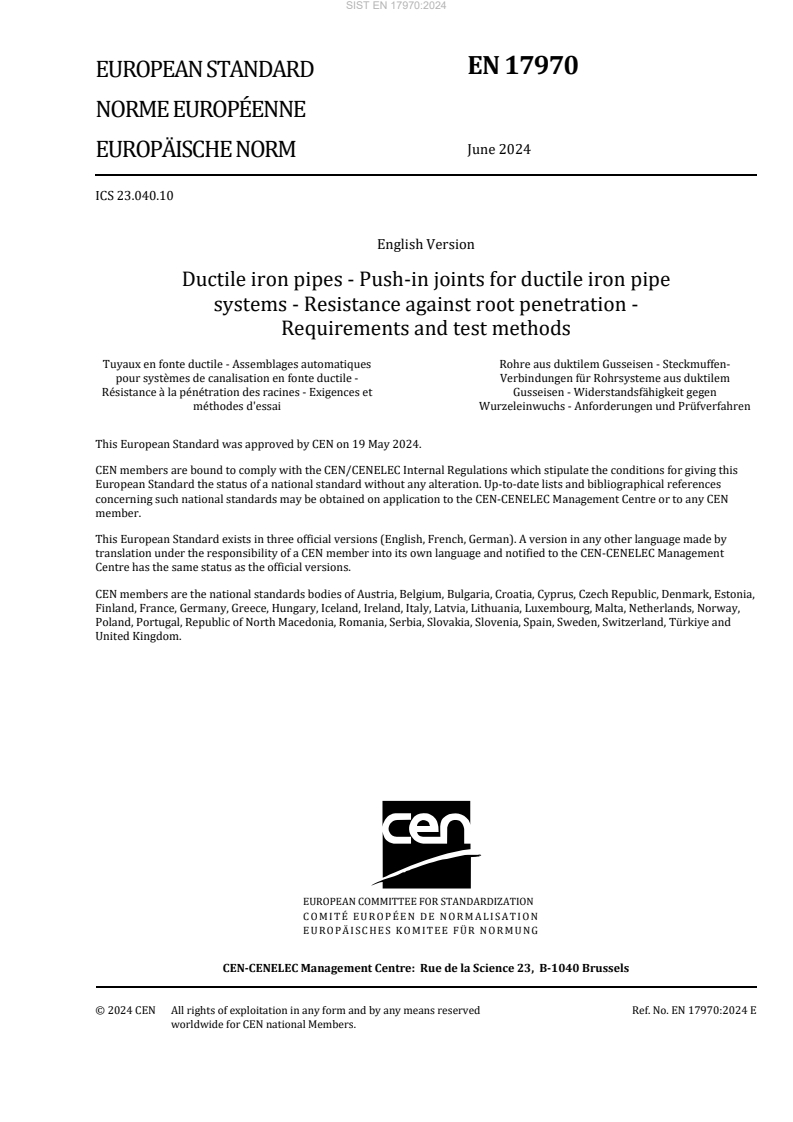

Overview
EN 17970:2024 - "Ductile iron pipes - Push-in joints for ductile iron pipe systems - Resistance against root penetration - Requirements and test methods" (CEN) specifies how to assess and demonstrate the resistance of ductile iron push‑in joints to tree root intrusion. Applicable to diffusion‑tight ductile cast iron pipes, accessories and fittings (per EN 598), the standard sets requirements on contact pressure between elastomeric seals and metal surfaces based on a risk assessment and defines a laboratory test method that simulates root‑tip penetration into the sealing gap.
Key topics and technical requirements
- Scope: Applies to diffusion‑tight ductile iron pipe systems and push‑in (flexible) joints.
- Definitions: clear terms for root penetration, contact pressure, sealing gap, resistance to root penetration, and diffusion‑tight pipe system.
- Risk‑based requirements: contact pressure requirements are set according to installation risk (proximity to trees, urban planting, “sponge city” conditions).
- Test method overview:
- Representative specimens from DN groups (DN 200, DN 400, DN 800).
- Compressed rubber gasket clamps four PTFE tubes (0°, 45°, 90°, 300°) to the sealing surface to create a gas‑tight assembly.
- PTFE tube specs: must sustain ≥10 bar gas pressure; flattened thickness 0.16–0.24 mm; flattened width 6–10 mm.
- Gas (N2 or purified air) pressure is increased until a flow of 120 ml/min is detected in a tube.
- Measurements recorded at multiple intervals (e.g., 24 h, 168 h, 336 h, … up to 2000 h) at 23 °C ±2 °C.
- Extrapolation by linear regression on a logarithmic time scale to determine opening pressure after 100 years.
- Performance judgment: a joint is considered root‑resistant if measured/extrapolated contact pressures meet the standard’s risk‑based requirements.
- Annex: informative guidance on influences (oxygen supply, contact pressure and seal width, soil conditions) and evidence that diffusion‑tight systems limit oxygen transport to roots.
Practical applications and users
- Who uses EN 17970:2024:
- Pipe and gasket manufacturers validating product root resistance.
- Municipal utilities, sewage and drainage designers specifying durable pipe systems.
- Civil contractors and installers selecting pipe systems for tree‑rich or urban green areas.
- Independent test laboratories performing long‑term sealing/resistance tests.
- Asset owners planning replacements in root‑affected networks.
- Use cases:
- Specifying root‑resistant ductile iron systems for sewer and drainage replacements.
- Comparing push‑in joint designs by validated contact pressure and long‑term resistance.
- Supporting procurement and compliance documentation for infrastructure projects.
Related standards
- EN 598 (ductile iron pipes, fittings, accessories and their joints for sewerage applications) - normative reference.
- EN 14741 (PTFE tube requirements and joint testing guidance) - referenced for PTFE tube characteristics.
- Industry guidance: DVGW GW 125 / DWA M 162 (trees and underground pipelines) for risk mitigation and trench measures.
Keywords: EN 17970:2024, ductile iron pipes, push‑in joints, root penetration, root intrusion, contact pressure, sealing gap, diffusion‑tight, test method, DN 200 DN 400 DN 800.
Relations
- Effective Date
- 28-Jan-2026
Get Certified
Connect with accredited certification bodies for this standard

Institut za varilstvo d.o.o. (Welding Institute)
Slovenia's leading welding institute since 1952. ISO 3834, EN 1090, pressure equipment certification, NDT personnel, welder qualification. Only IIW Au
Sponsored listings
Frequently Asked Questions
EN 17970:2024 is a standard published by the European Committee for Standardization (CEN). Its full title is "Ductile iron pipes - Push-in joints for ductile iron pipe systems - Resistance against root penetration - Requirements and test methods". This standard covers: This document is applicable to diffusion-tight pipes, accessories and fittings in ductile cast iron to EN 598 and to cast iron pipe systems. The document gives requirements on the contact pressure based on a risk assessment and gives a test method that simulates the penetration of a root tip into the sealing gap.
This document is applicable to diffusion-tight pipes, accessories and fittings in ductile cast iron to EN 598 and to cast iron pipe systems. The document gives requirements on the contact pressure based on a risk assessment and gives a test method that simulates the penetration of a root tip into the sealing gap.
EN 17970:2024 is classified under the following ICS (International Classification for Standards) categories: 23.040.10 - Iron and steel pipes. The ICS classification helps identify the subject area and facilitates finding related standards.
EN 17970:2024 has the following relationships with other standards: It is inter standard links to EN 598:2007+A1:2009. Understanding these relationships helps ensure you are using the most current and applicable version of the standard.
EN 17970:2024 is available in PDF format for immediate download after purchase. The document can be added to your cart and obtained through the secure checkout process. Digital delivery ensures instant access to the complete standard document.
Standards Content (Sample)
SLOVENSKI STANDARD
01-september-2024
Cevi iz duktilne železove litine - Spoji za cevne sisteme iz duktilne železove litine -
Odpornost proti vraščanju korenin - Zahteve in preskusne metode
Ductile iron pipes - Push-in joints for ductile iron pipe systems - Resistance against root
intrusion - Requirements and test methods
Rohre aus duktilem Gusseisen - Steckmuffen-Verbindungen für Rohrsysteme aus
duktilem Gusseisen – Widerstandsfähigkeit gegen Wurzeleinwuchs - Anforderungen und
Prüfverfahren
Tuyaux en fonte ductile - Assemblages automatiques pour systèmes de tuyaux en fonte
ductile - Résistance à la pénétration des racines - Exigences et méthodes d’essai
Ta slovenski standard je istoveten z: EN 17970:2024
ICS:
23.040.10 Železne in jeklene cevi Iron and steel pipes
2003-01.Slovenski inštitut za standardizacijo. Razmnoževanje celote ali delov tega standarda ni dovoljeno.
EN 17970
EUROPEAN STANDARD
NORME EUROPÉENNE
June 2024
EUROPÄISCHE NORM
ICS 23.040.10
English Version
Ductile iron pipes - Push-in joints for ductile iron pipe
systems - Resistance against root penetration -
Requirements and test methods
Tuyaux en fonte ductile - Assemblages automatiques Rohre aus duktilem Gusseisen - Steckmuffen-
pour systèmes de canalisation en fonte ductile - Verbindungen für Rohrsysteme aus duktilem
Résistance à la pénétration des racines - Exigences et Gusseisen - Widerstandsfähigkeit gegen
méthodes d'essai Wurzeleinwuchs - Anforderungen und Prüfverfahren
This European Standard was approved by CEN on 19 May 2024.
CEN members are bound to comply with the CEN/CENELEC Internal Regulations which stipulate the conditions for giving this
European Standard the status of a national standard without any alteration. Up-to-date lists and bibliographical references
concerning such national standards may be obtained on application to the CEN-CENELEC Management Centre or to any CEN
member.
This European Standard exists in three official versions (English, French, German). A version in any other language made by
translation under the responsibility of a CEN member into its own language and notified to the CEN-CENELEC Management
Centre has the same status as the official versions.
CEN members are the national standards bodies of Austria, Belgium, Bulgaria, Croatia, Cyprus, Czech Republic, Denmark, Estonia,
Finland, France, Germany, Greece, Hungary, Iceland, Ireland, Italy, Latvia, Lithuania, Luxembourg, Malta, Netherlands, Norway,
Poland, Portugal, Republic of North Macedonia, Romania, Serbia, Slovakia, Slovenia, Spain, Sweden, Switzerland, Türkiye and
United Kingdom.
EUROPEAN COMMITTEE FOR STANDARDIZATION
COMITÉ EUROPÉEN DE NORMALISATION
EUROPÄISCHES KOMITEE FÜR NORMUNG
CEN-CENELEC Management Centre: Rue de la Science 23, B-1040 Brussels
© 2024 CEN All rights of exploitation in any form and by any means reserved Ref. No. EN 17970:2024 E
worldwide for CEN national Members.
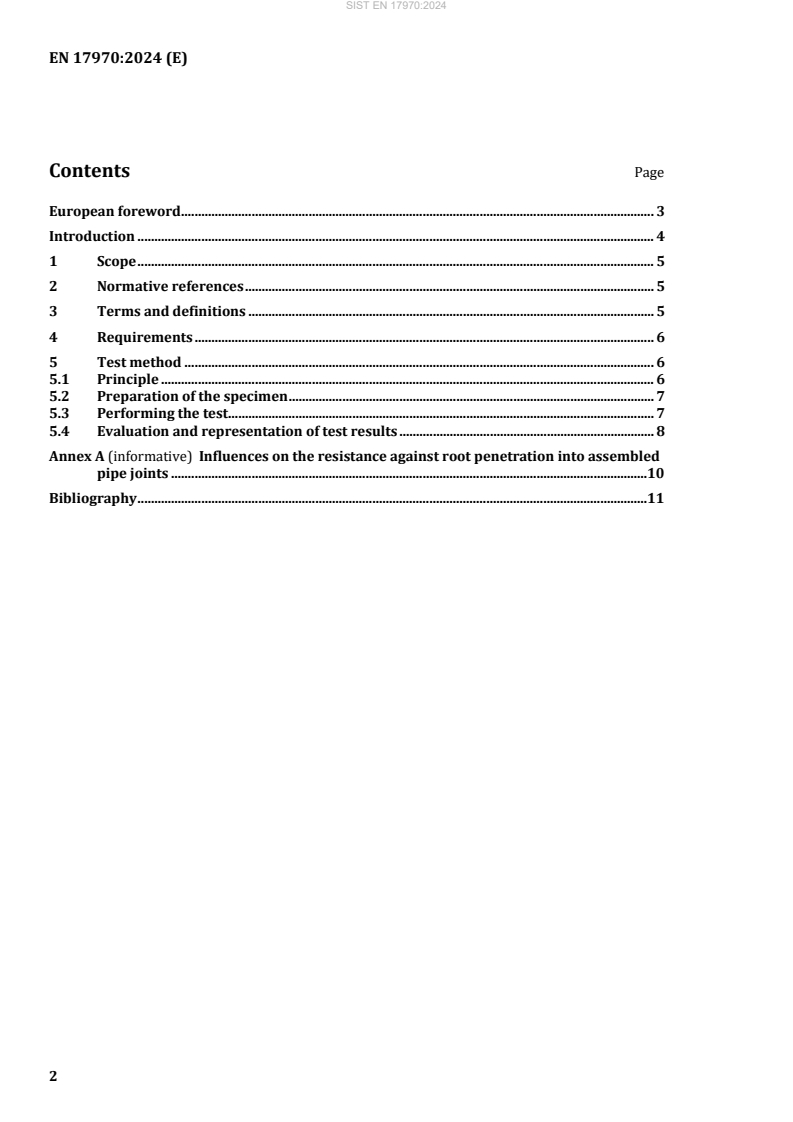
Contents Page
European foreword . 3
Introduction . 4
1 Scope . 5
2 Normative references . 5
3 Terms and definitions . 5
4 Requirements . 6
5 Test method . 6
5.1 Principle . 6
5.2 Preparation of the specimen . 7
5.3 Performing the test . 7
5.4 Evaluation and representation of test results . 8
Annex A (informative) Influences on the resistance against root penetration into assembled
pipe joints .10
Bibliography .11
European foreword
This document (EN 17970:2024) has been prepared by Technical Committee CEN/TC 203 “Cast iron
pipes, fittings and their joints”, the secretariat of which is held by AFNOR.
This European Standard shall be given the status of a national standard, either by publication of an
identical text or by endorsement, at the latest by December 2024, and conflicting national standards shall
be withdrawn at the latest by December 2024.
Attention is drawn to the possibility that some of the elements of this document may be the subject of
patent rights. CEN shall not be held responsible for identifying any or all such patent rights.
Any feedback and questions on this document should be directed to the users’ national standards body.
A complete listing of these bodies can be found on the CEN website.
According to the CEN-CENELEC Internal Regulations, the national standards organisations of the
following countries are bound to implement this European Standard: Austria, Belgium, Bulgaria, Croatia,
Cyprus, Czech Republic, Denmark, Estonia, Finland, France, Germany, Greece, Hungary, Iceland, Ireland,
Italy, Latvia, Lithuania, Luxembourg, Malta, Netherlands, Norway, Poland, Portugal, Republic of North
Macedonia, Romania, Serbia, Slovakia, Slovenia, Spain, Sweden, Switzerland, Türkiye and the United
Kingdom.
Introduction
The test described in this document is adjusted from a standardized test method for plastic pipes to the
characteristics of push-in joints for ductile iron pipe systems.
The undesired penetration of tree roots into push-in joints
— causes obstacles to flow with the resulting risks of blockages and backing-up;
— causes leakage in sewage systems with the hazards to the soil and groundwater which this entails;
— leads to high, recurring costs for root removal;
— needs the replacement or renovation of the affected section of sewage or drainage system.
In this case, even after replacement or renovation, the cause often remains in effect – namely the close
proximity of the tree with the route of the drainage and sewage system. Therefore, root-resistant pipe
systems should be used when laying new drainage and sewage systems and replacing existing ones.
1 Scope
This document is applicable to diffusion-tight pipes, accessories and fittings in ductile cast iron to EN 598
and to cast iron pipe systems.
The document gives requirements on the contact pressure based on a risk assessment and gives a test
method that simulates the penetration of a root tip into the sealing gap.
2 Normative references
The following documents are referred to in the text in such a way that some or all of their content
constitutes requirements of this document. For dated references, only the edition cited applies. For
undated references, the latest edition of the referenced document (including any amendments) applies.
EN 598:2007+A1:2009, Ductile iron pipes, fittings, accessories and their joints for sewerage applications —
Requirements and test methods
3 Terms and definitions
For the purposes of this document, the following terms and definitions apply.
ISO and IEC maintain terminology databases for use in standardization at the following addresses:
— ISO Online browsing platform: available at https://www.iso.org/obp
— IEC Electropedia: available at https://www.electropedia.org
3.1
root penetration
penetration of tree root tips into the sealing gap of push-in-joints
3.2
contact pressure
pressure between the metallic se
...