

EN 17372:2021
(Main)Power operated pedestrian swing door drives with self closing function - Requirements and test methods
- Abstract
This document is applicable to power-operated pedestrian swing door drives with self closing function using mechanically stored energy for single and double leaf swing doorsets with or without fire resistance and smoke control characteristics. It defines requirements and test methods for the self-closing function.
This document does not apply to:
- electrically controlled hold-open systems according to EN 14637;
- door coordinating devices according to EN 1158;
- electrically powered hold-open devices for swing doors according to EN 1155.
Requirements and test methods for hold-open systems are not part of this document.
Additional requirements and test methods for the use of power-operated pedestrian swing door drives with self closing function on double-leaf swing doors are described in EN 1158 and are therefore not part of this document.
- Status
- Published
- Publication Date
- 30-Mar-2021
- Withdrawal Date
- 29-Sep-2021
- Technical Committee
- CEN/TC 33 - Doors, windows, shutters and building hardware
- Drafting Committee
- CEN/TC 33/WG 9 - Powered Pedestian Doors (PPD)
- Current Stage
- 9093 - Decision to confirm - Review Enquiry
- Start Date
- 16-Sep-2026
- Completion Date
- 07-Oct-2026


Overview
EN 17372:2021 (CEN) specifies requirements and test methods for power‑operated pedestrian swing door drives that incorporate a self‑closing function using mechanically stored energy. It applies to single‑ and double‑leaf swing doorsets, with or without fire resistance and smoke‑control characteristics. The standard focuses on the self‑closing behaviour that must be preserved even in case of power failure and sets out how compliance is verified by testing.
Key Topics and Requirements
- Scope & exclusions: covers mechanically stored‑energy self‑closing drives but excludes electrically controlled hold‑open systems (EN 14637), door coordinating devices (EN 1158) and electrically powered hold‑open devices (EN 1155).
- Product characteristics (Clause 4): materials, structural design, installation positions (transom or door‑leaf mounting) and user information that ensure the self‑closing function performs as intended.
- Self‑closing function: definitions and requirements for closing force, adjustable closing force, opening angle, opening time, backcheck, reactivation of active mode and permanent hold‑open behaviour.
- Durability & environmental effects: tests for durability during active and passive modes, damped closing, manual triggering of hold‑open, blocking behaviour and temperature dependency in passive mode.
- Testing & assessment (Clause 5): functional tests, durability tests, sampling, test door installation, tolerances and temperature testing procedures.
- Information, marking & labelling: required documentation for installers and users and labelling rules for traceability and safe operation.
Practical Applications
- Ensures reliable self‑closing performance for automatic pedestrian swing doors in commercial, public and residential buildings.
- Used when doors require mechanical self‑closing capability (e.g., fire/smoke doors, controlled access points) that must operate during power loss.
- Helps manufacturers design drives that meet standardized durability, safety and performance criteria.
- Supports test laboratories and certification bodies in performing consistent, repeatable compliance testing.
Who Uses This Standard
- Door drive and hardware manufacturers
- Test and certification laboratories
- Specifiers, architects and façade/door system engineers
- Building owners, facility managers and fire safety engineers
- Installers and maintenance technicians ensuring compliant installation and servicing
Related Standards
- EN 1154 - Controlled door closing devices
- EN 1155 - Electrically powered hold‑open devices for swing doors
- EN 1158 - Door coordinating devices
- EN 14637 - Electrically controlled hold‑open systems
- EN 16005 - Power operated pedestrian doorsets - Safety in use
- EN ISO 13849‑1 - Safety‑related parts of control systems
Keywords: EN 17372:2021, power‑operated pedestrian swing door drives, self‑closing function, requirements and test methods, CEN standard, durability tests, fire and smoke control doors.
Relations
- Effective Date
- 28-Jan-2026
- Effective Date
- 28-Jan-2026
- Effective Date
- 28-Jan-2026
- Refers
EN 1154:1996 - Building hardware - Controlled door closing devices - Requirements and test methods - Effective Date
- 28-Jan-2026
- Effective Date
- 28-Jan-2026
Get Certified
Connect with accredited certification bodies for this standard

DIBt (Deutsches Institut für Bautechnik)
German Institute for Building Technology.
DIN CERTCO
DIN Group product certification.

Aboma Certification B.V.
Specialized in construction, metal, and transport sectors.
Sponsored listings
Frequently Asked Questions
EN 17372:2021 is a standard published by the European Committee for Standardization (CEN). Its full title is "Power operated pedestrian swing door drives with self closing function - Requirements and test methods". This standard covers: This document is applicable to power-operated pedestrian swing door drives with self closing function using mechanically stored energy for single and double leaf swing doorsets with or without fire resistance and smoke control characteristics. It defines requirements and test methods for the self-closing function. This document does not apply to: - electrically controlled hold-open systems according to EN 14637; - door coordinating devices according to EN 1158; - electrically powered hold-open devices for swing doors according to EN 1155. Requirements and test methods for hold-open systems are not part of this document. Additional requirements and test methods for the use of power-operated pedestrian swing door drives with self closing function on double-leaf swing doors are described in EN 1158 and are therefore not part of this document.
This document is applicable to power-operated pedestrian swing door drives with self closing function using mechanically stored energy for single and double leaf swing doorsets with or without fire resistance and smoke control characteristics. It defines requirements and test methods for the self-closing function. This document does not apply to: - electrically controlled hold-open systems according to EN 14637; - door coordinating devices according to EN 1158; - electrically powered hold-open devices for swing doors according to EN 1155. Requirements and test methods for hold-open systems are not part of this document. Additional requirements and test methods for the use of power-operated pedestrian swing door drives with self closing function on double-leaf swing doors are described in EN 1158 and are therefore not part of this document.
EN 17372:2021 is classified under the following ICS (International Classification for Standards) categories: 91.060.50 - Doors and windows. The ICS classification helps identify the subject area and facilitates finding related standards.
EN 17372:2021 has the following relationships with other standards: It is inter standard links to EN 1155:1997, EN ISO 13849-1:2023, EN 16005:2023+A1:2024, EN 1154:1996, EN 15269-3:2022. Understanding these relationships helps ensure you are using the most current and applicable version of the standard.
EN 17372:2021 is available in PDF format for immediate download after purchase. The document can be added to your cart and obtained through the secure checkout process. Digital delivery ensures instant access to the complete standard document.
Standards Content (Sample)
SLOVENSKI STANDARD
01-julij-2021
Pogoni avtomatskih nihajnih vrat za prehod ljudi s funkcijo samozapiranja -
Zahteve in preskusne metode
Power operated pedestrian swing door drives with self closing function - Requirements
and test methods
Kraftbetätigte Drehflügeltürantriebe mit Selbstschließfunktion - Anforderungen und
Prüfverfahren
Opérateurs motorisés de portes battantes pour piétons avec fonction de fermeture
automatique - Exigences et méthodes d’essai
Ta slovenski standard je istoveten z: EN 17372:2021
ICS:
91.060.50 Vrata in okna Doors and windows
2003-01.Slovenski inštitut za standardizacijo. Razmnoževanje celote ali delov tega standarda ni dovoljeno.
EN 17372
EUROPEAN STANDARD
NORME EUROPÉENNE
March 2021
EUROPÄISCHE NORM
ICS 91.060.50
English Version
Power operated pedestrian swing door drives with self
closing function - Requirements and test methods
Opérateurs motorisés de portes battantes pour piétons Kraftbetätigte Drehflügeltürantriebe mit
avec fonction de fermeture automatique - Exigences et Selbstschließfunktion - Anforderungen und
méthodes d'essai Prüfverfahren
This European Standard was approved by CEN on 18 January 2021.
CEN members are bound to comply with the CEN/CENELEC Internal Regulations which stipulate the conditions for giving this
European Standard the status of a national standard without any alteration. Up-to-date lists and bibliographical references
concerning such national standards may be obtained on application to the CEN-CENELEC Management Centre or to any CEN
member.
This European Standard exists in three official versions (English, French, German). A version in any other language made by
translation under the responsibility of a CEN member into its own language and notified to the CEN-CENELEC Management
Centre has the same status as the official versions.
CEN members are the national standards bodies of Austria, Belgium, Bulgaria, Croatia, Cyprus, Czech Republic, Denmark, Estonia,
Finland, France, Germany, Greece, Hungary, Iceland, Ireland, Italy, Latvia, Lithuania, Luxembourg, Malta, Netherlands, Norway,
Poland, Portugal, Republic of North Macedonia, Romania, Serbia, Slovakia, Slovenia, Spain, Sweden, Switzerland, Turkey and
United Kingdom.
EUROPEAN COMMITTEE FOR STANDARDIZATION
COMITÉ EUROPÉEN DE NORMALISATION
EUROPÄISCHES KOMITEE FÜR NORMUNG
CEN-CENELEC Management Centre: Rue de la Science 23, B-1040 Brussels
© 2021 CEN All rights of exploitation in any form and by any means reserved Ref. No. EN 17372:2021 E
worldwide for CEN national Members.
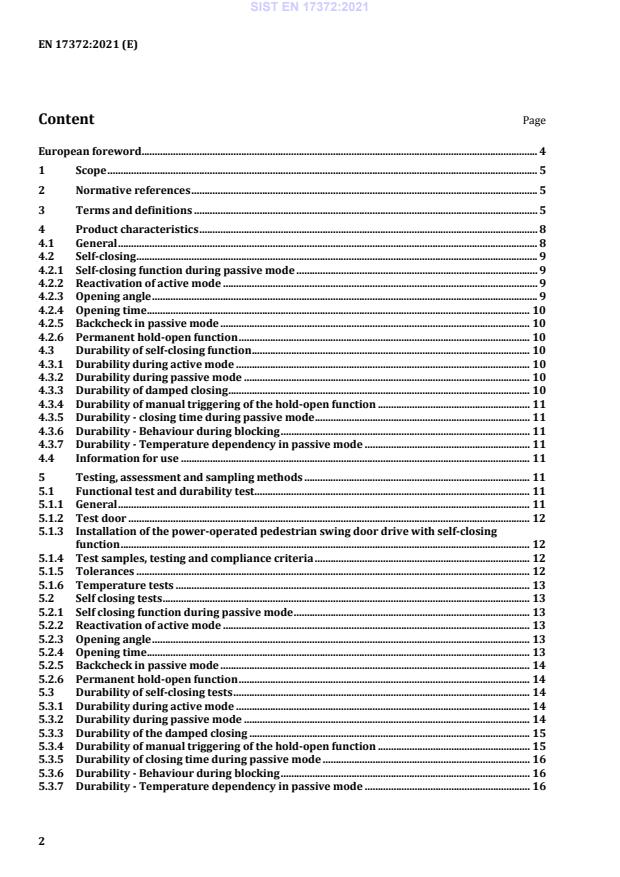
Content Page
European foreword . 4
1 Scope . 5
2 Normative references . 5
3 Terms and definitions . 5
4 Product characteristics . 8
4.1 General . 8
4.2 Self-closing . 9
4.2.1 Self-closing function during passive mode . 9
4.2.2 Reactivation of active mode . 9
4.2.3 Opening angle . 9
4.2.4 Opening time . 10
4.2.5 Backcheck in passive mode . 10
4.2.6 Permanent hold-open function . 10
4.3 Durability of self-closing function . 10
4.3.1 Durability during active mode . 10
4.3.2 Durability during passive mode . 10
4.3.3 Durability of damped closing . 10
4.3.4 Durability of manual triggering of the hold-open function . 11
4.3.5 Durability - closing time during passive mode . 11
4.3.6 Durability - Behaviour during blocking . 11
4.3.7 Durability - Temperature dependency in passive mode . 11
4.4 Information for use . 11
5 Testing, assessment and sampling methods . 11
5.1 Functional test and durability test . 11
5.1.1 General . 11
5.1.2 Test door . 12
5.1.3 Installation of the power-operated pedestrian swing door drive with self-closing
function . 12
5.1.4 Test samples, testing and compliance criteria . 12
5.1.5 Tolerances . 12
5.1.6 Temperature tests . 13
5.2 Self closing tests . 13
5.2.1 Self closing function during passive mode . 13
5.2.2 Reactivation of active mode . 13
5.2.3 Opening angle . 13
5.2.4 Opening time . 13
5.2.5 Backcheck in passive mode . 14
5.2.6 Permanent hold-open function . 14
5.3 Durability of self-closing tests . 14
5.3.1 Durability during active mode . 14
5.3.2 Durability during passive mode . 14
5.3.3 Durability of the damped closing . 15
5.3.4 Durability of manual triggering of the hold-open function . 15
5.3.5 Durability of closing time during passive mode . 16
5.3.6 Durability - Behaviour during blocking . 16
5.3.7 Durability - Temperature dependency in passive mode . 16
5.4 Inspection of Information for use . 16
6 Marking and labelling . 17
Annex A (normative) Flow diagram test sequence functional test and durability test . 18
Annex B (informative) Overview of tests and related requirements . 19
Bibliography . 20
European foreword
This document (EN 17372:2021) has been prepared by Technical Committee CEN/TC 33 “Doors,
windows, shutters, building hardware and curtain walling”, the secretariat of which is held by AFNOR.
This European Standard shall be given the status of a national standard, either by publication of an
identical text or by endorsement, at the latest by September 2021, and conflicting national standards
shall be withdrawn at the latest by September 2021.
Attention is drawn to the possibility that some of the elements of this document may be the subject of
patent rights. CEN shall not be held responsible for identifying any or all such patent rights.
In addition to meeting requirements and test methods of this document, it could be essential that
power-operated pedestrian swing door drives with self-closing function satisfy further technical rules
(e.g. 2014/30/EU, Electromagnetic compatibility, 2006/42/EC, Machine Directive) in regard to the
safety in use and the intended application in buildings.
According to the CEN-CENELEC Internal Regulations, the national standards organisations of the
following countries are bound to implement this European Standard: Austria, Belgium, Bulgaria,
Croatia, Cyprus, Czech Republic, Denmark, Estonia, Finland, France, Germany, Greece, Hungary, Iceland,
Ireland, Italy, Latvia, Lithuania, Luxembourg, Malta, Netherlands, Norway, Poland, Portugal, Republic of
North Macedonia, Romania, Serbia, Slovakia, Slovenia, Spain, Sweden, Switzerland, Turkey and the
United Kingdom.
1 Scope
This document is applicable to power-operated pedestrian swing door drives with self closing function
using mechanically stored energy for single and double leaf swing doorsets with or without fire
resistance and smoke control characteristics. It defines requirements and test methods for the self-
closing function.
This document does not apply to:
— electrically controlled hold-open systems according to EN 14637;
— door coordinating devices according to EN 1158;
— electrically powered hold-open devices for swing doors according to EN 1155.
Requirements and test methods for hold-open systems are not part of this document.
Additional requirements and test methods for the use of power-operated pedestrian swing door drives
with self closing function on double-leaf swing doors are described in EN 1158 and are therefore not
part of this document.
2 Normative references
The following documents are referred to in the text in such a way that some or all of their content
constitutes requirements of this document. For dated references, only the edition cited applies. For
undated references, the latest edition of the referenced document (including any amendments) applies.
EN 1154, Building hardware — Controlled door closing devices — Requirements and test methods
EN 1155, Building hardware — Electrically powered hold-open devices for swing doors — Requirements
and test methods
EN 16005, Power operated pedestrian doorsets — Safety in use — Requirements and test methods
EN ISO 13849-1, Safety of machinery — Safety-related parts of control systems — Part 1: General
principles for design (ISO 13849-1)
3 Terms and definitions
For the purposes of this document, the terms and definitions given in EN 1154, EN 1155 and the
following apply.
ISO and IEC maintain terminological databases for use in standardization at the following addresses:
— IEC Electropedia: available at http://www.electropedia.org/
— ISO Online browsing platform: available at https://www.iso.org/obp
3.1
power-operated pedestrian swing door drive with self-closing function
drive that is equipped with a self-closing function for moving a swing door leaf
3.2
self-closing function
function for closing a swing door leaf by means of mechanically stored energy which is preserved even
in case of power failure
3.3
adjustable closing force
in-built function that allows the closing moment of the self-closing function to be adjusted over a range
of power sizes
3.4
backcheck
feature that allows a period of decelaration before the final open position of the door leaf is reached
3.5
hold-open system
combination of compatible components which has the function to hold open self-closing fire/smoke
control doorsets and, in the case of fire, to release these doorsets for self-closing, at the earliest possible
moment
Note 1 to entry: Hold-open systems, according to this document, are intended for the control of individual door
assemblies only.
Note 2 to entry: A hold-open system consists at least of a fire detector, a hold-open device, a control unit and a
power supply unit. All, or any, of these elements could be in a common enclosure.
3.6
hold-open device
devices of a hold-open system that store the energy required for the closing movement and releases the
door leaf to close on request by a triggering mechanism
Note 1 to entry: Common hold-open devices are, for example, magnetic clamps, door drives with magnetic valve
and magnetic couplings.
3.7
transom mounting
mounting of the power-operated pedestrian swing door drive with self-closing function to the doorset
frame and/or the doorset lintel
3.8
door leaf installation
mounting of the power-operated pedestrian swing door drive with self-closing function to the door leaf
3.9
lock release
electrically activated device that keeps the door leaf closed in a deenergised state and that enables the
opening of the door leaf when external power (open circuit principle) is supplied
Note 1 to entry: Common examples are electro-mechanical operated locks according to EN 14846 and striking
plates.
3.10
control unit
component of the power-operated pedestrian swing door drive with self-closing function, which
processes the signals of activators, external safety devices into opening, closing and stop commands
suitable for the drive
Note 1 to entry: Other functions of the control unit includes the control of the lock release, the regulation of the
hold-open time and the execution of release signals e.g. caused by manually moving the door leaf out of the hold
open position.
3.11
external protection device
additional installed device, electrically connected to the power-operated pedestrian swing door drive
with self-closing function, which monitors the swept area of the door leaf and interrupts the movement
of the door leaf if a person or an object is within the swing range of the door leaf or if it sends a signal to
reverse the door leaf
3.12
activator
means by which the power operation of the doorset is started
Note 1 to entry: It is possible to have “conscious activators” (e.g. switches, manual pushing the door leaf, push-
buttons) which are used to consciously open the door leaf and “unconscious activators” (e.g. radar, light barriers,
contact mats) where the door leaf is unconsciously open when the monitored zone is entered.
3.13
triggering device
device of a hold-open system that processes a sent signal from devices of this hold-open system and
causes the switching off of the drive function when certain criteria are met whereby the self-closing
function of the power-operated pedestrian swing door drive with self closing function shall be
maintained
3.14
active mode
operating mode in which all actions of the power-operated pedestrian swing door drive with self
closing function are controlled by the control unit
3.15
passive mode
operating mode in which the power-driven movement of the door leaf, as well as any hold-open
function of the door leaf, will be switched off
3.16
power supply
device of a power-operated pedestrian swing door drive with self-closing function which is used to
supply power to e.g. the control unit, motor, protection devices, lock releases, activators and, if
applicable, triggering devices
3.17
installation position
position at which a power-operated pedestrian swing door drive with self-closing function is mounted
to the doorset
3.18
power-operated
movement performed, at least in one direction, by an external energy supply (e.g. electrically) instead of
manual or stored mechanical energy
4 Product characteristics
4.1 General
The materials and the structural design of the power-operated pedestrian swing door drive with self-
closing function shall be such that for installation and adjustment according the manufacturer's
specification and the intended use the requirements according to 4.2 to 4.3 are fulfilled.
An overview of tests and related requirements is given in Annex B (see Table B.1).
Power operated swing door drives with self-closing function for self-closing doorsets may be mounted
only to doorsets that have been prepared for the power-driven operation, e.g. with lock release and
triggering mechanism.
The installation and the adjustment of power operated swing door drives with self-closing function
shall comply with the manufacturer's specifications.
The maximum door leaf width is relevant for the selection of the power size of a power-operated
pedestrian swing door drive with self-closing function.
Due to their low closing torque, power size 1 and 2 power-operated pedestrian swing door drives with
self-closing function shall not be used on doorsets with fire resistance and smoke control
characteristics.
Table 1 — Power size of power-operated pedestrian swing door drive with self-closing function
Power Door Weight Closing torque Opening Efficiency
size leaf of test
torque between
between between For any
width door
between 0° and 4°
other
leaf
0° and 4° 88° and
opening
4° and 60°
92°
angle
mm kg Nm Nm Nm Nm Nm %
max. min. max. min. min. max. min.
1 750 20 9 13 3 2 26 50
2 850 40 13 18 4 3 36 50
3 950 60 18 26 6 4 47 50
4 1 100 80 26 37 9 6 62 50
5 1 250 100 37 54 12 8 83 50
6 1 400 120 54 87 18 11 134 50
7 1 600 160 87 140 29 18 215 50
NOTE 1 In case of unusually tall or heavy doorsets, windy environmental conditions or special installations the
use of higher power sizes can be considered.
NOTE 2 The test door leaf weights are only related to power sizes for the purpose of the test procedure. These
test door leaf weights are not intended to indicate max values for actual use.
4.2 Self-closing
4.2.1 Self-closing function during passive mode
During passive mode power-operated pedestrian swing door drives with self-closing function shall
function as a controlled door closing device.
A failure of the power supply for the power-operated pedestrian swing door drive with self-closing
function and/or functional faults of the power-operated pedestrian swing door drive with self-closing
function shall not impair the self-closing function. The door shall start to close and switch into passive
mode:
— within no more than 3 s after a triggering signal has been received from the triggering device of the
hold-open system;
— within 15 s in case of a mains failure for the power-operated pedestrian swing door drive with self-
closing function; or
in case of a functional fault of the power-operated pedestrian swing door drive with self-closing
function which will impair the self-closing function, the (functional) fault shall either be detected
automatically or within no more than 3 s after a triggering signal has been received from the triggering
device of the hold-open system. The reactivation shall only be possible after fixing the fault.
In case the signal paths of the control unit according to 3.10 are used to realize these requirements,
then the “Performance Level d“ (category 2) according to EN ISO 13849-1 shall be verified for each
relevant signal path.
The relevant signal paths are to be provided by the manufacturer in the form of a block diagram to
support the test.
Compliance shall be verified by a test according to 5.2.1.
NOTE The mentioned requirements apply to the self-closing function. This is to ensure that a swing door is
closed in case of fire. If a control unit according to 3.10 initiates the switching into the passive mode due to a
functional fault (e.g. display, external protection device), this is not to be understood in terms of the previously
mentioned requirements as long as a triggering signal of the triggering mechanism or a mains failure continues to
switch into passive mode and the self-closing function is not impaired under these requirements.
4.2.2 Reactivation of active mode
The switching from the passive to the active mode of the power-operated pedestrian swing door drive
with self-closing function shall be only possible if the triggering signal is no longer present and after a
reset is carried out.
NOTE This, for example, will be a reset via a button, the program switch of the drive or the door leaf.
The compliance shall be verified by a test according to 5.2.2.
4.2.3 Opening angle
The opening angle of the door leaf shall be adjustable in the active mode as well as limitable in the
passive mode. The power-operated pedestrian swing door drive with self-closing function installed
according to the manufac
...