

EN 1111:2017/prA1
(Amendment)Sanitary tapware - Thermostatic mixing valves (PN 10) - General technical specification
General Information
- Abstract
This European Standard specifies general construction, performance and material requirements for PN 10 thermostatic mixing valves (TMV) and includes test methods for the verification of mixed water temperature performance at the point of use below 45 °C. This does not exclude the selection of higher temperatures where available. When these devices are used to provide anti-scald protection for children, elderly and disabled persons the mixed water temperature needs to be set at a suitable bathing temperature (body temperature approximately 38 °C) as children are at risk to scalding at lower temperatures than adults. This does not obviate the need for supervision of young children during bathing.
It applies to valves intended for use on sanitary appliances in kitchens, washrooms (incl. all rooms with sanitary tapware, e.g. toilets and cloakrooms) and bath rooms operating under the conditions specified in Table 1.
This standard allows TMVs to supply a single outlet or a small number of outlets in a "domestic" application (e.g. one valve controlling a shower, bath, basin and/or bidet), excluding valves specifically designed for supplying a large number of outlets (i.e. for institutional use).
The tests described are type tests (laboratory tests) and not quality control tests carried out during manufacture.
Table 1 - Conditions of use
- Status
- Not Published
- Publication Date
- 31-Jul-2022
- Withdrawal Date
- 31-Jan-2023
- Technical Committee
- CEN/TC 164 - Water supply
- Drafting Committee
- CEN/TC 164/WG 8 - Sanitary tapware
- Current Stage
- 4098 - Decision to abandon - Enquiry
- Start Date
- 30-Sep-2022
- Completion Date
- 30-Sep-2026

Overview
EN 1111:2017/prA1 - issued by CEN - is a European technical specification for sanitary tapware thermostatic mixing valves (PN 10). It defines general construction, performance and material requirements for PN 10 thermostatic mixing valves (TMVs) and sets out laboratory type test methods to verify mixed water temperature performance at the point of use (below 45 °C). The amendment prA1 updates test procedures, timing and acceptance criteria to ensure predictable anti-scald protection and reliable temperature control in domestic installations.
Key Topics and Requirements
- Scope: Applies to TMVs for sanitary appliances in kitchens, washrooms and bathrooms for domestic use (single valve supplying one or a small number of outlets). Excludes valves intended to serve large institutional outlet groups.
- Temperature limits: Tests verify mixed water temperature below 45 °C; for bathing protection of children/elderly/disabled the standard highlights a suitable setpoint near body temperature (~38 °C).
- Performance testing: Type tests (laboratory, not factory QC) cover:
- Temperature control accuracy and stability under setpoint changes.
- Response to flow-rate reduction (new requirement: reduce to 45–55% of initial flow).
- Response to supply pressure and temperature variations (specified recovery times and maximum deviations).
- Transient behavior limits (maximum allowed deviations, oscillation amplitudes and timing; many timings revised to maximum 30 s for stabilization).
- Construction and materials: General requirements to ensure durability and safe operation under PN 10 conditions (as detailed in the standard).
- Referenced requirements: Aerators or water-saving accessories are subject to EN 246 dimensions where applicable; if non‑compliant, flow and acoustic tests are performed on the product as delivered.
- Amendment details: prA1 modifies multiple subclauses (13.x, 16.8.3.1) - e.g., revised measurement procedures, added informative figures, and relaxed dimensional test-rig constraints while keeping specified supply pressures.
Applications and Users
- Manufacturers of thermostatic mixing valves (TMV) - for product design, testing and product declarations.
- Independent test laboratories - to perform type tests and verify compliance with EN 1111 test methods and timing.
- Product specifiers, plumbing engineers, architects and consultants - when selecting TMVs for domestic washrooms, baths and showers.
- Installers, facility managers and regulators - for understanding performance expectations, anti-scald guidance and compliance context.
Related Standards
- EN 246 (aerator/flow dimensions) - referenced for flow and acoustic testing.
- CEN/TC 164 “Water supply” - technical committee responsible for the document.
Keywords: EN 1111, thermostatic mixing valves, TMV, PN 10, anti-scald, mixed water temperature, sanitary tapware, CEN, type tests.
Relations
- Effective Date
- 26-Jun-2019
Get Certified
Connect with accredited certification bodies for this standard

DIBt (Deutsches Institut für Bautechnik)
German Institute for Building Technology.
DIN CERTCO
DIN Group product certification.

Aboma Certification B.V.
Specialized in construction, metal, and transport sectors.
Sponsored listings
Frequently Asked Questions
EN 1111:2017/prA1 is a draft published by the European Committee for Standardization (CEN). Its full title is "Sanitary tapware - Thermostatic mixing valves (PN 10) - General technical specification". This standard covers: This European Standard specifies general construction, performance and material requirements for PN 10 thermostatic mixing valves (TMV) and includes test methods for the verification of mixed water temperature performance at the point of use below 45 °C. This does not exclude the selection of higher temperatures where available. When these devices are used to provide anti-scald protection for children, elderly and disabled persons the mixed water temperature needs to be set at a suitable bathing temperature (body temperature approximately 38 °C) as children are at risk to scalding at lower temperatures than adults. This does not obviate the need for supervision of young children during bathing. It applies to valves intended for use on sanitary appliances in kitchens, washrooms (incl. all rooms with sanitary tapware, e.g. toilets and cloakrooms) and bath rooms operating under the conditions specified in Table 1. This standard allows TMVs to supply a single outlet or a small number of outlets in a "domestic" application (e.g. one valve controlling a shower, bath, basin and/or bidet), excluding valves specifically designed for supplying a large number of outlets (i.e. for institutional use). The tests described are type tests (laboratory tests) and not quality control tests carried out during manufacture. Table 1 - Conditions of use
This European Standard specifies general construction, performance and material requirements for PN 10 thermostatic mixing valves (TMV) and includes test methods for the verification of mixed water temperature performance at the point of use below 45 °C. This does not exclude the selection of higher temperatures where available. When these devices are used to provide anti-scald protection for children, elderly and disabled persons the mixed water temperature needs to be set at a suitable bathing temperature (body temperature approximately 38 °C) as children are at risk to scalding at lower temperatures than adults. This does not obviate the need for supervision of young children during bathing. It applies to valves intended for use on sanitary appliances in kitchens, washrooms (incl. all rooms with sanitary tapware, e.g. toilets and cloakrooms) and bath rooms operating under the conditions specified in Table 1. This standard allows TMVs to supply a single outlet or a small number of outlets in a "domestic" application (e.g. one valve controlling a shower, bath, basin and/or bidet), excluding valves specifically designed for supplying a large number of outlets (i.e. for institutional use). The tests described are type tests (laboratory tests) and not quality control tests carried out during manufacture. Table 1 - Conditions of use
EN 1111:2017/prA1 is classified under the following ICS (International Classification for Standards) categories: 91.140.70 - Sanitary installations. The ICS classification helps identify the subject area and facilitates finding related standards.
EN 1111:2017/prA1 has the following relationships with other standards: It is inter standard links to EN 1111:2017. Understanding these relationships helps ensure you are using the most current and applicable version of the standard.
EN 1111:2017/prA1 is available in PDF format for immediate download after purchase. The document can be added to your cart and obtained through the secure checkout process. Digital delivery ensures instant access to the complete standard document.
Standards Content (Sample)
SLOVENSKI STANDARD
01-maj-2021
Sanitarne armature - Termostatski mešalni ventili (PN 10) - Splošna tehnična
specifikacija
Sanitary tapware - Thermostatic mixing valves (PN 10) - General technical specification
Sanitärarmaturen - Thermostatische Mischer (PN 10) - Allgemeine technische
Spezifikation
Robinetterie sanitaire - Mitigeurs thermostatiques (PN 10) - Spécifications techniques
générales
Ta slovenski standard je istoveten z: EN 1111:2017/prA1
ICS:
91.140.70 Sanitarne naprave Sanitary installations
2003-01.Slovenski inštitut za standardizacijo. Razmnoževanje celote ali delov tega standarda ni dovoljeno.
DRAFT
EUROPEAN STANDARD
EN 1111:2017
NORME EUROPÉENNE
EUROPÄISCHE NORM
prA1
April 2021
ICS 91.140.70
English Version
Sanitary tapware - Thermostatic mixing valves (PN 10) -
General technical specification
Robinetterie sanitaire - Mitigeurs thermostatiques (PN Sanitärarmaturen - Thermostatische Mischer (PN 10) -
10) - Spécifications techniques générales Allgemeine technische Spezifikation
This draft amendment is submitted to CEN members for enquiry. It has been drawn up by the Technical Committee CEN/TC 164.
This draft amendment A1, if approved, will modify the European Standard EN 1111:2017. If this draft becomes an amendment,
CEN members are bound to comply with the CEN/CENELEC Internal Regulations which stipulate the conditions for inclusion of
this amendment into the relevant national standard without any alteration.
This draft amendment was established by CEN in three official versions (English, French, German). A version in any other
language made by translation under the responsibility of a CEN member into its own language and notified to the CEN-CENELEC
Management Centre has the same status as the official versions.
CEN members are the national standards bodies of Austria, Belgium, Bulgaria, Croatia, Cyprus, Czech Republic, Denmark, Estonia,
Finland, France, Germany, Greece, Hungary, Iceland, Ireland, Italy, Latvia, Lithuania, Luxembourg, Malta, Netherlands, Norway,
Poland, Portugal, Republic of North Macedonia, Romania, Serbia, Slovakia, Slovenia, Spain, Sweden, Switzerland, Turkey and
United Kingdom.
Recipients of this draft are invited to submit, with their comments, notification of any relevant patent rights of which they are
aware and to provide supporting documentation.
Warning : This document is not a European Standard. It is distributed for review and comments. It is subject to change without
notice and shall not be referred to as a European Standard.
EUROPEAN COMMITTEE FOR STANDARDIZATION
COMITÉ EUROPÉEN DE NORMALISATION
EUROPÄISCHES KOMITEE FÜR NORMUNG
CEN-CENELEC Management Centre: Rue de la Science 23, B-1040 Brussels
© 2021 CEN All rights of exploitation in any form and by any means reserved Ref. No. EN 1111:2017/prA1:2021 E
worldwide for CEN national Members.
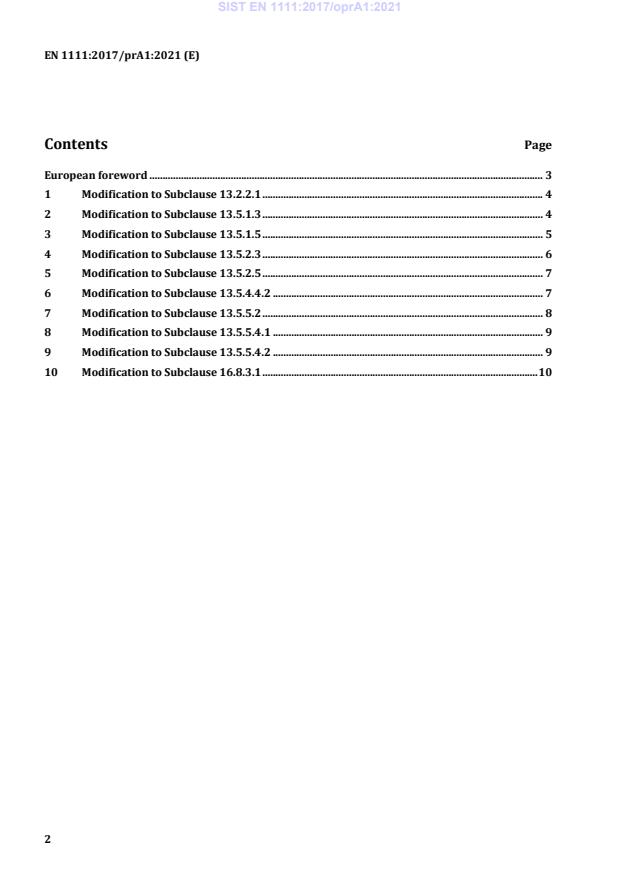
Contents Page
European foreword . 3
1 Modification to Subclause 13.2.2.1 . 4
2 Modification to Subclause 13.5.1.3 . 4
3 Modification to Subclause 13.5.1.5 . 5
4 Modification to Subclause 13.5.2.3 . 6
5 Modification to Subclause 13.5.2.5 . 7
6 Modification to Subclause 13.5.4.4.2 . 7
7 Modification to Subclause 13.5.5.2 . 8
8 Modification to Subclause 13.5.5.4.1 . 9
9 Modification to Subclause 13.5.5.4.2 . 9
10 Modification to Subclause 16.8.3.1 . 10
European foreword
This document (EN 1111:2017/prA1:2021) has been prepared by Technical Committee CEN/TC 164
“Water supply”, the secretariat of which is held by AFNOR.
This document is currently submitted to the CEN Enquiry.
1 Modification to Subclause 13.2.2.1
Replace entire subclause:
"The measurement is made at the maximum available flow rate going from cold to hot and then from
hot to cold. For the measurement a TMV, as supplied, or the outlet pipework, as defined in A.3, is used.
If the TMV is equipped with water saving accessories or aerators not complying with the flow rates
specified in EN 246, the flow rate test and acoustic test shall be made with the mixing valve as delivered
by the manufacturer.
Single sequential valves shall be adjusted to be able to attain a maximum 44 °C. Starting at full cold (off)
slowly adjust to 44 °C and then return to 34 °C.
Other device control systems (e.g. push-buttons, touch screens, etc.) shall be tested by a method that
ensures the correlation between outlet temperature and flow rate can be suitably recorded. The
procedure is subject to agreement between manufacturer and test laboratory."
with:
"The measurement is made at the maximum available flow rate going from cold to hot and then from
hot to cold. For the measurement a TMV, as supplied or, for valves without integral atmospheric
discharge, with the outlet pipework as defined in A.3 is used.
If the TMV is equipped with water saving accessories or aerators not complying with the dimensions
specified in EN 246, the flow rate test and acoustic test shall be made with the mixing valve as delivered
by the manufacturer.
Single sequential valves shall be adjusted to be able to attain a maximum 44 °C. Starting at full cold (off)
slowly adjust to 44 °C and then return to 34 °C.
Other device control systems (e.g. push-buttons, touch screens, etc.) shall be tested by a method that
ensures the correlation between outlet temperature and flow rate can be suitably recorded. The
procedure is subject to agreement between manufacturer and test laboratory.".
2 Modification to Subclause 13.5.1.3
Replace entire subclause: "
a) Starting from full hot determine the reference points in the following sequence: (38 ± 0,5) °C, (36 -
1) °C, (40 - 1)°C
b) apply and maintain the initial settings shown in Table 8 and allow water to flow until the outlet
temperature has stabilized;
c) start recording the mixed water temperature versus time;
d) within 1 s adjust the temperature control device to read ϑ = (36 - 1) °C;
mix
e) allow the outlet temperature to stabilize;
f) restore the settings in b);
g) within 1 s adjust the temperature control device to read ϑ = (40 - 1) °C;
mix
h) upon temperature stabilization stop recording mixed water temperature versus time."
with: "
a) Apply and maintain the initial inlet settings shown in Table 8 and allow water to flow for period of
maximum 30 s
b) starting from full hot, determine the position of the temperature control for the set temperatures in
the following sequence:
T1 : (38-1) °C,
...