

EN 16856:2020
(Main)Portable aerosol dispensers for fire extinguishing purposes
- Abstract
This draft European Standard specifies the characteristics, performance and test methods for extinguishing aerosol dispensers, in accordance with Directive 75/324/EEC, for fire extinguishing purposes. Requirements in this draft Standard are specified for products containing less than 1 kg or 1 l of extinguishing media, which can be expelled by the action of internal pressure and are intended to extinguish test fires of type A + B, or type A + F, or type A + B + F classes of EN 2. These extinguishing aerosol dispensers are intended to be used by untrained persons for domestic applications. They are not intended to be used on gas fires (class C) and metal fires (class D).
Requirements are specified for minimum performance in Annex I for extinguishing test fires of type A, type B and type F classes of EN 2, as appropriate.
Annex A gives the conditioning treatment to be applied to extinguishing aerosol dispensers prior to testing as described in Annex B to Annex K.
- Status
- Published
- Publication Date
- 21-Apr-2020
- Withdrawal Date
- 30-Oct-2020
- Technical Committee
- CEN/TC 70 - Manual means of fire fighting equipment
- Drafting Committee
- CEN/TC 70/WG 6 - Portable aerosol dispensers
- Current Stage
- 9060 - Closure of 2 Year Review Enquiry - Review Enquiry
- Start Date
- 02-Dec-2025
- Completion Date
- 02-Dec-2025



Overview
EN 16856:2020 is the CEN (European) standard that specifies requirements, performance criteria and test methods for portable aerosol dispensers for fire extinguishing purposes. It applies to non‑refillable metallic aerosol containers holding less than 1 kg or 1 L of extinguishing media, expelled by internal pressure. These products are intended for domestic fire safety and use by untrained persons to fight limited fires classified under EN 2 as A + B, A + F, or A + B + F. The standard explicitly excludes use on gas fires (class C) and metal fires (class D) and aligns with Directive 75/324/EEC on aerosol dispensers.
Key Topics
- Scope & definitions: Terminology for aerosol fire extinguishers, batch, body, and product use cases.
- Construction & design: Requirements for body/closure, operation, corrosion and impact resistance, shock/mechanical damage protection, dielectric properties, life of product and prototype testing.
- Filling requirements: Allowed extinguishing media, filling pressure, media tolerance and maximum developed pressure limits.
- Performance requirements:
- Delay on operation, duration of discharge, minimum discharge of contents
- Retention of charge after partial discharge
- Effective throw and fire‑extinguishing performance ratings (see Annex I for minimum performance)
- Test methods & conditioning: Detailed normative annexes (A–K) cover conditioning, corrosion, impact, drop, pressure and burst tests, discharge tests, retention tests, dielectric testing, chemical and pressure stability and full fire performance tests for classes A, B and F.
- Production & sampling tests: Verification of strength, burst tests, crimped closure checks, discharge and leak tests; sampling procedures for production lots.
- Marking & colour: Requirements for primary and secondary product information and colour coding suitable for consumer products.
Applications
- Manufacturers and product designers of portable aerosol fire extinguishers for home and small‑scale use.
- Testing and certification laboratories performing compliance testing and type/production checks.
- Regulatory authorities and market surveillance bodies assessing products under Directive 75/324/EEC.
- Retailers and procurement teams specifying safe, standards‑compliant domestic firefighting devices.
- Fire safety consultants recommending appropriate consumer fire protection solutions.
Related standards
Normative references include: EN 2, EN 3 (portable extinguishers), EN 615 (powders), EN 1568‑3/4 (foam concentrates), container standards EN 14848 / EN 14850 / EN 15006 / EN 15008, and test standards such as EN ISO 9227 (salt spray). The standard complements EU aerosol directives and national implementation by CEN members.
Keywords: EN 16856:2020, portable aerosol dispensers, aerosol fire extinguishers, domestic fire safety, EN 2, Directive 75/324/EEC, fire extinguishing performance, testing and certification.
Relations
- Effective Date
- 21-Oct-2026
- Effective Date
- 25-Aug-2026
- Effective Date
- 09-Feb-2026
- Refers
EN ISO 9227:2022 - Corrosion tests in artificial atmospheres - Salt spray tests (ISO 9227:2022) - Effective Date
- 28-Jan-2026
- Refers
EN 3-3:1994 - Portable fire extinguishers - Construction, resistance to pressure, mechanical tests - Effective Date
- 28-Jan-2026
- Effective Date
- 28-Jan-2026
- Effective Date
- 28-Jan-2026
- Effective Date
- 28-Jan-2026
- Effective Date
- 28-Jan-2026
- Effective Date
- 28-Jan-2026
- Effective Date
- 28-Jan-2026
- Effective Date
- 28-Jan-2026
- Effective Date
- 28-Jan-2026
- Effective Date
- 28-Jan-2026
- Effective Date
- 28-Jan-2026
Get Certified
Connect with accredited certification bodies for this standard

CIS Institut d.o.o.
Personal Protective Equipment (PPE) certification body. Notified Body NB-2890 for EU Regulation 2016/425 PPE.

Kiwa BDA Testing
Building and construction product certification.
Kmetijski inštitut Slovenije
Agricultural Institute of Slovenia. Soil testing, plant health, agricultural product analysis.
Sponsored listings
Frequently Asked Questions
EN 16856:2020 is a standard published by the European Committee for Standardization (CEN). Its full title is "Portable aerosol dispensers for fire extinguishing purposes". This standard covers: This draft European Standard specifies the characteristics, performance and test methods for extinguishing aerosol dispensers, in accordance with Directive 75/324/EEC, for fire extinguishing purposes. Requirements in this draft Standard are specified for products containing less than 1 kg or 1 l of extinguishing media, which can be expelled by the action of internal pressure and are intended to extinguish test fires of type A + B, or type A + F, or type A + B + F classes of EN 2. These extinguishing aerosol dispensers are intended to be used by untrained persons for domestic applications. They are not intended to be used on gas fires (class C) and metal fires (class D). Requirements are specified for minimum performance in Annex I for extinguishing test fires of type A, type B and type F classes of EN 2, as appropriate. Annex A gives the conditioning treatment to be applied to extinguishing aerosol dispensers prior to testing as described in Annex B to Annex K.
This draft European Standard specifies the characteristics, performance and test methods for extinguishing aerosol dispensers, in accordance with Directive 75/324/EEC, for fire extinguishing purposes. Requirements in this draft Standard are specified for products containing less than 1 kg or 1 l of extinguishing media, which can be expelled by the action of internal pressure and are intended to extinguish test fires of type A + B, or type A + F, or type A + B + F classes of EN 2. These extinguishing aerosol dispensers are intended to be used by untrained persons for domestic applications. They are not intended to be used on gas fires (class C) and metal fires (class D). Requirements are specified for minimum performance in Annex I for extinguishing test fires of type A, type B and type F classes of EN 2, as appropriate. Annex A gives the conditioning treatment to be applied to extinguishing aerosol dispensers prior to testing as described in Annex B to Annex K.
EN 16856:2020 is classified under the following ICS (International Classification for Standards) categories: 13.220.10 - Fire-fighting. The ICS classification helps identify the subject area and facilitates finding related standards.
EN 16856:2020 has the following relationships with other standards: It is inter standard links to EN 3-11:2026, ISO 657-1:1989, ISO 4470:1981, EN ISO 9227:2022, EN 3-3:1994, EN 3-8:2021, EN 462-5:1996, EN 14848:2020, EN 1568-4:2018, EN 3-10:2009, EN 15008:2017, EN 1568-3:2018, EN 3-7:2004+A1:2007, EN 14850:2005, EN 3-9:2006. Understanding these relationships helps ensure you are using the most current and applicable version of the standard.
EN 16856:2020 is available in PDF format for immediate download after purchase. The document can be added to your cart and obtained through the secure checkout process. Digital delivery ensures instant access to the complete standard document.
Standards Content (Sample)
SLOVENSKI STANDARD
01-junij-2020
Prenosni aerosolni razpršilniki za gašenje požara
Portable aerosol dispensers for fire extinguishing purposes
Löschspraydosen
Générateur d’aérosol portatif à fonction extinctrice
Ta slovenski standard je istoveten z: EN 16856:2020
ICS:
13.220.10 Gašenje požara Fire-fighting
2003-01.Slovenski inštitut za standardizacijo. Razmnoževanje celote ali delov tega standarda ni dovoljeno.
EN 16856
EUROPEAN STANDARD
NORME EUROPÉENNE
April 2020
EUROPÄISCHE NORM
ICS 13.220.10
English Version
Portable aerosol dispensers for fire extinguishing
purposes
Générateur d'aérosol portatif à fonction extinctrice Feuerlöschsprays
This European Standard was approved by CEN on 27 January 2020.
CEN members are bound to comply with the CEN/CENELEC Internal Regulations which stipulate the conditions for giving this
European Standard the status of a national standard without any alteration. Up-to-date lists and bibliographical references
concerning such national standards may be obtained on application to the CEN-CENELEC Management Centre or to any CEN
member.
This European Standard exists in three official versions (English, French, German). A version in any other language made by
translation under the responsibility of a CEN member into its own language and notified to the CEN-CENELEC Management
Centre has the same status as the official versions.
CEN members are the national standards bodies of Austria, Belgium, Bulgaria, Croatia, Cyprus, Czech Republic, Denmark, Estonia,
Finland, France, Germany, Greece, Hungary, Iceland, Ireland, Italy, Latvia, Lithuania, Luxembourg, Malta, Netherlands, Norway,
Poland, Portugal, Republic of North Macedonia, Romania, Serbia, Slovakia, Slovenia, Spain, Sweden, Switzerland, Turkey and
United Kingdom.
EUROPEAN COMMITTEE FOR STANDARDIZATION
COMITÉ EUROPÉEN DE NORMALISATION
EUROPÄISCHES KOMITEE FÜR NORMUNG
CEN-CENELEC Management Centre: Rue de la Science 23, B-1040 Brussels
© 2020 CEN All rights of exploitation in any form and by any means reserved Ref. No. EN 16856:2020 E
worldwide for CEN national Members.
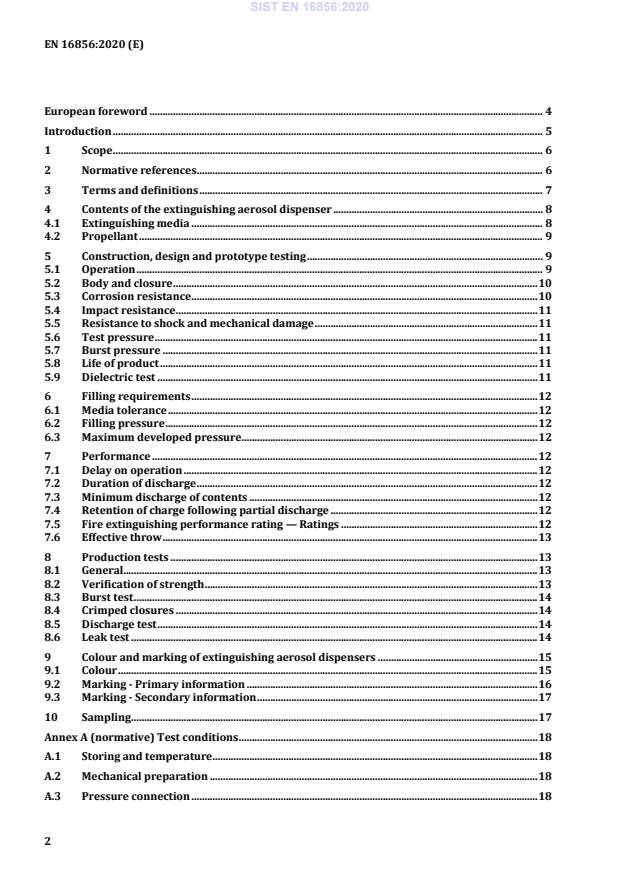
European foreword . 4
Introduction . 5
1 Scope . 6
2 Normative references . 6
3 Terms and definitions . 7
4 Contents of the extinguishing aerosol dispenser . 8
4.1 Extinguishing media . 8
4.2 Propellant . 9
5 Construction, design and prototype testing . 9
5.1 Operation . 9
5.2 Body and closure . 10
5.3 Corrosion resistance . 10
5.4 Impact resistance . 11
5.5 Resistance to shock and mechanical damage . 11
5.6 Test pressure . 11
5.7 Burst pressure . 11
5.8 Life of product . 11
5.9 Dielectric test . 11
6 Filling requirements . 12
6.1 Media tolerance . 12
6.2 Filling pressure . 12
6.3 Maximum developed pressure. 12
7 Performance . 12
7.1 Delay on operation . 12
7.2 Duration of discharge . 12
7.3 Minimum discharge of contents . 12
7.4 Retention of charge following partial discharge . 12
7.5 Fire extinguishing performance rating — Ratings . 12
7.6 Effective throw . 13
8 Production tests . 13
8.1 General. 13
8.2 Verification of strength . 13
8.3 Burst test . 14
8.4 Crimped closures . 14
8.5 Discharge test . 14
8.6 Leak test . 14
9 Colour and marking of extinguishing aerosol dispensers . 15
9.1 Colour . 15
9.2 Marking - Primary information . 16
9.3 Marking - Secondary information . 17
10 Sampling . 17
Annex A (normative) Test conditions . 18
A.1 Storing and temperature . 18
A.2 Mechanical preparation . 18
A.3 Pressure connection . 18
Annex B (normative) Corrosion test . 19
B.1 External corrosion. 19
B.2 Internal corrosion . 19
Annex C (normative) Impact test . 20
Annex D (normative) Mechanical drop test . 22
Annex E (normative) Pressure tests for bodies . 23
E.1 General . 23
E.2 Test for resistance to pressure . 23
E.3 Minimum burst test . 23
Annex F (normative) Measurement of forces . 24
Annex G (normative) Discharge tests . 25
G.1 Duration of discharge and minimum discharge of contents . 25
G.2 Intermittent discharge and minimum discharge of contents . 26
G.3 Effective throw . 26
Annex H (normative) Test for retention of charge after partial discharge . 27
Annex I (normative) Fire extinguishing performance tests . 28
I.1 General . 28
I.2 Schedule for testing . 28
I.3 Class A fire test. 28
I.4 Class B fire test. 31
I.5 Class F fire test . 33
Annex J (normative) Dielectric test . 37
J.1 General . 37
J.2 Apparatus . 37
J.3 Test procedure . 37
Annex K (normative) Chemical and pressure stability test . 39
Annex L (informative) Example of breakdown and order of tests . 40
Bibliography . 41
European foreword
This document (EN 16856:2020) has been prepared by Technical Committee CEN/TC 70 “Manual
means of firefighting equipment”, the secretariat of which is held by AFNOR.
This European Standard shall be given the status of a national standard, either by publication of an
identical text or by endorsement, at the latest by October 2020, and conflicting national standards shall
be withdrawn at the latest by October 2020.
Attention is drawn to the possibility that some of the elements of this document may be the subject of
patent rights. CEN shall not be held responsible for identifying any or all such patent rights.
According to the CEN-CENELEC Internal Regulations, the national standards organisations of the
following countries are bound to implement this European Standard: Austria, Belgium, Bulgaria,
Croatia, Cyprus, Czech Republic, Denmark, Estonia, Finland, France, Germany, Greece, Hungary, Iceland,
Ireland, Italy, Latvia, Lithuania, Luxembourg, Malta, Netherlands, Norway, Poland, Portugal, Republic of
North Macedonia, Romania, Serbia, Slovakia, Slovenia, Spain, Sweden, Switzerland, Turkey and the
United Kingdom.
Introduction
This document has been written with the aim of producing a specification for small disposable, aerosol
dispensers for fire extinguishing purposes with an acceptable level of performance. This type of product
is intended for domestic use only in situations where fires of limited proportions are anticipated
because of the nature of some process or activity, where the possibility of fire spreading to other
materials is remote, or where people are present at the likely times of risk. These products are not
intended to supplant extinguishers that comply with EN 3.
Special attention is drawn to Directive 75/324/EEC of 20 May 1975, on the approximation of the laws
of the member states relating to Aerosol Dispensers, Directive 2008/47/EC and Commission Directive
94/1/EC of 6 January 1994 adapting some technicalities of Council Directive 75/324/EEC on the
approximation of the laws of the Member States relating to aerosol dispensers.
1 Scope
This document specifies the requirements for non-refillable portable aerosol dispensers for fire
extinguishing purposes.
It supplements the characteristics, performance and test methods for extinguishing aerosol dispensers
for fire extinguishing purposes, in addition to the requirements of the Directive 75/324/EEC.
Requirements in this document are specified for products containing less than 1 kg or 1 l of
extinguishing media, which can be expelled by the action of internal pressure and are intended to
extinguish test fires of type A + B, or type A + F, or type A + B + F classes of EN 2. These extinguishing
aerosol dispensers are intended to be used by untrained persons for domestic applications. They are
not intended to be used on gas fires (class C) and metal fires (class D).
Requirements are specified for minimum performance in Annex I for extinguishing test fires of type A,
type B and type F classes of EN 2, as appropriate.
Annex A gives the conditioning to be applied to extinguishing aerosol dispensers prior to testing as
described in Annex B to Annex K.
2 Normative references
The following documents are referred to in the text in such a way that some or all of their content
constitutes requirements of this document. For dated references, only the edition cited applies. For
undated references, the latest edition of the referenced document (including any amendments) applies.
EN 2, Classification of fires
EN 3 (all parts), Portable Fire Extinguishers
EN 615, Fire protection - Fire extinguishing media - Specifications for powders (other than class D
powders)
EN 1568-3, Fire extinguishing media - Foam concentrates - Part 3: Specification for low expansion foam
concentrates for surface application to water-immiscible liquids
EN 1568-4, Fire extinguishing media - Foam concentrates - Part 4: Specification for low expansion foam
concentrates for surface application to water-miscible liquids
EN 14848, Aerosol containers - Metal containers with 25,4 mm aperture - Dimensions of valve cups
EN 14850, Aerosol containers - Metal containers with 25,4 mm aperture - Measurement of contact height
EN 15006, Metal aerosol containers - Aluminium containers - Dimensions of the 25,4 mm aperture
EN 15008, Aerosol containers - Aluminium containers - Dimensions of one-piece cans with 25,4 mm
aperture
EN ISO 9227, Corrosion tests in artificial atmospheres - Salt spray tests (ISO 9227:2017)
ISO 657-1, Hot-rolled steel sections — Part 1: Equal-leg angles — Dimensions
ISO 4470, Sawn timber — Determination of the average moisture content of a lot
3 Terms and definitions
For the purposes of this document, the following terms and definitions apply.
ISO and IEC maintain terminological databases for use in standardization at the following addresses:
• IEC Electropedia: available at http://www.electropedia.org/
• ISO Online browsing platform: available at http://www.iso.org/obp
3.1
fire extinguishing aerosol dispenser
non-refillable metallic container intended for a single use, which holds a compressed gas and liquid,
paste or powder extinguishing media, equipped with a valve allowing a controlled discharge of the
contents
3.2
batch
definite quantity of products or components produced at one time under uniform condition
3.3
body
metallic container of the extinguishing aerosol dispenser not fitted with its accessories, such as valves
3.4
valve
self-closing release device allowing the discharge of the extinguishing media to be interruptible
3.5
charge of an extinguishing aerosol dispenser
mass or volume of the extinguishing media contained in the extinguishing aerosol dispenser
3.6
maximum pressure at maximum operating temperature
P(T )
max
pressure within the extinguishing aerosol dispenser when filled with the quantity of solid, liquid and
gaseous content to the maximum upper tolerance specified under production conditions, at a
temperature of T
max
3.7
working pressure
pressure declared by the manufacturer as the pressure within the extinguishing aerosol dispenser,
when filled with quantities of solid, liquid and gaseous content at 20 °C
3.8
extinguishing media
substance including any additive, such as corrosion inhibitor, freezing point depressant or foaming
agent, contained in the extinguishing aerosol dispenser that causes extinction of a fire
3.9
protective cap
cover over the valve of the extinguishing aerosol dispenser
Note 1 to entry: if fitted, the protective cap may be the safety device.
3.10
propellant
compressed gas held in the container, which provides the required pressure for the discharge of the
extinguishing media
3.11
fire rating
designation of the largest test fire that has been extinguished when tested in accordance with 7.5.2,
7.5.3 and 7.5.4
3.12
domestic
premises occupied as a private dwelling, including any garden, yard, garage, outhouse, or appurtenance
of such premises, which is not used in common by the occupants of more than one such dwelling
3.13
safety device
part that needs to be broken or removed before the extinguishing aerosol dispenser, and can be
activated to prevent inadvertent operation
3.14
security seal
part that is broken when removing the safety device and once broken cannot be replaced
3.15
minimum operating temperature
T
min
minimum temperature declared by the manufacturer at which the extinguishing aerosol dispenser will
operate
3.16
maximum operating temperature
T
max
maximum temperature declared by the manufacturer
4 Contents of the extinguishing aerosol dispenser
4.1 Extinguishing media
The extinguishing media shall be one of the following:
— water based, including additives conforming to the physical and chemical characteristics declared
by the manufacturer;
— powder conforming to EN 615.
For products containing AFFF, use EN 1568-3 or EN 1568-4; and for those containing powder use
EN 615.
Where an EN or ISO standard applies, it should be used.
4.2 Propellant
Only propellants listed in Table 1 or mixtures thereof shall be used. The maximum water content shall
be as specified in Table 1, except when used in a water-based extinguishing aerosol dispenser. Tracers
may be added to the propellant to facilitate leakage detection, but the content shall not exceed a mass
fraction of 10 % of the propellant content.
Table 1 — Permitted propellants
Propellant Maximum water content
mass fraction
%
Air 0,006
Argon 0,006
Helium 0,006
Nitrogen 0,006
5 Construction, design and prototype testing
5.1 Operation
5.1.1 The extinguishing aerosol dispenser shall be operated by activating the valve. The method of
activation shall be readily apparent. It shall be possible to operate the valve by one single action after
having removed the safety device. It shall not be necessary for any movement of the actuating
mechanism to be repeated in order to initiate discharge.
5.1.2 The construction of the extinguishing aerosol dispenser shall ensure no parts can be removed,
excluding items in 5.1.6 and 5.1.7.
5.1.3 The design of the extinguishing aerosol dispenser shall allow visual identification if the
extinguishing aerosol dispenser has been unsealed.
5.1.4 If during visual inspection the seal is found to be broken the extinguishing aerosol dispenser
shall be discarded.
5.1.5 The extinguishing aerosol dispenser shall be used with the valve upright.
5.1.6 The extinguishing aerosol dispenser shall incorporate a safety device to prevent inadvertent
operation, which shall be so constructed that any unaided manual attempt to initiate discharge will not
deform or break any part in a way that would prevent the subsequent discharge of the extinguishing
aerosol dispenser.
5.1.7 The extinguishing aerosol dispenser shall have a security seal, which shall be broken by the
removal of the safety device. The force required to remove the safety device and break the security seal
shall be between 5 N and 50 N, see Annex F. This security seal shall not be re-usable.
5.1.8 The extinguishing aerosol dispenser shall incorporate a valve to enable the discharge to be
started. The force required to actuate the device shall be between 5 N and 50 N. This valve shall be self-
closing enabling the discharge to be interrupted, see Annex F.
5.2 Body and closure
5.2.1 Body
The body shall be a metallic seamless container and shall have a maximum total capacity of 1000 ml,
and if in aluminium shall be in accordance with EN 15006 and EN 15008.
Seamless steel containers are allowed.
5.2.2 Closure
The closure shall be crimped under the neck ring of the body, in accordance with EN 14848 and
EN 14850.
5.3 Corrosion resistance
5.3.1 External corrosion
After testing in accordance with B.1, the extinguishing aerosol dispenser shall show no signs of
corrosion or other chemical degradation likely to impair its operation or safety, and shall fulfill the
following requirements:
— the force required to release the safety device shall be as specified in 5.1.7;
— the force required to actuate the extinguishing aerosol dispenser shall be as specified in 5.1.8;
— when the extinguishing aerosol dispenser is tested in accordance with G.1 each duration of
operation at (20 ± 10) °C shall be within ± 25 % with a maximum deviation of 5 s of the average
value determined in 7.2;
— the extinguishing aerosol dispenser shall fulfil requirement of 5.7;
— the rate of pressure loss shall not exceed 5 % of the working pressure per annum.
5.3.2 Internal corrosion
After testing in accordance with B.2, the extinguishing aerosol dispenser shall fulfill the following
requirements:
— the rate of pressure loss shall not exceed 5 % of the working pressure per annum;
— when the extinguishing aerosol dispenser is tested in accordance with G.1 each duration of
operation at (20 ± 10) °C shall be within ± 25 % with a maximum deviation of 5 s of the average
value determined in 7.2;
— the extinguishing aerosol dispenser shall fulfill the requirements of 5.7.
5.3.3 Chemical and pressure stability
The contents shall not generate pressure by reacting with the body or any lining. The complete
assembly shall be chemically stable. Small increases are permitted, but the total pressure may increase
by a maximum of 10 % of the working pressure during the test, but shall be stable by the end of the test.
It shall be tested in accordance with Annex K.
5.4 Impact resistance
After being subjected to testing in accordance with Annex C, the extinguishing aerosol dispenser (with
safety device) correctly charged and equipped with all the fittings that are subject to internal pressure
in normal operation, may leak but the body shall not rupture. To ensure any leak does not affect the
performance of the extinguishing aerosol dispenser, it shall operate as intended and be tested after 5
min of being subjected to the tests in Annex C. The discharge time shall be ± 25 % with a maximum
deviation of 5 s of the actual time measured in 7.2 and the minimum discharge shall be in accordance
with 7.3.
5.5 Resistance to shock and mechanical damage
After being subjected to testing in accordance with Annex D, the extinguishing aerosol dispenser (with
safety device) shall operate as intended i.e. the discharge time shall be ± 25 % with a maximum
deviation of 5 s of the average effective discharge time measured in 7.2 and the minimum discharge
shall be in accordance with 7.3.
5.6 Test pressure
The body shall withstand an internal pressure of 10 bar or 1,5 times the P(T ), whichever is the
max
greater, without permanent deformation and no increase in volume greater than 1 % when tested in
accordance with E.2.
5.7 Burst pressure
The minimum burst pressure of the assembly, fitted with all pressure retaining parts, shall be 18 bar or
at least 1,2 times test pressure, whichever is the greater, when tested in accordance with E.3.
The assembly shall not fragment or eject any parts.
5.8 Life of product
The extinguishing aerosol dispenser has a maximum expiry date of 39 months from the date of
manufacture.
Extinguishing aerosol dispensers are intended to be discarded after any use and are not to be refilled.
NOTE Disposal might be controlled by National laws and regulations.
5.9 Dielectric test
5.9.1 General
The dielectric test is designed to determine the electrical conductivity of the water based extinguishing
aerosol dispenser discharge stream during the test when performed in accordance with Annex J.
5.9.2 Required performance
When the extinguishing aerosol dispenser is in operation and the metallic plate is live, the current
between the aerosol dispenser and earth, and between the nozzle and earth, shall not be more than
0,5 mA at any time during the complete discharge of the extinguishing aerosol dispenser. The test shall
be carried out in accordance with Annex J.
6 Filling requirements
6.1 Media tolerance
The filling tolerance of the contents shall be ± 3 % for all extinguishing media.
The filling tolerance for each individual constituent excluding water of the content shall be −0/ + 10 %
on the declared composition of the media.
6.2 Filling pressure
The filling pressure shall be ± 0,5 bar of the working pressure as declared by the manufacturer, at 20 °C.
6.3 Maximum developed pressure
The lowest allowed T is 50 °C
max
The filling pressure, when filled to the upper tolerance, shall be such that the maximum developed
pressure at 50 °C shall not exceed 15 bar.
Where T is declared greater than 50 °C, all the requirements of the ADD required at 50 °C shall be
max
performed at the declared T
max.
7 Performance
7.1 Delay on operation
Not more than 2 s shall elapse between actuation of the valve and commencement of the discharge
when tested in accordance with G.1.
7.2 Duration of discharge
The duration of effective discharge for each aerosol dispenser shall be not less than 6 s when tested in
accordance with G.1 (continuous discharge). The time should be recorded for each dispenser and the
average noted. The deviation shall be within 20 % with a maximum of 5 s.
7.3 Minimum discharge of contents
The extinguishing aerosol dispenser, when operated in its normal working position, shall discharge not
less than 85 % of the nominal charge, when tested in accordance with G.1 (continuous discharge) and
G.2 (intermittent discharge).
7.4 Retention of charge following partial discharge
The second pressure shall not be less than 80 % of the first, when the extinguishing aerosol dispenser is
tested in accordance with Annex H.
7.5 Fire extinguishing performance rating — Ratings
7.5.1 General
The extinguishing aerosol dispenser shall fulfil the requirements of 7.5.2 and 7.5.3 or 7.5.2 and 7.5.4 or
7.5.2, 7.5.3 and 7.5.4.
7.5.2 Class A rating
The class A rating of the extinguishing aerosol dispenser shall be 5A or 8A when tested in accordance
with the test method described in I.3.
7.5.3 Class B rating
The class B rating of the extinguishing aerosol dispenser shall be 21B or 34B when tested in accordance
with the test method described in I.4.
7.5.4 Class F rating
The class F rating of the extinguishing aerosol dispenser shall be 5F or 15F when tested in accordance
with the test method described in I.5.
7.6 Effective throw
At least 75 % of the extinguishing agent shall reach a throwing distance of at least 2 m when the
extinguishing aerosol dispenser is placed vertically at a height of 1,5 m when tested in accordance with
G.3.
8 Production tests
8.1 General
In addition to any other scheme of quality control, extinguishing aerosol dispensers shall be tested
according to the production testing schemes of this sub clause.
8.2 Verification of strength
8.2.1 General
The integrity of each extinguishing aerosol dispenser shall be verified by one of the following methods.
Directive 75/324/EEC specifies that if 8.2.3 or 8.2.4 are used the test method shall be approved by a
competent authority.
NOTE Further information in bibliography [4] and [5].
8.2.2 Hot water bath method
Each extinguishing aerosol dispenser shall be fully immersed in water, which is maintained at 50 °C.
The extinguishing aerosol dispenser shall remain in the water bath long enough to allow the contents to
also reach 50 °C and therefore develop P(T ). The extinguishing aerosol dispenser shall then be
max
observed for a period of 15s, any extinguishing aerosol dispenser that deforms or show any sign of
leakage with bubbles shall be rejected (this does not satisfy the requirement of 8.6).
For each production cycle it shall be demonstrated that P(T ) is actually reached in a representative
max
test sample.
8.2.3 Hot final test method
Each extinguishing aerosol dispenser shall be warmed in such a way as to ensure that the contents are
at 50 °C and therefore develops the internal pressure P(T ). This pressure shall be maintained for a
max
minimum of 15 s, any extinguishing aerosol dispensers that deform shall be rejected.
Leaks shall be detected with the same precision as in the case of the hot water bath test.
8.2.4 Cold final test method
Prior to assembly, each body shall be subjected to test pressure in accordance with E.2. No permanent
deformation shall be detected.
8.3 Burst test
From every batch, bodies shall be selected at random in accordance with the sampling plan in Table 2
and shall be subjected to a burst pressure test in accordance with E.3.
The pressure at which each of the bodies bursts shall be greater than that calculated in 5.7.
Table 2 — Burst test sampling plan
Number of assemblies per Number of assemblies
batch N sampled
N ≤ 2 500 5
Each additional 2 500 5
If a body bursts at a pressure less than that calculated in 5.7, then the test shall be repeated with
another number of samples, randomly selected from the same batch in accordance with Table 2. If a
body from the second series of tests bursts below the pressure calculated in 5.7, then the whole batch
shall be rejected.
8.4 Crimped closures
8.4.1 During production, the first extinguishing aerosol dispenser produced from each batch of valves
or bodies and the first extinguishing aerosol dispenser produced from each crimping head each day,
shall be checked for conformity to 5.2.2 and the results recorded.
If this sample does not conform, a further sample, produced after any appropriate adjustments, shall be
checked.
Production shall not commence until a sample conforming to 5.2.2 has been tested.
8.4.2 If more than 2500 extinguishing aerosol dispensers are produced in a day, from a crimping
head, one extinguishing aerosol dispenser in every 2500 subsequently produced shall be tested; if one
fails to conform to 5.2.2 then checks to identify all faulty extinguishing aerosol dispensers shall be
made. All that do not conform to 5.2.2 shall be rejected and the procedure specified in 8.4.1 shall be
repeated.
A record of the measured dimensions shall be kept.
8.5 Discharge test
One extinguishing aerosol dispenser in every 2500 shall be fully discharged in the normal working
position with the valve fully opened. The discharge duration and percentage discharge shall be
recorded. If these extinguishing aerosol dispensers do not meet the requirements of 7.2 and 7.3, then 10
more extinguishing aerosol dispensers shall be tested, if any fail, the batch shall be rejected.
8.6 Leak test
Each extinguishing aerosol dispenser shall be submitted to a final inspection of the filled and
pressurized extinguishing aerosol dispenser, capable of detecting a leakage rate equivalent to a loss of
pressure of 5 % per annum. Products with a leakage rate greater than 5 % per annum shall be rejected.
NOTE Leak detection by means of tracer gas detection is a suitable test method.
9 Colour and marking of extinguishing aerosol dispensers
9.1 Colour
The extinguishing aerosol dispensers shall be coloured as follows:
— between 50 % and 70 % of the surface area of the extinguishing aerosol dispensing body shall be
red in the range RAL 3000 to RAL 3002 as specified in Farbregister RAL −841-GL;
— the remainder of the surface area, which will be an area of between 50 % and 30 % of the
extinguishing aerosol body shall be of colour to identify the classes of fires on which the aerosol
dispenser can be used.
The zone of colour shall be a single horizontal zone located anywhere between the two arrows shown in
accordance with Figure 1.
All text and symbols shall be printed in a colour contrasting to the colour of the background on which it
is printed. A light reflectance value (LRV) difference of 70 % or more is required (see bibliography [6]).
The marking shall remain clear and legible throughout the expected life of the extinguishing aerosol
dispenser.
Key
1 Red area 70 %
2 Red area 50 %
Figure 1 — Cylinder red area and colour
9.2 Marking - Primary information
9.2.1 The extinguishing aerosol dispenser shall be marked with the following:
a) the words “Fire extinguishing spray” in letters of height not less than 4 mm;
b) for A + B, the words “Suitable for small fires, except gas and cooking oil fires” (colour zone
RAL 7001 – Silver Grey) in letters of height not less than 4 mm,
for A + F the words “Suitable for small fires, except gas and liquid fuel fires” (colour zone RAL –
1003 Signal Yellow) in letters of height not less than 4 mm,
for A + B + F, the words “Suitable for small fires, except gas fires” (colour zone RAL 1013 – Oyster
White) in letters of height not less than 4 mm;
c) for water based extinguishing aerosol dispensers the words, in letters of height not less than 4 mm:
WARNING - Do not use on live electrical equipment
This warning applies despite the requirement of 5.9.
d) for all extinguishing aerosol dispensers the words, in letters of height not less than 1,5 mm:
WARNING –Keep x metre distance from the fire
Where x is declared by the manufacturer and may not be less than 1 m;
e) the method of operation in symbols (optional) of minimum size 20 mm and words with letters of
height not less than 1,5 mm;
f) graphical symbols indicating the fire class, see EN 3-7, minimum size 15 mm, shall be located in the
colour coded area;
g) an instruction to discard the extinguishing aerosol dispenser if the security seal is broken or
missing, or after any use (including partial use) or after the expiry date marked on the
extinguishing aerosol dispenser, in letters of height not less than 1,5 mm;
h) do not dispose of with general household waste. Please recycle this product in accordance with
local requirements, in letters of height not less than 1,5 mm.
The height of the lettering of the text when specified shall be determined by reference to an upper case
letter E.
The text of the instructions for use shall be in the language or languages (limited to a maximum of
three) of the country where the extinguishing aerosol dispenser is intended to be used.
9.2.2 All instructions concerning safety, i.e. items a), b), c) and d) of 9.2.1 shall be in a prominent
position and in lettering that stands out by reason either of its size or its colour.
9.3 Marking - Secondary information
9.3.1 The extinguishing aerosol dispenser shall be marked with the following:
a) the name and address and trademark (if a trademark exists) of the legally responsible entity for
placing the extinguishing aerosol dispenser in the market;
b) the filling date and the expiry date (month and year) and the batch number; the expiry date shall be
39 months after the filling date, see 5.8;
c) the words: “Conforms to EN 16856”;
d) the class of fire and fire rating achieved;
e) the nominal mass, type of extinguishing media and the total volume of the body;
f) operating temperature range, top and bottom limits;
g) the instruction: “Keep out of reach of children”;
h) the instruction: “Not to be refilled”;
i) the instruction: “Pressurized container; protect from sunlight and other sources of heat and do not
expose to temperatures exceeding 50 °C. Do not pierce or burn, even after use”;
j) the “Ʒ” (inverted epsilon) indicating compliance with the current EU aerosol dispensers directive;
k) the warning: “If damaged this product must be discarded”;
l) any additional operating instructions that alerts the consumer to the specific dangers of the
product.
The letter height shall not be less than 1,2 mm and the markings specified in g), h), i), j), k), and l) shall
have a letter height greater than that used for the markings specified in a), b), c), d), e) and f).
9.3.2 The markings specified in 9.3.1 shall be marked on a part of the extinguishing aerosol dispenser
separate from that bearing the markings specified in 9.2.1.
Marking of EN 16856 on or in relationship to a product represents a manufacturer’s declaration of
conformity, i.e. a claim by or on behalf of the manufacturer that the product meets the requirements of
the standard. The accuracy of the claim is solely the claimant’s responsibility.
10 Sampling
Annex L provides an example of samples required for completion of testing.
Annex A
(normative)
Test conditions
A.1 Storing and temperature
Unless otherwise stated, store extinguishing aerosol dispensers for not less than 24 h at a temperature
of (22 ± 8) °C before tests are carried out and maintain them within this temperature range until tested.
Unless stated otherwise, the ambient temperature for carrying out the tests is 0 °C to 30 °C.
For the discharge performance tests of Annex F, Annex G and Annex H and the fire performance tests of
Annex I use extinguishing aerosol dispensers fitted with a protective cap or safety device.
A.2 Mechanical preparation
Hold the extinguishing aerosol dispenser in the vertical position and drop it vertically 500 times from a
height of (15 ± 1) mm at a frequency of (1 ± 0,02) Hz onto a rigid steel plate, of dimensions (300 ± 5)
mm square and (60 ± 1) mm thick. Store the extinguishing aerosol dispenser at a temperature (22 ± 8)
°C for not less than 24 h.
A.3 Pressure connection
A.3.1 Permanent connection
The extinguishing aerosol dispenser shall be submitted for testing fitted with a suitable permanent
pressure connection to the body to allow the internal pressure to be measured.
NOTE The extinguishing aerosol fitted with the permanent suitable connection will be provided by the
manufacturer.
A.3.2 External measuring device
The extinguishing aerosol dispenser shall be submitted for testing with a suitable connecting device to
allow the internal pressure to be measured.
NOTE The suitable device will be provided by the manufacturer.
Annex B
(normative)
Corrosion test
NOTE See 5.3.1, 5.3.2, 5.7, and 7.2.
B.1 External corrosion
Six complete extinguishing aerosol dispensers shall be subjected to a salt spray test in accordance with
EN ISO 9227 type NSS for a period of 240 h and then shall be washed to remove any salt deposits.
B.2 Internal corrosion
Prepare ten extinguishing aerosol dispensers as described in A.1, A.2 and A.3.2, and examine for
leakage.
Divide the extinguishing aerosol dispensers in
...