


EN 1915-1:2001+A1:2009
(Main)Aircraft ground support equipment - General requirements - Part 1: Basic safety requirements
Aircraft ground support equipment - General requirements - Part 1: Basic safety requirements
This Part of EN 1915 applies to GSE when used in civil air transport as intended by the manufacturer and contains safety requirements relating to the equipment in general.
This Part of EN 1915 deals with the technical requirements to minimize the hazards listed in clause 4 which can arise during operation and maintenance of GSE as intended by the manufacturer or his authorised representative.
This European Standard is intended to be used in conjunction with EN 1915-2, EN 1915-3 (for vehicles) and EN 1915-4, and with the relevant part of EN 12312.
This Part of EN 1915 does not apply to unmodified automotive parts when used on GSE for the purpose for which they are designed.
This Part of EN 1915 does not establish additional requirements for the following:
- operation elsewhere than in an airport environment;
- operation in severe conditions, e.g. ambient temperature below -20 C or over 50 C, tropical or saturated salty atmospheric environment, strong magnetic or radiation field;
- operation subject to special rules, e.g. potentially explosive atmosphere except as regards operation in the vicinity of an aircraft fuel tank during fuelling operation;
- hazards caused by power supply other than from electrical networks;
- hazards occurring during construction, transportation, commissioning and decommissioning of the GSE;
- hazards caused by wind velocity in excess of the figures given in this European Standard;
- direct contact with food stuffs;
- earthquake, flood, landslide, lightning and more generally any natural catastrophe;
- electromagnetic compatibility (EMC);
- cableless remote control;
- hazards caused by noise and vibration, see EN 1915-3 and EN 1915-4;
- hazards caused by errors in the software.
This Part of EN 1915 is not applicable to GSE which are manufactured before the date of publication by CEN of this Standard.
Luftfahrt-Bodengeräte - Allgemeine Anforderungen - Teil 1: Grundlegende Sicherheitsanforderungen
Dieser Teil von EN 1915 gilt für Bodengeräte, die entsprechend den vom Hersteller festgelegten Betriebsbedingungen
im zivilen Luftverkehr eingesetzt werden. Er enthält die allgemeinen Sicherheitsanforderungen
an diese Geräte.
Dieser Teil von EN 1915 behandelt die technischen Anforderungen zum Minimieren der in Abschnitt 4 angegebenen
Gefährdungen, die bei Betrieb oder Wartung unter den vom Hersteller oder seinem autorisierten
Bevollmächtigten festgelegten Bedingungen entstehen können.
!Es ist beabsichtigt, diese Europäische Norm in Verbindung mit EN 1915-2, EN 1915-3 (für Fahrzeuge) und
EN 1915-4 und mit dem entsprechenden Teil der EN 12312 anzuwenden."
Dieser Teil von EN 1915 gilt nicht für fahrzeugtechnische Teile, die an Luftfahrt-Bodengeräten entsprechend
ihrer konstruktiven Bestimmung unverändert Verwendung finden.
In diesem Teil von EN 1915 sind für folgende Aspekte keine zusätzlichen Festlegungen enthalten:
- Betrieb außerhalb des Flughafens;
- Betrieb unter erschwerten Bedingungen, z. B. bei Umgebungstemperaturen unter −20 °C oder über
50 °C, in tropischer oder gesättigter Salz-Atmosphäre oder in starken magnetischen oder Strahlungsfeldern;
- Betrieb, der besonderen Regelungen unterliegt, z. B. in potentiell explosionsfähiger Atmosphäre, mit
Ausnahme des Betriebs in der Nähe eines Flugzeugtanks beim Betanken;
- Gefährdungen aus anderer Energieversorgung als der aus elektrischen Stromnetzen;
- Gefährdungen, die während Bau, Transport, Inbetriebnahme und Außerbetriebnahme von Bodengeräten
auftreten;
- Gefährdungen aus Windgeschwindigkeiten oberhalb der in dieser Europäischen Norm angegebenen
Werte;
- direkter Kontakt mit Nahrungsmitteln;
- Erdbeben, Überschwemmungen, Erdrutsche, Blitze und allgemein jede Art von Naturkatastrophen;
- elektromagnetische Verträglichkeit (EMV);
- drahtlose Fernsteuerungen;
- !durch Lärm und Vibration verursachte Gefährdungen, siehe EN 1915-3 und EN 1915-4";
- Gefährdungen aus Fehlern in der Software.
Matériels au sol pour aéronefs - Exigences générales - Partie 1: Caractéristiques fondamentales de sécurité
Podporna oprema na tleh za letalski promet - Splošne zahteve - 1. del: Osnovne varnostne zahteve
General Information
- Status
- Withdrawn
- Publication Date
- 24-Mar-2009
- Withdrawal Date
- 22-Jan-2013
- Technical Committee
- CEN/TC 274 - Aircraft ground support equipment
- Drafting Committee
- CEN/TC 274/SC 1/WG 1 - Basic safety requirements
- Current Stage
- 9960 - Withdrawal effective - Withdrawal
- Start Date
- 23-Jan-2013
- Completion Date
- 23-Jan-2013
- Directive
- Harmonized Standard2006/42/EC - Directive 2006/42/EC of the European Parliament and of the Council of 17 May 2006 on machinery, and amending Directive 95/16/EC (recast)OJ Ref: C 214, C 214, C 214, C 214, C 214, C 214, C 214, C OJ Date: 08-Sep-2009
Not Harmonized98/37/EC - Machinery
Relations
- Effective Date
- 19-Jan-2023
- Effective Date
- 28-Jan-2009
- Effective Date
- 30-Jan-2013
- Effective Date
- 09-Feb-2026
- Effective Date
- 09-Feb-2026
- Effective Date
- 09-Feb-2026
- Effective Date
- 28-Jan-2026
- Effective Date
- 28-Jan-2026
- Effective Date
- 28-Jan-2026
- Effective Date
- 28-Jan-2026
- Effective Date
- 28-Jan-2026
- Effective Date
- 28-Jan-2026
- Effective Date
- 28-Jan-2026
- Effective Date
- 28-Jan-2026
- Effective Date
- 28-Jan-2026

Get Certified
Connect with accredited certification bodies for this standard

DEKRA North America
DEKRA certification services in North America.

Eagle Registrations Inc.
American certification body for aerospace and defense.

Element Materials Technology
Materials testing and product certification.
Sponsored listings
Frequently Asked Questions
EN 1915-1:2001+A1:2009 is a standard published by the European Committee for Standardization (CEN). Its full title is "Aircraft ground support equipment - General requirements - Part 1: Basic safety requirements". This standard covers: This Part of EN 1915 applies to GSE when used in civil air transport as intended by the manufacturer and contains safety requirements relating to the equipment in general. This Part of EN 1915 deals with the technical requirements to minimize the hazards listed in clause 4 which can arise during operation and maintenance of GSE as intended by the manufacturer or his authorised representative. This European Standard is intended to be used in conjunction with EN 1915-2, EN 1915-3 (for vehicles) and EN 1915-4, and with the relevant part of EN 12312. This Part of EN 1915 does not apply to unmodified automotive parts when used on GSE for the purpose for which they are designed. This Part of EN 1915 does not establish additional requirements for the following: - operation elsewhere than in an airport environment; - operation in severe conditions, e.g. ambient temperature below -20 C or over 50 C, tropical or saturated salty atmospheric environment, strong magnetic or radiation field; - operation subject to special rules, e.g. potentially explosive atmosphere except as regards operation in the vicinity of an aircraft fuel tank during fuelling operation; - hazards caused by power supply other than from electrical networks; - hazards occurring during construction, transportation, commissioning and decommissioning of the GSE; - hazards caused by wind velocity in excess of the figures given in this European Standard; - direct contact with food stuffs; - earthquake, flood, landslide, lightning and more generally any natural catastrophe; - electromagnetic compatibility (EMC); - cableless remote control; - hazards caused by noise and vibration, see EN 1915-3 and EN 1915-4; - hazards caused by errors in the software. This Part of EN 1915 is not applicable to GSE which are manufactured before the date of publication by CEN of this Standard.
This Part of EN 1915 applies to GSE when used in civil air transport as intended by the manufacturer and contains safety requirements relating to the equipment in general. This Part of EN 1915 deals with the technical requirements to minimize the hazards listed in clause 4 which can arise during operation and maintenance of GSE as intended by the manufacturer or his authorised representative. This European Standard is intended to be used in conjunction with EN 1915-2, EN 1915-3 (for vehicles) and EN 1915-4, and with the relevant part of EN 12312. This Part of EN 1915 does not apply to unmodified automotive parts when used on GSE for the purpose for which they are designed. This Part of EN 1915 does not establish additional requirements for the following: - operation elsewhere than in an airport environment; - operation in severe conditions, e.g. ambient temperature below -20 C or over 50 C, tropical or saturated salty atmospheric environment, strong magnetic or radiation field; - operation subject to special rules, e.g. potentially explosive atmosphere except as regards operation in the vicinity of an aircraft fuel tank during fuelling operation; - hazards caused by power supply other than from electrical networks; - hazards occurring during construction, transportation, commissioning and decommissioning of the GSE; - hazards caused by wind velocity in excess of the figures given in this European Standard; - direct contact with food stuffs; - earthquake, flood, landslide, lightning and more generally any natural catastrophe; - electromagnetic compatibility (EMC); - cableless remote control; - hazards caused by noise and vibration, see EN 1915-3 and EN 1915-4; - hazards caused by errors in the software. This Part of EN 1915 is not applicable to GSE which are manufactured before the date of publication by CEN of this Standard.
EN 1915-1:2001+A1:2009 is classified under the following ICS (International Classification for Standards) categories: 49.100 - Ground service and maintenance equipment. The ICS classification helps identify the subject area and facilitates finding related standards.
EN 1915-1:2001+A1:2009 has the following relationships with other standards: It is inter standard links to EN 1915-1:2001, EN 1915-1:2001/prA1, EN 1915-1:2013, EN 60073:2002, EN 60529:1991, ISO 3864-1:2002, EN 12312-14:2014, EN 2286:1989, EN 12312-10:2005+A1:2009, EN 12312-5:2021+A1:2025, EN 12312-2:2014, EN ISO 6682:1995, EN 12312-8:2018, EN 12312-15:2020+A2:2025, EN 4611-006:2012. Understanding these relationships helps ensure you are using the most current and applicable version of the standard.
EN 1915-1:2001+A1:2009 is associated with the following European legislation: EU Directives/Regulations: 2006/42/EC, 98/37/EC; Standardization Mandates: M/079, M/396. When a standard is cited in the Official Journal of the European Union, products manufactured in conformity with it benefit from a presumption of conformity with the essential requirements of the corresponding EU directive or regulation.
EN 1915-1:2001+A1:2009 is available in PDF format for immediate download after purchase. The document can be added to your cart and obtained through the secure checkout process. Digital delivery ensures instant access to the complete standard document.
Standards Content (Sample)
2003-01.Slovenski inštitut za standardizacijo. Razmnoževanje celote ali delov tega standarda ni dovoljeno.Podporna oprema na tleh za letalski promet - Splošne zahteve - 1. del: Osnovne varnostne zahteveLuftfahrt-Bodengeräte - Allgemeine Anforderungen - Teil 1: Grundlegende SicherheitsanforderungenMatériels au sol pour aéronefs - Exigences générales - Partie 1: Caractéristiques fondamentales de sécuritéAircraft ground support equipment - General requirements - Part 1: Basic safety requirements49.100Oprema za servis in vzdrževanje na tlehGround service and maintenance equipmentICS:Ta slovenski standard je istoveten z:EN 1915-1:2001+A1:2009SIST EN 1915-1:2002+A1:2009en,de01-junij-2009SIST EN 1915-1:2002+A1:2009SLOVENSKI
STANDARD
EUROPEAN STANDARD NORME EUROPÉENNE EUROPÄISCHE NORM
EN 1915-1:2001+A1
March 2009 ICS 49.100 Supersedes EN 1915-1:2001English Version
Aircraft ground support equipment - General requirements - Part 1: Basic safety requirements
Matériel au sol pour aéronefs - Exigences générales - Partie 1: Caractéristiques fondamentales de sécurité
Luftfahrt-Bodengeräte - Allgemeine Anforderungen - Teil 1: Grundlegende Sicherheitsanforderungen This European Standard was approved by CEN on 6 January 2001 and includes Amendment 1 approved by CEN on 15 February 2009.
CEN members are bound to comply with the CEN/CENELEC Internal Regulations which stipulate the conditions for giving this European Standard the status of a national standard without any alteration. Up-to-date lists and bibliographical references concerning such national standards may be obtained on application to the CEN Management Centre or to any CEN member.
This European Standard exists in three official versions (English, French, German). A version in any other language made by translation under the responsibility of a CEN member into its own language and notified to the CEN Management Centre has the same status as the official versions.
CEN members are the national standards bodies of Austria, Belgium, Bulgaria, Cyprus, Czech Republic, Denmark, Estonia, Finland, France, Germany, Greece, Hungary, Iceland, Ireland, Italy, Latvia, Lithuania, Luxembourg, Malta, Netherlands, Norway, Poland, Portugal, Romania, Slovakia, Slovenia, Spain, Sweden, Switzerland and United Kingdom.
EUROPEAN COMMITTEE FOR STANDARDIZATION
COMITÉ EUROPÉEN DE NORMALISATION EUROPÄISCHES KOMITEE FÜR NORMUNG
Management Centre:
Avenue Marnix 17,
B-1000 Brussels © 2009 CEN All rights of exploitation in any form and by any means reserved worldwide for CEN national Members. Ref. No. EN 1915-1:2001+A1:2009: ESIST EN 1915-1:2002+A1:2009
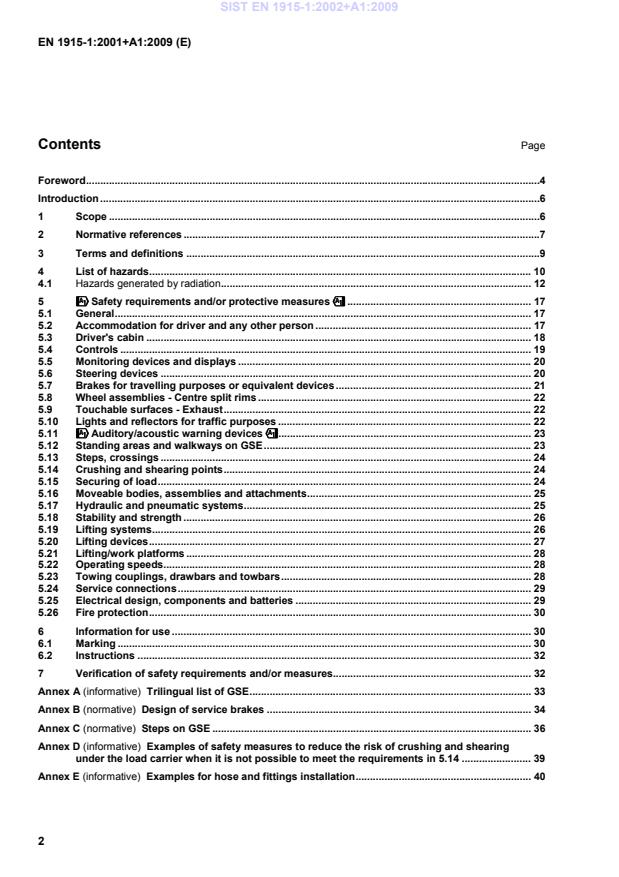
Trilingual list of GSE . 33Annex B (normative)
Design of service brakes . 34Annex C (normative)
Steps on GSE . 36Annex D (informative)
Examples of safety measures to reduce the risk of crushing and shearing under the load carrier when it is not possible to meet the requirements in 5.14 . 39Annex E (informative)
Examples for hose and fittings installation . 40SIST EN 1915-1:2002+A1:2009
!!!!Relationship between this European Standard and the Essential Requirements of EU Directive 98/37/EC"""" . 44Annex ZB (informative)
!!!!Relationship between this European Standard and the Essential Requirements of EU Directive 2006/42/EC"""" . 45Bibliography . 46 SIST EN 1915-1:2002+A1:2009
A further European Standard (EN 12312) in several parts covering specific requirements for different aircraft ground support equipment is in preparation. The parts of EN 12312 - Aircraft ground support equipment - Specific requirements are: Part 1: Passenger stairs Part 12: Potable water service equipment Part 2: Catering vehicles Part 13: Lavatory service equipment Part 3: Conveyor belt vehicles Part 14: Disabled/Incapacitated passenger
Part 4: Passenger boarding bridges
boarding equipment
Part 5: Aircraft fuelling equipment
Part 15: Baggage and equipment tractors Part 6: Deicers and deicing/antiicing equipment Part 16: Air start equipment Part 7: Aircraft movement equipment Part 17: Air conditioning equipment Part 8: Maintenance stairs and platforms Part 18: Oxygen/Nitrogen units Part 9: Container/Pallet loaders Part 19: Aircraft jacks, axle jacks and hydraulic Part 10: Container/Pallet transfer transporters
tail stanchions Part 11: Container/Pallet dollies and loose load
Part 20: Ground power equipment. Trailers SIST EN 1915-1:2002+A1:2009
According to the CEN/CENELEC Internal Regulations, the national standards organizations of the following countries are bound to implement this European Standard: Austria, Belgium, Bulgaria, Cyprus, Czech Republic, Denmark, Estonia, Finland, France, Germany, Greece, Hungary, Iceland, Ireland, Italy, Latvia, Lithuania, Luxembourg, Malta, Netherlands, Norway, Poland, Portugal, Romania, Slovakia, Slovenia, Spain, Sweden, Switzerland and United Kingdom. SIST EN 1915-1:2002+A1:2009
1 Scope This Part of EN 1915 applies to GSE when used in civil air transport as intended by the manufacturer and contains safety requirements relating to the equipment in general. SIST EN 1915-1:2002+A1:2009
EN ISO 12100-2:2003" apply. Additional terms and definitions are: 3.1 aircraft ground support equipment (GSE) mobile equipment built for the special requirements of aviation NOTE 1 The "special requirements" result from the specific design and turnaround procedure of aircraft, giving rise to designs not generally used in other areas, in particular: GSE for passenger, baggage and cargo handling; GSE for aircraft ground handling and servicing; mobile parts of passenger boarding bridges (PBB). NOTE 2 A trilingual list of GSE is given in annex A. 3.2 passenger any person other than a crew member, an employee of the carrier in an official capacity, an authorized representative of a national authority or a person accompanying a cargo consignment, who is carried aboard a flight handled by the GSE NOTE Passengers exclusively use those types of GSE specifically designed for their access to and from the aircraft. 3.3 lifting/work platform platform, cabin or workplace which is designed for lifting loads and/or persons 3.4 workplace area where operators stay during normal operation e.g. driver/co-driver seats, passageways, fixed walkways, stairs, ladders, platforms 3.5 standing area area on GSE where a person stands or works in an upright position during operation SIST EN 1915-1:2002+A1:2009
3.6 walkway area on GSE intended to be used by persons moving from one place to another 3.7 stabilizer support used to maintain and/or increase the stability and capable of supporting and/or levelling the GSE 3.8 friction-type safeguard safety equipment which restricts or prevents movement of parts in relation to each other by the use of frictional forces e.g. brakes, safety gears 3.9 instructions documents supplied by the manufacturer or supplier describing the intended use of the GSE and containing information for safe operation, installation, transport and maintenance 3.10 operational use activities, effects, processes or movements that result from intended use of the GSE 3.11 unintentional movement any movement without operator's conscious intent e.g. caused by failure of the GSE 3.12 unit load device (ULD) assembly of components comprising one of either e.g. an aircraft pallet and pallet net, an aircraft pallet, a container with integral pallet or an aircraft container 4 List of hazards This list is based on EN 1050:1996 and contains the hazards and hazardous situations, as far as they are dealt with in this European Standard, identified by risk assessment as significant for this type of machinery and which require action to eliminate or reduce risks. !See also the complementary list of hazards in the other parts of EN 1915 and in the different parts of EN 12312." SIST EN 1915-1:2002+A1:2009
Hazards identified in Annex A of EN 1050:1996
Relevant clauses in this Part of EN 1915or EN 1915-2:2001
1 Mechanical hazards due to: – machine parts or workpieces, e.g.: a) shape; b) relative location; c) mass and stability (potential energy of elements which may move under the effect of gravity); d) mass and velocity (kinetic energy of elements in controlled or uncontrolled motion); e) inadequacy of mechanical strength.
!deleted text"
EN 1915-2:20015.2, 5.3, 5.4
– accumulation of energy inside the machinery, e.g.: f) elastic elements (springs); g) liquids and gases under pressure; h) the effect of vacuum. EN 1915-2:20015.3.2
1.1 Crushing hazard 5.2, 5.3.1, 5.3.2, 5.6.1, 5.12.2, 5.14,
1.2 Shearing hazard 5.18
1.3 Cutting or severing hazard
1.4 Entanglement hazard
1.5 Drawing-in or trapping hazard
1.6 Impact hazard
1.7 Stabbing or puncture hazard
1.8 Friction or abrasion hazard
1.9 High pressure fluid injection or ejection hazard 5.6.2, 5.17
2 Electrical hazards due to:
2.1 Contact of persons with live parts (direct contact)
5.24, 5.25
2.2 Contact of persons with parts which have become live under faulty conditions (indirect contact) 5.25 (continued)
Table 1 (continued)
No corresponding to EN 1050:1996
Hazards identified in Annex A of EN 1050:1996
Relevant clauses in this Part of EN 1915
2.3 Approach to live parts under high voltage
not dealt with
2.4 Electrostatic phenomena not dealt with
2.5 Thermal radiation or other phenomena such as the projection of molten particles and chemical effect from short circuits, overloads, etc. 5.24, 5.25
3 Thermal hazards, resulting in:
3.1
Burns, scalds and other injuries by a possible contact of persons with objects or materials with an extreme high or low temperature, by flames or explosions and also by the radiation of heat sources
5.9, 5.25.3
3.2 Damage to health by hot or cold working environment
not dealt with
4 Hazards generated by noise, resulting in:
4.1 Hearing loss (deafness), other physiological disorders (e.g. loss of balance, loss of awareness)
not dealt with
4.2 Interference with speech communication, acoustic signals, etc.
Hazards generated by vibration
5.1 Use of hand-held machines resulting in a variety of neurological and vascular disorders
not dealt with
5.2 Whole body vibration, particularly when combined with poor postures
6 4.1 Hazards generated by radiation
6.1 Low frequency, radio frequency radiation, micro waves
not dealt with
6.2 Infrared, visible and ultraviolet light
6.3 X and gamma rays
6.4 Alpha, beta rays, electron or ion beams, neutrons
6.5 Lasers
(continued)
No corresponding to EN 1050:1996 Hazards identified in Annex A of EN 1050:1996
Relevant clauses in this Part of EN 1915
7 Hazards generated by materials and substances (and their constituent elements) processed or used by the machinery
7.1 Hazards from contact with or inhalation of harmful fluids, gases, mists, fumes, and dusts
5.3.2, 5.25.3
7.2 Fire or explosion hazard 5.25.3
7.3 Biological or microbiological (viral or bac-terial) hazards not dealt with
8 Hazards generated by neglecting ergonomic principles in machinery design as, e.g. hazards from:
8.1 Unhealthy postures or excessive effort
5.2, 5.6.1
8.2 Inadequate consideration of hand-arm or foot-leg anatomy 5.4.1
8.3 Neglected use of personal protection equipment not dealt with
8.4 Inadequate local lighting 5.4.1, 5.5
8.5 Mental overload and underload, stress not dealt with
8.6 Human error, human behavior 5.4.3, 6
8.7 Inadequate design, location or identification of manual controls 5.4.1
8.8 Inadequate design or location of visual display units 5.5
9 4.1.1 Combination of hazards 10 Unexpected start-up, unexpected overrun/overspeed (or any similar malfunction) from: 10.1 Failure/disorder of the control system
5.4, 5.25.1 10.2 Restoration of energy supply after an interruption 5.25.1 10.3 External influences on electrical equipment not dealt with 10.4 Other external influences (gravity, wind, etc.) 5.18 10.5 Errors in the software not dealt with (continued) SIST EN 1915-1:2002+A1:2009
Relevant clauses in this Part of EN 1915 10.6 Errors made by the operator (due to mismatch of machinery with human characteristics and abilities, see 8.6)
5.4.3, 6 11 Impossibility of stopping the machine in the best possible conditions 5.4 12 Variations in the rotational speed of tools not dealt with 13 Failure of the power supply 5.25.1 14 Failure of the control circuit 5.4.5.1 15 Errors of fitting 5.24 16 Break-up during operation 5.8, 5.16.2 17 Falling or ejected objects or fluids 5.8, 5.17 18 Loss of stability/overturning of machinery 5.18 19 Slip, trip and fall of persons (related to machinery) 5.12, 5.13 Additional hazards, hazardous situations and hazardous events due to mobility 20 Relating to the travelling function 20.1 Movement when starting the engine
not dealt with 20.2 Movement without a driver at the driving position 5.4.5, 5.7.2, 5.22.1 20.3 Movement without all parts in a safe posi-tion 5.22.1 20.4 Excessive speed of pedestrian controlled machinery 5.22.1 20.5 Excessive oscillations when moving not dealt with 20.6 Insufficient ability of machinery to be slowed down, stopped and immobilised 5.4.5, 5.7, 5.24 21 Linked to the work position (including driving station) on the machine 21.1 Fall of persons during access to (or at/from) the work position
5.12, 5.13 21.2 Exhaust gases/lack of oxygen at the work position 5.3.2 (continued)
Relevant clauses in this Part of EN 1915 21.3 Fire (flammability of the cab, lack of extinguishing means)
5.3.1, 5.26 21.4 Mechanical hazards at the work position: a) contact with the wheels; b) rollover; c) fall of objects, penetration by objects; d) break-up of parts rotating at high speed; e) contact of persons with machine parts or tools (pedestrian controlled machines).
5.4.4 5.4.4 5.4.4, 5.15, 5.16 5.4.4 5.6.3 21.5 Insufficient visibility from the work positions 5.3.1, 5.5 21.6 Inadequate lighting
5.3.1, 5.10.1, 5.10.3 21.7 Inadequate seating 5.2.1, 5.2.3 21.8 Noise at the work position not dealt with 21.9 Vibration at the work position not dealt with 21.10 Insufficient means for evacuation/emergency exit 5.19.3 22 Due to the control system 22.1 Inadequate location of manual controls
5.4.1, 5.4.4 22.2 Inadequate design of manual controls and their mode of operation 5.4.1, 5.4.5 23 From handling the machine (lack of stability) 5.18 24 Due to the power source and to the transmission of power 24.1 Hazards from the engine and the batteries
5.25 24.2 Hazards from transmission of power between machines not dealt with 24.3 Hazards from coupling and towing 5.23 25 From/to third persons 25.1 Unauthorised start-up/use
5.4.2 25.2 Drift of a part away from its stopping position 5.7.2, 5.16, 5.23 25.3 Lack or inadequacy of visual or acoustic warning means 5.4.5.2, 5.10.2, 5.10.3, 5.11 (continued)
Table 1 (continued)
No corresponding to EN 1050:1996
Hazards identified in Annex A of EN 1050:1996
Relevant clauses in this Part of EN 1915 26 Insufficient instructions for the driver/operator
6 Additional hazards, hazardous situations and hazardous events due to lifting 27 Mechanical hazards and hazardous events 27.1 from load falls, collisions, machine tipping caused by: 27.1.1 lack of stability
5.18, 5.21.1, 5.22 27.1.2 uncontrolled loading – overloading – overturning moments exceeded 5.22 27.1.3 uncontrolled amplitude of movements 5.16.1, 5.16.3, 5.21 27.1.4 unexpected/unintended movement of loads 5.15 27.1.5 inadequate holding devices/accessories
5.16.1, 5.19.1, 5.19.2 27.1.6 collision of more than one machine not dealt with 27.2 from access of persons to load support not dealt with 27.3 from derailment not dealt with 27.4 from insufficient mechanical strength of parts 5.18, 5.19.1, 5.21 27.5 from inadequate design of pulleys, drums 5.19, 5.20.2, 5.20.3 27.6 from inadequate selection of chains, ropes, lifting and accessories and their inadequate integration into the machine 5.19, 5.20.2, 5.20.3 27.7 from lowering of the load under the control of friction brake 5.16.3 27.8 from abnormal conditions of assembly/testing/ use/maintenance 5.19.2 27.9 from the effect of load on persons (impact by load or counterweight) not dealt with 28 Electrical hazards 28.1 from lightning
not dealt with 29 Hazards generated by neglecting ergonomic principles 29.1 insufficient visibility from the driving posi-tion
not dealt with (continued)
Table 1 (concluded)
No corresponding to EN 1050:1996
Hazards identified in Annex A of EN 1050:1996
Relevant clauses in this Part of
EN 1915 Additional hazards, hazardous situations and hazardous events due to the lifting or moving of persons 34 Mechanical hazards and hazardous events due to: 34.1 Inadequate mechanical strength – inad-equate working coefficients
5.18 34.2 Failing of loading control
not dealt with 34.3 Failing of controls in person carrier (func-tion, priority) not dealt with 34.4 Overspeed of person carrier 5.22 35 Falling of person from person carrier 5.12 36 Falling or overturning of person carrier 5.18 37 Human error, human behaviour 5.4, 5.5, 6
5 !!!!Safety requirements and/or protective measures"""" 5.1 General !GSE shall comply with the safety requirements and/or protective measures of this clause, with the requirements of EN 1915-2, EN 1915-3 and EN 1915-4 as relevant, as well as with the requirements of the relevant part of EN 12312. In addition, the machine shall be designed according to the principles of
EN ISO 12100 for relevant but not significant hazards, which are not dealt with by this document." For the application of EN 954-1, EN 953, EN 982 and EN 983, the manufacturer shall carry out an adequate risk assessment for the requirements thereof where choice is necessary and that are not dealt with in the part of EN 12312 series for specific type of GSE. NOTE This specific risk assessment is part of the general risk assessment relating to the hazards not covered by this C standard. 5.2 Accommodation for driver and any other person 5.2.1 General requirements Accommodation for driver and any other person shall have adequate space. Corners and edges in the working area shall be avoided by design or cushioned by covers. SIST EN 1915-1:2002+A1:2009
...
Questions, Comments and Discussion
Ask us and Technical Secretary will try to provide an answer. You can facilitate discussion about the standard in here.
Loading comments...