

EN 14332:2004
(Main)Foodstuffs - Determination of trace elements - Determination of arsenic in seafood by graphite furnace atomic absorption spectrometry (GFAAS) after microwave digestion
- Abstract
This document specifies a method for the determination of arsenic in seafood by graphite furnace atomic absorption spectrometry (GFAAS) after microwave digestion [1], [2]. The collaborative study has included food having an arsenic content ³ 2 mg/kg dry matter.
Specific foodstuffs for which European Standards exist are excluded from the scope of this horizontal document. It is the task of the analyst to review if vertical documents exist.
- Status
- Published
- Publication Date
- 13-Jul-2004
- Withdrawal Date
- 30-Jan-2005
- Technical Committee
- CEN/TC 275 - Food analysis - Horizontal methods
- Drafting Committee
- CEN/TC 275/WG 10 - Trace elements (heavy metals)
- Current Stage
- 9093 - Decision to confirm - Review Enquiry
- Start Date
- 05-Mar-2025
- Completion Date
- 07-Oct-2026


Overview
EN 14332:2004 (CEN) specifies a laboratory method for determination of arsenic in seafood using graphite furnace atomic absorption spectrometry (GFAAS) after microwave digestion of samples. This horizontal standard targets trace element analysis in marine-origin foodstuffs and was validated in a collaborative study that included foods with arsenic content ≥ 2 mg/kg dry matter. The document excludes specific foodstuffs for which dedicated European (vertical) standards already exist - analysts must check for any applicable vertical standards before applying this method.
Keywords: EN 14332:2004, arsenic in seafood, GFAAS, microwave digestion, trace elements, foodstuffs, CEN.
Key Topics
- Scope and applicability: Method intended for arsenic determination in seafood and related marine products; not applicable where specific European standards exist for particular food types.
- Sample preparation: Emphasizes microwave digestion as the sample decomposition step prior to instrumental analysis (no procedural parameters are invented here; consult the standard for detailed digestion conditions).
- Analytical technique: Use of graphite furnace atomic absorption spectrometry (GFAAS) for sensitive measurement of arsenic at trace levels.
- Performance validation: Method performance verified by collaborative study; demonstrated applicability for samples with arsenic ≥ 2 mg/kg dry matter.
- Analyst responsibilities: Users must confirm whether vertical (product-specific) standards apply and ensure laboratory competence for trace element analysis.
Keywords: microwave digestion, GFAAS, trace arsenic, collaborative study, sample digestion.
Applications
This standard is practical for laboratories and organizations involved in:
- Food safety testing and regulatory compliance for seafood arsenic levels.
- Quality control at seafood processors and distributors.
- Public health monitoring and exposure assessment related to arsenic in marine foods.
- Research and surveillance studies measuring trace elements in fish, shellfish, and other marine products.
- Environmental and fisheries laboratories requiring validated methods for arsenic in biota.
Typical users: food testing laboratories, national reference labs, regulatory agencies, seafood industry QC teams, academic researchers.
Keywords: seafood testing, food safety labs, arsenic monitoring, quality control.
Related Standards
- The standard is a horizontal document; specific European (vertical) standards for particular seafood products may take precedence. Analysts should review current CEN and national lists to identify any product-specific methods or more stringent requirements before applying EN 14332:2004.
Keywords: CEN, European Standards, vertical documents, trace element standards.
Relations
- Effective Date
- 28-Jan-2026
- Effective Date
- 28-Jan-2026
- Effective Date
- 09-Feb-2026
- Effective Date
- 09-Feb-2026
Get Certified
Connect with accredited certification bodies for this standard

BSI Group
BSI (British Standards Institution) is the business standards company that helps organizations make excellence a habit.

Bureau Veritas
Bureau Veritas is a world leader in laboratory testing, inspection and certification services.

DNV
DNV is an independent assurance and risk management provider.
Sponsored listings
Frequently Asked Questions
EN 14332:2004 is a standard published by the European Committee for Standardization (CEN). Its full title is "Foodstuffs - Determination of trace elements - Determination of arsenic in seafood by graphite furnace atomic absorption spectrometry (GFAAS) after microwave digestion". This standard covers: This document specifies a method for the determination of arsenic in seafood by graphite furnace atomic absorption spectrometry (GFAAS) after microwave digestion [1], [2]. The collaborative study has included food having an arsenic content ³ 2 mg/kg dry matter. Specific foodstuffs for which European Standards exist are excluded from the scope of this horizontal document. It is the task of the analyst to review if vertical documents exist.
This document specifies a method for the determination of arsenic in seafood by graphite furnace atomic absorption spectrometry (GFAAS) after microwave digestion [1], [2]. The collaborative study has included food having an arsenic content ³ 2 mg/kg dry matter. Specific foodstuffs for which European Standards exist are excluded from the scope of this horizontal document. It is the task of the analyst to review if vertical documents exist.
EN 14332:2004 is classified under the following ICS (International Classification for Standards) categories: 67.120.30 - Fish and fishery products. The ICS classification helps identify the subject area and facilitates finding related standards.
EN 14332:2004 has the following relationships with other standards: It is inter standard links to EN 13804:2013, EN 13805:2014, EN 61918:2008, EN 50174-2:2009. Understanding these relationships helps ensure you are using the most current and applicable version of the standard.
EN 14332:2004 is available in PDF format for immediate download after purchase. The document can be added to your cart and obtained through the secure checkout process. Digital delivery ensures instant access to the complete standard document.
Standards Content (Sample)
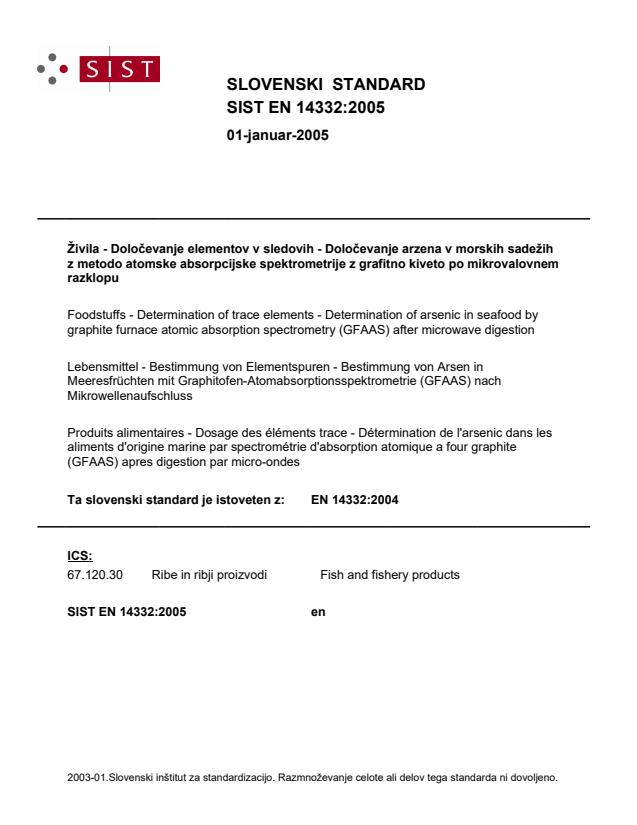
2003-01.Slovenski inštitut za standardizacijo. Razmnoževanje celote ali delov tega standarda ni dovoljeno.UD]NORSXLebensmittel - Bestimmung von Elementspuren - Bestimmung von Arsen in Meeresfrüchten mit Graphitofen-Atomabsorptionsspektrometrie (GFAAS) nach MikrowellenaufschlussProduits alimentaires - Dosage des éléments trace - Détermination de l'arsenic dans les aliments d'origine marine par spectrométrie d'absorption atomique a four graphite (GFAAS) apres digestion par micro-ondesFoodstuffs - Determination of trace elements - Determination of arsenic
...