

EN ISO 16321-3:2022/A1:2026
(Amendment)Eye and face protection for occupational use - Part 3: Additional requirements for mesh protectors - Amendment 1 (ISO 16321-3:2021/Amd 1:2025)
- Status
- Published
- Publication Date
- 09-Jun-2026
- Technical Committee
- CEN/TC 85 - Eye-protective equipment
- Drafting Committee
- CEN/TC 85 - Eye-protective equipment
- Current Stage
- 6060 - Definitive text made available (DAV) - Publishing
- Start Date
- 10-Jun-2026
- Completion Date
- 10-Jun-2026
- Directive
- 2016/425 - Regulation (EU) 2016/425 of the European Parliament and of the Council of 9 March 2016 on personal protective equipment and repealing Council Directive 89/686/EECOJ Ref: 2026/1971 OJ Date: 04-Sep-2026

EN ISO 16321-3:2022/A1:2026 is a CEN amendment to the European adoption of ISO 16321-3 for eye and face protection for occupational use. It updates the mesh-protector requirement in clause 4.3, which is the part that checks the number of apertures in mesh face shields, goggles and mesh spectacles. Manufacturers, test laboratories, conformity assessment bodies and buyers use it when specifying or checking mesh eye and face protection.
What does EN ISO 16321-3:2022/A1:2026 specify?
EN ISO 16321-3:2022/A1:2026 specifies a targeted change to Part 3 of the eye and face protection series. The amendment replaces the first paragraph of clause 4.3, so users apply the revised aperture-count requirement instead of the earlier wording.
The document is therefore short and focused. Its practical job is to refine how mesh protectors are judged during testing, rather than to restate the whole of Part 3.
What are the key requirements of EN ISO 16321-3:2022/A1:2026?
EN ISO 16321-3:2022/A1:2026 changes the way the number of apertures in mesh protectors is verified. The key point is that the requirement now distinguishes between product types and ties the check to a named test method.
- Clause 4.3 is the only technical point changed by the amendment. In practice, users should read the revised paragraph as replacing the earlier aperture-count rule.
- Mesh face shields and goggles are treated together in the amended text. For these products, the test counts whole apertures within a square aperture over a defined mesh area, so laboratories need a consistent counting window and sample size.
- Mesh spectacles are treated separately from mesh face shields and goggles. This matters because the standard applies a different aperture-count condition to spectacles, so product classification affects acceptance.
- The amendment uses ISO 18526-3:2020, 11.1 as the test reference. That means the aperture check is not improvised by the tester - the counting is linked to a specific laboratory method.
- The requirement is about the number of whole apertures per unit area of mesh. In practice, manufacturers need to control the mesh pattern, and buyers need to specify the correct product type before testing starts.
- The wording in the amendment is procedural as well as technical. It tells the reader what to count, how to sample the mesh, and which test clause to follow.
- Because the same clause now separates product groups, quality teams should make sure drawings, product descriptions and test reports identify whether the item is a mesh face shield, goggle or spectacle.
What terms does EN ISO 16321-3:2022/A1:2026 define?
EN ISO 16321-3:2022/A1:2026 uses a small set of product and test terms that matter for applying clause 4.3.
- Mesh protectors - eye and face protectors made from a mesh structure that is assessed by aperture count.
- Mesh face shields - mesh protectors intended to cover the face, with the amended requirement grouped together with goggles.
- Goggles - close-fitting eye and face protection covered by the same aperture-count rule as mesh face shields.
- Mesh spectacles - spectacle-style mesh protectors with their own aperture-count condition in the amended clause.
- Square aperture - the square counting area used during testing to assess the mesh openings.
- Whole apertures - complete mesh openings that are counted within the test area.
- ISO 18526-3:2020, 11.1 - the referenced test clause used to perform the aperture-number check.
Who uses EN ISO 16321-3:2022/A1:2026?
EN ISO 16321-3:2022/A1:2026 is used by people who design, test, approve or buy occupational eye and face protection. That includes manufacturers of mesh protectors, test and certification laboratories, quality managers, and purchasing teams.
It is also relevant to occupational safety specialists and PPE reviewers who need to specify the right product type and the right test method. In practice, they use it to confirm that mesh face shields, goggles and spectacles are checked against the same revised framework in clause 4.3.
What changed in EN ISO 16321-3:2022/A1:2026 from the previous edition?
EN ISO 16321-3:2022/A1:2026 replaces the specification of the number of apertures in mesh protectors in clause 4.3. The amendment introduces separate wording for mesh face shields and goggles on one side, and mesh spectacles on the other, with the test linked to ISO 18526-3:2020, 11.1.
Which standards are used with EN ISO 16321-3:2022/A1:2026?
The amendment names ISO 18526-3:2020, 11.1 as the test reference for checking the number of apertures in mesh protectors. That standard contributes the laboratory method used to carry out the aperture-count test.
EN ISO 16321-3:2022 is the Part 3 document being amended here. In practice, users read this amendment together with the base Part 3 requirement it updates.
What does the EN ISO 16321-3:2022/A1:2026 document contain?
EN ISO 16321-3:2022/A1:2026 contains the amendment notice and the replacement text for clause 4.3. The operative content is a revised paragraph that separates mesh face shields and goggles from mesh spectacles and directs the reader to ISO 18526-3:2020, 11.1 for testing.
The document is used for product specification, laboratory verification and conformity assessment. Its purpose is to make the aperture-count check for mesh protectors clearer and product-specific.
Relations
- Effective Date
- 12-Feb-2026
- Effective Date
- 30-Oct-2024
Get Certified
Connect with accredited certification bodies for this standard

CIS Institut d.o.o.
Personal Protective Equipment (PPE) certification body. Notified Body NB-2890 for EU Regulation 2016/425 PPE.

Kiwa BDA Testing
Building and construction product certification.
Kmetijski inštitut Slovenije
Agricultural Institute of Slovenia. Soil testing, plant health, agricultural product analysis.
Sponsored listings
Frequently Asked Questions
EN ISO 16321-3:2022/A1:2026 is a amendment published by the European Committee for Standardization (CEN). Its full title is "Eye and face protection for occupational use - Part 3: Additional requirements for mesh protectors - Amendment 1 (ISO 16321-3:2021/Amd 1:2025)". This standard covers: Eye and face protection for occupational use - Part 3: Additional requirements for mesh protectors - Amendment 1 (ISO 16321-3:2021/Amd 1:2025)
Eye and face protection for occupational use - Part 3: Additional requirements for mesh protectors - Amendment 1 (ISO 16321-3:2021/Amd 1:2025)
EN ISO 16321-3:2022/A1:2026 is classified under the following ICS (International Classification for Standards) categories: 13.340.20 - Head protective equipment. The ICS classification helps identify the subject area and facilitates finding related standards.
EN ISO 16321-3:2022/A1:2026 has the following relationships with other standards: It is inter standard links to ISO 16321-3:2021/Amd 1:2025, EN ISO 16321-3:2022. Understanding these relationships helps ensure you are using the most current and applicable version of the standard.
EN ISO 16321-3:2022/A1:2026 is associated with the following European legislation: EU Directives/Regulations: 2016/425; Standardization Mandates: M/571, M/571 Amd 1. When a standard is cited in the Official Journal of the European Union, products manufactured in conformity with it benefit from a presumption of conformity with the essential requirements of the corresponding EU directive or regulation.
EN ISO 16321-3:2022/A1:2026 is available in PDF format for immediate download after purchase. The document can be added to your cart and obtained through the secure checkout process. Digital delivery ensures instant access to the complete standard document.
Standards Content (Sample)
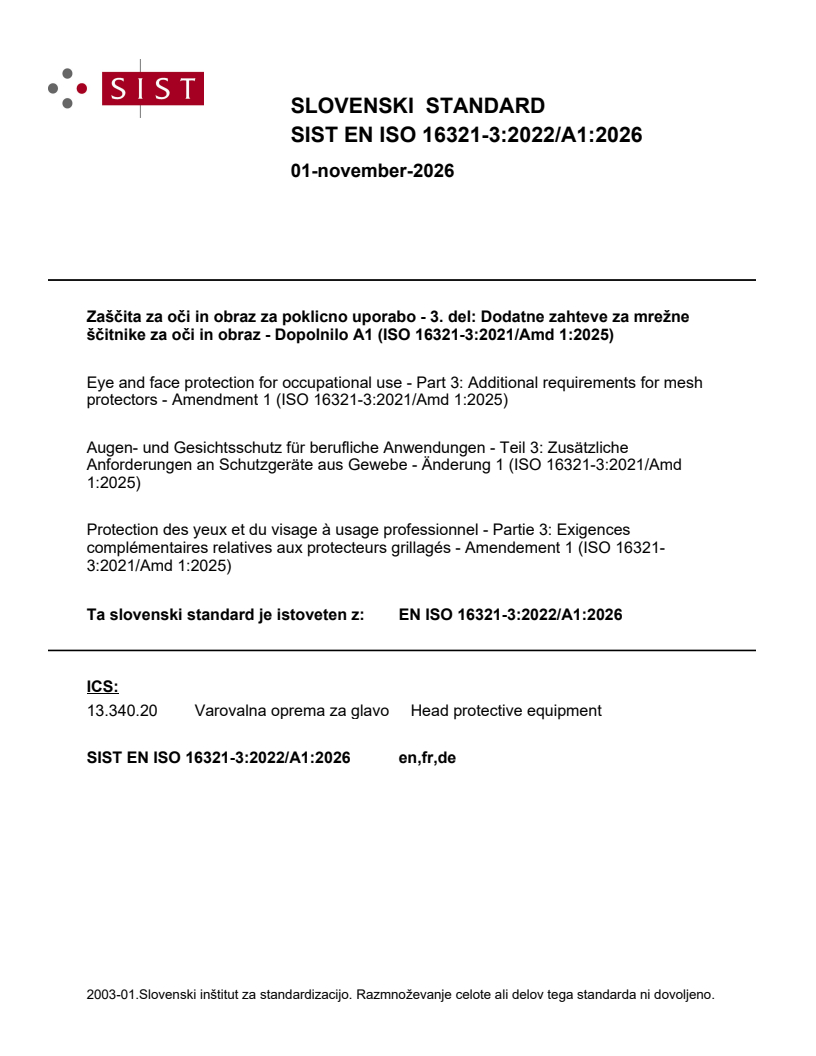
SLOVENSKI STANDARD
01-november-2026
Zaščita za oči in obraz za poklicno uporabo - 3. del: Dodatne zahteve za mrežne
ščitnike za oči in obraz - Dopolnilo A1 (ISO 16321-3:2021/Amd 1:2025)
Eye and face protection for occupational use - Part 3: Additional requirements for mesh
protectors - Amendment 1 (ISO 16321-3:2021/Amd 1:2025)
Augen- und Gesichtsschutz für berufliche Anwendungen - Teil 3: Zusätzliche
Anforderungen an Schutzgeräte aus Gewebe - Änderung 1 (ISO 16321-3:2021/Amd
1:2025)
Protection des yeux et du visage à usage professionnel - Partie 3: Exigences
complémentaires relatives aux protecteurs grillagés - Amendement 1 (ISO 16321-
3:2021/Amd 1:2025)
Ta slovenski standard je istoveten z: EN ISO 16321-3:2022/A1:2026
ICS:
13.340.20 Varovalna oprema za glavo Head protective equipment
2003-01.Slovenski inštitut za standardizacijo. Razmnoževanje celote ali delov tega standarda ni dovoljeno.
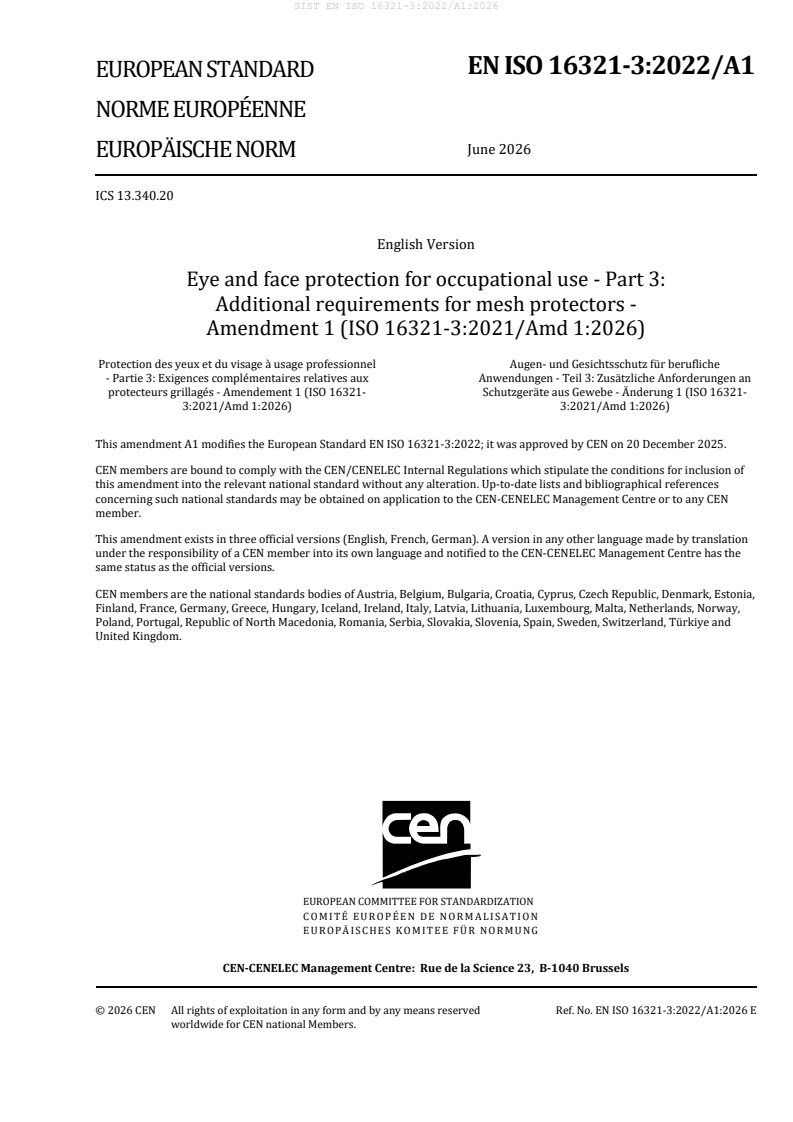
EN ISO 16321-3:2022/A1
EUROPEAN STANDARD
NORME EUROPÉENNE
June 2026
EUROPÄISCHE NORM
ICS 13.340.20
English Version
Eye and face protection for occupational use - Part 3:
Additional requirements for mesh protectors -
Amendment 1 (ISO 16321-3:2021/Amd 1:2026)
Protection des yeux et du visage à usage professionnel Augen- und Gesichtsschutz für berufliche
- Partie 3: Exigences complémentaires relatives aux Anwendungen - Teil 3: Zusätzliche Anforderungen an
protecteurs grillagés - Amendement 1 (ISO 16321- Schutzgeräte aus Gewebe - Änderung 1 (ISO 16321-
3:2021/Amd 1:2026) 3:2021/Amd 1:2026)
This amendment A1 modifies the European Standard EN ISO 16321-3:2022; it was approved by CEN on 20 December 2025.
CEN members are bound to comply with the CEN/CENELEC Internal Regulations which stipulate the conditions for inclusion of
this amendment into the relevant national standard without any alteration. Up-to-date lists and bibliographical references
concerning such national standards may be obtained on application to the CEN-CENELEC Management Centre or to any CEN
member.
This amendment exists in three official versions (English, French, German). A version in any other language made by translation
under the responsibility of a CEN member into its own language and notified to the CEN-CENELEC Management Centre has the
same status as the official versions.
CEN members are the national standards bodies of Austria, Belgium, Bulgaria, Croatia, Cyprus, Czech Republic, Denmark, Estonia,
Finland, France, Germany, Greece, Hungary, Iceland, Ireland, Italy, Latvia, Lithuania, Luxembourg, Malta, Netherlands, Norway,
Poland, Portugal, Republic of North Macedonia, Romania, Serbia, Slovakia, Slovenia, Spain, Sweden, Switzerland, Türkiye and
United Kingdom.
EUROPEAN COMMITTEE FOR STANDARDIZATION
COMITÉ EUROPÉEN DE NORMALISATION
EUROPÄISCHES KOMITEE FÜR NORMUNG
CEN-CENELEC Management Centre: Rue de la Science 23, B-1040 Brussels
© 2026 CEN All rights of exploitation in any form and by any means reserved Ref. No. EN ISO 16321-3:2022/A1:2026 E
worldwide for CEN national Members.
Contents Page
European foreword . 3
European foreword
This document (EN ISO 16321-3:2022/A1:2026) has been prepared by Technical Committee ISO/TC 94
"Personal safety -- Personal protective equipment" in collaboration with Technical Committee CEN/TC
85 “Eye protective equipment” the secretariat of which is held by AFNOR.
This Amendment to the European Standard EN ISO 16321-3:2022 shall be given the status of a national
standard, either by publication of an identical text or by endorsement, at the latest by December 2026,
and conflicting national standards shall be withdrawn at the latest by December 2026.
Attention is drawn to the possibility that some of the elements of this document may be the subject of
patent rights. CEN shall not be held responsible for identifying any or all such patent rights.
This document has been prepared under a standardization request addressed to CEN by the European
Commission. The Standing Committee of the EFTA States subsequently approves these requests for its
Member States.
Any feedback and questions on this document should be directed to the users’ national standards
body/national committee. A complete listing of these bodies can be found on the CEN website.
According to the CEN-CENELEC Internal Regulations, the national standards organizations of the
following countries are bound to implement this European Standard: Austria, Belgium, Bulgaria,
Croatia, Cyprus, Czech Republic, Denmark, Estonia, Finland, France, Germany, Greece, Hungary, Iceland,
Ireland, Italy, Latvia, Lithuania, Luxembourg, Malta, Netherlands, Norway, Poland, Portugal, Republic of
North Macedonia, Romania, Serbia, Slovakia, Slovenia, Spain, Sweden, Switzerland, Türkiye and the
United Kingdom.
Endo
...