


CEN/TS 17489-1:2020
(Main)Personal identification - Secure and interoperable European Breeder Documents - Part 1: Framework overview
Personal identification - Secure and interoperable European Breeder Documents - Part 1: Framework overview
This document provides an overview of a framework on breeder documents. It introduces the document structure of CEN/TS 17489 (all parts) that specifies how citizens retain the control of breeder document data and how they can use them to support identity proofing and verification. Moreover, the framework provides methodologies to assess and increase the level of trust in breeder documents.
This framework specifies methods for:
- defining physical and logical/digital representations of a secure breeder document (hardware based, paper-based, server-based),
- securing breeder document processes,
- linking the document to its legitimate holder.
The following types of breeder documents are in the scope of the framework:
- birth certificates,
- marriage and partnership certificates,
- death certificates.
The following breeder documents management processes including first-time application, later-in-life registration of an identity, and content update (e.g. name-changing) are in the scope of this framework:
- registration,
- issuance,
- renewal,
- inspection/verification,
- revocation.
The specification of policies is out of scope.
Personenidentifikation - Sichere und interoperable europäische Ausgangsdokumente - Teil 1: Grundstruktur
Dieses Dokument enthält einen Überblick über ein Rahmenwerk für Ausgangsdokumente. Es stellt die Dokumentenstruktur von CEN/TS 17489 (alle Teile) vor, worin festgelegt wird, wie Bürger die Kontrolle über Ausgangsdokumentdaten erhalten und wie sie diese zur Unterstützung des Identitätsnachweises und zur Verifizierung verwenden können. Darüber hinaus stellt das Rahmenwerk Methoden bereit, um die Vertrauensstufe von Ausgangsdokumenten zu bewerten und zu verbessern.
Dieses Rahmenwerk legt Methoden fest für:
die Definition von physischen und logischen/digitalen Darstellungen eines sicheren Ausgangsdokuments (Hardware-basiert, papierbasiert, Server-basiert),
die Absicherung von Ausgangsdokumentverfahren,
die Verknüpfung des Dokuments mit seinem rechtmäßigen Inhaber.
Zum Anwendungsbereich des Rahmenwerks gehören die folgenden Arten von Ausgangsdokumenten:
Geburtsurkunden,
Heirats und Lebenspartnerschaftsurkunden,
Sterbeurkunden.
Zum Anwendungsbereich dieses Rahmenwerks gehören die folgenden Managementverfahren für Ausgangs¬dokumente, einschließlich erstmaliger Beantragung, Registrierung einer Identität zu einem späteren Lebenszeitpunkt und Aktualisierung des Inhalts (beispielsweise Änderung des Namens):
Registrierung,
Ausstellung,
Erneuerung,
Prüfung/Verifizierung,
Widerruf.
Die Festlegung von Leitlinien liegt außerhalb des Anwendungsbereichs.
Identification personnelle - Documents sources Européens sécurisés et interopérables - Partie 1 : Structure générale
Osebna identifikacija - Varni in interoperabilni evropski izvorni dokumenti - 1. del: Splošna struktura
General Information
- Status
- Published
- Publication Date
- 18-Aug-2020
- Drafting Committee
- CEN/TC 224/WG 19 - Breeder Documents
- Current Stage
- 9060 - Closure of 2 Year Review Enquiry - Review Enquiry
- Start Date
- 03-Mar-2024
- Completion Date
- 03-Mar-2024
Overview
CEN/TS 17489-1:2020 - Personal identification - Secure and interoperable European Breeder Documents - Part 1: Framework overview - defines a high‑level framework for creating secure, interoperable breeder documents (birth, marriage/partnership, death certificates). The Technical Specification describes how citizens retain control of breeder document data, how breeder documents support identity proofing and verification, and methods to assess and raise trust in these documents. The document covers physical and logical/digital representations (hardware‑based, paper‑based, server‑based), process security, and linking documents to legitimate holders. Policy specification is explicitly out of scope.
Key Topics
- Framework scope and structure: Part 1 provides the overall framework and references Parts 2–5 (data model, basic technologies, certificate profiles, trust establishment/processes).
- Document representations: Methods for defining secure physical and digital breeder documents, including options for machine‑readable and electronic seals (e.g., CES/VES concepts referenced).
- Lifecycle processes: Registration, issuance, renewal, inspection/verification and revocation of breeder documents, including first‑time and later‑in‑life registrations (e.g., name changes).
- Trust & verification: Methodologies to assess and increase confidence in breeder documents and to link documents to legitimate holders for identity proofing.
- Design principles: Emphasis on extensibility and interoperability to support future breeder document types and integration into identity management (IdM) ecosystems.
- Terminology and references: Uses ISO/IEC terms where applicable and aligns with international interoperability efforts.
Applications
- Civil registries and municipal authorities: Standardize breeder document issuance and machine‑readable formats to reduce manual entry and translation errors.
- Passport and travel document offices: Improve identity proofing inputs for travel document issuance to reduce fraud stemming from compromised breeder documents.
- Identity management and eID system designers: Integrate breeder documents in secure IdM workflows and automated verification services.
- Vendor and integrators: Implement hardware tokens, server APIs, visual/electronic seals, and verification tools that comply with the framework.
- Verification services and border control: Use standardized data sets and digital verification to speed up and harden inspection processes.
Who should use this standard
- National standards bodies, civil registry operators, ministries of interior, passport authorities, identity solution vendors, system integrators, and organizations designing secure document issuance and verification workflows.
Related standards
- ICAO Doc 9303 (machine‑readable travel documents), ICCS conventions, ISO/IEC terminology (e.g., ISO/IEC 24760‑1), and relevant EU initiatives on travel document fraud prevention.
CEN/TS 17489‑1:2020 is a foundational reference for secure, interoperable breeder documents in Europe, enabling improved identity proofing, reduced fraud risk, and better citizen control of personal identity data.

Frequently Asked Questions
CEN/TS 17489-1:2020 is a technical specification published by the European Committee for Standardization (CEN). Its full title is "Personal identification - Secure and interoperable European Breeder Documents - Part 1: Framework overview". This standard covers: This document provides an overview of a framework on breeder documents. It introduces the document structure of CEN/TS 17489 (all parts) that specifies how citizens retain the control of breeder document data and how they can use them to support identity proofing and verification. Moreover, the framework provides methodologies to assess and increase the level of trust in breeder documents. This framework specifies methods for: - defining physical and logical/digital representations of a secure breeder document (hardware based, paper-based, server-based), - securing breeder document processes, - linking the document to its legitimate holder. The following types of breeder documents are in the scope of the framework: - birth certificates, - marriage and partnership certificates, - death certificates. The following breeder documents management processes including first-time application, later-in-life registration of an identity, and content update (e.g. name-changing) are in the scope of this framework: - registration, - issuance, - renewal, - inspection/verification, - revocation. The specification of policies is out of scope.
This document provides an overview of a framework on breeder documents. It introduces the document structure of CEN/TS 17489 (all parts) that specifies how citizens retain the control of breeder document data and how they can use them to support identity proofing and verification. Moreover, the framework provides methodologies to assess and increase the level of trust in breeder documents. This framework specifies methods for: - defining physical and logical/digital representations of a secure breeder document (hardware based, paper-based, server-based), - securing breeder document processes, - linking the document to its legitimate holder. The following types of breeder documents are in the scope of the framework: - birth certificates, - marriage and partnership certificates, - death certificates. The following breeder documents management processes including first-time application, later-in-life registration of an identity, and content update (e.g. name-changing) are in the scope of this framework: - registration, - issuance, - renewal, - inspection/verification, - revocation. The specification of policies is out of scope.
CEN/TS 17489-1:2020 is classified under the following ICS (International Classification for Standards) categories: 35.240.15 - Identification cards. Chip cards. Biometrics. The ICS classification helps identify the subject area and facilitates finding related standards.
You can purchase CEN/TS 17489-1:2020 directly from iTeh Standards. The document is available in PDF format and is delivered instantly after payment. Add the standard to your cart and complete the secure checkout process. iTeh Standards is an authorized distributor of CEN standards.
Standards Content (Sample)
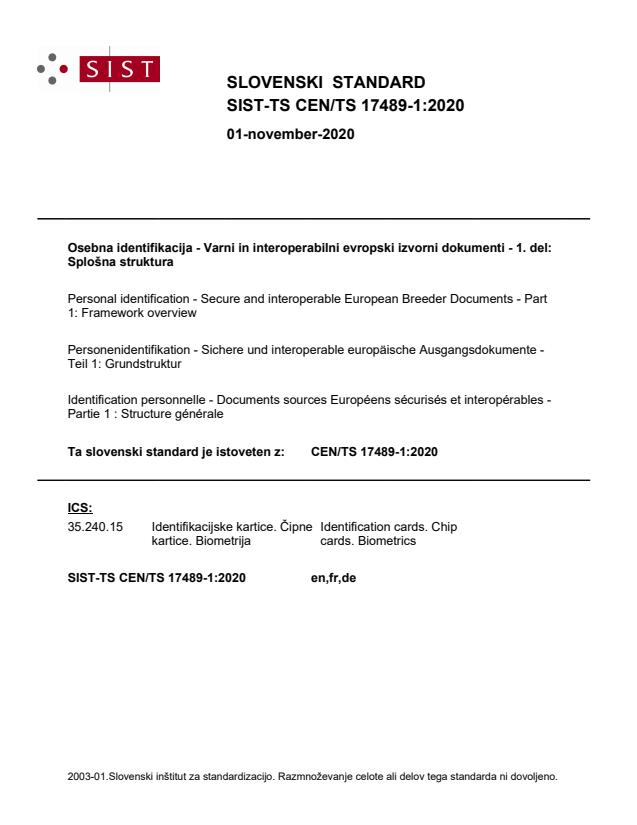
SLOVENSKI STANDARD
01-november-2020
Osebna identifikacija - Varni in interoperabilni evropski izvorni dokumenti - 1. del:
Splošna struktura
Personal identification - Secure and interoperable European Breeder Documents - Part
1: Framework overview
Personenidentifikation - Sichere und interoperable europäische Ausgangsdokumente -
Teil 1: Grundstruktur
Identification personnelle - Documents sources Européens sécurisés et interopérables -
Partie 1 : Structure générale
Ta slovenski standard je istoveten z: CEN/TS 17489-1:2020
ICS:
35.240.15 Identifikacijske kartice. Čipne Identification cards. Chip
kartice. Biometrija cards. Biometrics
2003-01.Slovenski inštitut za standardizacijo. Razmnoževanje celote ali delov tega standarda ni dovoljeno.
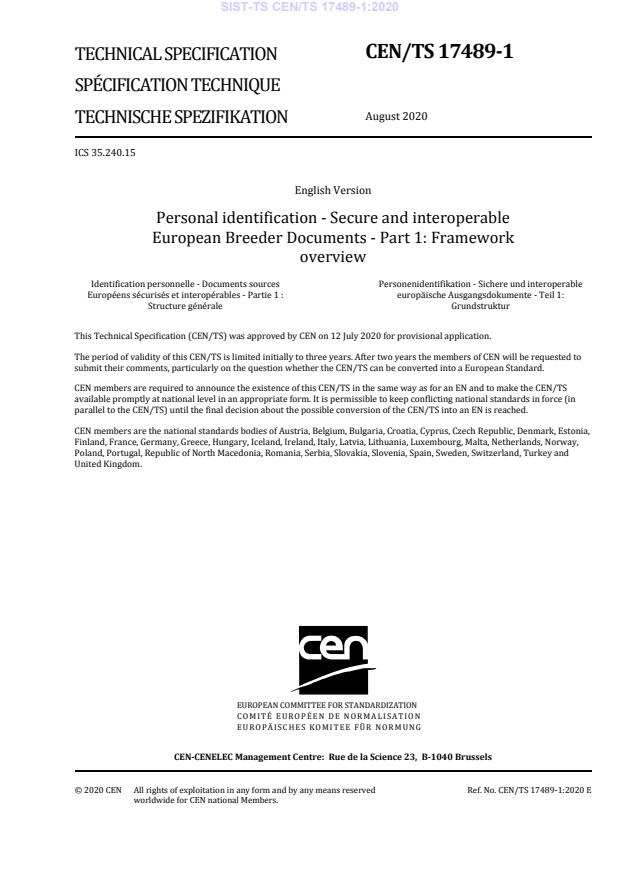
CEN/TS 17489-1
TECHNICAL SPECIFICATION
SPÉCIFICATION TECHNIQUE
August 2020
TECHNISCHE SPEZIFIKATION
ICS 35.240.15
English Version
Personal identification - Secure and interoperable
European Breeder Documents - Part 1: Framework
overview
Identification personnelle - Documents sources Personenidentifikation - Sichere und interoperable
Européens sécurisés et interopérables - Partie 1 : europäische Ausgangsdokumente - Teil 1:
Structure générale Grundstruktur
This Technical Specification (CEN/TS) was approved by CEN on 12 July 2020 for provisional application.
The period of validity of this CEN/TS is limited initially to three years. After two years the members of CEN will be requested to
submit their comments, particularly on the question whether the CEN/TS can be converted into a European Standard.
CEN members are required to announce the existence of this CEN/TS in the same way as for an EN and to make the CEN/TS
available promptly at national level in an appropriate form. It is permissible to keep conflicting national standards in force (in
parallel to the CEN/TS) until the final decision about the possible conversion of the CEN/TS into an EN is reached.
CEN members are the national standards bodies of Austria, Belgium, Bulgaria, Croatia, Cyprus, Czech Republic, Denmark, Estonia,
Finland, France, Germany, Greece, Hungary, Iceland, Ireland, Italy, Latvia, Lithuania, Luxembourg, Malta, Netherlands, Norway,
Poland, Portugal, Republic of North Macedonia, Romania, Serbia, Slovakia, Slovenia, Spain, Sweden, Switzerland, Turkey and
United Kingdom.
EUROPEAN COMMITTEE FOR STANDARDIZATION
COMITÉ EUROPÉEN DE NORMALISATION
EUROPÄISCHES KOMITEE FÜR NORMUNG
CEN-CENELEC Management Centre: Rue de la Science 23, B-1040 Brussels
© 2020 CEN All rights of exploitation in any form and by any means reserved Ref. No. CEN/TS 17489-1:2020 E
worldwide for CEN national Members.
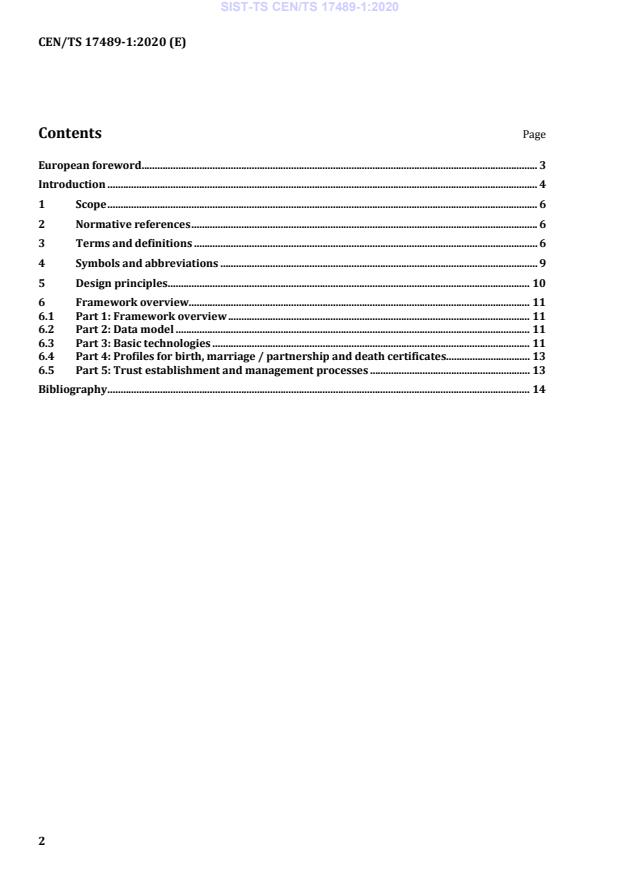
Contents Page
European foreword . 3
Introduction . 4
1 Scope . 6
2 Normative references . 6
3 Terms and definitions . 6
4 Symbols and abbreviations . 9
5 Design principles . 10
6 Framework overview. 11
6.1 Part 1: Framework overview . 11
6.2 Part 2: Data model . 11
6.3 Part 3: Basic technologies . 11
6.4 Part 4: Profiles for birth, marriage / partnership and death certificates. 13
6.5 Part 5: Trust establishment and management processes . 13
Bibliography . 14
European foreword
This document (CEN/TS 17489-1:2020) has been prepared by Technical Committee CEN/TC 224
“Personal identification and related personal devices with secure element, systems, operations and
privacy in a multi sectorial environment”, the secretariat of which is held by AFNOR.
Attention is drawn to the possibility that some of the elements of this document may be the subject of
patent rights. CEN shall not be held responsible for identifying any or all such patent rights.
According to the CEN/CENELEC Internal Regulations, the national standards organisations of the
following countries are bound to announce this Technical Specification: Austria, Belgium, Bulgaria,
Croatia, Cyprus, Czech Republic, Denmark, Estonia, Finland, France, Germany, Greece, Hungary, Iceland,
Ireland, Italy, Latvia, Lithuania, Luxembourg, Malta, Netherlands, Norway, Poland, Portugal, Republic of
North Macedonia, Romania, Serbia, Slovakia, Slovenia, Spain, Sweden, Switzerland, Turkey and the United
Kingdom.
Introduction
A legally recognized identity enables citizens to exercise their rights and access state and other services.
This includes the right to travel and access to travel documents such as passports, as well as access to
education, healthcare, social services, and bank accounts. In order to establish legally recognized
identities of citizens, states implement identity management (IdM) systems.
Breeder documents are legal documents which certify a vital event of a person and are essential
components of these IdM systems. According to the United Nations terminology [10] vital events include
live birth, death, foetal death, marriage (which includes partnership), divorce, adoption, legitimation,
recognition of parenthood, annulment of marriage, or legal separation. These vital events of a person are
recorded in the civil register (if used) of the state, during a process which is called registration, and a
corresponding breeder document is issued to the citizen.
The Organization for Security and Co-operation in Europe (OSCE) points out the importance of a breeder
document (denoted as primary documents) framework [8]:
“While there are several layers of identity management that produce different types of identity documents,
frameworks for issuing primary identity documents are the critical components of the entire identity
management system. They provide a framework for the legal establishment of one’s identity and identity
documents on the basis of which other types of identity documents may be issued.”
While there are standardized frameworks for identity documents such as travel documents including
passports, a standardized framework for secure and interoperable breeder documents is missing.
For machine readable travel documents (MRTDs) including passports, the International Civil Aviation
Organization (ICAO) has published the Doc 9303 standard [4] which has been prepared in collaboration
with the standardization group ISO/IEC JTC 1/SC 17/WG3. The international adoption and
implementation of this document establishes a certain security level for travel documents and enables
interoperability, e.g. by means of the standardized layout and character set used for travel documents.
The lack of breeder document standardization leads to interoperability as well as security issues. The
layout of breeder documents differs between states and often even between the municipalities of a state.
Breeder documents typically do not support machine readable technologies, and therefore their data
must be manually entered for subsequent processing which is error prone and time consuming. The non-
standardized layout can hinder a verifier to identify the required breeder document data and a
translation of the breeder document is potentially required. This translation potentially uses a
transliteration of names, i.e. a conversion of the names from one alphabet to another, and this can lead to
different spellings of the name of the same person, e.g. if diacritical marks are used in the original breeder
document, but not used in the translated document.
For instance, the International Commission on Civil Status (ICCS) [6] has addressed these interoperability
issues in several conventions and recommendations that specify a data set and a character set to be used
as well as identifiers for the different data fields of a breeder document.
Breeder documents are typically used as an identity evidence in identity proofing scenarios for issuing
travel documents. Due to the established security level of travel documents and the typically lower
security level of breeder documents fraudsters aim at obtaining authentic travel documents on the basis
of false identities based e.g. on non-genuine or forged breeder documents instead of forging or
counterfeiting travel documents. Therefore fraudsters use
— counterfeit breeder documents, i.e. unauthorized reproductions of genuine documents;
— forged breeder documents, i.e. genuine breeder document that have been altered;
— genuine breeder documents of another person; i.e. they impersonate the legitimate holder of the
breeder documents. As breeder documents such as birth certificates usually do not include
information that links the breeder document to its legitimate holder, strong organisational methods
are required to establish this link, in particular in the case of first-time registration;
— forged data and identity evidence documents to obtain breeder documents with false data
representations.
Breeder documents are considered the weakest link in the issuance process of travel documents, see the
ICAO guidelines [5] for best practices on how breeder documents are used in this process. For this reason
the European Union (EU) has funded projects to investigate solutions for strengthening the security of
breeder documents: The FIDELITY project [3] suggests among others a standardized birth certificate
design, the support of physical security features and an online verification of the birth certificate. The
ORIGINS project [9] analysed the issuance of breeder documents used for passport delivery, identified
loopholes in this process, and proposed security measures and processes to enhance the security of
breeder documents. These enhancements include the standardization of breeder documents and the
harmonization of the related processes. In addition, the European Commission has issued an action plan
to strengthen the European response to travel document fraud [2] which recommends a minimum
security level for breeder documents to prevent counterfeiting and forging.
The breeder document framework in CEN/TS 17489 (all parts) takes the results of these EU projects [3],
[9] into considerations as well as the ICCS conventions and recommendations [6].
1 Scope
This document provides an overview of a framework on breeder documents. It introduces the document
structure of CEN/TS 17489 (all parts) that specifies how citizens retain the control of breeder document
data and how they can use them to support identity proofing and verification. Moreover, the framework
provides methodologies to assess and increase the level of trust in breeder documents.
This framework specifies methods for:
— defining physical and logical/digital representations of a secure breeder document (hardware based,
paper-based, server-based),
— securing breeder document processes,
— linking the document to its legitimate holder.
The following types of breeder documents are in the scope of the framework:
— birth certificates,
— marriage and partnership certificates,
— death certificates.
The following breeder documents management processes including first-time application, later-in-life
registration of an identity, and content update (e.g. name-changing) are in the scope of this framework:
— registration,
— issuance,
— renewal,
— inspection/verification,
— revocation.
The specification of policies is out of scope.
2 Normative references
There are no normative references in this document.
3 Terms and definitions
For the purposes of this document, the following terms and definitions apply.
ISO and IEC maintain terminological databases for use in standardization at the following addresses:
— IEC Electropedia: available at http://www.electropedia.org/
— ISO Online browsing platform: available at https://www.iso.org/obp/ui
3.1
attribute
characteristic or property of an entity (3.6)
[SOURCE: ISO/IEC 24760-1:2019, 3.1.3]
3.2
breeder document
evidence (3.7) about a vital event (3.19) of an entity (3.6) including attributes (3.1)
3.3
compact electronic seal
CES
data format for an electronic seal (3.5) usable in data size constrained environments
3.4
domain
domain of applicability
context
environment where an entity (3.6) can use a set of attributes (3.1) for identification (3.8) and other
purposes
[SOURCE: ISO/IEC 24760-1:2019, 3.2.3]
3.5
electronic seal
data in electronic form, which is attached to or logically associated with other data in electronic form to
ensure the latter’s origin and integrity
[SOURCE: REGULATION (EU) No 910/2014]
3.6
entity
item relevant for the purpose of operation of a domain (3.4) that has recognizably distinct existence
Note 1 to entry: An entity may have a physical or a logical embodiment, such as a person, an organization, a
device, a service, etc.
[SOURCE: ISO/IEC 24760-1:2019, 3.1.1 – modified Note 1]
3.7
evidence
information which is used, either by itself or in conjunction with other information, to establish proof
about an event or action
Note 1 to entry: Evidence does not necessarily prove the truth or existence of somethi
...
The article discusses CEN/TS 17489-1:2020, a framework for secure and interoperable European breeder documents. The framework outlines how citizens can control and use their breeder document data for identity proofing and verification. It also provides methods to assess and increase trust in breeder documents. The framework specifies methods for defining physical and digital representations of breeder documents, securing document processes, and linking documents to their legitimate holders. The types of breeder documents covered include birth, marriage, and death certificates, and the framework includes processes such as registration, issuance, renewal, and verification. However, the specification of policies is not included in the scope of the framework.
기사 제목: CEN/TS 17489-1:2020 - 개인 식별 - 안전하고 상호 운용 가능한 유럽 족보 문서 - 파트 1: 프레임워크 개요 기사 내용: 이 문서는 족보 문서에 대한 프레임워크 개요를 제공한다. 그것은 시민들이 족보 문서 데이터의 통제를 유지하고 신분 증명과 확인을 지원하기 위해 해당 데이터를 사용하는 방법을 명시하는 CEN/TS 17489 (모든 부분)의 문서 구조를 소개한다. 또한, 이 프레임워크는 족보 문서에 대한 신뢰 수준을 평가하고 높이기 위한 방법론을 제공한다. 이 프레임워크는 다음을 위한 방법을 명시한다: - 안전한 족보 문서의 물리적 및 논리적/디지털 표현 정의 (하드웨어 기반, 종이 기반, 서버 기반) - 족보 문서 과정 보안 - 문서를 해당 소유자와 연결 다음 유형의 족보 문서가 이 프레임워크의 범위에 포함된다: - 출생 증명서 - 결혼 및 파트너십 증명서 - 사망 증명서 다음 족보 문서 관리 과정은 이 프레임워크의 범위에 포함된다: - 등록 - 발급 - 갱신 - 검사/확인 - 취소 정책의 명시는 이 프레임워크의 범위를 벗어난다.
記事タイトル:CEN/TS 17489-1:2020 - 個人識別 - 安全で相互運用可能なヨーロッパ飼育者文書 - パート1:フレームワーク概要 記事内容:この文書は、飼育者文書に関するフレームワークの概要を提供しています。CEN/TS 17489(すべての部分)のドキュメント構造を紹介し、市民が飼育者文書データの制御を保持し、それらを使用して身元の証明と確認を支援する方法を指定しています。さらに、このフレームワークでは、飼育者文書への信頼レベルの評価と向上のための手法も提供しています。 このフレームワークでは、以下の方法が指定されています: - 安全な飼育者文書の物理的および論理的/デジタル表現の定義(ハードウェアベース、紙ベース、サーバーベース) - 飼育者文書プロセスのセキュリティ - 文書と正規の所持者のリンク 次の種類の飼育者文書がフレームワークの範囲に含まれます: - 出生証明書 - 結婚およびパートナーシップ証明書 - 死亡証明書 次の飼育者文書管理プロセスがフレームワークの範囲に含まれます: - 登録 - 発行 - 更新 - 検査/確認 - 取り消し ポリシーの指定は範囲外です。
Questions, Comments and Discussion
Ask us and Technical Secretary will try to provide an answer. You can facilitate discussion about the standard in here.
Loading comments...