

EN 17456:2021
(Main)Wood flooring and parquet - Determination of top layer delamination of multilayer elements - Test method
- Abstract
This document specifies a test method to determine the top layer delamination of multilayer parquet elements according to EN 13489 with different structures, dimensions and adhesives for internal use as flooring, at the time of the first delivery of the product.
The document specifies a test method with three aging-treatments (AT1, AT2 and AT3) of the test specimens.
The test method described in this document allows to determine a top layer bonding quality, also for parquet used on floor heating, and for the identification of bonding failure.
NOTE 1 For bottom layer of three layers elements the test method is applicable even if the experience is limited.
AT1 is a suitable treatment for the prognosis of multilayer parquets under dry indoor conditions and can be applied for all type of glues of parquets. It can be used for main underfloor heating systems.
AT2 is a suitable treatment for the assessment of multilayer parquets with PVAc-glues for top layer bonding.
AT3 is a suitable treatment for the assessment of multilayer parquets with different type of glues other than PVA-c for top layer bonding.
This document does not apply to the bonding quality of plywood if it is in use in the multilayer parquet construction.
NOTE 2 This document does not allow to estimate the compatibility of use in wet conditions.
- Status
- Published
- Publication Date
- 13-Apr-2021
- Withdrawal Date
- 30-Oct-2021
- Technical Committee
- CEN/TC 175 - Round and sawn timber
- Drafting Committee
- CEN/TC 175/WG 33 - Specific user requirements - Timber in flooring
- Current Stage
- 9020 - Submission to 2 Year Review Enquiry - Review Enquiry
- Start Date
- 15-Jul-2026
- Completion Date
- 15-Jul-2026



Overview
EN 17456:2021 - Wood flooring and parquet - Determination of top layer delamination of multilayer elements - Test method is a CEN standard that defines a laboratory procedure to assess top layer delamination in multilayer parquet at the time of first delivery. The method applies to multilayer parquet elements (per EN 13489) with different structures, dimensions and adhesives intended for internal flooring, including products used over floor heating. The standard is a practical yes/no decision test for bonding failure rather than a quantitative strength measurement.
Key topics and requirements
- Purpose: Determine top layer bonding quality and identify bonding failure (delamination) after accelerated aging treatments.
- Specimens: At least five test specimens cut to 100 mm length × element width × element thickness; long-side profiles kept, short-side profiles removed; specimens free of manufacturing defects.
- Conditioning: Pre-test conditioning to constant mass at (23 ± 2) °C and (50 ± 5) % RH (ISO 554).
- Aging treatments (AT):
- AT1 (oven drying): (100 ± 4) h at (60 ± 2) °C - suitable for dry indoor prognosis and compatible with main underfloor heating systems; applicable to all glue types.
- AT2 (humid storage + re-drying): 72 h at 95 % RH (23 ± 2) °C, reconditioning (24–48 h), then 8 h at 60 °C and 16 h at 80 °C - intended for assessment of top layer bonding with PVAc glues.
- AT3 (cold water immersion + re-drying): 6 h immersion in water at (20 ± 2) °C, reconditioning (24–48 h), then same drying cycle as AT2 - for glues other than PVAc.
- Apparatus: Conditioning room, water bath, convection drying oven, balance (0.01 g), sliding calliper (0.1 mm), 0.2 mm feeler gauge, climate chamber (95 % RH).
- Evaluation: Visual inspection at both cross-sections, use feeler gauge (held 65 mm from tip) to verify openings (>5 mm marked), measure delamination length with a calliper and express as percent of initial top layer width.
- Limitations: Not applicable to bonding quality of plywood used within multilayer constructions; does not estimate suitability for wet-use conditions.
Applications and users
- Who uses it: flooring manufacturers, quality control laboratories, test houses, product certifiers, installers, dealers and regulatory authorities.
- Practical uses: pre-delivery quality verification, comparative checks of adhesive systems (PVAc vs. others), assessment of suitability for underfloor heating installations, identification of bonding failures for warranty and acceptance testing.
- Decision support: The standard’s round-robin validation supports its use as a pass/fail method for top layer delamination.
Related standards
- EN 13489 - Multilayer parquet element requirements (product reference)
- EN 13756 - Terminology for wood flooring and parquet
- ISO 554 - Standard atmospheres for conditioning and testing
- EN 321 (informative reference) - guidance on oven loading for reproducible drying
Key phrase targets: EN 17456:2021, wood flooring, parquet, top layer delamination, multilayer parquet test method, aging treatment AT1 AT2 AT3, floor heating bonding quality.
Relations
- Effective Date
- 22-Jul-2026
- Effective Date
- 28-Jan-2026
- Effective Date
- 28-Jan-2026
- Effective Date
- 22-Jul-2026
- Effective Date
- 28-Jan-2026
Get Certified
Connect with accredited certification bodies for this standard

Gozdarski inštitut Slovenije
Slovenian Forestry Institute. Forest management certification support, timber testing.
Sponsored listings
Frequently Asked Questions
EN 17456:2021 is a standard published by the European Committee for Standardization (CEN). Its full title is "Wood flooring and parquet - Determination of top layer delamination of multilayer elements - Test method". This standard covers: This document specifies a test method to determine the top layer delamination of multilayer parquet elements according to EN 13489 with different structures, dimensions and adhesives for internal use as flooring, at the time of the first delivery of the product. The document specifies a test method with three aging-treatments (AT1, AT2 and AT3) of the test specimens. The test method described in this document allows to determine a top layer bonding quality, also for parquet used on floor heating, and for the identification of bonding failure. NOTE 1 For bottom layer of three layers elements the test method is applicable even if the experience is limited. AT1 is a suitable treatment for the prognosis of multilayer parquets under dry indoor conditions and can be applied for all type of glues of parquets. It can be used for main underfloor heating systems. AT2 is a suitable treatment for the assessment of multilayer parquets with PVAc-glues for top layer bonding. AT3 is a suitable treatment for the assessment of multilayer parquets with different type of glues other than PVA-c for top layer bonding. This document does not apply to the bonding quality of plywood if it is in use in the multilayer parquet construction. NOTE 2 This document does not allow to estimate the compatibility of use in wet conditions.
This document specifies a test method to determine the top layer delamination of multilayer parquet elements according to EN 13489 with different structures, dimensions and adhesives for internal use as flooring, at the time of the first delivery of the product. The document specifies a test method with three aging-treatments (AT1, AT2 and AT3) of the test specimens. The test method described in this document allows to determine a top layer bonding quality, also for parquet used on floor heating, and for the identification of bonding failure. NOTE 1 For bottom layer of three layers elements the test method is applicable even if the experience is limited. AT1 is a suitable treatment for the prognosis of multilayer parquets under dry indoor conditions and can be applied for all type of glues of parquets. It can be used for main underfloor heating systems. AT2 is a suitable treatment for the assessment of multilayer parquets with PVAc-glues for top layer bonding. AT3 is a suitable treatment for the assessment of multilayer parquets with different type of glues other than PVA-c for top layer bonding. This document does not apply to the bonding quality of plywood if it is in use in the multilayer parquet construction. NOTE 2 This document does not allow to estimate the compatibility of use in wet conditions.
EN 17456:2021 is classified under the following ICS (International Classification for Standards) categories: 79.080 - Semi-manufactures of timber. The ICS classification helps identify the subject area and facilitates finding related standards.
EN 17456:2021 has the following relationships with other standards: It is inter standard links to ISO 554:1976, EN 915:1996, EN 13756:2018, EN 14354:2026, EN 13489:2023. Understanding these relationships helps ensure you are using the most current and applicable version of the standard.
EN 17456:2021 is available in PDF format for immediate download after purchase. The document can be added to your cart and obtained through the secure checkout process. Digital delivery ensures instant access to the complete standard document.
Standards Content (Sample)
SLOVENSKI STANDARD
01-julij-2021
Lesene talne obloge in parket - Ugotavljanje delaminacije zgornje plasti večslojnih
elementov - Preskusna metoda
Wood flooring and parquet - Determination of top layer delamination of multilayer
elements - Test method
Holzfußböden und Parkett - Bestimmung der Delaminierung der Decklagen von
Mehrschichtelementen - Prüfverfahren
Planchers en bois et parquets - Détermination du décollement de la couche supérieure
des éléments contrecollés - Méthode d'essai
Ta slovenski standard je istoveten z: EN 17456:2021
ICS:
79.080 Polizdelki iz lesa Semi-manufactures of timber
97.150 Talne obloge Floor coverings
2003-01.Slovenski inštitut za standardizacijo. Razmnoževanje celote ali delov tega standarda ni dovoljeno.
EN 17456
EUROPEAN STANDARD
NORME EUROPÉENNE
April 2021
EUROPÄISCHE NORM
ICS 79.080
English Version
Wood flooring and parquet - Determination of top layer
delamination of multilayer elements - Test method
Planchers en bois et parquets - Détermination du Holzfußböden und Parkett - Bestimmung der
décollement de la couche supérieure des éléments Delaminierung der Decklagen von
contrecollés - Méthode d'essai Mehrschichtelementen - Prüfverfahren
This European Standard was approved by CEN on 12 March 2021.
CEN members are bound to comply with the CEN/CENELEC Internal Regulations which stipulate the conditions for giving this
European Standard the status of a national standard without any alteration. Up-to-date lists and bibliographical references
concerning such national standards may be obtained on application to the CEN-CENELEC Management Centre or to any CEN
member.
This European Standard exists in three official versions (English, French, German). A version in any other language made by
translation under the responsibility of a CEN member into its own language and notified to the CEN-CENELEC Management
Centre has the same status as the official versions.
CEN members are the national standards bodies of Austria, Belgium, Bulgaria, Croatia, Cyprus, Czech Republic, Denmark, Estonia,
Finland, France, Germany, Greece, Hungary, Iceland, Ireland, Italy, Latvia, Lithuania, Luxembourg, Malta, Netherlands, Norway,
Poland, Portugal, Republic of North Macedonia, Romania, Serbia, Slovakia, Slovenia, Spain, Sweden, Switzerland, Turkey and
United Kingdom.
EUROPEAN COMMITTEE FOR STANDARDIZATION
COMITÉ EUROPÉEN DE NORMALISATION
EUROPÄISCHES KOMITEE FÜR NORMUNG
CEN-CENELEC Management Centre: Rue de la Science 23, B-1040 Brussels
© 2021 CEN All rights of exploitation in any form and by any means reserved Ref. No. EN 17456:2021 E
worldwide for CEN national Members.
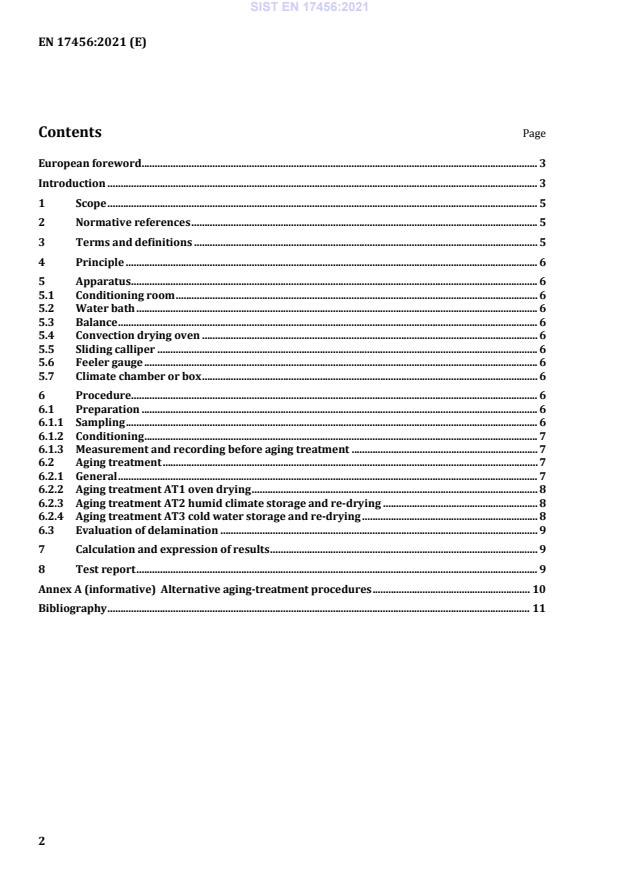
Contents Page
European foreword . 3
Introduction . 3
1 Scope . 5
2 Normative references . 5
3 Terms and definitions . 5
4 Principle . 6
5 Apparatus . 6
5.1 Conditioning room . 6
5.2 Water bath . 6
5.3 Balance . 6
5.4 Convection drying oven . 6
5.5 Sliding calliper . 6
5.6 Feeler gauge . 6
5.7 Climate chamber or box . 6
6 Procedure. 6
6.1 Preparation . 6
6.1.1 Sampling . 6
6.1.2 Conditioning . 7
6.1.3 Measurement and recording before aging treatment . 7
6.2 Aging treatment . 7
6.2.1 General . 7
6.2.2 Aging treatment AT1 oven drying . 8
6.2.3 Aging treatment AT2 humid climate storage and re-drying . 8
6.2.4 Aging treatment AT3 cold water storage and re-drying . 8
6.3 Evaluation of delamination . 9
7 Calculation and expression of results . 9
8 Test report . 9
Annex A (informative) Alternative aging-treatment procedures . 10
Bibliography . 11
European foreword
This document (EN 17456:2021) has been prepared by Technical Committee CEN/TC 175 “Round and
sawn timber”, the secretariat of which is held by AFNOR.
This European Standard shall be given the status of a national standard, either by publication of an
identical text or by endorsement, at the latest by October 2021, and conflicting national standards shall
be withdrawn at the latest by October 2021.
Attention is drawn to the possibility that some of the elements of this document may be the subject of
patent rights. CEN shall not be held responsible for identifying any or all such patent rights.
According to the CEN-CENELEC Internal Regulations, the national standards organisations of the
following countries are bound to implement this European Standard: Austria, Belgium, Bulgaria, Croatia,
Cyprus, Czech Republic, Denmark, Estonia, Finland, France, Germany, Greece, Hungary, Iceland, Ireland,
Italy, Latvia, Lithuania, Luxembourg, Malta, Netherlands, Norway, Poland, Portugal, Republic of North
Macedonia, Romania, Serbia, Slovakia, Slovenia, Spain, Sweden, Switzerland, Turkey and the United
Kingdom.
Introduction
This document is one of a series of standards specifying requirements and test methods for wood flooring
and parquet.
This document specifies a test method with three aging-treatments to measure the top layer bonding of
multilayer parquet with different structures, dimensions and adhesives.
Floor heating systems, low energy or passive houses as well as public areas with heavy exposures
represent a potential high stress to wood flooring and parquet elements that require them to withstand
the effects of temperature and humidity occurring in practical installation situations.
The test method described in this document simulates these situations. By that the already existing large
amount of knowledge about multilayer parquet and values for product characteristics attested by long
use and experience is extended for the benefit of producers, installers, dealers and customers. For new
products, technical data will have to be verified by testing.
NOTE A Round Robin trial was carried out involving seven international laboratories. The test method is
therefore suitable as a yes/no decision for failure in the top layer bonding or poor product quality, but it does not
allow quantification. It is possible to use it in conjunction with low limits of allowable delamination.
1 Scope
This document specifies a test method to determine the top layer delamination of multilayer parquet
elements according to EN 13489 with different structures, dimensions and adhesives for internal use as
flooring, at the time of the first delivery of the product.
The document specifies a test method with three aging-treatments (AT1, AT2 and AT3) of the test
specimens.
The test method described in this document allows to determine a top layer bonding quality, also for
parquet used on floor heating, and for the identification of bonding failure.
NOTE 1 For bottom layer of three layers elements the test met
...