

prEN 12903
(Main)Products used for the treatment of water intended for human consumption - Powdered activated carbon
- Abstract
This European Standard is applicable to powdered activated carbon used for treatment of water intended for human consumption. It describes the characteristics of powdered activated carbon and specifies the requirements and the corresponding test methods for powdered activated carbon. It gives information on its use in water treatment.
- Status
- Not Published
- Publication Date
- 09-Dec-2027
- Technical Committee
- CEN/TC 164 - Water supply
- Drafting Committee
- CEN/TC 164/WG 9 - Drinking water treatment
- Current Stage
- 4020 - Submission to enquiry - Enquiry
- Start Date
- 08-Oct-2026
- Due Date
- 27-Aug-2026
- Completion Date
- 27-Aug-2026
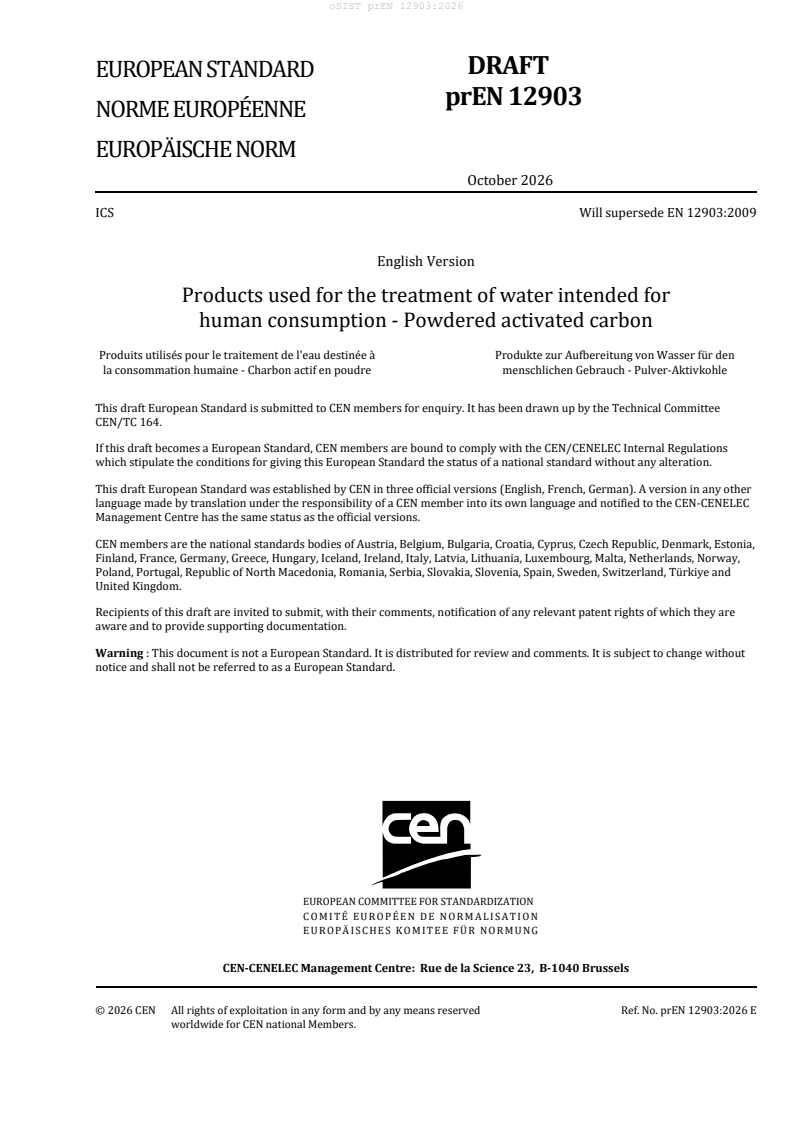

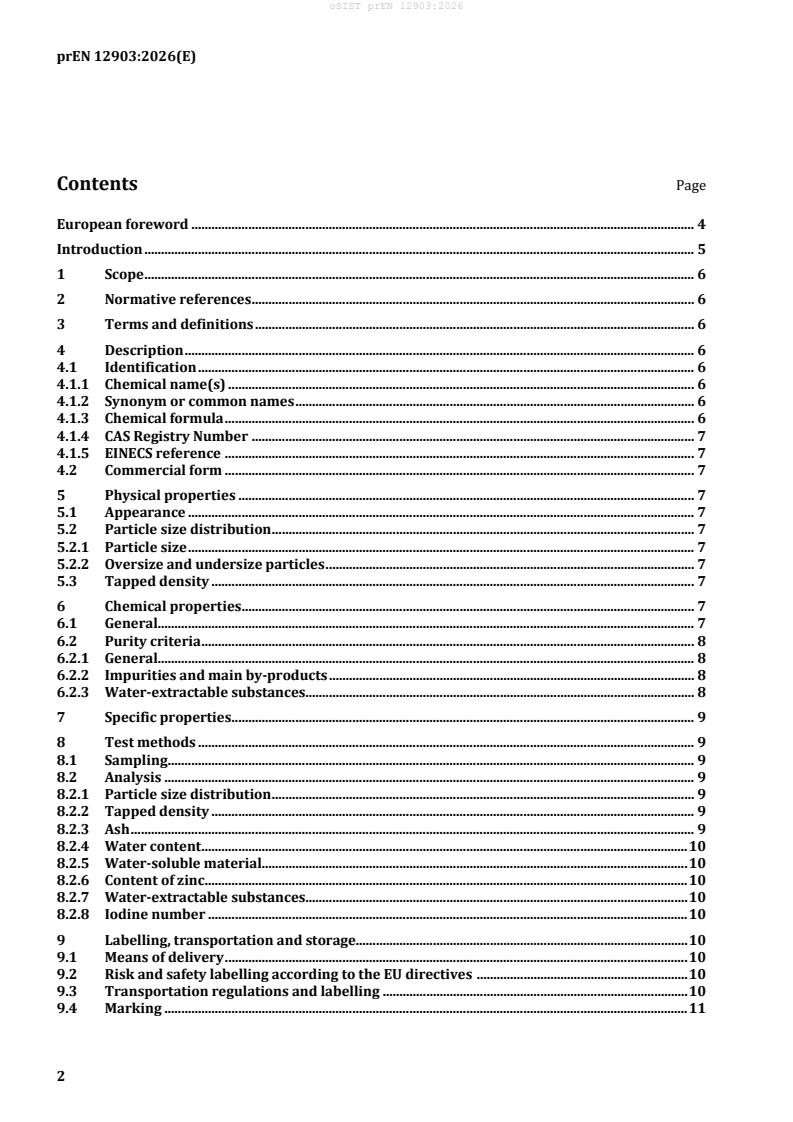
prEN 12903 is a CEN draft European Standard for powdered activated carbon used in the treatment of water intended for human consumption. It specifies the product characteristics, the requirements to check, and the test methods to use, for manufacturers, suppliers, laboratories, water-treatment operators, and buyers.
What does prEN 12903 specify?
prEN 12903 applies to powdered activated carbon for treating water intended for human consumption. It covers how the product is described, which physical and chemical properties it shall meet, how those properties are tested, and how the product is labelled, transported, and stored.
The document is organized into scope, normative references, terms and definitions, description, physical properties, chemical properties, specific properties, test methods, and labelling/transport/storage. Annex A gives general information on powdered activated carbon.
| Annex | What it covers |
|---|---|
| Annex A | General information on powdered activated carbon, including origin, properties, use, handling, and emergency advice |
What are the key requirements of prEN 12903?
prEN 12903 sets out the main product checks for powdered activated carbon used in drinking water treatment. In practice, these are the characteristics a manufacturer must declare and the properties a buyer or laboratory should verify.
Product identity and form
Clause 4 identifies the product as either Activated Carbon - High Density Skeleton or Activated Carbon - Low Density Skeleton. It also gives the common names, chemical formula, CAS Registry Number, and EINECS references. The commercial form is a powder with grades that differ in adsorption, porosity, particle size, and purity, so users need to match the grade to the treatment task.
Physical properties
Clause 5 describes the appearance as a black powder and sets a particle size expectation: at least 95 % by mass shall be below 150 µm, while the full particle size distribution shall remain within the manufacturer’s declared values. Oversize and undersize particles also have to stay within declared values. Tapped density shall comply with the manufacturer’s declared values, which matters because density affects dosing, transport, and handling.
Chemical purity
Clause 6 requires the raw materials to be stated by the manufacturer and sets purity criteria for common impurities and by-products. Table 1 covers ash, water at packing, water-soluble material, and zinc, with the zinc limit applying only to activated carbons made with ZnCl2. Table 2 covers water-extractable substances, including arsenic, cadmium, chromium, mercury, nickel, lead, antimony, selenium, cyanide, PAH, and aluminium, with aluminium reported as a typical value rather than limited. This tells users what may migrate into treated water and what to check against local water-quality rules.
Adsorption performance
Clause 7 gives the iodine number as the specific property used here, with a minimum of 600 mg/g. That value acts as a practical indicator of adsorption capacity, so it helps users compare products for contaminant removal, even though some applications may accept lower values.
Sampling and testing
Clause 8 states that conformity assessment samples shall come from the production site. Samples taken at delivery or from a filter are not valid for this purpose because transport and handling can change the material. Clause 8 also directs most analyses to EN 12902, including particle size distribution, tapped density, ash, water content, water-soluble material, zinc, water-extractable substances, and iodine number.
Delivery, marking, and storage
Clause 9 covers sacks, FIBC bags, drums, boxes, and bulk delivery, and requires clean or dedicated delivery equipment so product purity is not affected. Marking shall identify the product, grade, net mass, supplier or manufacturer, and conformity with EN 12903. The product shall be kept dry and away from oxidants, volatile solvents, and moisture.
What terms does prEN 12903 define?
prEN 12903 defines the two activated carbon types used in the standard and the main performance terms that control specification and testing.
- Activated Carbon - High Density Skeleton - activated carbon made by charring and activation with steam or other gases.
- Activated Carbon - Low Density Skeleton - activated carbon made by charring and activation with chemical activation agents such as phosphoric acid.
- PAC - the common abbreviation for powdered activated carbon.
- Tapped density - the density measured after tapping, used to describe how the powder packs and behaves in handling.
- Iodine number - an adsorption index used here as the specific property for product performance.
- Water-extractable substances - substances that can leach from the carbon into water and therefore need control.
Who uses prEN 12903?
prEN 12903 is used by manufacturers and suppliers of powdered activated carbon, water-treatment utilities, laboratories, and buyers specifying product quality. It is also relevant to quality managers and compliance teams who need a consistent basis for product acceptance, sampling, labelling, and storage in drinking water treatment.
What changed in prEN 12903 from the previous edition?
prEN 12903 is set to supersede EN 12903:2009. The foreword states these technical changes:
- the term bulk density packed was replaced by tapped density
- the zinc limit applies only to activated carbons manufactured with ZnCl2
- aluminium was added as a water-extractable substance, with a typical value to be reported
- editorial changes were made to align the text with other standards in the series
Which standards are used with prEN 12903?
prEN 12903 relies on two normative references:
- EN 12901 - provides the terms and definitions used for products used in treatment of water intended for human consumption.
- EN 12902 - provides the test methods used for this product, including the sampling and analytical procedures named in Clause 8.
What does the prEN 12903 document contain?
prEN 12903 contains product identification details, physical-property requirements, chemical purity criteria, and a specific adsorption index based on iodine number. It also contains a test section that points most analyses to EN 12902, which is important for consistent quality control and conformity assessment.
The document includes tables for main impurities and by-products, and for water-extractable substances. It also includes an informative annex with background on raw materials, manufacturing routes, adsorption properties, typical use in water treatment, safe handling, and emergency actions.
Relations
- Effective Date
- 29-Jun-2022
Get Certified
Connect with accredited certification bodies for this standard

ECOCERT
Organic and sustainability certification.

Eurofins Food Testing Global
Global leader in food, environment, and pharmaceutical product testing.

Intertek Bangladesh
Intertek certification and testing services in Bangladesh.
Sponsored listings
Frequently Asked Questions
prEN 12903 is a draft published by the European Committee for Standardization (CEN). Its full title is "Products used for the treatment of water intended for human consumption - Powdered activated carbon". This standard covers: This European Standard is applicable to powdered activated carbon used for treatment of water intended for human consumption. It describes the characteristics of powdered activated carbon and specifies the requirements and the corresponding test methods for powdered activated carbon. It gives information on its use in water treatment.
This European Standard is applicable to powdered activated carbon used for treatment of water intended for human consumption. It describes the characteristics of powdered activated carbon and specifies the requirements and the corresponding test methods for powdered activated carbon. It gives information on its use in water treatment.
prEN 12903 is classified under the following ICS (International Classification for Standards) categories: 71.100.80 - Chemicals for purification of water. The ICS classification helps identify the subject area and facilitates finding related standards.
prEN 12903 has the following relationships with other standards: It is inter standard links to EN 12903:2009. Understanding these relationships helps ensure you are using the most current and applicable version of the standard.
prEN 12903 is available in PDF format for immediate download after purchase. The document can be added to your cart and obtained through the secure checkout process. Digital delivery ensures instant access to the complete standard document.
Standards Content (Sample)
Contents
- Introduction
- 1 Scope
- 2 Normative references
- 3 Terms and definitions
- 3.1 activated Carbon – High Density Skeleton (steam activated carbon)
- 3.2 activated Carbon – Low Density Skeleton (chemically activated carbon)
- 4 Description
- 4.1 Identification
- 4.2 Commercial form
- 5 Physical properties
- 5.1 Appearance
- 5.2 Particle size distribution
- 5.3 Tapped density
- 6 Chemical properties
- 6.1 General
- 6.2 Purity criteria
- 7 Specific properties
- 8 Test methods
- 8.1 Sampling
- 8.2 Analysis
- 9 Labelling, transportation and storage
- 9.1 Means of delivery
- 9.2 Risk and safety labelling according to the EU directives
- 9.3 Transportation regulations and labelling
- 9.4 Marking
- 9.5 Storage
- Annex A
- Bibliography
Introduction
In respect of potential adverse effects on the quality of water intended for human consumption, caused by the product covered by this document:
a) this document provides no information as to whether the product may be used without restriction in any of the Member States of the EU or EFTA; b) it should be noted that, while awaiting the adoption of verifiable European criteria, existing national regulations concerning the use and/or the characteristics of this product remain in force. NOTE Conformity with this document does not confer or imply acceptance or approval of the product in any of the Member States of the EU or EFTA. The use of the product covered by this document is subject to regulation or control by National Authorities.
Attention is drawn to the possibility that some of the elements of this document may be the subject of patent rights. CEN [and/or CENELEC] shall not be held responsible for identifying any or all such patent rights.
oSIST prEN 12903:2026 prEN 12903:2026(E)
1 Scope
This document is applicable to powdered activated carbon used for treatment of water intended for human consumption. It describes the characteristics of powdered activated carbon and specifies the requirements and the corresponding test methods for powdered activated carbon. It gives information on its use in water treatment.
2 Normative references
The following documents are referred to in the text in such a way that some or all of their content constitutes requirements of this document. For dated references, only the edition cited applies. For undated references, the latest edition of the referenced document (including any amendments) applies. EN 12901, Products used for treatment of water intended for human consumption - Inorganic supporting and filtering materials - Definitions EN 12902, Products used for treatment of water intended for human consumption - Inorganic supporting and filtering materials - Methods of test
3 Terms and definitions
For the purposes of this document, the terms and definitions given in EN 12901 and the following apply. ISO and IEC maintain terminology databases for use in standardization at the following addresses:
- ISO Online browsing platform: available at https://www.iso.org/obp/
- IEC Electropedia: available at https://www.electropedia.org/
3.1 activated Carbon – High Density Skeleton (steam activated carbon)
activated carbon produced by charring and activation of raw materials with steam or other gases
3.2 activated Carbon – Low Density Skeleton (chemically activated carbon)
activated carbon produced by charring and activation of raw materials with chemical activation agents such as phosphoric acid
4 Description
4.1 Identification
4.1.1 Chemical name(s)
Activated Carbon – High Density Skeleton Activated Carbon – Low Density Skeleton
4.1.2 Synonym or common names
Activated coal, activated charcoal, active carbon, PAC.
4.1.3 Chemical formula
C (elementary).
oSIST prEN 12903:2026 prEN 12903:2026 (E) 1)
4.1.4 CAS Registry Number
7440-44-0.
2)
4.1.5 EINECS reference
931-328-0 (Activated Carbon – High Density Skeleton) 931-334-3 (Activated Carbon – Low Density Skeleton)
4.2 Commercial form
Powdered activated carbon is available in many grades, differing mainly in adsorption characteristics, porosity, particle size and purity.
5 Physical properties
5.1 Appearance
The product is a black powder.
5.2 Particle size distribution
5.2.1 Particle size
At least a mass fraction of 95 % shall have a particle size less than 150 µm. NOTE Other values can be necessary for certain applications. The particle size distribution is commonly specified as a given mass fraction less than a specified particle size. The particle size distribution shall be within the manufacturer’s declared values.
5.2.2 Oversize and undersize particles
The proportion of oversize and undersize particles shall be within the manufacturer’s declared values.
5.3 Tapped density
The tapped density shall be within the manufacturer’s declared values. 3 3 NOTE The tapped density of powdered activated carbon is typically in the range 200 kg/m to 750 kg/m .
6 Chemical properties
6.1 General
Powdered activated carbon is manufactured by controlled oxidation, by means of steam or chemicals, from carbonaceous raw materials including coconut, wood, peat or coal. The raw materials shall be stated by the manufacturer.
High internal porosity results in adsorptive properties and, depending on the raw material and the manufacturing process, it can have acid or basic properties. It is a reducing agent with catalytic properties. Activated carbon can react with oxidants to form carbon dioxide. The carbon content of the commercial product does not affect adsorption characteristics.
1) Chemical Abstracts Service Registry Number.
2) European Inventory of Existing Commercial Chemical Substances.
oSIST prEN 12903:2026 prEN 12903:2026(E)
6.2 Purity criteria
6.2.1 General
This document specifies the minimum purity requirements for powdered activated carbon used for the treatment of water intended for human consumption. Limits are given for impurities commonly present in the product.
Limits have been given for impurities and chemical parameters where these are likely to be present in significant quantities from the current production process and raw materials. If the production process or raw materials lead to significant quantities of other impurities, by-products or additives being present, this shall be notified to the user and, when necessary, to the relevant authorities. NOTE Users of this product should check the national regulations in order to clarify whether it is of appropriate purity for treatment of water intended for human consumption, taking into account raw water quality, contents of other impurities and additives used in the products not stated in the product standard.
6.2.2 Impurities and main by-products
The product shall conform to the requirements specified in Table 1. Table 1 — Main impurities and by-products a) Impurity Limit in mass fraction
b) Ash max. 15 c) d) Water (at the time of packing) max. 5 Water-soluble material max. 3 e) Zinc max. 0,002 a) Expressed on a dry basis except for water content.
...