

oSIST prEN 12903:2026
(Main)Products used for the treatment of water intended for human consumption - Powdered activated carbon
- Abstract
This European Standard is applicable to powdered activated carbon used for treatment of water intended for human consumption. It describes the characteristics of powdered activated carbon and specifies the requirements and the corresponding test methods for powdered activated carbon. It gives information on its use in water treatment.
- Status
- Not Published
- Public Enquiry End Date
- 24-Dec-2026
- Technical Committee
- IOVO - Water supply and waste water engineering
- Current Stage
- 4020 - Public enquire (PE) (Adopted Project)
- Start Date
- 26-Oct-2026
- Due Date
- 15-Mar-2027

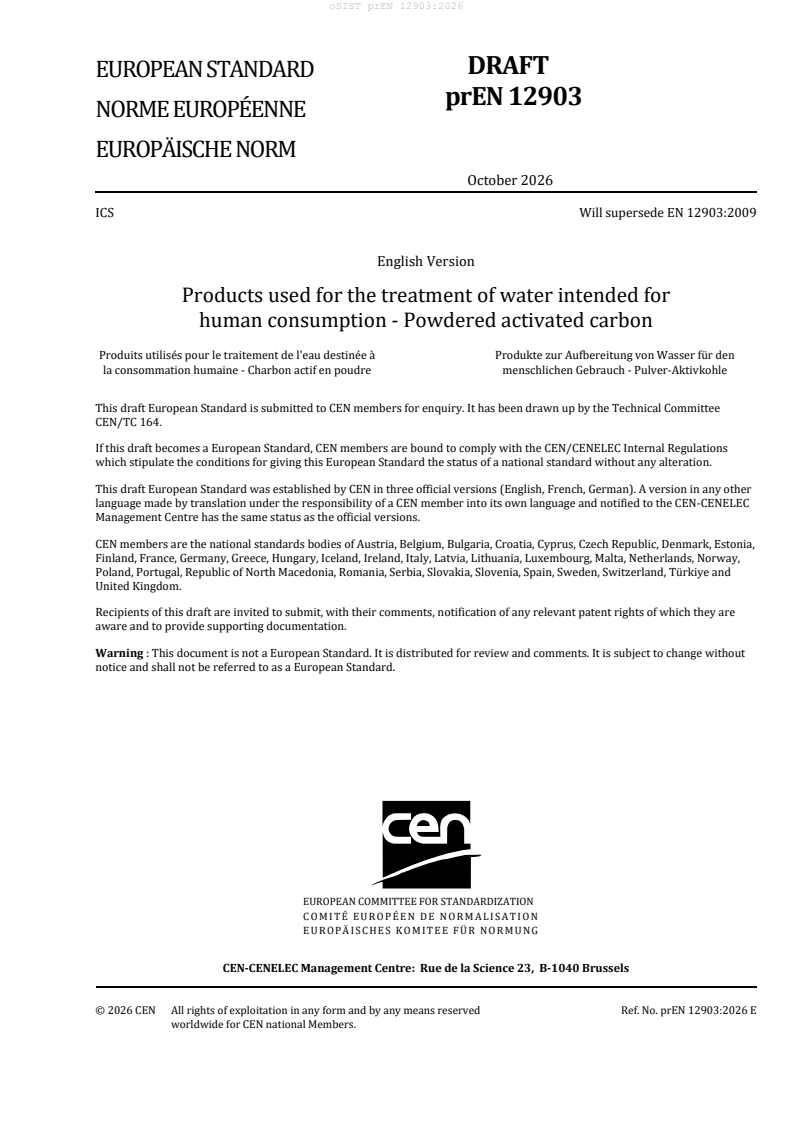
oSIST prEN 12903:2026 is a draft European Standard for powdered activated carbon used in the treatment of water intended for human consumption. It specifies the product's characteristics, requirements, test methods, labelling, transport and storage, and it also gives practical information on use in water treatment. The document is meant for manufacturers, suppliers, laboratories and water-treatment users who need a common technical basis for specifying and checking the product.
What does oSIST prEN 12903:2026 specify?
oSIST prEN 12903:2026 applies to powdered activated carbon for treatment of water intended for human consumption. It sets out how the product is identified, which physical and chemical properties matter, how those properties are tested, and what information has to accompany delivery.
The document is organized into:
- Clauses 1-3: scope, normative references, and terms and definitions
- Clause 4: description and identification
- Clause 5: physical properties
- Clause 6: chemical properties and purity criteria
- Clause 7: specific properties
- Clause 8: test methods
- Clause 9: labelling, transportation and storage
- Annex A: general information on powdered activated carbon
What are the key requirements of oSIST prEN 12903:2026?
Product identity and declared material type
oSIST prEN 12903:2026 identifies two product types: Activated Carbon - High Density Skeleton and Activated Carbon - Low Density Skeleton. It also lists common names such as activated coal, activated charcoal, active carbon and PAC, and it records the chemical name, formula and registry references.
In practice, this means the supplier has to declare the exact material type and the buyer should tie the purchase specification to that declared identity. Clause 6.1 also says the raw materials used, such as coconut, wood, peat or coal, shall be stated by the manufacturer.
Physical properties that affect handling and dosing
oSIST prEN 12903:2026 requires the product to be a black powder, with particle size distribution, oversize/undersize fraction and tapped density all within the manufacturer’s declared values. Clause 5.2 also states that at least 95% by mass shall be smaller than 150 µm.
In practice, these limits matter because particle size and density affect dusting, slurry preparation, dosing accuracy and the way the carbon behaves in treatment equipment. Buyers often need to specify these declared values because different applications may need different particle size ranges.
Purity criteria and contaminant limits
oSIST prEN 12903:2026 sets minimum purity requirements in Clause 6.2. It limits ash, water content at packing, water-soluble material and zinc, and it gives limits for water-extractable substances such as arsenic, cadmium, chromium, mercury, nickel, lead, antimony, selenium, cyanide and PAH. Aluminium is listed with a typical value to be reported.
In practice, this is the main contamination-control section. The zinc limit applies only to products manufactured with ZnCl2, and the notes explain that some applications may need different limits because of raw material, moisture pickup or special product design.
Performance indicator
oSIST prEN 12903:2026 sets a minimum iodine number of 600 mg/g in Clause 7.
In practice, the iodine number is the document's main specified indicator for adsorption performance. Lower values may be acceptable for some applications, but that has to be agreed for the intended use.
Sampling, testing, delivery and storage
oSIST prEN 12903:2026 requires samples for conformity assessment to be taken at the production site, and Clause 8 requires sampling and analysis to follow EN 12902. Clause 9 requires clean delivery means, product marking, and storage away from oxidants, volatile solvents and moisture.
In practice, this protects the representativeness of the sample and the quality of the delivered product. It also gives the basic handling rules needed to avoid contamination, wetting and loss of performance.
What terms does oSIST prEN 12903:2026 define?
- Activated Carbon - High Density Skeleton - activated carbon produced by charring and activation of raw materials with steam or other gases.
- Activated Carbon - Low Density Skeleton - activated carbon produced by charring and activation of raw materials with chemical activation agents such as phosphoric acid.
- PAC - a common name for powdered activated carbon used in water treatment.
- CAS Registry Number - the chemical registry identifier listed for the product as 7440-44-0.
- EINECS reference - the European inventory reference number listed for the two product types.
- Tapped density - the density value used in this standard to characterize the compacted powder, reported within the manufacturer's declared values.
- Iodine number - the adsorption-related indicator used in Clause 7, with a minimum value set by the standard.
Who uses oSIST prEN 12903:2026?
oSIST prEN 12903:2026 is used by manufacturers and suppliers of powdered activated carbon, drinking water treatment operators, laboratory staff, buyers and quality managers, and bodies checking product conformity. It is relevant wherever powdered activated carbon is selected, received, sampled, tested, stored or dosed into water treatment processes.
In practice, users rely on it to write purchase specifications, check delivery paperwork, compare grades, arrange laboratory testing, and judge whether a product is suitable for a particular water treatment objective.
What changed in oSIST prEN 12903:2026 from the previous edition?
oSIST prEN 12903:2026 will supersede EN 12903:2009. The foreword states these significant technical changes:
- the term bulk density packed was replaced by tapped density
- the zinc limit now applies only to activated carbons manufactured with ZnCl2
- aluminium was added as a water-extractable substance with a typical value to be reported
- editorial changes were made to harmonize the text with other standards in the series
Which standards are used with oSIST prEN 12903:2026?
- EN 12901 - provides the terms and definitions used in this document.
- EN 12902 - provides the sampling and test methods used for particle size distribution, tapped density, ash, water content, water-soluble material, zinc, water-extractable substances and iodine number.
What does the oSIST prEN 12903:2026 document contain?
The document contains two requirements tables in Clause 6 and one informative table in Annex A. Table 1 sets the main impurity and by-product limits, and Table 2 sets the limits for water-extractable substances.
Clause 8 gives the test-method framework and points most analyses to EN 12902. Clause 9 covers delivery forms, marking, transport classifications and storage precautions. Annex A adds general information on raw materials, manufacturing routes, typical properties, adsorption indices, uses, handling advice and emergency measures, so the reader can understand how powdered activated carbon is used in practice.
Relations
- Effective Date
- 19-Jan-2023
Get Certified
Connect with accredited certification bodies for this standard

ECOCERT
Organic and sustainability certification.

CIS Institut d.o.o.
Personal Protective Equipment (PPE) certification body. Notified Body NB-2890 for EU Regulation 2016/425 PPE.

Eurofins Food Testing Global
Global leader in food, environment, and pharmaceutical product testing.
Sponsored listings
Frequently Asked Questions
oSIST prEN 12903:2026 is a draft published by the Slovenian Institute for Standardization (SIST). Its full title is "Products used for the treatment of water intended for human consumption - Powdered activated carbon". This standard covers: This European Standard is applicable to powdered activated carbon used for treatment of water intended for human consumption. It describes the characteristics of powdered activated carbon and specifies the requirements and the corresponding test methods for powdered activated carbon. It gives information on its use in water treatment.
This European Standard is applicable to powdered activated carbon used for treatment of water intended for human consumption. It describes the characteristics of powdered activated carbon and specifies the requirements and the corresponding test methods for powdered activated carbon. It gives information on its use in water treatment.
oSIST prEN 12903:2026 is classified under the following ICS (International Classification for Standards) categories: 13.060.20 - Drinking water; 71.100.80 - Chemicals for purification of water. The ICS classification helps identify the subject area and facilitates finding related standards.
oSIST prEN 12903:2026 has the following relationships with other standards: It is inter standard links to SIST EN 12903:2009. Understanding these relationships helps ensure you are using the most current and applicable version of the standard.
oSIST prEN 12903:2026 is available in PDF format for immediate download after purchase. The document can be added to your cart and obtained through the secure checkout process. Digital delivery ensures instant access to the complete standard document.
Standards Content (Sample)
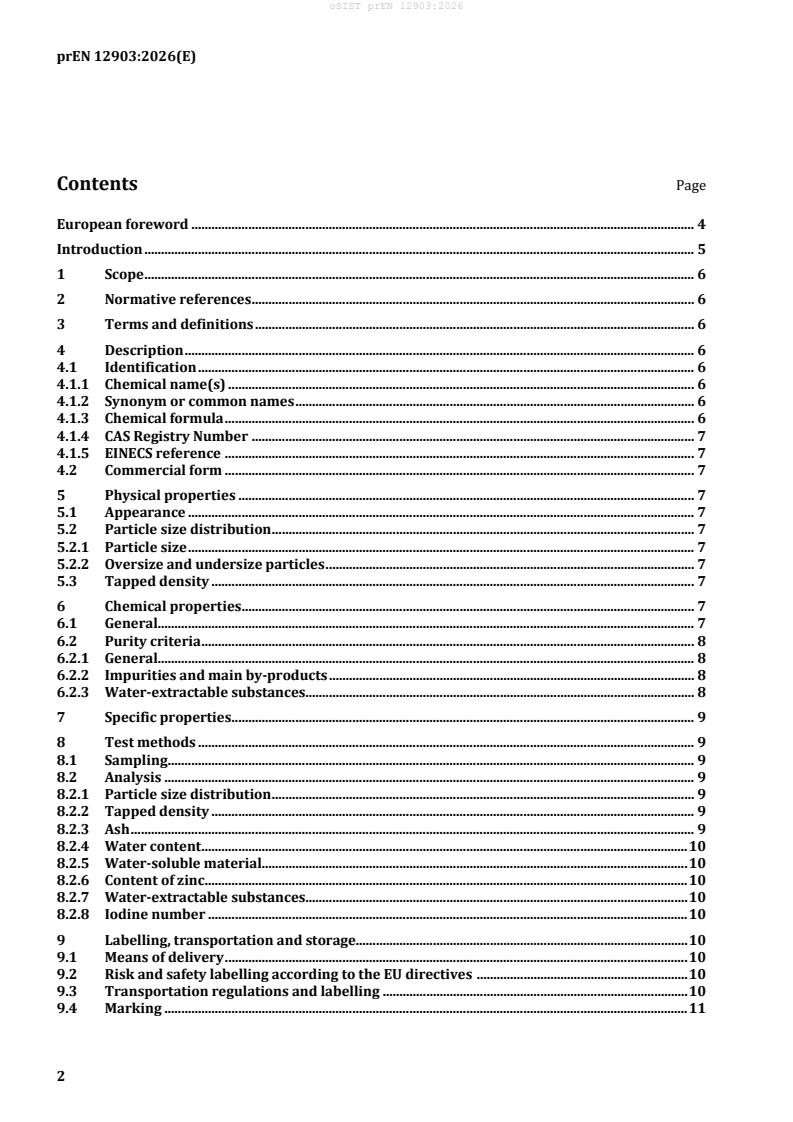
Contents
- Introduction
- 1 Scope
- 2 Normative references
- 3 Terms and definitions
- 3.1 activated Carbon – High Density Skeleton (steam activated carbon)
- 3.2 activated Carbon – Low Density Skeleton (chemically activated carbon)
- 4 Description
- 4.1 Identification
- 4.2 Commercial form
- 5 Physical properties
- 5.1 Appearance
- 5.2 Particle size distribution
- 5.3 Tapped density
- 6 Chemical properties
- 6.1 General
- 6.2 Purity criteria
- 7 Specific properties
- 8 Test methods
- 8.1 Sampling
- 8.2 Analysis
- 9 Labelling, transportation and storage
- 9.1 Means of delivery
- 9.2 Risk and safety labelling according to the EU directives
- 9.3 Transportation regulations and labelling
- 9.4 Marking
- 9.5 Storage
- Annex A
- Bibliography
Introduction
In respect of potential adverse effects on the quality of water intended for human consumption, caused by the product covered by this document:
a) this document provides no information as to whether the product may be used without restriction in any of the Member States of the EU or EFTA; b) it should be noted that, while awaiting the adoption of verifiable European criteria, existing national regulations concerning the use and/or the characteristics of this product remain in force. NOTE Conformity with this document does not confer or imply acceptance or approval of the product in any of the Member States of the EU or EFTA. The use of the product covered by this document is subject to regulation or control by National Authorities.
Attention is drawn to the possibility that some of the elements of this document may be the subject of patent rights. CEN [and/or CENELEC] shall not be held responsible for identifying any or all such patent rights.
oSIST prEN 12903:2026 prEN 12903:2026(E)
1 Scope
This document is applicable to powdered activated carbon used for treatment of water intended for human consumption. It describes the characteristics of powdered activated carbon and specifies the requirements and the corresponding test methods for powdered activated carbon. It gives information on its use in water treatment.
2 Normative references
The following documents are referred to in the text in such a way that some or all of their content constitutes requirements of this document. For dated references, only the edition cited applies. For undated references, the latest edition of the referenced document (including any amendments) applies. EN 12901, Products used for treatment of water intended for human consumption - Inorganic supporting and filtering materials - Definitions EN 12902, Products used for treatment of water intended for human consumption - Inorganic supporting and filtering materials - Methods of test
3 Terms and definitions
For the purposes of this document, the terms and definitions given in EN 12901 and the following apply. ISO and IEC maintain terminology databases for use in standardization at the following addresses:
- ISO Online browsing platform: available at https://www.iso.org/obp/
- IEC Electropedia: available at https://www.electropedia.org/
3.1 activated Carbon – High Density Skeleton (steam activated carbon)
activated carbon produced by charring and activation of raw materials with steam or other gases
3.2 activated Carbon – Low Density Skeleton (chemically activated carbon)
activated carbon produced by charring and activation of raw materials with chemical activation agents such as phosphoric acid
4 Description
4.1 Identification
4.1.1 Chemical name(s)
Activated Carbon – High Density Skeleton Activated Carbon – Low Density Skeleton
4.1.2 Synonym or common names
Activated coal, activated charcoal, active carbon, PAC.
4.1.3 Chemical formula
C (elementary).
oSIST prEN 12903:2026 prEN 12903:2026 (E) 1)
4.1.4 CAS Registry Number
7440-44-0.
2)
4.1.5 EINECS reference
931-328-0 (Activated Carbon – High Density Skeleton) 931-334-3 (Activated Carbon – Low Density Skeleton)
4.2 Commercial form
Powdered activated carbon is available in many grades, differing mainly in adsorption characteristics, porosity, particle size and purity.
5 Physical properties
5.1 Appearance
The product is a black powder.
5.2 Particle size distribution
5.2.1 Particle size
At least a mass fraction of 95 % shall have a particle size less than 150 µm. NOTE Other values can be necessary for certain applications. The particle size distribution is commonly specified as a given mass fraction less than a specified particle size. The particle size distribution shall be within the manufacturer’s declared values.
5.2.2 Oversize and undersize particles
The proportion of oversize and undersize particles shall be within the manufacturer’s declared values.
5.3 Tapped density
The tapped density shall be within the manufacturer’s declared values. 3 3 NOTE The tapped density of powdered activated carbon is typically in the range 200 kg/m to 750 kg/m .
6 Chemical properties
6.1 General
Powdered activated carbon is manufactured by controlled oxidation, by means of steam or chemicals, from carbonaceous raw materials including coconut, wood, peat or coal. The raw materials shall be stated by the manufacturer.
High internal porosity results in adsorptive properties and, depending on the raw material and the manufacturing process, it can have acid or basic properties. It is a reducing agent with catalytic properties. Activated carbon can react with oxidants to form carbon dioxide. The carbon content of the commercial product does not affect adsorption characteristics.
1) Chemical Abstracts Service Registry Number.
2) European Inventory of Existing Commercial Chemical Substances.
oSIST prEN 12903:2026 prEN 12903:2026(E)
6.2 Purity criteria
6.2.1 General
This document specifies the minimum purity requirements for powdered activated carbon used for the treatment of water intended for human consumption. Limits are given for impurities commonly present in the product.
Limits have been given for impurities and chemical parameters where these are likely to be present in significant quantities from the current production process and raw materials. If the production process or raw materials lead to significant quantities of other impurities, by-products or additives being present, this shall be notified to the user and, when necessary, to the relevant authorities. NOTE Users of this product should check the national regulations in order to clarify whether it is of appropriate purity for treatment of water intended for human consumption, taking into account raw water quality, contents of other impurities and additives used in the products not stated in the product standard.
6.2.2 Impurities and main by-products
The product shall conform to the requirements specified in Table 1. Table 1 — Main impurities and by-products a) Impurity Limit in mass fraction
b) Ash max. 15 c) d) Water (at the time of packing) max. 5 Water-soluble material max. 3 e) Zinc max. 0,002 a) Expressed on a dry basis except for water content.
...