

EN 447:2007
(Main)Grout for prestressing tendons - Basic requirements
- Abstract
This European Standard covers the materials that may be used in the manufacture of cement grouts and the required properties and composition of the grout. It is applicable to grouting of tendons in all types of structures including bridges and buildings.
- Status
- Published
- Publication Date
- 02-Oct-2007
- Technical Committee
- CEN/TC 104 - Concrete ( performance, production, placing and compliance criteria )
- Drafting Committee
- CEN/TC 104/SC 2 - Execution of concrete structures
- Current Stage
- 9093 - Decision to confirm - Review Enquiry
- Start Date
- 24-Jun-2025
- Completion Date
- 21-Oct-2026

Overview
EN 447:2007 - Grout for prestressing tendons: Basic requirements is a CEN European Standard that sets out the essential materials, composition and performance requirements for cement grouts used to grout prestressing tendons in all types of structures (bridges, buildings, post‑tensioned elements). Its aim is to ensure long‑term protection of prestressing steel, bond where required, and void filling to avoid corrosion and frost damage.
Key topics and technical requirements
- Materials
- Cement: comply with EN 197‑1 (CEM I or other permitted types); cement type must be declared.
- Water: comply with EN 1008.
- Admixtures: permitted in accordance with EN 934‑2 / EN 934‑4; follow manufacturer instructions.
- Additions: silica fume allowed if EN 13263 compliant; other concrete additions as permitted per EN 206‑1 and declared.
- Batching and mixing
- Materials batched by mass (water and liquid admixtures may be by mass or volume).
- Batching accuracy: ±2% for cement/dry admixtures/additions; ±1% for water/liquid admixtures.
- Mixing: mechanical mixing to produce homogeneous, stable grout; w/c ratio normally below 0.4 and must be declared.
- Performance and properties (testing per EN 445)
- Sieve test: no lumps retained.
- Fluidity: measured by cone or spread methods; limits apply immediately after mixing and 30 min later (fluidity must not change >20% over that period).
- Bleeding: ≤ 0.3% of initial volume after 3 h (wick‑induced or inclined tube test).
- Volume change: between −1% and +5% after 24 h at rest.
- Strength: ≥ 30 N/mm² at 28 days (or ≥ 27 N/mm² at 7 days if estimating 28‑day strength).
- Setting time: initial set ≥ 3 h, final set ≤ 24 h (EN 196‑3).
- Chemical limits: chloride ≤ 0.10% (by weight of cement), sulfates ≤ 4.5%, sulfide ions ≤ 0.01% (sum from constituent materials).
- Conformity & quality
- Manufacturer production control, initial type testing (new mixes or material changes), and periodic audit testing to confirm ongoing compliance.
Applications
- Grouting of prestressing tendons in:
- Bridges and civil infrastructure
- Commercial and residential buildings with post‑tensioning
- Precast prestressed elements
- Primary functions: protect prestressing steel from corrosion, provide bond where required, transfer transverse stresses and fill voids to prevent frost damage.
Who should use this standard
- Grout manufacturers and suppliers
- Structural and bridge engineers (specification and design)
- Contractors and specialist grouting crews (execution and mixing)
- Quality control/assurance inspectors and testing laboratories
- Procurement and standards teams writing specifications
Related standards
- EN 445 - Grout for prestressing tendons: Test methods
- EN 446 - Grout for prestressing tendons: Grouting procedures
- EN 196‑3, EN 197‑1, EN 206‑1, EN 934‑2 / EN 934‑4, EN 13263
EN 447:2007 is essential when specifying or testing cement grout for prestressing tendons, ensuring consistent performance, durability and safety of prestressed concrete works.
Relations
- Effective Date
- 22-Dec-2008
- Effective Date
- 28-Jan-2026
- Effective Date
- 28-Jan-2026
- Refers
EN 196-3:2016 - Methods of testing cement - Part 3: Determination of setting times and soundness - Effective Date
- 28-Jan-2026
- Effective Date
- 28-Jan-2026
- Effective Date
- 28-Jan-2026
- Effective Date
- 28-Jan-2026
- Effective Date
- 28-Jan-2026
- Effective Date
- 28-Jan-2026
- Effective Date
- 28-Jan-2026
- Effective Date
- 28-Jan-2026
- Effective Date
- 28-Jan-2026
- Effective Date
- 28-Jan-2026
- Effective Date
- 28-Jan-2026
- Effective Date
- 28-Jan-2026
Get Certified
Connect with accredited certification bodies for this standard

DIBt (Deutsches Institut für Bautechnik)
German Institute for Building Technology.
DIN CERTCO
DIN Group product certification.

Aboma Certification B.V.
Specialized in construction, metal, and transport sectors.
Sponsored listings
Frequently Asked Questions
EN 447:2007 is a standard published by the European Committee for Standardization (CEN). Its full title is "Grout for prestressing tendons - Basic requirements". This standard covers: This European Standard covers the materials that may be used in the manufacture of cement grouts and the required properties and composition of the grout. It is applicable to grouting of tendons in all types of structures including bridges and buildings.
This European Standard covers the materials that may be used in the manufacture of cement grouts and the required properties and composition of the grout. It is applicable to grouting of tendons in all types of structures including bridges and buildings.
EN 447:2007 is classified under the following ICS (International Classification for Standards) categories: 91.100.30 - Concrete and concrete products. The ICS classification helps identify the subject area and facilitates finding related standards.
EN 447:2007 has the following relationships with other standards: It is inter standard links to EN 447:1996, EN 13263-1:2005+A1:2009, EN 1008:2002, EN 196-3:2016, EN 13263-2:2005+A1:2009, EN 197-1:2011, EN 934-2:2009+A1:2012, EN 934-4:2009, EN 206-1:2000, EN 445:2007, EN 17678-1:2022, EN 446:2007, EN 1537:2013, EN 13670:2009, EN 14199:2015. Understanding these relationships helps ensure you are using the most current and applicable version of the standard.
EN 447:2007 is associated with the following European legislation: Standardization Mandates: M/BC/CEN/87/11. When a standard is cited in the Official Journal of the European Union, products manufactured in conformity with it benefit from a presumption of conformity with the essential requirements of the corresponding EU directive or regulation.
EN 447:2007 is available in PDF format for immediate download after purchase. The document can be added to your cart and obtained through the secure checkout process. Digital delivery ensures instant access to the complete standard document.
Standards Content (Sample)
2003-01.Slovenski inštitut za standardizacijo. Razmnoževanje celote ali delov tega standarda ni dovoljeno.Grout for prestressing tendons - Basic requirementsInjekcijska masa za prednapete kable - Osnovne zahteveCoulis pour câble de précontrainte - Prescriptions pour les coulis courantsEinpressmörtel für Spannglieder - Allgemeine AnforderungenTa slovenski standard je istoveten z:EN 447:2007SIST EN 447:2008en,fr,de91.100.30ICS:SIST EN 447:19981DGRPHãþDSLOVENSKI
STANDARDSIST EN 447:200801-marec-2008
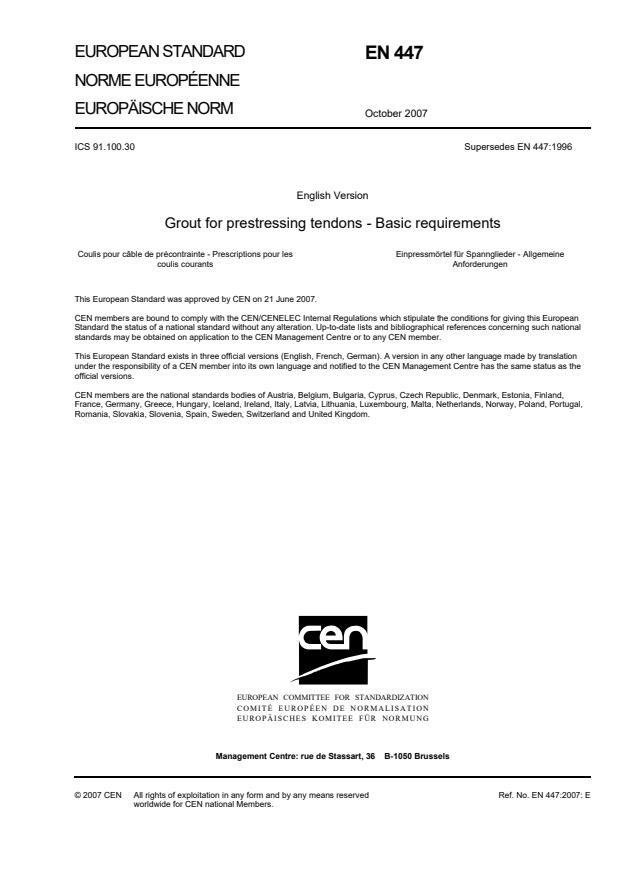
EUROPEAN STANDARDNORME EUROPÉENNEEUROPÄISCHE NORMEN 447October 2007ICS 91.100.30Supersedes EN 447:1996
English VersionGrout for prestressing tendons - Basic requirementsCoulis pour câble de précontrainte - Prescriptions pour lescoulis courantsEinpressmörtel für Spannglieder - AllgemeineAnforderungenThis European Standard was approved by CEN on 21 June 2007.CEN members are bound to comply with the CEN/CENELEC Internal Regulations which stipulate the conditions for giving this EuropeanStandard the status of a national standard without any alteration. Up-to-date lists and bibliographical references concerning such nationalstandards may be obtained on application to the CEN Management Centre or to any CEN member.This European Standard exists in three official versions (English, French, German). A version in any other language made by translationunder the responsibility of a CEN member into its own language and notified to the CEN Management Centre has the same status as theofficial versions.CEN members are the national standards bodies of Austria, Belgium, Bulgaria, Cyprus, Czech Republic, Denmark, Estonia, Finland,France, Germany, Greece, Hungary, Iceland, Ireland, Italy, Latvia, Lithuania, Luxembourg, Malta, Netherlands, Norway, Poland, Portugal,Romania, Slovakia, Slovenia, Spain, Sweden, Switzerland and United Kingdom.EUROPEAN COMMITTEE FOR STANDARDIZATIONCOMITÉ EUROPÉEN DE NORMALISATIONEUROPÄISCHES KOMITEE FÜR NORMUNGManagement Centre: rue de Stassart, 36
B-1050 Brussels© 2007 CENAll rights of exploitation in any form and by any means reservedworldwide for CEN national Members.Ref. No. EN 447:2007: E
• Provide protection to the prestressing steel against corrosion; • Provide a bond between the prestressing steel and the ducts where required for the design of the structure; • Allow transfer of compressive stresses in the structure in a direction transverse to internal tendons; • Fill all voids where water may accumulate and cause frost damage. The testing regimes anticipated by this European Standard include three levels: (1) Initial type and audit testing in accordance with this European standard; (2) Suitability testing for confirmation of the selected grout for a specific project in accordance with EN 446; (3) Inspection during grouting works on a specific project in accordance with EN 446. The test methods for each of the regimes are given in EN 445.
System of CEN and EOTA documents as basis for design, execution and materials selection for protective measures of prestressing systems (only main modules). EN 1992 Eurocode 2:Design of concrete structures prEN 13670 Execution of concrete structures ETAG 013 Post-tensioning kits for prestressing
of structuresEN 446 Grout for prestressing tendons Grouting proceduresEN 447 Grout for prestressing tendonsBasic requirementsEN 445 Grout for prestressing tendonsTest methods CEN Workshop Agreement CWA 14646 Requirements for the installation of post-tensioning kits for prestressing of structures and qualification of specialist company and its personnel.
1 Scope This European Standard covers the materials that may be used in the manufacture of cement grouts and the required properties and composition of the grout. It is applicable to grouting of tendons in all types of structures including bridges and buildings. 2 Normative references The following referenced documents are indispensable for the application of this document. For dated references, only the edition cited applies. For undated references, the latest edition of the referenced document (including any amendments) applies. EN 196-3, Methods of testing cement – Part 3: Determination of setting times and soundness EN 197-1, Cement – Part 1: Composition, specifications and conformity criteria for common cements EN 206-1:2000, Concrete – Part 1: Specification, performance, production and conformity EN 445, Grout for prestressing tendons – Test methods EN 446, Grout for prestressing tendons – Grouting procedures EN 934-2, Admixtures for concrete, mortar and grout – Part 2: Concrete admixtures - Definitions, requirements, conformity, marking and labelling
EN 934-4, Admixtures for concrete, mortar and grout – Part 4: Admixtures for grout for prestressing tendons – Definitions, requirements, conformity, marking and labelling EN 1008, Mixing water for concrete – Specification for sampling, testing and assessing the suitability of water, including water recovered from processes in the concrete industry, as mixing water for concr
...