

FprCEN/TS 18120-16
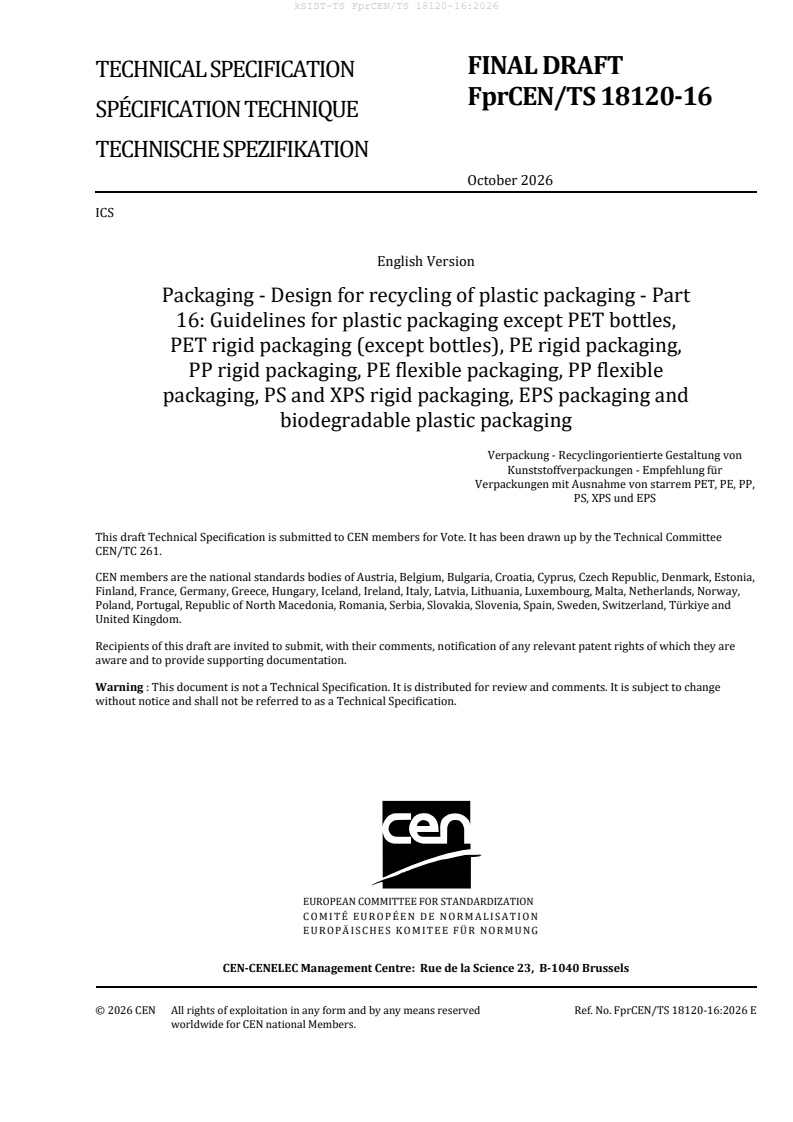
(Main)Packaging — Design for recycling of plastic packaging — Part 16: Guidelines for plastic packaging except PET bottles, PET rigid packaging (except bottles), PE rigid packaging, PP rigid packaging, PE flexible packaging, PP flexible packaging, PS and XPS rigid packaging, EPS packaging and biodegradable plastic packaging
- Abstract
This document covers design aspects of any packaging with the main body of the packaging unit predominantly made of any other plastic material or format than PET bottles, PET rigid packaging (except bottles), PE rigid packaging, PP rigid packaging, PE flexible packaging, PP flexible packaging, PS and XPS rigid packaging, EPS packaging and biodegradable plastic packaging. This document covers the packaging categories 9, 17 and 18 from Regulation 2025/40 and the design of separate components predominantly made of any other plastic than rigid PET, PE, PP, PS, XPS, EPS and biodegradable plastics with respect to compatibility of the design with state-of-the-art collecting, sorting and recycling processes and suitability for use as recyclate in an application. This document covers thermoplastic and thermoset polymers.
- Status
- Not Published
- Publication Date
- 17-Mar-2027
- Technical Committee
- CEN/TC 261 - Packaging
- Current Stage
- 5020 - Submission to Vote - Formal Approval
- Start Date
- 29-Oct-2026
- Due Date
- 22-Jul-2026
- Completion Date
- 29-Oct-2026

FprCEN/TS 18120-16 is a CEN draft Technical Specification in the EN 18120 series for design for recycling of plastic packaging. It gives guidelines for plastic packaging outside the PET, PE, PP, PS, XPS and EPS families covered by the other parts, and for separate plastic components made of other materials, so designers and recyclability assessors can judge compatibility with current collection, sorting and recycling systems. The document applies to thermoplastic and thermoset polymers.
What does FprCEN/TS 18120-16 specify?
FprCEN/TS 18120-16 specifies design aspects for plastic packaging whose main body is predominantly made of other plastic materials or formats than the named PET, PE, PP, PS, XPS, EPS and biodegradable packaging groups. It also covers packaging categories 9, 17 and 18 from Regulation 2025/40 and separate components made of other plastics, in relation to collectability, sortability, recyclability and use as recyclate.
The document is organized into:
- Clause 1 - Scope
- Clause 2 - Normative references
- Clause 3 - Terms and definitions
- Clause 4 - Generic aspects for design compatibility with recycling, with 4.1 general guidance, 4.2 composite main packaging bodies, and 4.3 integrated components made of a different material
What are the key requirements of FprCEN/TS 18120-16?
Scope and stream placement
FprCEN/TS 18120-16 is intended for packaging types not covered by the other EN 18120 parts. In practice, this means a designer uses this part when the packaging does not fall into the dedicated PET, PE, PP, PS, XPS or EPS guideline parts.
The series uses compatibility levels described in the introduction as green, yellow and red. These indicate full, limited or no compatibility with state-of-the-art collection, sorting and recycling, which helps teams decide whether a design is likely to move through existing systems without problems.
Clause 4.1 says packaging covered by this part shall not be sorted into the recycling streams described by other standards in the series unless full compatibility with that stream can be demonstrated. In practice, that means a design should not be assumed to fit a different recycling stream just because it uses plastic.
Composite main bodies
Clause 4.2 highlights that composite packaging, where the main body is predominantly plastic but also contains non-plastic material, can be harder to sort under EN 18120-3 and harder to recycle into secondary raw materials of sufficient quality. For engineers and buyers, the practical point is that mixed-material body designs need extra attention because they can reduce sorting performance and recycling yield.
Integrated components made of a different material
Clause 4.3 states that integrated paper, cardboard, metal, glass or wood components can affect sorting under EN 18120-3 and the recycling steps that follow. The document notes that state-of-the-art recycling can handle some such components, but not all, and that residues from removed components can still affect yield, processing or material quality.
FprCEN/TS 18120-16 therefore points designers toward removable integrated components made in a removable form, such as washable adhesive, parts attached without adhesive, or paper without fiberloss. In practice, this means the design should let the different material be removed cleanly, or avoid the mixed-material feature altogether.
What terms does FprCEN/TS 18120-16 define?
- Design for recycling - the design approach used to judge whether packaging is compatible with current collection, sorting and recycling systems.
- Packaging recyclability - the combination of design for recycling and proven collection, sorting and recycling in practice.
- In place expanded polyurethane - foam-in-bag or expandable foam fills that swell around products to create custom-fit protective cushions.
- Thermoplastic polyurethane (TPU) - an elastomeric polymer that combines rubber-like elasticity with the processability of thermoplastics.
- State-of-the-art collection, sorting and recycling - the current practical benchmark used throughout the series when judging compatibility.
Who uses FprCEN/TS 18120-16?
FprCEN/TS 18120-16 is used by packaging designers, packaging converters, brand owners, recyclability assessors and sustainability teams working with plastic packaging. It also matters to recycling technologists and quality managers who need to check whether a packaging design will sort, recycle and yield recyclate in current systems.
In practice, users apply it when choosing materials, deciding whether a mixed-material component should be removable, and checking whether a design belongs in a dedicated EN 18120 stream or in this generic part.
Which standards are used with FprCEN/TS 18120-16?
EN 18120-1 is the normative reference. It provides the shared definitions and principles for design for recycling that this part relies on.
EN 18120-3 is referenced in clauses 4.2 and 4.3 for sortability assessment. It contributes the evaluation framework used when a composite body or a different-material component may affect sorting.
The EN 18120 series parts named in the introduction provide the related material-specific guidelines and evaluation protocols for PET bottles, PET rigid packaging, PE and PP rigid and flexible packaging, PS and XPS rigid packaging, and EPS packaging. Part 16 fills the gap for other plastic packaging and mixed-material cases.
What does the FprCEN/TS 18120-16 document contain?
FprCEN/TS 18120-16 contains the foreword, introduction, scope, normative references, terms and definitions, and one short technical clause on generic design compatibility with recycling. Clause 4 is the core of the document.
The technical content is descriptive rather than procedural. It explains how composite plastic bodies and integrated non-plastic components can affect collection, sorting and recycling, and it points designers toward removable or cleanly separable solutions.
The document also sets out the EN 18120 series context and the compatibility labels used across the series. That framing is what users need when they are comparing packaging designs against current recycling practice.
Frequently Asked Questions
FprCEN/TS 18120-16 is a draft published by the European Committee for Standardization (CEN). Its full title is "Packaging — Design for recycling of plastic packaging — Part 16: Guidelines for plastic packaging except PET bottles, PET rigid packaging (except bottles), PE rigid packaging, PP rigid packaging, PE flexible packaging, PP flexible packaging, PS and XPS rigid packaging, EPS packaging and biodegradable plastic packaging". This standard covers: This document covers design aspects of any packaging with the main body of the packaging unit predominantly made of any other plastic material or format than PET bottles, PET rigid packaging (except bottles), PE rigid packaging, PP rigid packaging, PE flexible packaging, PP flexible packaging, PS and XPS rigid packaging, EPS packaging and biodegradable plastic packaging. This document covers the packaging categories 9, 17 and 18 from Regulation 2025/40 and the design of separate components predominantly made of any other plastic than rigid PET, PE, PP, PS, XPS, EPS and biodegradable plastics with respect to compatibility of the design with state-of-the-art collecting, sorting and recycling processes and suitability for use as recyclate in an application. This document covers thermoplastic and thermoset polymers.
This document covers design aspects of any packaging with the main body of the packaging unit predominantly made of any other plastic material or format than PET bottles, PET rigid packaging (except bottles), PE rigid packaging, PP rigid packaging, PE flexible packaging, PP flexible packaging, PS and XPS rigid packaging, EPS packaging and biodegradable plastic packaging. This document covers the packaging categories 9, 17 and 18 from Regulation 2025/40 and the design of separate components predominantly made of any other plastic than rigid PET, PE, PP, PS, XPS, EPS and biodegradable plastics with respect to compatibility of the design with state-of-the-art collecting, sorting and recycling processes and suitability for use as recyclate in an application. This document covers thermoplastic and thermoset polymers.
FprCEN/TS 18120-16 is available in PDF format for immediate download after purchase. The document can be added to your cart and obtained through the secure checkout process. Digital delivery ensures instant access to the complete standard document.
Standards Content (Sample)
SLOVENSKI STANDARD
01-december-2026
Embalaža - Načrtovanje za recikliranje plastične embalaže - 16. del: Smernice za
plastično embalažo, razen PET-plastenk, toge embalaže iz polietilen tereftalata
(PET), polietilena (PE), polipropilena (PP), polistirena (PS) in ekstrudiranega
polistirena (XPS), fleksibilne embalaže iz polietilena (PE) in polipropilena (PP),
embalaže iz ekspandiranega polistirena (EPS) ter biorazgradljive plastične
embalaže
Packaging - Design for recycling of plastic packaging - Part 16: Guidelines for plastic
packaging except PET bottles, PET rigid packaging (except bottles), PE rigid packaging,
PP rigid packaging, PE flexible packaging, PP flexible packaging, PS and XPS rigid
packaging, EPS packaging and biodegradable plastic packaging
Verpackung - Recyclingorientierte Gestaltung von Kunststoffverpackungen - Empfehlung
für Verpackungen mit Ausnahme von starrem PET, PE, PP, PS, XPS und EPS
Ta slovenski standard je istoveten z: FprCEN/TS 18120-16
ICS:
13.030.50 Recikliranje Recycling
55.020 Pakiranje in distribucija blaga Packaging and distribution of
na splošno goods in general
83.080.20 Plastomeri Thermoplastic materials
2003-01.Slovenski inštitut za standardizacijo. Razmnoževanje celote ali delov tega standarda ni dovoljeno.
FINAL DRAFT
TECHNICAL SPECIFICATION
SPÉCIFICATION TECHNIQUE
TECHNISCHE SPEZIFIKATION
October 2026
ICS
English Version
Packaging - Design for recycling of plastic packaging - Part
16: Guidelines for plastic packaging except PET bottles,
PET rigid packaging (except bottles), PE rigid packaging,
PP rigid packaging, PE flexible packaging, PP flexible
packaging, PS and XPS rigid packaging, EPS packaging and
biodegradable plastic packaging
Verpackung - Recyclingorientierte Gestaltung von
Kunststoffverpackungen - Empfehlung für
Verpackungen mit Ausnahme von starrem PET, PE, PP,
PS, XPS und EPS
This draft Technical Specification is submitted to CEN members for Vote. It has been drawn up by the Technical Committee
CEN/TC 261.
CEN members are the national standards bodies of Austria, Belgium, Bulgaria, Croatia, Cyprus, Czech Republic, Denmark, Estonia,
Finland, France, Germany, Greece, Hungary, Iceland, Ireland, Italy, Latvia, Lithuania, Luxembourg, Malta, Netherlands, Norway,
Poland, Portugal, Republic of North Macedonia, Romania, Serbia, Slovakia, Slovenia, Spain, Sweden, Switzerland, Türkiye and
United Kingdom.
Recipients of this draft are invited to submit, with their comments, notification of any relevant patent rights of which they are
aware and to provide supporting documentation.
Warning : This document is not a Technical Specification. It is distributed for review and comments. It is subject to change
without notice and shall not be referred to as a Technical Specification.
EUROPEAN COMMITTEE FOR STANDARDIZATION
COMITÉ EUROPÉEN DE NORMALISATION
EUROPÄISCHES KOMITEE FÜR NORMUNG
CEN-CENELEC Management Centre: Rue de la Science 23, B-1040 Brussels
© 2026 CEN All rights of exploitation in any form and by any means reserved Ref. No. FprCEN/TS 18120-16:2026 E
worldwide for CEN national Members.
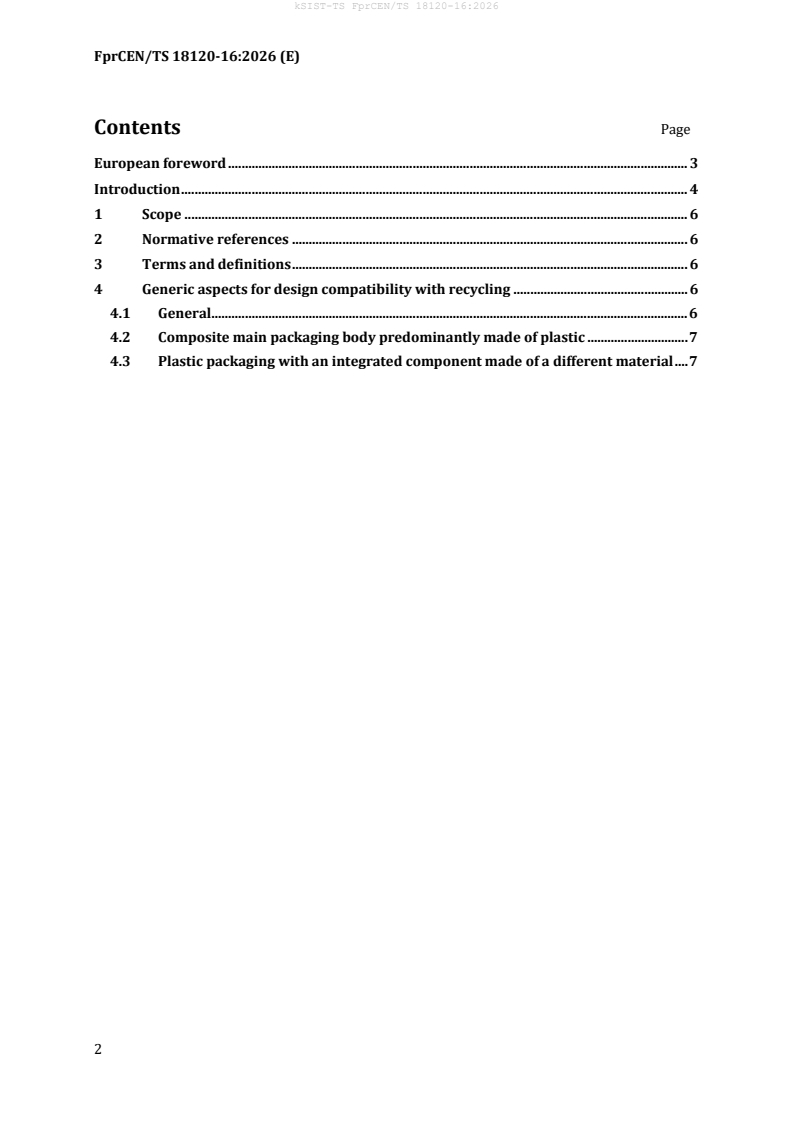
Contents Page
European foreword . 3
Introduction . 4
1 Scope . 6
2 Normative references . 6
3 Terms and definitions . 6
4 Generic aspects for design compatibility with recycling . 6
4.1 General . 6
4.2 Composite main packaging body predominantly made of plastic . 7
4.3 Plastic packaging with an integrated component made of a different material . 7
European foreword
This document (FprCEN/TS 18120-16:2026) has been prepared by Technical Committee CEN/TC
261 “Packaging”, the secretariat of which is held by AFNOR.
This document is currently submitted to the Vote on TS.
This document has been prepared to complete a standardization request M/584 addressed to CEN
by the European Commission with the aim to cover all categories described into the Packaging
and Packaging Waste Regulation. The Standing Committee of the EFTA States subsequently
approves these requests for its Member States.
Introduction
The series of standards EN 18120 consisting of multiple parts aims via a series of guidelines and
protocols to establish consistency and improvement for the Design for recycling of household,
industrial and commercial plastic packaging.
— Part 1: Definitions and principles for design-for-recycling of plastic packaging
— Part 3: Evaluation processes for the sortability of plastic packaging
— Part 4: Guideline for PET bottles
— Part 5: Guideline for PET rigid packaging (except bottles)
— Part 6: Guideline for PE and PP rigid packaging
— Part 7: Guideline for PE and PP flexible packaging
— Part 8: Guideline for PS and XPS rigid packaging
— Part 9: Guideline for EPS packaging
— Part 10: Recyclability evaluation process for plastic packaging — Protocols for PET bottles
— Part 11: Recyclability evaluation process for plastic packaging — Protocols for PET rigid
packaging (except bottles)
— Part 12: Recyclability evaluation process for plastic packaging — Protocols for PE and PP
...