

prEN 12999
(Main)Cranes - Loader cranes
- Abstract
This document specifies requirements for design, calculation, examinations and tests of hydraulic powered loader cranes and their mountings on vehicles or static foundations.
This document applies to loader cranes designed to be installed on:
- road vehicles, including trailers, with load carrying capability;
- tractors (road or agricultural), where only a towed trailer has capability to carry goods;
- demountable bodies to be carried by any of the above;
- other types of carriers (e.g. separate loaders, crawlers, rail vehicles, non-seagoing vessels);
- static foundations.
NOTE 1 A demountable body is a detachable frame designed to be carried by a vehicle or trailer.
NOTE 2 A separate loader is a vehicle, with no load carrying capacity, equipped with a loader crane and designed to load or unload other vehicles and trailers.
This document also applies to loader cranes equipped with special tools or interchangeable equipment (e.g. grapple, clamshell bucket, pallet clamp, etc.), as specified in the operator’s manual.
This document does not apply to loader cranes used on board sea going vessels or to articulated boom system cranes which are designed as total integral parts of special equipment such as forwarders.
The hazards covered by this document are identified in Clause 4.
This document does not cover hazards related to the lifting of persons.
NOTE 3 The use of cranes for lifting of persons can be subject to specific national regulations.
This document is not applicable to loader cranes manufactured before the publication of this document. For loader cranes designed before the publication of this document, the provisions concerning stress calculations in the version of EN 12999 that was valid at the time of their design, are still applicable.
- Status
- Not Published
- Publication Date
- 11-Nov-2027
- Technical Committee
- CEN/TC 147 - Cranes - Safety
- Drafting Committee
- CEN/TC 147/WG 18 - Loader cranes
- Current Stage
- 4020 - Submission to enquiry - Enquiry
- Start Date
- 16-Jul-2026
- Due Date
- 29-Jul-2026
- Completion Date
- 16-Jul-2026


prEN 12999 is a CEN draft European Standard for hydraulic powered loader cranes and their mountings on vehicles or static foundations. It specifies requirements for design, calculation, examination and testing, and it is aimed at crane manufacturers, installers, inspectors, and users who need a common safety basis. The document also covers instructions for use, marking, installation guidance, and verification methods.
What does prEN 12999 specify?
prEN 12999 specifies the safety and performance requirements for loader cranes, their mountings, and the checks used to verify them. It applies to cranes fitted on road vehicles, trailers, tractors, demountable bodies, other carriers such as crawlers, rail vehicles and non-seagoing vessels, and on static foundations.
The scope also includes loader cranes with special tools or interchangeable equipment, when these are covered in the operator’s manual. It excludes cranes on seagoing vessels, articulated boom system cranes that are integral parts of special equipment such as forwarders, and hazards related to lifting persons.
The document is organized into Clauses 1 to 7, followed by informative and normative annexes that add examples, calculation methods, control layouts, cabin requirements, installation guidance, and the link to EU machinery law.
| Annex | What it covers |
|---|---|
| A | Examples of configurations and mountings |
| B | Stress history parameter s and stress history classes S |
| C | Explanatory notes on rated capacity limiters, timber handling cranes, and control stations |
| D | Examples of dangerous movements |
| E | Symbols for working and setting-up functions |
| F | Preferred vertical control layout from the ground |
| G | Horizontal control layout order |
| H | Control levers for high seats and remote controls |
| I | Crane cabins for vehicle mounted loader cranes up to a net lifting moment of 250 kNm |
| J | Examples of raised control stations |
| K | Raised control stations - handrails, handholds, ladders and steps |
| L | Installation of a loader crane on a vehicle |
| M | Overview of crane standards published by CEN/TC 147 |
| ZA | Relationship to Regulation (EU) 2023/1230 |
What are the key requirements of prEN 12999?
prEN 12999 ties crane design to hazard control, verification, and information for use. The main practical message is that the crane must be designed for the loads, movements, stability, controls, installation, and operating information that match its intended use.
Design starts from risk reduction and load calculation
Clause 5.1 requires compliance with the safety measures in the document and use of EN ISO 12100:2010 principles for other relevant hazards. For rated capacity, the calculation is based on cylinder pressure, cylinder area, geometry, dead loads, and load combinations.
In practice, this means the manufacturer must base the crane’s lifting capability on measurable design data and not only on nominal ratings. The scope of the calculation affects the load chart, structure sizing, and later verification.
Structure and stability are treated as core safety issues
Clause 5.2 covers structural calculation, dynamic factors, load combinations, and foreseeable misuse. Clause 5.3 covers stress analysis, including bolted connections. Clause 5.4 addresses mechanical arrangements such as stabilizers, manual boom extensions, securing for transport, hoists, and hooks.
For users and installers, this means the crane must remain safe under working loads, movement effects, and expected handling mistakes. Annex B is useful here because it links duty and cycle history to stress history classes S, which supports fatigue-related decisions.
The hydraulic system must control motion and loss of pressure
Clause 5.5 covers pumps, reservoirs, pressure limiting devices, hoses, line rupture protection, sink rate, and the slewing mechanism. The document distinguishes ordinary loader cranes from timber handling cranes, where some line-rupture behaviour is treated differently because of the operating context.
In practice, the hydraulic system is not just a power source - it is a safety system. Designers have to control pressure, leakage, rupture effects, and unintended lowering so that loads do not move in an unsafe way.
Overload protection and limiting devices are central
Clause 5.6 requires limiting and indicating devices, including rated capacity limiters, rated capacity indicators, operational warnings, acoustic warning, motion limiters, speed limiters, and a stopping device at each control station. The clause also requires certain safety functions and tamper protection where a device can be inhibited.
This matters because many accidents start with overloading or with movements that reduce stability. Annex D shows examples of dangerous movements that overload protection is intended to stop, and Annex C explains how rated capacity limiters relate to cylinder forces and crane geometry.
Controls, stations, and access must support safe operation
Clauses 5.8 and 5.9 address control symbols, layout order, high-seat controls, remote controls, control stations, raised control stations, and access and egress. Annex E gives the symbols for working and setting-up functions, while Annexes F, G, and H show preferred layouts.
For operators, this reduces the chance of wrong lever selection or confusing control direction. For installers and designers, it means the control station must be arranged so the operator can see the load and reach the controls safely.
Electrical systems, installation, and EMC are part of the safety package
Clause 5.10 covers electrical systems and electromagnetic compatibility. Clause 5.12 covers mounting, stability, electrical installation, and access. Annex L gives installation data for a vehicle-mounted crane, including sub-frame considerations and PTO and pump displacement information.
This is important because a correctly designed crane can still be unsafe if mounted badly or affected by electrical interference. Installers need vehicle data, power data, and stability data before fitting the crane.
Verification combines calculation, inspection, and testing
Clause 6 requires conformity to be verified by calculation and/or test. It includes functional tests, static tests, dynamic tests, stability tests, test documentation, and documentation of variable rated capacity. The first crane of a series needs conceptual verification for loss of mechanical strength.
For buyers and auditors, this means the standard expects evidence, not only design declarations. Clause 6.3 also sets the measurement approach for noise from self-powered loader cranes.
Instructions and marking complete the safety case
Clause 7 requires instructions for the installer, instructions for use, maintenance instructions, and marking. The information includes rated capacity, inclination limits, pre-start checks, ground conditions, temperature range, noise information, and stress history data.
This matters in daily use because safe operation depends on the operator knowing the crane limits and the installer knowing the fitting data. The marking clauses identify the manufacturer, installer, loads, slewing centre, maximum ground load, and special signs for timber handling cranes and high seats.
What terms does prEN 12999 define?
prEN 12999 defines the main crane parts and several safety terms used throughout the document.
- Loader crane - A power driven hoisting mechanism with a slewing column and boom system designed for loading and unloading vehicles.
- Self-powered loader crane - A loader crane with its power source and hydraulic pump built into the machine.
- Rated capacity - The load the crane is designed to lift for a given operating condition such as configuration and load position.
- Rated capacity limiter - A system that automatically prevents handling loads above the rated capacity.
- Control station - The position from which the loader crane is operated.
- Stabilizer - An aid connected to the crane base or vehicle that improves stability without lifting the vehicle from the ground.
- SRP/CS (Safety Related Parts of Control System) - The control-system parts that perform safety functions and are assessed for safety performance.
Who uses prEN 12999?
prEN 12999 is used by crane manufacturers, vehicle body builders, crane installers, and designers who need to design and mount loader cranes. It is also used by health and safety bodies, market surveillance authorities, accident prevention organizations, service providers, and maintenance teams.
In practice, manufacturers use it for design and type verification, installers use it for fitting and commissioning, and buyers or specifiers use it to compare equipment on a common safety basis. Users and employers use it for operation, checks, and maintenance planning.
What changed in prEN 12999 from the previous edition?
prEN 12999 will supersede EN 12999:2020+A1:2025. The European foreword states one significant technical change: the document now addresses the risk of data corruption in Clause 5.7.
Which standards are used with prEN 12999?
prEN 12999 relies on dated normative references for design, testing, controls, access, hydraulics, electrics, noise, and documentation.
| Reference | What it contributes |
|---|---|
| EN ISO 12100:2010 | General risk assessment and risk reduction principles |
| EN 13001-1, EN 13001-2, EN 13001-3-1, EN 13001-3-2, EN 13001-3-5, EN 13001-3-6 | Crane design principles, load actions, and component strength checks |
| EN 13135:2013+A1:2018 | Requirements for crane equipment |
| EN 13557:2024 | Control devices and control stations |
| EN 13586:2020 | Access to cranes |
| EN ISO 4413:2010 | Hydraulic safety rules |
| EN IEC 61000-6-2:2019 and EN IEC 61000-6-4:2019 | EMC immunity and emission in industrial environments |
| EN ISO 11201:2010 and EN ISO 3744:2026 | Noise measurement methods |
| EN ISO 20607:2019 | Instruction handbook drafting principles |
| EN 62745:2017 and EN 62745:2017/A11:2020 | Cableless control systems |
| EN 12077-2:2024 | Limiting and indicating devices |
| EN 60204-32:2008 | Electrical equipment of hoisting machines |
What does the prEN 12999 document contain?
prEN 12999 contains hazard lists, structural and hydraulic calculation requirements, control and station layouts, verification methods, and operating information requirements. It also includes test procedures for functional, static, dynamic, stability, and noise verification.
The annexes add practical material that the clauses refer to: example configurations, stress-history calculations, dangerous movement examples, control symbols, cabin dimensions, raised-station access measures, and vehicle installation data. Annex ZA links the normative clauses to the essential requirements of Regulation (EU) 2023/1230.
Relations
- Effective Date
- 10-Sep-2025
Frequently Asked Questions
prEN 12999 is a draft published by the European Committee for Standardization (CEN). Its full title is "Cranes - Loader cranes". This standard covers: This document specifies requirements for design, calculation, examinations and tests of hydraulic powered loader cranes and their mountings on vehicles or static foundations. This document applies to loader cranes designed to be installed on: - road vehicles, including trailers, with load carrying capability; - tractors (road or agricultural), where only a towed trailer has capability to carry goods; - demountable bodies to be carried by any of the above; - other types of carriers (e.g. separate loaders, crawlers, rail vehicles, non-seagoing vessels); - static foundations. NOTE 1 A demountable body is a detachable frame designed to be carried by a vehicle or trailer. NOTE 2 A separate loader is a vehicle, with no load carrying capacity, equipped with a loader crane and designed to load or unload other vehicles and trailers. This document also applies to loader cranes equipped with special tools or interchangeable equipment (e.g. grapple, clamshell bucket, pallet clamp, etc.), as specified in the operator’s manual. This document does not apply to loader cranes used on board sea going vessels or to articulated boom system cranes which are designed as total integral parts of special equipment such as forwarders. The hazards covered by this document are identified in Clause 4. This document does not cover hazards related to the lifting of persons. NOTE 3 The use of cranes for lifting of persons can be subject to specific national regulations. This document is not applicable to loader cranes manufactured before the publication of this document. For loader cranes designed before the publication of this document, the provisions concerning stress calculations in the version of EN 12999 that was valid at the time of their design, are still applicable.
This document specifies requirements for design, calculation, examinations and tests of hydraulic powered loader cranes and their mountings on vehicles or static foundations. This document applies to loader cranes designed to be installed on: - road vehicles, including trailers, with load carrying capability; - tractors (road or agricultural), where only a towed trailer has capability to carry goods; - demountable bodies to be carried by any of the above; - other types of carriers (e.g. separate loaders, crawlers, rail vehicles, non-seagoing vessels); - static foundations. NOTE 1 A demountable body is a detachable frame designed to be carried by a vehicle or trailer. NOTE 2 A separate loader is a vehicle, with no load carrying capacity, equipped with a loader crane and designed to load or unload other vehicles and trailers. This document also applies to loader cranes equipped with special tools or interchangeable equipment (e.g. grapple, clamshell bucket, pallet clamp, etc.), as specified in the operator’s manual. This document does not apply to loader cranes used on board sea going vessels or to articulated boom system cranes which are designed as total integral parts of special equipment such as forwarders. The hazards covered by this document are identified in Clause 4. This document does not cover hazards related to the lifting of persons. NOTE 3 The use of cranes for lifting of persons can be subject to specific national regulations. This document is not applicable to loader cranes manufactured before the publication of this document. For loader cranes designed before the publication of this document, the provisions concerning stress calculations in the version of EN 12999 that was valid at the time of their design, are still applicable.
prEN 12999 is classified under the following ICS (International Classification for Standards) categories: 53.020.20 - Cranes. The ICS classification helps identify the subject area and facilitates finding related standards.
prEN 12999 has the following relationships with other standards: It is inter standard links to EN 12999:2020+A1:2025. Understanding these relationships helps ensure you are using the most current and applicable version of the standard.
prEN 12999 is associated with the following European legislation: EU Directives/Regulations: 2023/1230; Standardization Mandates: M/605. When a standard is cited in the Official Journal of the European Union, products manufactured in conformity with it benefit from a presumption of conformity with the essential requirements of the corresponding EU directive or regulation.
prEN 12999 is available in PDF format for immediate download after purchase. The document can be added to your cart and obtained through the secure checkout process. Digital delivery ensures instant access to the complete standard document.
Standards Content (Sample)
SLOVENSKI STANDARD
01-julij-2026
Dvigala - Nakladalna dvigala
Cranes - Loader cranes
Krane - Ladekrane
Appareils de levage à charge suspendue - Grues de chargement
Ta slovenski standard je istoveten z: prEN 12999
ICS:
53.020.20 Dvigala Cranes
2003-01.Slovenski inštitut za standardizacijo. Razmnoževanje celote ali delov tega standarda ni dovoljeno.
DRAFT
EUROPEAN STANDARD
NORME EUROPÉENNE
EUROPÄISCHE NORM
July 2026
ICS 53.020.20 Will supersede EN 12999:2020+A1:2025
English Version
Cranes - Loader cranes
Appareils de levage à charge suspendue - Grues de Krane - Ladekrane
chargement
This draft European Standard is submitted to CEN members for enquiry. It has been drawn up by the Technical Committee
CEN/TC 147.
If this draft becomes a European Standard, CEN members are bound to comply with the CEN/CENELEC Internal Regulations
which stipulate the conditions for giving this European Standard the status of a national standard without any alteration.
This draft European Standard was established by CEN in three official versions (English, French, German). A version in any other
language made by translation under the responsibility of a CEN member into its own language and notified to the CEN-CENELEC
Management Centre has the same status as the official versions.
CEN members are the national standards bodies of Austria, Belgium, Bulgaria, Croatia, Cyprus, Czech Republic, Denmark, Estonia,
Finland, France, Germany, Greece, Hungary, Iceland, Ireland, Italy, Latvia, Lithuania, Luxembourg, Malta, Netherlands, Norway,
Poland, Portugal, Republic of North Macedonia, Romania, Serbia, Slovakia, Slovenia, Spain, Sweden, Switzerland, Türkiye and
United Kingdom.
Recipients of this draft are invited to submit, with their comments, notification of any relevant patent rights of which they are
aware and to provide supporting documentation.
Warning : This document is not a European Standard. It is distributed for review and comments. It is subject to change without
notice and shall not be referred to as a European Standard.
EUROPEAN COMMITTEE FOR STANDARDIZATION
COMITÉ EUROPÉEN DE NORMALISATION
EUROPÄISCHES KOMITEE FÜR NORMUNG
CEN-CENELEC Management Centre: Rue de la Science 23, B-1040 Brussels
© 2026 CEN All rights of exploitation in any form and by any means reserved Ref. No. prEN 12999:2026 E
worldwide for CEN national Members.
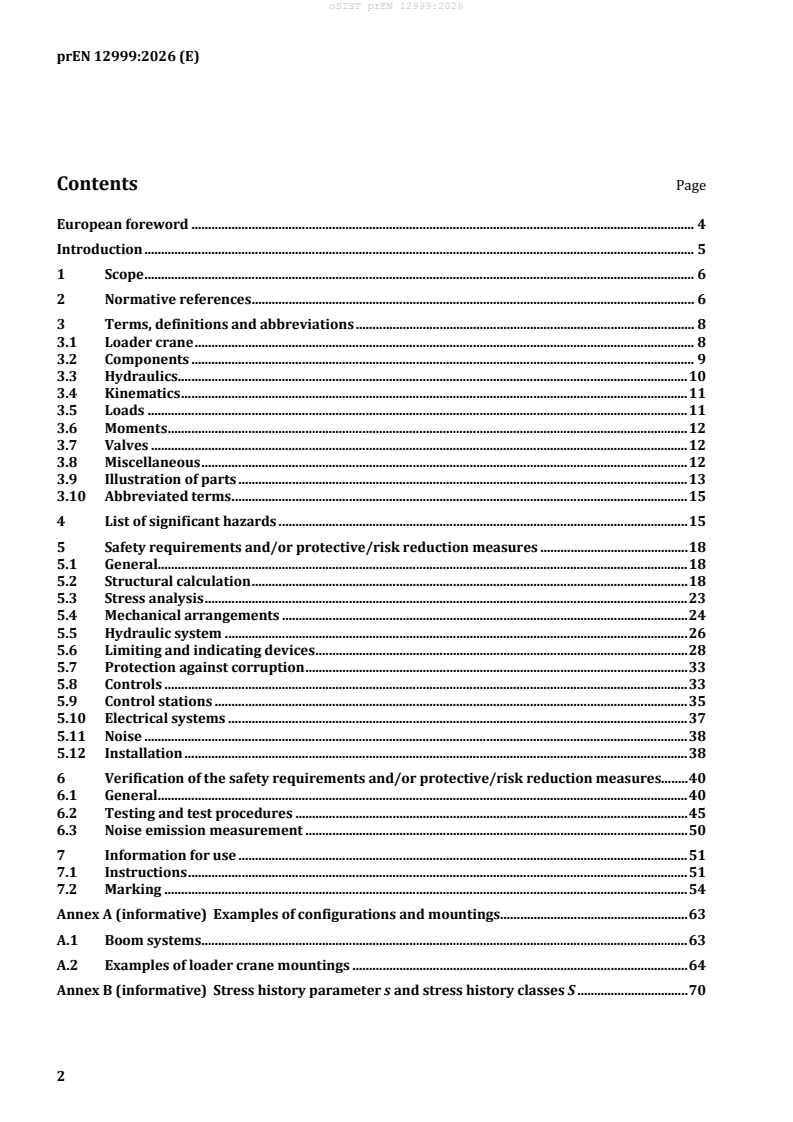
Contents Page
European foreword . 4
Introduction . 5
1 Scope . 6
2 Normative references . 6
3 Terms, definitions and abbreviations . 8
3.1 Loader crane . 8
3.2 Components . 9
3.3 Hydraulics. 10
3.4 Kinematics . 11
3.5 Loads . 11
3.6 Moments . 12
3.7 Valves . 12
3.8 Miscellaneous . 12
3.9 Illustration of parts . 13
3.10 Abbreviated terms . 15
4 List of significant hazards . 15
5 Safety requirements and/or protective/risk reduction measures . 18
5.1 General. 18
5.2 Structural calculation . 18
5.3 Stress analysis . 23
5.4 Mechanical arrangements . 24
5.5 Hydraulic system . 26
5.6 Limiting and indicating devices . 28
5.7 Protection against corruption . 33
5.8 Controls . 33
5.9 Control stations . 35
5.10 Electrical systems . 37
5.11 Noise . 38
5.12 Installation . 38
6 Verification of the safety requirements and/or protective/risk reduction measures. 40
6.1 General. 40
6.2 Testing and test procedures . 45
6.3 Noise emission measurement . 50
7 Information for use . 51
7.1 Instructions . 51
7.2 Marking . 54
Annex A (informative) Examples of configurations and mountings. 63
A.1 Boom systems. 63
A.2 Examples of loader crane mountings . 64
Annex B (informative) Stress history parameter s and stress history classes S . 70
Annex C (informative) Explanatory notes. 74
C.1 Rated capacity limiters . 74
C.2 Safety functions of the rated capacity limiter . 74
C.3 Timber handling cranes – Line rupture . 75
C.4 Control stations . 75
Annex D (informative) Examples of dangerous movements . 76
Annex E (normative) Symbols for working and setting-up functions . 78
Annex F (informative) Control system – Preferred vertical layout for controls operated from
the ground . 80
Annex G (informative) Control system – Horizontal layout order . 82
Annex H (informative) Control levers for high seats and remote controls . 85
H.1 High seat controls . 85
H.2 Remote controls . 85
Annex I (normative) Crane cabins fitted on vehicle mounted loader cranes up to a net lifting
moment of 250 kNm . 88
Annex J (informative) Examples of raised control stations . 91
Annex K (normative) Raised control stations – Measures regarding handrails and
handholds, ladders and steps . 94
Annex L (informative) Installation of a loader crane on a vehicle . 97
L.1 General . 97
L.2 Installation: minimum data . 97
L.3 Power take off (PTO) and pump displacement . 99
L.4 Calculation method for determination of sub-frame dimensions . 100
Annex M (informative) Overview of standards published by CEN/TC 147 . 103
M.1 General . 103
M.2 Selecting a suitable standard . 103
Annex ZA (informative) Relationship between this European Standard and the essential
requirements of Regulation (EU) 2023/1230 aimed to be covered . 105
Bibliography . 108
European foreword
This document prEN 12999:2026 has been prepared by Technical Committee CEN/TC 147 “Cranes -
Safety”, the secretariat of which is held by SFS.
This document is currently submitted to the CEN Enquiry.
This document will supersede EN 12999:2020+A1:2025.
EN 12999:2020+A1:2025:
— addressing the risk of data corruption, see 5.7.
This document has been prepared under a standardization request addressed to CEN by the European
Commission. The Standing Committee of the EFTA States subsequently approves these requests for its
Member States.
For the relationship with EU Legislation, see informative Annex ZA, which is an integral part of this
document.
Introduction
This document is a type-C standard as stated in EN ISO 12100:2010.
This document is of relevance, in particular, for the following stakeholder groups representing the market
players with regard to machinery safety:
— machine manufacturers (small, medium and large enterprises);
— health and safety bodies (regulators, accident prevention organizations, market surveillance, etc.).
Others can be affected by the level of machinery safety achieved with the means of the document by the
above-mentioned stakeholder groups:
— machine users/employers (small, medium and large enterprises);
— machine users/employees (e.g. trade unions, organizations for people with special needs);
— service providers, e.g. for maintenance (small, medium and large enterprises);
— consumers (in case of machinery intended for use by consumers).
The above-mentioned stakeholder groups have been given the possibility to participate at the drafting
process of this document.
The machinery concerned and the extent to which hazards, hazardous situations or hazardous events are
covered are indicated in the Scope of this document.
When requirements of this type-C standard are different from those which are stated in type-A or type-B
standards, the requirements of this type-C standard take precedence over the requirements of the other
standards for machines that have been designed and built according to the requirements of this type-C
standard.
The machinery concerned and the extent to which hazards are covered are indicated in the scope of this
document.
1 Scope
This document specifies requirements for design, calculation, examinations and tests of hydraulic
powered loader cranes and their mountings on vehicles or static foundations.
This document applies to loader cranes designed to be installed on:
— road vehicles, including trailers, with load carrying capability;
— tractors (road or agricultural), where only a towed trailer has capability to carry goods;
— demountable bodies to be carried by any of the above;
— other types of carriers (e.g. separate loaders, crawlers, rail vehicles, non-seagoing vessels);
— static foundations.
NOTE 1 A demountable body is a detachable frame designed to be carried by a vehicle or trailer.
NOTE 2 A separate loader is a vehicle, with no load carrying capacity, equipped with a loader crane and designed
to load or unload other vehicles and trailers.
This document also applies to loader cranes equipped with special tools or interchangeable equipment
(e.g. grapple, clamshell bucket, pallet clamp, etc.), as specified in the operator’s manual.
This document does not apply to loader cranes used on board sea going vessels or to articulated boom
system cranes which are designed as total integral parts of special equipment such as forwarders.
The hazards covered by this document are identified in Clause 4.
This document does not cover hazards related to the lifting of persons.
NOTE 3 The use of cranes for lifting of persons can be subject to specific national regulations.
This document is not applicable to loader cranes manufactured before the publication of this document.
For loader cranes designed before the publication of this document, the provisions concerning stress
calculations in the version of EN 12999 that was valid at the time of their design, are still applicable.
2 Normative references
The following documents are referred to in the text in such a way that some or all of their content
constitutes requirements of this document. For dated references, only the edition cited applies. For
undated references, the latest edition of the referenced document (including any amendments) applies.
NOTE In the event of conflicting statements between referenced documents and this document, the statements
in this document apply.
EN 1677-2:2000+A1:2008, Components for slings — Safety — Part 2: Forged steel lifting hooks with latch,
Grade 8
EN 12077-2:2024, Cranes safety — Requirements for health and safety — Part 2: Limiting and indicating
devices
EN 14492-2:2019, Cranes — Power driven winches and hoists — Part 2: Power driven hoists
EN 13001-1:2015, Cranes — General design — Part 1: General principles and requirements
EN 13001-2:2021, Crane safety — General design — Part 2: Load actions
EN 13001-3-1:2025, Cranes — General design — Part 3-1: Limit states and proof competence of steel
structure
EN 13001-3-2:2014, Cranes — General design — Part 3-2: Limit states and proof of competence of wire
ropes in reeving systems
EN 13001-3-5:2025, Cranes — General design — Part 3-5: Limit states and proof of competence of forged
and cast hooks
EN 13001-3-6:2026, Cranes — General design — Part 3-6: Limit states and proof of competence of
machinery — Hydraulic cylinders
EN 13135:2013+A1:2018, Cranes — Safety — Design — Requirements for equipment
EN 13557:2024, Cranes — Control devices and control stations
EN 13586:2020, Cranes — Access
EN 14033-2:2017, Railway applications — Track — Railbound construction and maintenance machines —
Part 2: Technical requirements for travelling and working
EN IEC 61000-6-2:2019, Electromagnetic compatibility (EMC) — Part 6-2: Generic standards — Immunity
standard for industrial environments (IEC 61000-6-2:2016)
EN IEC 61000-6-4:2019, Electromagnetic compatibility (EMC) — Part 6-4: Generic standards — Emission
standard for industrial environments (IEC 61000-6-4:2018)
EN 60204-32:2008, Safety of machinery — Electrical equipment of machines — Part 32: Requirements for
hoisting machines (IEC 60204-32:2008)
EN 62745:2017, Safety of machinery — Requirements for cableless control systems of machinery
EN 62745:2017/A11:2020, Safety of machinery — Requirements for cableless control systems of machinery
EN ISO 898-1:2013, Mechanical properties of fasteners made of carbon steel and alloy steel — Part 1: Bolts,
screws and studs with specified property classes — Coarse thread and fine pitch thread (ISO 898-1:2013)
EN ISO 898-1:2013/AC:2013, Mechanical properties of fasteners made of carbon steel and alloy steel —
Part 1: Bolts, screws and studs with specified property classes — Coarse thread and fine pitch thread —
Technical Corrigendum 1 (ISO 898-1:2013/Cor 1:2013)
EN ISO 3744:2026, Acoustics — Determination of sound power levels of noise sources using sound pressure
— Engineering methods for an essentially free field over a reflecting plane (ISO 3744:2025, including
corrected version 2026-01)
EN ISO 4413:2010, Hydraulic fluid power — General rules and safety requirements for systems and their
components (ISO 4413:2010)
EN ISO 5353:1998, Earth-moving machinery, and tractors and machinery for agriculture and forestry —
Seat index point (ISO 5353:1995)
EN ISO 6892-1:2019, Metallic materials — Tensile testing — Part 1: Method of test at room temperature
(ISO 6892-1:2019)
EN ISO 11201:2010, Acoustics — Noise emitted by machinery and equipment — Determination of emission
sound pressure levels at a work station and at other specified positions in an essentially free field over a
reflecting plane with negligible environmental corrections (ISO 11201:2010)
EN ISO 11688-1:2009, Acoustics — Recommended practice for the design of low-noise machinery and
equipment — Part 1: Planning (ISO/TR 11688-1:1995)
EN ISO 12100:2010, Safety of machinery — General principles for design — Risk assessment and risk
reduction (ISO 12100:2010)
EN ISO 13849-1:2023, Safety of machinery — Safety-related parts of control systems — Part 1: General
principles for design (ISO 13849-1:2023)
EN ISO 13849-2:2012, Safety of machinery — Safety-related parts of control systems — Part 2: Validation
(ISO 13849-2:2012)
EN ISO 13854:2019, Safety of machinery — Minimum gaps to avoid crushing of parts of the human body
(ISO 13854:2017)
EN ISO 13857:2019, Safety of machinery — Safety distances to prevent hazard zones being reached by
upper and lower limbs (ISO 13857:2019)
EN ISO 20607:2019, Safety of machinery — Instruction handbook — General drafting principles
(ISO 20607:2019)
3 Terms, definitions and abbreviations
For the purposes of this document, the following terms and definitions apply
ISO and IEC maintain terminology databases for use in standardization at the following addresses:
— ISO Online browsing platform: available at https://www.iso.org/obp/
— IEC Electropedia: available at https://www.electropedia.org/
3.1 Loader crane
3.1.1
loader crane
power driven hoisting mechanism comprising a column, which slews about a base, and a boom system
which is attached on to the top of the column and being designed for loading and unloading vehicles
Note 1 to entry: Annex A gives examples of configuration and mountings.
3.1.2
self -powered loader crane
loader crane that has power source and hydraulic pump as integral parts of the machine
3.1.3
timber handling crane
loader crane specifically designed, manufactured and equipped with a grapple for loading/unloading of
unprepared timber (e.g. tree trunks, branches)
3.2 Components
3.2.1
base
housing incorporating anchoring points and bearings for the slewing column
3.2.2
boom
structural member in the articulated system of the loader crane
3.2.3
manual boom extension
part of the articulated system which can be manually attached or manually extended to increase the
outreach of the articulated system
3.2.4
boom system
complete system, consisting of booms, boom extensions and cylinders
3.2.5
column
structural member which supports the boom system
3.2.6
control system
interface between the operating levers and the actuating components which provide movements of the
loader crane
3.2.7
control station
position from which the loader crane may be operated
3.2.8
high seat
control station connected to the column, consequently rotating with the crane
3.2.9
hoist
machines for lifting and lowering suspended loads over predetermined distances, using ropes, chains or
belts
3.2.10
raised control station
control station that cannot be reached from the ground level, i.e. a high seat attached to the column of the
loader crane or a platform positioned above the base of the loader crane
Note 1 to entry: See Annex J.
3.2.11
stabilizer
aid to the supporting structure connected to the base of the crane or to the vehicle to provide stability,
without lifting the vehicle from the ground
3.2.12
stabilizer extension
part of the stabilizer capable of extending the stabilizer leg laterally from the transport position to the
operating position
3.2.13
stabilizer leg
part of a stabilizer capable of contacting the ground to provide the required stability
3.2.14
static foundation
fixed support incorporating mounting points for a crane
3.2.15
crane cabin
cabin attached to the crane, designed to operate the crane
3.2.16
vehicle cabin
cabin being part of the vehicle, mainly designed to operate the vehicle
3.2.17
leg tilting device
powered device that enables rotating the stabilizer leg to a raised position
3.2.18
stabilizer control station
position from which the stabilizers can be operated
3.3 Hydraulics
3.3.1
current working pressure
working pressure acting on the piston area, giving the same resultant force as the actual pressures acting
on both sides of the piston, and that corresponds to the rated capacity at any time
3.3.2
hydraulic line rupture
failure of a hydraulic line which results in a loss of pressure in the line
3.3.3
maximum working pressure
maximum pressure in pump circuit or individual working function
3.3.4
sink rate
distance in a given time at which the load lowers due to internal leakage of hydraulic components
3.3.5
stability test pressure
equivalent pressure acting on the piston area of the 1st boom cylinder, used for stability testing and giving
the same resultant force as the actual pressures acting on both sides of the piston
3.4 Kinematics
3.4.1
crane inclination
angle between the slewing axis and a vertical line, due to working on slanted or uneven ground
3.4.2
lifting movement
raising or lowering of the boom system and/or the load which causes a change in its vertical position
3.4.3
maximum outreach
largest outreach shown on the load chart
3.4.4
outreach
horizontal distance between the axis of rotation of the column and point of load attachment
3.4.5
hydraulic outreach
outreach which can be obtained with hydraulically actuated parts of the boom system
3.4.6
slewing
rotational movement of the column and boom system about the axis of the column
3.5 Loads
3.5.1
dead load
force due to masses of fixed and movable crane parts which act permanently on the structure while the
crane is being used
3.5.2
gross load
sum of payload, lifting attachments and if applicable a portion of the hoist rope
3.5.3
maximum working load
maximum load that may be lifted shown on the load plate
3.5.4
payload
load which is lifted by the crane and suspended from the non-fixed load-lifting attachment(s) or, if such
an attachment is not used, directly from the fixed load lifting attachment(s)
3.5.5
rated capacity
load that the crane is designed to lift for a given operating condition (e.g. configuration, position of the
load)
3.5.6
rated capacity indicator
device which gives, within tolerance limits specified in 5.6.2.1, at least a continuous indication that the
rated capacity is exceeded, and another continuous indication (on certain crane types) of the approach
to the rated capacity
3.5.7
rated capacity limiter
system that automatically prevents the crane from handling loads in excess of its rated capacity (see also
C.1)
3.6 Moments
3.6.1
net lifting moment
rated capacity multiplied by outreach
3.6.2
total lifting moment
sum of net lifting moment and the moment produced by dead loads
3.7 Valves
3.7.1
load holding valve
valve which is normally closed and is opened by an external force to enable flow of fluid out of a hydraulic
actuator
3.7.2
main relief valve
valve which limits the pressure supplied to the hydraulic system of the crane
3.7.3
port relief valve
valve which limits the pressure supplied to a hydraulic actuator
3.7.4
pressure relief valve
valve which automatically relieves the hydraulic oil to the tank when the pressure exceeds a specified
value
3.8 Miscellaneous
3.8.1
hazard zone
danger zone
any space within and/or around machinery in which a person can be exposed to a hazard
[SOURCE: EN ISO 12100:2010, 3.11]
3.8.2
setting-up function
crane function used to prepare the crane for lifting
3.8.3
vessel
floating installation that the crane is mounted on
3.9 Illustration of parts
The terms which are used in this document for the main parts of a loader crane are indicated in Figure 1
a) and b).
Boom system consists of items 6 to 12 plus items 16 to 22, if applicable.
a)
b)
Key
1 base 9 2nd boom cylinder 17 3rd boom
2 stabilizer extension 10 boom extension, hydraulic 18 3rd boom cylinder
3 stabilizer leg 11 extension cylinders 19 boom extension, hydraulic
4 slewing mechanism, e.g. rack and 12 boom extension, manual 20 extension cylinders
pinion, slewing ring
5 Column 13 hook 21 hook
6 1st boom 14 controls 22 boom extension, manual
7 1st boom cylinder 15 stabilizer foot
8 2nd boom 16 3rd boom adapter
Figure 1 — Main parts of a loader crane
3.10 Abbreviated terms
Table 1 — Abbreviated terms
Abbreviation Meaning
SRP/CS Safety Related Parts of Control System
PL Performance Level
PFH Average probability of dangerous failure per hour
D
PLr Performance Level Required
MTTF expectation of the mean time to dangerous failure
D
4 List of significant hazards
Table 2 shows a list of significant hazardous situations and hazardous events that could result in risks to
persons during intended use and foreseeable misuse. It also contains corresponding cross-references to
the relevant clauses in this document that are necessary to reduce or eliminate the risks associated with
those hazards. As a minimum, the hazards covered by Table 2 shall be included in the risk assessment.
Table 2 — List of significant hazards and associated requirements
No. Hazards Relevant clause(s) in
this document
1 Mechanical hazards due to:
1.1 - Inadequacy of mechanical strength of the crane 5.1, 5.2, 5.3, 5.4, 5.5.8,
and its parts 5.9.2.1, 5.9.2.2
1.2 Crushing hazard 5.9.1, 5.9.2.3, 5.12.2.3
1.3 Shearing hazard 5.9.1, 5.9.2.3, 5.12.2.3
1.4 Entanglement hazard 5.9.1, 5.9.2.2, 5.9.2.3,
5.12.2.3
1.5 Drawing-in or trapping hazard 5.9.1, 5.9.2.2, 5.9.2.3,
5.12.2.3
1.6 Impact hazard 5.9.1, 5.9.2.3, 5.12.2.3
1.7 High pressure fluid injection or ejection hazard 5.5.1, 5.5.5, 5.12.2.3,
5.12.7, 7.1.3.6, 7.1.4.2
1.8 Ejection of parts 5.4.1.2, 5.4.1.3, 5.4.2, 5.4.3
1.9 Loss of stability 5.4.1, 5.6.1, 5.6.3, 5.12.2.1,
5.12.3
1.10 Slip, trip, fall 5.9.2.2, 5.9.2.3, 5.9.2.4,
5.12.5
No. Hazards Relevant clause(s) in
this document
2 Electrical hazards due to:
2.1 Contact of persons with live parts (direct contact) 5.10, 5.12.4, 7.1.3.1 d)
2.2 Approach to live parts under high voltage 5.6.1.4, 5.9.1, 7.1.3.1 d)
2.3 Electrostatic phenomena Not applicable.
2.4 Thermal radiation or other phenomena such as the Not applicable.
projection of molten particles and chemical effects
from short circuits, overloads, etc.
3 Thermal hazards, resulting in:
3.1 Burns, scalds and other injuries by possible contact 5.5.5, 5.12.2.3
of persons with objects or materials with an
extreme high or low temperature, by flames or
explosions and also by radiation of heat sources
3.2 Damage to health by hot or cold working 5.9.1, Annex I
environment
4 Hazards generated by noise 5.11, 6.3, 7.1.3.9
- Hearing loss.
- Tinnitus, physiological disorders, stress.
- Risks (accidents, reduced intelligibility of
messages) due to interference with speech
communication and perception of acoustic signals.
5 Hazards generated by materials and substances
(and their constituent elements) processed or
used by the machinery
5.1 Hazards from contact with or inhalation of harmful 5.12.2.3, 7.1.4.1
fluids, gases, mists, fumes and dusts
6 Hazards generated by neglecting ergonomic
principles in machinery design, as e.g. hazards
from:
6.1 Unhealthy postures or excessive effort 5.4.1.3, 5.4.2, 5.8, 5.9,
5.12.5
6.2 Inadequate consideration of hand-arm or foot-leg 5.8, 5.9
anatomy
6.3 Inadequate local lighting 7.1.3.7 f)
6.4 Human error, human behaviour 5.6, 5.8.1, 5.8.2, 7.1.3,
7.1.4, Annex E
6.5 Inadequate design, location or identification of 5.4.1.3, 5.4.3, 5.8, 5.9,
manual controls Annex E
6.6 Inadequate design or location of visual display 5.6.1.1
units
No. Hazards Relevant clause(s) in
this document
7 Unexpected start-up, unexpected
overrun/overspeed(or any similar
malfunction) from:
7.1 Failure/disorder of the control system 5.5.6.1, 5.5.6.2, 5.5.7,
5.6.1.3, 5.6.6, 5.6.8, 5.8.1
8 Hazards caused by missing and/or incorrectly
positioned safety related measures/ means
8.1 Guards 5.5.5, 5.8.1, 5.9.2.2, 5.9.2.3,
5.12.2.3
8.2 Safety related (protection) devices 5.4.1, 5.4.3, 5.6.3, 5.6.6,
5.6.7
8.3 Safety signs, signals, symbols 5.4.1.3, 5.6.7, 5.8.2, 7.1.4,
7.2.5, Annex E
8.4 Information or warning devices 5.6.1, 5.6.4, 5.6.7, 7.1, 7.2
8.5 Visibility 5.4.3, 5.9.1, 7.2.4.1
8.6 Emergency devices 5.6.3, 5.6.8
9 Assembly errors 7.1.2, 7.1.4
10 Loss of stability/overturning of machine 5.4.1, 5.6.1, 5.6.2, 5.6.3,
5.6.4, 5.6.5, 5.6.6, 5.12.3,
6.2.5
11 Mechanical hazards and hazardous events
11.1 From load falls, collisions, machine tipping caused
by:
11.1.1 Lack of stability 5.12.3, 6.2.5
11.1.2 Uncontrolled loading – overloading – stabilizing 5.5.4, 5.6.1, 5.6.2, 5.6.3,
moment exceeded 5.6.4, 5.6.5
11.1.3 Uncontrolled amplitude of movements 5.6.6
11.1.4 Unexpected/unintended movement of loads 5.5.5, 5.5.6, 5.5.7, 5.5.8
11.1.5 Inadequate holding devices/ accessories 5.4.2, 7.1.3.7
11.2 From access of persons to load support 7.1.3.1 e)
11.3 From insufficient mechanical strength of parts 5.1, 5.2, 5.3, 5.5.8, 5.12.2
11.4 From abnormal conditions of 5.12, 7.1, 7.2
assembly/testing/use/maintenance
12 Hazards generated by neglecting ergonomic
principles
12.1 Insufficient visibility from the driving position 5.9.1
5 Safety requirements and/or protective/risk reduction measures
5.1 General
Machinery shall conform to the safety requirements and/or protective/risk reduction measures of this
clause. In addition, the machine shall be designed in accordance with the principles of EN ISO 12100:2010
for other relevant but less significant hazards, which are not dealt with by this document.
The rated capacity shall be calculated from the following:
a) the working pressure in the cylinders;
b) the area of the load carrying cylinders;
c) the geometry;
d) dead loads;
e) load combinations.
For the purpose of the calculations rated capacity is equal to gross load.
5.2 Structural calculation
5.2.1 Information to be given in the calculation
The following information shall be given in the calculation:
a) type of crane and method of operation;
b) the assumed number of all load or working cycles;
c) details of the load-carrying system reflecting actual service conditions including outline drawings and
principal dimensions;
d) the assumed loading conditions including maximum crane inclination;
e) the governing hoisting class, hoist drive class and stress history classes or stress history parameters;
f) the material for the individual components and joints;
g) the shapes, dimensions and static cross-section values of all load-carrying members;
h) the analyses separately for the individual structural components and essential connections.
5.2.2 Dynamic factors
5.2.2.1 Hoisting and gravity effects of the mass of the crane
The dynamic effects due to vibrations of the structure when raising or lowering a load shall be included
in the calculation by applying the factor ϕ on the gravitational forces due to the masses of the crane. It
shall be used for the design of the crane structure itself and its supports. For load combinations A1, B1
and C1, the value of ϕ shall be the lowest of the two values 1,1 and ϕ , or expressed as an equation:
1 2
ϕ = min (1,1 ; ϕ )
1 2
In general ϕ = 1,1. However, it shall not exceed the value of ϕ in case ϕ is less than 1,1.
1 2 2
shall be 0,95.
For load combinations A2 and B2, the value of ϕ1
5.2.2.2 Hoisting and gravity effects of the gross load
In the case of hoisting or grounding a load as well as starting or stopping a vertical motion, the vibrational
effects shall be included in the calculation by multiplying the gravitational force due to the mass of the
ϕ
hoisted gross load by a factor , see Figure 2.
Key
mH mass of the gross load
vH vertical hoisting speed
F force from the gross load
ϕ2 dynamic factor on the gross load
g gravity constant
Figure 2 — Dynamic effect when hoisting a load
The factor ϕ shall be taken as follows:
ϕ2 = ϕ2,min + β2 × vh
ϕ β
and are given in Table 3 for the appropriate hoisting class. Loader cranes are assigned to hoisting
2,min 2
classes HC1 and HC2 in accordance with their dynamic and elastic characteristics:
— HC1 for crane mounted on a vehicle or structures of equivalent flexibility;
— HC2 for rigidly mounted cranes, e.g. mounted on a static foundation or vessel.
Rigidly mounted cranes, equipped with a device that limits the peak pressure (e.g. an accumulator) in the
first boom cylinder, may be assigned to HC1.
v
is the steady vertical hook speed, in metres per second, related to the lifting attachment. Values of v
h h
are given in Table 4.
Table 3 — Value of β and ϕ
2 2,min
Hoisting class of β ϕ for HD1 and HD4 ϕ for HD5
2 2,min 2,min
appliance
HC1 0,17 1,05 1,05
HC2 0,34 1,10 1,05
Table 4 — Values of v
h
Load combination Type of control system and its operation method
HD1 HD4 HD5
A1, B1 v 0,5 × v v = 0
h,max h,max h
C1 v v 0,5 × v
h,max h,max h,max
Key
HD1 is when the lifting movement can only be operated at a fixed speed, e.g. simple on-off control;
HD4 is when the start of the lifting movement is performed with continuously increasing speed, e.g.
proportional spool valve;
HD5 is when the step-less control automatically ensures that the dynamic factor ϕ2 does not exceed ϕ2,min,
e.g. electronically controlled proportional pressure compensated spool valve;
vh,max is the maximum vertical hook speed.
In load combinations A1 and B1, v is the maximum vertical hook speed that is given by any single
h,max
hydraulic drive action.
In load combination C1, vh,max is the maximum vertical hook speed from all booms being rotated (i.e.
articulated) simultaneously.
NOTE In load combinations A and B it is assumed that the dynamic peaks from simultaneous movements do
not coincide. The unlikely event that the dynamic peaks coincide and are superimposed is covered by load
combination C1.
5.2.2.3 Effect of sudden release of a part of the gross load
For cranes that release or drop a part of the gross load as a working procedure during intended use, such
as when grabs or magnets are used, the peak dynamic effect on the crane can be simulated by multiplying
the gross load by the factor Φ .
The value shall be given by:
Φ = 1 – Δm × (1 + β)/m
where
m is the mass of the gross load;
Δm is the released or dropped part of the gross load;
β = 0,5 for cranes equipped with grabs or similar slow-release devices;
β = 1,0 for cranes equipped with magnets or similar rapid-release devices.
5.2.2.4 Effects caused by acceleration/deceleration of the slewing drive
The dynamic factor Φ shall have the value 1,05 for hook duty and 1,3 for bucket or grapple duty.
5h
5.2.3 Loads and forces
5.2.3.1 General
The following loads and forces shall be taken into account:
a) regular loads:
1) dead loads;
2) gross load;
3) dynamic forces;
4) centrifugal forces;
b) occasional loads:
1) in-service wind loads;
2) other climatic and environmental effects such as temperature, snow and ice;
3) loads due to vessel motions and accelerations;
4) loads on stairways, platforms and handrails;
c) exceptional loads:
1) test loads;
2) loads caused by movements suddenly stopped by a mechanical device, e.g. end stroke of slewing
cylinder or a safety device, e.g. emergency stop, hydraulic line rupture valve;
3) sudden release of the load, e.g. rope failure, sling failure;
4) forces due to simultaneous dynamic peaks caused by raising or lowering a load at the maximum
sum of the vertical speeds from all articulation drives.
5.2.3.2 Regular loads
5.2.3.2.1 Dead loads
The dead loads shall be computed as the gravitational forces due to masses of fixed and movable crane
parts which act permanently on the structure.
5.2.3.2.2 Gross load
The gross load shall be computed as the gravitational force due to the sum of payload, lifting attachments
and if applicable a portion of the hoist rope.
5.2.3.2.3 Forces due to acceleration/deceleration of the slewing drive
The horizontal loads from the masses of the crane and of the gross load shall be calculated as follows:
F = m × g × tan α, α ≥ 3°
hi i
where
F is the horizontal load i acting on the gross load or a mass point of the boom;
hi
m is the gross load or mass point of boom;
i
g is the gravity acceleration;
α is the maximum inclination for the crane in accordance with the manufacturer’s
specification. This value shall include the effect of list and trim of vessel with cranes mounted.
However, the minimum value that may be used is α = 3°.
5.2.3.2.4 Centrifugal forces
The centrifugal forces acting on slewing cranes shall only be calculated from the dead load of the boom
system components, the counterweight, if applicable, and the gross load without applying the factors
mentioned in 5.2.2.
5.2.3.2.5 Forces on stabilizer legs
The stabilizer legs shall be loaded by simultaneously acting vertical and horizontal forces. The horizontal
force shall act at the stabilizer foot with the leg at its maximum length and in the direction laterally
outwards from the vehicle. The magnitude of the horizontal force shall be at least 5 % of the vertical force.
5.2.3.3 Occasional loads
5.2.3.3.1 Wind loads
Wind loads shall be calculated according to EN 13001-2:2021, Clause 4.2.3.1 and Annex A. Only in-service
wind needs to be applied.
5.2.3.3.2 Loads from vessel accelerations due to waves
Loads arising from crane support accelerations caused by wave motions (sway, surge and heave for
translational motions and roll, pitch and yaw for angular motions of the vessel) shall be accounted for.
The accelerations shall be applied to the masses of the crane and the gross load.
5.2.3.3.3 Loads from relative motions of vessel
Loads due to relative motions between the crane supporting vessel and the load supporting fixed (e.g.
quay constructions) or moving structure (e.g. floating units, vessels, barges) shall be accounted for and
applied to the masses of the crane and the gross load.
5.2.3.3.4 Loads from acceleration due to quay landing impact of vessel
L
...