

prEN 1491
(Main)Building valves - Expansion valves - Tests and requirements
- Abstract
This document specifies dimensions, materials and performance requirements (including methods of test) for expansion valves, of nominal sizes from DN 15 to DN 50, having working pressures ) from 0,1 MPa (1 bar) to 1,0 MPa (10 bar).
Expansion valves are intended for fitting to the cold potable water supply of storage water heaters, having a maximum distribution temperature of 95 °C, for all energy sources.
Expansion valves do not control the temperature and alone do not constitute the protection required for storage water heaters. Expansion valves limit pressure, in the water heaters to what they are fitted, that is produced by thermal expansion of the water.
NOTE The use of the device specified in this document does not override the need to use controls (e.g. thermostats and cut-outs) which act directly on the power sources of water heaters (for more information see Annex A).
- Status
- Not Published
- Publication Date
- 19-Jul-2027
- Technical Committee
- CEN/TC 164 - Water supply
- Current Stage
- 4020 - Submission to enquiry - Enquiry
- Start Date
- 10-Sep-2026
- Due Date
- 07-Apr-2026
- Completion Date
- 10-Sep-2026

prEN 1491 is a CEN draft European Standard for building valves - expansion valves - tests and requirements. It specifies dimensions, materials, performance requirements and test methods for expansion valves used on the cold potable water supply of storage water heaters. The document is aimed at manufacturers, test laboratories and technical buyers who need to select, test, mark or document these valves.
What does prEN 1491 specify?
prEN 1491 specifies requirements for expansion valves of nominal sizes DN 15 to DN 50 and working pressures from 0,1 MPa (1 bar) to 1,0 MPa (10 bar). It applies to valves fitted to the cold potable water supply of storage water heaters with a maximum distribution temperature of 95 °C, for all energy sources.
prEN 1491 also makes clear that an expansion valve does not control temperature and, by itself, does not provide the full protection needed for a storage water heater. In practice, the valve limits pressure rise caused by thermal expansion of the water, while the installation still needs the appropriate controls on the heat source.
The document is organized into clauses on scope, normative references, terms and definitions, materials, compatibility with disinfection, design and pressure characteristics, test apparatus, hydraulic tests, mechanical tests, classification, designation, marking, and technical documents.
| Annex | What it covers |
|---|---|
| Annex A | Test sequences for expansion valves |
| Annex B | Classification of water heaters according to heating method |
| Annex C | Disinfection of test rig |
What are the key requirements of prEN 1491?
prEN 1491 combines product design requirements with the tests used to verify them. For a manufacturer or buyer, the most important point is that the valve must meet the stated geometry, pressure behavior, material durability and marking rules before it can be accepted for use on a storage water heater.
Materials and durability
prEN 1491 requires the materials to be corrosion resistant or protected against corrosion, and different materials used together must not damage each other. That matters because these valves work in potable water installations and need to remain functional over time.
Where dezincification-resistant copper alloy is required, the material must be tested to EN ISO 6509-1 and marked “DR” in the cases stated by the standard. The practical effect is that the buyer can identify valves intended for more demanding water conditions.
The outside and inside surfaces may have a coating, but the coating must not impair function. For materials with inadequate corrosion resistance, the document requires a salt spray test to EN ISO 9227, with the whole device tested and the result judged against the cold water pressure test after exposure.
For brass bodies with female threads to EN 10226-1 and compression ends to EN 1254-2, prEN 1491 requires a residual stress test based on ISO 6957. The body must show no stress corrosion cracking, which helps prevent cracking failures in service.
Design, dimensions and pressure behavior
prEN 1491 requires the spring to be isolated from the water by a diaphragm or an equivalent arrangement. Sliding parts must not seize or stick, rotating or sliding parts must not be in contact with water, and the setting parts must not be reachable by the end user without damaging the device.
The valve body must have at least two suitable flats for a spanner, and the device must include an operating control that can be checked regularly. If the rotary control works in only one direction, that direction must be counterclockwise, and the valve must close when manual effort is removed.
The nominal outlet diameter must be at least equal to the inlet dimension. End connections are to follow the relevant European standards, and heat-joined connections such as capillary joints are not permitted. The outlet passage to an air break to drain must have a smallest cross-section of at least 4 mm, and the discharge connection to drain service must meet EN 1717 and EN 806-2.
The pressure requirements define how the valve opens and closes in service and in testing. The nominal set pressure must not be greater than 1,0 MPa (10 bar), the water tightness pressure is related to the nominal set pressure, the valve must start to open at the opening pressure, the flow at the opening point must exceed 2,4 l/h, the rating pressure is higher again, and the closing pressure must fall below the nominal set pressure. In practice, these limits define the valve's protection function and the acceptance limits for test results.
Test methods and apparatus
prEN 1491 sets tolerances for laboratory testing so results are comparable. Flow rate and pressure are controlled to ±2 %, cold water temperature to ±5 K, hot water temperature to ±2 K, time to +10 %, and force to ±5 %. Measuring instruments must be accurate to ±2 %, except temperature measurement, which must be ±1 K.
The cold water pressure test verifies opening pressure, water tightness, opening flow and discharge flow. The device is first operated manually and stored, then tested at ambient water temperature without moving the operating control. The test includes repeated pressure changes and a 120 s water-tightness hold.
The endurance test subjects the valve to 10 000 cycles at 65 °C or the maximum temperature specified by the manufacturer, at a pressure above the opening pressure. The result from the cold water pressure test must remain within ±10 % of its original value.
The operating control is also checked separately. It must be workable under the defined force or torque limits, and after 300 opening operations at 65 °C it must still operate within those limits and allow water flow.
Mechanical strength, classification and marking
prEN 1491 includes mechanical strength tests for the body, the operating control, threaded connections and captive nuts or tail pieces. The body pressure test uses 2,5 MPa for 120 s, the bending moment test applies a DN-dependent bending load, and the torsional and torque tests check that the connecting parts do not suffer visible damage.
The valves are classified according to the characteristics of the water heater, including inlet size, output power and volume. Annex B links this classification to heater heating methods and to the other safety devices typically used with them.
Each valve must be designated by DN, nominal set pressure and the reference to this document. It must also be permanently marked with the manufacturer identification, DN, nominal set pressure, flow direction, operating positions, manufacture date or code, model reference, and, where applicable, “DR”.
What terms does prEN 1491 define?
- Expansion valve - a valve that limits the pressure of water in the heater by discharging water to drain.
- Air break to drain - a vertical separation or full disconnection between the outlet and the atmospheric overflow spill level.
- Nominal set pressure (Pnr) - the pressure set during production.
- Water tightness pressure - the pressure up to which the valve remains closed.
- Initial opening pressure (Pdc) - the pressure at which the valve opens for the first time after storage, shown by the first droplet at the outlet.
- Opening pressure (Po) - the pressure at which water first appears at the outlet.
- Rating pressure (Pdn) - the pressure at which the discharged flow is above the specified limit.
- Closing pressure (Pf) - the pressure at which the valve closes after reaching the rating pressure.
Who uses prEN 1491?
prEN 1491 is used by manufacturers of building valves, test laboratories, quality teams, installers and technical buyers working with storage water heaters and potable water systems. It is also relevant to designers and specifiers who need to choose a valve that matches the heater size, pressure setting and installation method.
What changed in prEN 1491 from the previous edition?
prEN 1491 will supersede EN 1491:2022. The European foreword states these significant technical changes:
- the materials chapter was completely revised
- testing with disinfectant was introduced
- a torque test was added
- testing of the expansion valve was changed and optimized
- the coating test procedure was revised
- normative references were updated
- editorial changes were made throughout the document
Which standards are used with prEN 1491?
prEN 1491 relies on several referenced standards that define installation rules, connection details and test methods:
- EN 806 (all parts) - specifications for installations inside buildings conveying water for human consumption; used for installation and maintenance context, and referred to in the technical documentation and Annex B.
- EN 1254-2 - compression fittings for use with copper tubes; relevant to connection types and the residual stress test.
- EN 1717 - protection against pollution of potable water installations; used for drain connection requirements.
- EN 10226-1 - thread dimensions and designation for pressure-tight threaded joints; used for threaded connections and torsional testing.
- EN ISO 6509-1 - dezincification resistance test for copper alloys; used for DR materials.
- EN ISO 9227 - salt spray corrosion testing; used for the corrosion resistance test.
- EN ISO 228-1 and EN 1254-20 - referenced as examples of relevant connection standards for end connections.
- EN 14597 - used in Annex B for temperature control and temperature limit devices in water-heater systems.
- EN 1487, EN 1488, EN 1489, EN 1490, EN 1213, EN 13828, EN 13959 and EN 1567 - cited in Annex B and the bibliography as related valve and safety-device standards for water-heater installations.
What does the prEN 1491 document contain?
The document includes the pressure relationships for set pressure, tightness, opening, rating, closing and initial opening conditions, together with the figures used to explain them. It also provides the test chemicals and conditions in Table 1, the discharge flow requirements in Table 2, and the mechanical loads in Tables 3 and 4.
Clause 8 contains the hydraulic test procedures, including the cold water pressure test, repeat determinations, endurance test and operating control tests. Clause 9 contains the mechanical strength tests for the body, control mechanism, threaded body connections and captive rotating nuts or tail pieces.
Annex A gives the sequence in which tests are carried out on different samples. Annex B provides the water-heater classification logic and the device combinations associated with indirect and direct heating systems. Annex C shows an example of a disinfection test rig used for compatibility testing.
Relations
- Effective Date
- 18-Dec-2024
Get Certified
Connect with accredited certification bodies for this standard

DIBt (Deutsches Institut für Bautechnik)
German Institute for Building Technology.

DIN CERTCO
DIN Group product certification.

Aboma Certification B.V.
Specialized in construction, metal, and transport sectors.
Sponsored listings
Frequently Asked Questions
prEN 1491 is a draft published by the European Committee for Standardization (CEN). Its full title is "Building valves - Expansion valves - Tests and requirements". This standard covers: This document specifies dimensions, materials and performance requirements (including methods of test) for expansion valves, of nominal sizes from DN 15 to DN 50, having working pressures ) from 0,1 MPa (1 bar) to 1,0 MPa (10 bar). Expansion valves are intended for fitting to the cold potable water supply of storage water heaters, having a maximum distribution temperature of 95 °C, for all energy sources. Expansion valves do not control the temperature and alone do not constitute the protection required for storage water heaters. Expansion valves limit pressure, in the water heaters to what they are fitted, that is produced by thermal expansion of the water. NOTE The use of the device specified in this document does not override the need to use controls (e.g. thermostats and cut-outs) which act directly on the power sources of water heaters (for more information see Annex A).
This document specifies dimensions, materials and performance requirements (including methods of test) for expansion valves, of nominal sizes from DN 15 to DN 50, having working pressures ) from 0,1 MPa (1 bar) to 1,0 MPa (10 bar). Expansion valves are intended for fitting to the cold potable water supply of storage water heaters, having a maximum distribution temperature of 95 °C, for all energy sources. Expansion valves do not control the temperature and alone do not constitute the protection required for storage water heaters. Expansion valves limit pressure, in the water heaters to what they are fitted, that is produced by thermal expansion of the water. NOTE The use of the device specified in this document does not override the need to use controls (e.g. thermostats and cut-outs) which act directly on the power sources of water heaters (for more information see Annex A).
prEN 1491 is classified under the following ICS (International Classification for Standards) categories: 91.140.60 - Water supply systems. The ICS classification helps identify the subject area and facilitates finding related standards.
prEN 1491 has the following relationships with other standards: It is inter standard links to EN 1491:2022. Understanding these relationships helps ensure you are using the most current and applicable version of the standard.
prEN 1491 is associated with the following European legislation: EU Directives/Regulations: 98/83/EC. When a standard is cited in the Official Journal of the European Union, products manufactured in conformity with it benefit from a presumption of conformity with the essential requirements of the corresponding EU directive or regulation.
prEN 1491 is available in PDF format for immediate download after purchase. The document can be added to your cart and obtained through the secure checkout process. Digital delivery ensures instant access to the complete standard document.
Standards Content (Sample)
SLOVENSKI STANDARD
01-november-2026
Ventili v stavbah - Ekspanzijski ventili - Preskusi in zahteve
Building valves - Expansion valves - Tests and requirements
Gebäudearmaturen - Sicherheitsventile für Expansionswasser - Prüfungen und
Anforderungen
Robinetterie de bâtiment - Soupapes d'expansion - Essais et exigences
Ta slovenski standard je istoveten z: prEN 1491
ICS:
23.060.01 Ventili na splošno Valves in general
91.140.60 Sistemi za oskrbo z vodo Water supply systems
2003-01.Slovenski inštitut za standardizacijo. Razmnoževanje celote ali delov tega standarda ni dovoljeno.
DRAFT
EUROPEAN STANDARD
NORME EUROPÉENNE
EUROPÄISCHE NORM
September 2026
ICS 91.140.60 Will supersede EN 1491:2022
English Version
Building valves - Expansion valves - Tests and
requirements
Robinetterie de bâtiment - Soupapes d'expansion - Gebäudearmaturen - Sicherheitsventile für
Essais et exigences Expansionswasser - Prüfungen und Anforderungen
This draft European Standard is submitted to CEN members for enquiry. It has been drawn up by the Technical Committee
CEN/TC 164.
If this draft becomes a European Standard, CEN members are bound to comply with the CEN/CENELEC Internal Regulations
which stipulate the conditions for giving this European Standard the status of a national standard without any alteration.
This draft European Standard was established by CEN in three official versions (English, French, German). A version in any other
language made by translation under the responsibility of a CEN member into its own language and notified to the CEN-CENELEC
Management Centre has the same status as the official versions.
CEN members are the national standards bodies of Austria, Belgium, Bulgaria, Croatia, Cyprus, Czech Republic, Denmark, Estonia,
Finland, France, Germany, Greece, Hungary, Iceland, Ireland, Italy, Latvia, Lithuania, Luxembourg, Malta, Netherlands, Norway,
Poland, Portugal, Republic of North Macedonia, Romania, Serbia, Slovakia, Slovenia, Spain, Sweden, Switzerland, Türkiye and
United Kingdom.
Recipients of this draft are invited to submit, with their comments, notification of any relevant patent rights of which they are
aware and to provide supporting documentation.
Warning : This document is not a European Standard. It is distributed for review and comments. It is subject to change without
notice and shall not be referred to as a European Standard.
EUROPEAN COMMITTEE FOR STANDARDIZATION
COMITÉ EUROPÉEN DE NORMALISATION
EUROPÄISCHES KOMITEE FÜR NORMUNG
CEN-CENELEC Management Centre: Rue de la Science 23, B-1040 Brussels
© 2026 CEN All rights of exploitation in any form and by any means reserved Ref. No. prEN 1491:2026 E
worldwide for CEN national Members.
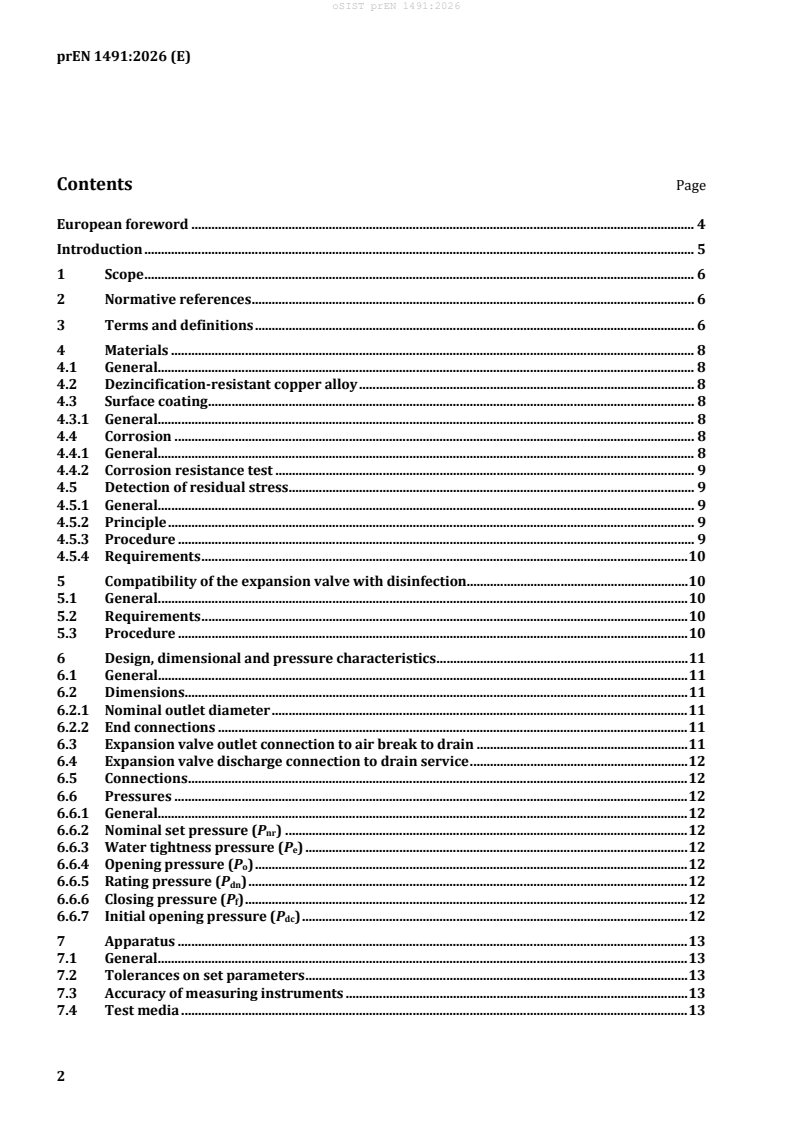
Contents Page
European foreword . 4
Introduction . 5
1 Scope . 6
2 Normative references . 6
3 Terms and definitions . 6
4 Materials . 8
4.1 General. 8
4.2 Dezincification-resistant copper alloy . 8
4.3 Surface coating . 8
4.3.1 General. 8
4.4 Corrosion . 8
4.4.1 General. 8
4.4.2 Corrosion resistance test . 9
4.5 Detection of residual stress . 9
4.5.1 General. 9
4.5.2 Principle . 9
4.5.3 Procedure . 9
4.5.4 Requirements . 10
5 Compatibility of the expansion valve with disinfection. 10
5.1 General. 10
5.2 Requirements . 10
5.3 Procedure . 10
6 Design, dimensional and pressure characteristics . 11
6.1 General. 11
6.2 Dimensions. 11
6.2.1 Nominal outlet diameter . 11
6.2.2 End connections . 11
6.3 Expansion valve outlet connection to air break to drain . 11
6.4 Expansion valve discharge connection to drain service . 12
6.5 Connections . 12
6.6 Pressures . 12
6.6.1 General. 12
6.6.2 Nominal set pressure (P ) . 12
nr
6.6.3 Water tightness pressure (P ) . 12
e
6.6.4 Opening pressure (P ) . 12
o
6.6.5 Rating pressure (P ) . 12
dn
6.6.6 Closing pressure (P ) . 12
f
6.6.7 Initial opening pressure (Pdc) . 12
7 Apparatus . 13
7.1 General. 13
7.2 Tolerances on set parameters . 13
7.3 Accuracy of measuring instruments . 13
7.4 Test media . 13
8 Hydraulic tests . 13
8.1 Cold water pressure tests . 13
8.1.1 General . 13
8.1.2 Water tightness pressure (P ) test . 13
e
8.1.3 Repeat tests . 14
8.2 Endurance test . 15
8.2.1 Procedure . 15
8.2.2 Requirements . 15
8.3 Operating control . 15
8.3.1 Operation test . 15
8.3.2 Endurance test . 15
9 Mechanical tests . 16
9.1 Mechanical strength . 16
9.1.1 Pressure test of the body of the expansion valve . 16
9.1.2 Bending moment test of the body of the expansion valve . 16
9.2 Mechanical strength of the operating control . 17
9.2.1 Procedure . 17
9.2.2 Requirements . 17
9.3 Torsional strength test of the expansion valve's body. 17
9.3.1 General . 17
9.3.2 Procedure . 17
9.3.3 Requirements . 17
9.4 Torque test of the captive rotating nuts/tail pieces . 17
9.4.1 General . 17
9.4.2 Procedure . 17
9.4.3 Requirements . 18
10 Classification . 18
11 Designation . 18
12 Marking . 19
13 Technical documents and presentation at delivery . 19
Annex A (informative) Test sequences . 21
Annex B (informative) Classification of water heaters according to heating method . 23
Annex C (informative) Disinfection of test rig . 25
Bibliography . 26
European foreword
This document (prEN 1491:2026) has been prepared by Technical Committee CEN/TC 164 “Water
supply”, the secretariat of which is held by AFNOR.
This document is currently submitted to the CEN Enquiry.
This document will supersede EN 1491:2022.
— chapter on materials was completely revised;
— testing with disinfectant was introduced;
— torque test was added;
— testing of the expansion valve was changed and optimized;
— coating test procedure was revised;
— normative references were updated;
— editorial changes have been made throughout the entire document.
Introduction
With regard to potential adverse effect on the quality of water intended for human consumption, caused
by the product covered by this document:
a) This document provides no information as to whether the product may be used without restriction
in any of the Member States of the EU or EFTA.
b) It should be noted that, whilst awaiting the adoption of verifiable European criteria, existing national
regulations concerning the use and or the characteristics of this product remain in force.
1 Scope
This document specifies dimensions, materials and performance requirements (including methods of
test) for expansion valves, of nominal sizes from DN 15 to DN 50, having working pressures ) from
0,1 MPa (1 bar) to 1,0 MPa (10 bar).
Expansion valves are intended for fitting to the cold potable water supply of storage water heaters, having
a maximum distribution temperature of 95 °C, for all energy sources.
Expansion valves do not control the temperature and alone do not constitute the protection required for
storage water heaters. Expansion valves limit pressure, in the water heaters to what they are fitted, that
is produced by thermal expansion of the water.
NOTE The use of the device specified in this document does not override the need to use controls (e.g.
thermostats and cut-outs) which act directly on the power sources of water heaters (for more information see
Annex A).
2 Normative references
The following documents are referred to in the text in such a way that some or all of their content
constitutes requirements of this document. For dated references, only the edition cited applies. For
undated references, the latest edition of the referenced document (including any amendments) applies.
EN 806 (all parts), Specifications for installations inside buildings conveying water for human consumption
EN 1254-2, Copper and copper alloys — Plumbing fittings — Part 2: Compression fittings for use with
copper tubes
EN 1717, Protection against pollution of water intended for human consumption in potable water
installations and general requirements for devices to prevent pollution by backflow
EN 10226-1, Pipe threads where pressure tight joints are made on the threads — Part 1: Taper external
threads and parallel internal threads — Dimensions, tolerances and designation
EN ISO 6509-1, Corrosion of metals and alloys — Determination of dezincification resistance of copper
alloys with zinc — Part 1: Test method (ISO 6509-1)
EN ISO 9227, Corrosion tests in artificial atmospheres — Salt spray tests (ISO 9227)
3 Terms and definitions
For the purposes of this document, the following terms and definitions apply.
ISO and IEC maintain terminology databases for use in standardization at the following addresses:
— ISO Online browsing platform: available at https://www.iso.org/obp/
— IEC Electropedia: available at https://www.electropedia.org/
All pressures are gauge unless otherwise stated.
3.1
expansion valve
valve that limits the pressure of the water in the water heater to a predetermined value by discharging
water to drain
Note 1 to entry: For the purpose of this standard the expansion valve is hereafter referred as the “device”.
3.2
air break to drain
vertical distance realised by air inlets or full disconnection between the lowest point of the outlet and
spill over level of the atmospheric over flow
3.3
nominal set pressure
P
nr
pressure of the expansion valve which is set on production
Note 1 to entry: The “nominal set pressure” (Pnr) is often called “set pressure”.
Key
Y pressure
X time
Figure 1 — Pressures
3.4
water tightness pressure
P
e
pressure up to which the expansion valve is closed
Note 1 to entry: See Figure 1.
3.5
initial opening pressure
P
dc
pressure at which the expansion valve opens for the first time, as indicated by the first droplet of water
at the outlet of the expansion valve, after a period of storage
Note 1 to entry: See Figure 1.
3.6
opening pressure
P
o
pressure at which the expansion valves opens as indicated by the appearance of water at the outlet of the
expansion valve
Note 1 to entry: See Figure 1.
3.7
rating pressure
P
dn
pressure at which the discharged flow is above the limit
Note 1 to entry: See Figure 1 and Table 2.
3.8
closing pressure
P
f
pressure at which the expansion valve closes after having reached the rating pressure
Note 1 to entry: See Figure 1.
4 Materials
4.1 General
NOTE Health and quality requirements in accordance with European and national legislation for final materials
in contact with water intended for human consumption are not covered by this document.
4.2 Dezincification-resistant copper alloy
Copper-zinc alloys containing more than 15 % zinc are subject to dezincification when submitted to
water capable of dezincification. In the countries where the use of products made of dezincification
resistant materials is required, the materials used shall guarantee a dezincification depth less than
200 μm in any direction. For this purpose, materials shall be tested in accordance with EN ISO 6509-1
and the product shall be marked in accordance with Clause 12.
4.3 Surface coating
4.3.1 General
The outside and inside surfaces of the device can contain a coating. Such coating shall not impair the
functional characteristics of the device.
Materials with inadequate corrosion resistance (e.g. iron steel) shall be tested for corrosion resistance in
accordance with 4.4.2.
4.4 Corrosion
4.4.1 General
The applied materials shall be corrosion resistant or protected against corrosion. The materials used shall
not have an adverse effect on each other.
Only for materials with inadequate corrosion resistance (e.g. iron steel), the corrosion resistance test in
accordance with 4.4.2 shall be applied.
4.4.2 Corrosion resistance test
4.4.2.1 General
The purpose of the corrosion resistance test is to qualify all used materials of the external part of the
product. The whole device shall be tested, not only the parts in contact with potable water.
4.4.2.2 Procedure
Samples shall be prepared for the corrosion resistance test as described as follows.
Carry out the test in accordance with the neutral saline-spray test of EN ISO 9227 and the following:
a) Subject the device to spraying for at least 100 h, interrupt the spraying treatment for (48 ± 1) h while
maintaining the heat in the tank and resume the spraying treatment for another (100 ± 1) h.
b) For the duration of the tests, the tank should only be opened to check and maintain the conditions,
the maximum rest period in spraying being 30 min per day. The heating should not be interrupted;
samples under test should not be handled, washed or checked.
c) After treatment and before visual examination, rinse the test samples in water to remove any salt
residue.
4.4.2.3 Requirements
The device shall comply with the requirements as included in cold water pressure test (see 8.1.2). The
results shall not deviate by more than 10 % from the original values.
4.5 Detection of residual stress
4.5.1 General
This test shall be performed for devices which have bodies made out of brass materials and with female
threads according to EN 10226-1 and compression ends according to EN 1254-2.
4.5.2 Principle
This test is based on ISO 6957. Its purpose is to verify the resistance to cracking under stress corrosion
in ammonia medium (see 4.5.3, b).
The test entails exposing test specimens consisting of the assembled device in an atmosphere loaded with
ammonia vapour.
4.5.3 Procedure
The paragraph below is integrated from ISO 6957.
Test solution:
a) Use solutions of analysis quality and of distilled water.
b) Solution of ammonia at 20 % (in weight).
c) The
...