

oSIST prEN 1491:2026
(Main)Building valves - Expansion valves - Tests and requirements
- Abstract
This document specifies dimensions, materials and performance requirements (including methods of test) for expansion valves, of nominal sizes from DN 15 to DN 50, having working pressures ) from 0,1 MPa (1 bar) to 1,0 MPa (10 bar).
Expansion valves are intended for fitting to the cold potable water supply of storage water heaters, having a maximum distribution temperature of 95 °C, for all energy sources.
Expansion valves do not control the temperature and alone do not constitute the protection required for storage water heaters. Expansion valves limit pressure, in the water heaters to what they are fitted, that is produced by thermal expansion of the water.
NOTE The use of the device specified in this document does not override the need to use controls (e.g. thermostats and cut-outs) which act directly on the power sources of water heaters (for more information see Annex A).
- Status
- Not Published
- Public Enquiry End Date
- 24-Nov-2026
- Technical Committee
- IOVO - Water supply and waste water engineering
- Current Stage
- 4020 - Public enquire (PE) (Adopted Project)
- Start Date
- 02-Oct-2026
- Due Date
- 19-Feb-2027
- Completion Date
- 26-Nov-2026

oSIST prEN 1491:2026 is the Slovenian publication of the draft European Standard prEN 1491, Building valves - Expansion valves - Tests and requirements. It specifies dimensions, materials, performance requirements and test methods for expansion valves used on the cold potable water supply of storage water heaters, so designers, test labs, quality teams and buyers can see what a compliant valve has to cover.
What does oSIST prEN 1491:2026 specify?
oSIST prEN 1491:2026 applies to expansion valves of nominal sizes DN 15 to DN 50 and working pressures from 0,1 MPa (1 bar) to 1,0 MPa (10 bar). The valves are intended for storage water heaters with a maximum distribution temperature of 95 °C for all energy sources.
oSIST prEN 1491:2026 also makes clear that an expansion valve limits pressure caused by thermal expansion of water, but does not control temperature and on its own does not provide the full protection needed for a storage water heater. The document is organized into clauses on scope, references, terms, materials, disinfection compatibility, design and pressure characteristics, test apparatus, hydraulic tests, mechanical tests, classification, designation, marking, and delivery documents.
| Annex | What it covers |
|---|---|
| Annex A | Test sequences for expansion valves |
| Annex B | Classification of water heaters according to heating method |
| Annex C | Disinfection of test rig |
What are the key requirements of oSIST prEN 1491:2026?
oSIST prEN 1491:2026 combines design rules with type tests, so the reader can check both how the valve is built and how it behaves in service. The most important requirements are below.
Materials and corrosion resistance - Clause 4: The applied materials shall be corrosion resistant or protected against corrosion, and materials must not adversely affect each other. Where dezincification-resistant materials are required, brass alloys shall meet the dezincification test and be marked accordingly. In practice, this is the main check for long-term durability in contact with water.
Surface coating and corrosion testing - Clause 4.3 to 4.4: Coatings on internal or external surfaces must not impair function, and materials with inadequate corrosion resistance are tested by neutral salt spray exposure. The whole device is tested, not just the wetted parts, so the exterior body and fittings are also verified.
Residual stress detection - Clause 4.5: Brass-bodied devices with female threads to EN 10226-1 and compression ends to EN 1254-2 are checked for stress-corrosion cracking in ammonia vapour. The practical point is to reduce the risk of cracking in service and during assembly.
Compatibility with disinfection - Clause 5: The entire device shall remain functional after exposure to one of the specified disinfectant solutions under circulation at 3 bar. This matters where drinking-water systems are shock-disinfected and the valve must still pass the cold-water pressure test afterwards.
Design, dimensions and pressure behaviour - Clause 6: The valve shall use a diaphragm or equivalent to isolate the spring from water, avoid seizure of sliding parts, and keep setting controls inaccessible without damage. The valve outlet shall not be smaller than the inlet, connections shall match relevant European standards, and heat-made or heat-broken joints are not permitted. The pressure points are defined around the nominal set pressure (Pnr): tightness at 0,9 Pnr, opening at 1,05 Pnr with flow above 2,4 l/h, rating at 1,2 Pnr, closing at 0,80 Pnr minimum, and initial opening at 0,95 Pnr to 1,2 Pnr.
Hydraulic and operating tests - Clause 8: The cold-water pressure test checks opening, tightness, discharge flow and re-closing, and is repeated to give three determinations. The endurance test runs 10 000 cycles, and the operating control is checked for manual use and then for 300 opening operations. In practice, this confirms that the valve still works after repeated pressure changes and regular user checks.
Mechanical strength and classification - Clauses 9 to 13: The body, operating control, threaded body and captive nuts or tail pieces are all mechanically tested, including pressure, bending moment and torque tests. The valve is then classified by water-heater characteristics, designated by DN and Pnr, marked permanently, and supplied with installation and maintenance information.
What terms does oSIST prEN 1491:2026 define?
In oSIST prEN 1491:2026, all pressures are gauge unless stated otherwise. The key terms are the ones that drive selection, testing and marking.
- Expansion valve - A valve that limits the pressure of water in a water heater by discharging water to drain.
- Air break to drain - A vertical separation created by air inlets or full disconnection between the outlet and the spill-over level of the atmospheric overflow.
- Nominal set pressure (Pnr) - The pressure set on production, often called the set pressure.
- Water tightness pressure - The pressure up to which the expansion valve remains closed.
- Opening pressure - The pressure at which water first appears at the outlet.
- Rating pressure (Pdn) - The pressure at which the discharged flow rises above the limit.
- Closing pressure (Pf) - The pressure at which the valve closes after reaching the rating pressure.
- Initial opening pressure (Pdc) - The pressure at which the valve opens for the first time after storage, shown by the first droplet at the outlet.
Who uses oSIST prEN 1491:2026?
oSIST prEN 1491:2026 is used by expansion-valve manufacturers, test laboratories, certification teams, water-heater designers, installers and quality managers. It helps them choose the right DN size and pressure setting, verify materials and corrosion resistance, plan hydraulic and mechanical tests, and prepare marking and technical instructions.
It is also useful for buyers and specification writers in building services and water-heater supply chains. They can use it to match the valve to the heater type, the discharge arrangement and the required safety system around the heater.
What changed in oSIST prEN 1491:2026 from the previous edition?
oSIST prEN 1491:2026 will supersede EN 1491:2022. The European foreword states these changes compared with EN 1491:2022:
- the materials chapter was completely revised;
- testing with disinfectant was introduced;
- the torque test was added;
- the testing of the expansion valve was changed and optimized;
- the coating test procedure was revised;
- normative references were updated;
- editorial changes were made throughout the document.
Which standards are used with oSIST prEN 1491:2026?
| Standard | What it contributes |
|---|---|
| EN 806 (all parts) | Rules for installations inside buildings conveying water for human consumption; also referenced for inspection, maintenance and the expansion vessel note |
| EN 806-2 | Installation of the discharge connection to drain service |
| EN 1717 | Protection against pollution and the drain-service connection requirements |
| EN 10226-1 | Thread dimensions and the threaded connections used in testing |
| EN 1254-2 | Compression fittings for copper tubes and the related residual-stress test applicability |
| EN ISO 6509-1 | Dezincification resistance test for copper alloys |
| EN ISO 9227 | Neutral salt-spray corrosion test |
| EN ISO 228-1 | Parallel internal thread dimensions for relevant end connections |
| ISO 6957 | Ammonia test for stress-corrosion resistance |
| EN 14597, EN 1487, EN 1488, EN 1489, EN 1490, EN 1213, EN 13828, EN 13959, EN 1567 | Water-heater control and safety devices named in Annex B for system selection and classification |
What does the oSIST prEN 1491:2026 document contain?
oSIST prEN 1491:2026 contains test methods and acceptance checks for materials, corrosion, disinfection compatibility, pressure performance and mechanical strength. It also includes the pressure relationships in Figure 1, the discharge flow values in Table 2, the bending moment values in Table 3, the tightening torques in Table 4 and the water-heater classification data in Table 5.
The annexes add practical support for testing and application. Annex A gives test sequences, Annex B explains how water heaters are classified by heating method, and Annex C shows an example of a disinfection test rig.
Relations
- Effective Date
- 18-Dec-2024
Get Certified
Connect with accredited certification bodies for this standard

DIBt (Deutsches Institut für Bautechnik)
German Institute for Building Technology.

DIN CERTCO
DIN Group product certification.

Aboma Certification B.V.
Specialized in construction, metal, and transport sectors.
Sponsored listings
Frequently Asked Questions
oSIST prEN 1491:2026 is a draft published by the Slovenian Institute for Standardization (SIST). Its full title is "Building valves - Expansion valves - Tests and requirements". This standard covers: This document specifies dimensions, materials and performance requirements (including methods of test) for expansion valves, of nominal sizes from DN 15 to DN 50, having working pressures ) from 0,1 MPa (1 bar) to 1,0 MPa (10 bar). Expansion valves are intended for fitting to the cold potable water supply of storage water heaters, having a maximum distribution temperature of 95 °C, for all energy sources. Expansion valves do not control the temperature and alone do not constitute the protection required for storage water heaters. Expansion valves limit pressure, in the water heaters to what they are fitted, that is produced by thermal expansion of the water. NOTE The use of the device specified in this document does not override the need to use controls (e.g. thermostats and cut-outs) which act directly on the power sources of water heaters (for more information see Annex A).
This document specifies dimensions, materials and performance requirements (including methods of test) for expansion valves, of nominal sizes from DN 15 to DN 50, having working pressures ) from 0,1 MPa (1 bar) to 1,0 MPa (10 bar). Expansion valves are intended for fitting to the cold potable water supply of storage water heaters, having a maximum distribution temperature of 95 °C, for all energy sources. Expansion valves do not control the temperature and alone do not constitute the protection required for storage water heaters. Expansion valves limit pressure, in the water heaters to what they are fitted, that is produced by thermal expansion of the water. NOTE The use of the device specified in this document does not override the need to use controls (e.g. thermostats and cut-outs) which act directly on the power sources of water heaters (for more information see Annex A).
oSIST prEN 1491:2026 is classified under the following ICS (International Classification for Standards) categories: 23.060.01 - Valves in general; 91.140.60 - Water supply systems. The ICS classification helps identify the subject area and facilitates finding related standards.
oSIST prEN 1491:2026 has the following relationships with other standards: It is inter standard links to SIST EN 1491:2022. Understanding these relationships helps ensure you are using the most current and applicable version of the standard.
oSIST prEN 1491:2026 is associated with the following European legislation: EU Directives/Regulations: 98/83/EC. When a standard is cited in the Official Journal of the European Union, products manufactured in conformity with it benefit from a presumption of conformity with the essential requirements of the corresponding EU directive or regulation.
oSIST prEN 1491:2026 is available in PDF format for immediate download after purchase. The document can be added to your cart and obtained through the secure checkout process. Digital delivery ensures instant access to the complete standard document.
Standards Content (Sample)
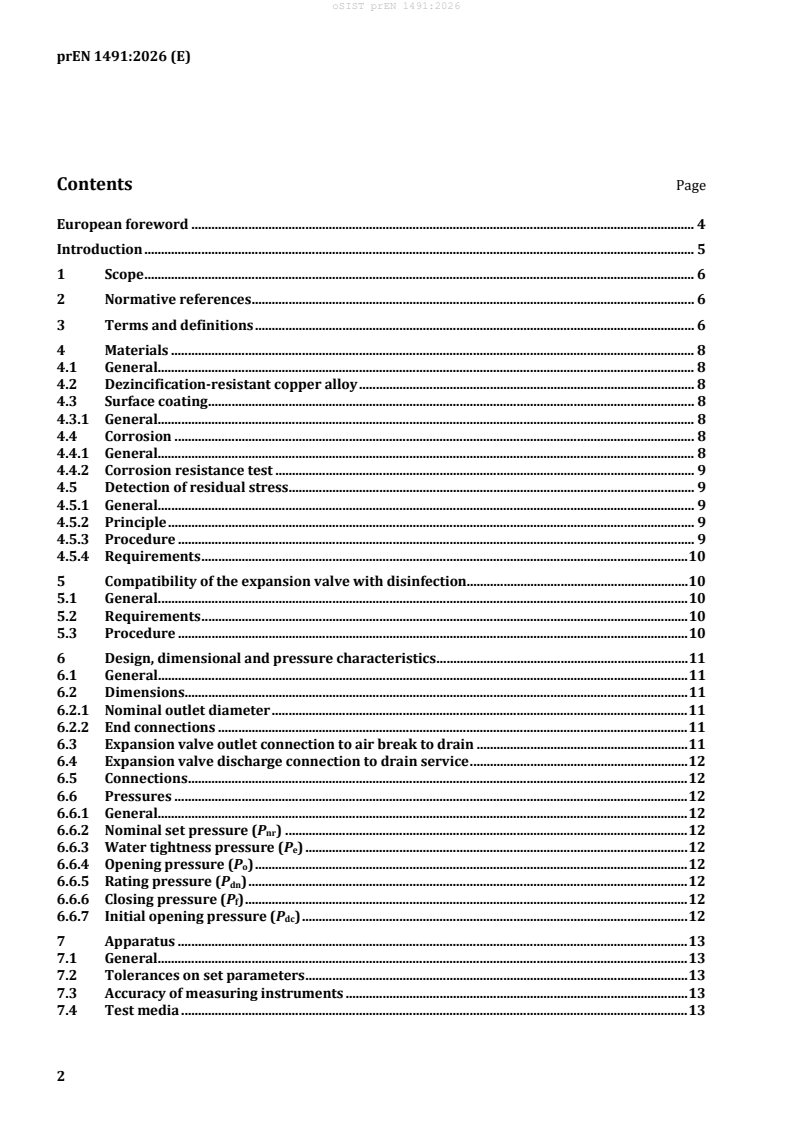
Contents
- Introduction
- 1 Scope
- 2 Normative references
- 3 Terms and definitions
- 3.1 expansion valve
- 3.2 air break to drain
- 3.3 nominal set pressure
- 3.4 water tightness pressure
- 3.5 initial opening pressure
- 3.6 opening pressure
- 3.7 rating pressure
- 3.8 closing pressure
- 4 Materials
- 4.1 General
- 4.2 Dezincification-resistant copper alloy
- 4.3 Surface coating
- 4.4 Corrosion
- 4.5 Detection of residual stress
- 5 Compatibility of the expansion valve with disinfection
- 5.1 General
- 5.2 Requirements
- 5.3 Procedure
- 6 Design, dimensional and pressure characteristics
- 6.1 General
- 6.2 Dimensions
- 6.3 Expansion valve outlet connection to air break to drain
- 6.4 Expansion valve discharge connection to drain service
- 6.5 Connections
- 6.6 Pressures
- 7 Apparatus
- 7.1 General
- 7.2 Tolerances on set parameters
- 7.3 Accuracy of measuring instruments
- 7.4 Test media
- 8 Hydraulic tests
- 8.1 Cold water pressure tests
- 8.2 Endurance test
- 8.3 Operating control
- 9 Mechanical tests
- 9.1 Mechanical strength
- 9.2 Mechanical strength of the operating control
- 9.3 Torsional strength test of the expansion valve's body
- 9.4 Torque test of the captive rotating nuts/tail pieces
- 10 Classification
- 11 Designation
- 12 Marking
- 13 Technical documents and presentation at delivery
- Annex A
- Annex B
- Annex C
- 1 PWC connection with backflow preventing unit fluid category 4, backflow preventer
- 6 PH-value sensor
- Bibliography
Introduction
With regard to potential adverse effect on the quality of water intended for human consumption, caused by the product covered by this document:
a) This document provides no information as to whether the product may be used without restriction in any of the Member States of the EU or EFTA.
b) It should be noted that, whilst awaiting the adoption of verifiable European criteria, existing national regulations concerning the use and or the characteristics of this product remain in force.
oSIST prEN 1491:2026 prEN 1491:2026 (E)
1 Scope
This document specifies dimensions, materials and performance requirements (including methods of
test) for expansion valves, of nominal sizes from DN 15 to DN 50, having working pressures ) from 0,1 MPa (1 bar) to 1,0 MPa (10 bar).
Expansion valves are intended for fitting to the cold potable water supply of storage water heaters, having a maximum distribution temperature of 95 °C, for all energy sources. Expansion valves do not control the temperature and alone do not constitute the protection required for storage water heaters. Expansion valves limit pressure, in the water heaters to what they are fitted, that is produced by thermal expansion of the water.
NOTE The use of the device specified in this document does not override the need to use controls (e.g. thermostats and cut-outs) which act directly on the power sources of water heaters (for more information see Annex A).
2 Normative references
The following documents are referred to in the text in such a way that some or all of their content constitutes requirements of this document. For dated references, only the edition cited applies. For undated references, the latest edition of the referenced document (including any amendments) applies. EN 806 (all parts), Specifications for installations inside buildings conveying water for human consumption EN 1254-2, Copper and copper alloys — Plumbing fittings — Part 2: Compression fittings for use with copper tubes EN 1717, Protection against pollution of water intended for human consumption in potable water installations and general requirements for devices to prevent pollution by backflow EN 10226-1, Pipe threads where pressure tight joints are made on the threads — Part 1: Taper external threads and parallel internal threads — Dimensions, tolerances and designation EN ISO 6509-1, Corrosion of metals and alloys — Determination of dezincification resistance of copper alloys with zinc — Part 1: Test method (ISO 6509-1) EN ISO 9227, Corrosion tests in artificial atmospheres — Salt spray tests (ISO 9227)
3 Terms and definitions
For the purposes of this document, the following terms and definitions apply. ISO and IEC maintain terminology databases for use in standardization at the following addresses:
- ISO Online browsing platform: available at https://www.iso.org/obp/
- IEC Electropedia: available at https://www.electropedia.org/
All pressures are gauge unless otherwise stated.
oSIST prEN 1491:2026 prEN 1491:2026 (E)
3.1 expansion valve
valve that limits the pressure of the water in the water heater to a predetermined value by discharging water to drain Note 1 to entry: For the purpose of this standard the expansion valve is hereafter referred as the “device”.
3.2 air break to drain
vertical distance realised by air inlets or full disconnection between the lowest point of the outlet and spill over level of the atmospheric over flow
3.3 nominal set pressure
P nr pressure of the expansion valve which is set on production Note 1 to entry: The “nominal set pressure” (Pnr) is often called “set pressure”.
Key Y pressure X time Figure 1 — Pressures
3.4 water tightness pressure
P e pressure up to which the expansion valve is closed Note 1 to entry: See Figure 1.
3.5 initial opening pressure
P dc pressure at which the expansion valve opens for the first time, as indicated by the first droplet of water at the outlet of the expansion valve, after a period of storage Note 1 to entry: See Figure 1.
oSIST prEN 1491:2026 prEN 1491:2026 (E)
3.6 opening pressure
P o pressure at which the expansion valves opens as indicated by the appearance of water at the outlet of the expansion valve Note 1 to entry: See Figure 1.
3.7 rating pressure
P dn pressure at which the discharged flow is above the limit Note 1 to entry: See Figure 1 and Table 2.
3.8 closing pressure
P f pressure at which the expansion valve closes after having reached the rating pressure Note 1 to entry: See Figure 1.
4 Materials
4.1 General
NOTE Health and quality requirements in accordance with European and national legislation for final materials in contact with water intended for human consumption are not covered by this document.
4.2 Dezincification-resistant copper alloy
Copper-zinc alloys containing more than 15 % zinc are subject to dezincification when submitted to water capable of dezincification. In the countries where the use of products made of dezincification resistant materials is required, the materials used shall guarantee a dezincification depth less than 200 μm in any direction. For this purpose, materials shall be tested in accordance with EN ISO 6509-1 and the product shall be marked in accordance with Clause 12.
4.3 Surface coating
4.3.1 General
The outside and inside surfaces of the device can contain a coating. Such coating shall not impair the functional characteristics of the device.
Materials with inadequate corrosion resistance (e.g. iron steel) shall be tested for corrosion resistance in accordance with 4.4.2.
4.4 Corrosion
4.4.1 General
The applied materials shall be corrosion resistant or protected against corrosion. The materials used shall not have an adverse effect on each other.
Only for materials with inadequate corrosion resistance (e.g. iron steel), the corrosion resistance test in accordance with 4.4.2 shall be applied.
oSIST prEN 1491:2026 prEN 1491:2026 (E)
4.4.2 Corrosion resistance test
4.4.2.1 General
The purpose of the corrosion resistance test is to qualify all used materials of the external part of the product. The whole device shall be tested, not only the parts in contact with potable water.
4.4.2.2 Procedure
Samples shall be prepared for the corrosion resistance test as described as follows. Carry out the test in accordance with the neutral saline-spray test of EN ISO 9227 and the following:
a) Subject the device to spraying for at least 100 h, interrupt the spraying treatment for (48 ± 1) h while maintaining the heat in the tank and resume the spraying treatment for another (100 ± 1) h. b) For the duration of the tests, the tank should only be opened to check and maintain the conditions, the maximum rest period in spraying being 30 min per day. The heating should not be interrupted; samples under test should not be handled, washed or checked.
c) After treatment and before visual examination, rinse the test samples in water to remove any salt residue.
4.4.2.3 Requirements
The device shall comply with the requirements as included in cold water pressure test (see 8.1.2). The results shall not deviate by more than 10 % from the original values.
4.5 Detection of residual stress
4.5.1 General
This test shall be performed for devices which have bodies made out of brass materials and with female threads according to EN 10226-1 and compression ends according to EN 1254-2.
4.5.2 Principle
This test is based on ISO 6957. Its purpose is to verify the resistance to cracking under stress corrosion in ammonia medium (see 4.5.3, b).
The test entails exposing test specimens consisting of the assembled device in an atmosphere loaded with ammonia vapour.
4.5.3 Procedure
The paragraph below is integrated from ISO 6957.
Test solution:
a) Use solutions of analysis quality and of distilled water.
b) Solution of ammonia at 20 % (in weight).
c) The pH of the test solution shall be adjusted to 9,5 by using hydrochloric acid. d) The test temperature shall be (23 ± 2) °C with a measurement uncertainty of ± 1 K.
oSIST prEN 1491:2026 prEN 1491:2026 (E) Test specimen:
a) The test specimen consists of three samples of a single assembled product. The test specimen shall be inserted into the test enclosure under no stress.
Instructions:
a) Rinse the test specimens with a clean non-chlorinated solvent (for example, ethanol). b) Let it dry in the air.
c) Insert the test specimens into the test enclosure along with the ammonia solution. The volume of the container made of glass (e.g. desiccator) shall be minimum (10 ± 1) l. d) The volume of the solution inserted shall be (200 ± 10) ml per 3 l of total volume of the container (e.g. for a 10 l container, this means (667 ± 33) ml).
e) Place the test specimens in the container in such a way that they will not touch each other and that they will not be in contact with the solution.
+2 After an exposure of ( 24 ) h, remove the test specimens and rinse them.
4.5.4 Requirements
After the test, the body of the device shall be inspected visually for stress corrosion cracking. No cracking shall occur.
At least two samples shall be in accordance with the test in 8.1.2.
5 Compatibility of the expansion valve with disinfection
5.1 General
The disinfection test is carried out to ensure that a device can continue to fulfil its function after several curative disinfection measures (shock disinfection) in a drinking water installation (see Table 1). Note See Annex C.
5.2 Requirements
The entire device shall remain functional after carrying out the disinfection test with one of the three disinfectant solutions (see Table 1).
The device shall comply with the requirements as included in cold water pressure test (see 8.1.2). The results shall not deviate by more than 10 % from the original values.
5.3 Procedure
The test circuit with the integrated device shall be filled with one of the disinfectant solutions listed in Table 1 maintaining a circulation at a pressure of 3 bar.
Maintain all parameters given in Table 1 during the entire testing time.
oSIST prEN 1491:2026 prEN 1491:2026 (E) Table 1 — Test chemicals Chemical Contact pH-value Chemical solution Concentration Temperature formula time test solution 100 mg ± 10 % Cl
sodium NaOCl 24 h (active chlorine) in 1 l 6,5 to 7,5 (20 ± 5) °C hypochlorite water 1 000 mg ± 10 % H O 2 2 H O hydrogen peroxide 24 h 6,5 to 7,5 (20 ± 5) °C 2 2 in 1 l water 6 mg ± 10 % ClO in 1 l
ClO chlorine dioxide 12 h 6,5 to 7,5 (20 ± 5) °C
water The test shall be carried out with one of the given chemicals as defined in Table 1.
...