

prEN 137
(Main)Respiratory protective devices - Self-contained open-circuit compressed air breathing apparatus with full face mask - Requirements, testing, marking
- Abstract
This document specifies minimum performance requirements for self-contained breathing apparatus (SCBA), except escape device and diving device.
This document specifies in the Annex D optional requirements regarding the interchangeability of the cylinder for single-cylinder SCBA.
Laboratory and practical performance tests are included for the assessment of compliance with the requirements.
- Status
- Not Published
- Publication Date
- 29-Oct-2024
- Technical Committee
- CEN/TC 79 - Respiratory protective devices
- Drafting Committee
- CEN/TC 79/WG 6 - Self-contained breathing apparatus
- Current Stage
- 4060 - Closure of enquiry - Enquiry
- Start Date
- 08-May-2025
- Due Date
- 11-Oct-2023
- Completion Date
- 08-May-2025

Overview
prEN 137 (draft 2025) is a CEN standard that defines minimum performance requirements, testing and marking for self-contained open-circuit compressed-air breathing apparatus (SCBA) fitted with a full face mask. The scope excludes escape devices and diving equipment. The document covers laboratory and practical performance tests and includes an optional Annex D addressing cylinder interchangeability for single-cylinder SCBA. This standard will supersede EN 137:2006 and was prepared by CEN/TC 79.
Key Topics
- Scope & Classification: Classification of SCBA types and intended use cases.
- Design & Ergonomics: Requirements for body harness, mass distribution, user comfort and field usability.
- Materials & Durability: Guidance on material selection, corrosion resistance and resistance to temperature and radiant heat.
- Connections & Interfaces: Standards for high, medium and low pressure connections, masks, demand valves and coupling strength.
- Full Face Mask Requirements: Fit, seal and compatibility with the breathing apparatus.
- Cylinder and Valve: Cylinder requirements and cylinder valve interfaces; optional interchangeability requirements in Annex D.
- Pressure Control & Warning Devices: Requirements for pressure reducers, gauges, pneumatic and electronic warning devices to alert users to low supply.
- Breathing Performance: Inhalation and exhalation resistance, lung-governed demand valves (positive and negative pressure) and breathing hose integrity.
- Leak-tightness & Air-tightness: Tests and tolerances for low- and high-pressure leak-tightness.
- Temperature & Flammability: Laboratory and practical tests for temperature performance and flammability resistance.
- Practical Performance Tests: Walking and work-simulation tests to confirm real-world operability.
- Marking & Manufacturer Information: Required markings, instructions and cylinder labelling to support safe use and maintenance.
Applications
This standard delivers practical value to manufacturers, purchasing authorities, safety officers and end users by:
- Ensuring consistency and safety in SCBA products used for firefighting, rescue, emergency response and industrial hazardous atmospheres.
- Supporting interoperability and reduced downtime via optional cylinder interchangeability requirements.
- Providing test methods and marking rules that facilitate compliance assessment, procurement specifications and maintenance planning.
Related Standards
- EN 137:2006 (to be superseded by prEN 137:2025)
- CEN/TC 79 (technical committee responsible for respiratory protective devices)
- ICS classification 13.340.30 (respiratory protective devices)
Manufacturers and conformity assessors should consult the full prEN 137 text for detailed requirements, normative references and the exact laboratory and practical test procedures referenced in the standard.
Relations
- Effective Date
- 19-Jan-2023
Get Certified
Connect with accredited certification bodies for this standard

CIS Institut d.o.o.
Personal Protective Equipment (PPE) certification body. Notified Body NB-2890 for EU Regulation 2016/425 PPE.

Kiwa BDA Testing
Building and construction product certification.
Kmetijski inštitut Slovenije
Agricultural Institute of Slovenia. Soil testing, plant health, agricultural product analysis.
Sponsored listings
Frequently Asked Questions
prEN 137 is a draft published by the European Committee for Standardization (CEN). Its full title is "Respiratory protective devices - Self-contained open-circuit compressed air breathing apparatus with full face mask - Requirements, testing, marking". This standard covers: This document specifies minimum performance requirements for self-contained breathing apparatus (SCBA), except escape device and diving device. This document specifies in the Annex D optional requirements regarding the interchangeability of the cylinder for single-cylinder SCBA. Laboratory and practical performance tests are included for the assessment of compliance with the requirements.
This document specifies minimum performance requirements for self-contained breathing apparatus (SCBA), except escape device and diving device. This document specifies in the Annex D optional requirements regarding the interchangeability of the cylinder for single-cylinder SCBA. Laboratory and practical performance tests are included for the assessment of compliance with the requirements.
prEN 137 is classified under the following ICS (International Classification for Standards) categories: 13.340.30 - Respiratory protective devices. The ICS classification helps identify the subject area and facilitates finding related standards.
prEN 137 has the following relationships with other standards: It is inter standard links to EN 137:2006. Understanding these relationships helps ensure you are using the most current and applicable version of the standard.
prEN 137 is associated with the following European legislation: EU Directives/Regulations: 2008/68/EC, 2014/90/EU, 2016/425, 89/686/EEC, 93/68/EEC, 93/95/EEC, 96/58/EC, 96/98/EC; Standardization Mandates: M/031, M/571 Amd 1, M/571 Amd 2, M/BC/CEN/88/7. When a standard is cited in the Official Journal of the European Union, products manufactured in conformity with it benefit from a presumption of conformity with the essential requirements of the corresponding EU directive or regulation.
prEN 137 is available in PDF format for immediate download after purchase. The document can be added to your cart and obtained through the secure checkout process. Digital delivery ensures instant access to the complete standard document.
Standards Content (Sample)
SLOVENSKI STANDARD
01-april-2025
Oprema za varovanje dihal - Avtonomni dihalni aparat na stisnjen zrak z odprtim
krogom in obrazno masko - Zahteve, preskušanje, označevanje
Respiratory protective devices - Self-contained open-circuit compressed air breathing
apparatus with full face mask - Requirements, testing, marking
Atemschutzgeräte - Behältergeräte mit Druckluft (Pressluftatmer) mit Vollmaske -
Anforderungen, Prüfung, Kennzeichnung
Appareils de protection respiratoire - Appareils de protection respiratoire autonomes à
circuit ouvert, à air comprimé avec masque complet - Exigences, essais, marquage
Ta slovenski standard je istoveten z: prEN 137
ICS:
13.340.30 Varovalne dihalne naprave Respiratory protective
devices
2003-01.Slovenski inštitut za standardizacijo. Razmnoževanje celote ali delov tega standarda ni dovoljeno.
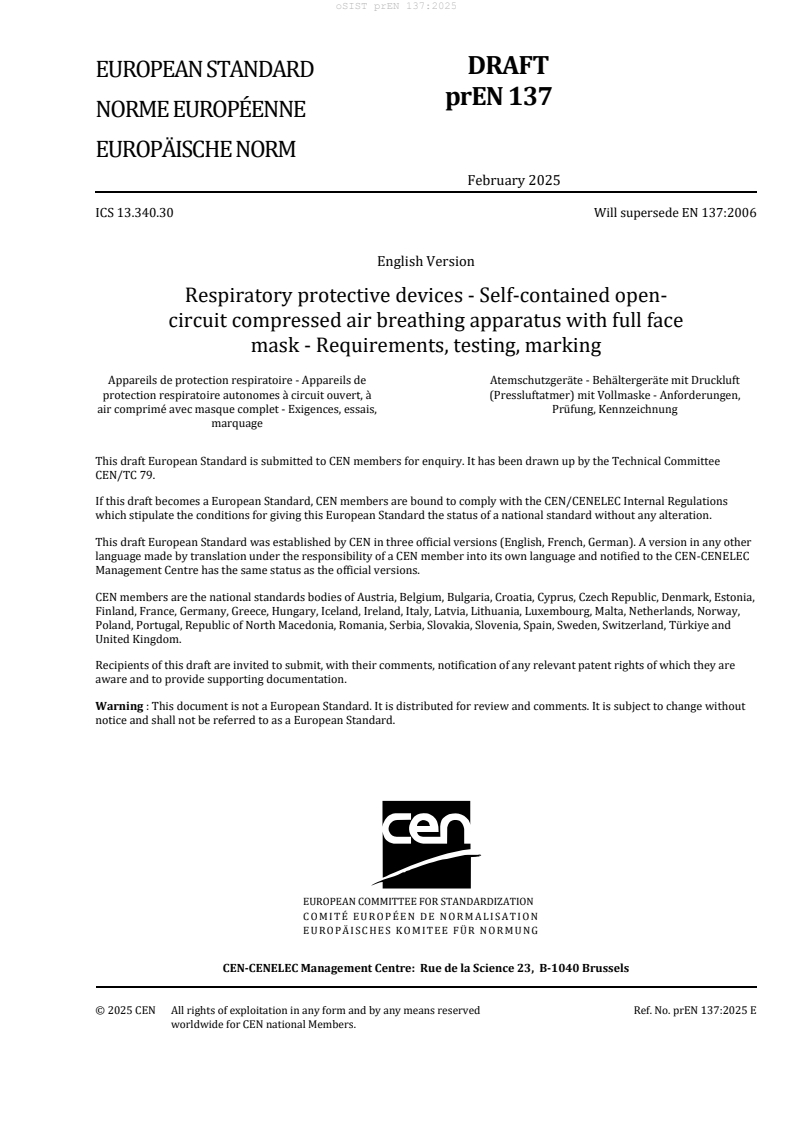
DRAFT
EUROPEAN STANDARD
NORME EUROPÉENNE
EUROPÄISCHE NORM
February 2025
ICS 13.340.30 Will supersede EN 137:2006
English Version
Respiratory protective devices - Self-contained open-
circuit compressed air breathing apparatus with full face
mask - Requirements, testing, marking
Appareils de protection respiratoire - Appareils de Atemschutzgeräte - Behältergeräte mit Druckluft
protection respiratoire autonomes à circuit ouvert, à (Pressluftatmer) mit Vollmaske - Anforderungen,
air comprimé avec masque complet - Exigences, essais, Prüfung, Kennzeichnung
marquage
This draft European Standard is submitted to CEN members for enquiry. It has been drawn up by the Technical Committee
CEN/TC 79.
If this draft becomes a European Standard, CEN members are bound to comply with the CEN/CENELEC Internal Regulations
which stipulate the conditions for giving this European Standard the status of a national standard without any alteration.
This draft European Standard was established by CEN in three official versions (English, French, German). A version in any other
language made by translation under the responsibility of a CEN member into its own language and notified to the CEN-CENELEC
Management Centre has the same status as the official versions.
CEN members are the national standards bodies of Austria, Belgium, Bulgaria, Croatia, Cyprus, Czech Republic, Denmark, Estonia,
Finland, France, Germany, Greece, Hungary, Iceland, Ireland, Italy, Latvia, Lithuania, Luxembourg, Malta, Netherlands, Norway,
Poland, Portugal, Republic of North Macedonia, Romania, Serbia, Slovakia, Slovenia, Spain, Sweden, Switzerland, Türkiye and
United Kingdom.
Recipients of this draft are invited to submit, with their comments, notification of any relevant patent rights of which they are
aware and to provide supporting documentation.
Warning : This document is not a European Standard. It is distributed for review and comments. It is subject to change without
notice and shall not be referred to as a European Standard.
EUROPEAN COMMITTEE FOR STANDARDIZATION
COMITÉ EUROPÉEN DE NORMALISATION
EUROPÄISCHES KOMITEE FÜR NORMUNG
CEN-CENELEC Management Centre: Rue de la Science 23, B-1040 Brussels
© 2025 CEN All rights of exploitation in any form and by any means reserved Ref. No. prEN 137:2025 E
worldwide for CEN national Members.
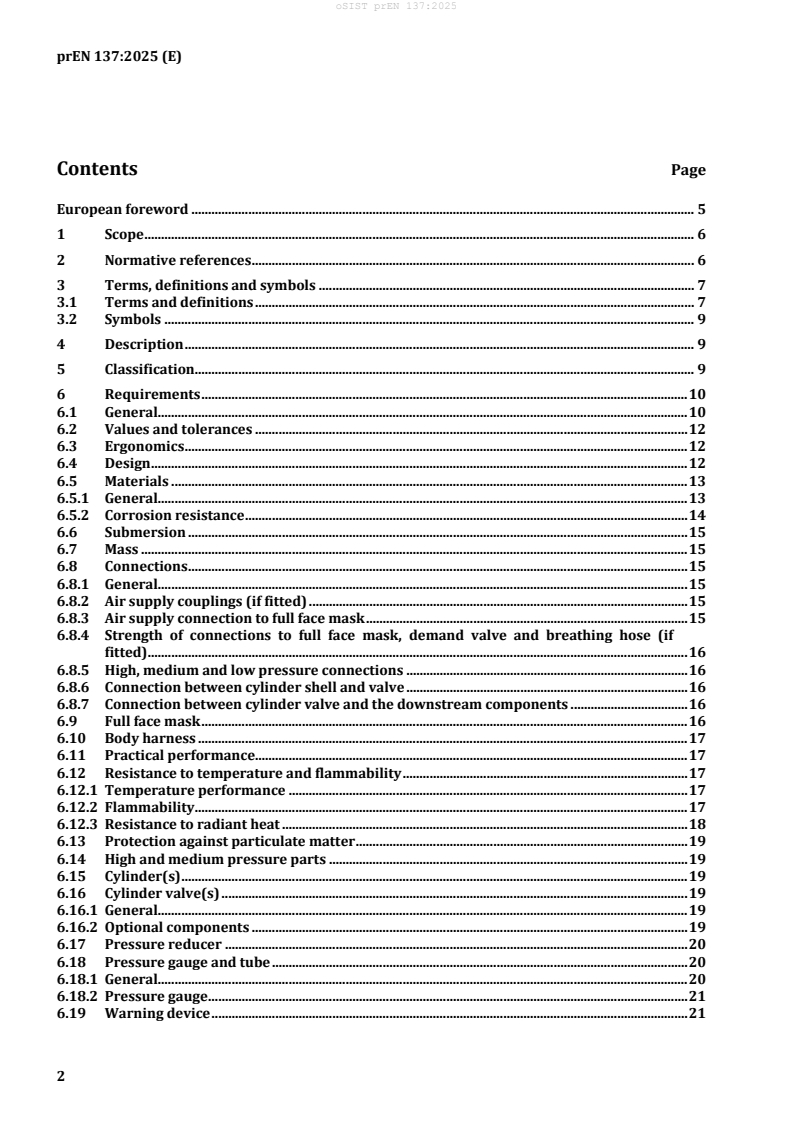
Contents Page
European foreword . 5
1 Scope . 6
2 Normative references . 6
3 Terms, definitions and symbols . 7
3.1 Terms and definitions . 7
3.2 Symbols . 9
4 Description . 9
5 Classification. 9
6 Requirements . 10
6.1 General. 10
6.2 Values and tolerances . 12
6.3 Ergonomics . 12
6.4 Design . 12
6.5 Materials . 13
6.5.1 General. 13
6.5.2 Corrosion resistance . 14
6.6 Submersion . 15
6.7 Mass . 15
6.8 Connections . 15
6.8.1 General. 15
6.8.2 Air supply couplings (if fitted) . 15
6.8.3 Air supply connection to full face mask . 15
6.8.4 Strength of connections to full face mask, demand valve and breathing hose (if
fitted) . 16
6.8.5 High, medium and low pressure connections . 16
6.8.6 Connection between cylinder shell and valve . 16
6.8.7 Connection between cylinder valve and the downstream components . 16
6.9 Full face mask . 16
6.10 Body harness . 17
6.11 Practical performance. 17
6.12 Resistance to temperature and flammability . 17
6.12.1 Temperature performance . 17
6.12.2 Flammability . 17
6.12.3 Resistance to radiant heat . 18
6.13 Protection against particulate matter . 19
6.14 High and medium pressure parts . 19
6.15 Cylinder(s) . 19
6.16 Cylinder valve(s) . 19
6.16.1 General. 19
6.16.2 Optional components . 19
6.17 Pressure reducer . 20
6.18 Pressure gauge and tube . 20
6.18.1 General. 20
6.18.2 Pressure gauge . 21
6.19 Warning device . 21
6.19.1 General . 21
6.19.2 Warning device — Pneumatic . 22
6.19.3 Warning device — Electronic . 22
6.20 Flexible medium pressure connecting tube(s) . 22
6.21 Lung governed demand valve . 23
6.21.1 Negative Pressure SCBA . 23
6.21.2 Positive Pressure SCBA . 23
6.21.3 Supplementary air supply . 23
6.22 Breathing resistance. 23
6.22.1 Inhalation resistance . 23
6.22.2 Exhalation resistance . 25
6.23 Static pressure . 26
6.24 Leak-tightness . 26
6.24.1 General . 26
6.24.2 Low pressure . 26
6.24.3 High pressure . 26
6.25 Temperature pre-conditioning . 26
6.26 Use of SCBA in potentially explosive atmospheres (optional) . 27
7 Testing . 27
7.1 General . 27
7.2 Inspection . 27
7.3 Resistance to temperature and flammability . 28
7.3.1 Laboratory tests with a breathing machine . 28
7.3.2 Practical performance test . 29
7.4 Resistance of the cylinder to extreme temperatures . 29
7.5 Pressure reducer . 29
7.5.1 General . 29
7.5.2 Pressure reducer relief valve . 30
7.6 Warning device . 30
7.7 Leak-tightness . 30
7.7.1 Low pressure test . 30
7.7.2 High pressure test . 31
7.8 Air-tightness . 31
7.9 Submersion . 31
7.10 Strength of connections to full face mask, demand valve and breathing hose (if
fitted) . 31
7.11 Resistance to collapse of breathing hose . 32
7.11.1 Principle . 32
7.11.2 Apparatus . 32
7.11.3 Procedure . 32
7.12 Practical performance . 32
7.12.1 General . 32
7.12.2 Walking test . 32
7.12.3 Work simulation test . 33
8 Marking . 33
8.1 General . 33
8.2 Cylinder . 34
9 Information supplied by the manufacturer . 34
9.1 General . 34
9.2 Cylinder . 35
Annex A (normative) Second medium pressure connector . 36
A.1 General. 36
A.1.1 Outlet connector . 36
A.1.2 Inlet connector . 36
A.1.3 Combined connector . 36
A.2 Requirements . 36
A.2.1 General. 36
A.2.2 Use as outlet connector . 36
A.2.3 Use as inlet connector . 37
A.3 Information supplied by the manufacturer . 37
Annex B (normative) Ambient air bypass device . 38
B.1 General. 38
B.2 Requirements . 38
B.3 Information supplied by the manufacturer . 38
Annex C (normative) Drop test for multiple cylinder devices . 40
Annex D (normative) Interchangeability of the cylinder with the basic part of the SCBA . 42
D.1 General. 42
D.2 Requirements . 42
D.2.1 Cylinder shell . 42
D.2.2 Cylinder valve . 42
D.2.3 Connection between cylinder shell and cylinder valve. 42
D.2.4 Connection between cylinder valve and downstream components . 42
D.2.5 Mass . 43
D.2.6 Dimensions of the cylinder . 43
D.2.6.1 General. 43
D.2.6.2 Use of dimensional gauge for the cylinder. 43
D.2.7 Dimensions of the basic part of SCBA . 44
D.2.7.1 General. 44
D.2.7.2 Use of dimensional gauge for the basic part . 44
D.3 Marking . 47
D.4 Information supplied by the manufacturer . 47
Annex ZA (informative) Relationship between this European Standard and the essential
health and safety requirements of Regulation 2016/425/EU [2016 OJ L81] aimed to
be covered . 49
Bibliography . 51
European foreword
This document (prEN 137:2025) has been prepared by Technical Committee CEN/TC 79 “Respiratory
protective devices”, the secretariat of which is held by DIN.
This document is a working document.
This document will supersede EN 137:2006.
a) risk assessment, required in specific clauses;
b) tolerance of ±5 % on temperature limits not otherwise specified and of ±1 °C on those specified;
c) reference to EU Directive 2014/68 on dimensions of pressurized parts;
d) test on corrosion resistance according to EN ISO 9227:2022;
e) flame engulfment according to ISO 16900-10:2015, 6.2.5;
f) elevated heat test;
g) drop test for multiple cylinder devices (Annex C);
h) use IN potentially explosive atmospheres;
i) optional requirements regarding interchangeability of cylinders (Annex D);
j) optional requirements regarding the Personal Alert Safet System (3.1.11).
This document has been prepared under a standardization request addressed to CEN by the European
Commission. The Standing Committee of the EFTA States subsequently approves these requests for its
Member States.
For the relationship with EU Legislation, see informative Annex ZA, which is an integral part of this
document.
1 Scope
This document specifies minimum performance requirements for self-contained breathing apparatus
(SCBA), except escape device and diving device.
This document specifies in the Annex D optional requirements regarding the interchangeability of the
cylinder for single-cylinder SCBA.
Laboratory and practical performance tests are included for the assessment of compliance with the
requirements.
2 Normative references
The following documents, in whole or in part, are normatively referenced in this document and are
indispensable for its application. For dated references, only the edition cited applies. For undated
references, the latest edition of the referenced document (including any amendments) applies.
EN 136:1998 , Respiratory protective devices — Full face masks — Requirements, testing, marking
EN 144-1:2018, Respiratory protective devices — Gas cylinder valves — Part 1: Inlet connections
EN 144-2:2018, Respiratory protective devices — Gas cylinder valves — Part 2: Outlet connections
EN 148-1:2018, Respiratory protective devices — Threads for facepieces — Standard thread connexion
EN 148-2:1999, Respiratory protective devices — Threads for facepieces — Centre thread connection
EN 148-3:1999, Respiratory protective devices — Threads for facepieces — Part 3: Thread connexion M
45 x 3
, Pressure gauges — Part 1: Bourdon tube pressure gauges — Dimensions, metrology,
EN 837-1:1996
requirements and testing
EN 12245:2022, Transportable gas cylinders — Fully wrapped composite cylinders
EN 12257:2002, Transportable gas cylinders — Seamless, hoop-wrapped composite cylinders
EN 13274-2:2019, Respiratory protective devices — Methods of test — Part 2: Practical performance tests
EN 13274-3:2001, Respiratory protective devices — Methods of test — Part 3: Determination of breathing
resistance
EN 13274-4:2020, Respiratory protective devices — Methods of test — Part 4: Flame test
EN ISO 9227:2022 , Corrosion tests in artificial atmospheres - Salt spray tests (ISO 9227:2022)
EN ISO 9809-2:2019, Gas cylinders — Design, construction and testing of refillable seamless steel gas
cylinders and tubes — Part 2: Quenched and tempered steel cylinders and tubes with tensile strength
greater than or equal to 1 100 MP (ISO 9809-2:2019)
EN ISO 10297:2024, Gas cylinders — Cylinder valves — Specification and type testing (ISO 10297:2024,
Corrected version 2024-05)
This normative reference is impacted by a corrigendum: EN 136:1998/AC:2003.
This normative reference is impacted by a corrigendum: EN 837-1:1996/AC:1998.
This normative reference is impacted by an amendment : EN ISO 9227:2022/A1:2024.
ISO 16900-10:2015, Respiratory protective devices — Methods of test and test equipment — Part 10:
Resistance to ignition, flame, radiant heat and heat
EN ISO 80079-36:2016 , Explosive atmospheres — Part 36: Non-electrical equipment for explosive
atmospheres - Basic method and requirements
EN IEC 60079-0:2018 , Electrical apparatus for explosive gas atmospheres — Part 0: General
requirements (IEC 60079-0:2017)
EN IEC 61000-6-2:2019, Electromagnetic compatibility (EMC) — Part 6-2: Generic standards —
Immunity standard for industrial environments (IEC 61000-6-2:2016)
ISO 11119-2:2020, Gas cylinders — Design, construction and testing of refillable composite gas cylinders
and tubes — Part 2: Fully wrapped fibre reinforced composite gas cylinders and tubes up to 450 l with
load-sharing metal liners
ISO 11119-3:2020, Gas cylinders — Design, construction and testing of refillable composite gas cylinders
and tubes — Part 3: Fully wrapped fibre reinforced composite gas cylinders and tubes up to 450 l with
non-load-sharing metallic or non-metallic liners or without liners
3 Terms, definitions and symbols
For the purposes of this document, the terms and definitions given in EN ISO 16972:2020 and
EN 134:2024 and the following apply.
3.1 Terms and definitions
3.1.1
basic part of SCBA
SCBA without mask nor cylinder
3.1.2
self-contained breathing apparatus
SCBA
self-contained open-circuit compressed air breathing apparatus with full face mask
3.1.3
cylinder
sub-assembly of SCBA generally comprising:
— cylinder shell;
— cylinder valve;
— label or other means of identifying the manufacturer of the cylinder body and of the cylinder-valve-
assembly;
— optional: pressure indicator, excess flow device, bursting disc, cylinder protection device, dip tube
or filter with the dip tube or other
This normative reference is impacted by a corrigendum: EN ISO 80079-36:2016/AC:2019.
This normative reference is amended by: EN IEC 60079-0:2018/A11:2024; by an EN IEC 60079-0:2018/prAB; And is
impacted by a corrigendum: EN IEC 60079-0:2018/AC:2020-0.
3.1.4
rated working pressure
maximum allowable pressure (PS) for which the equipment is designed, as specified by the
manufacturer
3.1.5
working pressure
settled pressure of compressed air at a uniform reference temperature of 15 °C in a fully charged
cylinder, in bar
3.1.6
bursting disc
device intended to protect pressurised cylinders against overpressure
3.1.7
excess flow device
EFV
device that limits, in the event of rupture of the valve or unwanted opening, the flow of air exiting from
the cylinder
3.1.8
pressure indicator
device indicating the presence or absence of pressure
3.1.9
cylinder valve
device which, when closed, prevents the flow of compressed air from cylinder
3.1.10
cylinder shell
recipient without valve designed to contain pressurized air
3.1.11
Personal Alert Safety System
(PASS)
device that continually senses for lack of movement of the wearer and automatically activates the alarm
signal, indicating the wearer needs assistance, but can also be manually activated to trigger the alarm
Note 1 to entry: PASS can be an integrated device with dispersed components, incorporated into the construction
or assembly of SCBA.
Note 2 to entry: PASS can have key(s) device(s) that activate(s) and/or de-activate(s) it. Different methods exist.
Note 3 to entry: The activation key can be e.g. removable, a smart card, a pressure activation, a push button or an
electronic signal.
Note 4 to entry: For de-activation, an intentional action via a removable key, smart card, push button or electronic
signal might be applied.
Note 5 to entry: See BS 10999:2010.
3.1.12
alarm signal
PASS-audible warning that is identifiable as an indication that a person needs assistance
3.1.13
pre-alarm signal
PASS-audible warning that is identifiable as an indication that a PASS is about to sound the alarm signal
3.2 Symbols
3.2.1
basic parts and cylinders both showing the following symbols are compatible to one another and
can be interchanged
Cylinder Backplate
50 mm × 65 mm 10,8 mm × 15 mm
Minimum
4 Description
This SCBA comprises cylinder(s) and typically body harness, lung governed demand valve, pressure
reducer, pressure indicator or gauge, warning device(s), connecting hoses or tubes and full face mask.
It may include pressure reducer relief valve, supplementary air supply, secondary medium pressure
connector(s), ambient air bypass device, a PASS device or other accessories.
The SCBA functions by enabling the wearer to breathe air on demand supplied from compressed air
cylinder(s). The exhaled air from the wearer then passes without re-circulation to the ambient
atmosphere.
5 Classification
Self-contained open-circuit compressed air breathing SCBA are classified as follows;
— Type 1: SCBA meeting basic requirements;
— Type 2: SCBA meeting higher requirements.
Type 1 is intended for use for planned activities not in high temperature environments where the
exposure to flames or radiant heat is not expected.
Type 2 is intended for use by fire and rescue services and considers the tactical procedures including
internal attacks (structural firefighting) of European fire services and established training methods.
The requirements of Type 2 include those provided by Type 1.
6 Requirements
6.1 General
For all SCBA being tested, pre-conditioning in accordance with 6.25 shall be performed.
All test samples specified in the related test clauses shall meet the relevant requirements.
Table 1 gives the requirement, number of samples, pre-conditioning and test clause numbers.
Table 1 — Test schedule
a
Number of test samples
Test Associated
Requirement Title Conditioning
clause requirements
Type 1 Type 2
Corrosion 1 1
6.5.2 EN ISO 9227:2022 7.2, 7.8
resistance
6.6 Submersion 1 1 6.25 7.9
6.8 Connections
6.8.1 General 2 2 6.25 7.2, 7.12
Air supply
6.8.2 couplings (if 2 2 6.25 7.2, 7.12
fitted)
Strength of
connections to
1 mask, 1 mask,
full face mask,
6.8.4 6.25 7.10
demand valve b b
1 LDV 1 LDV
and breathing
hose (if fitted)
6.10 Body harness 2 2 6.25 7.12
Practical
6.11 2 2 7.3.2.1.1 7.3.2
performance
6.12.2 Flammability
7.2, 7.3.1.3,
6.12.2.1 Components 1 1 6.25
7.7
ISO 16900-
10:2015,
Flame
6.12.2.2 X 1 6.25 6.22
6.2.5,
engulfment
7.2
ISO 16900-
10:2015,
Elevated heat
6.12.2.3 X 1 6.25 6.22
6.2.5,
test
7.2
a
Number of test samples
Test Associated
Requirement Title Conditioning
clause requirements
Type 1 Type 2
Resistance to EN 136:19
6.12.3 X 1 6.25 6.22
radiant heat 98, 8.6
6.17 Pressure reducer
Reducer relief 7.2, 7.5.1
6.17 1 1 6.25
valve and 7.5.2
Pressure gauge 7.2 m), 7.9, EN 837-1:1996
6.18 1 1 6.25
and tube 7.12 , Clause 6
6.19 Warning device 1 1 6.25 7.2 m), 7.6
Lung governed
6.21 2 2 6.25 7.2 m)
demand valve
6.22.1 Inhalation resistance
EN 13274-
3:2001,
Negative
6.22.1.2 2 2 6.25 method 2,
pressure SCBA
settings E
and H
EN 13274-
3:2001,
Positive
6.22.1.3 2 2 6.25 method 2,
pressure SCBA
settings E
and H
Low
6.22.1.4.1 2 2 6.25 7.3.1.1
temperatures
High
6.22.1.4.2 2 2 6.25 7.3.1.2
temperatures
6.22.2 Exhalation resistance
EN 13274-
3:2001,
Negative
6.22.2.3 2 2 6.25 method 2,
pressure SCBA
settings E
and H
EN 13274-
3:2001,
Positive
6.22.2.4 2 2 6.25 method 2,
pressure SCBA
settings E
and H
Low
6.22.2.5.1 2 2 6.25 7.3.1.1
temperatures
High
6.22.2.5.2 2 2 6.25 7.3.1.2
temperatures
6.23 Static pressure
6.23 Static pressure 2 2 6.25 7.2
6.24 Leak-tightness
6.24.2 Low pressure 1 1 6.25 7.7.1
6.24.3 High pressure 1 1 6.25 7.7.2
a
Number of test samples
Test Associated
Requirement Title Conditioning
clause requirements
Type 1 Type 2
a
Samples can be used for more than one test.
b
LDV is the abbreviation for lung governed demand valve.
Where it is required in a specific clause a declaration that a risk assessment, e.g. a Failure Modes and
Effect Analysis (FMEA) concerning these specific requirements has been conducted, shall be supplied.
NOTE Further information is given in EN IEC 60812:2018 [1].
Where fitted, auxiliary equipment identified in Annexes A, B and D shall in addition meet the
requirements listed in those annexes.
To ensure the interchangeability of cylinder-valve-assemblies optional requirements are specified. This
applies to single cylinder SCBA which comply with the requirements of this document.
Interchangeability can only be claimed on components which have passed the tests as a complete SCBA.
6.2 Values and tolerances
Temperature limits, values which are not stated as maxima or minima shall be subject to a tolerance
of ±5 %. Unless otherwise specified, the ambient conditions for testing shall be between 16 °C and 32 °C
and (50 ± 30) % relative humidity.
Any temperature limits specified shall be subject to an accuracy of ±1 °C.
6.3 Ergonomics
The requirements of this document are intended to take account of the interaction between the wearer,
the SCBA, and where possible the working environment in which the SCBA is likely to be used. The
SCBA shall meet the requirements specified in 6.4, 6.10 and 6.11.
6.4 Design
6.4.1 The design of the SCBA shall be such as to allow the inspections to be performed in accordance
with the information supplied by the manufacturer.
Check in accordance with 7.2.
6.4.2 The diameter of pressurized parts with a pressure greater than 0,5 bar downstream of the
cylinder valve(s) shall not exceed DN 32 mm to ensure safe use evaluated as per the sound engineering
practice. (See EU Directive 2014/68)
Check compliance to this in the technical file.
The SCBA shall be robust to withstand the rough usage it is likely to receive in service.
Testing shall be performed in accordance with 7.12.
6.4.3 Any part of the SCBA likely to be in contact with the wearer shall be free from sharp edges and
burrs.
The SCBA shall not have protruding parts that can be caught on projections in narrow passages or by
moving parts.
All parts requiring manipulation by the wearer shall be readily accessible and easily distinguishable
from one another by touch. All adjustable parts and controls shall be constructed so that their
adjustment is not liable to cause accidental alteration during use.
A declaration that this was addressed by a risk assessment, e.g. a FMEA, shall be supplied.
Check in accordance with 7.2 and test in accordance with 7.12.
6.4.4 The device shall be so designed that the wearer can remove it and, while still wearing the full
face mask, continue to breathe from the device.
The device shall be designed to ensure its full function in any orientation.
The cylinder valve(s) of cylinder(s) shall be arranged so that the wearer can operate it (them) while
wearing the device.
Testing shall be performed in accordance with 7.12.
6.4.5 If devices (of the same type) are designed for use with different sizes of cylinders, changing of
cylinders shall be possible without the use of special tools.
It shall not be possible to simultaneously fit two or more cylinders of different working pressures to the
same basic part of SCBA.
It shall not be possible to fit a basic part of SCBA which is designed to operate with a lower rated
working pressure to a cylinder with a higher working pressure.
Check in accordance with 7.2.
6.4.6 The cylinder shall comply with a recognized standard, e.g. EN ISO 9809-2:2019 for Type I,
EN 12257:2002 for Type II and EN 12245:2022 for Type III, IV and V.
Check in accordance with 7.2.
6.5 Materials
6.5.1 General
All materials shall have adequate resistance to deterioration by temperature and flammability as
specified in 6.12 and adequate mechanical strength as specified in 6.8, 6.14, 6.20.
SCBA shall not have exposed unprotected metal components manufactured from Magnesium, Titanium,
Aluminium, or of their alloys, containing these metals which, on impact with rusted iron or steel, are
likely to produce sparks capable of igniting flammable gas/air mixtures. Protective surface finishes
include, but are not limited to, thermal spray, anodizing, powder coating, hard coating, and liquid paint.
Exposed components are those that can be touched, during use, by the exposed surface identification
probe given in Figure 1.
Dimensions in millimetres
Key
1 handle at the discretion of the manufacturer
Figure 1 — Exposed surface identification probe
Materials which come into direct contact with the wearer's skin shall not be known to be likely to cause
irritation or any other adverse effect to health.
The manufacturer shall supply a declaration that this was addressed by a risk assessment, e.g. a FMEA.
Check in accordance with 7.2 and test in accordance with 7.12.
6.5.2 Corrosion resistance
The following is mandatory for SCBA of Type 2 and optional for SCBA of Type 1.
The SCBA including the cylinder shall be exposed for 8 h to a neutral 5 % concentration salt water spray
in accordance with EN ISO 9227:2022, then left for 16 h in the environment at a temperature of
between 20 °C and 25 °C with a relative humidity of (65 ± 20) %.
This procedure shall be carried out three times in a period of 72 h.
After exposure to the above-mentioned conditions, significant corrosion which has penetrated the
materials shall not be observed and the SCBA shall not have lost more than 5 % of its pressure.
The SCBA shall be tested when filled at working pressure with the valve closed.
Check in accordance with 7.2 and test in accordance with 7.8.
6.6 Submersion
The SCBA shall continue to function satisfactorily after being submerged in water. Before submersion
and after removal from the water the SCBA shall meet the requirements of 6.22, only for room
temperature.
Testing shall be performed in accordance with 7.9.
6.7 Mass
The mass of the SCBA in the ready for use state, with cylinder at working pressure, including its
components as listed in Clause 4 and excluding removable accessories not essential for safe use of
SCBA, shall not exceed 18 kg. If the helmet is also intended to serve as a mask head harness it will not be
considered for the mass limit.
The manufacturer shall supply a declaration that this was addressed by a risk assessment, e.g. a FMEA.
Check in accordance with 7.2.
6.8 Connections
6.8.1 General
Components of the SCBA shall be readily separated for cleaning, examining and testing. All demountable
connections shall be readily connected and secured, where possible by hand. Any means for sealing
used shall be retained in position when the joints and couplings are disconnected during normal use
and maintenance.
A declaration that this was addressed by a risk assessment, e.g. a FMEA, shall be supplied.
Check in accordance with 7.2 and test in accordance with 7.12.
6.8.2 Air supply couplings (if fitted)
The SCBA shall be constructed so that any twisting of the hoses and tubes does not affect the fit or
performance of the SCBA, or cause the hoses and or tubes to become disconnected. The design of the
couplings shall be such as to prevent unintentional interruption of the air supply.
A declaration that this was addressed by a risk assessment, e.g. a FMEA, shall be
...