

EN 926-2:2013+A1:2021
(Main + Amendment)Paragliding equipment - Paragliders - Part 2: Requirements and test methods for classifying flight safety characteristics
General Information
- Abstract
2020-08-31 - Awaiting resolution of technical issues with TC.
- Status
- Published
- Publication Date
- 21-Dec-2021
- Withdrawal Date
- 29-Jun-2022
- Technical Committee
- CEN/TC 136 - Sports, playground and other recreational equipment
- Drafting Committee
- CEN/TC 136/WG 6 - Paragliding equipment
- Current Stage
- 6060 - Definitive text made available (DAV) - Publishing
- Start Date
- 22-Dec-2021
- Due Date
- 13-Apr-2021
- Completion Date
- 22-Dec-2021

Overview
EN 926-2:2013+A1:2021, published by CEN, establishes the requirements and test methods for classifying the flight safety characteristics of paragliders. It serves as a core European standard for manufacturers, independent test laboratories, and regulatory bodies, aiming to enhance flight safety, evaluate paraglider performance, and provide clear information to pilots regarding the demands and skills required for different paragliding equipment.
This standard is part of a broader series addressing paragliding equipment, focusing specifically on flight characteristics that relate to pilot safety. It gives an objective framework for paraglider classification, helping pilots select equipment suited to their skill level and intended use.
Key Topics
Flight Safety Classification: EN 926-2 sets out procedures for classifying paragliders according to the skills required for safe operation. The classification system uses a four-tier approach (Classes A, B, C, D), ranging from wings suitable for beginners to those intended for highly experienced pilots.
Test Methods: The standard describes standardized flight test procedures. These include assessments of take-off and landing characteristics, response to turbulence, recovery from abnormal flight conditions (such as stalls, spins, and collapses), pitch and roll stability, and control movements.
Behavioral Criteria: Paragliders are evaluated against detailed criteria such as inflation behavior, speed range, stall resistance, spiral dives, and recovery from both symmetric and asymmetric collapses. Each behavior is measured and classified, ensuring objectivity and transparency.
Requirements for Test Labs: Testing must be performed by independent, qualified laboratories. This ensures reliability and impartiality in the classification of flight safety characteristics.
Documentation and Marking: The standard lays out requirements for user manuals, test records, and product marking, so that pilots receive accurate safety and classification information.
Applications
Manufacturers: Designers and producers of paragliders use EN 926-2 for certifying new models, ensuring they meet defined safety and performance standards for the European market and beyond.
Test Laboratories: Certified testing laboratories apply these procedures to objectively evaluate paraglider characteristics, providing standardized safety classifications.
Pilot Guidance: Pilots rely on the class system (A-D) to select gliders appropriate to their skill level and flying experience, reducing risk and enhancing overall safety.
Regulatory Compliance: National and regional aviation authorities reference EN 926-2 for regulatory oversight and certification processes, harmonizing safety standards across countries.
Training Schools: Paragliding instructors and flight schools use the classification system to recommend suitable gliders to students and new pilots, ensuring gradual progression and safety during training.
Related Standards
EN 926-2 forms part of an integrated suite of European paragliding equipment standards, including:
- EN 926-1: Paragliding equipment - Paragliders - Part 1: Requirements and test methods for structural strength
- EN 1651: Paragliding equipment - Harnesses - Safety requirements and strength tests
- EN 12491: Paragliding equipment - Emergency parachutes - Safety requirements and test methods
- EN 966: Helmets for airborne sports
Together, these standards cover the full range of safety requirements for paragliding, from material strength and harness safety to emergency procedures and equipment classification.
By using EN 926-2:2013+A1:2021, stakeholders across the paragliding industry contribute to safer, more reliable paragliding experiences, supporting responsible product development, risk-aware pilot selection, and consistent regulatory standards throughout Europe and beyond.
Relations
- Effective Date
- 22-Jul-2020
- Effective Date
- 22-Jul-2020
- Effective Date
- 28-Jan-2026
- Effective Date
- 28-Jan-2026
- Refers
EN 1651:2018+A1:2020 - Paragliding equipment - Harnesses - Safety requirements and strength tests - Effective Date
- 28-Jan-2026
- Effective Date
- 28-Jan-2026
Frequently Asked Questions
EN 926-2:2013+A1:2021 is a standard published by the European Committee for Standardization (CEN). Its full title is "Paragliding equipment - Paragliders - Part 2: Requirements and test methods for classifying flight safety characteristics". This standard covers: 2020-08-31 - Awaiting resolution of technical issues with TC.
2020-08-31 - Awaiting resolution of technical issues with TC.
EN 926-2:2013+A1:2021 is classified under the following ICS (International Classification for Standards) categories: 97.220.40 - Outdoor and water sports equipment. The ICS classification helps identify the subject area and facilitates finding related standards.
EN 926-2:2013+A1:2021 has the following relationships with other standards: It is inter standard links to EN 926-2:2013, EN 926-2:2013/FprA1, EN 966:2012+A1:2012, EN 926-1:2015, EN 1651:2018+A1:2020, EN 12491:2015+A1:2021. Understanding these relationships helps ensure you are using the most current and applicable version of the standard.
EN 926-2:2013+A1:2021 is available in PDF format for immediate download after purchase. The document can be added to your cart and obtained through the secure checkout process. Digital delivery ensures instant access to the complete standard document.
Standards Content (Sample)
SLOVENSKI STANDARD
01-februar-2022
Nadomešča:
SIST EN 926-2:2014
Oprema za jadralno padalstvo - Jadralna padala - 2. del: Zahteve in preskusne
metode za razvrščanje po značilnostih, pomembnih za varno letenje (vključuje
dopolnilo A1)
Paragliding equipment - Paragliders - Part 2: Requirements and test methods for
classifying flight safety characteristics
Ausrüstung für das Gleitschirmfliegen - Gleitschirme - Teil 2: Anforderungen und
Prüfverfahren zur Klassifizierung der sicherheitsrelevanten Flugeigenschaften
Équipement pour le parapente - Parapentes - Partie 2 : Exigences et méthodes d'essai
pour la classification des caractéristiques de sécurité en vol
Ta slovenski standard je istoveten z: EN 926-2:2013+A1:2021
ICS:
97.220.40 Oprema za športe na Outdoor and water sports
prostem in vodne športe equipment
2003-01.Slovenski inštitut za standardizacijo. Razmnoževanje celote ali delov tega standarda ni dovoljeno.
EN 926-2:2013+A1
EUROPEAN STANDARD
NORME EUROPÉENNE
December 2021
EUROPÄISCHE NORM
ICS 97.220.40
English Version
Paragliding equipment - Paragliders - Part 2:
Requirements and test methods for classifying flight safety
characteristics
Équipement pour le parapente - Parapentes - Partie 2 : Ausrüstung für das Gleitschirmfliegen - Gleitschirme -
Exigences et méthodes d'essai pour la classification des Teil 2: Anforderungen und Prüfverfahren zur
caractéristiques de sécurité en vol Klassifizierung der sicherheitsrelevanten
Flugeigenschaften
This European Standard was approved by CEN on 14 September 2013 and includes Amendment 1 approved by CEN on 10
August 2020.
CEN members are bound to comply with the CEN/CENELEC Internal Regulations which stipulate the conditions for giving this
European Standard the status of a national standard without any alteration. Up-to-date lists and bibliographical references
concerning such national standards may be obtained on application to the CEN-CENELEC Management Centre or to any CEN
member.
This European Standard exists in three official versions (English, French, German). A version in any other language made by
translation under the responsibility of a CEN member into its own language and notified to the CEN-CENELEC Management
Centre has the same status as the official versions.
CEN members are the national standards bodies of Austria, Belgium, Bulgaria, Croatia, Cyprus, Czech Republic, Denmark, Estonia,
Finland, France, Germany, Greece, Hungary, Iceland, Ireland, Italy, Latvia, Lithuania, Luxembourg, Malta, Netherlands, Norway,
Poland, Portugal, Republic of North Macedonia, Romania, Serbia, Slovakia, Slovenia, Spain, Sweden, Switzerland, Turkey and
United Kingdom.
EUROPEAN COMMITTEE FOR STANDARDIZATION
COMITÉ EUROPÉEN DE NORMALISATION
EUROPÄISCHES KOMITEE FÜR NORMUNG
CEN-CENELEC Management Centre: Rue de la Science 23, B-1040 Brussels
© 2021 CEN All rights of exploitation in any form and by any means reserved Ref. No. EN 926-2:2013+A1:2021 E
worldwide for CEN national Members.
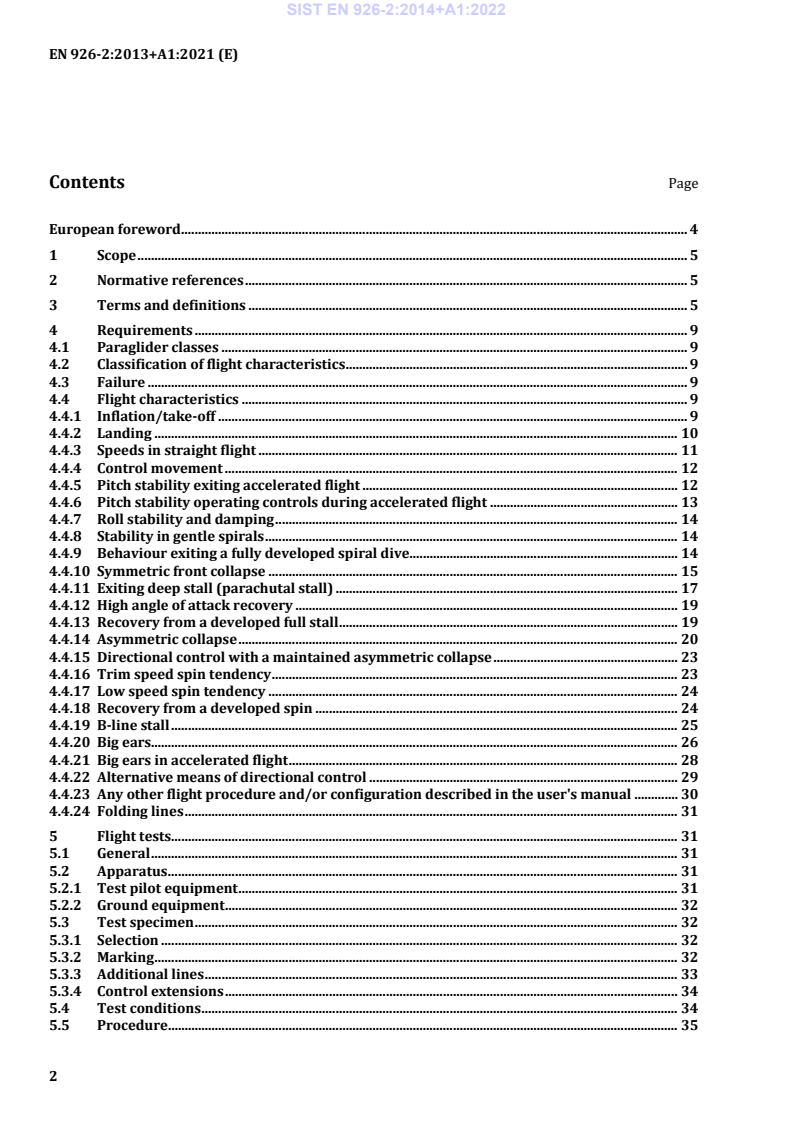
Contents Page
European foreword . 4
1 Scope . 5
2 Normative references . 5
3 Terms and definitions . 5
4 Requirements . 9
4.1 Paraglider classes . 9
4.2 Classification of flight characteristics . 9
4.3 Failure . 9
4.4 Flight characteristics . 9
4.4.1 Inflation/take-off . 9
4.4.2 Landing . 10
4.4.3 Speeds in straight flight . 11
4.4.4 Control movement . 12
4.4.5 Pitch stability exiting accelerated flight . 12
4.4.6 Pitch stability operating controls during accelerated flight . 13
4.4.7 Roll stability and damping . 14
4.4.8 Stability in gentle spirals . 14
4.4.9 Behaviour exiting a fully developed spiral dive . 14
4.4.10 Symmetric front collapse . 15
4.4.11 Exiting deep stall (parachutal stall) . 17
4.4.12 High angle of attack recovery . 19
4.4.13 Recovery from a developed full stall . 19
4.4.14 Asymmetric collapse . 20
4.4.15 Directional control with a maintained asymmetric collapse . 23
4.4.16 Trim speed spin tendency . 23
4.4.17 Low speed spin tendency . 24
4.4.18 Recovery from a developed spin . 24
4.4.19 B-line stall . 25
4.4.20 Big ears. 26
4.4.21 Big ears in accelerated flight . 28
4.4.22 Alternative means of directional control . 29
4.4.23 Any other flight procedure and/or configuration described in the user's manual . 30
4.4.24 Folding lines . 31
5 Flight tests . 31
5.1 General . 31
5.2 Apparatus . 31
5.2.1 Test pilot equipment . 31
5.2.2 Ground equipment . 32
5.3 Test specimen . 32
5.3.1 Selection . 32
5.3.2 Marking . 32
5.3.3 Additional lines . 33
5.3.4 Control extensions . 34
5.4 Test conditions . 34
5.5 Procedure. 35
5.5.1 General . 35
5.5.2 Trimmers . 35
5.5.3 Other adjustable or removable devices . 35
5.5.4 Video documentation . 35
5.5.5 Radio documentation . 36
5.5.6 Harness dimensions . 36
5.5.7 Ballast . 37
5.5.8 Sitting position. 37
5.5.9 Controls in hand . 37
5.5.10 Wraps . 37
5.5.11 Timing when starting test measurements . 37
5.5.12 Timing when exiting stalled flight conditions . 38
5.5.13 Exiting developed spin rotation . 38
5.5.14 Pitch angles . 38
5.5.15 Keep course . 38
5.5.16 Twist . 38
5.5.17 Collapse on the opposite side . 38
5.5.18 Details of test manoeuvres to be carried out . 38
6 Test files . 45
6.1 Test file information . 45
6.2 Items accompanying the test files . 46
7 User's manual . 46
8 Manufacturing record . 49
9 Marking . 49
Annex A (normative) Measuring suspension line lengths . 51
European foreword
This document (EN 926-2:2013+A1:2021) has been prepared by Technical Committee CEN/TC 136 “Sports,
play-ground and other recreational facilities and equipment”, the secretariat of which is held by DIN.
This European Standard shall be given the status of a national standard, either by publication of an identical
text or by endorsement, at the latest by June 2022, and conflicting national standards shall be withdrawn at
the latest by June 2022.
Attention is drawn to the possibility that some of the elements of this document may be the subject of patent
rights. CEN shall not be held responsible for identifying any or all such patent rights.
This document includes Amendment 1 approved by CEN on 2020-08-10.
This document supersedes !EN 926-2:2013."
The start and finish of text introduced or altered by amendment is indicated in the text by tags !".
In comparison with the previous edition EN 926-2:2005, the following significant changes have been made:
— editorial revision;
— introduction of new definitions;
— modification of paraglider's classification;
— update of marking;
— introduction of additional lines paragraph;
— harness dimensions have been modified;
— test methods for asymmetric and symmetric collapse have been improved;
— update of test method for behaviour exiting a fully developed spiral dive.
This document is one of a series of standards on equipment for paragliding as follows:
— EN 926-1, Paragliding equipment — Paragliders — Part 1: Requirements and test methods for structural
strength
— EN 926-2, Paragliding equipment — Paragliders — Part 2: Requirements and test methods for classifying
flight safety characteristics
— EN 1651, Paragliding equipment — Harnesses — Safety requirements and strength tests
— EN 12491, Paragliding equipment — Emergency parachutes — Safety requirements and test methods
Any feedback and questions on this document should be directed to the users’ national committee. A
complete listing of these bodies can be found on the CENELEC website.
According to the CEN-CENELEC Internal Regulations, the national standards organizations of the following
countries are bound to implement this European Standard: Austria, Belgium, Bulgaria, Croatia, Cyprus, Czech
Republic, Denmark, Estonia, Finland, France, Germany, Greece, Hungary, Iceland, Ireland, Italy, Latvia,
Lithuania, Luxembourg, Malta, Netherlands, Norway, Poland, Portugal, Republic of North Macedonia,
Romania, Slovakia, Slovenia, Spain, Sweden, Switzerland, Turkey and the United Kingdom.
1 Scope
This document specifies requirements and test methods for classifying the flight safety characteristics of
paragliders in terms of the demands on pilot flying skills.
This document is intended for the use of independent testing laboratories qualified for flight testing
paragliders.
2 Normative references
The following documents are referred to in the text in such a way that some or all of their content constitutes
requirements of this document. For dated references, only the edition cited applies. For undated references,
the latest edition of the referenced document (including any amendments) applies.
EN 926-1, Paragliding equipment - Paragliders - Part 1: Requirements and test methods for structural strength
EN 966, Helmets for airborne sports
EN 1651, Paragliding equipment — Harnesses — Safety requirements and strength tests
EN 12491, Paragliding equipment - Emergency parachutes - Safety requirements and test methods
3 Terms and definitions
For the purposes of this document, the following terms and definitions apply.
ISO and IEC maintain terminological databases for use in standardization at the following addresses:
• IEC Electropedia: available at http://www.electropedia.org/
• ISO Online browsing platform: available at http://www.iso.org/obp
3.1
paraglider
ultralight glider with no primary rigid structure, for which take-off and landing are on foot, with the pilot
(and potentially one passenger) carried in a harness (or harnesses) connected to the wing
3.2
harness
assembly composed of straps and fabric for supporting the pilot in the seated or semi-recumbent or standing
position
Note 1 to entry: The harness is attached to the wing via two rings or connectors; it can also be integral with the wing
via risers.
3.3
emergency parachute
emergency device intended to slow the descent of a paraglider pilot in the event of an incident in flight,
which is deployed by the pilot by an intentional manual action
Note 1 to entry: This may be unsteered or steerable.
3.4
controls
primary steering and speed controls which are designated as such by the manufacturer
3.5
trimmer
lockable pitch adjustment system
Note 1 to entry: Action by the pilot is required to return it to the initial position.
3.6
accelerator
secondary pitch control mechanism generally operated by the feet, which automatically returns to the initial
position when the action of the pilot stops
3.7
accelerator fully activated
when the mechanical limits of the glider are reached and further action on the accelerator does not result in
a further decrease of the angle of attack
3.8
action of the pilot
any transfer of weight, action on the controls, the accelerator or on the trimmer
3.9
normal flight
flight condition in which the paraglider is fully inflated and is following a trajectory close to straight flight (at
a speed close to trim speed) without any action on the part of the pilot
Note 1 to entry: A small number of cells may still be collapsed.
3.10
spiral dive
flight condition in which the paraglider is fully inflated and is following a circling, steep, nose down
trajectory with pitch angle of more than 70° and the angle of the span relative to the horizontal between 0°
and 40° as illustrated in Figure 1
Key
a angle of the span relative to the horizon
b pitch angle
Figure 1 — Illustration of a spiral dive
3.11
spontaneous recovery
when the paraglider returns to normal flight without any action on the part of the pilot
3.12
front collapse
folding under of the leading edge such that the top surface is visible to the pilot
Note 1 to entry: Deformation of the leading edge is not considered to be a front collapse.
3.13
cascade
transition from one involuntary abnormal flight condition to another involuntary abnormal flight condition
3.14
minimum speed
slowest airspeed maintainable without entering a deep stall or full stall
3.15
trim speed
airspeed of the paraglider in straight flight without activating the controls or the accelerator
3.16
maximum speed
airspeed of the paraglider in straight flight with the controls in the zero position and the accelerator fully
activated
Note 1 to entry: Maximum speed is only used when referring to gliders equipped with an accelerator.
3.17
low speed
airspeed of the paraglider in straight flight with the controls at 50 % of travel between the zero and the
symmetric stall position, i.e. 50 % of the symmetric control travel
3.18
weight in flight
total weight (mass) of the pilot and his entire paragliding equipment (including the glider) ready to fly
Note 1 to entry: For the purposes of this document, masses are indicated in kilograms rounded to the nearest integer
value.
3.19
additional lines
cross lines or folding lines used to help the test pilot in achieving specified manoeuvres
3.20
cross line
single line going from one riser to any position on an opposite A-line or A-line attachment point
3.21
folding lines
!copy of the A-lines (with two allowed exceptions) used to help the test pilot achieving specific
manoeuvers
Note 1 to entry: The allowed exceptions are that the number of upper level lines may be increased and the length of
the upper level of lines may be altered by up to 100 mm to ensure that the profile of the glider is undeformed and the
collapse follows the required pattern."
4 Requirements
4.1 Paraglider classes
The class of a paraglider is determined according to 4.2.
The class is intended to give pilots a guideline on whether a paraglider is suitable for their level of skill (see
Table 1).
Table 1 — Description of the paraglider classes
Class Description of flight characteristics Description of pilot skills required
A Paragliders with maximum passive safety and Designed for all pilots including pilots under all
extremely forgiving flying characteristics. levels of training.
Gliders with good resistance to departures from
normal flight.
B Paragliders with good passive safety and Designed for all pilots and may be suitable for
forgiving flying characteristics. Gliders with pilots under training if recommended by the
some resistance to departures from normal manufacturer.
flight.
C Paragliders with moderate passive safety and Designed for pilots familiar with recovery
with potentially dynamic reactions to techniques, who fly “actively” and regularly, and
turbulence and pilot errors. Recovery to normal understand the implications of flying a glider
flight may require precise pilot input. with reduced passive safety.
D Paragliders with demanding flying Designed for pilots well practised in recovery
characteristics and potentially violent reactions techniques, who fly very actively, have
to turbulence and pilot errors. Recovery to significant experience of flying in turbulent
normal flight requires precise pilot input. conditions, and who accept the implications of
flying such a wing.
4.2 Classification of flight characteristics
When testing in accordance with the procedures 5.5.18.1 to 5.5.18.23, various aspects of the paraglider's
behaviour are measured. These measurements are classified according to 4.4.1 to 4.4.24.
The class of a paraglider according to this document is determined by the highest classification obtained, i.e.
by the highest level of pilot skill required (see Table 1).
4.3 Failure
The glider has failed the test procedure if either:
a) as a consequence of tests 5.5.18.1 to 5.5.18.23 any failure of any part or component occurs;
b) the results of any of the tests 5.5.18.1 to 5.5.18.23 are not classified A, B, C or D.
NOTE In the classification tables in 4.4.1 to 4.4.24 the letter “F” (failed) is used to identify unacceptable behaviour.
4.4 Flight characteristics
4.4.1 Inflation/take-off
When tested in accordance with 5.5.18.1, it is found out how difficult it is to take-off with this glider
(including checking for undesirable tendencies).
The behaviour of the paraglider is measured according to Table 2 and classified according to Table 3.
Table 2 — Measurements and possible ranges in the inflation/take-off test
Measurement Ranges
Rising behaviour Smooth, easy and constant
rising, no pilot correction
required
Easy rising, some pilot
correction is required
Overshoots, shall be slowed
down to avoid a front collapse
Hangs back
Special take-off technique No
required
Yes
Table 3 — Classification of a paraglider's behaviour in the inflation/take-off test
Measurement and ranges (according to Classification
Table 2)
Rising behaviour —
Smooth, easy and constant rising A
Easy rising, some pilot correction is required B
Overshoots, shall be slowed down to avoid C
a front collapse
Hangs back D
Special take-off technique required —
No A
Yes C
4.4.2 Landing
When tested in accordance with 5.5.18.2, it is found out how difficult it is to flare and land this glider
(including checking for undesirable tendencies).
The behaviour of the paraglider is measured according to Table 4 and classified according to Table 5.
Table 4 — Measurements and possible ranges in the landing test
Measurement Ranges
Special landing technique required No
Yes
Table 5 — Classification of a paraglider's behaviour in the landing test
Measurement and ranges (according to Table 4) Classification
Special landing technique required —
No A
Yes D
4.4.3 Speeds in straight flight
When tested in accordance with 5.5.18.3, it is made sure that the paraglider is not too slow (hands up) and
that an adequate speed range is achievable using the controls only (not activating the accelerator).
The behaviour of the paraglider is measured according to Table 6 and classified according to Table 7.
(The speeds recorded in this test are not to be published.)
Table 6 — Measurements and possible ranges in the speeds in straight flight test
Measurement Ranges
Trim speed more than 30 km/h Yes
No
Speed range using the controls larger Yes
than 10 km/h
No
Minimum speed Less than 25 km/h
25 km/h to 30 km/h
Greater than
30 km/h
Table 7 — Classification of a paraglider's behaviour in the speeds in straight flight test
Measurement and ranges (according to
Classification
Table 6)
Trim speed more than 30 km/h —
Yes A
No F
Speed range using the controls larger than —
10 km/h
Yes A
No F
Minimum speed —
Less than 25 km/h A
25 km/h to 30 km/h B
Greater than 30 km/h D
4.4.4 Control movement
The paraglider shall have acceptable control force and control travel.
When tested in accordance with 5.5.18.4, the glider's control force and control travel are measured
according to Table 8 and classified according to Table 9.
Table 8 — Measurements and possible ranges in the control movement test
Measurement Ranges
Symmetric control pressure Increasing
Approximately constant
Decreasing
Symmetric control travel (cm) max. weight in flight up max. weight in flight max. weight in flight
to 80 kg 80 kg to 100 kg greater than 100 kg
Greater than 55 Greater than 60 Greater than 65
40 to 55 45 to 60 50 to 65
35 to 40 35 to 45 35 to 50
Less than 35 Less than 35 Less than 35
Table 9 — Classification of a paraglider's behaviour in the control movement test
Measurement and ranges (according to Table 8) Classification
Symmetric control Symmetric control travel (cm) —
pressure
max. weight in flight max. weight in flight max. weight in flight —
up to 80 kg 80 kg to 100 kg greater than 100 kg
Increasing Greater than 55 Greater than 60 Greater than 65 A
Increasing 40 to 55 45 to 60 50 to 65 C
Increasing 35 to 40 35 to 45 35 cm to 50 D
Increasing Less than 35 Less than 35 Less than 35 F
Approximately constant Greater than 55 Greater than 60 Greater than 65 B
Approximately constant 40 to 55 45 to 60 50 to 65 C
Approximately constant 35 to 40 35 to 45 35 to 50 F
Approximately constant Less than 35 Less than 35 Less than 35 F
Decreasing any any any F
4.4.5 Pitch stability exiting accelerated flight
This test is only required for paragliders equipped with an accelerator.
When tested in accordance with 5.5.18.5, it is checked that the paraglider returns to normal flight when the
accelerator is quickly released.
The behaviour of the paraglider is measured according to Table 10 and classified according to Table 11.
Table 10 — Measurements and possible ranges in the pitch stability exiting accelerated flight test
Measurement Ranges
Dive forward angle on exit Dive forward less than 30°
Dive forward 30° to 60°
Dive forward more than 60°
Collapse occurs Yes
No
Table 11 — Classification of a paraglider's behaviour in the pitch stability exiting accelerated flight
test
Measurement and ranges (according to
Classification
Table 10)
Dive forward angle on exit —
Dive forward less than 30° A
Dive forward 30° to 60° C
Dive forward more than 60° F
Collapse occurs —
No A
Yes F
4.4.6 Pitch stability operating controls during accelerated flight
This test is only required for paragliders equipped with an accelerator.
When tested in accordance with 5.5.18.6, the behaviour of the paraglider after activating the controls in
accelerated flight is checked.
The behaviour of the paraglider is measured according to Table 12 and classified according to Table 13.
Table 12 — Measurements and possible ranges in the pitch stability operating controls during
accelerated flight test
Measurement Ranges
Collapse occurs No
Yes
Table 13 — Classification of a paraglider's behaviour in the pitch stability operating controls
during accelerated flight test
Measurement and ranges (according to Table 12) Classification
Collapse occurs —
No A
Yes F
4.4.7 Roll stability and damping
When tested in accordance with 5.5.18.7, it is checked that the paraglider returns to normal flight from large
control input and that roll oscillations are damped.
The behaviour of the paraglider is measured according to Table 14 and classified according to Table 15.
Table 14 — Measurements and possible ranges in the roll stability and damping test
Measurement Ranges
Oscillations Reducing
Not reducing
Table 15 — Classification of a paraglider's behaviour in the roll stability and damping test
Measurement and ranges (according to Table 14) Classification
Oscillations —
Reducing A
Not reducing F
4.4.8 Stability in gentle spirals
When tested in accordance with 5.5.18.8, the glider's behaviour during and exiting from gentle spirals is
measured according to Table 16 and classified according to Table 17.
Table 16 — Measurements and possible ranges in the stability in gentle spirals test
Measurement Ranges
Tendency to return to straight flight Spontaneous exit
Turn remains
constant
Turn tightens
Table 17 — Classification of a paraglider's behaviour in the stability in gentle spirals test
Measurement and ranges (according to Table 16) Classification
Tendency to return to straight flight —
Spontaneous exit A
Turn remains constant C
Turn tightens F
4.4.9 Behaviour exiting a fully developed spiral dive
When tested in accordance with 5.5.18.9, the glider's behaviour during and exiting from steep spirals is
measured according to Table 18 and classified according to Table 19.
The G force and/or the rate of turn are recorded for documentation and information purposes.
Table 18 — Measurements and possible ranges in the behaviour exiting a fully developed spiral dive
Measurement Ranges
Initial response of glider (first 180°) Immediate reduction of rate of turn
No immediate reaction
Immediate increase in rate of turn
Tendency to return to straight flight Spontaneous exit (g force decreasing, rate of turn
decreasing)
Turn remains constant (g force constant, rate of
turn constant)
Turn tightens (g force increasing, rate of turn
increasing)
Turn angle to recover normal flight Less than 720°, spontaneous recovery
720° to 1 080°, spontaneous recovery
1 080° to 1 440°, spontaneous recovery
With pilot action
Table 19 — Classification of a paraglider's behaviour in the behaviour exiting a fully developed spiral
dive
Measurement and ranges (according to Table 18) Classification
Initial response of glider (first 180°) —
Immediate reduction of rate of turn A
No immediate reaction B
Immediate increase in rate of turn C
Tendency to return to straight flight —
Spontaneous exit (g force decreasing, rate of turn decreasing) A
Turn remains constant (g force constant, rate of turn constant) D
Turn tightens (g force increasing, rate of turn increasing) F
Turn angle to recover normal flight —
Less than 720°, spontaneous recovery A
720° to 1 080°, spontaneous recovery B
1 080° to 1 440°, spontaneous recovery C
With pilot action D
4.4.10 Symmetric front collapse
When tested in accordance with 5.5.18.10, the glider's behaviour and recovery from a front collapse is
measured according to Table 20 and classified according to Table 21.
If the paraglider is equipped with an accelerator, its behaviour in the symmetric front collapse test shall be
classified both with and without its use.
Table 20 — Measurements and possible ranges in the symmetric front collapse test
Measurement Ranges
Entry Rocking back less than 45°
Rocking back greater than 45°
Recovery Spontaneous in less than 3 s
Spontaneous in 3 s to 5 s
Recovery through pilot action in less than a further 3 s
Recovery through pilot action in more than a further 3 s
Dive forward angle on exit Dive forward 0° to 30°
Dive forward 30° to 60°
Dive forward 60° to 90°
Dive forward greater than 90°
Change of course Keeping course
Entering a turn of less than 90°
Entering a turn of 90° to 180°
Cascade occurs No
Yes
Table 21 — Classification of a paraglider's behaviour in the symmetric front collapse test
Measurement and ranges (according to Table 20) Classification
Entry —
Rocking back less than 45° A
Rocking back greater than 45° C
Recovery —
Spontaneous in less than 3 s A
Spontaneous in 3 s to 5 s B
Recovery through pilot action in less than a further 3 s D
Recovery through pilot action in more than a further 3 s F
Dive forward angle on exit Change of course —
Dive forward 0° to 30° Keeping course A
Dive forward 0° to 30° Entering a turn of less than 90° A
Dive forward 0° to 30° Entering a turn of 90° to 180° C
Dive forward 30° to 60° Keeping course B
Dive forward 30° to 60° Entering a turn of less than 90° B
Dive forward 30° to 60° Entering a turn of 90° to 180° C
Dive forward 60° to 90° Keeping course D
Dive forward 60° to 90° Entering a turn of less than 90° D
Dive forward 60° to 90° Entering a turn of 90° to 180° F
Dive forward greater than 90° Keeping course F
Dive forward greater than 90° Entering a turn of less than 90° F
Dive forward greater than 90° Entering a turn of 90° to 180° F
Cascade occurs —
No A
Yes F
4.4.11 Exiting deep stall (parachutal stall)
When tested in accordance with 5.5.18.11, it is found out how difficult it is to exit a deep stall with this glider
(including checking for undesirable tendencies).
The behaviour of the paraglider is measured according to Table 22 and classified according to Table 23.
Table 22 — Measurements and possible ranges in the exiting deep stall (parachutal stall) test
Measurement Ranges
Deep stall achieved Yes
No
Recovery Spontaneous in less than 3 s
Spontaneous in 3 s to 5 s
Recovery through pilot action in less than a further 5 s
Recovery through pilot action in more than a further 5 s
Dive forward angle on exit Dive forward 0° to 30°
Dive forward 30° to 60°
Dive forward 60° to 90°
Dive forward greater than 90°
Change of course Changing course less than 45°
Changing course 45° or more
Cascade occurs No
Yes
Table 23 — Classification of a paraglider's behaviour in the exiting deep stall (parachutal stall) test
Measurement and ranges (according to Table 22) Classification
Deep stall achieved —
Yes A
No A
Recovery —
Spontaneous in less than 3 s A
Spontaneous in 3 s to 5 s C
Recovery through pilot action in less than a further 5 s D
Recovery through pilot action in more than a further 5 s F
Dive forward angle on exit —
Dive forward 0° to 30° A
Dive forward 30° to 60° B
Dive forward 60° to 90° D
Dive forward greater than 90° F
Change of course —
Changing course less than 45° A
Changing course 45° or more C
Cascade occurs —
No A
Yes F
4.4.12 High angle of attack recovery
When tested in accordance with 5.5.18.12, the glider's recovery from high angles of attack is measured
according to Table 24 and classified according to Table 25.
Table 24 — Measurements and possible ranges in the high angle of attack recovery test
Measurement Ranges
Recovery Spontaneous in less than 3 s
Spontaneous in 3 s to 5 s
Recovery through pilot action in less than a further
3 s
Recovery through pilot action in more than a further
3 s
Cascade occurs No
Yes
Table 25 — Classification of a paraglider's behaviour in the high angle of attack recovery test
Measurement and ranges (according to Table 24) Classification
Recovery —
Spontaneous in less than 3 s A
Spontaneous in 3 s to 5 s C
Recovery through pilot action in less than a further 3 s D
Recovery through pilot action in more than a further 3 s F
Cascade occurs —
No A
Yes F
4.4.13 Recovery from a developed full stall
When tested in accordance with 5.5.18.13, the glider's behaviour when recovering from a maintained full
stall (and in particular its dive forward behaviour) is measured according to Table 26 and classified
according to Table 27.
Table 26 — Measurements and possible ranges in the full stall test
Measurement Ranges
Dive forward angle on exit Dive forward 0° to 30°
Dive forward 30° to 60°
Dive forward 60° to 90°
Dive forward greater than 90°
Collapse No collapse
Symmetric collapse
Cascade occurs (other than collapses) No
Yes
Rocking back Less than 45°
Greater than 45°
Line tension Most lines tight
Many visibly slack lines
Table 27 — Classification of a paraglider's behaviour in the full stall test
Measurement and ranges (according to Table 26) Classification
Dive forward angle on exit —
Dive forward 0° to 30° A
Dive forward 30° to 60° B
Dive forward 60° to 90° C
Dive forward greater than 90° F
Collapse —
No collapse A
Symmetric collapse C
Cascade occurs (other than collapses) —
No A
Yes F
Rocking back —
Less than 45° A
Greater than 45° C
Line tension —
Most lines tight A
Many visibly slack lines F
4.4.14 Asymmetric collapse
When tested in accordance with 5.5.18.14, the glider's behaviour and recovery from an asymmetric collapse
is measured according to Table 28 and classified according to Table 29.
If the paraglider is equipped with an accelerator, its behaviour in the asymmetric collapse test shall be
classified both with and without its use.
Table 28 — Measurements and possible ranges in the asymmetric collapse test
Measurement Ranges
Change of course until re-inflation Less than 90°
90° to 180°
180° to 360°
Greater than 360°
Maximum dive forward or roll angle Dive or roll angle 0° to 15°
Dive or roll angle 15° to 45°
Dive or roll angle 45° to 60°
Dive or roll angle 60° to 90°
Dive or roll angle greater than 90°
Re-inflation behaviour Spontaneous re-inflation
Inflates in less than 3 s from start of pilot
action
Inflates in 3 s to 5 s from start of pilot action
No re-inflation within a further 5 s
Total change of course Less than 360°
Greater than 360°
Collapse on the opposite side occurs No (or only a small number of collapsed cells
with a spontaneous re-inflation)
Yes, no turn reversal
Yes, causing turn reversal
Twist occurs No
Yes
Cascade occurs No
Yes
Table 29 — Classification of a paraglider's behaviour in the asymmetric collapse test
Measurement and ranges (according to Table 28) Classification
Change of course until re-inflation Maximum dive forward or roll angle —
Less than 90° Dive or roll angle 0° to 15° A
Dive or roll angle 15° to 45° A
Dive or roll angle 45° to 60° C
Dive or roll angle 60° to 90° D
Dive or roll angle greater than 90° F
90° to 180° Dive or roll angle 0° to 15° A
Dive or roll angle 15° to 45° B
Dive or roll angle 45° to 60° C
Dive or roll angle 60° to 90° D
Dive or roll angle greater than 90° F
180° to 360° Dive or roll angle 0° to 15° A
Dive or roll angle 15° to 45° C
Dive or roll angle 45° to 60° C
Dive or roll angle 60° to 90° D
Dive or roll angle greater than 90° F
Greater than 360° Dive or roll angle 0° to 15° C
Dive or roll angle 15° to 45° C
Dive or roll angle 45° to 60° D
Dive or roll angle 60° to 90° F
Dive or roll angle greater than 90° F
Re-inflation behaviour —
Spontaneous re-inflation A
Inflates in less than 3 s from start of pilot action C
Inflates in 3 s to 5 s from start of pilot action D
No re-inflation within a further 5 s F
Total change of course —
Less than 360° A
Greater than 360° with tendency to recover (g force decreasing, C
rate of turn decreasing)
Greater than 360° without tendency to recover (g force not F
decreasing, rate of turn not decreasing)
Collapse on the opposite side occurs —
No (or only a small number of collapsed cells with a spontaneous A
re- inflation)
Yes, no turn reversal C
Yes, causing turn reversal D
Twist occurs —
No A
Yes F
Cascade occurs —
No A
Yes F
-----------------
...