


CEN/TS 18334:2026
(Main)Extractables and leachables assessment in vaping products
General Information
- Abstract
This document specifies the testing approach to establish levels of extractable and leachable substances in vaping products, e-liquid cartridges, and e-liquid refill containers.
This document also specifies a risk assessment approach to enable manufacturers to understand the risk associated with the levels of extractable and leachable substances.
Establishing the shelf life of products is not within the scope of this document however assessing leachables to understand whether their levels are within acceptable limits over the anticipated shelf life of the product, as defined by toxicological risk assessment, is within the scope of this document.
- Status
- Not Published
- Publication Date
- 22-Sep-2026
- Technical Committee
- CEN/TC 437 - Electronic cigarettes and e-liquids
- Drafting Committee
- CEN/TC 437/WG 5 - Extractables and leachables
- Current Stage
- 5060 - Closure of Vote - Formal Approval
- Start Date
- 09-Jul-2026
- Due Date
- 12-Oct-2026
- Completion Date
- 09-Jul-2026

Overview
CEN/TS 18334:2026 - Extractables and leachables assessment in vaping products - is an important European standard developed by the European Committee for Standardization (CEN), specifically under Technical Committee CEN/TC 437. This technical specification provides a comprehensive framework for evaluating extractable and leachable substances in vaping products, including electronic cigarettes, e-liquid cartridges, and refill containers. The standard outlines both the testing approach for detecting chemical migration and a risk-based assessment methodology to help manufacturers ensure consumer safety by assessing potential exposure to harmful substances that may migrate from device materials into the e-liquid and ultimately the aerosol inhaled by users.
Key Topics
CEN/TS 18334:2026 addresses several critical aspects essential for the safe production and evaluation of vaping products:
Extractables and Leachables Definitions: The standard clarifies terminology and differentiates between substances extractable under laboratory conditions and those that migrate into e-liquid or aerosol during regular use.
Testing Approach: It provides a structured process including:
- Desk-based risk assessment of materials and components.
- Extraction studies to identify and quantify potential extractables.
- Toxicological risk prioritization to determine substances of concern.
- Leachables assessment within e-liquid or aerosol, if preliminary findings exceed defined thresholds.
Toxicological Risk Assessment: Guidance on assessing identified chemicals against accepted safety thresholds, including the application of Analytical Evaluation Thresholds (AETs) and Permitted Daily Exposure Limits (PDEs).
Analytical Methods: Recommendations for various analytical techniques such as gas chromatography mass spectrometry (GC-MS), liquid chromatography mass spectrometry (LC-MS), and inductively coupled plasma mass spectrometry (ICP-MS), ensuring a broad coverage of potential organic and inorganic contaminants.
Documentation and Traceability: The importance of maintaining comprehensive records of risk assessment, test conditions, and analytical findings.
Applications
The practical value and applications of CEN/TS 18334:2026 are far-reaching across the vaping industry:
Product Development: Manufacturers use this standard to evaluate new materials and design choices, selecting components with low risk of harmful chemical migration into e-liquids.
Quality Assurance: Quality managers apply the guidance to maintain compliance, monitor for potential contamination, and verify that leachables in finished products remain below specified safety thresholds.
Regulatory Compliance: The standard supports manufacturers in demonstrating adherence to European safety requirements for vaping products, facilitating access to the market and avoidance of recalls or regulatory action.
Toxicological Evaluation: Risk assessors and toxicologists rely on this framework for conducting scientifically robust exposure evaluations and ensuring public health is not compromised.
Laboratory Testing: Accredited laboratories use the prescribed test methods to generate reproducible, traceable data on extractables and leachables in vaping devices and packaging.
Related Standards
CEN/TS 18334:2026 references or complements several key standards in the vaping and analytical testing domains, including:
- CEN/TS 17287:2019: Focuses on materials in e-liquid contact and migration concerns.
- EN 17957: Covers vaping regimes for direct-to-lung inhalation products.
- EN ISO 20768: Relates to routine analytical vaping machine methods and conditions.
- ISO 10993-18: Guidance on chemical characterization of medical devices, including extraction and analytical methods.
- ICH M7 & Q3D: Provide thresholds and methodologies for impurity analysis and elemental impurity control.
Conclusion
By implementing the guidance in CEN/TS 18334:2026, manufacturers, testing laboratories, and regulatory bodies can ensure vaping products are thoroughly assessed for extractables and leachables, supporting both consumer safety and product compliance. Adherence to this technical specification helps mitigate risks, improve product quality, and foster trust in the vaping market.
Get Certified
Connect with accredited certification bodies for this standard

Control Union Certifications
Global certification for agriculture and sustainability.

ECOCERT
Organic and sustainability certification.

FSC International
Forest Stewardship Council certification.
Sponsored listings
Frequently Asked Questions
CEN/TS 18334:2026 is a draft published by the European Committee for Standardization (CEN). Its full title is "Extractables and leachables assessment in vaping products". This standard covers: This document specifies the testing approach to establish levels of extractable and leachable substances in vaping products, e-liquid cartridges, and e-liquid refill containers. This document also specifies a risk assessment approach to enable manufacturers to understand the risk associated with the levels of extractable and leachable substances. Establishing the shelf life of products is not within the scope of this document however assessing leachables to understand whether their levels are within acceptable limits over the anticipated shelf life of the product, as defined by toxicological risk assessment, is within the scope of this document.
This document specifies the testing approach to establish levels of extractable and leachable substances in vaping products, e-liquid cartridges, and e-liquid refill containers. This document also specifies a risk assessment approach to enable manufacturers to understand the risk associated with the levels of extractable and leachable substances. Establishing the shelf life of products is not within the scope of this document however assessing leachables to understand whether their levels are within acceptable limits over the anticipated shelf life of the product, as defined by toxicological risk assessment, is within the scope of this document.
CEN/TS 18334:2026 is classified under the following ICS (International Classification for Standards) categories: 65.160 - Tobacco, tobacco products and related equipment. The ICS classification helps identify the subject area and facilitates finding related standards.
CEN/TS 18334:2026 is available in PDF format for immediate download after purchase. The document can be added to your cart and obtained through the secure checkout process. Digital delivery ensures instant access to the complete standard document.
Standards Content (Sample)
SLOVENSKI STANDARD
01-junij-2026
Ocena izločljivih in izlužljivih snovi v izdelkih za uparjanje
Extractables and leachables assessment in vaping products
Bewertung extrahierbarer und auslaugbarer Stoffe in Dampfprodukten
Ta slovenski standard je istoveten z: FprCEN/TS 18334
ICS:
65.160 Tobak, tobačni izdelki in Tobacco, tobacco products
oprema and related equipment
2003-01.Slovenski inštitut za standardizacijo. Razmnoževanje celote ali delov tega standarda ni dovoljeno.
FINAL DRAFT
TECHNICAL SPECIFICATION
FprCEN/TS 18334
SPÉCIFICATION TECHNIQUE
TECHNISCHE SPEZIFIKATION
April 2026
ICS 65.160
English Version
Extractables and leachables assessment in vaping products
Bewertung extrahierbarer und auslaugbarer Stoffe in
Dampfprodukten
This draft Technical Specification is submitted to CEN members for Vote. It has been drawn up by the Technical Committee
CEN/TC 437.
CEN members are the national standards bodies of Austria, Belgium, Bulgaria, Croatia, Cyprus, Czech Republic, Denmark, Estonia,
Finland, France, Germany, Greece, Hungary, Iceland, Ireland, Italy, Latvia, Lithuania, Luxembourg, Malta, Netherlands, Norway,
Poland, Portugal, Republic of North Macedonia, Romania, Serbia, Slovakia, Slovenia, Spain, Sweden, Switzerland, Türkiye and
United Kingdom.
Recipients of this draft are invited to submit, with their comments, notification of any relevant patent rights of which they are
aware and to provide supporting documentation.
Warning : This document is not a Technical Specification. It is distributed for review and comments. It is subject to change
without notice and shall not be referred to as a Technical Specification.
EUROPEAN COMMITTEE FOR STANDARDIZATION
COMITÉ EUROPÉEN DE NORMALISATION
EUROPÄISCHES KOMITEE FÜR NORMUNG
CEN-CENELEC Management Centre: Rue de la Science 23, B-1040 Brussels
© 2026 CEN All rights of exploitation in any form and by any means reserved Ref. No. FprCEN/TS 18334:2026 E
worldwide for CEN national Members.
FprCEN/TS 18334:2026 (E)
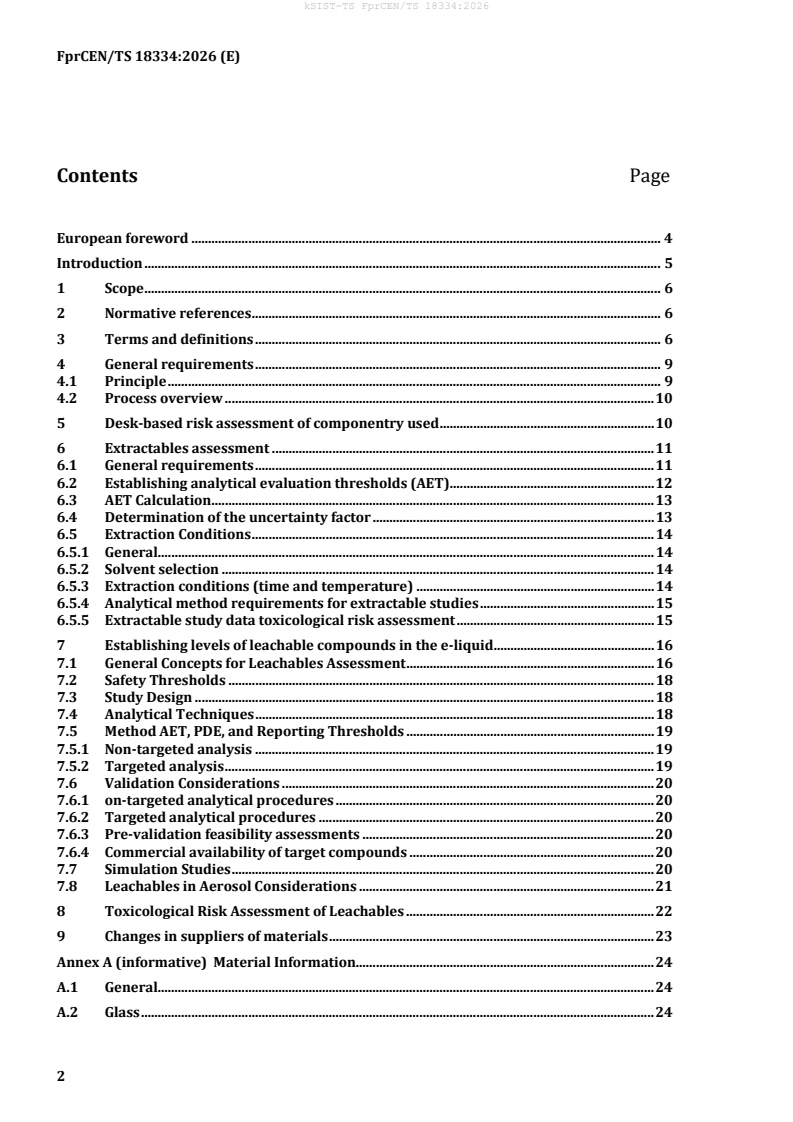
Contents Page
European foreword . 4
Introduction . 5
1 Scope . 6
2 Normative references . 6
3 Terms and definitions . 6
4 General requirements . 9
4.1 Principle . 9
4.2 Process overview . 10
5 Desk-based risk assessment of componentry used . 10
6 Extractables assessment . 11
6.1 General requirements . 11
6.2 Establishing analytical evaluation thresholds (AET) . 12
6.3 AET Calculation . 13
6.4 Determination of the uncertainty factor . 13
6.5 Extraction Conditions . 14
6.5.1 General. 14
6.5.2 Solvent selection . 14
6.5.3 Extraction conditions (time and temperature) . 14
6.5.4 Analytical method requirements for extractable studies . 15
6.5.5 Extractable study data toxicological risk assessment . 15
7 Establishing levels of leachable compounds in the e-liquid . 16
7.1 General Concepts for Leachables Assessment . 16
7.2 Safety Thresholds . 18
7.3 Study Design . 18
7.4 Analytical Techniques . 18
7.5 Method AET, PDE, and Reporting Thresholds . 19
7.5.1 Non-targeted analysis . 19
7.5.2 Targeted analysis . 19
7.6 Validation Considerations . 20
7.6.1 on-targeted analytical procedures . 20
7.6.2 Targeted analytical procedures . 20
7.6.3 Pre-validation feasibility assessments . 20
7.6.4 Commercial availability of target compounds . 20
7.7 Simulation Studies . 20
7.8 Leachables in Aerosol Considerations . 21
8 Toxicological Risk Assessment of Leachables . 22
9 Changes in suppliers of materials . 23
Annex A (informative) Material Information. 24
A.1 General. 24
A.2 Glass . 24
FprCEN/TS 18334:2026 (E)
A.3 Metal . 24
A.4 Plastic substances and elastomers . 24
A.5 Ceramics . 24
A.6 Plant based materials used with minimal processing . 25
Bibliography . 26
FprCEN/TS 18334:2026 (E)
European foreword
This document (FprCEN/TS 18334:2026) has been prepared by Technical Committee CEN/TC 437
“Electronic cigarettes and e-liquids”, the secretariat of which is held by AFNOR.
This document is currently submitted to the Vote on TS.
FprCEN/TS 18334:2026 (E)
Introduction
This document provides state-of-the-art guidance for the testing of extractables and leachables in vaping
products.
Extractables and Leachables refers to substances that have the potential to migrate from components and
materials of construction into the e-liquid unintentionally.
Extractables can be released from a material of construction under laboratory conditions which may be
varied to accelerate or exaggerate the removal of compounds from the construction materials.
Extractables have the potential to leach into the e-liquid.
Leachables are substances that migrate from a material of construction into the e-liquid under normal
conditions of storage and use. These substances, or their degradation products, once in the e-liquid, may
then aerosolize for transfer to the consumer.
This document states the general principles and requirements for measuring and assessing extractable
and leachable substances in vaping products.
The recommendations in this document are relevant to the majority of product types currently available,
and the principles have been developed with the potential for application to future products. The
principles may also be applied to the e-liquid manufacturing process equipment.
FprCEN/TS 18334:2026 (E)
1 Scope
This document is applicable to electronic cigarettes and similar vapour producing devices intended to
produce aerosol from e-liquids for consumption by inhalation. It is applicable to devices intended for use
with e-liquids. This document is also applicable to e-liquid containers.
This document:
— specifies the considerations and approach required to establish levels of extractable and leachable
substances in vaping products, e-liquid cartridges, and e-liquid refill containers;
— specifies a risk-based approach to enable manufacturers to understand the risk associated with the
levels of extractable and leachable substances;
— describes an approach to toxicological risk assessment that contributes to an understanding of
whether leachable compound levels are within acceptable limits over the anticipated shelf life of the
product;
— builds on the requirements of CEN/TS 17287:2019, 5.1 Material (migration) by detailing an
analytical and toxicological approach to establish that “no e-liquid contact material shall transfer
constituents into the e-liquid at levels that endanger human health”
— does not consider that substances may also transfer directly to the user via direct contact with
components as this consideration is included in CEN/TS 17287;
— does not specify all testing necessary to establish the shelf life of products.
2 Normative references
The following documents, in whole or in part, are normatively referenced in this document and are
indispensable for its application. For dated references, only the edition cited applies. For undated
references, the latest edition of the referenced document (including any amendments) applies.
EN 17957, Vapour products - Vaping regime for products intended to be used for direct to lung inhalation
EN ISO 20768, Vapour products — Routine analytical vaping machine — Definitions and standard
conditions
3 Terms and definitions
For the purposes of this document, the following terms and definitions apply.
ISO and IEC maintain terminological databases for use in standardization at the following addresses:
— ISO Online browsing platform: available at https://www.iso.org/obp
— IEC Electropedia: available at http://www.electropedia.org/
3.1
accelerated extraction
extraction whose duration is shorter than, but still representative of the duration of typical use and whose
conditions are exaggerated without resulting in a chemical or physical change to the substances being
extracted
FprCEN/TS 18334:2026 (E)
3.2
analytical evaluation threshold
AET
threshold below which the analysts do not need identification, quantification, or reporting as an
extractable or a leachable
3.3
component
item which forms one part of a vaping device or e-liquid container, but is not itself a vaping device or e-
liquid container
3.4
compound
individual chemical substance that usually has a unique CAS RN number
3.5
constituent
individual chemical substance within an ingredient
3.6
e-liquid
base liquid, which may or may not contain nicotine and/or nicotine salts and/or other ingredients,
intended for transformation into an aerosol by a vaping device
3.7
e-liquid cartridge
e-liquid container that can be loaded directly into an e-cigarette, which can be disposable
3.8
exaggerated extraction
extraction that is intended to result in a greater number or amount of chemical constituents being
released as compared to the amount generated under the usual conditions of use
Note 1 to entry: It is important to ensure that the exaggerated extraction does not result in a chemical or physical
change of the material or the substances being extracted.
3.9
extractable
substance that is released from a component when the component is extracted using laboratory
extraction conditions and extraction vehicles
3.10
extraction vehicle
medium (solution or solvent) which is used to extract (or leach) a test article for the purpose of
establishing the test article’s extractables or leachables profile
Note 1 to entry: It is preferred that extraction vehicles be analytically expedient
3.11
flavouring
ingredient that imparts smell and/or taste
FprCEN/TS 18334:2026 (E)
3.12
ingredient
any compound or mixture of compounds intentionally included in an e-liquid
EXAMPLE Vegetable glycerol, propylene glycol, nicotine, flavourings
3.13
leachable
substance that is released from a vaping device or material during its usual use
3.14
manufacturer
any entity which manufactures a product or has a product designed or manufactured, and/or markets
that product under their name or trademark
3.15
nicotine
(S)-3-(1-methyl-2-pyrrolidinyl)pyridine, conforming to the Chemical Abstracts Service nomenclature
under n° CAS: 54-11-5
3.16
Permitted Daily Exposure Limit
PDE
PDE limit for a compound represents the amount of that compound that is unlikely to cause harm to an
individual when exposed to that compound during long term exposure
3.17
safety concern threshold
SCT
threshold below which a leachable (or an extractable as a probable leachable) has a dose so low that it
presents a negligible safety concern from carcinogenic and non-carcinogenic toxic effects
3.18
semi-quantitative analysis
analytical approach which provides an analyte’s concentration by using the response from a surrogate
substance (or substances), specifically accounting for the relative responses of the analyte and the
surrogate
3.19
simulated-use extraction
extraction using a method that simulates typical use
Note 1 to entry: A simulated-use extraction is performed to estimate the type and amount of substances that are
expected to be released from a vaping device or e-liquid container during its typical use. A simulated-use extraction
is designed to produce an extractables profile that represents the worst-case leachables profile, meaning that all
leachables are also extractables and the levels of all individual extractables are at least equal to the level of all
individual leachables.
3.20
toxicological risk assessment
act of determining the potential of a chemical to elicit an adverse effect based on a specified level of
exposure
FprCEN/TS 18334:2026 (E)
3.21
vaping product
product that vapourises e-liquid to generate an inhalable aerosol carried by air drawn through the device
by the user
Note 1 to entry: Vaping products also referred to as electronic cigarette, e-cig, vapour product, personal vapouriser,
or ENDS/ENNDS.
Note 2 to entry: Vaping products differ from tobacco products in that they do not contain tobacco.
4 General requirements
4.1 Principle
Vaping products are diverse in their design and approach to delivering an inhalable aerosol. Regardless
of an individual product's design, there may be a risk of chemicals migrating from the parts of the e-
cigarette into the e-liquid, which may then be inhaled by the user. This may or may not contribute to
health effects of the user; however, a process to establish the potential health impact of substances that
may migrate into e-liquid is contained herein.
No assessment is included in relation to the impact of substance migration into e-liquid on product
quality issues e.g. integrity of the container, changes in e-liquid colour or flavour etc.
A stepwise approach is proposed consisting of:
a) Desk-based risk assessment of componentry used
b) Extraction study
c) Toxicological risk prioritization based on extractable study data
d) Leachable study in e-liquid (if required based on toxicological assessment of extraction study data)
e) Toxicological assessment of leachable in e-liquid study data
f) Leachable study in aerosol (if required based on toxicological assessment of leachable study in e-
liquid data)
g) Toxicological assessment of leachable in aerosol study data
NOTE In case assessment is required to also assess organoleptic changes to the product, the materials and
limitations expressed in food contact material legislation can be followed. Commission Regulation (EU) No 10/2011
of 14 January 2011 on plastic materials and articles intended to come into contact with food.
FprCEN/TS 18334:2026 (E)
4.2 Process overview
Dashed line indicates an optional route as a decision may be made to proceed directly to aerosol
leachables testing in case it is predicted that PDE (3.16) will be exceeded in liquid but transfer to aerosol
may be limited.
“High risk extractable identified” defined and determined by toxicological assessment.
Figure 1 — Process Overview Flow Chart
5 Desk-based risk assessment of componentry used
To establish the requirement for further extractable and leachable studies, a desk-based risk assessment
is first conducted.
The desk-based assessment consists of establishing whether there is existing extractable and leachable
data for the componentry to evaluate the level of risk they pose in terms of chemical migration into the
e-liquid and subsequent risk of aerosolization. Generally, materials that are in contact with the e-liquid
are considered high risk as the contact can be over a prolonged period of time, materials in contact with
only the aerosol shall be considered and risk justified based on the likelihood of contact temperatures
FprCEN/TS 18334:2026 (E)
being elevated, whereas materials that are not in contact with the e-liquid or aerosol are considered low
risk; however, the risk shall be documented and justified for each component by the manufacturer.
Based on the output of the risk assessment, a decision as to which components are included in the
extractable and leachable studies can be made, including the potential to leverage any existing data.
6 Extractables assessment
6.1 General requirements
Extraction studies are performed to detect, identify, and quantify extractables for toxicological risk
assessment. The laboratory undertaking this assessment shall be suitably accredited and with suitable
method qualification reports, with its scope of accreditation appropriate to the analytical procedures
being performed.
Identification of extractables is performed by non-targeted analysis. Analytical methods used for non-
targeted analysis shall perform four functions:
a) they shall detect a wide range of chemical species (volatiles, semi-volatiles, non-volatiles, and
elemental impurities);
b) they shall be able to separate chemical species to distinguish between the analytes. This enables a
unique response for each analyte;
c) they shall provide, as far as reasonably practicable, information with which the chemical species
identity can be elucidated whilst minimizing the number of unknown compounds, an appropriate
library shall be maintained to allow identification of compounds/minimize number of unknown
compounds. They shall minimize erroneous identification and quantitation e.g. by use of an
appropriate array of standards accounting for their response factors and method uncertainty;
d) they shall provide information with which the chemical species concentration can be estimated in a
semiquantitative manner.
Extractions from the components identified in the desk-based assessment shall be made. This can either
be performed by combining the components or by extraction of individual components or by combining
components made from the same materials. Each of these approaches have advantages and
disadvantages, non-exhaustive examples of these are highlighted in the Table 1:
More information can be found in EN ISO/IEC 17025:2017.
FprCEN/TS 18334:2026 (E)
Table 1
Extraction Advantage Disadvantage
a
Combined all components Minimizes number of extract Data will not establish the
solutions for analysis which source of any compound
reduces the cost for testing extracted (does not establish
extractable profile for each
material or component)
Combining components made Reduces the number of Will establish extract profile
a
from the same materials sample solutions for analysis for each material but not for
controlling the cost of testing each component
Extraction of individual Establishes an extract profile Requires the highest number
components separately for each individual of samples for analysis and
component allowing any therefore is more expensive
problematic components to than combination
be identified and replaced approaches.
a
When combining components, the ratio shall be maintained to that in the product.
6.2 Establishing analytical evaluation thresholds (AET)
An AET (3.2) is a value used to ensure appropriate sensitivity of the analytical techniques used in
extractable and leachable studies. The AET should be derived from a safety-based threshold (such as an
adequate toxicological threshold of concern (TTC) as established by the International Council for
Harmonization (ICH) M7 guideline [9] or SCT (3.17) as established by the Product Quality Research
Institute [2]. If this is not practically achievable, an analytical threshold, such as the Limit of Quantification
(LOQ) can be used as the reporting threshold. If the LOQ is used to derive the AET, the appropriateness
of the threshold shall be considered in the toxicological risk assessment. The threshold concept can be
applied to extractables in the circumstance that extractables are used to project the worst-case release of
leachables from test article.
AET is only applicable to organic extractables or leachables. Metals may have differing levels, dependent
on the individual element, that may be considered acceptable, such as those described in ICH Q3D
‘Elemental Impurities’ [10].
Thresholds, such as a TTC or SCT, establish a daily dose of leachables (and other potentially toxic
impurities) below which there is limited toxicological risk over long term exposure.
Some highly toxic substances (i.e. cohorts of concern) are excluded from a TTC approach and their
presence should be ruled out before the AET is applied. Any specifically targeted analytes of concern for
the specific material of construction should be assessed individually, independent of the AET. Types and
examples of cohorts of concern are described in ISO/TS 21726 [11].
Chemical species present at levels below the safety-based threshold are deemed to be appropriately safe
and do not require additional assessment (identification and quantification). These thresholds (e.g. SCT
or TTC) in combination with an appropriate factor that addresses the uncertainty of the analytical
method, become identification thresholds, as substances dosed at and above the threshold should be
identified to allow for their safety assessment — while substances dosed below the threshold are deemed
to present an acceptably low toxicological safety risk without identification.
FprCEN/TS 18334:2026 (E)
6.3 AET Calculation
The application of the threshold concept requires that a dose-based threshold (e.g. SCT or TTC) be
converted to a concentration-based threshold (AET).
The conversion from a dose-based threshold (e.g. SCT or TTC) from typically µg/day to a concentration-
based threshold (AET) in µg/mL.
The AET in μg/mL can be calculated using Formula (1).
SCT × A ×CF
AET =
µg/mL
B ×C ××S UF
(1)
where
AET is threshold below which the analyst need not identify or quantify leachables or report them
for potential toxicological assessment (µg/mL);
SCT or (TTC) is the safety concern threshold or threshold of toxicological concern (µg/day);
A is the number, amount or surface area of test items extracted (item, g, cm2);
B is the volume of extract used (mL);
C is the number, amount or surface area of test item used by the consumer daily (item, g,
cm2/day);
S is the number of sequential extracts performed (exhaustive extractions);
UF is the uncertainty factor;
CF is the concentration factor (calculated using Formula (2).
InitialV olume
CF=
FinalV olume
(2)
A toxicologist shall be consulted in selecting the appropriate safety-based threshold that supports the
toxicological risk assessment.
6.4 Determination of the uncertainty factor
As the analytical procedures used to assess extractables from materials vary, their respective accuracy of
the reported value will also vary; the quantification technique can have a particularly large impact on the
accuracy of the reported value. For example, quantification can involve using a surrogate standard to
normalize the responses obtained for all relevant analytes. In such an approach, one estimates the
concentration of each analyte based on the assumption that all analytes respond similarly, among
themselves and to the surrogate standard (i.e. all substances have the same response factor). Due to the
likely variability in analyte response factors, the concentration estimates obtained from a surrogate may
result in differing degrees of accuracy. An uncertainty factor can be applied to account for the varying
levels of accuracy.
The uncertainty factors may be justified based on the means of quantitation, for example, through the use
of relative response factor libraries or targeted analysis using validated methods. When quantification is
achieved using relative response factor libraries, the user should justify the uncertainty factor values
selected. When quantification is achieved with calibration curves generated via the analysis of authentic
standards with qualified analytical methods, the concentration estimates obtained for the qualified
analytes are considered highly accurate, resulting in the possibility of an uncertainty factor as low as 1.
Without information to better inform the analysts on the correct uncertainty factor, a factor of 4 can be
applied for GC-MS methods and a factor of 10 for LC-MS methods. The AET is adjusted via the uncertainty
FprCEN/TS 18334:2026 (E)
factor to account for the more poorly responding analytes. Using an uncertainty factor in the AET
calculation increases the likelihood that poorly responding analytes will be detected above the TTC.
Refer to ISO 10993-18 and its amendments for approaches to establishing and justifying a particular
uncertainty factor.
6.5 Extraction Conditions
6.5.1 General
An extraction study is typically a two-step process in which substances are extracted from the sample
through the use of parameters such as extraction media, time and temperature. The resultant extract is
chemically analysed to identify the extracted substances.
The goal of the extraction process is to produce an extractables profile that equals or exceeds the
leachables generated during actual use but does not chemically alter the extractables or deform/degrade
the sample to such an extent that the correlation between extractables and leachables cannot be made.
Even though the extraction conditions are such that the extractable profile should be exaggerated
compared to the leachables profile, the possibility remains that not all leachables will be observed during
the extractable study.
There are a number of factors which need to be considered when designing an extraction study. When
defining the experimental conditions, the overall study objective should be carefully considered.
6.5.2 Solvent selection
The solvents chosen shall include a pH range that brackets the pH range of the product, or for open
systems where the specific e-liquids that will be used with products are unknown, the pH range of the
solvents chosen for extraction shall bracket the pH of the e-liquids being used with the product (pH limits
for e-liquids are specified in EN 17648: E-liquid ingredients [5]).
The solvents chosen shall include polar and semi-polar solutions e.g. propan-2-ol, ethanol, and water.
Nicotine shall be excluded due to the potential for residue forming under extraction conditions.
All solvents used shall be of analytical quality.
For vaping products using propylene glycol and glycerol, use of the following solvent systems may be
considered for extraction:
— To extract organic compounds:
— 20 % propan-2-ol, 80 % water, acidified to lower pH level with 1 M acetic acid
— 20 % propan-2-ol, 80 % water, basified to upper pH level with 0.1N NaOH
— 50 % ethanol, 50 % water
— To extract metals/elemental impurities:
— 1 % v/v aqueous nitric acid
Other solvents may be justified based on the properties of the test articles. For example, ethanol may be
used; however, ethanol may react with extracted compounds.
6.5.3 Extraction conditions (time and temperature)
Based on using the solvent systems detailed in 6.5.2, the following extraction conditions (times and
temperatures) may be considered:
— Prolonged contact (e.g. greater than 30 days):
FprCEN/TS 18334:2026 (E)
— Exhaustive extraction using either 72 h at 50°C
— Short-term contact (e.g. less than 30 days):
— Exaggerated extraction using Arrhenius equation to calculate appropriate time and temperature
conditions as per ASTM F1980 [6] and appropriate Q10 value e.g. 2.
Under certain circumstances e.g. for long contact times (e.g. > 30 days), it may not be possible to
accelerate the extraction time sufficiently based on the use of the Arrhenius equation (as per
ASTM F1980). For such circumstances exhaustive extraction determination may be more appropriate in
order to generate the worst-case extractables profile over the expected contact time. Refer to
ISO 10993-18 Annex D for further details relating to exhaustive extraction.
6.5.4 Analytical method requirements for extractable studies
The propan-2-ol/water and ethano
...