


EN 14041:2004
(Main)Resilient, textile and laminate floor coverings - Essential characteristics
Resilient, textile and laminate floor coverings - Essential characteristics
This European Standard specifies the health, safety and energy saving requirements for:
· resilient floor coverings manufactured from plastics, linoleum, cork or rubber, excluding loose-laid mats;
· textile floor coverings, excluding loose-laid mats and rugs;
· laminate floor coverings;
· floor panels for loose-laying.
It also specifies procedures for testing for the evaluation of conformity of the products and the requirements for marking and labelling.
The products are intended for use as floor coverings within a building or externally, according to the manufacturers' specifications.
The European Standard does not apply to floor coverings containing asbestos.
This European Standard does not specify requirements unrelated to health, safety and energy saving, which are covered in the separate European Standards for these products, listed in annex A. To perform correctly, products covered by this standard require correct installation and maintenance. This standard does not, however, cover installation or maintenance, but does give advice on minimising slip hazards.
Elastische, textile und Laminat-Bodenbeläge - Wesentliche Eigenschaften
Revêtements de sol résilients, textiles et stratifiés - Caractéristiques essentielles
La présente Norme européenne spécifie les exigences relatives à la santé, à la sécurité et aux économies d'énergie pour :
- les revêtements de sol résilients fabriqués à partir de plastiques, de linoléum, de liège ou de caoutchouc, à l'exclusion des tapis non posés ;
- revêtements de sol textiles, à l'exclusion des tapis en pose libre ;
- revêtements de sol stratifiés ;
- panneaux de sol en pose libre.
La présente norme spécifie également les procédures d'essai pour l'évaluation de la conformité des produits et les exigences relatives au marquage et à l'étiquetage.
Les produits sont destinés à être utilisés comme revêtements de sol pour usage intérieur ou usage extérieur conformément aux spécifications des fabricants.
La norme ne s'applique pas aux revêtements de sol contenant de l'amiante.
La présente Norme européenne ne spécifie pas les exigences qui ne sont pas liées à la santé, à la sécurité et aux économies d'énergie et qui sont couvertes par les normes européennes distinctes relatives à ces produits, dont la liste est donnée dans l'annexe A. Pour donner de bonnes performances, les produits relevant de la présente norme doivent être correctement installés et entretenus. La présente norme ne traite pas de l'installation ou de l'entretien, mais elle donne des conseils pour réduire au minimum les risques de glissade
Netekstilne, tekstilne in laminirane (plastene) talne obloge - Bistvene značilnosti
General Information
- Status
- Withdrawn
- Publication Date
- 03-Aug-2004
- Withdrawal Date
- 13-Apr-2025
- Technical Committee
- CEN/TC 134 - Resilient and textile floor coverings
- Drafting Committee
- CEN/TC 134/WG 6 - Harmonization
- Current Stage
- 9960 - Withdrawal effective - Withdrawal
- Start Date
- 17-Jan-2018
- Completion Date
- 14-Apr-2025
- Directive
- 89/106/EEC - Construction products
Relations
- Effective Date
- 24-Jan-2018
- Corrected By
EN 14041:2004/AC:2006 - Resilient, textile and laminate floor coverings - Essential characteristics - Effective Date
- 08-Jun-2022
- Corrected By
EN 14041:2004/AC:2005 - Resilient, textile and laminate floor coverings - Essential characteristics - Effective Date
- 08-Jun-2022
- Effective Date
- 18-Jan-2023

Frequently Asked Questions
EN 14041:2004 is a standard published by the European Committee for Standardization (CEN). Its full title is "Resilient, textile and laminate floor coverings - Essential characteristics". This standard covers: This European Standard specifies the health, safety and energy saving requirements for: · resilient floor coverings manufactured from plastics, linoleum, cork or rubber, excluding loose-laid mats; · textile floor coverings, excluding loose-laid mats and rugs; · laminate floor coverings; · floor panels for loose-laying. It also specifies procedures for testing for the evaluation of conformity of the products and the requirements for marking and labelling. The products are intended for use as floor coverings within a building or externally, according to the manufacturers' specifications. The European Standard does not apply to floor coverings containing asbestos. This European Standard does not specify requirements unrelated to health, safety and energy saving, which are covered in the separate European Standards for these products, listed in annex A. To perform correctly, products covered by this standard require correct installation and maintenance. This standard does not, however, cover installation or maintenance, but does give advice on minimising slip hazards.
This European Standard specifies the health, safety and energy saving requirements for: · resilient floor coverings manufactured from plastics, linoleum, cork or rubber, excluding loose-laid mats; · textile floor coverings, excluding loose-laid mats and rugs; · laminate floor coverings; · floor panels for loose-laying. It also specifies procedures for testing for the evaluation of conformity of the products and the requirements for marking and labelling. The products are intended for use as floor coverings within a building or externally, according to the manufacturers' specifications. The European Standard does not apply to floor coverings containing asbestos. This European Standard does not specify requirements unrelated to health, safety and energy saving, which are covered in the separate European Standards for these products, listed in annex A. To perform correctly, products covered by this standard require correct installation and maintenance. This standard does not, however, cover installation or maintenance, but does give advice on minimising slip hazards.
EN 14041:2004 is classified under the following ICS (International Classification for Standards) categories: 59.080.60 - Textile floor coverings; 97.150 - Floor coverings. The ICS classification helps identify the subject area and facilitates finding related standards.
EN 14041:2004 has the following relationships with other standards: It is inter standard links to EN 14041:2018, EN 14041:2004/AC:2006, EN 14041:2004/AC:2005, prEN 14041. Understanding these relationships helps ensure you are using the most current and applicable version of the standard.
EN 14041:2004 is associated with the following European legislation: EU Directives/Regulations: 305/2011, 89/106/EEC; Standardization Mandates: M/119. When a standard is cited in the Official Journal of the European Union, products manufactured in conformity with it benefit from a presumption of conformity with the essential requirements of the corresponding EU directive or regulation.
You can purchase EN 14041:2004 directly from iTeh Standards. The document is available in PDF format and is delivered instantly after payment. Add the standard to your cart and complete the secure checkout process. iTeh Standards is an authorized distributor of CEN standards.
Standards Content (Sample)
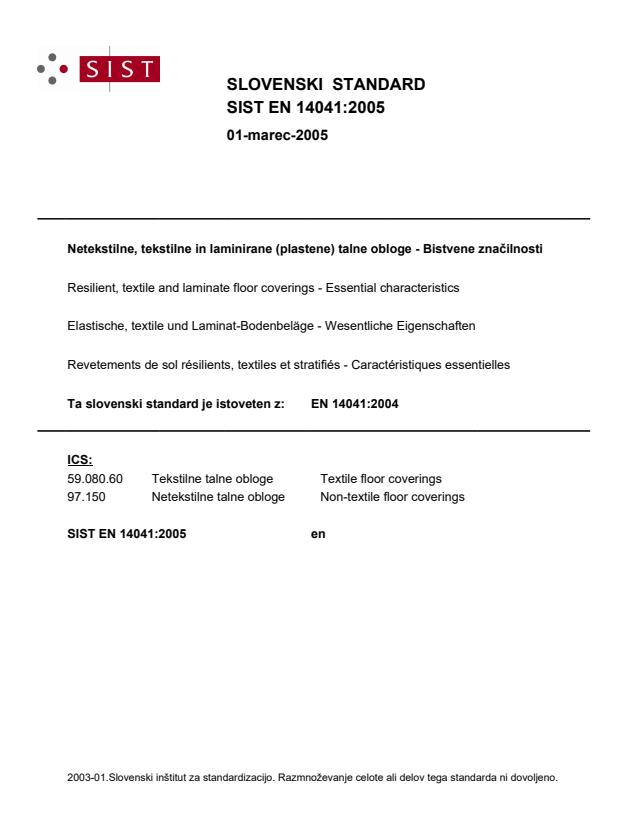
2003-01.Slovenski inštitut za standardizacijo. Razmnoževanje celote ali delov tega standarda ni dovoljeno.Resilient, textile and laminate floor coverings - Essential characteristicsRevetements de sol résilients, textiles et stratifiés - Caractéristiques essentiellesElastische, textile und Laminat-Bodenbeläge - Wesentliche Eigenschaften97.150Netekstilne talne oblogeNon-textile floor coverings59.080.60Tekstilne talne oblogeTextile floor coveringsICS:SIST EN 14041:2005enTa slovenski standard je istoveten z:EN 14041:200401-marec-2005SIST EN 14041:2005SLOVENSKI
STANDARD
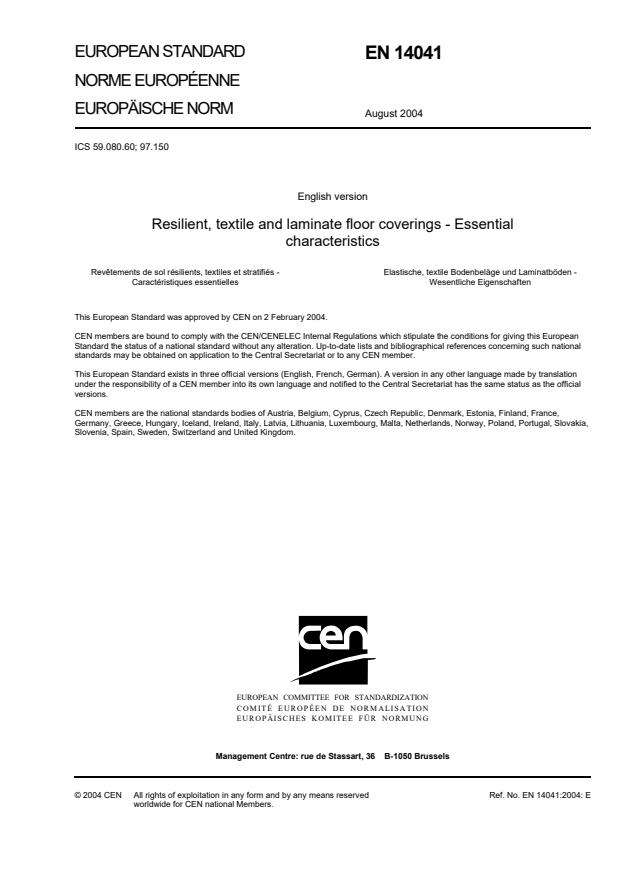
EUROPEAN STANDARDNORME EUROPÉENNEEUROPÄISCHE NORMEN 14041August 2004ICS 59.080.60; 97.150English versionResilient, textile and laminate floor coverings - EssentialcharacteristicsRevêtements de sol résilients, textiles et stratifiés -Caractéristiques essentiellesElastische, textile Bodenbeläge und Laminatböden -Wesentliche EigenschaftenThis European Standard was approved by CEN on 2 February 2004.CEN members are bound to comply with the CEN/CENELEC Internal Regulations which stipulate the conditions for giving this EuropeanStandard the status of a national standard without any alteration. Up-to-date lists and bibliographical references concerning such nationalstandards may be obtained on application to the Central Secretariat or to any CEN member.This European Standard exists in three official versions (English, French, German). A version in any other language made by translationunder the responsibility of a CEN member into its own language and notified to the Central Secretariat has the same status as the officialversions.CEN members are the national standards bodies of Austria, Belgium, Cyprus, Czech Republic, Denmark, Estonia, Finland, France,Germany, Greece, Hungary, Iceland, Ireland, Italy, Latvia, Lithuania, Luxembourg, Malta, Netherlands, Norway, Poland, Portugal, Slovakia,Slovenia, Spain, Sweden, Switzerland and United Kingdom.EUROPEAN COMMITTEE FOR STANDARDIZATIONCOMITÉ EUROPÉEN DE NORMALISATIONEUROPÄISCHES KOMITEE FÜR NORMUNGManagement Centre: rue de Stassart, 36
B-1050 Brussels© 2004 CENAll rights of exploitation in any form and by any means reservedworldwide for CEN national Members.Ref. No. EN 14041:2004: E
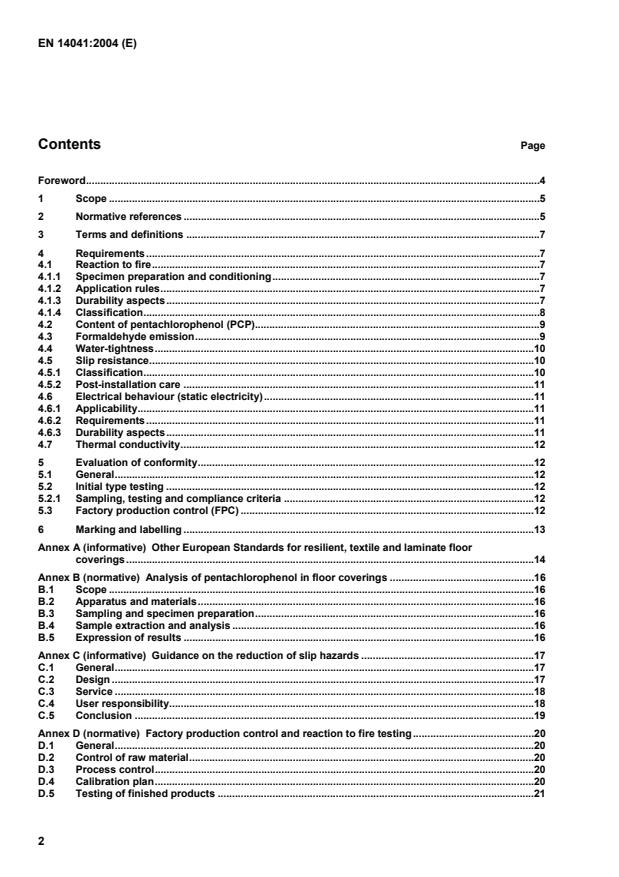
Other European Standards for resilient, textile and laminate floor coverings.14 Annex B (normative)
Analysis of pentachlorophenol in floor coverings.16 B.1 Scope.16 B.2 Apparatus and materials.16 B.3 Sampling and specimen preparation.16 B.4 Sample extraction and analysis.16 B.5 Expression of results.16 Annex C (informative)
Guidance on the reduction of slip hazards.17 C.1 General.17 C.2 Design.17 C.3 Service.18 C.4 User responsibility.18 C.5 Conclusion.19 Annex D (normative)
Factory production control and reaction to fire testing.20 D.1 General.20 D.2 Control of raw material.20 D.3 Process control.20 D.4 Calibration plan.20 D.5 Testing of finished products.21
Clauses of this European Standard addressing essential requirements or other provisions of EU Directives.23 ZA.1 Scope and relevant clauses.23 ZA.2 Procedure for the attestation of conformity of products.25 ZA.3 CE Marking and labelling – Information to accompany the CE marking.28 Bibliography.30
with foam backing. EN 1817, Resilient floor coverings – Specification for homogeneous and heterogeneous smooth rubber floor coverings. EN 12199, Resilient floor coverings – Specifications for homogeneous and heterogeneous relief rubber floor coverings. EN 12466:1998, Resilient floor coverings – Vocabulary. EN 12524, Building materials and products – Hygrothermal properties – Tabulated design values. EN 12673, Water quality – Gas chromatographic determination of some selected chlorophenols in water. EN 13238:2001, Reaction to fire tests for building products – Conditioning procedures and general rules for selection of substrates. EN 13329, Laminate floor coverings – Specifications, requirements and test methods. EN 13501-1:2002, Fire classification of construction products and building elements – Part 1: Classification using test data from reaction to fire tests. EN 13553, Resilient floor coverings – Polyvinyl chloride floor coverings for use in special wet areas – Specification. EN 13893, Resilient, laminate and textile floor coverings – Measurement of dynamic coefficient of friction on dry floor surfaces. EN ISO 9001, Quality management systems – Requirements. EN ISO 9239-1:2002, Reaction to fire tests for floorings – Part 1: Determination of the burning behaviour using a radiant heat source (ISO 9239-1:2002). EN ISO 11925-2:2002, Reaction to fire tests - Ignitability of building products subjected to direct impingement of flame - Part 2: Single-flame source test (ISO 11925-2:2002). ISO 1957, Machine-made textile floor coverings – Selection and cutting of specimens for physical tests. ISO 2424:1992, Textile floor coverings – Vocabulary. ISO 6356, Textile floor coverings – Assessment of static electrical propensity – Walking test. ISO 10965, Textile floor coverings – Determination of electrical resistance. ISO 11379, Textile floor coverings – Laboratory cleaning procedure using spray extraction.
Table 2 – Classes of reaction to fire for textile floor coverings, classified without further testing Floor covering type1 EN product standard Class3 Floorings Non-FR machine-made wall-to-wall pile carpets and pile carpet tiles2 EN 1307 EfL Non-FR needled textile floor coverings without pile2 EN 1470 EfL Non-FR needled textile floor coverings with pile2 EN 13297 EfL 1) Floor covering glued or loose laid over a Class A2-s1,d0 substrate. 2) Textile floor coverings having a total mass of max. 4,8 kg/m², a minimum pile thickness of 1,8 mm (ISO 1766) and: -
a surface of 100% wool, -
a surface of
80% wool or more - 20% polyamide or less, -
a surface of
80% wool or more - 20% polyamide/polyester or less, -
a surface of 100% polyamide, -
a surface of 100% polypropylene and if with SBR-foam backing, a total mass of > 0,780 kg/m². All polypropylene carpets with other foam backings are excluded. 3) Class as provided for in Table 2 in the Annex to Decision 2000/147/EC.
EN 1816 3,4 4,3 4 EfL Homogeneous and heterogeneous smooth rubber floor coverings EN 1817 3,0 6,0 1,8 EfL Homogeneous and heterogeneous
relief rubber floor coverings EN 12199 4,6 6,7 2,5 EfL 1 Floor covering loose laid over any wood based substrate of at least Class D-s2,d0 or any substrate of at least Class A2-s1,d0. 2 Class as provided for in Table 2 in the Annex to Decision 2000/147/EC.
4.2 Content of pentachlorophenol (PCP)1 Resilient, textile and laminate floor coverings shall not contain PCP or a derivative thereof as a component in the production process of the product or of its raw materials. In cases where verification is required, if the content is less than 0,1 % by mass by the method of Annex B, this requirement shall be considered to be met. 4.3 Formaldehyde emission When formaldehyde-containing materials have been added to the product as a part of the production process, the product shall be tested and classified into one of two classes: E1 or E2, as specified in Table 4 and Table 5. NOTE Products of class E1 can be used without causing an indoor air concentration greater than 0,1 × 10⁻⁶
(0,1 ppm) of formaldehyde.
1 Attention is drawn to Commission Directive 1999/51/EC that covers restrictions on the marketing and use of certain dangerous substances including PCP and is reflected in national regulations.
Test method Requirement Initial type testing a ENV 717-1 Release ≤ 0,124 mg/m3
ENV 717-1 Release ≤ 0,124 mg/m3
Factory production control EN 717-2 Release ≤ 3,5 mg/m2h a For established products, initial type testing may also be done on the basis of existing data with EN 717-2 testing, either from factory production control or from external inspection.
Table 5 – Formaldehyde class E2
Test method Requirement ENV 717-1 Release > 0,124 mg/m3
Initial type testing EN 717-2 Release > 3,5 mg/m2h to ≤ 8 mg/m2h ENV 717-1 Release > 0,124 mg/m3
Factory production control EN 717-2 Release > 3,5 mg/m2h to ≤ 8 mg/m2h
4.4 Water-tightness Where required, resilient floor coverings shall meet the requirements of EN 13553. 4.5 Slip resistance 4.5.1 Classification If a claim for slip resistance is made, the floor covering intended to be used in dry and non-contaminated conditions shall have a dynamic coefficient of friction of ≥ 0,30 when tested ex-factory under dry conditions in accordance with EN 13893 and shall be declared as technical class DS. Although such floors may be subjected to occasional spillage and wet cleaning, the manufacturer does not guarantee the performance under these conditions. If no claim for slip resistance is made, the floor coverings for which no performance has been determined shall be declared as technical class NPD.
Clean the test specimens three times, with an interval of 2 h ± 15 min between cycles, each cleaning cycle consisting of two strokes:
– for the first stroke use the spray extraction machine with simultaneous spray and extraction;
– for the second stroke operate the machine only as an extraction machine. Carry out the first cleaning cycle using the reference cleaning solution at ambient temperature 25 °C ± 10 °C and the second and third cleaning cycle with water at ambient temperature without any addition of chemicals. After this, the test of 4.6.2 shall be repeated and the requirements met. NOTE Dirt and application of polymers can affect the antistatic and electrical properties of resilient and laminate floor coverings.
Other European Standards for resilient, textile and laminate floor coverings The following published or draft standards specify the general requirements and the requirements relating to the classification schem
...
The EN 14041:2004 standard is a comprehensive document focusing on the essential characteristics of resilient, textile, and laminate floor coverings. Its scope clearly delineates the health, safety, and energy-saving requirements pertinent to various types of floor coverings, including those made from plastics, linoleum, cork, or rubber, while explicitly excluding loose-laid mats. The standard is significant in ensuring that the floor coverings not only meet specific safety criteria but also contribute to energy efficiency within built environments. One of the notable strengths of this standard is its thoroughness in addressing the conformity evaluation processes. By specifying testing procedures, it enables manufacturers to ensure that their products meet the established health and safety benchmarks, thereby fostering consumer trust and compliance within the market. Additionally, the requirements for marking and labeling provide a transparent framework for both consumers and professionals in the industry, facilitating informed decision-making. Furthermore, the standard's emphasis on the intended use of floor coverings, both indoors and externally, underlines its practical relevance to manufacturers and users. The guidance on minimizing slip hazards is a particularly valuable inclusion, enhancing the safety measures associated with installation, despite the standard not directly covering installation or maintenance processes. Another important aspect is the exclusion of asbestos-containing products, which aligns with contemporary health standards and reflects a commitment to consumer safety. This ensures that the focus remains on sustainable and health-conscious materials, which is crucial in today’s environmentally aware market. Overall, EN 14041:2004 is a pertinent and robust standard that plays a vital role in guiding the manufacturing and use of resilient, textile, and laminate floor coverings, ensuring that they meet essential health, safety, and energy efficiency criteria.
La norme EN 14041:2004 définit des caractéristiques essentielles pour les revêtements de sol résilients, textiles et stratifiés, mettant en avant des exigences cruciales en matière de santé, de sécurité et d'économie d'énergie. Son champ d'application est particulièrement pertinent pour les revêtements de sol en plastiques, linoléum, liège ou caoutchouc, ainsi que pour les revêtements textiles et les panneaux de sol à poser librement. En excluant les tapis et les revêtements contenant de l'amiante, cette norme se concentre sur des produits innovants et sûrs, garantissant ainsi la santé des utilisateurs tout en répondant aux besoins énergétiques modernes. Parmi ses points forts, la norme souligne l'importance de procédures de test rigoureuses pour l'évaluation de la conformité des produits, ce qui renforce la confiance des consommateurs et des professionnels. Les exigences de marquage et d'étiquetage précises permettent également une identification facile et claire des caractéristiques essentielles de chaque produit. La norme EN 14041:2004 se distingue par sa pertinence en tant qu'outil normatif dans le secteur des revêtements de sol. Bien qu'elle ne couvre pas l'installation et l'entretien, elle offre des conseils pour minimiser les risques de glissade, contribuant ainsi à la sécurité des utilisateurs. Cela en fait une référence clé pour les fabricants, distributeurs et installateurs cherchant à garantir des solutions de revêtement de sol à la fois sûres, durables et conformes aux réglementations européennes. En résumé, la norme EN 14041:2004 constitue un cadre normatif solide, garantissant des produits de revêtement de sol qui répondent aux exigences contemporaines de santé, de sécurité et d'économie d'énergie.
EN 14041:2004は、レジリエント(弾力性のある)、繊維(テキスタイル)、およびラミネートフロアカバリングに関する基本特性を定義した欧州標準であり、その適用範囲は広範囲にわたります。この標準は、プラスチック、リノリウム、コルク、ゴム製のレジリエントフロアカバリング、繊維製フロアカバリング、ラミネートフロアカバリング、及びそのためのフロアパネルを対象としています。これにより、建物内または外部での使用に適した健康、安全、エネルギー節約の要件が明確に定められています。 この標準の強みは、製品の適合性を評価するための測定手順を規定している点です。これにより、各製品が期待される性能基準を満たしているかどうかを確実に判断できるため、消費者に対する信頼性を高めます。また、製品のマーキングおよびラベリング要件を明示することで、利用者が適切な情報を得られるようにしています。 特に、EN 14041:2004は健康と安全、エネルギー節約に関連する要件に焦点を当てており、アスベストを含むフロアカバリングには適用されない点が明確に示されています。これにより、アスベストなどの危険因子を排除した製品の選定が促進され、安全な環境での使用を保証します。 加えて、スリップの危険を最小限に抑えるためのアドバイスも提供されており、消費者や設計者にとって非常に有用な情報となっています。ただし、この標準は、製品の適切な設置やメンテナンスの手順は含まれていないため、それらは別のガイドラインに従う必要があります。 総じて、EN 14041:2004は、製品が満たすべき重要な基準を明確に示し、フロアカバリングの安全性と性能を確保するために不可欠な文書です。
SIST EN 14041:2005 표준은 다층 바닥재(탄력적인, 섬유 및 라미네이트)와 관련된 필수 특성을 규정하고 있습니다. 이 표준의 범위는 다양한 바닥재 유형을 포괄하며, 특히 플라스틱, 리놀륨, 코르크 또는 고무로 제조된 탄력적인 바닥재, 섬유 바닥재, 라미네이트 바닥재를 포함합니다. 또한, 이 표준은 제품의 적합성을 평가하기 위한 시험 절차와 표기 및 라벨링 요구사항을 명시합니다. 이 표준의 강점은 제품의 건강, 안전 및 에너지 절약 요구사항을 명확히 정의하고 있다는 점입니다. 이는 소비자가 신뢰할 수 있는 바닥재 제품을 선택할 수 있도록 도와줍니다. 또한, 구체적인 시험 절차를 제공하여 제조업체가 제품의 품질과 성능을 검증할 수 있는 기준을 마련하고 있습니다. 이 표준은 비소가 포함된 바닥재에는 적용되지 않으며, 이는 사용자 안전을 더욱 강화하는 요소로 작용합니다. SIST EN 14041:2005 표준은 건물 또는 외부에서 사용하기 위한 바닥재를 위한 것이다. 이 표준은 바닥재의 올바른 설치 및 유지 관리가 필요하다는 점을 언급하지만, 구체적인 설치 방법이나 유지 관리 지침은 제공하지 않습니다. 대신, 미끄러짐 위험을 최소화하는 방법에 대한 조언을 포함하고 있어 사용자의 안전을 최우선으로 고려하고 있다고 할 수 있습니다. 결론적으로, SIST EN 14041:2005 표준은 건강, 안전 및 에너지 절약을 위한 기초적 요구사항을 충족하는 바닥재 제품 개발에 중요한 기준을 제공합니다. 이는 바닥재 사용자에게 안전하고 신뢰할 수 있는 솔루션을 제공하는 데 필수적인 역할을 하며, 시장에서의 경쟁력을 높이는 데 기여합니다.
Die Norm EN 14041:2004 legt die wesentlichen Eigenschaften von elastischen, textilen und Laminatfußbodenbelägen fest, wobei der Schwerpunkt auf Gesundheits-, Sicherheits- und Energiewirtschaftsanforderungen liegt. Diese europäische Norm bietet einen klaren Rahmen für Produkte, die aus Kunststoffen, Linoleum, Kork oder Gummi hergestellt werden, und schließt lose verlegte Matten aus. Ebenso behandelt sie textile Fußbodenbeläge und Laminatfußbodenbeläge sowie Bodenpaneele für lose Verlegung. Eine der Stärken dieser Norm ist die Festlegung von Prüfverfahren zur Evaluierung der Konformität der Produkte gemäß den spezifischen Anforderungen. Dies gewährleistet, dass die Fußbodenbeläge den hohen Standards für Sicherheit und Energieeinsparung gerecht werden und somit den Einsatz in Gebäuden oder im Außenbereich entsprechend den Herstellerspezifikationen ermöglichen. Zudem wird durch die Norm die Kennzeichnung und Beschriftung von Produkten standardisiert, was die Transparenz und Nachvollziehbarkeit für Verbraucher und Anwender erhöht. Die Relevanz der Norm EN 14041:2004 wird besonders deutlich, da sie keine Anforderungen definiert, die nicht mit Gesundheit, Sicherheit und Energieeinsparung in Zusammenhang stehen. Dadurch kann der Nutzer sicherstellen, dass die Produkte nicht nur funktional, sondern auch sicher sind. In einer Zeit, in der gesundheitsbewusstes und umweltfreundliches Bauen eine immer größere Rolle spielt, bietet diese Norm wertvolle Richtlinien. Darüber hinaus gibt die Norm Empfehlungen zur Minimierung von Rutschgefahren, was einen zusätzlichen Sicherheitsaspekt darstellt. Es ist wichtig zu beachten, dass die richtige Installation und Wartung für die korrekte Funktion der Produkte unerlässlich sind, auch wenn die Norm diese Aspekte nicht direkt abdeckt. Die klare Abgrenzung, dass Produkte, die Asbest enthalten, nicht unter diese Norm fallen, trägt ebenfalls zur Sicherheit bei. Insgesamt bietet die EN 14041:2004 einen entscheidenden Beitrag zur Standardisierung in der Branche der Fußbodenbeläge, indem sie essentielle Kriterien für Qualität und Sicherheit festlegt und somit einen hohen Stellenwert im Markt einnimmt.
Questions, Comments and Discussion
Ask us and Technical Secretary will try to provide an answer. You can facilitate discussion about the standard in here.
Loading comments...