


EN 1420-1:1999
(Main)Influence of organic materials on water intended for human consumption - Determination of odour and flavour assessment of water in piping systems - Part 1: Test method
Influence of organic materials on water intended for human consumption - Determination of odour and flavour assessment of water in piping systems - Part 1: Test method
This standard specifies a test method for determining the odour and flavour of test waters after their contact with the organic materials used in piping systems, where the term products comprises pipes, fittings and ancillaries including their coatings and joints. The test method described in this standard is applicable to products to be used under various conditions for the transport of water in ended for human consumption and raw water used for the manufacture of water intended for human consumption.
Einfluß von Werkstoffen auf Wasser für den menschlichen Gebrauch - Bestimmung des Geruchs und Geshmacks des Wassers in Rohrleitungssystemen - Teil 1: Prüfverfahren
Diese Norm legt ein Verfahren zur Bestimmung von Geruch und Geschmack in Prüfwässern nach deren Kontakt mit den Innenoberflächen von Produkten aus organischen Stoffen fest, die in Rohrleitungssystemen eingesetzt werden, wobei der Begriff 'Produkté Rohre, Formstücke und Ausrüstungsgegenstände einschließlich deren Beschichtungen und Verbindungsstücke beinhaltet. Die in dieser Norm beschriebene Methode ist auf Produkte anwendbar, die unter verschiedenen Bedingungen für den Transport von Wasser für den menschlichen Gebrauch und Rohwasser, das zu Wasser für den menschlichen Gebrauch aufbereitet werden soll, vorgesehen sind.
Influence des matériaux organiques sur l'eau destinée à la consommation humaine - Détermination de l'odeur et de la flaveur de l'eau dans les réseaux de conduites - Partie 1: Méthode d'essai
La présente norme européenne spécifie une méthode de détermination de l'odeur et de la flaveur des eaux d'essai après leur contact avec les matériaux organiques utilisés dans les réseaux de conduites; le terme "produits" comprend les tubes, raccords, accessoires et leurs revêtements et les assemblages. La méthode d'essai décrite dans la présente norme européenne est applicable aux produits utilisables dans diverses conditions pour le transport de l'eau destinée à la consommation humaine et de l'eau brute utilisée pour la production d'eau destinée à la consommation humaine.
Vpliv organskih materialov na pitno vodo - Ugotavljanje vonja in okusa vode v vodovodnih instalacijah - 1. del: Preskusne metode
General Information
- Status
- Withdrawn
- Publication Date
- 17-Aug-1999
- Withdrawal Date
- 13-Apr-2025
- Technical Committee
- CEN/TC 164 - Water supply
- Drafting Committee
- CEN/TC 164/WG 3 - Effects of materials in contact with drinking water
- Current Stage
- 9960 - Withdrawal effective - Withdrawal
- Start Date
- 27-Jan-2016
- Completion Date
- 14-Apr-2025
Relations
- Effective Date
- 03-Feb-2016



Frequently Asked Questions
EN 1420-1:1999 is a standard published by the European Committee for Standardization (CEN). Its full title is "Influence of organic materials on water intended for human consumption - Determination of odour and flavour assessment of water in piping systems - Part 1: Test method". This standard covers: This standard specifies a test method for determining the odour and flavour of test waters after their contact with the organic materials used in piping systems, where the term products comprises pipes, fittings and ancillaries including their coatings and joints. The test method described in this standard is applicable to products to be used under various conditions for the transport of water in ended for human consumption and raw water used for the manufacture of water intended for human consumption.
This standard specifies a test method for determining the odour and flavour of test waters after their contact with the organic materials used in piping systems, where the term products comprises pipes, fittings and ancillaries including their coatings and joints. The test method described in this standard is applicable to products to be used under various conditions for the transport of water in ended for human consumption and raw water used for the manufacture of water intended for human consumption.
EN 1420-1:1999 is classified under the following ICS (International Classification for Standards) categories: 13.060.20 - Drinking water. The ICS classification helps identify the subject area and facilitates finding related standards.
EN 1420-1:1999 has the following relationships with other standards: It is inter standard links to EN 1420:2016. Understanding these relationships helps ensure you are using the most current and applicable version of the standard.
EN 1420-1:1999 is associated with the following European legislation: EU Directives/Regulations: 93/38/EEC; Standardization Mandates: M/BC/CEN/88/15. When a standard is cited in the Official Journal of the European Union, products manufactured in conformity with it benefit from a presumption of conformity with the essential requirements of the corresponding EU directive or regulation.
You can purchase EN 1420-1:1999 directly from iTeh Standards. The document is available in PDF format and is delivered instantly after payment. Add the standard to your cart and complete the secure checkout process. iTeh Standards is an authorized distributor of CEN standards.
Standards Content (Sample)
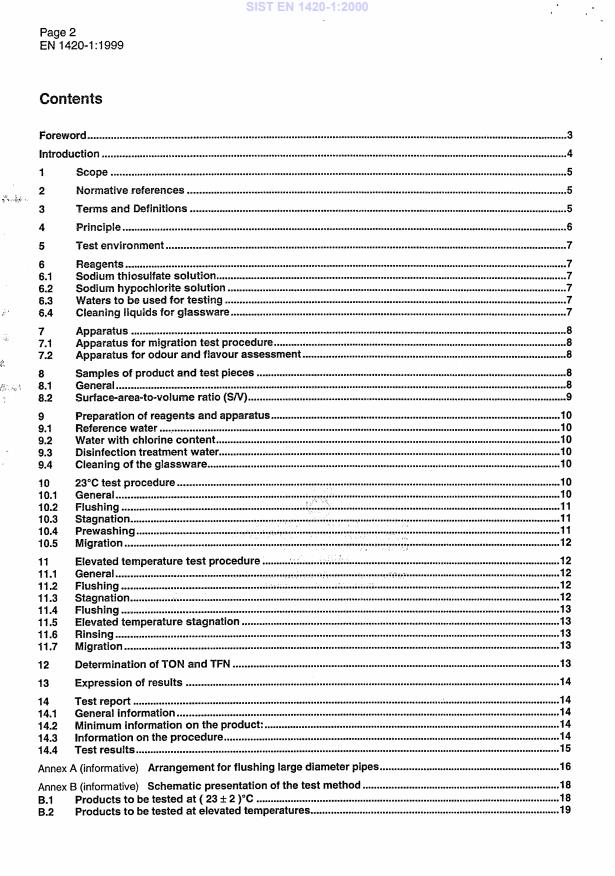
2003-01.Slovenski inštitut za standardizacijo. Razmnoževanje celote ali delov tega standarda ni dovoljeno.Vpliv organskih materialov na pitno vodo - Ugotavljanje vonja in okusa vode v vodovodnih instalacijah - 1. del: Preskusne metodeEinfluß von Werkstoffen auf Wasser für den menschlichen Gebrauch - Bestimmung des Geruchs und Geshmacks des Wassers in Rohrleitungssystemen - Teil 1: PrüfverfahrenInfluence des matériaux organiques sur l'eau destinée a la consommation humaine - Détermination de l'odeur et de la flaveur de l'eau dans les réseaux de conduites - Partie 1: Méthode d'essaiInfluence of organic materials on water intended for human consumption - Determination of odour and flavour assessment of wate
...
標準EN 1420-1:1999は、人間の消費を目的とした水に対する有機材料の影響を評価するためのテスト方法を規定しており、その範囲は非常に重要です。具体的には、パイプシステムに使用される有機材料との接触後のテスト水の臭気と風味の評価を行うことに焦点を当てています。この標準は、パイプや継手、付属品などの製品が含まれ、そのコーティングや接合部も対象となります。 この標準の強みは、特に飲料水の運搬に関わる製品が、様々な条件下で使用される際の水質への影響を詳細に評価できる点にあります。水道水や人間の消費を目的とした水の製造に使用される原水に対しても適用できるため、水質管理における信頼性を高めます。具体的なテスト方法が明文化されていることで、各社が統一した基準に基づいて評価を行うことができるため、同業他社との比較もしやすくなります。 この標準はまた、消費者の健康を守るために重要であり、適切な水質の確保が求められる現代において、その関連性はますます高まっています。有機材料が水に与える臭気や風味の影響を明確に評価することで、最終的には水道水の品質向上にも寄与することが期待されます。したがって、EN 1420-1:1999は水質管理の側面から見ても重要な役割を果たす標準であると言えるでしょう。
표준 EN 1420-1:1999는 인간 소비를 위한 물에 대한 유기 물질의 영향을 평가하는 테스트 방법을 명확하게 정의하고 있습니다. 이 표준의 범위는 파이프 시스템에서 사용되는 유기 물질과 접촉한 후의 물의 냄새와 맛을 측정하는 방법을 포함하고 있습니다. 여기서 언급되는 제품은 파이프, 이음쇠, 부속품을 포함하며, 이들의 코팅 및 접합부도 포함됩니다. 이 표준의 주요 강점은 다양한 조건에서 사용하는 제품에 대한 테스트 방법을 규정하고 있다는 점입니다. 이는 인간 소비를 위한 물의 수송에 있어 안전성과 품질을 보장하는 데 중요한 역할을 합니다. 또한, 물의 맛과 냄새에 대한 평가를 통해 해당 제품이 인체에 미치는 영향을 사전에 파악할 수 있어 실질적인 안전성을 제공할 수 있습니다. EN 1420-1:1999 표준은 파이프 시스템에서 물이 유기 물질과 접촉하는 과정에서 발생할 수 있는 잠재적인 문제를 미리 감지함으로써, 물의 품질을 유지하는 데 기여합니다. 이는 인간 건강에 직접적인 영향을 미칠 수 있는 요소들을 감시하고 규제하는 데 있어 매우 중요합니다. 따라서 이 표준은 수돗물 및 인간 소비를 위한 물의 제조에 필수적인 기초 자료로 활용될 수 있습니다.
La norme EN 1420-1:1999 est un document essentiel qui traite de l'influence des matériaux organiques sur l'eau destinée à la consommation humaine. Son champ d'application est clairement défini, spécifiant une méthode d'essai pour évaluer l'odeur et la saveur de l'eau de test après contact avec les matériaux organiques présents dans les systèmes de plomberie. Ces systèmes comprennent non seulement les tuyaux, mais aussi les raccords et accessoires, sans oublier les revêtements et joints qui peuvent avoir un impact significatif sur la qualité de l'eau. L'une des principales forces de cette norme est sa capacité à fournir un cadre rigoureux pour la détermination de l'odeur et de la saveur de l'eau. En définissant clairement les conditions d'essai et les types de produits applicables, la norme garantit une approche cohérente et reproductible dans le cadre de l’évaluation de la qualité de l'eau. Cela est particulièrement crucial pour les produits qui sont utilisés dans le transport de l'eau destinée à la consommation humaine, ainsi que pour l'eau brute utilisée dans le processus de fabrication de l'eau potable. En outre, la pertinence de la norme EN 1420-1:1999 ne peut pas être sous-estimée dans le contexte des réglementations de santé publique et de sécurité alimentaire. Elle contribue à assurer que les matériaux utilisés dans les systèmes de distribution d'eau ne compromettent pas la qualité de l'eau, permettant ainsi de protéger la santé des consommateurs. La norme s'applique sous diverses conditions, ce qui en fait un outil flexible et adaptable pour les fabricants et les responsables de la qualité. En mettant l'accent sur l'évaluation de l'odeur et de la saveur, elle assure aux utilisateurs finaux que l'eau qu'ils consomment est non seulement sûre, mais également agréable à boire. Dans l'ensemble, la norme SIST EN 1420-1:2000 constitue une référence incontournable pour tous les acteurs impliqués dans la chaîne de production et de distribution d'eau potable, et elle joue un rôle crucial dans la préservation de la qualité de l'eau destinée à la consommation humaine.
The standard EN 1420-1:1999 provides a comprehensive framework for evaluating the odour and flavour of water that has interacted with organic materials in piping systems. Its primary scope focuses on the assessment of test waters that have been in contact with various components such as pipes, fittings, ancillaries, and any associated coatings and joints. This specification is crucial, as it directly addresses the quality of water intended for human consumption, ensuring that any organic materials used in piping systems do not negatively impact the sensory attributes of the water. One of the strengths of this standard is its detailed methodology for conducting tests, which ensures consistency and reliability in results across different applications. The clear definition of the test procedure allows for the reproducibility of results, enabling manufacturers and water quality professionals to reliably assess the safety and palatability of water conveyed through organic materials. This is particularly relevant in today's context, where the quality of drinking water is paramount and regulations surrounding water safety continue to evolve. Moreover, the standard’s relevance extends beyond mere compliance. It serves as a pivotal tool for manufacturers of piping systems, ensuring that their products meet established criteria for taste and odour, ultimately contributing to the overall safety and acceptability of drinking water. The incorporation of organic materials in piping systems has been a growing concern, and this standard addresses these challenges effectively. By focusing specifically on the interaction between water and organic materials in piping systems, EN 1420-1:1999 offers significant insights that are critical for enhancing water quality assurance processes. Thus, it stands as a vital resource for standardizing testing protocols that protect public health and support industry best practices.
Die Norm EN 1420-1:1999 stellt einen wichtigen Schritt in der Sicherstellung der Wasserqualität dar, insbesondere in Bezug auf die Beurteilung von Geruch und Geschmack von Wasser, das durch Rohrleitungssysteme transportiert wird. Der Anwendungsbereich dieser Norm ist klar definiert und befasst sich speziell mit der Bestimmung der Einflüsse organischer Materialien auf Trinkwasser. Ein zentraler Stärke der Norm liegt in ihrer umfassenden Methodik, die es ermöglicht, die Interaktion zwischen Wasser und organischen Materialien wie Rohren, Fittings und deren Beschichtungen zu analysieren. Diese Testmethode ist essenziell, um sicherzustellen, dass Produkte, die in Wasserversorgungssystemen verwendet werden, keine unerwünschten Gerüche oder Geschmäcker an das Wasser abgeben. Dies ist besonders relevant für die Qualitätssicherung von Wasser, das für den menschlichen Verzehr gedacht ist, sowie für Rohwasser, das zur Herstellung von Trinkwasser genutzt wird. Die Relevanz der Norm EN 1420-1:1999 zeigt sich auch in ihrer Anwendung unter verschiedenen Bedingungen, was sie zu einem vielseitigen Instrument für Hersteller und Betreiber von Wasserversorgungssystemen macht. Die Norm trägt dazu bei, die gesetzlichen Anforderungen sowie die Erwartungen der Verbraucher in Bezug auf die sensorischen Eigenschaften von Trinkwasser zu erfüllen und fördert somit das Vertrauen in die Wasserqualität. Insgesamt bietet die Norm einen strukturierten Ansatz zur Überprüfung der Qualität von Wasser in Rohrsystemen, was sowohl für die öffentliche Gesundheit als auch für die industrielle Anwendung von entscheidender Bedeutung ist.
Questions, Comments and Discussion
Ask us and Technical Secretary will try to provide an answer. You can facilitate discussion about the standard in here.
Loading comments...