


EN ISO 12417-1:2024
(Main)Cardiovascular implants and extracorporeal systems - Vascular device-drug combination products - Part 1: General requirements (ISO 12417-1:2024)
Cardiovascular implants and extracorporeal systems - Vascular device-drug combination products - Part 1: General requirements (ISO 12417-1:2024)
This document specifies requirements for vascular device-drug combination products (VDDCPs).
With regard to safety, this document outlines requirements for intended performance, design attributes, materials, design evaluation, manufacturing, sterilization, packaging and information supplied by the manufacturer.
For implanted products, this document is intended to be used as a supplement to ISO 14630, which specifies general requirements for the performance of non-active surgical implants. This document is intended to be used as a supplement to relevant device-specific standards, such as the ISO 25539 series specifying requirements for endovascular devices. Requirements listed in this document also address VDDCPs that are not permanent implants.
NOTE 1 Due to variations in the design of combination products covered by this document and due to the relatively recent development of some of these combination products, acceptable standardized in vitro test results and clinical study results are not always available. As further scientific and clinical data become available, appropriate revision of this document can be necessary.
This document applies to delivery systems or parts of the delivery system that are an integral component of the vascular device and that are drug-covered (e.g. drug-covered balloon catheters and drug-covered guidewires).
This document does not apply to devices whose PMOA provide a conduit for delivery of a drug (e.g. infusion catheters), unless they contain a drug component that is intended to have an ancillary action to the device part (e.g. antimicrobial coated infusion catheter).
This document does not apply to procedures and devices used prior to and following the introduction of the VDDCP (e.g. balloon angioplasty devices) that do not affect the drug-related aspects of the device.
This document does not provide a comprehensive pharmacological evaluation of VDDCPs.
NOTE 2 Some information about the requirements of certain national and regional authorities is given in Annex B.
The connection of absorbable components of VDDCPs (e.g. coatings) with drug-related aspects of the device are addressed in this document. This document does not provide an exhaustive list of the degradation and other time-dependent aspects of absorbable implants and coatings.
NOTE 3 For more information on absorbable coatings, refer to ISO/TS 17137 and ASTM F3036-13.
This document does not address issues associated with viable or non-viable biological materials such as tissues, cells or proteins.
This document does not address issues associated with active surgical implants (i.e. implants that require power not generated by the human body or gravity).
Kardiovaskuläre Implantate und extrakorporale Systeme - Vaskuläre Medizinprodukt-Arzneimittel-Kombinationsprodukte - Teil 1: Allgemeine Anforderungen (ISO 12417-1:2024)
Dieser Teil von ISO 12417 legt Anforderungen an vaskuläre Medizinprodukt/Arzneimittel-Kombinations-produkte (VDDCPs) basierend auf dem aktuellen technischen und medizinischen Kenntnisstand fest. VDDCPs sind Medizinprodukte mit unterschiedlichen klinischen Indikationen für den Einsatz im menschlichen vaskulären Blutsystem. Ein VDDCP enthält als integralen Bestandteil eine oder mehrere Substanz(en), die bei getrennter Anwendung als medizinisch wirksame Substanz oder medizinisch wirksames Produkt (medizinischer Wirkstoff, Arzneimittel) angesehen werden können, deren Wirkung jedoch der des Medizinproduktes ergänzend ist und dessen primären Wirkmechanismus (PMOA) unterstützt. Im Hinblick auf die Sicherheit umreißt dieser Teil von ISO 12417 Anforderungen an die vorgesehene Funktion, an Konstruktionsmerkmale, Materialien, Designprüfung, Herstellung, Sterilisation, Verpackung und die vom Hersteller bereitzustellenden Informationen. In Bezug auf implantierte Produkte sollte diese Internationale Norm als Ergänzung zu ISO 14630 angesehen werden, in der allgemeine Anforderungen an die Funktion von nichtaktiven chirurgischen Implantaten festgelegt sind. Außerdem sollte die vorliegende Internationale Norm als Ergänzung zu den einschlägigen Normen zu speziellen Medizinprodukten, wie z. B. zur Normenreihe ISO 25539, die Anforderungen an endovaskuläre Medizinprodukte enthält, angesehen werden. Die im vorliegenden Teil von ISO 12417 aufgeführten Anforderungen gelten auch für VDDCPs, bei denen es sich nicht um dauerhafte Implantate handelt.
ANMERKUNG Aufgrund von Abweichungen im Design der vom vorliegenden Teil von ISO 12417 behandelten Kombinationsprodukte und aufgrund der relativ neuen Entwicklungen bei einigen dieser Kombinationsprodukte stehen annehmbare genormte in vitro-Testergebnisse und Ergebnisse klinischer Studien nicht immer zur Verfügung. Daher kann bei Vorliegen weiterer wissenschaftlicher und klinischer Daten eine entsprechende Überarbeitung dieses Teils von ISO 12417 erforderlich werden.
Einführsysteme oder Teile des Einführsystems fallen in den Anwendungsbereich dieses Teils von ISO 12417, sofern sie einen integralen Bestandteil des vaskulären Medizinproduktes bilden und wirkstoffbeschichtet sind (z. B. wirkstoffbeschichtete Ballonkatheter und wirkstoffbeschichtete Führungsdrähte).
Medizinprodukte, deren PMOA darin besteht, eine Leitung für die Zufuhr eines Arzneimittels bereitzustellen (wie z. B. Infusionskatheter) sind nicht Gegenstand des vorliegenden Teils von ISO 12417, es sei denn, sie enthalten eine Arzneimittelkomponente, die eine die Wirkung des Medizinproduktteils ergänzende Wirkung haben soll (z. B. ein mit einem Antimikrobiotikum beschichteter Infusionskatheter).
Die vor und nach Einsetzen des VDDCP angewendeten Verfahren und Medizinprodukte (z. B. angioplastische Ballons) sind nicht Gegenstand des vorliegenden Teils von ISO 12417, es sei denn, sie haben Einfluss auf die arzneimittelbezogenen Aspekte des Medizinproduktes.
Der vorliegende Teil von ISO 12417 behandelt die pharmakologische Bewertung von VDDCPs nicht erschöp-fend. Einige Informationen zu den Anforderungen unterschiedlicher nationaler und regionaler Behörden finden sich in Anhang B.
Absorbierbare Bestandteile von VDDCPs (z. B. Beschichtungen) werden von diesem Teil von ISO 12417 in ihrer Verbindung zu arzneimittelbezogenen Aspekten des Medizinproduktes behandelt. Der Abbau und andere zeitabhängige Aspekte von absorbierbaren Implantaten und Beschichtungen werden in dieser Internationalen Norm nicht vollständig behandelt.
[...]
Implants cardiovasculaires et circuits extra-corporels - Produits de combinaison médicament-dispositif vasculaire - Partie 1: Exigences générales (ISO 12417-1:2024)
Le présent document spécifie les exigences relatives aux produits de combinaison médicament-dispositif vasculaire (VDDCP).
En matière de sécurité, le présent document définit les exigences relatives aux performances prévues, aux caractéristiques de conception, aux matériaux, à l'évaluation de la conception, à la fabrication, à la stérilisation, à l'emballage et aux informations fournies par le fabricant.
Pour les produits implantés, le présent document a vocation à être utilisé comme un complément à l'ISO 14630, qui spécifie les exigences générales relatives aux performances des implants chirurgicaux non actifs. Le présent document a vocation à être utilisé comme un complément aux normes spécifiques aux dispositifs pertinentes, notamment la série ISO 25539- qui spécifie les exigences relatives aux dispositifs endovasculaires. Les exigences énumérées dans le présent document concernent également les VDDCP qui ne sont pas implantés à titre permanent.
NOTE 1 En raison des variantes de conception parmi les produits de combinaison traités par le présent document et en raison du caractère relativement récent de la mise au point de certains de ces produits, il n'y a pas toujours de résultats d'essai in vitro normalisé acceptables ni de résultats d'étude clinique disponibles. Lorsque de nouvelles données scientifiques et cliniques seront disponibles, il pourra s'avérer nécessaire de procéder à une révision appropriée du présent document.
Le présent document s'applique aux systèmes de pose ou parties du système de pose qui font partie intégrante du dispositif vasculaire et qui sont revêtus de médicament (par exemple, cathéters à ballonnet revêtus de médicament ou fils guides revêtus de médicament).
Le présent document ne s'applique pas aux dispositifs dont le PMOA est la fourniture d'un conduit pour l'administration d'un médicament (par exemple, cathéters de perfusion), à moins qu'ils ne contiennent un composant médicamenteux dont l'action est auxiliaire à celle du dispositif (par exemple, cathéter de perfusion à revêtement antimicrobien).
Le présent document ne s'applique pas aux modes opératoires et aux dispositifs utilisés avant et après l'introduction du VDDCP (par exemple, les dispositifs d'angioplastie transluminale percutanée) s'ils n'ont pas d'incidence sur les aspects médicamenteux du dispositif.
Le présent document ne fournit pas d'évaluation pharmacologique complète des VDDCP.
NOTE 2 Des informations relatives aux exigences de certaines autorités nationales et régionales sont données dans l'Annexe B.
Le rapport entre les composants absorbables des VDDCP (par exemple, les revêtements) et les aspects médicamenteux du dispositif est abordé dans le présent document. Le présent document ne fournit pas de liste exhaustive de la dégradation et des autres aspects temporels relatifs aux implants et aux revêtements absorbables.
NOTE 3 Pour plus d'informations sur les revêtements absorbables, se reporter à l'ISO/TS 17137 et à l'ASTM F3036-13.
Le présent document n'aborde pas les questions liées aux matériaux biologiques viables ou non viables, tels que les tissus, les cellules ou les protéines.
Le présent document n'aborde pas les questions liées aux implants chirurgicaux actifs (c'est-à-dire les implants nécessitant de l'énergie non produite par le corps humain ou la pesanteur).
Vsadki (implantati) za srce in ožilje ter zunajtelesni pretočni sistemi - Žilni medicinski kombinirani proizvodi/zdravila - 1. del: Splošne zahteve (ISO 12417-1:2024)
Ta dokument določa zahteve za žilne medicinske kombinirane proizvode/zdravila (VDDCP).
V zvezi z varnostjo ta dokument določa zahteve za predvideno zmogljivost, obliko, materiale, vrednotenje oblike, izdelavo, pakiranje in informacije, ki jih zagotovi proizvajalec.
Za izdelke, namenjene vsaditvi, je ta dokument namenjen kot dodatek k standardu ISO 14630, ki določa splošne zahteve za lastnosti neaktivnih kirurških vsadkov. Ta dokument je namenjen kot dodatek k ustreznim standardom za določene pripomočke, kot je skupina standardov ISO 25539, ki določajo zahteve za znotrajžilne pripomočke. Zahteve, navedene v tem dokumentu, se nanašajo tudi na žilne medicinske kombinirane proizvode/zdravila, ki niso trajni vsadki.
OPOMBA 1: Zaradi razlik v zasnovi kombiniranih izdelkov, ki so zajeti v tem dokumentu in ker so nekateri od teh izdelkov bili razviti nedavno, sprejemljivi standardizirani preskusi in vitro in rezultati kliničnih študij niso vedno na voljo. S pojavom novih znanstvenih in kliničnih podatkov bodo morda potrebne ustrezne revizije tega dokumenta.
Ta dokument se ne uporablja za sisteme dovajanja ali dele sistemov dovajanja, ki so ključna komponenta žilnega pripomočka in so prevlečeni z zdravilom (npr. balonski katetri in vodilne žice, prevlečene z zdravilom).
Ta dokument se ne uporablja za pripomočke, katerih primarni način uporabe zagotavlja cevko za dovajanje zdravila (npr. infuzijski katetri), razen če vsebujejo komponento zdravila, ki je namenjena za delovanje kot dodatek delu pripomočka (npr. infuzijski kateter s protimikrobskim premazom).
Ta dokument se ne uporablja za postopke in pripomočke, ki se uporabljajo pred in po vsaditvi žilnega medicinskega kombiniranega proizvoda/zdravila (npr. pripomočka za angioplastiko), če ne vplivajo na vidike pripomočka, ki so povezani z zdravili.
Ta dokument ne navaja celovitega farmakološkega vrednotenja žilnih medicinskih kombiniranih proizvodov/zdravil.
OPOMBA 2: Nekateri podatki glede zahtev določenih nacionalnih in regionalnih organov so podani v dodatku B.
Ta dokument obravnava povezavo absorpcijskih komponent žilnih medicinskih kombiniranih proizvodov/zdravil (npr. premazi) z vidiki pripomočka, ki so povezani z zdravili. Ta dokument ne podaja izčrpnega seznama razgradnje in drugih od časa odvisnih vidikov absorpcijskih vsadkov in premazov.
OPOMBA 3: Več informacij o absorpcijskih premazih glej standard ISO/TS 17137 in ASTM F3036-13.
Ta dokument ne obravnava vprašanj, povezanih z neživimi biološkimi materiali, kot so tkiva, celice ali beljakovine.
Ta dokument ne obravnava vprašanj, povezanih z aktivnimi kirurškimi vsadki (tj. vsadki, ki zahtevajo moč, ki je ne ustvarja človeško telo ali sila gravitacije).
General Information
Relations
Overview - EN ISO 12417-1:2024 (VDDCP general requirements)
EN ISO 12417-1:2024, “Cardiovascular implants and extracorporeal systems - Vascular device‑drug combination products - Part 1: General requirements”, defines safety and performance expectations for vascular device‑drug combination products (VDDCPs). Published as the CEN-endorsed version of ISO 12417-1:2024, this standard updates and supersedes the 2015 edition and is intended as a supplement to general implant standards (e.g., ISO 14630) and device‑specific standards (for example, the ISO 25539 series for endovascular devices).
Key scope points:
- Applies to VDDCPs including integral drug‑covered delivery system components (e.g., drug‑coated balloons, drug‑covered guidewires).
- Covers intended performance, design attributes, materials, design evaluation, manufacturing, sterilization, packaging and manufacturer information.
- Excludes comprehensive pharmacological evaluations, active implants, viable biological materials and devices whose primary mode is only a drug conduit (unless the drug has an ancillary action).
Key topics and technical requirements
This standard sets out general, test‑supportive and documentation requirements rather than prescriptive pharmacology. Major technical areas include:
- Intended performance and classification - clear definition of clinical use, location and device classification relevant to VDDCP risk management.
- Design attributes - requirements for the drug‑containing part (matrix, active pharmaceutical ingredient, release characteristics).
- Materials - selection and characterization of materials including absorbable coatings and their interactions with the drug component.
- Design evaluation - pre‑clinical in vitro and in vivo testing, sampling, conditioning, and reporting; plus clinical evaluation plans and post‑market surveillance.
- Manufacturing and quality control - raw material reporting (API and excipients), batch release testing and change control.
- Sterilization and packaging - validation of sterility where applicable, residuals, and transport/storage effects on drug stability.
- Information supplied by manufacturer - labelling, instructions for use, and traceability records.
- Annex B provides guidance on some national/regional submission expectations.
Practical applications and users
Who uses EN ISO 12417-1:2024:
- Medical device manufacturers developing drug‑eluting stents, drug‑coated balloons, drug‑coated guidewires, and other VDDCPs.
- Regulatory affairs and quality assurance teams preparing technical documentation and regulatory submissions.
- R&D, clinical affairs and testing laboratories planning pre‑clinical and clinical evaluations.
- Notified bodies, competent authorities and contract manufacturers assessing conformity, sterilization and packaging processes.
Adopting EN ISO 12417-1:2024 helps ensure consistent approaches to safety, performance evidence and post‑market surveillance for vascular device‑drug combination products.
Related standards
- ISO 14630 (non‑active surgical implants - general requirements)
- ISO 25539 series (endovascular devices)
- ISO/TS 17137 and ASTM F3036 (for absorbable coatings guidance)
Frequently Asked Questions
EN ISO 12417-1:2024 is a standard published by the European Committee for Standardization (CEN). Its full title is "Cardiovascular implants and extracorporeal systems - Vascular device-drug combination products - Part 1: General requirements (ISO 12417-1:2024)". This standard covers: This document specifies requirements for vascular device-drug combination products (VDDCPs). With regard to safety, this document outlines requirements for intended performance, design attributes, materials, design evaluation, manufacturing, sterilization, packaging and information supplied by the manufacturer. For implanted products, this document is intended to be used as a supplement to ISO 14630, which specifies general requirements for the performance of non-active surgical implants. This document is intended to be used as a supplement to relevant device-specific standards, such as the ISO 25539 series specifying requirements for endovascular devices. Requirements listed in this document also address VDDCPs that are not permanent implants. NOTE 1 Due to variations in the design of combination products covered by this document and due to the relatively recent development of some of these combination products, acceptable standardized in vitro test results and clinical study results are not always available. As further scientific and clinical data become available, appropriate revision of this document can be necessary. This document applies to delivery systems or parts of the delivery system that are an integral component of the vascular device and that are drug-covered (e.g. drug-covered balloon catheters and drug-covered guidewires). This document does not apply to devices whose PMOA provide a conduit for delivery of a drug (e.g. infusion catheters), unless they contain a drug component that is intended to have an ancillary action to the device part (e.g. antimicrobial coated infusion catheter). This document does not apply to procedures and devices used prior to and following the introduction of the VDDCP (e.g. balloon angioplasty devices) that do not affect the drug-related aspects of the device. This document does not provide a comprehensive pharmacological evaluation of VDDCPs. NOTE 2 Some information about the requirements of certain national and regional authorities is given in Annex B. The connection of absorbable components of VDDCPs (e.g. coatings) with drug-related aspects of the device are addressed in this document. This document does not provide an exhaustive list of the degradation and other time-dependent aspects of absorbable implants and coatings. NOTE 3 For more information on absorbable coatings, refer to ISO/TS 17137 and ASTM F3036-13. This document does not address issues associated with viable or non-viable biological materials such as tissues, cells or proteins. This document does not address issues associated with active surgical implants (i.e. implants that require power not generated by the human body or gravity).
This document specifies requirements for vascular device-drug combination products (VDDCPs). With regard to safety, this document outlines requirements for intended performance, design attributes, materials, design evaluation, manufacturing, sterilization, packaging and information supplied by the manufacturer. For implanted products, this document is intended to be used as a supplement to ISO 14630, which specifies general requirements for the performance of non-active surgical implants. This document is intended to be used as a supplement to relevant device-specific standards, such as the ISO 25539 series specifying requirements for endovascular devices. Requirements listed in this document also address VDDCPs that are not permanent implants. NOTE 1 Due to variations in the design of combination products covered by this document and due to the relatively recent development of some of these combination products, acceptable standardized in vitro test results and clinical study results are not always available. As further scientific and clinical data become available, appropriate revision of this document can be necessary. This document applies to delivery systems or parts of the delivery system that are an integral component of the vascular device and that are drug-covered (e.g. drug-covered balloon catheters and drug-covered guidewires). This document does not apply to devices whose PMOA provide a conduit for delivery of a drug (e.g. infusion catheters), unless they contain a drug component that is intended to have an ancillary action to the device part (e.g. antimicrobial coated infusion catheter). This document does not apply to procedures and devices used prior to and following the introduction of the VDDCP (e.g. balloon angioplasty devices) that do not affect the drug-related aspects of the device. This document does not provide a comprehensive pharmacological evaluation of VDDCPs. NOTE 2 Some information about the requirements of certain national and regional authorities is given in Annex B. The connection of absorbable components of VDDCPs (e.g. coatings) with drug-related aspects of the device are addressed in this document. This document does not provide an exhaustive list of the degradation and other time-dependent aspects of absorbable implants and coatings. NOTE 3 For more information on absorbable coatings, refer to ISO/TS 17137 and ASTM F3036-13. This document does not address issues associated with viable or non-viable biological materials such as tissues, cells or proteins. This document does not address issues associated with active surgical implants (i.e. implants that require power not generated by the human body or gravity).
EN ISO 12417-1:2024 is classified under the following ICS (International Classification for Standards) categories: 11.040.40 - Implants for surgery, prosthetics and orthotics. The ICS classification helps identify the subject area and facilitates finding related standards.
EN ISO 12417-1:2024 has the following relationships with other standards: It is inter standard links to EN ISO 12417-1:2015. Understanding these relationships helps ensure you are using the most current and applicable version of the standard.
EN ISO 12417-1:2024 is associated with the following European legislation: EU Directives/Regulations: 2017/745; Standardization Mandates: M/575. When a standard is cited in the Official Journal of the European Union, products manufactured in conformity with it benefit from a presumption of conformity with the essential requirements of the corresponding EU directive or regulation.
You can purchase EN ISO 12417-1:2024 directly from iTeh Standards. The document is available in PDF format and is delivered instantly after payment. Add the standard to your cart and complete the secure checkout process. iTeh Standards is an authorized distributor of CEN standards.
Standards Content (Sample)
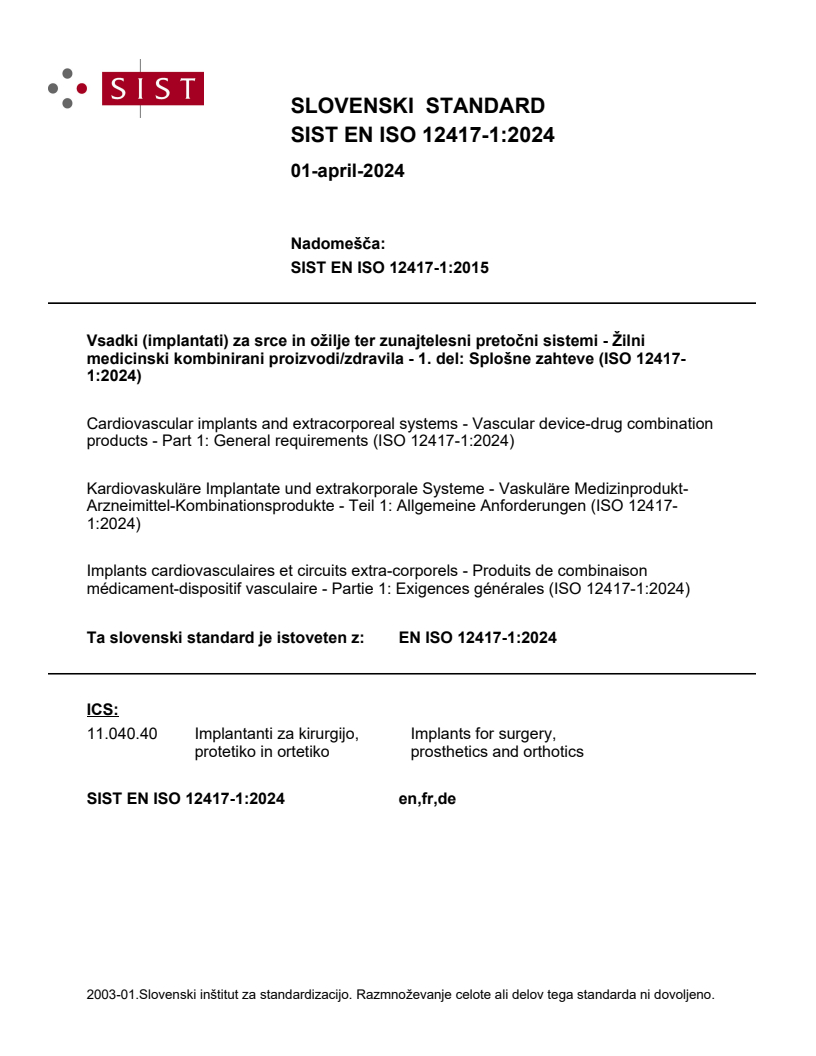
SLOVENSKI STANDARD
01-april-2024
Nadomešča:
SIST EN ISO 12417-1:2015
Vsadki (implantati) za srce in ožilje ter zunajtelesni pretočni sistemi - Žilni
medicinski kombinirani proizvodi/zdravila - 1. del: Splošne zahteve (ISO 12417-
1:2024)
Cardiovascular implants and extracorporeal systems - Vascular device-drug combination
products - Part 1: General requirements (ISO 12417-1:2024)
Kardiovaskuläre Implantate und extrakorporale Systeme - Vaskuläre Medizinprodukt-
Arzneimittel-Kombinationsprodukte - Teil 1: Allgemeine Anforderungen (ISO 12417-
1:2024)
Implants cardiovasculaires et circuits extra-corporels - Produits de combinaison
médicament-dispositif vasculaire - Partie 1: Exigences générales (ISO 12417-1:2024)
Ta slovenski standard je istoveten z: EN ISO 12417-1:2024
ICS:
11.040.40 Implantanti za kirurgijo, Implants for surgery,
protetiko in ortetiko prosthetics and orthotics
2003-01.Slovenski inštitut za standardizacijo. Razmnoževanje celote ali delov tega standarda ni dovoljeno.
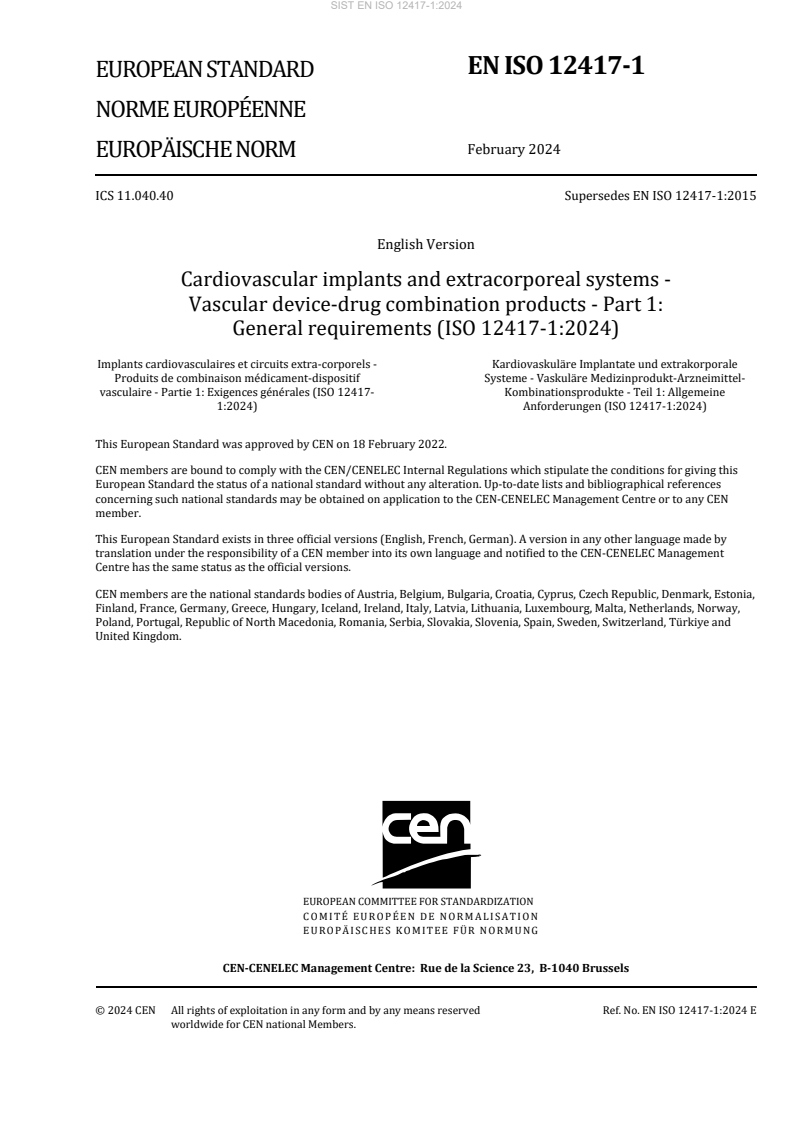
EN ISO 12417-1
EUROPEAN STANDARD
NORME EUROPÉENNE
February 2024
EUROPÄISCHE NORM
ICS 11.040.40 Supersedes EN ISO 12417-1:2015
English Version
Cardiovascular implants and extracorporeal systems -
Vascular device-drug combination products - Part 1:
General requirements (ISO 12417-1:2024)
Implants cardiovasculaires et circuits extra-corporels - Kardiovaskuläre Implantate und extrakorporale
Produits de combinaison médicament-dispositif Systeme - Vaskuläre Medizinprodukt-Arzneimittel-
vasculaire - Partie 1: Exigences générales (ISO 12417- Kombinationsprodukte - Teil 1: Allgemeine
1:2024) Anforderungen (ISO 12417-1:2024)
This European Standard was approved by CEN on 18 February 2022.
CEN members are bound to comply with the CEN/CENELEC Internal Regulations which stipulate the conditions for giving this
European Standard the status of a national standard without any alteration. Up-to-date lists and bibliographical references
concerning such national standards may be obtained on application to the CEN-CENELEC Management Centre or to any CEN
member.
This European Standard exists in three official versions (English, French, German). A version in any other language made by
translation under the responsibility of a CEN member into its own language and notified to the CEN-CENELEC Management
Centre has the same status as the official versions.
CEN members are the national standards bodies of Austria, Belgium, Bulgaria, Croatia, Cyprus, Czech Republic, Denmark, Estonia,
Finland, France, Germany, Greece, Hungary, Iceland, Ireland, Italy, Latvia, Lithuania, Luxembourg, Malta, Netherlands, Norway,
Poland, Portugal, Republic of North Macedonia, Romania, Serbia, Slovakia, Slovenia, Spain, Sweden, Switzerland, Türkiye and
United Kingdom.
EUROPEAN COMMITTEE FOR STANDARDIZATION
COMITÉ EUROPÉEN DE NORMALISATION
EUROPÄISCHES KOMITEE FÜR NORMUNG
CEN-CENELEC Management Centre: Rue de la Science 23, B-1040 Brussels
© 2024 CEN All rights of exploitation in any form and by any means reserved Ref. No. EN ISO 12417-1:2024 E
worldwide for CEN national Members.
Contents Page
European foreword . 3
European foreword
This document (EN ISO 12417-1:2024) has been prepared by Technical Committee ISO/TC 150
"Implants for surgery" in collaboration with Technical Committee CEN/TC 285 “Non-active surgical
implants” the secretariat of which is held by DIN.
This European Standard shall be given the status of a national standard, either by publication of an
identical text or by endorsement, at the latest by August 2024, and conflicting national standards shall
be withdrawn at the latest by August 2024.
Attention is drawn to the possibility that some of the elements of this document may be the subject of
patent rights. CEN shall not be held responsible for identifying any or all such patent rights.
This document supersedes EN ISO 12417-1:2015.
Any feedback and questions on this document should be directed to the users’ national standards
body/national committee. A complete listing of these bodies can be found on the CEN website.
According to the CEN-CENELEC Internal Regulations, the national standards organizations of the
following countries are bound to implement this European Standard: Austria, Belgium, Bulgaria,
Croatia, Cyprus, Czech Republic, Denmark, Estonia, Finland, France, Germany, Greece, Hungary, Iceland,
Ireland, Italy, Latvia, Lithuania, Luxembourg, Malta, Netherlands, Norway, Poland, Portugal, Republic of
North Macedonia, Romania, Serbia, Slovakia, Slovenia, Spain, Sweden, Switzerland, Türkiye and the
United Kingdom.
Endorsement notice
The text of ISO 12417-1:2024 has been approved by CEN as EN ISO 12417-1:2024 without any
modification.
International
Standard
ISO 12417-1
Second edition
Cardiovascular implants and
2024-02
extracorporeal systems —
Vascular device-drug combination
products —
Part 1:
General requirements
Implants cardiovasculaires et circuits extra-corporels — Produits
de combinaison médicament-dispositif vasculaire —
Partie 1: Exigences générales
Reference number
ISO 12417-1:2024(en) © ISO 2024
ISO 12417-1:2024(en)
© ISO 2024
All rights reserved. Unless otherwise specified, or required in the context of its implementation, no part of this publication may
be reproduced or utilized otherwise in any form or by any means, electronic or mechanical, including photocopying, or posting on
the internet or an intranet, without prior written permission. Permission can be requested from either ISO at the address below
or ISO’s member body in the country of the requester.
ISO copyright office
CP 401 • Ch. de Blandonnet 8
CH-1214 Vernier, Geneva
Phone: +41 22 749 01 11
Email: copyright@iso.org
Website: www.iso.org
Published in Switzerland
ii
ISO 12417-1:2024(en)
Contents Page
Foreword .v
Introduction .vi
1 Scope . 1
2 Normative references . 2
3 Terms and definitions . 2
4 Intended performance . 6
4.1 General .6
4.2 Classification .6
4.3 Intended clinical location .7
5 Design attributes . 7
5.1 General .7
5.2 Drug-containing part of the VDDCP .7
5.2.1 General .7
5.2.2 Matrix .8
5.2.3 Active pharmaceutical ingredient .8
6 Materials . 9
7 Design evaluation . 9
7.1 General .9
7.2 Pre-clinical evaluation . .10
7.2.1 Sampling .10
7.2.2 Conditioning of test samples.10
7.2.3 Pre-clinical in vitro test reports and additional information .11
7.2.4 Pre-clinical in vitro evaluation .11
7.2.5 Preclinical in vivo evaluation . .17
7.3 Clinical evaluation . 22
7.3.1 Purpose . 22
7.3.2 Specific aims . 22
7.3.3 Clinical investigation plan . 22
7.3.4 Data acquisition . . . 23
7.3.5 Final report . 25
7.4 Post-market surveillance . 26
8 Manufacturing .26
8.1 General . 26
8.2 Raw material reporting and analysis of the API . 26
8.3 Raw material analysis and reporting for excipients .27
8.4 VDDCP batch release testing .27
9 Sterilization .28
9.1 Products supplied sterile — Testing to support “Sterile” labelling . 28
9.2 Products supplied non-sterile . 28
9.3 Sterilization residuals . 28
10 Packaging.28
10.1 General . 28
10.2 Considerations for VDDCPs . 28
10.3 Impact of changes in storage and shipping temperatures on VDDCP . 28
11 Information supplied by the manufacturer .29
11.1 General . 29
11.2 Labelling . 29
11.2.1 VDDCP label(s) . 29
11.2.2 Record label . 29
11.3 Instructions for use . 30
iii
ISO 12417-1:2024(en)
Annex A (informative) Description of potential clinical and technical events .31
Annex B (informative) Local information regarding submission issues for VDDCPs .36
Bibliography .42
iv
ISO 12417-1:2024(en)
Foreword
ISO (the International Organization for Standardization) is a worldwide federation of national standards
bodies (ISO member bodies). The work of preparing International Standards is normally carried out through
ISO technical committees. Each member body interested in a subject for which a technical committee
has been established has the right to be represented on that committee. International organizations,
governmental and non-governmental, in liaison with ISO, also take part in the work. ISO collaborates closely
with the International Electrotechnical Commission (IEC) on all matters of electrotechnical standardization.
The procedures used to develop this document and those intended for its further maintenance are described
in the ISO/IEC Directives, Part 1. In particular, the different approval criteria needed for the different types
of ISO document should be noted. This document was drafted in accordance with the editorial rules of the
ISO/IEC Directives, Part 2 (see www.iso.org/directives).
ISO draws attention to the possibility that the implementation of this document may involve the use of (a)
patent(s). ISO takes no position concerning the evidence, validity or applicability of any claimed patent
rights in respect thereof. As of the date of publication of this document, ISO had not received notice of (a)
patent(s) which may be required to implement this document. However, implementers are cautioned that
this may not represent the latest information, which may be obtained from the patent database available at
www.iso.org/patents. ISO shall not be held responsible for identifying any or all such patent rights.
Any trade name used in this document is information given for the convenience of users and does not
constitute an endorsement.
For an explanation of the voluntary nature of standards, the meaning of ISO specific terms and expressions
related to conformity assessment, as well as information about ISO's adherence to the World Trade
Organization (WTO) principles in the Technical Barriers to Trade (TBT), see www.iso.org/iso/foreword.html.
This document was prepared by Technical Committee ISO/TC 150, Implants for surgery, Subcommittee
SC 2, Cardiovascular implants and extracorporeal systems, in collaboration with the European Committee for
Standardization (CEN) Technical Committee CEN/TC 285, Non-active surgical implants, in accordance with
the Agreement on technical cooperation between ISO and CEN (Vienna Agreement).
This second edition cancels and replaces the first edition (ISO 12417-1:2015), which has been technically
revised.
The main changes are as follows:
— the text regarding ethylene oxide sterilization limits has been revised,
— references have been updated, and
— terms and definitions have been revised.
A list of all parts in the ISO 12417 series can be found on the ISO website.
Any feedback or questions on this document should be directed to the user’s national standards body. A
complete listing of these bodies can be found at www.iso.org/members.html.
v
ISO 12417-1:2024(en)
Introduction
Vascular device-drug combination products (VDDCPs) are medical devices with various clinical indications
for use in the human vascular blood system. A VDDCP incorporates, as an integral part, substance(s) which,
if used separately, can be considered to be a medicinal substance or product (drug substance, drug product)
but the action of the medicinal substance is ancillary to that of the device and supports the primary mode of
action (PMOA) of the device.
Many vascular device-drug combination products have been shown to be safe and effective in clinical use.
This revision is not intended to require additional evaluation of these products as the testing would not
provide useful information regarding the expected clinical performance of the product. Manufacturers
can rely on historical data gathered in the previous edition of this document (i.e. ISO 12417-1:2015).
Similarly, for product modifications or changes in intended clinical use, this edition of this document (i.e.
ISO 12417-1:202X) is not intended to require additional evaluation of any aspects of the product that are not
expected to change clinical performance.
When developing this document, it was impossible to consider all future and emerging technologies. VDDCPs
using such technologies need to be evaluated following the basic requirements of this document. Testing
beyond the scope of this document can also be necessary to characterize these future and emerging device
systems.
vi
International Standard ISO 12417-1:2024(en)
Cardiovascular implants and extracorporeal systems —
Vascular device-drug combination products —
Part 1:
General requirements
1 Scope
This document specifies requirements for vascular device-drug combination products (VDDCPs).
With regard to safety, this document outlines requirements for intended performance, design attributes,
materials, design evaluation, manufacturing, sterilization, packaging and information supplied by the
manufacturer.
For implanted products, this document is intended to be used as a supplement to ISO 14630, which specifies
general requirements for the performance of non-active surgical implants. This document is intended to
be used as a supplement to relevant device-specific standards, such as the ISO 25539 series specifying
requirements for endovascular devices. Requirements listed in this document also address VDDCPs that are
not permanent implants.
NOTE 1 Due to variations in the design of combination products covered by this document and due to the relatively
recent development of some of these combination products, acceptable standardized in vitro test results and clinical
study results are not always available. As further scientific and clinical data become available, appropriate revision of
this document can be necessary.
This document applies to delivery systems or parts of the delivery system that are an integral component
of the vascular device and that are drug-covered (e.g. drug-covered balloon catheters and drug-covered
guidewires).
This document does not apply to devices whose PMOA provide a conduit for delivery of a drug (e.g. infusion
catheters), unless they contain a drug component that is intended to have an ancillary action to the device
part (e.g. antimicrobial coated infusion catheter).
This document does not apply to procedures and devices used prior to and following the introduction of the
VDDCP (e.g. balloon angioplasty devices) that do not affect the drug-related aspects of the device.
This document does not provide a comprehensive pharmacological evaluation of VDDCPs.
NOTE 2 Some information about the requirements of certain national and regional authorities is given in Annex B.
The connection of absorbable components of VDDCPs (e.g. coatings) with drug-related aspects of the device
are addressed in this document. This document does not provide an exhaustive list of the degradation and
other time-dependent aspects of absorbable implants and coatings.
NOTE 3 For more information on absorbable coatings, refer to ISO/TS 17137 and ASTM F3036-13.
This document does not address issues associated with viable or non-viable biological materials such as
tissues, cells or proteins.
This document does not address issues associated with active surgical implants (i.e. implants that require
power not generated by the human body or gravity).
ISO 12417-1:2024(en)
2 Normative references
The following documents are referred to in the text in such a way that some or all of their content constitutes
requirements of this document. For dated references, only the edition cited applies. For undated references,
the latest edition of the referenced document (including any amendments) applies.
ISO 10993-1, Biological evaluation of medical devices — Part 1: Evaluation and testing within a risk management
process
ISO 10993-2, Biological evaluation of medical devices — Part 2: Animal welfare requirements
ISO 10993-7, Biological evaluation of medical devices — Part 7: Ethylene oxide sterilization residuals
ISO 11070, Sterile single-use intravascular introducers, dilators and guidewires
ISO 11607-1, Packaging for terminally sterilized medical devices — Part 1: Requirements for materials, sterile
barrier systems and packaging systems
ISO 14155, Clinical investigation of medical devices for human subjects — Good clinical practice
ISO 14630:2012, Non-active surgical implants — General requirements
ISO 14937, Sterilization of health care products — General requirements for characterization of a sterilizing
agent and the development, validation and routine control of a sterilization process for medical devices
ISO 14971:2019, Medical devices — Application of risk management to medical devices
ISO 15223-1, Medical devices — Symbols to be used with information to be supplied by the manufacturer — Part
1: General requirements
ISO 25539-2, Cardiovascular implants — Endovascular devices — Part 2: Vascular stents
3 Terms and definitions
For the purposes of this document, the terms and definitions provided in ISO 14630 and the following apply.
ISO and IEC maintain terminology databases for use in standardization at the following addresses:
— ISO Online browsing platform: available at https:// www .iso .org/ obp
— IEC Electropedia: available at https:// www .electropedia .org/
3.1
active pharmaceutical ingredient
API
drug substance
pharmacologically active (drug or medicinal) substance used as a raw material, which is coated on, bound to
or incorporated into the device to achieve an ancillary device function (e.g. minimizing vascular restenosis)
3.2
batch
quantity of vascular device-drug combination product (3.27) at the final stage or pre-final stage of manufacture
which has undergone the same manufacturing cycle, using the same components (e.g. same coating solution,
same device size) and meets the same specifications
ISO 12417-1:2024(en)
3.3
change
alteration to an activity or to the vascular device-drug combination product (3.27) to improve or maintain the
composition or performance of a vascular device-drug combination product
Note 1 to entry: Certain local regional authorities require that changes are reported, including small alterations to a
vascular device-drug combination product, a manufacturing process or a test procedure, even if it is not necessarily
captured by a corrective action/preventative action (CAPA) system.
3.4
clinical event
complication, failure or device-related observation that can be observed with clinical use of a vascular
device-drug combination product (3.27)
Note 1 to entry: It is possible events will not have clinical significance and cannot be attributable to the vascular
device-drug combination product.
3.5
compendial pharmaceutical reference standard
reference substance, reference preparation or reference spectrum recognized by a national pharmacopoeia
3.6
device part of the vascular device-drug combination product
device part of the VDDCP
device part
DP
part of the vascular device-drug combination product (3.27) intended that treats vascular disease by
temporary or long-term intervention or implantation that does not achieve its primary mode of action in or
on the human body by pharmacological, immunological or metabolic means, but that can be assisted in its
function by such means
3.7
assay
biological or chemical method to determine the activity or potency of a substance
3.8
drug product
medicinal product
active pharmaceutical ingredient (3.1), in its final form for administration to the patient (e.g. tablet, solution,
spray), that is intended to prevent, diagnose or treat disease and that achieves its principal intended action
in or on the body by pharmacological, immunological or metabolic means
3.9
drug-containing part of the vascular device-drug combination product
drug-containing part
DCP
part of the vascular device-drug combination product (3.27) that consists of the active pharmaceutical
ingredient (3.1) or matrix (3.21) and associated device interfaces intended to assist in the primary mode
of action of the device by diminishing or ameliorating, potential unintended effects that placement of the
device part (3.6) can potentially stimulate
Note 1 to entry: Some vascular device-drug combination product can incorporate medicinal or drug substances that
are primarily intended to optimize the DP properties of the vascular device-drug combination product.
3.10
DCP interface
drug-containing part interface
common boundary or interconnection between the various components of the device part(s) (3.6) and the
drug-containing part(s) (3.9) of a vascular device-drug combination product (3.27)
EXAMPLE 1 Interface between the matrix (3.21) containing the active pharmaceutical ingredient (3.1) and packaging
materials with direct drug-containing part contact.
ISO 12417-1:2024(en)
EXAMPLE 2 Device surface(s).
EXAMPLE 3 Interface between the matrix and the active pharmaceutical ingredient.
3.11
delivery system
transport device that physically or mechanically positions the vascular device-drug combination product
(3.27) and/or the drug-containing part (3.9) at the intended anatomic location
EXAMPLE The delivery system of a drug-coated balloon would position the balloon in the lumen of the lesion
intended to be treated.
3.12
drug content
total labelled amount of active pharmaceutical ingredient (3.1) in a vascular device-drug combination product
(3.27)
Note 1 to entry: Drug content can be expressed as µg per drug-containing part (3.9) of a certain size.
3.13
drug delivery
local interaction between the vascular device-drug combination product (3.27) drug and the in vivo
environment, whether the drug is released from, eluted from, or remains bound to the vascular device-drug
combination product
3.14
drug-related impurity
substance in the drug-containing part (3.9) of a vascular device-drug combination product (3.27) that is not
the active pharmaceutical ingredient (3.1) or an excipient (3.19)
Note 1 to entry: Drug-related impurities can include drug degradation products or degradants, drug-synthesis-related
impurities, isomers of the drug, residual drug solvents or biological contaminants (e.g. occurring with drugs derived
from biological systems).
3.15
drug release characterization
in vitro characterization of the active pharmaceutical ingredient (3.1) released from the drug-containing part
(3.9) of a vascular device-drug combination product (3.27) over time
EXAMPLE The release can be determined by a drug elution test and can include a curve shape (or profile), a drug
release rate, or both.
3.16
durability
ability to maintain adequate integrity and robustness during procedural (i.e. access, deployment,
withdrawal), post-procedural and long-term use (i.e. over time) according to design specifications
3.17
efficacy
effectiveness
ability of the vascular device-drug combination product (3.27) to achieve the planned and desired physiological
result
3.18
evaluate
analyse qualitatively
ISO 12417-1:2024(en)
3.19
excipient
additional material(s), other than the active pharmaceutical ingredient (3.1), that are intentional components
of the drug-containing part (3.9) of a vascular device-drug combination product (3.27)
EXAMPLE Filler, extender, diluent, wetting agent, solvent, colorant, stabilizer, antioxidant, preservative, pH
maintainer, polymers, adhesives.
3.20
functionality
ability of the vascular device-drug combination product (3.27) to perform physically, chemically, and/or
mechanically, as designed
Note 1 to entry: Functionality does not include the physiological response to the vascular device-drug combination
product [i.e. efficacy (3.17)].
3.21
matrix
organic or inorganic material, other than living cells, intentionally applied by a manufacturer to a vascular
device and designed for the purpose of drug storage, local drug activity at the surface and/or enabling,
retarding, delaying or modifying drug release
Note 1 to entry: The matrix can:
— be permanent or temporary (dissolvable, absorbable or degradable);
— include surface treatments such as primers;
— be a coating with or without an active pharmaceutical ingredient (3.1), or consisting of multiple excipients (3.19)
and/or multiple active pharmaceutical ingredients.
3.22
particulate
particle
mobile matter, other than gas bubbles, present on, or arising from the use of the vascular device-drug
combination product (3.27)
3.23
pharmacokinetics
absorption, distribution, metabolism and elimination of a drug in vivo
3.24
procedural fluid
blood and serum, saline, and contrast media that come into contact with a vascular device-drug combination
product (3.27)
3.25
stability testing
tests undertaken according to a prescribed stability protocol to establish, support or confirm the shelf life of
a vascular device-drug combination product (3.27)
Note 1 to entry: Additional guidance on the drug-related aspects of the drug-containing part (3.9) of the vascular
device-drug combination product can be found in ICH Q1A.
3.26
content uniformity
uniformity of drug content
comparison of the uniformity of the drug content (3.12) between individual vascular device-drug combination
products (3.27) within each batch (3.2) as compared to the labelled claim
ISO 12417-1:2024(en)
3.27
vascular device-drug combination product
VDDCP
vascular medical device that incorporates one or more active pharmaceutical ingredients (3.1) as an integral
part of the device that is not necessarily part of the device's primary mode of action (i.e. ancillary mode of
action)
Note 1 to entry: The vascular device-drug combination product can be permanently deployed (e.g. an implant like a
drug-eluting stent) or temporarily deployed (e.g. a drug-eluting balloon).
3.28
vascular device-drug combination product deployment
VDDCP deployment
physical or mechanical positioning of the vascular device-drug combination product (3.27) so that the drug-
containing part (3.9) is in contact with the intended anatomic treatment site
Note 1 to entry: The vascular device-drug combination product may be permanently deployed (e.g. a drug-eluting
stent) or temporarily deployed (e.g. a drug-eluting balloon).
3.29
vascular device-drug combination product specification
VDDCP specification
list of required test procedures and appropriate acceptance criteria which are numerical limits, ranges or
other criteria for the tests described
Note 1 to entry: A specification is a critical quality standard. It establishes the set of criteria to which a vascular device-
drug combination product (3.27) has to conform.
Note 2 to entry: Additional guidance on the drug-related aspects of the drug-containing part (3.9) of the vascular
device-drug combination product can be found in ICH Q6A.
3.30
primary mode of action
PMOA
single mode of action of a combination product that provides the most important therapeutic action of the
combination product
Note 1 to entry: The most important therapeutic action is the mode of action expected to make the greatest
contribution to the overall intended therapeutic effects of the combination product
Note 2 to entry: Additional guidance on the drug-related aspects of the drug-containing part (3.9) of the vascular
device-drug combination product (3.27) can be found in ICH Q1A.
4 Intended performance
4.1 General
The requirements of ISO 14630:2012, Clause 4, shall apply.
4.2 Classification
A VDDCP is a product that is considered to be a medical device but which incorporates, as an integral part,
substances which, if used separately, can be considered to be a medicinal product or drug product. It is
classified as a medical device, provided that the action of the medicinal or drug substance is ancillary to
that of the device, as reflected in the product claim and as supported by the scientific data provided by the
manufacturer of the device.
ISO 12417-1:2024(en)
4.3 Intended clinical location
The intended clinical location shall be identified as one or more of the following:
a) abdominal aorta;
b) arterio-venous shunt for vascular access;
c) carotid;
d) coronary;
e) femoral;
f) iliac;
g) popliteal;
h) intracerebral;
i) renal;
j) thoracic aorta;
k) thoraco-abdominal aorta;
l) tibial;
m) other arterial or venous vessels to be specified.
5 Design attributes
5.1 General
The design attributes to meet the intended performance of the VDDCP shall consider at least:
a) the ability of the device part of the VDDCP (i.e. the device without the API and matrix) to fulfill all
product-specific requirements for the PMOA (e.g. the mechanical function), which are defined in the
device-related standards;
b) the ability of the drug-containing part of the VDDCP to fulfill the drug-specific function and requirements
of the VDDCP as defined in 5.2;
c) the ability of the VDDCP to meet defined chemical, physical, mechanical or compatibility specifications
after interaction with the DCP/matrix and device or manufacturing processes;
d) the ability of the VDDCP to meet applicable interactional (ergonomic, connections, coupling)
requirements, unless justified.
5.2 Drug-containing part of the VDDCP
5.2.1 General
The design attributes of the VDDCP to meet the intended performance of the DCP shall additionally consider
at least:
a) the ability of the DCP to be consistently, accurately, and safely brought into contact with the intended
anatomic treatment site;
b) the appropriate physical and chemical compatibility of the DCP interfaces (i.e. the device, the drug, the
matrix and any packaging with direct DCP contact);
ISO 12417-1:2024(en)
c) the appropriately justified/conducted biocompatibility of the DCP;
d) conformance of the DCP to VDDCP specifications at the time of manufacture and after storage;
e) the ability of the DCP to deliver or maintain the intended amount of drug safely at the target site in
accordance with the specification of the VDDCP at product release and for the duration of the labelled
shelf life;
f) the appropriate interaction between the VDDCP and procedural fluids.
5.2.2 Matrix
The design attributes of the VDDCP to meet the intended performance of the matrix shall additionally
consider at least:
a) the ability of the matrix to maintain adequate integrity during procedural use in accordance with the
design specifications (e.g. freedom from significant delamination, flaps, and bare spots) and over time
as applicable for the VDDCP;
b) the ability of the matrix to maintain adequate resistance to unintended generation of particles;
c) conformance of the matrix to VDDCP specifications at the time of manufacture and after storage;
d) conformance of the matrix dimensions, physical and chemical properties, and other matrix parameters
(e.g. porosity, mass, density, distribution, glass transition temperature, melting temperature,
fragmentation point) to the design requirements;
e) if soluble or degradable, the ability of the matrix to control the release of drug and the interaction of
any solubilized or degradation products with the body (i.e. biocompatibility of the matrix as well as the
degradation products);
f) the effect of imaging (e.g. the heating caused by magnetic resonance imaging [MRI]) on the matrix.
5.2.3 Active pharmaceutical ingredient
The design attributes of the VDDCP to meet the intended performance of the API shall additionally consider
at least:
a) conformance of drug content, impurities and degradants to the API specification upon receipt and after
storage and handling of the API before introduction into the VDDCP manufacturing process;
b) the ability to reproducibly incorporate, as demonstrated by content uniformity, the desired drug and
amount within the VDDCP;
c) the ability to release the drug in accordance with the VDDCP specification as applicable for devices that
intended to release drug;
d) conformance of drug content, drug impurities and drug degradants to VDDCP specifications for finished
devices after manufacturing (e.g. batch release) and after storage;
NOTE There can be other impurities, evaluated separately from the drug-related impurities, that are related
to manufacture of the matrix or other components of the VDDCP or come from sterilization or processing aids,
such as monomers, catalysts, residual matrix-related solvents, residual processing solvents or matrix-related
degradation products or degradants. There also can be other biological impurities such as endotoxin, evaluated
separately from the drug-related impurities.
e) appropriate interaction between the drug(s) and the matrix and/or the device to which the drug(s)
is(are) applied;
f) appropriate interaction between the drug(s) and the tissue to which the drug(s) is(are) applied;
g) the effect of imaging (e.g. MRI) on the drug of a VDDCP (e.g. heating).
ISO 12417-1:2024(en)
NOTE Additional guidance on the drug-related specifications can be found in ICH Q6A as well as in general and
[79]
individual monographs of pharmacopoeias of the different regions [e.g. the United States Pharmacopeia (USP) ,
[103] [98]
Japanese Pharmacopoeia (JP) and European Pharmacopoeia (EP) ].
6 Materials
The requirements of ISO 14630:2012, Clause 6, shall apply when selecting the API, matrix and DP materials
used to design the VDDCP (e.g. metals, polymers, drugs).
a) The inclusion of materials in the VDDCP, can require analysis and/or estimation of potential patient
exposure, analysis of possible alternative substances, material or designs, and/or benefit risk
assessments for the continued use of the materials.
b) Justification can be required for the continued use of materials or substances found in VDDCP (e.g. if
these substances are identified as being of concern).
c) Additional testing to facilitate proper disposal or additional
...
La norme EN ISO 12417-1:2024 est un document crucial qui établit des exigences générales pour les produits combinés dispositifs vasculaires-médicaments (VDDCP). Son périmètre couvre une variété d'éléments essentiels, désignant des prescriptions claires concernant la performance visée, les attributs de conception, les matériaux, l'évaluation de conception, la fabrication, la stérilisation, l'emballage et l'information fournie par le fabricant. L'un des points forts de cette norme réside dans son engagement envers la sécurité des produits implantés. Elle s'érige en complément à ISO 14630, qui traite des exigences générales pour la performance des implants chirurgicaux non actifs, et à d'autres normes spécifiques aux dispositifs, telles que la série ISO 25539, qui définit les exigences pour les dispositifs endovasculaires. Cela souligne son caractère pertinent dans le cadre d'une réglementation strictement basée sur les besoins du secteur médical. La norme traite également des produits qui ne sont pas des implants permanents, élargissant ainsi la portée des VDDCP couverts. De plus, elle aborde les systèmes de livraison ou les parties de ces systèmes qui sont des composants intégrés du dispositif vasculaire et sont recouverts de médicaments. Cet aspect assure que même les dispositifs tels que les cathéters à ballonnet et les fils guides recouverts de médicaments sont conformes aux exigences spécifiées. Il est important de noter que la norme inclut des considérations sur les composants absorbables des VDDCP et leur relation avec les aspects liés au médicament du dispositif. Cependant, elle précise aussi certaines limites; elle ne fournit pas une évaluation pharmacologique exhaustive des VDDCP et n'aborde pas les matériaux biologiques viables ou non viables, ainsi que les implants chirurgicaux actifs. En conclusion, la norme EN ISO 12417-1:2024 représente une avancée significative dans l'établissement de critères clairs et précis pour les produits combinés dispositifs vasculaires-médicaments, garantissant une approche systématique et rigoureuse pour assurer la sécurité et l'efficacité de ces dispositifs critiques dans le domaine médical.
EN ISO 12417-1:2024 표준은 혈관 장치-약물 조합 제품(VDDCPs)에 대한 요구 사항을 명확하게 규정하고 있습니다. 이 문서는 안전성 측면에서 의도된 성능, 설계 속성, 자재, 설계 평가, 제조, 멸균, 포장 및 제조업체가 제공하는 정보에 대한 요구 사항을 포괄적으로 다루고 있습니다. 특히 이 표준은 비활성 외과용 임플란트에 대한 일반 요구사항을 규정한 ISO 14630에 대한 보충으로 사용될 수 있으며, 혈관 장치에 대한 요구 사항을 규정한 ISO 25539 시리즈와 같은 관련 장치-특정 표준과도 연계하여 사용될 수 있습니다. 이 표준의 강점 중 하나는 영구 임플란트가 아닌 VDDCP에 대해서도 적용된다는 점입니다. 이는 최근 개발된 조합 제품의 설계 변화를 고려하여 표준화된 시험 결과나 임상 연구 결과가 항상 이용 가능하지 않음을 인식하고, 향후 과학적 및 임상 데이터가 축적됨에 따라 이 문서의 적절한 수정이 필요할 수 있음을 명시하고 있습니다. 또한, 약물 커버가 포함된 혈관 장치의 구성 요소로서의 전달 시스템에 대한 요구 사항을 명확히 하고 있으며, 약물 전달을 위한 도관 역할을 하는 기기(예: 주입 카테터)에는 적용되지 않는다는 점도 주목할 만합니다. 이로 인해 해당 제품의 안전성과 효과가 체계적으로 평가될 수 있도록 하는 중요한 틀을 제공합니다. 마지막으로, 이 문서는 흡수성 구성 요소와 약물 관련 측면의 연결성을 다루며, 임플란트의 분해 및 시간 의존적 측면에 대한 포괄적인 목록을 제공하지는 않지만, ISO/TS 17137 및 ASTM F3036-13와 같은 추가 정보를 통해 사용자가 필요한 내용을 이해할 수 있도록 안내합니다. 전반적으로 EN ISO 12417-1:2024 표준은 혈관 장치-약물 조합 제품의 안전하고 효과적인 설계를 위한 중요한 기준을 제시하며, 관련 업계에 상당한 기여를 할 것으로 기대됩니다.
Die Norm EN ISO 12417-1:2024 behandelt die Anforderungen an vaskuläre Arzneimittel-Kombinationsprodukte (VDDCPs) und definiert wesentliche Aspekte, die für die Sicherheit und die beabsichtigte Leistung von Bedeutung sind. Im Kern spezifiziert dieses Dokument die grundlegenden Anforderungen hinsichtlich Designmerkmalen, Materialien, Herstellungsverfahren, Sterilisation, Verpackung und der vom Hersteller bereitgestellten Informationen. Ein besonders starkes Merkmal dieser Norm ist ihre Fähigkeit, sowohl für implantierte Produkte als auch für vorübergehende VDDCPs Anwendung zu finden. Sie dient zudem als Ergänzung zu bestehenden Standards, wie der ISO 14630, die allgemeine Anforderungen für nicht-aktive chirurgische Implantate festlegt, sowie zu gerätespezifischen Normen wie der ISO 25539-Serie für endovaskuläre Geräte. Dies zeigt die Relevanz der Norm in der medizinischen Geräteindustrie und ihre Rolle im Kontext der Sicherheit von vaskulären Implantaten. Darüber hinaus thematisiert die Norm spezifische Anforderungen für die Liefer- und Bestandteile von VDDCPs, die mit Arzneimitteln überzogen sind, wie beispielsweise Arzneimittel-beschichtete Ballonkatheter. Ein wichtiges Augenmerk liegt auf dem Zusammenhang zwischen den absorbierbaren Komponenten der VDDCPs und deren arzneimittelbezogenen Aspekten, obwohl das Dokument keine umfassende pharmakologische Bewertung bereitstellt. Ein weiteres starkes Merkmal ist die Berücksichtigung der Variationen im Design dieser Kombination Produkte und der Notwendigkeit, künftige Revisionen an die aktuell verfügbaren wissenschaftlichen und klinischen Daten anzupassen. Dies gewährleistet die fortlaufende Aktualität und Anwendbarkeit der Norm im sich rasch entwickelnden Bereich der vaskulären Implantate und Arzneimittel. Die Norm enthält auch Hinweise auf sicherheitsspezifische Faktoren und fordert eine Darstellung der Ergebnisse in Bezug auf sicherheitsrelevante Tests. Trotzdem behandelt das Dokument nicht alle Aspekte bezüglich biologischer Materialien oder aktiver chirurgischer Implantate, was eine klare Abgrenzung der Anwendungsbereiche schafft. Die EN ISO 12417-1:2024 stellt somit eine essenzielle Standardisierung für die Entwicklung und den Einsatz von vaskulären Arzneimittel-Kombinationsprodukten dar, indem sie die leitenden Voraussetzungen für Sicherheit und Leistung in diesem leistungsstarken Bereich definiert.
EN ISO 12417-1:2024は、血管デバイスと薬剤の組み合わせ製品(VDDCP)に関する一般的な要求事項を定めた重要な標準です。この文書は、血管デバイスの安全性、意図された性能、設計の特性、材料、設計評価、製造、滅菌、包装、および製造者が提供する情報に関連する要求事項を詳述しています。 この標準の強みは、VDDCPに適用されるさまざまな側面を包括的に扱っている点です。特に、埋め込み型製品に関しては、ISO 14630の一般的要求事項を補完するものとして使用されることが想定されています。また、ISO 25539シリーズのようなデバイス固有の標準とも連携することで、血管デバイスの性能に関する具体的な要件を提供します。 さらに、VDDCPが恒久的なインプラントでない場合にも対応しているため、臨床現場における多様なニーズに応えることができます。特に、薬剤被覆バルーンカテーテルや薬剤被覆ガイドワイヤーのようなデリバリーシステムやその構成要素が対象となり、薬剤に関連する側面を詳細に規定しています。 ただし、この標準にはいくつかの制限もあります。具体的には、VDDCPの相互作用における吸収可能な成分や薬剤に関連する側面を扱いながらも、吸収可能なインプラントやコーティングの劣化に関する完全なリストを示すものではありません。また、活性手術インプラントや生物材料(組織、細胞、タンパク質)に関連する問題もカバーしていません。このような点を考慮しながら使用することが重要です。 全体として、EN ISO 12417-1:2024は、血管デバイス-薬剤の組み合わせ製品に関する安全性や性能の基準を提供する上で、非常に関連性の高い標準であり、今後の科学的なデータや臨床研究の進展に応じて、適切な改訂が必要となる可能性があります。
The standard EN ISO 12417-1:2024 establishes comprehensive requirements specifically tailored for vascular device-drug combination products (VDDCPs), ensuring a high level of safety and performance for these crucial medical devices. This document articulates the necessary guidelines regarding intended performance, design attributes, materials, design evaluation, manufacturing processes, sterilization, packaging, and the information provided by the manufacturer, thus addressing multiple facets of product development and oversight. One of the significant strengths of this standard is its compatibility with existing frameworks, as it acts as a supplement to ISO 14630, which outlines general requirements for non-active surgical implants. By integrating with this standard, EN ISO 12417-1:2024 offers a harmonized approach towards ensuring the efficacy and safety of VDDCPs, particularly emphasizing those that are not permanent implants. The standard acknowledges the dynamic nature of combination products by stating the necessity for potential revisions as more scientific and clinical data become available, showcasing its adaptability in a rapidly evolving field. The document also clearly specifies the scope of applications for VDDCPs, including drug-covered delivery systems like balloon catheters and guidewires, which are critical in modern medical applications. By delineating what is included and excluded from its purview-such as active surgical implants and devices used in procedures that do not influence drug delivery-this standard effectively narrows its focus to ensure the requirements are relevant and applicable. Additionally, EN ISO 12417-1:2024 addresses the connection between absorbable components and drug-related aspects, underscoring the significance of degradation and time-dependent properties within VDDCPs. This focus on absorbable coatings indicates the standard's relevance in contemporary research and development scenarios, where such technologies are increasingly being implemented. The inclusion of national and regional regulatory insights in Annex B further enhances the document’s utility, making it a valuable resource for manufacturers striving to meet diverse regulatory expectations. In summary, EN ISO 12417-1:2024 provides a structured and pertinent framework for the development, evaluation, and regulation of vascular device-drug combination products, reinforcing the safety and effectiveness of these innovative medical devices within the healthcare landscape. Its comprehensive scope and strengths make it a critical standard for professionals involved in the design and manufacture of VDDCPs.
Questions, Comments and Discussion
Ask us and Technical Secretary will try to provide an answer. You can facilitate discussion about the standard in here.
Loading comments...