

EN 12255-8:2024
(Main)Wastewater treatment plants - Part 8: Sludge treatment and storage
- Abstract
This document specifies design principles and performance requirements for sludge treatment and storage facilities at wastewater treatment plants serving more than 50 PT.
Guidance on operation is provided where it is necessary in order to facilitate the design of control and automation and design access to points of operation.
NOTE Other sludges and organic wastes can be treated together with municipal sewage sludge where national and local regulations permit.
- Status
- Published
- Publication Date
- 07-May-2024
- Technical Committee
- CEN/TC 165 - Waste water engineering
- Drafting Committee
- CEN/TC 165/WG 40 - Wastewater treatment plants > 50 PT
- Current Stage
- 6060 - Definitive text made available (DAV) - Publishing
- Start Date
- 08-May-2024
- Due Date
- 07-Jul-2023
- Completion Date
- 08-May-2024

Overview
EN 12255-8:2024 - "Wastewater treatment plants - Part 8: Sludge treatment and storage" (CEN) provides design principles and performance requirements for sludge treatment and storage at wastewater treatment plants serving more than 50 population equivalents (PT). The standard covers process selection, equipment design and key operational guidance where needed to support control and automation and access for operation. It also notes that other organic wastes can be co‑treated with municipal sewage sludge where permitted by local regulations.
Key topics and technical requirements
EN 12255-8:2024 addresses the full sludge chain and includes technical guidance on:
- Sludge conditioning and polymer use (storage, dosing and optimization)
- Sludge thickening: process selection and methods (gravity thickening, mechanical thickening, dissolved air flotation)
- Disinfection: thermal, chemical and other methods plus verification of success
- Pre‑treatment prior to biological stabilization (e.g., disintegration, hydrolysis)
- Biological stabilization: anaerobic digestion (mesophilic/thermophilic ranges), aerobic digestion, composting and pseudo‑stabilization
- Dewatering and drying: mechanical dewatering, sludge drying beds, belt and solar dryers
- Sludge handling and storage: liquid holding tanks, lagoons, dewatered sludge storage areas, silos
- Components and service life: sludge pumps, pipelines and other mechanical elements
- Health and safety requirements and operational recommendations (including control and automation considerations)
- Informative annexes with process checks, sludge characteristics, methods to predict dewatering performance and polymer consumption optimization
The document supersedes EN 12255-8:2001 and includes updated design recommendations, sludge drying systems and alignment with current state of the art.
Applications and who uses this standard
EN 12255-8:2024 is essential for professionals involved in municipal and domestic wastewater sludge management, including:
- Design and consulting engineers specifying sludge treatment trains and equipment
- Plant operators and asset managers implementing operations, control and automation
- Municipal authorities and regulators setting performance expectations and procurement requirements
- Equipment manufacturers and suppliers developing thickening, dewatering, digestion and drying systems
- Environmental consultants evaluating sludge reuse, disposal and compliance
Use cases include new plant design, upgrades to existing sludge facilities, equipment selection, and developing operational protocols that align with performance requirements.
Related standards
- EN 12255 series (Parts 1–16) for general wastewater treatment plant requirements
- EN 12255-9: Odour control and ventilation
- EN 12255-10: Safety principles
Keywords: EN 12255-8:2024, sludge treatment, sludge storage, wastewater treatment plants, sludge dewatering, anaerobic digestion, sludge thickening, polymer dosing, plant design, control and automation.
Relations
- Effective Date
- 19-Jan-2023
- Effective Date
- 28-Jan-2026
- Effective Date
- 28-Jan-2026
- Effective Date
- 28-Jan-2026
Get Certified
Connect with accredited certification bodies for this standard

CIS Institut d.o.o.
Personal Protective Equipment (PPE) certification body. Notified Body NB-2890 for EU Regulation 2016/425 PPE.

Kiwa BDA Testing
Building and construction product certification.
Kmetijski inštitut Slovenije
Agricultural Institute of Slovenia. Soil testing, plant health, agricultural product analysis.
Sponsored listings
Frequently Asked Questions
EN 12255-8:2024 is a standard published by the European Committee for Standardization (CEN). Its full title is "Wastewater treatment plants - Part 8: Sludge treatment and storage". This standard covers: This document specifies design principles and performance requirements for sludge treatment and storage facilities at wastewater treatment plants serving more than 50 PT. Guidance on operation is provided where it is necessary in order to facilitate the design of control and automation and design access to points of operation. NOTE Other sludges and organic wastes can be treated together with municipal sewage sludge where national and local regulations permit.
This document specifies design principles and performance requirements for sludge treatment and storage facilities at wastewater treatment plants serving more than 50 PT. Guidance on operation is provided where it is necessary in order to facilitate the design of control and automation and design access to points of operation. NOTE Other sludges and organic wastes can be treated together with municipal sewage sludge where national and local regulations permit.
EN 12255-8:2024 is classified under the following ICS (International Classification for Standards) categories: 13.060.30 - Sewage water. The ICS classification helps identify the subject area and facilitates finding related standards.
EN 12255-8:2024 has the following relationships with other standards: It is inter standard links to EN 12255-8:2001, EN 12255-9:2023, EN 12255-10:2023, CEN/TR 13767:2004. Understanding these relationships helps ensure you are using the most current and applicable version of the standard.
EN 12255-8:2024 is associated with the following European legislation: EU Directives/Regulations: 93/38/EEC; Standardization Mandates: M/BC/CEN/88/15. When a standard is cited in the Official Journal of the European Union, products manufactured in conformity with it benefit from a presumption of conformity with the essential requirements of the corresponding EU directive or regulation.
EN 12255-8:2024 is available in PDF format for immediate download after purchase. The document can be added to your cart and obtained through the secure checkout process. Digital delivery ensures instant access to the complete standard document.
Standards Content (Sample)
SLOVENSKI STANDARD
01-julij-2024
Čistilne naprave za odpadno vodo - 8. del: Obdelava in skladiščenje blata
Wastewater treatment plants - Part 8: Sludge treatment and storage
Kläranlagen - Teil 8: Schlammbehandlung und -lagerung
Stations d'épuration - Partie 8: Stockage et traitement des boues
Ta slovenski standard je istoveten z: EN 12255-8:2024
ICS:
13.060.30 Odpadna voda Sewage water
2003-01.Slovenski inštitut za standardizacijo. Razmnoževanje celote ali delov tega standarda ni dovoljeno.
EN 12255-8
EUROPEAN STANDARD
NORME EUROPÉENNE
May 2024
EUROPÄISCHE NORM
ICS 13.060.30 Supersedes EN 12255-8:2001
English Version
Wastewater treatment plants - Part 8: Sludge treatment
and storage
Stations d'épuration - Partie 8 : Stockage et traitement Kläranlagen - Teil 8: Schlammbehandlung und -
des boues lagerung
This European Standard was approved by CEN on 27 February 2024.
CEN members are bound to comply with the CEN/CENELEC Internal Regulations which stipulate the conditions for giving this
European Standard the status of a national standard without any alteration. Up-to-date lists and bibliographical references
concerning such national standards may be obtained on application to the CEN-CENELEC Management Centre or to any CEN
member.
This European Standard exists in three official versions (English, French, German). A version in any other language made by
translation under the responsibility of a CEN member into its own language and notified to the CEN-CENELEC Management
Centre has the same status as the official versions.
CEN members are the national standards bodies of Austria, Belgium, Bulgaria, Croatia, Cyprus, Czech Republic, Denmark, Estonia,
Finland, France, Germany, Greece, Hungary, Iceland, Ireland, Italy, Latvia, Lithuania, Luxembourg, Malta, Netherlands, Norway,
Poland, Portugal, Republic of North Macedonia, Romania, Serbia, Slovakia, Slovenia, Spain, Sweden, Switzerland, Türkiye and
United Kingdom.
EUROPEAN COMMITTEE FOR STANDARDIZATION
COMITÉ EUROPÉEN DE NORMALISATION
EUROPÄISCHES KOMITEE FÜR NORMUNG
CEN-CENELEC Management Centre: Rue de la Science 23, B-1040 Brussels
© 2024 CEN All rights of exploitation in any form and by any means reserved Ref. No. EN 12255-8:2024 E
worldwide for CEN national Members.
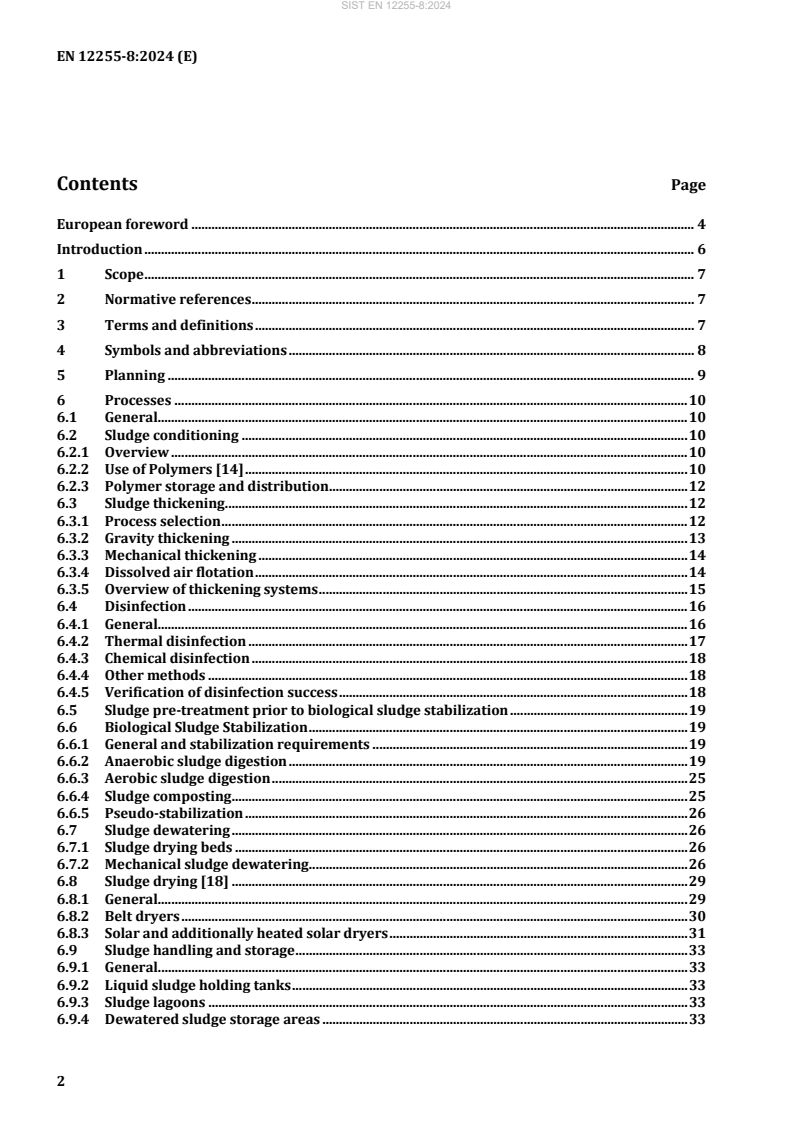
Contents Page
European foreword . 4
Introduction . 6
1 Scope . 7
2 Normative references . 7
3 Terms and definitions . 7
4 Symbols and abbreviations . 8
5 Planning . 9
6 Processes . 10
6.1 General. 10
6.2 Sludge conditioning . 10
6.2.1 Overview . 10
6.2.2 Use of Polymers [14] . 10
6.2.3 Polymer storage and distribution . 12
6.3 Sludge thickening . 12
6.3.1 Process selection . 12
6.3.2 Gravity thickening . 13
6.3.3 Mechanical thickening . 14
6.3.4 Dissolved air flotation . 14
6.3.5 Overview of thickening systems . 15
6.4 Disinfection . 16
6.4.1 General. 16
6.4.2 Thermal disinfection . 17
6.4.3 Chemical disinfection . 18
6.4.4 Other methods . 18
6.4.5 Verification of disinfection success . 18
6.5 Sludge pre-treatment prior to biological sludge stabilization . 19
6.6 Biological Sludge Stabilization . 19
6.6.1 General and stabilization requirements . 19
6.6.2 Anaerobic sludge digestion . 19
6.6.3 Aerobic sludge digestion . 25
6.6.4 Sludge composting . 25
6.6.5 Pseudo-stabilization . 26
6.7 Sludge dewatering . 26
6.7.1 Sludge drying beds . 26
6.7.2 Mechanical sludge dewatering . 26
6.8 Sludge drying [18] . 29
6.8.1 General. 29
6.8.2 Belt dryers . 30
6.8.3 Solar and additionally heated solar dryers . 31
6.9 Sludge handling and storage . 33
6.9.1 General. 33
6.9.2 Liquid sludge holding tanks . 33
6.9.3 Sludge lagoons . 33
6.9.4 Dewatered sludge storage areas . 33
6.9.5 Dewatered or dry sludge silos . 34
7 Components . 34
7.1 Service life . 34
7.2 Sludge pipelines . 34
7.3 Sludge pumps . 34
8 Health and safety . 35
Annex A (informative) Other guidance and information . 36
A.1 Process checks . 36
A.2 Sludge pre-treatment prior to biological sludge stabilization . 36
A.2.1 Sludge disintegration . 36
A.2.2 Biological hydrolysis . 39
A.2.3 Recommendations . 39
A.3 Basic sludge characteristics . 40
A.3.1 General . 40
A.3.2 Further sludge characteristics . 41
A.4 Methods to optimize the polymer consumption . 42
A.5 Methods to predict dewatering performance . 42
Bibliography . 44
European foreword
This document (EN 12255-8:2024) has been prepared by Technical Committee CEN/TC 165
“Wastewater engineering”, the secretariat of which is held by DIN.
This European Standard shall be given the status of a national standard, either by publication of an
identical text or by endorsement, at the latest by November 2024, and conflicting national standards shall
be withdrawn at the latest by November 2024.
Attention is drawn to the possibility that some of the elements of this document may be the subject of
patent rights. CEN shall not be held responsible for identifying any or all such patent rights.
This document supersedes EN 12255-8:2001.
The main changes compared to the previous edition EN 12255-8:2001 are listed below:
a) comprehensive revision and additions in all sections;
b) addition of design recommendations;
c) addition of sludge drying systems;
d) adaptation to the current state of the art;
d) updating of the Normative references;
e) editorial revision.
It is the eighth part prepared by Working Group CEN/TC 165/WG 40 relating to the general requirements
and processes for treatment plants for a total number of inhabitants and population equivalents (PT)
over 50. EN 12255 with the generic title “Wastewater treatment plants” consists of the following Parts:
— Part 1: General construction principles
— Part 2: Storm management systems
— Part 3: Preliminary treatment
— Part 4: Primary treatment
— Part 5: Lagooning processes
— Part 6: Activated sludge process
— Part 7: Biological fixed-film reactors
— Part 8: Sludge treatment and storage
— Part 9: Odour control and ventilation
— Part 10: Safety principles
— Part 11: General data required
— Part 12: Control and automation
— Part 13: Chemical treatment — Treatment of wastewater by precipitation/flocculation
— Part 14: Disinfection
— Part 15: Measurement of the oxygen transfer in clean water in aeration tanks of activated sludge plants
— Part 16: Physical (mechanical) filtration
NOTE 1 Part 2 is under preparation.
NOTE 2 For requirements on pumping installations at wastewater treatment plants see EN 752 and EN 16932
(all parts).
Any feedback and questions on this document should be directed to the users’ national standards body.
A complete listing of these bodies can be found on the CEN website.
According to the CEN-CENELEC Internal Regulations, the national standards organisations of the
following countries are bound to implement this European Standard: Austria, Belgium, Bulgaria, Croatia,
Cyprus, Czech Republic, Denmark, Estonia, Finland, France, Germany, Greece, Hungary, Iceland, Ireland,
Italy, Latvia, Lithuania, Luxembourg, Malta, Netherlands, Norway, Poland, Portugal, Republic of North
Macedonia, Romania, Serbia, Slovakia, Slovenia, Spain, Sweden, Switzerland, Türkiye and the United
Kingdom.
Introduction
Differences in wastewater treatment throughout Europe have led to a variety of systems being developed.
This document gives fundamental information about the systems; this document has not attempted to
specify all available systems. A generic arrangement of wastewater treatment plants is illustrated below
in Figure 1.
Key
1 preliminary treatment
2 primary treatment
3 secondary treatment
4 tertiary treatment
5 additional treatment (e.g. disinfection or removal of micropollutants)
6 sludge treatment
7 lagoons (as an alternative)
A raw wastewater
B effluent for re-use (e.g. irrigation)
C discharged effluent
D screenings and grit
E primary sludge
F secondary sludge
G tertiary sludge
H stabilized sludge
I digester gas
J returned water from dewatering
Figure 1 — Schematic diagram of wastewater treatment plants
Detailed information additional to that contained in this document can be obtained by referring to the
bibliography.
The primary application is for wastewater treatment plants designed for the treatment of domestic and
municipal wastewater.
1 Scope
This document specifies design principles and performance requirements for sludge treatment and
storage facilities at wastewater treatment plants serving more than 50 PT.
Guidance on operation is provided where it is necessary in order to facilitate the design of control and
automation and design access to points of operation.
NOTE Other sludges and organic wastes can be treated together with municipal sewage sludge where national
and local regulations permit.
2 Normative references
The following documents are referred to in the text in such a way that some or all of their content
constitutes requirements of this document. For dated references, only the edition cited applies. For
undated references, the latest edition of the referenced document (including any amendments) applies.
EN 12255-9, Wastewater treatment plants — Part 9: Odour control and ventilation
EN 12255-10, Wastewater treatment plants — Part 10: Safety principles
3 Terms and definitions
For the purposes of this document, the following terms and definitions apply.
ISO and IEC maintain terminological databases for use in standardization at the following addresses:
— ISO Online browsing platform: available at https://www.iso.org/obp
— IEC Electropedia: available at https://www.electropedia.org/
3.1
psychrophilic
process conditions for microorganisms which are active below 30 °C
Note 1 to entry: In the context of wastewater applications the effective temperature range for this is higher than
given in some other disciplines.
3.2
mesophilic
process conditions for microorganisms which are active at temperatures between 30 °C and 45 °C
Note to entry: In the context of wastewater applications the minimum temperature for this is higher than given
in some other disciplines.
3.3
thermophilic
process conditions for microorganisms which are active at temperatures above 45 °C
3.4
pseudo stabilisation
process preventing organic degradation so long as particular conditions (such as pH value or dryness)
are maintained, but for which degradation recommences when the conditions are no longer met
3.5
stock solution
partially prepared mixture of chemical and water in a condition to facilitate handling or distribution
3.6
normal litre
litre of gas, usually dry, referenced to 1 atmosphere (101,325 kPa) and 0 °C
[SOURCE: Adapted from ISO 20675:2018, 3.41 by conversion to litres]
Note 1 to entry: The unit is expressed l . In other documents the unit Nl is sometimes used.
n.
4 Symbols and abbreviations
For the purposes of this document, the following symbols and abbreviations apply.
Abbreviations
AS active substance of polymers
BOD biochemical oxygen demand in 5 days
CHP combined heat and power generating system
CO carbon monoxide
COD chemical oxygen demand
d day
DAF dissolved air flotation
DD degree of disintegration (%)
DS dry solids
EPS exopolymeric substances
FOG fat oil and grease
VS volatile solids
kWh kilowatt hours of electrical power
el
kWh kilowatt hours of thermal power
th
MAP magnesium ammonium phosphate (struvite)
MSRT mean solids residence time
N nitrogen
NaOH sodium hydroxide
NPSH nett positive suction head
SVI sludge volume index
UV – ultraviolet (light)
WAS waste activated sludge (surplus sludge)
WWTP waste water treatment plant
Symbols
C volatile organic acids concentration calculated as acetate in mg/l
Ac,equ
C COD concentrations in the sludge water of the untreated sludge in mg/l
COD,0
C COD concentrations in the sludge water of the treated sludge
COD,1
C reference COD concentration [mg/l]
COD,R
DD degree of disintegration (%)
k -1
H hydrolysis rate in d
t retention time in d
R
T temperature in °C
η ratio of degraded volatile solids to initial volatile solids
VS
η degree of COD disintegration
Dis.COD
5 Planning
The planned utilization or disposal of sludge influences subsequent utilization. It can be subject to a
variety of regulations dependent upon the site of the treatment plant and the proposed routes for use or
disposal.
The choice of the sludge treatment process depends on the size of the treatment plant, the type, origin
and characteristics of the sludge to be treated and the final method of utilization or disposal routes and
related quality requirements, e.g. nutrients, pollutants, pathogenic microorganisms and caloric value.
Processes which allow for more than one sludge utilization or disposal option are preferable.
Consideration shall be given to the possibility of centralized sludge treatment facilities which allow a
wider range of treatment techniques. Special care is needed in respect of extra loads e.g. of nitrogen
generated from sludge liquors at centralized facilities. Sufficient storage capacity shall be available to
prevent sludge overflow under all likely conditions.
The following factors shall be considered in planning sludge treatment:
— sludge characteristics;
— import of sludges and other organic waste;
— utilization or disposal routes and related quality requirements, e.g. nutrients, harmful substances and
calorific value;
— minimum and maximum daily sludge production (volume and dry solids mass);
— future sludge production;
— range of solids concentrations (total and volatile solids);
— physical characteristics (e.g. viscosity and temperature);
— biological properties (degradability, inhibitors and toxicants);
— aggressive or corrosive conditions;
— likely emissions including greenhouse gases, pollutants, and odours (see also EN 12255-9);
— removal of gross solids which can cause blockage or malfunction by screening;
— effect of abrasive or deposit forming solids such as grit;
— effect of additives used in wastewater treatment, such as precipitants, coagulants and flocculants and
their influence on utilization;
— impact of return liquors on the wastewater treatment process e.g. peak loads of ammonia and
phosphorus from sludge processing;
— health and safety of operators and the general public (see also EN 12255-10) e.g. generation of toxic
and /or explosive atmospheres;
— noise;
— visual appearance.
The planning stage should include determination of the extent to which the operation of the plants will
be automated (see EN 12255-12) as there will be differences between systems designed primarily to
operate automatically and those requiring manual intervention. However, all plants shall have provisions
for manual intervention in order to safeguard operation in the event of control system failure.
6 Processes
6.1 General
Provision shall be made to allow the sampling of input and output for each unit process (see
EN ISO 5667-13).
Flow measurement for each unit process should be considered.
The design shall take account of any requirements for control of odour, noise, vibration and explosive
atmospheres in accordance with EN 12255-9 and EN 12255-10.
Annex A gives other guidance and information.
6.2 Sludge conditioning
6.2.1 Overview
Sludge needs to be conditioned before dewatering and in some cases before thickening. The most
common conditioning is done with polymers (usually polyacrylamides), but natural polymers (e.g. based
on chitin or potato starch) are also available though they are not as effective. Such natural polymers have
the advantage that they are easily biodegradable.
Sludge conditioning can also be achieved with cations such as iron, aluminium and calcium, which achieve
coagulation of micro-flocs by compensation of the negative surface charge on particles. Such salts also
achieve phosphate precipitation during wastewater treatment. Agglomeration of micro-flocs occurs
depending on shear forces, but the resulting flocs are weak. Formation of large and strong flocs requires
addition of polymers which form polymer bridges between particles.
Both under- and overdosing of polymers lead to suboptimal thickening and dewatering results. There is
a narrow optimum range.
6.2.2 Use of Polymers [14]
Polymers can be distinguished according to their following properties:
— consistency (granular, emulsion or dispersion);
— non-ionic, cationic or anionic (cationic or non-ionic are usually used for sludge conditioning);
— charge density (usually between 20 % and 70 %);
— molecular weight (usually between 104 g/mol and 108 g/mol);
— molecular structure (linear, branched or cross-linked);
— mass ratio of active ingredients (about 95 % for granular products, 25 % to 50 % for emulsions and
about 30 % for dispersions).
The storage area for concentrated liquid polymers shall be designed to provide for a maximum storage
time of 6 months, because the effectiveness of some polymers deteriorates when they are stored longer.
Polymer stations shall be configured to dilute the concentrated polymer to a 0,1 % to 1 % stock solution
by intensive mixing into clean dilution water (potable water or water from another source with sufficient
quality). Polymer stations shall be designed such that they provide for a ripening time of the stock
solution after preparation of at least 45 min before it is used, and a retention time typically between 4 h
and 6 h, at most 24 h. Stock solutions shall be kept in untransparent tanks because UV-light can
deteriorate them.
Cylindrical vessels for the preparation of stock solutions should have a height to diameter ratio > 1,2. The
3 3
mixing power should be 1 kW/m to 3 kW/m depending on the vessel’s shape and concentration of the
stock. For a stock solution viscosity of up to 800 MPa⋅s a mixer with one or two axial propellers, having
diameters of up to 300 mm, and a rotation speed of 300 rpm to 1 000 rpm should be used. A distance of
the impeller from the wall of 200 mm is recommended to prevent high shear. To prevent vortex formation
the mixer should not be located at the centre of the vessel, or rotation reducing baffles should be provided.
The dilution water for the preparation of stock solutions should have potable water quality. Where other
water is used, its anion (e.g. chloride, nitrate and sulphate) and its cation (e.g. iron and manganese)
concentrations should be analysed to establish its appropriateness.
The dosing concentration of polymers should be between 0,1 % and 0,3 % so that its viscosity is reduced
and mixing into the sludge improved. Final effluent may be used for dilution. The use of two variable
frequency progressive-cavity pumps is recommended for the stock solution and the dilution water as
well as a static inline mixer to mix the two flows. Flow meters for the stock solution and the dilution water
are also recommended to control polymer dosage and concentration.
The most efficient units, which can be used for solid and liquid polymers, consist of two batch vessels, the
first for preparation and ripening, and the second for storing and dosing the stock solution. There are also
units with a single flow-through vessel having three compartments. The latter cannot prevent some
short-circuit flow so that the ripening time is not well defined.
Liquid products can be prepared in a single-stage, continuous-flow polymer station. It is recommended
to provide space for a downstream ripening tank in order to be able to retrofit such a tank if required.
Where only liquid polymers are used, preparation units can be smaller, because their ripening time is
shorter. The stock solution can be prepared in a single agitated vessel wherein concentrated polymer is
mixed into clean water. The stock solution is then diluted in an inline mixer (see above). However, it is
recommended to provide a dosing vessel, or at least space for such a vessel, to provide for additional
ripening time.
Polymer stations shall be easy to clean in order to prevent growth of fungi and other germs.
The diluted dosing solution shall be rapidly mixed into the sludge, e.g. through a static or dynamic mixer.
Dosage into the suction side of a centrifugal pump is also an option. It is recommended to provide two or
three dosing points for later optimization. Polymer is often dosed immediately upstream of centrifuges
because the acceleration provides for intensive mixing, though there is little time for floc formation. Prior
floc formation would be ineffective because flocs would be damaged by high shear at the entrance into
the centrifuge.
With highly effective dynamic mixers, stock solutions with a concentration of up to 0,4 % can be directly
mixed into the sludge without the need of further dilution. They consume power, but can save polymer
and improve the dewatering result. In addition, the polymer preparation unit is less complex and dilution
water is saved. Thinner dosing solutions of polymer will dilute the sludge more than thicker dosing
solutions. This added water also has to be removed during sludge dewatering.
Except for thickening centrifuges, the conditioned sludge should be subject to gentle shear to provide for
good floc formation after mixing. This can be done in a gently agitated vessel or in a pipe reactor.
Requirements related to operation:
— no more stock solution should be prepared than is necessary for dewatering the daily sludge amount,
as the stock solution cannot be stored for an extended time;
— polymer preparation stations should be designed for a ripening time of stock solutions of minimum
45 min to guarantee maximum effectiveness of the polymer;
— simple jar tests provide indications for the effectiveness of various kinds of polymer. Laboratory
centrifuge or filter tests provide information about optimum thickening or dewatering results. It shall
be considered whether such testing equipment should be provided in the plant’s laboratory;
— the design shall include consideration of the costs, depending on polymer dosage and dewatering
results. These shall include polymer and sludge transport and disposal costs.
Information and recommendations for process checks are provided in A.1.
6.2.3 Polymer storage and distribution
Polymer containers and preparation units shall be installed in intercepting or double walled tanks
because polymers in concentrations above 0,2 % are water contaminants. The intercepting or double
walled tanks shall be water-tight. The intercepting tanks shall have a sufficient volume to withhold the
maximum leakage volume. Both shall be provided with a leak sensor.
Pipelines for polymer solutions shall be either installed above an intercepting tank or shall be double
walled with a leak sensor. National regulations can apply.
6.3 Sludge thickening
6.3.1 Process selection
Sludge thickening can be performed in gravity thickeners or dissolved air flotation tanks, or with
mechanical thickening equipment such as filters or centrifuges.
The selection of the thickening method and its design shall take into account the following factors:
— the solids concentration required by subsequent processes;
— the required separation ratio, i.e. the maximum allowable solids content in the removed water;
— re-solubilisation of phosphorus in gravity thickeners;
— possibility to control the process;
— ease of operation;
— calculated service life of structures and equipment;
— capital and operation costs.
6.3.2 Gravity thickening
Gravity thickeners can be used for the thickening of primary and/or secondary and tertiary sludge. They
can also be used for the thickening of digested sludge. However, they should not be used for the thickening
of WAS from activated sludge systems with enhanced biological phosphorus removal because WAS
releases phosphates under anoxic and anaerobic conditions which would be returned to the system.
Gravity thickeners can be operated continuously or in batch mode depending on the size of the plant.
Gravity thickeners should have a depth of at least 3 m, have a bottom slope of at least 50° (conical) or 60°
(pyramidal) to the horizontal, or should be equipped with either an agitator or a rake with a bottom
scraper (e.g. a picket fence).
They should be provided with a sensor determining the upper level of the consolidating sludge to permit
a high sludge level while preventing sludge overflow.
Other features to be considered include:
— retention time; when it is longer than a day, hydrolysis and acidification can begin causing odour
emission, foaming, sludge bulking and impaired dewaterability; however, hydrolysis can be desired
upstream of anaerobic digestion;
— controlled sludge feeding and decanted sludge water removal;
— retention and removal of scum;
— supernatant withdrawal at different levels (e.g. using a vertically moveable device);
— means permitting observing the quality of the supernatant liquor during removal;
— ventilation and exhaust air deodorisation if thickeners are covered.
Factors affecting the design of gravity thickeners include:
— the surface flow rate (≤0,75 m/h);
2 2
— the surface mass loading rate (up to 100 kg/(m ⋅d) for primary sludge, 40 kg/(m ⋅d) to
2 2 2
80 kg/(m ⋅d) for mixed sludges and 20 kg/(m ⋅d) to 50 kg/(m ⋅d) for WAS depending on its sludge
volume index;
— the solids retention time (usually ≤ 1,5 d);
— the depth of the consolidation zone (≈ 2 m).
The following solids concentrations are likely to arise under normal conditions (the values given in
Table 1 have a wider range):
— primary sludge: 3 % to 6 %;
— mixed sludge: 2 % to 5 %;
— WAS, dependent on its SVI: 1 % to 3 % (higher concentrations are possible with polymer addition);
— anaerobically digested mixed sludge: 3 % to 5 %.
Gravity thickeners for anaerobically digested sludge can also be used for intermediate sludge storage and
have a retention time of several days. They should be provided with gas-tight covers and be connected to
the digester gas system in order to prevent emission and permit use of the released methane, a
greenhouse gas that has global warming potential 25 times stronger than carbon dioxide.
6.3.3 Mechanical thickening
Secondary and/or tertiary sludge is usually mechanically thickened whereas primary sludge is usually
gravity thickened. Mechanical sludge thickening requires prior flocculation with polymers. DAF
thickening of WAS can be done with or without polymers, depending on the required concentration and
its stability.
Blended raw sludge (gravity thickened primary and mechanically thickened secondary sludge) usually
has a concentration between 4 % and 6 %. However, it is also quite common to mechanically thicken
blended raw sludge to concentrations between 6 % and 8 %.
The DS concentration achieved is often not limited by the machine’s performance, but by the ability to
pump the thickened sludge. Sludge viscosity and power consumption for pumping rise exponentially with
its DS concentration. WAS should not be thickened to above 7 % DS.
Thickening machines are similar to machines used for mechanical dewatering. For this reason,
information from 6.7.2 can also apply. The most common machines for mechanical thickening and their
capacities are:
3 3
— screw thickener (8 m /h to 100m /h);
3 3
— drum thickener (3 m /h to 100 m /h);
3 3
— disk thickener (5 m /h to 40 m /h);
3 3
— belt thickener (10 m /h to 150 m /h);
3 3
— decanting centrifuges (5 m /h to 200 m /h).
Mechanical sludge thickening equipment should:
— operate automatically with the possibility for manual override;
— include all equipment required for storage, preparation and dosage of any necessary flocculant
(polymer);
— be enclosed or located in adequately ventilated rooms to reduce corrosion and for operator health
and safety protection.
6.3.4 Dissolved air flotation
Waste activated sludge (WAS), backwash water from biofilters, fat, oil and grease (FOG) and scum can be
thickened by dissolved air flotation with or without prior flocculation. A portion of the effluent is
recirculated and saturated with air in a pressure vessel or pipe. The pressure of the more or less air
saturated water is released in nozzles generating “milky water”, which contains microbubbles, and
blended with the influent. Multiphase pumps can be used for both pressurizing the recirculated water
and injecting air.
The diameter of the released air bubbles is between 0,04 mm and 0,08 mm. Higher pressures cause
higher velocities through the nozzles and this leads to smaller bubbles. Where bubbles are too small they
rise too slowly. Where bubbles are too large they create turbulence on the surface and disturb scum
thickening. Typically, the pressure differential across the nozzle is 0,4 MPa to 0,6 MPa.
Prior flocculation with polymers can be needed to achieve sufficient solids concentrations of the
thickened sludge and to improve process stability. Conditioning with iron or aluminium salts to form
micro-flocs is also possible. Coagulation and/or flocculation occurs in a tubular reactor or in a stirred
batch reactor.
To avoid under- and overdosing of chemicals, the solids concentration of the inflow should be kept
constant wherever possible. Where this is not possible the solids concentration of the inflow should be
measured for controlling the chemical dosing.
Dimensioning of a dissolved air flotation unit shall take account of the following:
— achievable solids concentration of the thickened sludge (for WAS: fluctuating between 2 % and 4 %
without flocculation and ≈ 4 % with prior flocculation);
— surface flow rate (1 m/h to 3 m/h for WAS and 3 m/h to 10 m/h for FOG and scum) depending on
prior flocculation;
2 2
— surface solids mass loading rate (5 kg/(m ⋅h) to 25 kg/(m ⋅h)) depending on the incoming solids
concentration;
— air/solids ratio (10 l to 40 l air per kg solids);
n n
— average air bubble diameter (0,04 mm to 0,08 mm);
— effluent recirculation ratio (30 % to 75 %);
— dissolved air pressure (0,3 MPa to 1,0 MPa);
— saturation ratio (80 % to 100 %).
Tanks should be 2 m to 3 m deep, depending on their volume, and have a length to width ratio of between
2 : 1 and 8 : 1. Circular tanks have a diameter of 5 m to 20 m. The tanks should be provided with bottom
and scum scrapers (usually chain scrapers in rectangular tanks) with a velocity of 0,01 m/s to 0,03 m/s.
A bottom sludge hopper and means for the removal of settled sludge should be provided.
The retention time in the blending zone should be 1 min to 2 min and the retention time in the flotation
zone should be between 20 min and 60 min.
Lamellae can be integrated into the tank to increase the surface loading rate and reduce the tank’s surface.
However, installation of lamellae is not recommended where the solids concentration of the inflow is
above 0,75 % DS.
Power consumption can be assumed to be between 0,1 kWh and 0,3 kWh per m of sludge inflow.
Multiphase pump systems are generally more energy efficient than systems with compressors and
saturation vessels.
It is recommended to perform prior on-site testing with a pilot plant where possible.
6.3.5 Overview of thickening systems
Table 1 shows data of various thickening systems.
Table 1 — Performance data of thickening systems (Source: DWA-M 381 [20] with information
about DAF added)
Filtering
Gravity thickening DAF Centrifuges
machines
Without With Without With With Without With
polymer polymer polymer polymer polymer polymer polymer
Primary sludge %DS 5 to 10 - - - - -
Mixed sludge %DS 4 to 6 5 to 8 - 6 to 10 - -
WAS %DS 2 to 3 3 to 4 3 to 5 4 to 6 5 to 7 5 to 7 6 to 8
Active polymer
g/kg DS - 0,5 to 3 - 1 to 4 3 to 7 - 1 to 1,5
consumption
Power
< 0,1 0,6 to 1,2 < 0,2 1–1,4 0,6 to 1
kWh/m
consumption
Power
180 to 100 to
kWh/kgDS < 20 100 to 140 < 30
consumption 220 140
A performance and cost analysis [20] had the result that mechanical thickening of WAS is not only the
most effective but also the most economical option.
6.4 Disinfection
6.4.1 General
Sludge disinfection can be achieved thermally by sludge heating (see 6.4.2), chemically (see 6.4.3) or by
a combination of both [22].
Disinfection requires a certain reduction of the activity of indicator organisms: faecal coliforms (e.g.
enterococcus faecalis), salmonella senftenbergis and helminth eggs (e.g. of ascaris suum). The
concentration of faecal coliforms and of salmonella should be reduced by minimum 5 logarithmic orders.
Some plant pathogens, are thermo-resistant viruses which:
— cannot reliably be inactivated by common sludge disinfection processes,
— are resistant to extreme pH values and
— can survive for up to 20 years in soil.
Therefore, sewage sludge from plants receiving wastewater from potato processing facilities is
unsuitable for agricultural applications.
NOTE European or national regulations can specify other or additional requirements and test procedures.
6.4.2 Thermal disinfection
Thermal disinfection requires a relationship of a certain temperature and its duration (see Figure 2).
Since sludge contains particles with a size of up to 1 cm, long detention times are required to ensure that
the core of particles is sufficiently disinfected. A greater safety factor should be applied where short
durations are used.
Figure 2 — Time temperature relationship according to Feachem [23] as published by
Roediger [24]
Processes which can achieve thermal disinfection include:
— pre-pasteurization (e.g. at 70 °C and a batch retention time of minimum 1 h);
— thermophilic aerobic or anaerobic digestion (e.g. at 60 °C and a batch retention time of minimum 4 h);
— thermophilic aerobic or anaerobic digestion (e.g. at 55 °C for 24 h and hydraulic retention time of
minimum 20 days);
— thermal drying (e.g. at 65 °C and a retention time of minimum 1 h);
— composting (e.g. if a temperature of 55 °C is maintained for 2 weeks, or a temperature of minimum
65 °C for one week).
NOTE National or local regulations or the relevant authority can set minimum criteria that need to be met.
6.4.3 Chemical disinfection
Chemical disinfection is usually achieved by raising the pH value to a certain level, commonly by addition
of lime.
Use of slaked lime:
— the pH value shall be raised to minimum 12;
— the required batch storage time is minimum 3 months;
— agitation is required to prevent formation of deposits.
Use of quicklime:
Dewatered sludge can be treated by addition of quicklime (CaO). Exothermic reactions heat the sludge.
Disinfection is achieved if:
— the temperature T (in °C) is raised to minimum 50 °C;
— the detention time t at this temperature is minimum:
R
−×0,14 T
( )
7 R,min
t =6××10 10 [s] (1)
Rmin
where
t is the minimum retention time in the reactor in seconds;
Rmin
T is the minimum temperature in the reactor in °C.
Rmin
6.4.4 Other methods
It is also possible to disinfect anaerobically digested sludge by long
...