

EN 16223-2:2022
(Main)Leather - Requirements for the designation and description of leather in upholstery and automotive interior applications - Part 2: Automotive interior applications
- Abstract
This document specifies requirements for the designations and descriptions used in the exchange of goods when exhibiting, promoting (e.g. advertising and labelling), and placing on the market when leather is used in automotive interiors.
This document provides general guidelines intended to be applied in the designation and description of automotive seating and interiors when reference is made to leather as a constituent material.
The designation or description of leather used in upholstered furniture, leather in footwear, leather goods and leather clothing including gloves are not covered by this document.
- Status
- Published
- Publication Date
- 05-Jul-2022
- Withdrawal Date
- 30-Jan-2023
- Technical Committee
- CEN/TC 289 - Leather
- Current Stage
- 6060 - Definitive text made available (DAV) - Publishing
- Start Date
- 06-Jul-2022
- Due Date
- 18-Nov-2021
- Completion Date
- 06-Jul-2022



Overview
EN 16223-2:2022 is a European standard developed by CEN that sets forth requirements for the proper designation and description of leather used specifically in automotive interior applications. This standard aims to ensure clear, consistent communication in the marketing, advertising, labeling, and exchange of leather materials within automotive interiors. It provides guidelines for automotive manufacturers, suppliers, and marketers to accurately represent leather content in car seats, steering wheels, door panels, and other interior components, promoting transparency and consumer trust.
This part 2 of the EN 16223 series focuses exclusively on automotive interiors, distinguishing it from Part 1, which covers upholstery applications. EN 16223-2:2022 supersedes the previous EN 16223:2012, reflecting updated principles and designations aligned with current industry practices.
Key Topics
Scope and Application:
The standard applies to leather used as a constituent material in automotive seating and interiors. It excludes leather used in upholstery, footwear, clothing, gloves, or leather goods.Definition of Key Terms:
EN 16223-2 defines terms critical to correct designation, including automotive seat, contact area, non-contact area, automotive interior components, and visible upholstered surface. Understanding these helps standardize which parts qualify as leather-covered in automotive interiors.General Principles:
The term “Leather” must only be used when the automotive interior or component is genuinely made of leather or visibly characterized by leather. This prevents misleading consumers regarding product materials.Designation Requirements:
- Leather seat: Contact and non-contact visible areas of seats must be covered in leather except for the rear side of the back seat.
- Leather faced seats: Where only contact areas are leather, this term must be used to indicate partial leather coverage.
- Leather steering wheel: At minimum, the steering wheel ring must be upholstered with leather. Split leather use must be clearly indicated.
- Leather interior: At least seats, steering wheel, gear knob, armrests, and door panels must be leather-covered.
- Full leather interior: Includes all “Leather interior” components plus the instrument panel and centre console.
Material Description:
Accurate description of leather types (e.g., full grain leather) must conform to referenced standards such as EN 15987. If split leather or other materials are used in combination, these must be clearly disclosed.Designation Transparency:
In cases where multiple materials are present, they must be listed in descending order of surface coverage to avoid consumer misunderstanding.
Applications
EN 16223-2:2022 is an essential standard for:
Automotive manufacturers and designers:
To correctly label and promote leather use in vehicle interiors and seating, complying with industry best practices and consumer protection guidelines.Marketing and labeling teams within the automotive sector:
For ensuring product descriptions in brochures, websites, and sales materials accurately reflect leather content.Regulatory bodies and quality assurance:
To assess claims of leather use in automotive interiors, ensuring those claims meet standardized requirements and reduce misleading information.Leather suppliers and tanneries:
Applying consistent terminology in trade and specification documents when providing leather to automotive industries.
This standard supports high-quality, truthful communication regarding leather in automotive interiors, facilitating trade, customer satisfaction, and regulatory compliance across Europe and beyond.
Related Standards
EN 16223-1:2022 – Leather: Requirements for the designation and description of leather in upholstery and automotive interior applications - Part 1: Upholstery applications. This complements Part 2 by covering leather used in furniture upholstery rather than automotive environments.
EN 15987 – Leather Terminology: Key definitions for the leather trade, referenced for consistent leather type descriptions within EN 16223-2.
International Council of Tanners (ICT) Code of Practice – Provides guiding principles on appropriate leather designation in automotive contexts, forming a conceptual base for the standard.
By adhering to EN 16223-2:2022, automotive companies can ensure their leather interior components meet recognized European standardization norms, fostering clarity, quality assurance, and trustworthy marketing of leather materials in vehicles.
Relations
- Effective Date
- 13-Jul-2022
- Effective Date
- 28-Jan-2026
Get Certified
Connect with accredited certification bodies for this standard

Control Union Certifications
Global certification for agriculture and sustainability.

Hohenstein Institut
Textile testing and certification.

Bureau Veritas Bangladesh
Bureau Veritas certification services in Bangladesh.
Sponsored listings
Frequently Asked Questions
EN 16223-2:2022 is a standard published by the European Committee for Standardization (CEN). Its full title is "Leather - Requirements for the designation and description of leather in upholstery and automotive interior applications - Part 2: Automotive interior applications". This standard covers: This document specifies requirements for the designations and descriptions used in the exchange of goods when exhibiting, promoting (e.g. advertising and labelling), and placing on the market when leather is used in automotive interiors. This document provides general guidelines intended to be applied in the designation and description of automotive seating and interiors when reference is made to leather as a constituent material. The designation or description of leather used in upholstered furniture, leather in footwear, leather goods and leather clothing including gloves are not covered by this document.
This document specifies requirements for the designations and descriptions used in the exchange of goods when exhibiting, promoting (e.g. advertising and labelling), and placing on the market when leather is used in automotive interiors. This document provides general guidelines intended to be applied in the designation and description of automotive seating and interiors when reference is made to leather as a constituent material. The designation or description of leather used in upholstered furniture, leather in footwear, leather goods and leather clothing including gloves are not covered by this document.
EN 16223-2:2022 is classified under the following ICS (International Classification for Standards) categories: 59.140.30 - Leather and furs. The ICS classification helps identify the subject area and facilitates finding related standards.
EN 16223-2:2022 has the following relationships with other standards: It is inter standard links to EN 16223:2012, EN 15987:2022. Understanding these relationships helps ensure you are using the most current and applicable version of the standard.
EN 16223-2:2022 is available in PDF format for immediate download after purchase. The document can be added to your cart and obtained through the secure checkout process. Digital delivery ensures instant access to the complete standard document.
Standards Content (Sample)
SLOVENSKI STANDARD
01-september-2022
Nadomešča:
SIST EN 16223:2013
Usnje - Zahteve za označevanje in opisovanje usnja za oblazinjenje in
avtomobilsko notranjo opremo - 2. del: Avtomobilska notranja oprema
Leather - Requirements for the designation and description of leather in upholstery and
automotive interior applications - Part 2: Automotive interior applications
Leder - Anforderungen an Bezeichnung und Beschreibung von Leder für Polsterungen
und die Innenausstattung von Automobilen - Teil 2: Verwendungen im
Automobilinnenbereich
Cuir - Exigences relatives à la désignation et à la description du cuir des garnitures et
intérieurs automobiles - Partie 2 : Intérieurs automobiles
Ta slovenski standard je istoveten z: EN 16223-2:2022
ICS:
43.020 Cestna vozila na splošno Road vehicles in general
59.140.30 Usnje in krzno Leather and furs
2003-01.Slovenski inštitut za standardizacijo. Razmnoževanje celote ali delov tega standarda ni dovoljeno.
EN 16223-2
EUROPEAN STANDARD
NORME EUROPÉENNE
July 2022
EUROPÄISCHE NORM
ICS 59.140.30 Supersedes EN 16223:2012
English Version
Leather - Requirements for the designation and
description of leather in upholstery and automotive
interior applications - Part 2: Automotive interior
applications
Cuir - Exigences relatives à la désignation et à la Leder - Anforderungen an Bezeichnung und
description du cuir des garnitures et intérieurs Beschreibung von Leder für Polsterungen und die
automobiles - Partie 2 : Intérieurs automobiles Innenausstattung von Automobilen - Teil 2:
Verwendungen im Automobilinnenbereich
This European Standard was approved by CEN on 22 May 2022.
CEN members are bound to comply with the CEN/CENELEC Internal Regulations which stipulate the conditions for giving this
European Standard the status of a national standard without any alteration. Up-to-date lists and bibliographical references
concerning such national standards may be obtained on application to the CEN-CENELEC Management Centre or to any CEN
member.
This European Standard exists in three official versions (English, French, German). A version in any other language made by
translation under the responsibility of a CEN member into its own language and notified to the CEN-CENELEC Management
Centre has the same status as the official versions.
CEN members are the national standards bodies of Austria, Belgium, Bulgaria, Croatia, Cyprus, Czech Republic, Denmark, Estonia,
Finland, France, Germany, Greece, Hungary, Iceland, Ireland, Italy, Latvia, Lithuania, Luxembourg, Malta, Netherlands, Norway,
Poland, Portugal, Republic of North Macedonia, Romania, Serbia, Slovakia, Slovenia, Spain, Sweden, Switzerland, Turkey and
United Kingdom.
EUROPEAN COMMITTEE FOR STANDARDIZATION
COMITÉ EUROPÉEN DE NORMALISATION
EUROPÄISCHES KOMITEE FÜR NORMUNG
CEN-CENELEC Management Centre: Rue de la Science 23, B-1040 Brussels
© 2022 CEN All rights of exploitation in any form and by any means reserved Ref. No. EN 16223-2:2022 E
worldwide for CEN national Members.
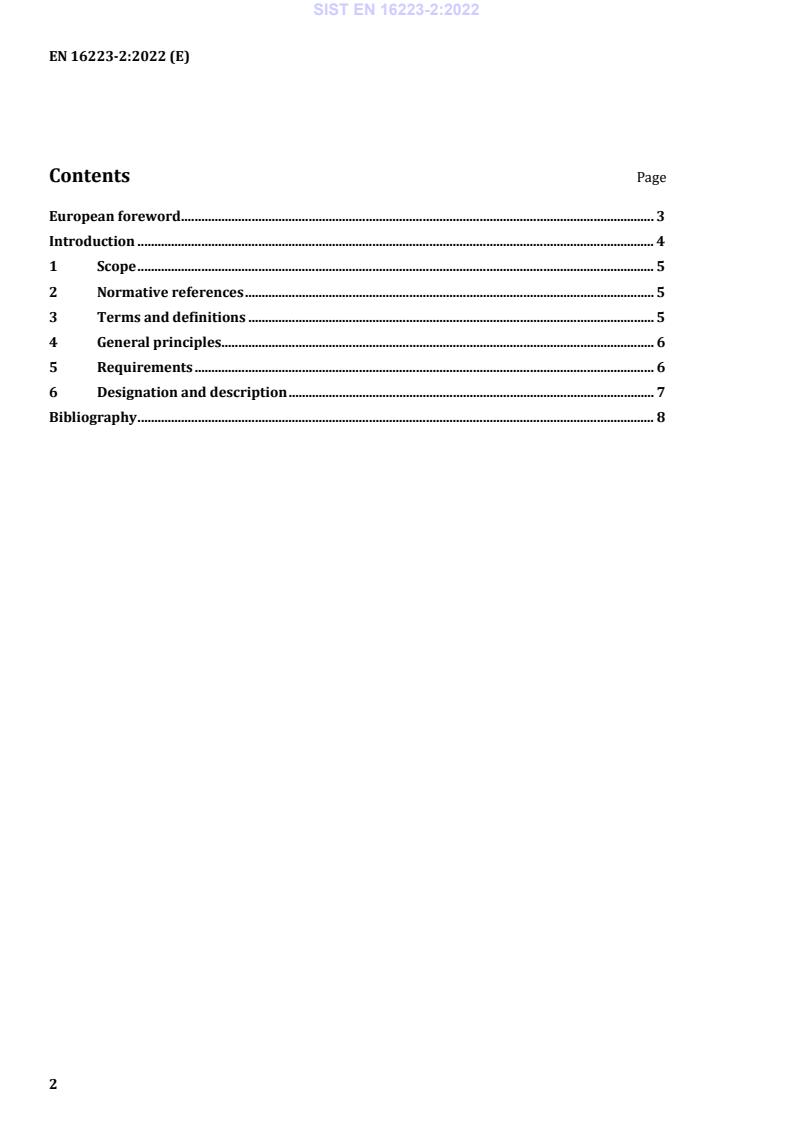
Contents Page
European foreword . 3
Introduction . 4
1 Scope . 5
2 Normative references . 5
3 Terms and definitions . 5
4 General principles . 6
5 Requirements . 6
6 Designation and description . 7
Bibliography . 8
European foreword
This document (EN 16223-2:2022) has been prepared by Technical Committee CEN/TC 289 “Leather”,
the secretariat of which is held by UNI.
This European Standard shall be given the status of a national standard, either by publication of an
identical text or by endorsement, at the latest by January 2023, and conflicting national standards shall
be withdrawn at the latest by January 2023.
Attention is drawn to the possibility that some of the elements of this document may be the subject of
patent rights. CEN shall not be held responsible for identifying any or all such patent rights.
EN 16223-1, supersedes EN 16223:2012.
This document, together with
In comparison with the previous edition, the following technical modifications have been made:
— EN 16223:2012, Leather - Requirements for the designation and description of leather in upholstery
and automotive interior applications has been split into two parts:
— Part 1 - Upholstery applications;
— Part 2 - Automotive interior application (this document).
— Modification in Clause 1 “Scope”, Clause 4 “General principles”, Clause 5 “Requirements” and
Clause 6 “Designation”.
— Editorial updates.
Any feedback and questions on this document should be directed to the users’ national standards body.
A complete listing of these bodies can be found on the CEN website.
According to the CEN-CENELEC Internal Regulations, the national standards organisations of the
following countries are bound to implement this European Standard: Austria, Belgium, Bulgaria, Croatia,
Cyprus, Czech Republic, Denmark, Estonia, Finland, France, Germany, Greece, Hungary, Iceland, Ireland,
Italy, Latvia, Lithuania, Luxembourg, Malta, Netherlands, Norway, Poland, Portugal, Republic of North
Macedonia, Romania, Serbia, Slovakia, Slovenia, Spain, Sweden, Switzerland, Turkey and the United
Kingdom.
Introduction
This document is based on the Code of Practice of the International Council of Tanners (ICT) – Code of
Practice on the appropriate designation of leather used in automotive applications (Hong Kong, 30 March
2009).
In the absen
...