

prEN 40000-10
(Main)Essential cybersecurity requirements for products - Part 10: Products with digital elements used in identity management systems and privileged access management software and hardware, including authentication and access control readers, including biometric readers
- Abstract
This project aims at covering the line 16 of the standardisation request and will provide:
• General description of the Product with digital elements belonging to that category and the product and/or components such Product with digital elements may integrate, including – amongst other:
o detailed description of that product category using in:
Identity management systems hardware and software are products with digital elements that provide mechanisms for identity lifecycle management, such as identity provisioning, maintenance, authentication, authorisation and deprovisioning, and including associated metadata.
Privileged access management hardware and software are products with digital elements that authenticate and authorise users or devices, granting or denying access to digital resources or to physical locations.
This category includes but is not limited to products (hardware, software and communication protocol) with digital elements that have the core functionality of either or both identity management and privileged access management; authentication and access control readers; biometric readers; single sign-on software; federated identity management software, protection and safety management (such as access control, intrusion alarm, CCTV and fire safety systems) and multi-factor authentication software.
o Intended product purpose and reasonably foreseeable use in the above categories;
o Identification of the various types of Products with digital elements;
o Delineation and interplay with the following other categories of Product with digital elements (identified by their line in the standardization request):
line 17
line 18
line 20
line 24
line 28
line 29
line 32
line 35
line 37
line 38
line 39
line 41
• Description of their life cycle;
• Relevance of cybersecurity essential requirements including the cybersecurity assessment requirements;
• Definition of applicable risk profiles to be considered for these Product with digital elements;
• Applicable cybersecurity requirements ensuring fulfillment of the essential requirements for each risk profile;
• Applicable cybersecurity assessment requirements for each risk profile.
A base document is provided
• Defining the risk profiles;
• Identifying initial cybersecurity security requirements.
- Status
- Not Published
- Publication Date
- 28-Mar-2027
- Drafting Committee
- CEN/TC 224/WG 17 - Protection Profiles in the context of SSCD
- Current Stage
- 4060 - Closure of enquiry - Enquiry
- Start Date
- 13-Aug-2026
- Due Date
- 23-Aug-2026
- Completion Date
- 13-Aug-2026

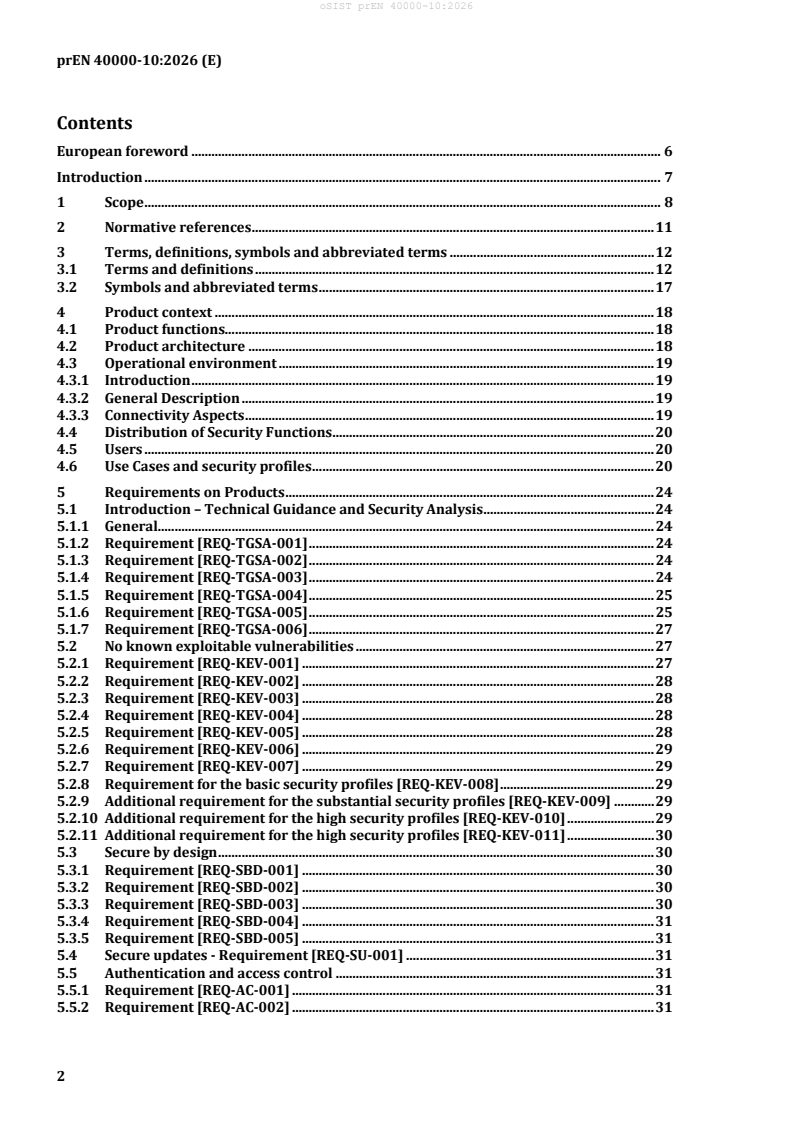
prEN 40000-10 is a draft European Standard from CEN on essential cybersecurity requirements for products with digital elements used in identity management systems and privileged access management software and hardware, including authentication and access control readers and biometric readers. It specifies the product context, security profiles, cybersecurity requirements and assessment rules for manufacturers, integrators, assessors and buyers who need to judge identity, authentication and access-control products.
What does prEN 40000-10 specify?
prEN 40000-10 specifies cybersecurity requirements and associated assessment requirements for products that provide identity management, authentication, authorization, access control or privileged access management. In practice, it is aimed at products whose primary or supporting function is to create, manage, verify, enforce or monitor identities and access rights for natural persons, legal persons, devices or systems.
The scope includes identity lifecycle functions such as registration, provisioning, maintenance, suspension, revocation and deletion, as well as access control functions for digital resources and physical locations. It also includes privileged access management for IT or OT systems and sensitive information, and it explicitly covers product types such as authentication and access control readers, biometric readers, single sign-on software, federated identity management software, one-time password software, hardware authentication devices, and multi-factor authentication software.
The document also names product families that are in scope when their main or supporting role relates to identity and access control, including identity wallets, EUDI Wallet, EU Business Wallet, crypto asset Wallet, digital travel credential, biometric databases, enrolment stations, access control systems, anti-intrusion systems, CCTV, fire safety systems and smart lock products.
Products outside the scope are other important and critical products covered by harmonised standards under the cited standardisation request, such as chip, Embedded OS, Applets, PKI products, cybersecurity products such as VPN and SIEM, and default-classified products such as anti-fire detector products.
| Annex | What it covers |
|---|---|
| C | General architecture and subsystems of a physical access control system (PACS) |
| D | General architecture and subsystems of an Identity Management System (IDMS) |
| F | Security problem definition, rationale, operating environment, assets, threats and security functions |
| G | Product interfaces |
| H | Product communication protocols |
| I | Attacks rating methodology |
| J | Proposed document structure for cryptographic specifications |
| K | Cryptography |
| R | Additional requirements and assessment provisions for remote data processing solutions (RDPS) |
What are the key requirements of prEN 40000-10?
prEN 40000-10 is built around a product-context approach: the manufacturer must describe the product, its architecture, its operational environment, who uses it, and the use cases and security profiles that apply. That matters because identity and access products behave very differently when they are used by a person, a legal person, a system or a physical object, and the document ties requirements to those situations.
Product context and use cases
Clause 4 defines the product functions, architecture, operational environment and distribution of security functions. It also defines user categories and maps representative use cases to security profiles. In practice, this means a vendor must state how the product is used, where security functions sit, and whether a scenario falls under a lower or higher security profile such as SP-2 or SP-3.
Security analysis and known vulnerabilities
Clause 5.1 requires technical guidance and security analysis based on intended purpose and reasonably foreseeable use. Clause 5.2 addresses no known exploitable vulnerabilities, with additional profile-based requirements. Annex I supports this by using an attack-potential method based on factors such as elapsed time, expertise, knowledge of the product, window of opportunity and equipment. For a reader, this means the product must be assessed not only for features, but also for how hard it would be to attack in the real deployment context.
Secure-by-design controls
Clause 5.3 groups the secure-by-design requirements, including controls on authentication and access control, integrity and confidentiality, data minimisation, availability protection, impact minimisation, attack-surface reduction, exploitation mitigation, logging and monitoring, and data removal and transparency. In practical terms, the product is expected to limit exposure, protect sensitive data, record relevant events, and reduce the damage caused if something goes wrong.
Secure updates and vulnerability handling
Clause 5.4 requires a secure update mechanism, including integrity checking and rollback. Clause 5.14 covers vulnerability handling. For operators, this means the product must support safe patching and a defined response to vulnerabilities without breaking the identity or access service.
Cryptography and cryptographic agility
Annex K covers state-of-the-art cryptography and crypto agility, while Annex J gives a structure for documenting key architecture, cryptographic dependencies and the link between security functions and cryptographic mechanisms. This is important because identity and access products often depend on cryptography for authentication, protected sessions, signing, credential handling and device trust.
Assessment and evidence
Clause 6 explains how conformity assessment is done against Clause 5 requirements. It uses Inspection, Analysis, Demonstration and Test (IADT) as the assessment methods, and it requires objective, repeatable evidence. Clause 6 also defines the evidence package around product characterisation, scope, risk and applicability, threat coverage, architecture, cryptography, software composition, test environment, configuration, preconditions, tools, guidance documents and execution evidence. That helps buyers and assessors compare products against the same evidence structure.
Remote data processing solutions
Annex R applies when one or more product functions rely on remote data processing solutions (RDPS). It treats the local product and the RDPS as a combined trust boundary, and it adds requirements for authentication, authorization, integrity, confidentiality, validation and availability across the product-RDPS interface. This matters for cloud-backed identity services and other products that delegate part of their function to remote services.
What terms does prEN 40000-10 define?
- Product with digital elements - A software or hardware product and its remote data processing solutions, including components placed on the market separately.
- Intended purpose - The use the manufacturer assigns to the product, including the conditions and context described in supplied information and technical documentation.
- Reasonably foreseeable use - A use that is not the intended purpose, but is likely to happen through normal human behaviour or technical interaction.
- Security profile - A set of security requirements chosen for a specific level of risk associated with a product with digital elements.
- Security analysis - The process used to understand a risk and determine its level.
- Attack potential - The effort needed to exploit a vulnerability in a product with digital elements.
- Remote data processing - Data processing performed at a distance, under the manufacturer’s design or responsibility, without which the product would not perform one of its functions.
- Use case - A typical usage scenario made from an environment, a user category and a product feature.
Who uses prEN 40000-10?
Manufacturers and developers use prEN 40000-10 to define the product boundary, document use cases, choose the right security profile and design secure identity or access functions. That includes suppliers of identity management systems, privileged access management software, authentication readers, biometric readers, wallets, access control systems and related hardware and software.
Security engineers, product assurance teams and conformity assessment bodies use it to plan and perform assessments, including interface testing, protocol review, attack-potential rating and evidence collection. The document is also relevant to integrators and operators who deploy products in corporate identity systems, physical access control, enrolment stations, building protection systems, border-control scenarios and other authentication or authorization environments.
Buyers, quality managers and procurement teams use it to check whether a product is designed for the intended deployment, whether it supports secure updates, logging, vulnerability handling and cryptography, and whether the supplier has documented the right interfaces, protocols and assessment evidence.
Which standards are used with prEN 40000-10?
- prEN 40000-1-3:2025 - The normative reference for vulnerability handling.
- EN ISO/IEC 15408 series and EN ISO/IEC 18045:2023 - Used in Annex I as the basis for the attack-potential and AVA_VAN methodology.
- EN ISO/IEC 27005:2024 and EN ISO/IEC 27000:2020 - Cited in the defined terms for risk, security analysis and the core security properties of confidentiality, integrity and availability.
What does the prEN 40000-10 document contain?
Clause 4 contains product context material, including product functions, architecture, operational environment, users and use cases. Clause 5 contains the normative cybersecurity requirements, grouped from technical guidance and known vulnerabilities through secure design, updates, access control, confidentiality, data minimisation, logging, transparency and vulnerability handling.
Clause 6 sets out the conformity assessment method and the evidence structure. It uses tables for assessment preparation and evidence tags, and it explains how IADT is applied to requirements in Clause 5. Annex C and Annex D describe the typical architectures of PACS and IDMS, while Annex F frames the security problem, assets, threats and security functions.
Annex G gives representative product interfaces, and Annex H gives representative communication protocols, both tied to conformity requirements. Annex I provides the attack-rating method and its scoring factors. Annex J gives a suggested structure for cryptographic specifications, Annex K covers cryptography requirements, and Annex R adds a full additional framework for products that depend on remote data processing solutions.
Get Certified
Connect with accredited certification bodies for this standard

BSI Group
BSI (British Standards Institution) is the business standards company that helps organizations make excellence a habit.

Bureau Veritas
Bureau Veritas is a world leader in laboratory testing, inspection and certification services.

DNV
DNV is an independent assurance and risk management provider.
Sponsored listings
Frequently Asked Questions
prEN 40000-10 is a draft published by the European Committee for Standardization (CEN). Its full title is "Essential cybersecurity requirements for products - Part 10: Products with digital elements used in identity management systems and privileged access management software and hardware, including authentication and access control readers, including biometric readers". This standard covers: This project aims at covering the line 16 of the standardisation request and will provide: • General description of the Product with digital elements belonging to that category and the product and/or components such Product with digital elements may integrate, including – amongst other: o detailed description of that product category using in: Identity management systems hardware and software are products with digital elements that provide mechanisms for identity lifecycle management, such as identity provisioning, maintenance, authentication, authorisation and deprovisioning, and including associated metadata. Privileged access management hardware and software are products with digital elements that authenticate and authorise users or devices, granting or denying access to digital resources or to physical locations. This category includes but is not limited to products (hardware, software and communication protocol) with digital elements that have the core functionality of either or both identity management and privileged access management; authentication and access control readers; biometric readers; single sign-on software; federated identity management software, protection and safety management (such as access control, intrusion alarm, CCTV and fire safety systems) and multi-factor authentication software. o Intended product purpose and reasonably foreseeable use in the above categories; o Identification of the various types of Products with digital elements; o Delineation and interplay with the following other categories of Product with digital elements (identified by their line in the standardization request): line 17 line 18 line 20 line 24 line 28 line 29 line 32 line 35 line 37 line 38 line 39 line 41 • Description of their life cycle; • Relevance of cybersecurity essential requirements including the cybersecurity assessment requirements; • Definition of applicable risk profiles to be considered for these Product with digital elements; • Applicable cybersecurity requirements ensuring fulfillment of the essential requirements for each risk profile; • Applicable cybersecurity assessment requirements for each risk profile. A base document is provided • Defining the risk profiles; • Identifying initial cybersecurity security requirements.
This project aims at covering the line 16 of the standardisation request and will provide: • General description of the Product with digital elements belonging to that category and the product and/or components such Product with digital elements may integrate, including – amongst other: o detailed description of that product category using in: Identity management systems hardware and software are products with digital elements that provide mechanisms for identity lifecycle management, such as identity provisioning, maintenance, authentication, authorisation and deprovisioning, and including associated metadata. Privileged access management hardware and software are products with digital elements that authenticate and authorise users or devices, granting or denying access to digital resources or to physical locations. This category includes but is not limited to products (hardware, software and communication protocol) with digital elements that have the core functionality of either or both identity management and privileged access management; authentication and access control readers; biometric readers; single sign-on software; federated identity management software, protection and safety management (such as access control, intrusion alarm, CCTV and fire safety systems) and multi-factor authentication software. o Intended product purpose and reasonably foreseeable use in the above categories; o Identification of the various types of Products with digital elements; o Delineation and interplay with the following other categories of Product with digital elements (identified by their line in the standardization request): line 17 line 18 line 20 line 24 line 28 line 29 line 32 line 35 line 37 line 38 line 39 line 41 • Description of their life cycle; • Relevance of cybersecurity essential requirements including the cybersecurity assessment requirements; • Definition of applicable risk profiles to be considered for these Product with digital elements; • Applicable cybersecurity requirements ensuring fulfillment of the essential requirements for each risk profile; • Applicable cybersecurity assessment requirements for each risk profile. A base document is provided • Defining the risk profiles; • Identifying initial cybersecurity security requirements.
prEN 40000-10 is classified under the following ICS (International Classification for Standards) categories: 35.030 - IT Security; 35.240.15 - Identification cards. Chip cards. Biometrics. The ICS classification helps identify the subject area and facilitates finding related standards.
prEN 40000-10 is associated with the following European legislation: EU Directives/Regulations: 2024/2847; Standardization Mandates: M/606. When a standard is cited in the Official Journal of the European Union, products manufactured in conformity with it benefit from a presumption of conformity with the essential requirements of the corresponding EU directive or regulation.
prEN 40000-10 is available in PDF format for immediate download after purchase. The document can be added to your cart and obtained through the secure checkout process. Digital delivery ensures instant access to the complete standard document.
Standards Content (Sample)
SLOVENSKI STANDARD
01-julij-2026
Bistvene zahteve kibernetske varnosti za izdelke - 10. del: Izdelki z digitalnimi
elementi, ki se uporabljajo v sistemih upravljanja identitete in programski ter
strojni opremi za vodenje privilegiranega dostopa, vključno z bralniki za
preverjanje pristnosti in nadzor dostopa, vključno z biometričnimi bralniki
Essential cybersecurity requirements for products - Part 10: Products with digital
elements used in identity management systems and privileged access management
software and hardware, including authentication and access control readers, including
biometric readers
Grundlegende Anforderungen an die Cybersicherheit für Produkte mit digitalen
Elementen, die in Identitätsmanagementsystemen und Software und Hardware für die
Verwaltung des privilegierten Zugangs verwendet werden, einschließlich
Authentifizierungs- und Zugangskontrollleser, einschließlich biometrischer Leser
Ta slovenski standard je istoveten z: prEN 40000-10
ICS:
35.030 Informacijska varnost IT Security
35.240.15 Identifikacijske kartice. Čipne Identification cards. Chip
kartice. Biometrija cards. Biometrics
2003-01.Slovenski inštitut za standardizacijo. Razmnoževanje celote ali delov tega standarda ni dovoljeno.
DRAFT
EUROPEAN STANDARD
NORME EUROPÉENNE
EUROPÄISCHE NORM
May 2026
ICS 35.030; 35.240.15
English Version
Essential cybersecurity requirements for products - Part
10: Products with digital elements used in identity
management systems and privileged access management
software and hardware, including authentication and
access control readers, including biometric readers
Grundlegende Anforderungen an die Cybersicherheit
für Produkte mit digitalen Elementen, die in
Identitätsmanagementsystemen und Software und
Hardware für die Verwaltung des privilegierten
Zugangs verwendet werden, einschließlich
Authentifizierungs- und Zugangskontrollleser,
einschließlich biometrischer Leser
This draft European Standard is submitted to CEN members for enquiry. It has been drawn up by the Technical Committee
CEN/TC 224.
If this draft becomes a European Standard, CEN members are bound to comply with the CEN/CENELEC Internal Regulations
which stipulate the conditions for giving this European Standard the status of a national standard without any alteration.
This draft European Standard was established by CEN in three official versions (English, French, German). A version in any other
language made by translation under the responsibility of a CEN member into its own language and notified to the CEN-CENELEC
Management Centre has the same status as the official versions.
CEN members are the national standards bodies of Austria, Belgium, Bulgaria, Croatia, Cyprus, Czech Republic, Denmark, Estonia,
Finland, France, Germany, Greece, Hungary, Iceland, Ireland, Italy, Latvia, Lithuania, Luxembourg, Malta, Netherlands, Norway,
Poland, Portugal, Republic of North Macedonia, Romania, Serbia, Slovakia, Slovenia, Spain, Sweden, Switzerland, Türkiye and
United Kingdom.
Recipients of this draft are invited to submit, with their comments, notification of any relevant patent rights of which they are
aware and to provide supporting documentation.
Warning : This document is not a European Standard. It is distributed for review and comments. It is subject to change without
notice and shall not be referred to as a European Standard.
EUROPEAN COMMITTEE FOR STANDARDIZATION
COMITÉ EUROPÉEN DE NORMALISATION
EUROPÄISCHES KOMITEE FÜR NORMUNG
CEN-CENELEC Management Centre: Rue de la Science 23, B-1040 Brussels
© 2026 CEN All rights of exploitation in any form and by any means reserved Ref. No. prEN 40000-10:2026 E
worldwide for CEN national Members.
Contents
European foreword . 6
Introduction . 7
1 Scope . 8
2 Normative references . 11
3 Terms, definitions, symbols and abbreviated terms . 12
3.1 Terms and definitions . 12
3.2 Symbols and abbreviated terms . 17
4 Product context . 18
4.1 Product functions. 18
4.2 Product architecture . 18
4.3 Operational environment . 19
4.3.1 Introduction . 19
4.3.2 General Description . 19
4.3.3 Connectivity Aspects . 19
4.4 Distribution of Security Functions . 20
4.5 Users . 20
4.6 Use Cases and security profiles . 20
5 Requirements on Products . 24
5.1 Introduction – Technical Guidance and Security Analysis . 24
5.1.1 General. 24
5.1.2 Requirement [REQ-TGSA-001] . 24
5.1.3 Requirement [REQ-TGSA-002] . 24
5.1.4 Requirement [REQ-TGSA-003] . 24
5.1.5 Requirement [REQ-TGSA-004] . 25
5.1.6 Requirement [REQ-TGSA-005] . 25
5.1.7 Requirement [REQ-TGSA-006] . 27
5.2 No known exploitable vulnerabilities . 27
5.2.1 Requirement [REQ-KEV-001] . 27
5.2.2 Requirement [REQ-KEV-002] . 28
5.2.3 Requirement [REQ-KEV-003] . 28
5.2.4 Requirement [REQ-KEV-004] . 28
5.2.5 Requirement [REQ-KEV-005] . 28
5.2.6 Requirement [REQ-KEV-006] . 29
5.2.7 Requirement [REQ-KEV-007] . 29
5.2.8 Requirement for the basic security profiles [REQ-KEV-008] . 29
5.2.9 Additional requirement for the substantial security profiles [REQ-KEV-009] . 29
5.2.10 Additional requirement for the high security profiles [REQ-KEV-010] . 29
5.2.11 Additional requirement for the high security profiles [REQ-KEV-011] . 30
5.3 Secure by design . 30
5.3.1 Requirement [REQ-SBD-001] . 30
5.3.2 Requirement [REQ-SBD-002] . 30
5.3.3 Requirement [REQ-SBD-003] . 30
5.3.4 Requirement [REQ-SBD-004] . 31
5.3.5 Requirement [REQ-SBD-005] . 31
5.4 Secure updates - Requirement [REQ-SU-001] . 31
5.5 Authentication and access control . 31
5.5.1 Requirement [REQ-AC-001] . 31
5.5.2 Requirement [REQ-AC-002] . 31
5.6 Integrity and Confidentiality . 32
5.6.1 Requirement [REQ-CON-001] . 32
5.6.2 Requirement [REQ-CON-002] . 32
5.6.3 Requirement [REQ-CON-003] . 32
5.7 Data minimisation . 32
5.7.1 Requirement [REQ-DM-001] . 32
5.7.2 Requirement [REQ-DM-002] . 33
5.7.3 Requirement [REQ-DM-003] . 33
5.8 Availability protection . 33
5.8.1 Requirement [REQ-AP-001] . 33
5.8.2 Requirement [REQ-AP-002] . 33
5.8.3 Requirement [REQ-AP-003] . 33
5.9 Impact minimisation . 34
5.9.1 Requirement [REQ-IM-001] . 34
5.9.2 Requirement [REQ-IM-002] . 34
5.10 Minimisation of attack surfaces . 34
5.10.1 Requirement [REQ-MAS-001] . 34
5.10.2 Requirement [REQ-MAS-002] . 34
5.10.3 Requirement [REQ-MAS-003] . 35
5.10.4 Requirement [REQ-MAS-004] . 35
5.10.5 Requirement [REQ-MAS-005] . 35
5.11 Exploitation mitigation mechanisms. 35
5.11.1 Requirement [REQ-EMM-001] . 35
5.11.2 Requirement [REQ-EMM-002] . 35
5.12 Logging and monitoring . 36
5.12.1 Requirement [REQ-LOG-001] . 36
5.12.2 Requirement [REQ-LOG-002] . 36
5.13 Data removal and transparency . 36
5.13.1 Requirement [REQ-DRT-001]. 36
5.13.2 Requirement [REQ-DRT-002]. 36
5.13.3 Requirement [REQ-DRT-003]. 37
5.13.4 Requirement [REQ-DRT-004]. 37
5.14 Vulnerability handling . 37
5.14.1 Requirement [REQ-VH-001] . 37
5.14.2 Requirement [REQ-VH-002] . 37
5.14.3 Requirement [REQ-VH-003] . 38
5.14.4 Requirement [REQ-VH-004] . 38
5.14.5 Requirement [REQ-VH-005] . 38
5.14.6 Requirement [REQ-VH-006] . 38
5.14.7 Requirement [REQ-VH-007] . 38
6 Conformity assessment against the normative requirements . 40
6.1 Introduction . 40
6.2 Conformity assessment against the normative requirements . 43
6.2.1 Technical Guidance Requirements (5.1) . 43
6.2.2 Security Analysis and Security Profile Level Requirements (5.2) . 52
6.2.3 Secure-by-Design Requirements (5.3) . 56
6.2.4 Cybersecurity Analysis Requirements (5.4) . 71
6.2.5 Vulnerability Management Requirements (5.5) . 75
6.2.6 Security Profile Requirements (5.6) . 81
Annex A (informative) Hardware products . 84
Annex B (informative) Software products . 87
Annex C (informative) Physical access control system . 90
C.1 General architecture of a PACS . 90
C.2 Detailed description of subsystems containing products . 90
C.2.1 Opening and locking devices including on/off-line connected locks . 90
C.2.2 Reading modules . 90
C.2.3 Local processing unit . 91
C.2.4 Door and I/O modules . 91
C.2.5 Centralized access management . 91
C.2.6 User interfaces . 92
Annex D (informative) Identity management system . 93
D.1 General architecture of an IDMS . 93
D.2 Detailed description of subsystems containing Products . 93
D.2.1 Identity repositories and directory services . 93
D.2.2 Identity enrolment and provisioning components . 93
D.2.3 Authentication services . 94
D.2.4 Authorization and policy management services . 94
D.2.5 Governance, audit, and compliance components . 94
D.2.6 User interfaces and self-service tools . 94
Annex E (normative) Threat levels and severity levels of the security analysis. 95
Annex F (informative) Security problem definition . 97
F.1 Synthesis . 97
F.2 Rationale . 97
F.3 Description of the technical operating environment . 97
F.4 Assets to be protected . 97
F.5 Threats . 97
F.6 Security functions . 97
F.7 Threats coverage . 97
Annex G (normative) Product interfaces . 98
Annex H (informative) Product communication protocols . 101
Annex I (normative) Attacks rating methodology . 102
Annex J (informative) Cryptographic specifications proposed document structure . 105
J.1 General description of the product . 105
J.2 Keys architecture . 105
J.3 List of the cryptographic dependencies . 105
J.4 Mapping between the security functions and the cryptographic mechanisms . 105
J.5 Detail of the cryptographic mechanisms . 105
Annex K (normative) Cryptography . 106
K.1 State of the Art Cryptography (CRY-SOTA) . 106
K.1.1 Requirement . 106
K.1.2 Assessment criteria . 106
K.2 Crypto agility . 108
K.2.1 Requirement . 108
K.2.2 Assessment criteria . 109
Annex L (normative) Risk registry . 111
Annex R (normative) Additional provisions for products relying on remote data processing
solutions (RDPS) . 124
R.1 Scope & Applicability . 124
R.2 RDPS as a product-boundary extension . 124
R.X Standard-specific identification of RDPS-dependent functions, RDPS interface(s), and
RDPS . 125
R.X.1 RDPS-dependent product functions . 125
R.X.2 RDPS interface(s) . 125
R.X.3 RDPS(s) . 125
R.3 Threat Model . 126
R.3.1 General . 126
R.3.2 Assets . 126
R.3.3 Threat catalogue . 126
R.3.4 Assets ↔ Threats mapping . 128
R.4 Security Requirements . 128
R.4.1 General . 128
R.4.2 Local product side requirements . 129
R.4.3 RDPS side requirements . 133
R.4.4 Threats ↔ Requirements mapping. 137
R.4.5 Mapping of CRA Annex I to Annex R requirements . 138
R.5 Security controls and mitigation guidance for RDPS requirements (informative) . 141
R.5.1 General . 141
R.5.2 Controls catalogue for REQ-RDPS-L-001 . 141
R.5.3 Controls catalogue for REQ-RDPS-L-002 . 141
R.6 Conformity assessment . 141
R.6.1 General . 142
R.6.2 Conformity assessment for REQ-RDPS-L-001 . 142
R.6.3 Conformity assessment for REQ-RDPS-R-001 . 143
R.6.4 Conformity assessment for REQ-RDPS-R-004 . 144
Annex ZA (informative) Relationship between this European Standard and the essential
requirements of Regulation (EU) 2024/2847 (CRA) aimed to be covered . 147
Bibliography . 149
European foreword
This document (prEN 40000-10:2026) has been prepared by Technical Committee CEN/TC 224
“Personal identification and related personal devices with secure element, systems, operations and
privacy in a multi sectorial environment”, the secretariat of which is held by AFNOR.
This document is currently submitted to the CEN Enquiry.
This document has been prepared under a standardisation request addressed to CEN by the European
Commission. The Standing Committee of the EFTA States subsequently approves these requests for its
Member States.
For the relationship with EU Legislation, see informative Annex ZA, which is an integral part of this
document.
Introduction
This document has been prepared in response to a standardisation request issued by the European
Commission in support of the implementation of Regulation (EU) 2024/2847 (Cyber Resilience Act, CRA).
The Cyber Resilience Act establishes horizontal cybersecurity requirements for products, including
requirements for the design, development and production of such products, as well as obligations for
economic operators throughout the lifecycle of those products. In particular, it lays down essential
cybersecurity requirements and conformity assessment procedures to ensure a high level of
cybersecurity within the Union.
This document specifies cybersecurity requirements and associated assessment provisions for identity
management systems that qualify as products and are classified as important products (Class 1) in
accordance with Commission Implementing Regulation (EU) 2025/2392.
The purpose of this document is to support manufacturers, conformity assessment bodies and other
relevant stakeholders in demonstrating conformity with the essential cybersecurity requirements set out
in Annex I of the Cyber Resilience Act for the category of products covered by its scope.
This document follows a risk-based approach, taking into account the specific characteristics, intended
use, and threat landscape applicable to identity management systems, including authentication,
authorisation, identity lifecycle management and access control functionalities. It defines relevant risk
profiles and maps them to corresponding cybersecurity requirements and assessment methods.
1 Scope
This document specifies cybersecurity requirements and associated assessment requirements for
identity management systems that qualify as products within the meaning of Regulation (EU) 2024/2847.
Such products are classified as important products (class 1) according to the implementing regulation
Commission Implementing Regulation (EU) 2025/2392.
Identity management systems are products that provide mechanisms for authentication or authorisation
and that may also provide mechanisms for the lifecycle management of identity credentials of natural
persons, legal persons, devices or systems, such as identity registration, provisioning, maintenance,
deregistration.
These systems include access management systems that control access of natural persons, legal persons,
devices or systems to digital resources or physical locations.
Privileged access management software is an access management system that controls and monitors
access rights to IT or OT systems and sensitive information within an organisation, including systems
enforcing differentiated access control policies for privileged users.
This category includes but is not limited to authentication and access control readers, biometric readers,
single sign-on software, federated identity management software, one-time password software,
hardware authentication devices such as transaction authentication number (TAN) generators,
authentication software and multi-factor authentication software.
This document covers:
• general description of the product belonging to that category and the product and/or components
such product with digital elements;
• description of their use case;
• security analysis;
• definition of applicable risk profiles to be considered for these product with digital elements;
• applicable cybersecurity requirements for each risk profile;
• applicable cybersecurity assessment and test requirements for each risk profile.
Products within the scope of this document:
The following non-exhaustive categories of products are within the scope of this document where their
primary or supporting function relates to identity management, authentication, authorisation, or logical
and physical access control to natural persons, legal persons, devices or systems.
Logical and Physical Identity lifecycle management
Products for:
• identity registration and enrolment;
• credential issuance, provisioning and activation;
• credential maintenance, suspension, revocation and deletion;
• identity wallets and digital credential containers;
• EUDI Wallet, EU Business Wallet;
• crypto asset Wallet;
• digital travel credential;
• middleware enabling the use, validation or verification of identity credentials;
• national or sectorial identity registries implemented as products;
• biometric databases;
• enrolment stations;
• digital transaction control components;
• mobile driving license;
• electronic identification products, including systems supporting digital product passport.
Logical and Physical Authentication
Products for:
• authentication software;
• multi-factor authentication (MFA) systems;
• two-factor authentication (2FA) systems;
• one-time password (OTP) software and hardware tokens;
• online authentication tokens;
• hardware authentication devices;
• single sign-on (SSO) systems;
• federated identity management systems;
• authentication and access control readers;
• biometric readers;
• presentation attack detection (PAD) software;
• identity attack detection (IAD) software;
• biometric matching software;
• automatic border control product;
• entry/exist product;
• ESTIA application.
Logical and Physical Biometric identity management
Products for:
• capture biometric data for enrolment purposes;
• perform biometric verification or identification;
• biometric matching;
• remote data processing system of biometric reference data;
• incorporate artificial intelligence components for biometric recognition, verification,
identification or fraud detection.
Logical and Physical Access management
Products for:
• logical access control systems;
• physical access control systems;
• access control readers and local control units;
• access control supervision and monitoring software;
• access management supervision systems;
• anti-intrusion systems;
• CCTV;
• smart lock.
Logical and Physical Privileged access management
• control and monitor access rights of privileged users;
• enforce differentiated access control policies;
• manage privileged credentials;
• monitor, record and audit privileged sessions;
• protect access to critical IT or OT systems and sensitive information.
Product not in the scope of this document:
All other important and critical products that are covered by harmonised standards as per the
standardisation request Mandate M/606 2025-02-03 such as:
• chip, Embedded OS, Applets;
• PKI products;
• cyber security products needed for securing IT infrastructures (VPN, SIEM….);
• all products that are classified as default such as the anti-fire detectors products.
2 Normative references
The following documents are referred to in the text in such a way that some or all of their content
constitutes requirements of this document. For dated references, only the edition cited applies. For
undated references, the latest edition of the referenced document (including any amendments) applies.
prEN 40000-1-3:2025, Cybersecurity requirements for products with digital elements - Part 1-3:
Vulnerability Handling
3 Terms, definitions, symbols and abbreviated terms
3.1 Terms and definitions
For the purposes of this document, the following terms and definitions apply.
ISO and IEC maintain terminology databases for use in standardisation at the following addresses:
— ISO Online browsing platform: available at https://www.iso.org/obp/
— IEC Electropedia: available at https://www.electropedia.org/
3.1.1
asset
anything that has value to an individual, an organization or a government
[SOURCE: ISO/IEC 27035-3:2020, 3.1]
3.1.2
authenticity
property that an entity is what it claims to be
[SOURCE: EN ISO/IEC 27000:2020, 3.6]
3.1.3
availability
property of being accessible and usable on demand by an authorized entity
[SOURCE: EN ISO/IEC 27000:2020, 3.7]
3.1.4
confidentiality
property that information is not made available or disclosed to unauthorized individuals, entities, or
processes
[SOURCE: EN ISO/IEC 27000:2020, 3.10]
3.1.5
integrity
property of accuracy and completeness
[SOURCE: EN ISO/IEC 27000:2020, 3.36]
3.1.6
likelihood
chance of something happening
Note 1 to entry: In risk management terminology, the word “likelihood” is used to refer to the chance of something
happening, whether defined, measured or determined objectively or subjectively, qualitatively or quantitatively,
and described using general terms or mathematically (such as a probability or a frequency over a given time
period).
Note 2 to entry: The English term “likelihood” does not have a direct equivalent in some languages; instead, the
equivalent of the term “probability” is often used. However, in English, “probability” is often narrowly interpreted
as a mathematical term. Therefore, in risk management terminology, “likelihood” is used with the intent that it
should have the same broad interpretation as the term “probability” has in many languages other than English.
[SOURCE: ISO 31000:2018, 3.7]
3.1.7
remediation
change made to a product or service to remove or mitigate a vulnerability
Note 1 to entry: A remediation typically takes the form of a binary file replacement, configuration change, or
source code patch and recompile. Different terms used for “remediation” include patch, fix, update, hotfix, and
upgrade. Mitigations are also called workarounds or countermeasures.
[SOURCE: EN ISO/IEC 29147:2020, 3.7]
3.1.8
residual risk
cybersecurity risk remaining after risk treatment
[SOURCE: EN ISO/IEC 27000:2020, 3.57]
3.1.9
product with digital elements
(hereinafter called “product”)
software or hardware product and its remote data processing solutions, including software or
hardware components being placed on the market separately
[SOURCE: CRA, Article 3(1)]
3.1.10
hardware
physical electronic information system, or parts thereof capable of processing, storing or transmitting
digital data
[SOURCE: CRA, Article 3(5)]
3.1.11
software
part of an electronic information system which consists of computer code
[SOURCE: CRA, Article 3(4)]
3.1.12
intended purpose
use for which a product with digital elements is intended by the manufacturer, including the specific
context and conditions of use, as specified in the information supplied by the manufacturer in the
instructions for use, promotional or sales materials and statements, as well as in the technical
documentation
[SOURCE: CRA, Article 3(23)]
3.1.13
embedded software
software product with digital elements loaded in a hardware Product with digital element, and in which
it is executed
Note 1 to entry: an embedded software is a sub part of a hardware Product with digital elements
3.1.14
hardware product with digital elements
product with digital elements that have the shape of a hardware
Note 1 to entry: hardware Product with digital elements are tangible
Note 2 to entry: a hardware Product with digital element can be the environment on which a software Product
with digital element is executed and optionally loaded.
3.1.15
software product with digital elements
sequence or set of instructions in a programming language which can be executed on a hardware
and/or a software environment
Note 1 to entry: Software product with digital elements are intangible.
Note 2 to entry: A set of data is not a software product with digital elements.
Note 3 to entry: The hardware environment is a hardware product with digital elements, and the software
environment is a software product with digital elements.
Note 4 to entry: A software product with digital elements is not necessarily loaded in the hardware or software
environment on which it is executed.
Note 5 to entry: A software product with digital elements loaded in a hardware product with digital elements and
in which it is executed is an embedded software. The combination of both is another hardware product with
digital elements and is thus tangible
3.1.16
electronic information system
system including electrical or electronic equipment, capable of processing, storing or transmitting
digital data
[SOURCE: CRA, Article 3(7)]
3.1.17
risk assessment
overall process of risk identification, risk analysis and risk evaluation
[SOURCE: ISO 31073:2022, 3.3.8]
3.1.18
security analysis
process used to understand the nature of a risk and to determine the level of risk
[SOURCE: EN ISO/IEC 27005:2024, 3.2.5]
3.1.19
security profile
set of security requirements defined to address a specific level of risk associated with a product with
digital elements
3.1.20
use case
combination of an environment, a user category and a product feature, used to describe a typical usage
scenario.
3.1.21
categorisation
process of assigning a product with digital elements to a defined category, hardware or software based
on its primary characteristics and intended function
3.1.22
requirement
need or expectation that is stated, generally implied or obligatory
Note 1 to entry: “Generally implied” means that it is custom or common practice for the organization and
interested parties that the need or expectation under consideration is implied.
[SOURCE: ISO 24518:2015, 3.1.3]
3.1.23
cybersecurity risk
potential for loss or disruption caused by an incident and is to be expressed as a combination of the
magnitude of such loss or disruption and the likelihood of occurrence of the incident
[SOURCE: CRA, Article 3(37)]
3.1.24
significant cybersecurity risk
cybersecurity risk which, based on its technical characteristics, can be assumed to have a high
likelihood of an incident that could lead to a severe negative impact, including by causing considerable
material or non-material loss or disruption
[SOURCE: CRA, Article 3(38)]
3.1.25
attack potential
measure of the effort needed to exploit a vulnerability in a Product with digital elements
Note 1 to entry: The attack potential usually decreases over time, as expertise, knowledge and capabilities of
attacker willing to exploit that vulnerability increases.
[SOURCE: EN ISO/IEC
...