


EN 15051-3:2013
(Main)Workplace exposure - Measurement of the dustiness of bulk materials - Part 3: Continuous drop method
Workplace exposure - Measurement of the dustiness of bulk materials - Part 3: Continuous drop method
This European Standard specifies the continuous drop test apparatus and associated test method for the reproducible production of dust from a bulk material under standard conditions, and the measurement of the inhalable and respirable fractions of this dust, with reference to existing European Standards, where relevant (see Clause 6).
The continuous drop method intends to simulate dust generation processes where there are continuous falling operations (conveying, discharging, filling, refilling, weighing, sacking, metering, loading, unloading etc.) and where dust is liberated by winnowing during falling. It can be modified to measure the thoracic fraction as well, but this modification is not described in this European Standard. It differs from the rotating drum method presented in EN 15051 2 in that in this European Standard, the bulk material is dropped only once, but continuously, while in EN 15051 2, the same bulk material is repeatedly dropped.
Furthermore, this European Standard specifies the environmental conditions, the sample handling and analytical procedures and the method of calculating and presenting the results. A classification scheme for dustiness is specified, to provide a standardised way to express and communicate the results to users of the bulk materials.
This European Standard is applicable to powdered, granular or pelletised bulk materials.
This European Standard is not applicable to test the dust released when solid bulk materials are mechanically treated (e.g. cut, crushed) or to evaluate handling procedures for the bulk materials.
Exposition am Arbeitsplatz - Messung des Staubungsverhaltens von Schüttgütern - Teil 3: Verfahren mit kontinuierlichem Fall
Diese Europäische Norm legt das Prüfverfahren mit kontinuierlichem Fall sowie die entsprechende Prüfeinrichtung fest, die bei der reproduzierbaren Erzeugung von Staub aus einem Schüttgut unter Normbedingungen angewendet wird; außerdem wird die Messung der einatembaren und alveolengängigen Fraktionen dieses Staubs festgelegt, gegebenenfalls unter Verweisung auf bestehende Europäische Normen (siehe Abschnitt 6).
Das Verfahren mit kontinuierlichem Fall zielt darauf ab, Stauberzeugungsprozesse zu simulieren, die bei Arbeitsschritten mit kontinuierlichem Fall entstehen (Fördern, Ablassen, Füllen, Nachfüllen, Wägen, Füllen in Säcke, Dosieren, Beladen, Entladen usw.) und bei denen Staub beim Fallen durch Windsichtung freigesetzt wird. Das Verfahren kann dahingehend abgeändert werden, dass auch die thorakale Fraktion gemessen wird, wobei dieses modifizierte Verfahren jedoch in dieser Europäischen Norm nicht beschrieben ist. Von dem in EN 15051 2 vorgestellten Verfahren mit rotierender Trommel unterscheidet sich das in dieser Europäischen Norm beschriebene Verfahren dadurch, dass das Schüttgut nur einmal, jedoch kontinuierlich fällt, während in EN 15051 2 dasselbe Schüttgut wiederholt fällt.
Ferner legt diese Europäische Norm die Umgebungsbedingungen, den Umgang mit den Proben und die Analyseverfahren sowie die Verfahren zur Berechnung und Darstellung der Ergebnisse fest Um eine genormte Grundlage für die Angabe und Weiterleitung der Ergebnisse an die Anwender von Schüttgütern zu schaffen, wird ein Klassifikationssystem für das Staubungsverhalten festgelegt.
Diese Europäische Norm gilt für pulverförmige, granulierte oder pelletierte Schüttgüter.
Diese Europäische Norm gilt weder für die Prüfung von Staub, der bei der mechanischen Behandlung fester Schüttgüter (z. B. beim Schneiden, Brechen) freigesetzt wird, noch für die Bewertung der Handhabungsverfahren von Schüttgütern.
Exposition sur les lieux de travail - Mesure du pouvoir de resuspension des matériaux pulvérulents en vrac - Partie 3: Méthode de la chute continue
La présente Norme européenne spécifie l’appareillage d’essai de chute continue et la méthode d’essai associée à utiliser pour produire des poussières de manière reproductible, à l’aide de matériaux en vrac, dans des conditions normalisées, en vue de mesurer les fractions inhalable et alvéolaire de ces poussières, en référence aux Normes européennes existantes, s’il y a lieu (voir Article 6).
La méthode de la chute continue vise à simuler les processus de génération de poussières dans le cas d’opérations impliquant une chute continue (convoyage, déchargement, remplissage, pesée, ensachage, mesurage, chargement, déchargement, etc.) et lorsque des poussières sont libérées par le vannage lors de la chute. Elle peut être modifiée pour mesurer également la fraction thoracique, mais cette modification n’est pas décrite dans la présente Norme européenne. Elle se différencie de la méthode du tambour rotatif présentée dans l’EN 15051-2 en ce que dans la présente Norme européenne, le matériau en vrac tombe en une seule fois, mais en continu, alors que dans l’EN 15051-2, le même matériau en vrac tombe de manière répétée.
La présente Norme européenne spécifie également les conditions ambiantes, les procédures de manipulation et d'analyse des échantillons ainsi que la méthode de calcul et d'expression des résultats. Un principe de classification du pouvoir de resuspension est également spécifié afin de normaliser le mode d'expression et de communication des résultats aux utilisateurs de matériaux en vrac.
La présente Norme européenne s’applique aux matériaux en vrac granulaires, en poudre ou sous forme de pastilles.
La présente Norme européenne ne s’applique pas à la détermination de l’empoussièrement dû au traitement mécanique (par exemple, découpe, concassage) de matériaux solides en vrac ni à l’évaluation des procédures de manipulation des matériaux.
Izpostavljenost na delovnem mestu - Meritve prašnosti razsutih materialov - 3. del: Metoda trajnega padanja
Ta evropski standard določa preskus trajnega padanja in povezane preskusne metode za ponovljivo pridobitev prahu iz razsutih materialov v standardnih pogojih in merjenje vdihljivih in respiratornih deležev prahu z upoštevanjem obstoječih evropskih standardov, kjer je ustrezno. Namen metode trajnega padanja je simulacija postopkov nastajanja prahu, kjer pride do trajnega padanja (prenos, razlaganje, polnjenje, ponovno polnjenje, tehtanje, odstranjevanje, merjenje, nalaganje, razkladanje itd.) in kjer se prah med padanjem preseje. Metodo je mogoče prilagoditi tudi za merjenje torakalne funkcije, vendar ta evropski standard ne opisuje te prilagoditve. Razlikuje se od metode z vrtečim bobnom, predstavljene v standardu EN 15051-2. Po tem evropskem standardu razsuti material pade na tla enkrat, medtem ko se po standardu EN 15051-2 razsuti material večkrat spusti na tla. Ta evropski standard navaja tudi okoljske pogoje, ravnanje z vzorci in analitične postopke ter metodo izračuna in predstavitve rezultatov. Določena je razvrstitvena shema prašnosti za zagotovitev standardiziranega načina izražanja in sporočanja rezultatov uporabnikom razsutih materialov. Ta evropski standard se uporablja za razsute materiale v prahu, granulah in peletih. Ta evropski standard se ne uporablja za preskušanje sproščanja prahu med mehanskim obdelovanjem trdnih razsutih materialov (npr. rezanje, drobljenje) ali za ocenjevanje postopkov ravnanja z razsutimi materiali.
General Information
- Status
- Withdrawn
- Publication Date
- 26-Nov-2013
- Withdrawal Date
- 11-Nov-2025
- Technical Committee
- CEN/TC 137 - Assessment of workplace exposure
- Drafting Committee
- CEN/TC 137/WG 3 - Particulate matter
- Current Stage
- 9093 - Decision to confirm - Review Enquiry
- Start Date
- 11-Oct-2019
- Completion Date
- 12-Nov-2025
Relations
- Effective Date
- 08-Jun-2022
- Effective Date
- 18-Jan-2023

Frequently Asked Questions
EN 15051-3:2013 is a standard published by the European Committee for Standardization (CEN). Its full title is "Workplace exposure - Measurement of the dustiness of bulk materials - Part 3: Continuous drop method". This standard covers: This European Standard specifies the continuous drop test apparatus and associated test method for the reproducible production of dust from a bulk material under standard conditions, and the measurement of the inhalable and respirable fractions of this dust, with reference to existing European Standards, where relevant (see Clause 6). The continuous drop method intends to simulate dust generation processes where there are continuous falling operations (conveying, discharging, filling, refilling, weighing, sacking, metering, loading, unloading etc.) and where dust is liberated by winnowing during falling. It can be modified to measure the thoracic fraction as well, but this modification is not described in this European Standard. It differs from the rotating drum method presented in EN 15051 2 in that in this European Standard, the bulk material is dropped only once, but continuously, while in EN 15051 2, the same bulk material is repeatedly dropped. Furthermore, this European Standard specifies the environmental conditions, the sample handling and analytical procedures and the method of calculating and presenting the results. A classification scheme for dustiness is specified, to provide a standardised way to express and communicate the results to users of the bulk materials. This European Standard is applicable to powdered, granular or pelletised bulk materials. This European Standard is not applicable to test the dust released when solid bulk materials are mechanically treated (e.g. cut, crushed) or to evaluate handling procedures for the bulk materials.
This European Standard specifies the continuous drop test apparatus and associated test method for the reproducible production of dust from a bulk material under standard conditions, and the measurement of the inhalable and respirable fractions of this dust, with reference to existing European Standards, where relevant (see Clause 6). The continuous drop method intends to simulate dust generation processes where there are continuous falling operations (conveying, discharging, filling, refilling, weighing, sacking, metering, loading, unloading etc.) and where dust is liberated by winnowing during falling. It can be modified to measure the thoracic fraction as well, but this modification is not described in this European Standard. It differs from the rotating drum method presented in EN 15051 2 in that in this European Standard, the bulk material is dropped only once, but continuously, while in EN 15051 2, the same bulk material is repeatedly dropped. Furthermore, this European Standard specifies the environmental conditions, the sample handling and analytical procedures and the method of calculating and presenting the results. A classification scheme for dustiness is specified, to provide a standardised way to express and communicate the results to users of the bulk materials. This European Standard is applicable to powdered, granular or pelletised bulk materials. This European Standard is not applicable to test the dust released when solid bulk materials are mechanically treated (e.g. cut, crushed) or to evaluate handling procedures for the bulk materials.
EN 15051-3:2013 is classified under the following ICS (International Classification for Standards) categories: 13.040.30 - Workplace atmospheres. The ICS classification helps identify the subject area and facilitates finding related standards.
EN 15051-3:2013 has the following relationships with other standards: It is inter standard links to EN 15051:2006, EN 15051-3:2025. Understanding these relationships helps ensure you are using the most current and applicable version of the standard.
You can purchase EN 15051-3:2013 directly from iTeh Standards. The document is available in PDF format and is delivered instantly after payment. Add the standard to your cart and complete the secure checkout process. iTeh Standards is an authorized distributor of CEN standards.
Standards Content (Sample)
2003-01.Slovenski inštitut za standardizacijo. Razmnoževanje celote ali delov tega standarda ni dovoljeno.Izpostavljenost na delovnem mestu - Meritve prašnosti razsutih materialov - 3. del: Metoda trajnega padanjaExposition am Arbeitsplatz - Messung des Staubungsverhaltens von Schüttgütern - Teil 3: Verfahren mit kontinuierlichem FallAtmosphères des lieux de travail - Mesurage du pouvoir de resuspension des matériaux pulvérulents en vrac - Partie 3: Méthode de la chute continueWorkplace exposure - Measurement of the dustiness of bulk materials - Part 3: Continuous drop method13.040.30Kakovost zraka na delovnem mestuWorkplace atmospheresICS:Ta slovenski standard je istoveten z:EN 15051-3:2013SIST EN 15051-3:2014en,fr,de01-julij-2014SIST EN 15051-3:2014SLOVENSKI
STANDARDSIST EN 15051:20061DGRPHãþD
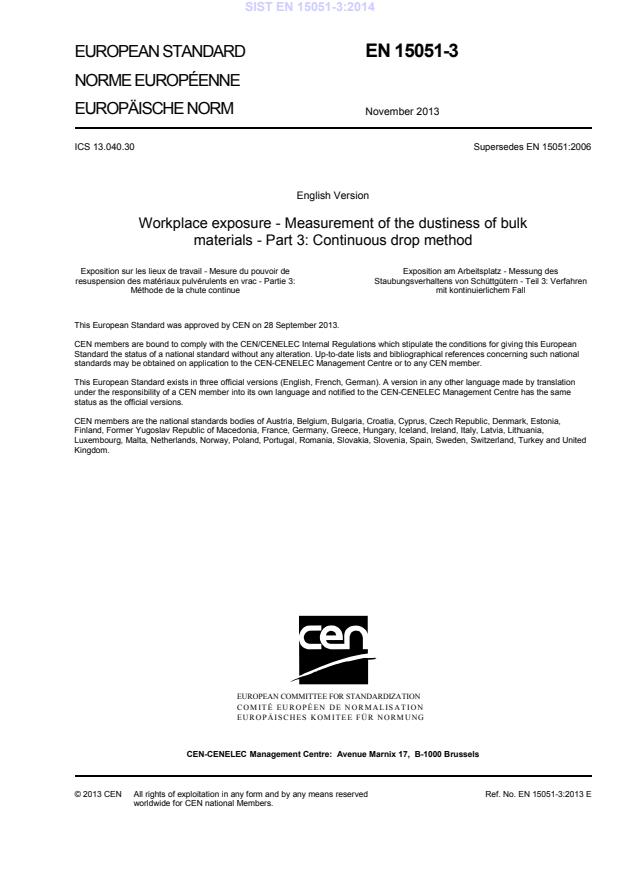
EUROPEAN STANDARD NORME EUROPÉENNE EUROPÄISCHE NORM
EN 15051-3
November 2013 ICS 13.040.30 Supersedes EN 15051:2006English Version
Workplace exposure - Measurement of the dustiness of bulk materials - Part 3: Continuous drop method
Exposition sur les lieux de travail - Mesure du pouvoir de resuspension des matériaux pulvérulents en vrac - Partie 3: Méthode de la chute continue
Exposition am Arbeitsplatz - Messung des Staubungsverhaltens von Schüttgütern - Teil 3: Verfahren mit kontinuierlichem Fall This European Standard was approved by CEN on 28 September 2013.
CEN members are bound to comply with the CEN/CENELEC Internal Regulations which stipulate the conditions for giving this European Standard the status of a national standard without any alteration. Up-to-date lists and bibliographical references concerning such national standards may be obtained on application to the CEN-CENELEC Management Centre or to any CEN member.
This European Standard exists in three official versions (English, French, German). A version in any other language made by translation under the responsibility of a CEN member into its own language and notified to the CEN-CENELEC Management Centre has the same status as the official versions.
CEN members are the national standards bodies of Austria, Belgium, Bulgaria, Croatia, Cyprus, Czech Republic, Denmark, Estonia, Finland, Former Yugoslav Republic of Macedonia, France, Germany, Greece, Hungary, Iceland, Ireland, Italy, Latvia, Lithuania, Luxembourg, Malta, Netherlands, Norway, Poland, Portugal, Romania, Slovakia, Slovenia, Spain, Sweden, Switzerland, Turkey and United Kingdom.
EUROPEAN COMMITTEE FOR STANDARDIZATION
COMITÉ EUROPÉEN DE NORMALISATION EUROPÄISCHES KOMITEE FÜR NORMUNG
CEN-CENELEC Management Centre:
Avenue Marnix 17,
B-1000 Brussels © 2013 CEN All rights of exploitation in any form and by any means reserved worldwide for CEN national Members. Ref. No. EN 15051-3:2013 ESIST EN 15051-3:2014
...
해당 기사는 EN 15051-3: 2013 표준에 대해 설명하고 있습니다. 이 표준은 작업장에서 대량 재료의 먼지 발생을 측정하기 위한 연속 드롭 방법을 규정합니다. 이 방법은 연속 낙하 작업(운반, 내보내기, 채우기, 다시 채우기, 계량, 포대, 측정, 로딩, 언로딩 등)에서 미립자가 낙하하는 동안 윈노잉에 의해 먼지가 발생하는 과정을 모방하기 위한 것입니다. 이 표준은 흉부 분포를 측정하는 방법도 수정될 수 있지만, 이 표준에서는 해당 수정 방법에 대해 설명되지 않았습니다. 이 표준은 EN 15051-2에서 제시된 회전 드럼 방법과 다르게, 미립자를 한 번만 연속으로 낙하시키는 차이가 있습니다. 또한, 이 표준은 환경 조건, 샘플 처리 및 분석 절차, 결과 계산 및 제시 방법을 규정합니다. 먼지성에 대한 분류 체계도 규정되어 있어 대량 재료 사용자에게 결과를 표준화된 방법으로 표현하고 전달할 수 있습니다. 이 표준은 분말, 과립 또는 펠렛형 대량 재료에 적용됩니다. 하지만 이 표준은 특정 재료가 기계적으로 처리될 때 방출되는 먼지를 테스트하거나 대량 재료의 처리 절차를 평가하지 않습니다.
The article discusses the EN 15051-3:2013 standard, which specifies the continuous drop method for measuring the dustiness of bulk materials in the workplace. The method involves simulating dust generation processes where there are continuous falling operations, such as conveying, filling, and loading. The standard provides guidelines for measuring the inhalable and respirable fractions of the dust and includes specifications for environmental conditions, sample handling, and result calculation. It also includes a classification scheme for dustiness to standardize the communication of results to users. The standard applies to powdered, granular, or pelletised bulk materials but does not cover the dust released during mechanical treatments or evaluate handling procedures.
この記事では、EN 15051-3:2013規格について説明しています。この規格は、作業場での大量材料の粉塵発生を測定するための連続落下法を定めています。この方法は、運搬や排出、充填、再充填、計量、袋詰め、計量、積み込み、荷降ろしなどの連続的な落下作業において、落下中に風揺によって粉塵が発生するプロセスを模倣することを意図しています。この規格では胸部の分布を測定する方法も修正することができますが、この規格ではその修正方法について説明されていません。これは、EN 15051-2で示される回転ドラム法とは異なり、粉体材料を一度だけ連続して落下させる点が異なります。 さらに、この規格では環境条件、サンプルの取り扱いおよび分析手順、結果の計算および表示方法も規定しています。粉塵性に対する分類基準も定められており、大量材料の使用者に結果を標準化された方法で表現し、伝えるための方法を提供しています。この規格は粉状、顆粒状またはペレット状の大量材料に適用されます。ただし、機械的に処理される固体材料から放出される粉塵をテストすることや、大量材料の取り扱い手順を評価することには適用されません。
Questions, Comments and Discussion
Ask us and Technical Secretary will try to provide an answer. You can facilitate discussion about the standard in here.
Loading comments...