

EN 4488:2013
(Main)Aerospace series - Non-metallic materials - Anaerobic polymerisable compounds - Threadlocking - Torque strength 2 Nm
- Abstract
This European Standard specifies the requirements relating to anaerobic polymerisable threadlocking compounds having a torque strength of 2 Nm for aerospace applications.
- Status
- Published
- Publication Date
- 15-Jan-2013
- Withdrawal Date
- 30-Jul-2013
- Technical Committee
- ASD-STAN - Aerospace
- Drafting Committee
- ASD-STAN/D 5 - Non-Metallic
- Current Stage
- 9093 - Decision to confirm - Review Enquiry
- Start Date
- 21-Jan-2024
- Completion Date
- 30-Sep-2026


Overview
EN 4488:2013 is a European Standard developed by the European Committee for Standardization (CEN) that specifies the requirements for anaerobic polymerisable compounds used as threadlocking agents with a torque strength of 2 Nm in aerospace applications. These non-metallic materials form a critical part of the aerospace industry's adhesive technology, ensuring the secure locking of threaded fasteners under demanding operational conditions.
Prepared under the Aerospace and Defence Industries Association of Europe (ASD-STAN), EN 4488:2013 aligns with the broader EN 4385 series, which governs non-metallic materials in aerospace, and complements technical specifications such as EN 3792. The standard promotes uniformity, safety, and reliability in threadlocking compounds across European aerospace manufacturing.
Key Topics
Anaerobic Polymerisable Compounds: EN 4488 covers liquid, acrylic ester-based one-part threadlocking adhesives that cure in the absence of oxygen when confined between metal surfaces, specifically formulated for aerospace grade performance.
Torque Strength Requirement: The core feature is a specified torque strength of 2 Nm ± 1 Nm, ensuring that fasteners remain locked under mechanical stress while allowing controlled disassembly.
Physical and Chemical Characteristics:
- Viscosity parameters defined for different grades (e.g., Grade 01 and Grade 02).
- Cure rate requirements ensuring a reliable polymerisation process.
- Stability under thermal conditions, including performance after exposure to dry heat (up to 150 °C) and low temperatures (down to −55 °C).
- Flashpoint above 100 °C, enhancing handling safety.
Storage and Shelf Life: Recommendations to store compounds below 25 °C, away from direct sunlight and oxygen, preserving shelf life for a minimum of 12 months.
Quality Assurance and Testing: Compliant with EN 3792, the standard mandates detailed batch acceptance tests and environmental testing to validate performance integrity.
Colour and Fluorescence: The compound’s colour must be agreed upon by purchaser and supplier, and it should exhibit fluorescence, facilitating inspection and quality control.
Applications
EN 4488:2013 threadlocking compounds are specifically designed for securing threaded fasteners in aerospace assemblies where:
Vibration and Shock Resistance is crucial to maintain mechanical stability of joints during flight and ground operations.
Temperature Variability demands adhesives that can resist extreme environmental cycles without degradation.
Safety and Reliability are paramount given the critical nature of aerospace components.
Typical aerospace applications include:
- Aircraft engine components and accessories.
- Structural fasteners on airframes.
- Hydraulic and fuel system assemblies.
- Avionics mounting and fastening solutions.
Using EN 4488 compliant compounds ensures compatibility with aerospace manufacturing requirements, improves maintenance procedures, and reduces the risk of fastener loosening due to torque fluctuations or thermal cycling.
Related Standards
EN 3792: Aerospace series – Anaerobic polymerisable compounds – Technical specification, which provides detailed definitions and testing methodologies referenced by EN 4488.
EN 4385: General organisation of standardisation for non-metallic aerospace materials, which explains the hierarchy and classification of related aerospace material standards.
TR 7000-7: Aerospace series rules for drafting and presentation of material standards related to anaerobic polymerisable compounds, complementing the structuring and technical detail of EN 4488.
ASD-STAN Technical Reports: These accompany EN standards in the aerospace domain and provide additional guidance on application and compliance.
Keywords: EN 4488:2013, aerospace threadlocking, anaerobic polymerisable compounds, torque strength 2 Nm, aerospace adhesives, non-metallic materials aerospace, aerospace fastener locking, EN 3792, EN 4385, aerospace adhesive standards, threadlocking compounds.
Get Certified
Connect with accredited certification bodies for this standard

BUREAU VERITAS Certification Germany
Bureau Veritas certification in Germany.

Element Materials Technology
Materials testing and product certification.

AQMS Ltd.
AQMS provides ISO certification to SMEs across the UK.
Sponsored listings
Frequently Asked Questions
EN 4488:2013 is a standard published by the European Committee for Standardization (CEN). Its full title is "Aerospace series - Non-metallic materials - Anaerobic polymerisable compounds - Threadlocking - Torque strength 2 Nm". This standard covers: This European Standard specifies the requirements relating to anaerobic polymerisable threadlocking compounds having a torque strength of 2 Nm for aerospace applications.
This European Standard specifies the requirements relating to anaerobic polymerisable threadlocking compounds having a torque strength of 2 Nm for aerospace applications.
EN 4488:2013 is classified under the following ICS (International Classification for Standards) categories: 49.025.50 - Adhesives. The ICS classification helps identify the subject area and facilitates finding related standards.
EN 4488:2013 is available in PDF format for immediate download after purchase. The document can be added to your cart and obtained through the secure checkout process. Digital delivery ensures instant access to the complete standard document.
Standards Content (Sample)
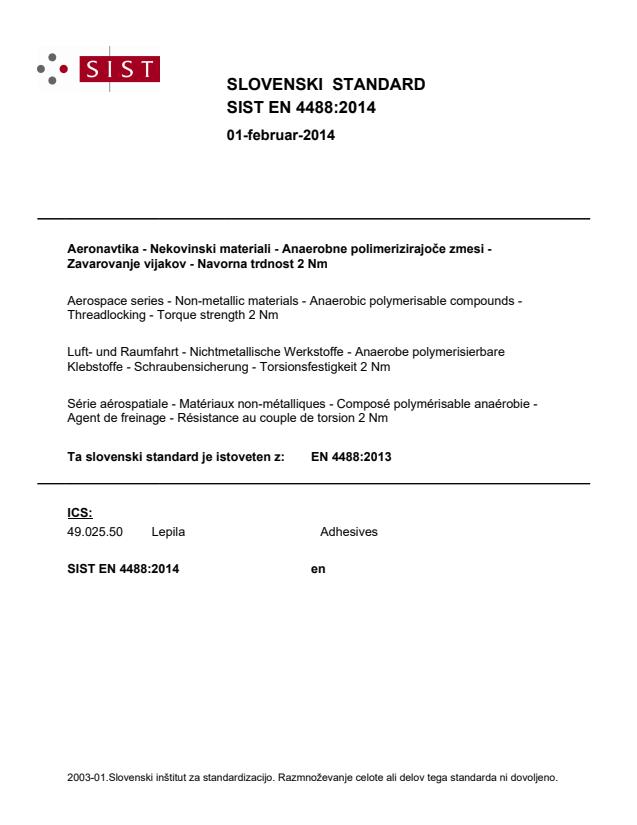
2003-01.Slovenski inštitut za standardizacijo. Razmnoževanje celote ali delov tega standarda ni dovoljeno.Luft- und Raumfahrt - Nichtmetallische Werkstoffe - Anaerobe polymerisierbare Klebstoffe - Schraubensicherung - Torsionsfestigkeit 2 NmSérie aérospatiale - Matériaux non-métalliques - Composé polymérisable anaérobie - Agent de freinage - Résistance au couple de torsion 2 NmAerospace series - Non-metallic materials - Anaerobic polymerisable compounds - Threadlocking - Torque strength 2 Nm49.025.50LepilaAdhesivesICS:Ta slovenski standard je istoveten z:EN 4488:2013SIST EN 4488:2014en01-februar-2014SIST EN 4488:2014SLOVENSKI
STANDARD
EUROPEAN STANDARD NORME EUROPÉENNE EUROPÄISCHE NORM
EN 4488
January 2013 ICS 49.025.50 English Version
Aerospace series - Non-metallic materials - Anaerobic polymerisable compounds - Threadlocking - Torque strength 2 Nm
Série aérospatiale - Matériaux non-métalliques - Composé polymérisable anaérobie - Agent de freinage - Résistance au couple de torsion 2 Nm
Luft- und Raumfahrt - Nichtmetallische Werkstoffe - Anaerobe polymerisierbare Klebstoffe - Schraubensicherung - Torsionsfestigkeit 2 Nm This European Standard was approved by CEN on 10 November 2012.
CEN members are bound to comply with the CEN/CENELEC Internal Regulations which stipulate the conditions for giving this European Standard the status of a national standard without any alteration. Up-to-date lists and bibliographical references concerning such national standards may be obtained on application to the CEN-CENELEC Management Centre or to any CEN member.
This European Standard exists in three official versions (English, French, German). A version in any other language made by translation under the responsibility of a CEN member into its own language and notified to the CEN-CENELEC Management Centre has the same status as the official versions.
CEN members are the national standards bodies of Austria, Belgium, Bulgaria, Croatia, Cyprus, Czech Republic, Denmark, Estonia, Finland, Former Yugoslav Republic of Macedonia, France, Germany, Greece, Hungary, Iceland, Ireland, Italy, Latvia, Lithuania, Luxembourg, Malta, Netherlands, Norway, Poland, Portugal, Romania, Slovakia, Slovenia, Spain, Sweden, Switzerland, Turkey and United Kingdom.
EUROPEAN COMMITTEE FOR STANDARDIZATION
COMITÉ EUROPÉEN DE NORMALISATION EUROPÄISCHES KOMITEE FÜR NORMUNG
Management Centre:
Avenue Marnix 17,
B-1000 Brussels © 2013 CEN All rights of exploitation in any form and by any means reserved worldwide for CEN national Members. Ref. No. EN 4488:2013: ESIST EN 4488:2014
...