

EN 2667-3:2019
(Main)Aerospace series - Non-metallic materials - Foaming structural adhesive films - Test methods - Part 3: Expansion ratio and volatile content
- Abstract
This document specifies the test method for determining the expansion ratio and the volatile content in structural foaming adhesive films.
- Status
- Published
- Publication Date
- 03-Sep-2019
- Withdrawal Date
- 30-Mar-2020
- Technical Committee
- ASD-STAN - Aerospace
- Drafting Committee
- ASD-STAN/D 4 - Metallic
- Current Stage
- 9093 - Decision to confirm - Review Enquiry
- Start Date
- 21-Jan-2025
- Completion Date
- 21-Oct-2026

Overview
EN 2667-3:2019 is a European standard developed by CEN, specifying test methods for assessing foaming structural adhesive films used in the aerospace sector. This part, "Expansion ratio and volatile content," outlines precise procedures to measure the expansion and mass loss due to volatiles in these adhesives during curing. These tests are crucial for ensuring the quality, performance, and reliability of structural adhesive films applied in aerospace manufacturing and maintenance.
Key Topics
Expansion Ratio Measurement
This metric represents the percentage increase in thickness of the adhesive film after curing compared to its original thickness. It is vital in controlling the adhesive’s foaming behavior and ensuring optimal mechanical bonding without excessive thickness variation.Volatile Content Determination
Volatile content quantifies the percentage mass loss of the adhesive film after curing, reflecting the release of solvents or other volatiles. Proper control of this factor helps in ensuring environmental compliance and material integrity.Test Specimen Preparation
Test specimens consist of square samples of foaming adhesive films placed between aluminium alloy sheets (2024-T3), prepared as per referenced standards EN 2090 and EN 2334. This ensures standardized substrate preparation for consistent test outcomes.Apparatus and Equipment
Essential equipment includes an air circulating oven with programmable temperature control, precision balance (1 mg accuracy), micrometer with flat-ended probe for thickness (0.01 mm resolution), and a desiccator for cooling cured specimens under controlled conditions.Calculation Methods
The standard provides explicit formulas for calculating expansion ratio and volatile content based on measurements before and after curing. Multiple measurements are averaged to improve accuracy and reproducibility.Reporting Requirements
Detailed test reports must document the adhesive identification, curing conditions, specimen dimensions, test results, and any deviations from the standard procedures.
Applications
EN 2667-3:2019 is essential for aerospace manufacturers, suppliers, and quality control laboratories involved in:
Aerospace Structural Bonding
Ensuring that non-metallic foaming adhesive films meet stringent expansion and volatile emission criteria for aircraft structural components.Material Qualification and Certification
Verifying adhesive film compliance prior to use in aircraft assembly or repair, supporting certification processes.Research and Development
Benchmarking new adhesive formulations and curing processes to optimize performance and minimize volatile emissions.Quality Assurance
Routine quality checks during production to maintain consistency and meet aerospace industry standards.
The standard contributes to safer, durable aerospace structures by maintaining adhesive integrity and controlling outgassing effects.
Related Standards
- EN 2090 – Aerospace series for Aluminium alloy 2024-T3 sheets used as bonding substrates in test specimens.
- EN 2334 – Chromic-sulphuric acid pickling method for aluminium alloys, specifying preparation of alloy surfaces before adhesive application.
- Other parts of EN 2667 series – Cover different test methods for foaming structural adhesive films, offering a comprehensive approach to material evaluation.
By aligning with these interconnected standards, EN 2667-3:2019 integrates into a broader framework supporting aerospace adhesive material performance and safety.
Keywords: EN 2667-3:2019, foaming structural adhesive films, aerospace adhesive test methods, expansion ratio, volatile content, aerospace non-metallic materials, adhesive film curing, aircraft structural bonding, adhesive quality testing, aerospace standards.
Relations
- Refers
EN 2334:1997 - Aerospace series - Chromic-sulphuric acid pickle of aluminium and aluminium alloys - Effective Date
- 28-Jan-2026
- Refers
EN 2090:2005 - Aerospace series - Aluminium alloy AL-P2024-T3 - Clad sheet and strip 0,3 mm <a <6 mm - Effective Date
- 28-Jan-2026
- Effective Date
- 28-Jan-2026
Get Certified
Connect with accredited certification bodies for this standard

BUREAU VERITAS Certification Germany
Bureau Veritas certification in Germany.

Element Materials Technology
Materials testing and product certification.

AQMS Ltd.
AQMS provides ISO certification to SMEs across the UK.
Sponsored listings
Frequently Asked Questions
EN 2667-3:2019 is a standard published by the European Committee for Standardization (CEN). Its full title is "Aerospace series - Non-metallic materials - Foaming structural adhesive films - Test methods - Part 3: Expansion ratio and volatile content". This standard covers: This document specifies the test method for determining the expansion ratio and the volatile content in structural foaming adhesive films.
This document specifies the test method for determining the expansion ratio and the volatile content in structural foaming adhesive films.
EN 2667-3:2019 is classified under the following ICS (International Classification for Standards) categories: 49.025.50 - Adhesives. The ICS classification helps identify the subject area and facilitates finding related standards.
EN 2667-3:2019 has the following relationships with other standards: It is inter standard links to EN 2334:1997, EN 2090:2005, EN 2667-2:2018. Understanding these relationships helps ensure you are using the most current and applicable version of the standard.
EN 2667-3:2019 is available in PDF format for immediate download after purchase. The document can be added to your cart and obtained through the secure checkout process. Digital delivery ensures instant access to the complete standard document.
Standards Content (Sample)
SLOVENSKI STANDARD
01-november-2019
Aeronavtika - Nekovinski materiali - Penaste folije gradbenih lepil - Preskusne
metode - 3. del: Ekspanzijsko razmerje in hlapna vsebina
Aerospace series - Non-metallic materials - Foaming structural adhesive films - Test
methods - Part 3 : Expansion ratio and volatile content
Luft- und Raumfahrt - Nichtmetallische Werkstoffe - Schäumende Strukturklebefolien -
Prüfverfahren - Teil 3: Ausdehnungsverhältnis und flüchtige Anteile
Série aérospatiale - Matériaux non-métalliques - Adhésifs structuraux expansibles en film
- Méthodes d’essai - Partie 3 : Taux d'expansion et taux de matières volatiles
Ta slovenski standard je istoveten z: EN 2667-3:2019
ICS:
49.025.50 Lepila Adhesives
2003-01.Slovenski inštitut za standardizacijo. Razmnoževanje celote ali delov tega standarda ni dovoljeno.
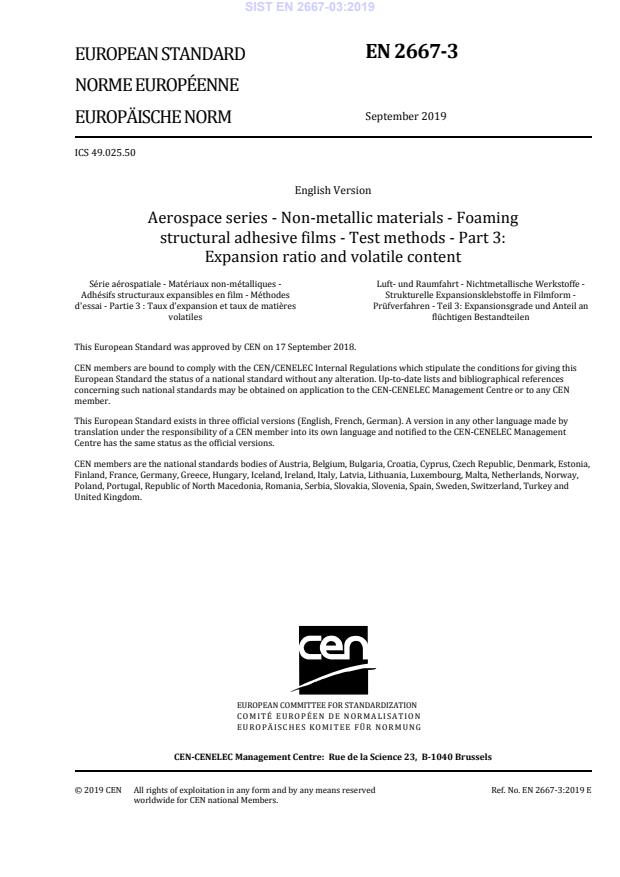
EN 2667-3
EUROPEAN STANDARD
NORME EUROPÉENNE
September 2019
EUROPÄISCHE NORM
ICS 49.025.50
English Version
Aerospace series - Non-metallic materials - Foaming
structural adhesive films - Test methods - Part 3:
Expansion ratio and volatile content
Série aérospatiale - Matériaux non-métalliques - Luft- und Raumfahrt - Nichtmetallische Werkstoffe -
Adhésifs structuraux expansibles en film - Méthodes Strukturelle Expansionsklebstoffe in Filmform -
d'essai - Partie 3 : Taux d'expansion et taux de matières Prüfverfahren - Teil 3: Expansionsgrade und Anteil an
volatiles flüchtigen Bestandteilen
This European Standard was approved by CEN on 17 September 2018.
CEN members are bound to comply with the CEN/CENELEC Internal Regulations which stipulate the conditions for giving this
European Standard the status of a national standard without any alteration. Up-to-date lists and bibliographical references
concerning such national standards may be obtained on application to the CEN-CENELEC Management Centre or to any CEN
member.
This European Standard exists in three official versions (English, French, German). A version in any other language made by
translation under the responsibility of a CEN member into its own language and notified to the CEN-CENELEC Management
Centre has the same status as the official versions.
CEN members are the national standards bodies of Austria, Belgium, Bulgaria, Croatia, Cyprus, Czech Republic, Denmark, Estonia,
Finland, France, Germany, Greece, Hungary, Iceland, Ireland, Italy, Latvia, Lithuania, Luxembourg, Malta, Netherlands, Norway,
Poland, Portugal, Republic of North Macedonia, Romania, Serbia, Slovakia, Slovenia, Spain, Sweden, Switzerland, Turkey and
United Kingdom.
EUROPEAN COMMITTEE FOR STANDARDIZATION
COMITÉ EUROPÉEN DE NORMALISATION
EUROPÄISCHES KOMITEE FÜR NORMUNG
CEN-CENELEC Management Centre: Rue de la Science 23, B-1040 Brussels
© 2019 CEN All rights of exploitation in any form and by any means reserved Ref. No. EN 2667-3:2019 E
worldwide for CEN national Members.
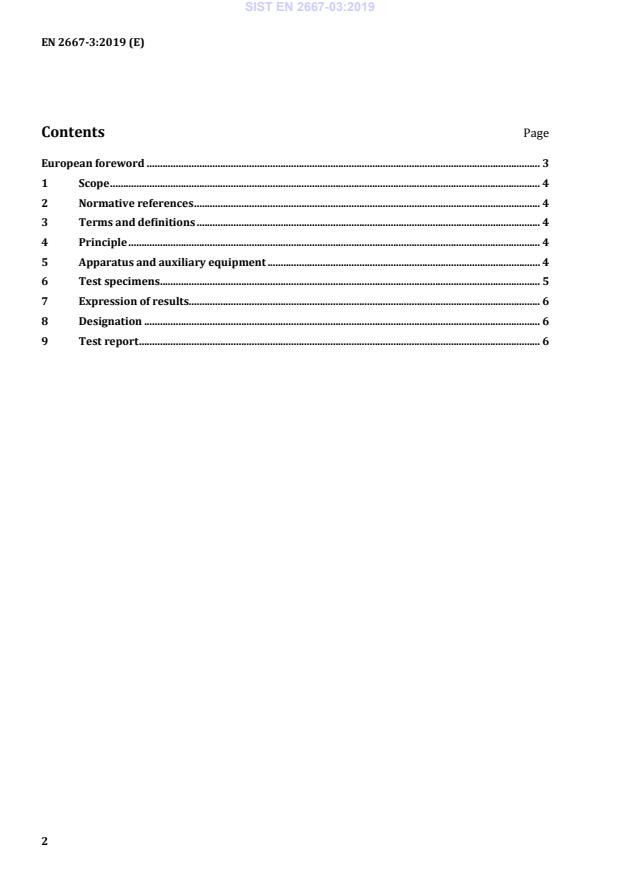
Contents Page
European foreword . 3
1 Scope . 4
2 Normative references . 4
3 Terms and definitions . 4
4 Principle . 4
5 Apparatus and auxiliary equipment . 4
6 Test specimens . 5
7 Expression of results. 6
8 Designation . 6
9 Test report . 6
European foreword
This document (EN 2667-3:2019) has been prepared by the Aerospace and Defence Industries
Association of Europe - Standardization (ASD-STAN).
After enquiries and votes carried out in accordance with the rules of this Association, this Standard has
received the approval of the National Associations and the Official Services of the member countries of
ASD, prior to its presentation to CEN.
This European Standard shall be given the status of a national standard, either by publication of an
identical text or by endorsement, at the latest by March 2020, and conflicting national standards shall
be withdrawn at the latest by March 2020.
Attention is drawn to the possibility that some of the elements of this document may be the subject of
patent rights. CEN shall not be held responsible for identifying any or all such patent rights.
According to the CEN-CENELEC Internal Regulations, the national standards organizations of the
following countries are bound to implement this European Standard: Austria, Belgium, Bulgaria,
Croatia, Cyprus, Czech Republic, Denmark, Estonia, Finland, France, Germany, Greece, Hungary, Iceland,
Ireland, Italy, Latvia, Lithuania, Luxembourg, Malta, Netherlands, Norway, Poland, Portugal, Republic of
North Macedonia, Romania, Serbia, Slovakia, Slovenia, Spain, Sweden, Switzerland, Turkey and the
Uni
...